
How to Use AI for Local SEO a UK Business Guide

So, how do you actually use AI for local SEO? It boils down to automating the heavy lifting. Think optimising your Google Business Profile (GBP), creating content that speaks directly to your local postcodes, handling customer reviews without breaking a sweat, and keeping an eye on your visibility across different neighbourhoods. It’s how a small business can punch well above its weight, maintaining the consistency and relevance that wins over local customers.
The New Blueprint for Local Dominance Using AI
Welcome to the new reality of local search. If you're running a business in the UK, you've probably realised that the old SEO playbook just doesn't cut it anymore. The local market is crowded, and your customers want precise, immediate answers when they search for services "near me." This is exactly where AI steps in and changes the game.
It's no longer enough to just have a profile. You need a presence that’s perfectly tuned, constantly fresh, and quick to respond. AI gives you the horsepower to make that happen without hiring a huge marketing department. Consider it your secret weapon for staying ahead of the competition and getting found by the people in your community who are ready to buy.
Why AI Is a Non-Negotiable for UK Businesses
Let's be blunt: the local search scene in the UK is Google's world. As of mid-2025, Google holds a staggering 93.5% share of all desktop and mobile search traffic. This isn't just a statistic; it's the entire playing field. It also explains why AI tools are so effective—they’re built to analyse the mountains of data from Google Business Profiles and local directories to sharpen your visibility in real-time. If you want to dive deeper, you can learn more about the local UK search landscape and why these figures are so critical.
For UK businesses specifically, AI can instantly audit your NAP (Name, Address, Phone) details for consistency across essential directories like Yell, Thomson Local, and Checkatrade. That’s a massive win, especially when you consider that 90% of users put more trust in listings with perfectly aligned information.
This workflow diagram really simplifies how it all comes together.
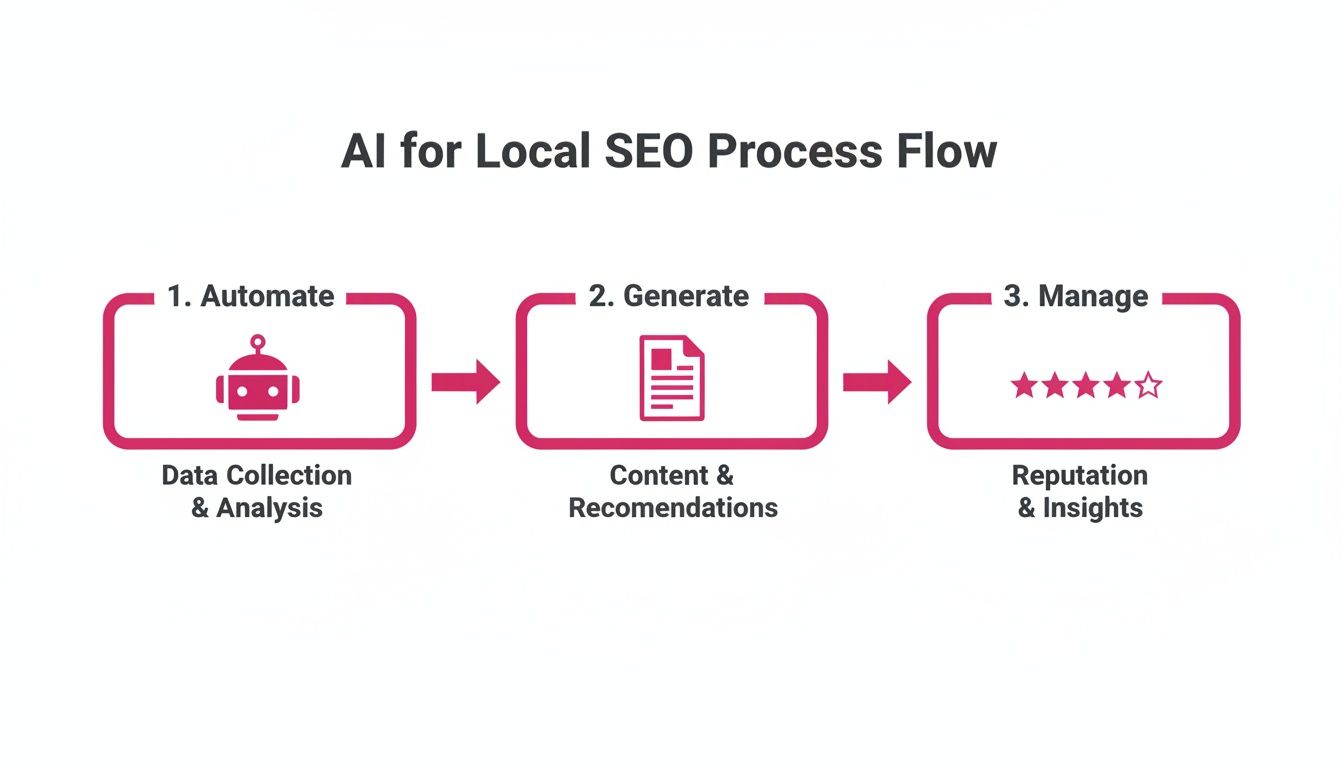
As you can see, the process breaks down complex, time-consuming tasks into three core pillars: automating your profile management, generating spot-on local content, and efficiently handling customer feedback.
To give you a clearer picture, here’s a quick breakdown of where AI truly shines in a local SEO strategy.
Core AI Applications in Local SEO
| Local SEO Task | How AI Helps | Key Business Benefit |
|---|---|---|
| GBP Optimisation | Suggests optimal categories, attributes, and service descriptions based on competitor and search data. | Increases visibility in local map packs and relevant searches, driving more calls and visits. |
| Hyper-Local Content | Generates articles, social posts, and service pages tailored to specific neighbourhoods or postcodes. | Attracts highly qualified local traffic and demonstrates community expertise. |
| Review Management | Drafts personalised, keyword-rich replies to customer reviews, analysing sentiment to prioritise responses. | Improves online reputation, builds customer trust, and frees up hours of manual work. |
| Local Rank Tracking | Monitors search rankings across multiple specific geographic locations (geo-grids) automatically. | Provides accurate visibility data, revealing where you're strong and where you need to improve. |
This table just scratches the surface, but it highlights how AI transforms tedious manual jobs into strategic advantages that directly impact your bottom line.
What to Expect in This Guide
Right, let's get into the practical side of things. This guide is a roadmap, not a textbook. We're going to walk through a clear, actionable process for weaving AI into your daily and weekly local SEO routine.
Here’s what we’ll cover:
- Building a strong foundation: How to use AI-driven insights to get your Google Business Profile in perfect shape.
- Creating hyper-local content: The secrets to producing content that resonates with your community and dominates "near me" searches.
- Mastering review management: A system for automating responses and turning customer feedback into a marketing asset.
- Measuring your success: How to track the metrics that actually matter for driving real business growth.
By the time you're finished, you'll have a complete blueprint for using AI to claim a real, measurable advantage in your local search rankings.
Building Your AI-Powered Local SEO Foundation
Before you can even think about dominating local search, you need a rock-solid foundation. This isn't about chasing fancy tricks; it's about getting the essentials so right that Google simply can’t ignore you. This is where AI stops being a buzzword and becomes a practical, everyday tool, helping you nail the core elements of your local presence with incredible speed and precision.
Your Google Business Profile (GBP) is the absolute centrepiece of this foundation. It’s often the very first impression a potential customer gets, so it needs to be perfect. Right away, AI gives you a huge advantage by acting as your personal competitor intelligence scout. It analyses what the top-ranking local businesses are doing and hands you a clear roadmap to follow.
Optimising Your Google Business Profile with AI
A well-optimised GBP isn't just complete; it’s strategically filled with exactly what local searchers are looking for. AI can analyse dozens of competitor profiles in your area to pinpoint the most impactful primary and secondary categories they're all using. It can also shine a light on popular attributes you might be missing, like "outdoor seating" for a cafe or "emergency call-outs" for an electrician.
Instead of just guessing what to write, you can feed specific prompts to an AI tool to generate genuinely compelling copy. For instance:
"Write a 750-character Google Business Profile description for a family-run Italian restaurant in Leeds called 'Mama's Kitchen'. Emphasise our handmade pasta, wood-fired pizzas, and welcoming atmosphere. Weave in keywords like 'best Italian restaurant Leeds', 'family-friendly dining', and 'authentic pizza'."
This takes you from a bland, generic description to one that's packed with the very terms local people are searching for. In the same way, AI can help you proactively fill out your Q&A section, answering common customer questions before they even have a chance to ask them.
Ensuring Flawless Citation Consistency
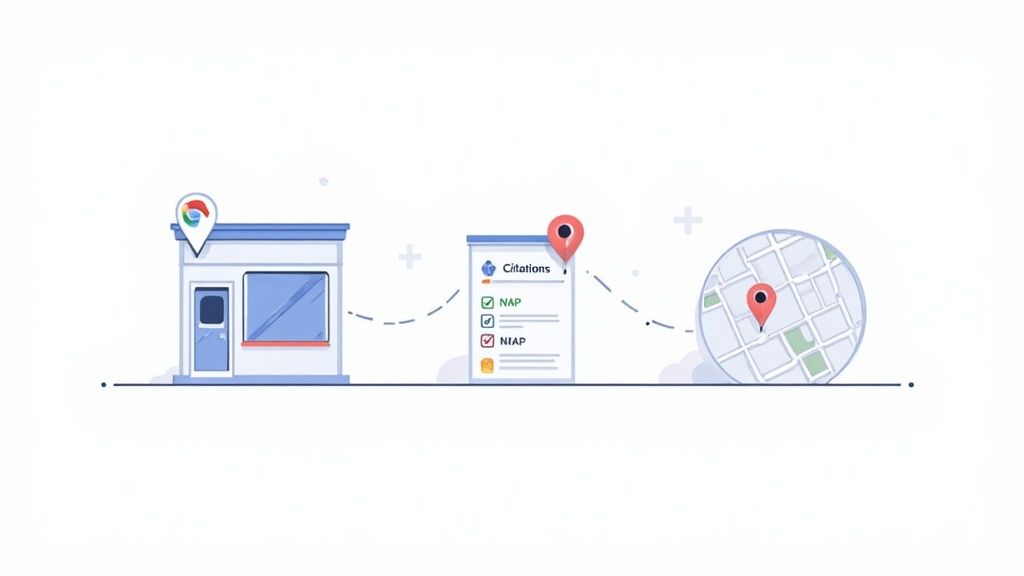
Moving beyond your GBP, your business's Name, Address, and Phone number (NAP) details must be identical everywhere they show up online. Inconsistent listings across directories like Yell, Thomson Local, or niche industry sites create confusion for search engines and erode trust. Trust me, auditing these by hand is a soul-destroying task.
AI-powered tools can automate this entire process. They scan dozens of UK-specific directories in minutes, flagging tiny but damaging inconsistencies like "St." vs. "Street" or an old phone number that’s still lurking around. This process, known as citation management, is a massive trust signal for Google.
Imagine a plumber in Manchester whose business moved years ago. An AI tool can instantly find old listings with the wrong address on several directories. By getting these cleaned up, the plumber sends a crystal-clear signal to Google that their current information is accurate and authoritative, which often results in an immediate boost in local map rankings. For businesses that want to get this right without the headache, expert GBP profile management services can streamline the whole thing, ensuring every detail is perfectly aligned.
Setting Up AI-Driven Monitoring
The final piece of your foundation is putting a system in place to track your performance right from day one. You can't improve what you don't measure, after all. AI-driven monitoring tools go way beyond simple rank tracking.
You can set them up to:
- Track brand mentions: Get an alert whenever your business name pops up online, whether it's in a glowing review or a local blog post.
- Monitor keyword performance: Watch how your rankings for crucial terms like "MOT centre in Birmingham" shift over time.
- Analyse geo-grids: See your search visibility laid out on a map, postcode by postcode, to spot exactly where you're strong and where competitors are eating your lunch.
This kind of proactive monitoring completely changes the game. Instead of waiting for business to drop off and then trying to figure out why, you can spot emerging issues or opportunities and jump on them immediately. With a perfectly optimised GBP, clean citations, and intelligent monitoring in place, your local SEO foundation is well and truly built to last.
Generating Hyper-Local Content That Ranks
While a perfectly optimised profile gets you on the map, it's hyper-local content that turns your business into a local landmark. Content is the real engine of local SEO, proving to both customers and search engines that you're an active, authoritative voice in the community. Using AI here isn't about churning out generic blog posts; it's about producing relevant, neighbourhood-specific resources at a scale that was simply impossible before.
This means getting granular. We need to move beyond broad service descriptions and start creating content that answers the exact questions local customers are asking. Think less "Emergency Plumbers" and more "How to Fix a Leaky Tap in a Bristol Victorian Terrace." It's this level of detail that snags those high-intent "near me" searches and builds genuine topical authority.

Crafting Neighbourhood-Specific Landing Pages
One of the most effective local SEO tactics is creating dedicated landing pages for each neighbourhood or town you serve. A single "Services in Manchester" page just can't hold a candle to individual pages for "Didsbury," "Chorlton," and "Ancoats." Manually building these out is a massive time-sink, but AI can produce solid foundational drafts in minutes.
For instance, a Bristol-based bakery could give an AI tool this kind of prompt:
"Write some SEO-optimised content for a new landing page targeting 'Wedding Cakes in Clifton'. I need you to mention our bespoke designs, locally sourced ingredients, and how close we are to popular Clifton wedding venues like the Clifton Observatory. Also, include a section answering common questions about wedding cake consultations and delivery in the BS8 postcode."
This prompt feeds the AI specific local context, pushing it to create something far more useful than a generic sales page. By weaving in local landmarks and postcodes, you're sending powerful relevance signals to Google.
Generating Valuable Local Blog Content
Regularly publishing helpful content tells search engines that your website is alive and well. AI can be a fantastic brainstorming partner and first-draft writer, helping you keep a consistent publishing schedule without burning out. The secret is to feed it prompts that tap directly into local interests and pain points.
Just look at what you can do with a few well-crafted prompts:
- For a garage: "Write a blog post titled '5 Common MOT Failures for Cars in London's ULEZ Zone'. Explain the emissions standards and how our pre-MOT check helps drivers in Ealing avoid any nasty surprises."
- For an estate agent: "Generate an article on 'The Best Primary Schools in the Edinburgh EH10 Postcode'. Briefly describe each school and its catchment area to help families who are thinking about moving to Morningside."
- For a coffee shop: "Outline a social media campaign for our 'Student Study Special' targeting university students in Cardiff. Create three post captions that mention landmarks near Cardiff University."
These prompts force the AI to think locally, using regional terms and mentioning familiar places that resonate with your target audience.
AI-driven content personalisation is poised to completely change the game for local SEO in the UK. Search engines are getting frighteningly good at interpreting a user's location and intent to serve up tailored results. With Google holding a staggering 93-94% of the search market share, your visibility depends on creating unique, localised content.
This shift means AI that can generate neighbourhood-specific pages—complete with UK postcodes, landmarks, and regionalisms like using 'boot' instead of 'trunk'—will run circles around generic approaches. What's more, research shows that consistently publishing localised content is a huge relevance signal, especially since over 65% of UK local searches happen on mobile. You can dive deeper into how UK search trends are evolving and what it means for businesses.
Moving Beyond Generic AI Output
The biggest mistake you can make is treating AI-generated text as the finished article. It’s the starting block, not the finish line. Your goal is to produce genuinely helpful resources that build trust and bring in local traffic. For example, using an AI-powered content publisher can help you efficiently scale your efforts, but the human touch is non-negotiable.
Always run through this checklist after getting that initial draft:
- Fact-Check Everything. AI has a tendency to make things up. Double-check every statistic, address, and local reference.
- Inject Your Brand Voice. Now, make it sound like you. Is your brand formal and professional, or friendly and fun? Ensure the tone is spot on.
- Add Your Human Insight. This is your secret weapon. Weave in your personal experience, customer stories, or unique tips that only a true local expert would know.
- Optimise for Mobile. Make sure the content is easy to scan on a phone. Use short paragraphs, bullet points, and clear headings.
By blending the speed of AI with your own invaluable human expertise, you create a powerful content strategy that doesn't just rank well—it genuinely connects with your local community.
Mastering Review Management with AI Automation
Let’s be honest: reviews are the lifeblood of any local business. They’re the digital equivalent of word-of-mouth, powerfully shaping customer decisions and your spot in Google's local rankings. But keeping up with them can feel like a full-time job. This is where AI steps in, turning a manual, time-sapping chore into a real strategic advantage by automating the whole process, from monitoring to responding.
AI platforms can keep a constant watch on the reviews coming in across Google, Yelp, and other industry-specific sites. This isn't about checking once a day; it's about real-time awareness. You'll never miss a chance to thank a happy customer or quickly put out a fire with a negative one before it gets out of hand.

This image nails it – AI can sift through a mountain of customer feedback to pull out what really matters, turning raw opinions into business intelligence you can actually use. But it gets even better.
Uncovering What Customers Really Think with Sentiment Analysis
The real magic of using AI for reviews is sentiment analysis. Instead of just scrolling through reviews one by one, an AI tool can chew through hundreds of them to spot the patterns. It can tell you, for example, that 25% of your glowing reviews rave about your "friendly staff," while 15% of your unhappy ones complain about "long waiting times."
This kind of data is gold. It’s clear, unbiased feedback on what you’re doing right and where you’re dropping the ball. Armed with these insights, you can make genuine operational changes that fix customer frustrations, which in turn leads to better experiences and, you guessed it, better reviews.
For businesses in the UK, this is absolutely crucial. Recent data shows that a massive 83% of consumers use Google to vet local businesses, making your review profile a make-or-break moment. AI helps you chase that sweet spot: a 4.5+ star rating with over 50 reviews, which is strongly linked to higher visibility. In the UK market, where review volume, recency, and how quickly you reply are massive ranking factors, AI tools give you a serious leg up. You can dig into more of these vital local consumer trends on Brightlocal.
Crafting the Perfect Reply in Seconds
Responding to reviews is non-negotiable. It shows you’re listening and that you actually care. The problem is, writing unique, thoughtful responses takes time most business owners don't have. AI can whip up personalised drafts in seconds, which you can then polish and post.
Here are a couple of prompts you can adapt for your own use:
- For a positive review: "Draft a warm and grateful reply to this 5-star review for my Glasgow restaurant. The customer mentioned enjoying the 'haggis neeps and tatties' and our 'attentive service'. Make sure to mention how glad we are they enjoyed our classic Scottish dish and thank them by name (John)."
- For a negative review: "Write a professional and empathetic response to this 2-star review. The customer was unhappy about a booking mix-up. Acknowledge their frustration, apologise sincerely for the error without making excuses, and offer to make it right. Invite them to contact our manager directly via email."
Pro Tip: Always, always give AI-generated responses a final human touch. Add a personal detail or tweak the wording to show it’s not just a robot talking. That combination of AI speed and genuine human empathy is what builds trust with your customers.
A dedicated review manager tool can wrap all of this functionality into one place, making your entire workflow incredibly smooth.
Real-World Success: A Glasgow Restaurant Case Study
Think about a bustling restaurant in Glasgow that was getting buried under dozens of reviews every week. They brought in an AI-assisted strategy and saw a huge change. They went from replying to just 30% of reviews to over 90%, most within a few hours. The AI helped them draft responses that consistently highlighted their best dishes and top-notch service, reinforcing what made them great.
The result? Within three months, their average Google rating climbed from 4.2 to 4.6 stars. Even better, their impressions on Google Business Profile for discovery searches (like "best restaurants in Glasgow") shot up. Google’s algorithm saw the increased engagement and steady stream of positive feedback and rewarded them with better visibility in that all-important Local Pack. It’s a perfect example of how getting on top of your reviews with AI leads directly to more people walking through your door.
Measuring Success and Advanced AI Tactics
So, you’ve rolled out your new AI-driven local SEO strategy. That’s a massive step, but the real magic happens when you start figuring out what's actually working and what's falling flat. Measuring success in local SEO isn't just about peeking at your keyword rankings anymore. It's about seeing the full picture—from the moment a potential customer searches for a local service to when they pick up the phone or walk through your door.
This is where AI shifts from being a simple doer to your very own strategic analyst. By keeping a close eye on the right key performance indicators (KPIs), you get a clear, unfiltered view of your return on investment. AI helps you connect your efforts—that polished Google Business Profile, the hyper-local content—to the cold, hard revenue your business is generating.
Key Performance Indicators to Track
It's time to ditch the vanity metrics. What we care about are the numbers that reflect genuine customer behaviour. And frankly, AI-powered platforms can crunch this data way more effectively than you or I ever could with a bunch of spreadsheets.
Here’s what you should be monitoring religiously:
- Local Pack Rankings: Are you consistently showing up in the top three map results for your money-making keywords? AI-powered geo-grid tools can show you exactly how you look, postcode by postcode. It’s the difference between guessing and knowing.
- GBP Click-Through Rates (CTR): Of all the people who see your profile, how many are actually clicking? If that number is low, it’s a red flag. It could mean your business description is uninspired or your review score is scaring people away.
- Phone Calls and Direction Requests: These are pure gold. They're actions taken by people with high intent. A steady climb in calls and navigation clicks from your GBP is one of the clearest signs that your local SEO is driving real leads.
Getting a handle on these metrics helps you move from gut feelings to data-backed decisions. If you want to go even deeper into how this all fits together, our comprehensive guide to local SEO analytics is the perfect next step.
Beyond Rank Tracking: AI-Powered Insights
Let’s be honest, traditional rank tracking is a bit one-dimensional. It tells you where you are, but offers no clue as to why or what you should do next. This is where AI analytics changes the game by uncovering trends and connections a human eye would almost certainly miss.
Imagine this: an AI tool flags that your visibility for "emergency plumber in Bristol" consistently dips over the weekend. That's not just data; it's a strategic nudge. It tells you to schedule GBP posts for Friday evenings or maybe run a weekend-specific offer to capture that search traffic. It turns raw numbers into a clear action plan.
The true advantage of AI in analytics lies in its ability to process multiple data streams at once. It can correlate a sudden spike in negative reviews mentioning "slow service" with a dip in your GBP's click-through rate, handing you a clear, actionable problem to solve that bridges the gap between your marketing and your on-the-ground operations.
The difference in depth and efficiency becomes crystal clear when you compare the old way with the new.
Manual vs AI-Powered Local SEO Analytics
This table really puts the two approaches into perspective. We've moved from a blurry, delayed snapshot to a high-definition, real-time video of our local performance.
| Metric/Task | Manual Approach | AI-Powered Approach |
|---|---|---|
| Rank Tracking | Manually checking a few keywords from one location, giving a skewed view. | Automated geo-grid tracking across dozens of postcodes for true local visibility. |
| Data Analysis | Exporting separate reports and trying to connect the dots in a spreadsheet. | Integrated dashboards that automatically correlate GBP actions with performance metrics. |
| Actionability | Identifying a problem but having to guess the solution. | Providing data-driven recommendations and highlighting specific optimisation opportunities. |
Ultimately, the AI-powered approach doesn't just save you time; it delivers insights that are simply out of reach when you're stuck doing things by hand.
Advanced AI Tactics for Local SEO
Once you’ve got a solid measurement routine in place, you can start exploring some of the more advanced tactics. This is where you can really build a moat around your business in the local search results.
A great example is local link building. Let's face it, this is usually a slow, tedious grind. But AI can scan local news sites, community blogs, and relevant business directories to pinpoint prime backlink opportunities in minutes. From there, you can even use it to draft personalised outreach emails, taking a process that used to take days and condensing it into a single afternoon.
Another powerful technique is generating LocalBusiness schema markup. This is basically a block of code you add to your website to spell out exactly who you are, where you are, and what you do for search engines. It sounds technical, I know. But you can give an AI a simple prompt like: "Generate LocalBusiness schema markup in JSON-LD format for a dental practice named 'Bright Smiles Dental' in Manchester." It will spit out the code for you to copy and paste, giving Google a much clearer understanding of your business.
Your Questions on AI and Local SEO, Answered
Jumping into new technology always throws up a few questions. If you're wondering about the practical side of using AI for local SEO—from costs and risks to how it stacks up against human expertise—you're in the right place. Let's clear up some of the most common queries.
What Are the Best AI Tools for a Small UK Business?
For a small business here in the UK, the trick is to start with tools that are powerful but not overwhelming. You don’t need a giant, enterprise-level platform from day one. Instead, look for solutions that help with the core jobs: managing your Google Business Profile, replying to reviews, and creating some basic local content.
A few great places to start include:
- All-in-one Platforms: Tools like BrightLocal or SurferSEO have brilliant local features. They use AI to help with everything from tracking your rankings to optimising your web pages for local search.
- Advanced Language Models: A subscription to something like ChatGPT-4 or Claude Pro is a seriously cost-effective way to get a handle on content generation, create Q&As for your profile, and draft replies to customer reviews.
- Specialised Local SEO Tools: You'll also find platforms built from the ground up to master local search, automating many of the tasks we’ve covered in this guide.
The most important thing is picking a tool that gets the UK details right—things like postcodes, regional slang, and the business directories that actually matter here. A generic tool just won't cut it. My advice? Start with one key area, like improving your review management, and then branch out as you get more confident.
Will Using AI-Generated Content Get My Website Penalised?
This is a big one, and a fair concern. The short answer is no, not if you do it properly. Google's official line is that it rewards high-quality, helpful content, regardless of whether it was written by a human, an AI, or a mix of both.
The real danger of a penalty comes from churning out low-quality, generic, or spammy content at scale. The problem isn't the AI itself, but how you use it. Think of AI as a very capable assistant, not a complete replacement for your own judgement.
Always, always review, edit, and add your own touch to any AI-generated text. Your job is to inject your brand's unique voice, add specific local flavour, and fact-check every single detail. Quality and helpfulness are what Google cares about, and a human touch is essential to nail that.
How Much Should I Budget for AI Tools for Local SEO?
The good news is you can get started without breaking the bank. Your budget can be pretty flexible, all depending on the path you take.
You could kick things off on a shoestring with a powerful language model like ChatGPT Plus, which usually costs around £20 per month. That’s more than enough firepower to handle content drafts and review responses.
If you're looking at more specialised, all-in-one local SEO platforms that weave AI into features like rank tracking and GBP optimisation, you can expect to pay anywhere from £50 to £200+ per month. The price often scales with the number of business locations you manage and the depth of features you need. A smart move for any small business is to start with a free trial or a lower-cost plan. Let it prove its worth and deliver a return before you commit to spending more.
Can AI Completely Replace My SEO Professional or Agency?
In a word, no. AI is an incredible tool for execution, but it doesn't replace real strategy and expertise. It can perform tasks with amazing speed—like drafting fifty review replies in an hour—but it can't come up with a comprehensive local SEO plan tailored to your specific business goals and competitors.
An SEO professional provides the critical thinking, the strategic direction, and the nuanced interpretation of data that AI just can't replicate right now. They understand the why behind the what.
The best approach is a hybrid one. An expert SEO strategist who uses AI tools can bring their vision to life far more effectively and at a much greater scale. This combination gets your business much better results than either could achieve alone. AI does the heavy lifting, freeing up the human expert to focus on what really moves the needle: strategy, analysis, and growth.
Ready to put these AI strategies into action? LocalHQ is the all-in-one platform designed to make it happen. With our AI Optimisation Wizard, Review Autoresponder, and geo-grid rank tracking, you can automate the hard work and focus on growing your local presence. Start your free trial of LocalHQ today and see the difference for yourself.