Your Ultimate 10-Point Local SEO Checklist for 2026
In today's competitive market, visibility to local customers is no longer optional; it's essential for survival and growth. Customers searching for products and services 'near me' have incredibly high purchase intent. If your business isn't appearing prominently in Google's local pack or on Maps, you are effectively handing sales directly to your competitors. A disorganised or inconsistent approach to local search engine optimisation (SEO) simply won't produce the results you need.
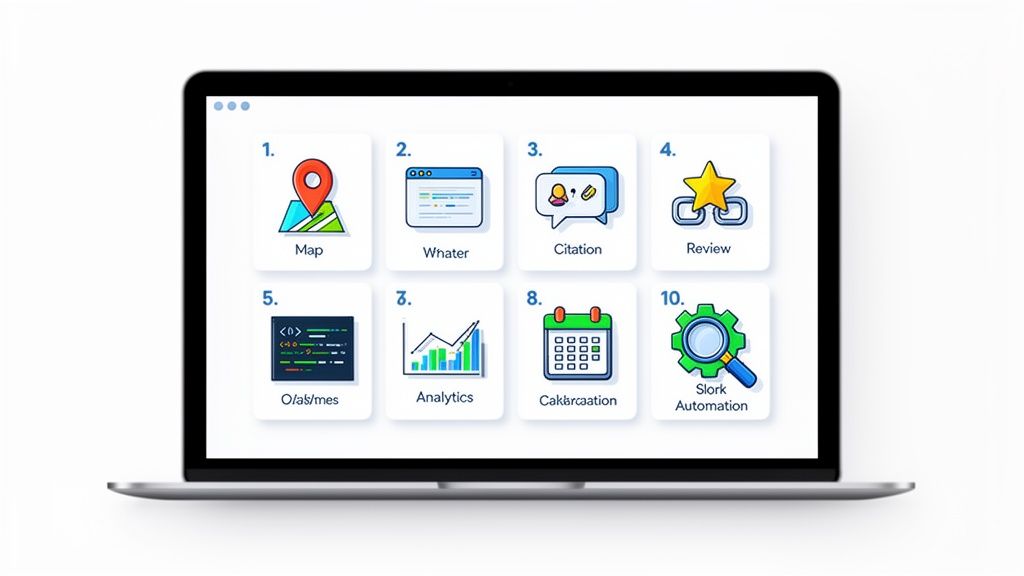
To truly dominate your local market, you need a systematic, repeatable process. This definitive local SEO checklist provides just that: a comprehensive, actionable framework covering every critical aspect of local search. We'll guide you through everything from foundational Google Business Profile (GBP) optimisation and local content strategy to advanced citation building and performance reporting. Each point is designed to be a clear, practical step you can implement immediately to improve your local rankings.
This guide is built for real-world application. We will detail specific workflows for single-location businesses, multi-location franchises, and marketing agencies, ensuring the advice is relevant to your unique needs. We’ll also highlight how a centralised platform can streamline these critical tasks, helping you turn local searches into loyal customers with greater efficiency and impact. Forget guesswork; this checklist is your roadmap to achieving measurable local search success and capturing the high-value customers in your area.
1. Optimise Your Google Business Profile with Complete and Accurate Information
Your Google Business Profile (GBP) is the cornerstone of your local SEO strategy. It's often the first impression a potential customer has of your business, appearing prominently in local search results and on Google Maps. Think of it as your digital storefront; an incomplete or inaccurate profile is like having a shop with a broken sign and unpublished opening hours, which actively turns customers away. This is a foundational step in any effective local seo checklist.
Completing your GBP signals to Google that your business is active, legitimate, and relevant to local searchers. The core of this optimisation is ensuring your NAP (Name, Address, Phone number) is perfectly consistent across the web. Beyond that, a fully fleshed-out profile with accurate opening hours, a link to your website, and correct business categories helps Google understand precisely what you offer and who to show your listing to. Inaccurate information doesn't just confuse customers, it erodes trust with search engines, significantly harming your visibility.
Actionable Tips for GBP Optimisation:
- Ensure 100% Completion: Fill out every single section Google provides. This includes services, products, accessibility attributes, and more. The more complete your profile, the more opportunities you have to rank for relevant queries.
- Select Precise Categories: Choose a primary category that best represents your main business offering, then add relevant secondary categories. For example, a restaurant should choose "Italian Restaurant" as its primary category, not just "Restaurant," and add secondary ones like "Pizza Delivery" or "Outdoor Seating."
- Maintain Holiday Hours: Proactively update your hours for public holidays, special events, or any temporary closures. Google often prompts users to confirm if your hours are correct, and failing to manage this looks unprofessional.
- Utilise All Media: Upload high-quality, recent photos and videos of your business exterior, interior, products, and team. This gives potential customers a genuine feel for your business before they even visit.
Key Insight: For multi-location businesses, maintaining NAP consistency and updating individual profiles can be a significant administrative burden. Using a centralised dashboard is crucial for efficiency and accuracy. A franchise with 50+ locations, for example, can use a tool to update holiday hours across all profiles simultaneously, saving hours of manual work and preventing errors. For more details on managing your profiles effectively, you can learn more about Google Business Profile management with LocalHQ.
2. Generate and Manage Customer Reviews Systematically
Customer reviews are a powerful trust signal for both potential customers and search engines. They act as social proof, directly influencing purchasing decisions, while also being a significant ranking factor in Google's local algorithm. A business with a steady stream of recent, positive reviews is seen as more credible, relevant, and trustworthy, which Google rewards with higher visibility. This is a non-negotiable part of any modern local seo checklist.
Implementing a systematic process for generating and managing reviews signals to Google that your business consistently delivers a quality experience. The quantity, velocity (how frequently you get new reviews), and quality (star rating) of your reviews all contribute to your local search ranking. Actively responding to all feedback, both positive and negative, further demonstrates that you are an engaged and customer-focused business, which helps build trust with prospects and search algorithms alike.
Actionable Tips for Review Management:
- Time Your Requests: Ask for a review within 24-48 hours of a service or purchase. The customer's experience will still be fresh in their mind, increasing the likelihood of them leaving detailed, valuable feedback.
- Make it Effortless: Remove all friction from the review process. Send customers a direct link to your Google review page via email or SMS, so they can leave feedback in just a few clicks.
- Personalise Your Approach: Customise your review requests based on the service received or the customer segment. A personalised message feels more genuine and is more likely to receive a response than a generic blast.
- Respond to Everything: Aim to reply to 100% of reviews within 24-48 hours. Thank customers for positive feedback and address negative comments professionally and constructively. This shows you value all customer opinions.
Key Insight: For multi-location businesses, consistently managing reviews across dozens or hundreds of profiles is a major operational challenge. A dental practice group, for example, can use automated review requests after each patient appointment to increase review volume by over 40%. Centralised tools are essential for maintaining a consistent brand voice and ensuring no review is missed. Learn how LocalHQ’s Review Autoresponder can craft on-brand replies in real-time, saving your team countless hours.
3. Schedule and Publish Consistent Local Content to Google Business Profile
Your Google Business Profile isn't a "set it and forget it" tool; it's a dynamic platform for engaging with your local audience. Regularly publishing content through GBP Posts, Events, and Offers keeps your profile active and demonstrates to Google that your business is current and operational. This activity acts as a powerful "freshness" signal, which can positively influence your rankings and encourage users to interact with your listing over a competitor's static profile. This is a crucial, ongoing task in any modern local seo checklist.
Consistent updates provide timely information to potential customers, such as announcing a seasonal promotion, showcasing a recently completed project, or highlighting an upcoming community event. Each post is an opportunity to reinforce your brand, share valuable updates, and drive conversions directly from the search results page. Failing to use these features means missing out on free, high-visibility advertising space that your competitors are likely utilising to capture customer attention.
Actionable Tips for GBP Content:
- Maintain a Regular Cadence: Aim to publish at least two to four times per week to maintain strong engagement and freshness signals. A consistent schedule is more important than sporadic bursts of activity.
- Use a Content Calendar: Plan your posts two to four weeks in advance to ensure a steady stream of relevant content. This helps align your GBP activity with your broader marketing campaigns and seasonal promotions.
- Optimise Your Visuals: Every post should include a high-quality, compelling image (minimum 800x600px). Visuals significantly increase engagement and help your posts stand out.
- Incorporate Local Keywords: Naturally weave local keywords and neighbourhood-specific terms into your post copy to enhance relevance for local searches. For instance, a home service company could mention a "boiler service in Clapham".
- Leverage Post Types: Use "Event" posts for sales, workshops, or community gatherings with a defined start and end date. Use "Offer" posts to create time-sensitive promotions with optional coupon codes to drive immediate action.
- Include a Clear Call-to-Action (CTA): Every post should guide the user on what to do next. Use CTAs like "Book Now," "Call Us," "Learn More," or "Visit Today" to direct traffic and generate leads.
Key Insight: For multi-location businesses, managing a consistent posting schedule across dozens or hundreds of profiles is a major operational challenge. A centralised content library and scheduling tool is essential. For example, a restaurant chain can use a platform to create a template for a "Weekly Special" post, then schedule it to be published across all its locations simultaneously, ensuring brand consistency and saving countless hours of manual work. Find out how you can schedule Google Business Profile posts with LocalHQ.
4. Build and Monitor Local Citations Across Directory Platforms
Beyond your own website and Google Business Profile, your business’s online presence is defined by mentions across a vast ecosystem of third-party sites. These mentions, known as citations, are online references to your business's Name, Address, and Phone number (NAP). Consistent, accurate citations on authoritative platforms like directories, review sites, and industry-specific portals act as powerful trust signals for search engines, verifying that your business is legitimate and located where it claims to be. This validation is a crucial component of any comprehensive local seo checklist.
In essence, every consistent citation is a vote of confidence for your local relevance. When Google’s crawlers find your exact NAP information replicated across reputable sites like Yelp, Apple Maps, and niche directories relevant to your industry, it reinforces the accuracy of your GBP data. Conversely, inconsistent or incorrect information, such as an old address or a wrong phone number, creates confusion for both customers and search engines. This NAP inconsistency can directly harm your local search rankings by eroding the trust Google has in your business information.
Actionable Tips for Citation Management:
- Establish Foundational Citations: Begin by securing listings on high-authority, general directories. Ensure your business is accurately listed on platforms like Apple Maps, Bing Places, and Yelp, as these are often the first places search engines look for verification.
- Prioritise Industry-Specific Directories: Identify and get listed on directories that are highly relevant to your niche. For example, a restaurant should be on OpenTable, a medical practice on Zocdoc, and a home services provider on HomeAdvisor.
- Guarantee Absolute NAP Consistency: Even minor variations, like using "St." instead of "Street" or "Ltd." instead of "Limited," can be flagged as inconsistencies. Your NAP should be an identical match on every single platform, without exception.
- Audit and Clean Up Existing Citations: Use a monitoring tool to regularly scan for existing citations. This will help you identify and correct any inaccuracies, duplicates, or outdated listings that could be negatively impacting your SEO.
Key Insight: For multi-location businesses, manually managing citations for each branch is a monumental task prone to human error. A retail chain with 50+ stores would struggle to keep NAP details consistent across hundreds of directories, especially during relocations or phone number changes. Utilising a centralised platform to automatically distribute and correct citation information ensures accuracy at scale, saving countless hours and protecting local rankings.
5. Implement Local Keyword Research and Optimisation Strategy
Local keyword research is the process of identifying the specific phrases and terms potential customers use when searching for your services within a particular geographic area. It moves beyond generic terms to capture high-intent queries that signal an immediate need. An effective strategy involves embedding these geographically-focused keywords into your website, Google Business Profile, and local content, making this an essential part of any local seo checklist.
Targeting local keywords helps Google connect your business with the most relevant searchers – those who are physically nearby and ready to make a purchase. For example, a plumber targeting the general keyword "plumber" faces immense competition, but by optimising for "emergency plumber in Clapham," they attract a highly-qualified local customer. This targeted approach ensures your marketing efforts reach an audience with a strong likelihood of conversion, directly impacting your bottom line and establishing your business as the local authority.
Actionable Tips for Local Keyword Optimisation:
- Combine Service and Location: Identify your core services and combine them with location modifiers. Think "[service] in [city]," "[service] near [neighbourhood]," or "[service] + [postcode]." For example, a dental practice should target both "dentist in Manchester" and "teeth cleaning in Deansgate."
- Analyse Competitor Keywords: Use benchmarking tools to discover which local keywords your direct competitors are successfully ranking for. This can reveal valuable opportunities you may have overlooked and inform your own content strategy.
- Integrate Keywords Naturally: Weave your chosen keywords into your GBP business description, services list, and regular posts. On your website, create dedicated landing pages for each service and location, ensuring the content is unique and genuinely helpful.
- Monitor and Adapt: Local search is dynamic. Use a geo-grid rank tracker to monitor your keyword performance across different service areas. Be prepared to update your keyword strategy based on seasonal demand fluctuations, like a landscaping business targeting "garden tidy up" in spring.
Key Insight: Many businesses struggle to identify the most impactful local keywords or understand how they stack up against the competition. AI-powered tools can remove the guesswork from this process. For instance, a multi-location legal firm can use an optimisation wizard to analyse each branch's profile, benchmark it against local competitors, and receive specific, data-driven recommendations for keywords and GBP categories, ensuring each office targets its most valuable local audience. For a smarter way to handle your keyword strategy, you can learn more about LocalHQ's keyword and category recommendations.
6. Optimise Local Website Pages and Technical SEO Foundation
Your website is the digital hub of your business, and its technical health is a critical pillar supporting all your local SEO efforts. While your Google Business Profile acts as the signpost, your website is the destination. A technically sound, locally optimised website provides search engines with the clear, structured information they need to understand your business's services, service areas, and relevance to local searchers. This is a non-negotiable component of any robust local seo checklist.
Technical SEO ensures your site is crawlable, indexable, and fast, while on-page local optimisation involves creating specific content that targets your geographical areas. For example, a home service company needs dedicated pages for each town it serves, not just a single "services" page. This bridge between your website's content and local search signals is what allows Google to confidently rank your business for queries like "plumber near me" or "best Italian restaurant in Manchester." A poorly structured or slow website actively works against your visibility, no matter how well-optimised your GBP is.
Actionable Tips for Website and Technical Optimisation:
- Create Unique Location Pages: For multi-location businesses, develop a unique, content-rich landing page for each physical branch. Avoid duplicating content; instead, include location-specific details like local testimonials, staff photos, opening hours, and neighbourhood information.
- Implement LocalBusiness Schema: Add
LocalBusinessschema markup to your homepage and location pages. This structured data explicitly tells search engines your business name, address, phone number, and business type in a language they can easily process. - Prioritise Mobile and Page Speed: Ensure your website is fully responsive and loads quickly on all devices. A slow mobile experience is a major deterrent for users and a negative ranking signal for Google. Use tools like Google's PageSpeed Insights to identify areas for improvement.
- Structure with Local Keywords: Use heading tags (H1, H2, H3) to create a clear content hierarchy on your pages. Your H1 should include your primary service and location, such as "Expert Boiler Repair in Bristol," with H2s covering related sub-topics.
Key Insight: Implementing and validating schema markup across dozens or hundreds of location pages can be a complex and error-prone task. An incorrect implementation can render it useless or even harm your rankings. Centralised management tools are essential for deploying, testing, and updating schema at scale, ensuring every location page is technically perfect and maximising its ranking potential. To explore how to manage this complex task, you can learn more about local landing page optimisation with LocalHQ.
7. Monitor Local Search Rankings with Geo-Specific Rank Tracking
Understanding where you rank on Google is crucial, but for local businesses, national-level data is practically useless. Geo-specific rank tracking shows you how your business appears in search results for customers in specific postcodes, neighbourhoods, or cities. Unlike broad keyword trackers, this approach acknowledges that rankings fluctuate significantly based on the searcher's physical location, providing a true picture of your visibility where it matters most: right on your customers' doorstep. This is a non-negotiable part of any modern local seo checklist.
Implementing a geo-grid rank tracker allows you to visualise your keyword performance across your service area, revealing strengths and weaknesses with pinpoint accuracy. For example, a home service provider might discover they rank on page one for "plumber in south London" when searched from Clapham, but are invisible in nearby Brixton. This granular insight helps you diagnose issues, allocate marketing budget more effectively, and tailor your on-page and off-page strategies to specific underperforming areas, turning data into a direct competitive advantage.
Actionable Tips for Geo-Specific Rank Tracking:
- Prioritise Key Terms: Start by tracking 10-20 high-priority keywords for each location to keep your data focused and manageable. Include branded terms (e.g., "Your Business Name + Town") to monitor your baseline visibility.
- Establish a Cadence: Check your rankings weekly or bi-weekly. This frequency is ideal for identifying meaningful trends and reacting to significant drops without getting lost in daily fluctuations.
- Connect Rankings to Strategy: Use the data to inform your content and optimisation efforts. If a specific service keyword is underperforming in a key area, create a location-specific landing page targeting that service and neighbourhood.
- Investigate Sudden Drops: A sudden, sharp decline in rankings for a particular area can signal a technical issue, a new competitor, or a negative review bomb. Geo-specific tracking helps you spot and diagnose these problems quickly.
Key Insight: For multi-location businesses, geo-grid tracking is essential for resource allocation. A restaurant chain can identify which of its branches are losing visibility for "[cuisine] near me" searches in affluent postcodes and then focus its marketing spend, such as local ads or content creation, specifically on boosting those underperforming locations rather than wasting budget on already dominant ones. To see how this works in practice, you can explore more about rank tracking for local keywords with LocalHQ.
8. Build Local Backlinks and Earn Local Authority Signals
While citations build a foundational presence, local backlinks are the currency of authority in local SEO. A backlink is a link from another website to yours, and when it comes from a trusted, geographically relevant source, it acts as a powerful vote of confidence. Google interprets these links as signals that your business is a prominent and respected part of the local community, which directly influences your search rankings. This step is a crucial part of any comprehensive local seo checklist.
Acquiring these links requires more proactive effort than simple directory listings, but the payoff is significantly higher. Links from local news outlets, well-regarded community blogs, or industry-specific associations in your area carry immense weight. For example, a link from a local newspaper article covering your business is far more valuable than dozens of low-quality directory citations because it signals genuine newsworthiness and local relevance. This process builds not just ranking potential but also your brand’s credibility and authority within your target market.
Actionable Tips for Local Link Building:
- Sponsor Local Events: Get involved in the community by sponsoring local sports teams, charity fun runs, or cultural festivals. These sponsorships almost always come with a link from the event organiser's website, providing a highly relevant local signal.
- Join Local Business Organisations: Memberships in your local Chamber of Commerce or other business associations typically include a listing and a link from their members' directory, which are often high-authority local sites.
- Foster Media Relationships: Build connections with local journalists, bloggers, and influencers. When you have something newsworthy to share, like an expansion or a special event, they will be more likely to cover your story and link back to your website.
- Create Localised Content: Develop content that is inherently valuable to your local area, such as a guide to "The Best Dog-Friendly Patios in Manchester" if you're a local pub. This type of resource naturally attracts links from other local websites and blogs.
Key Insight: For multi-location businesses, local link building can be scaled by creating a centralised strategy with localised execution. A national retail chain can create a template for store managers to engage with their local communities, providing guidance on identifying sponsorship opportunities or contacting local bloggers. This empowers local teams to build relevant links at scale, with tools like LocalHQ helping to track the impact of these efforts on each location's specific search performance. To explore how to manage and measure these campaigns effectively, you can learn more about Local SEO analytics with LocalHQ.
9. Develop Location-Specific Landing Pages with Localised Content
While your homepage serves your entire brand, location-specific landing pages are crucial for connecting with customers at a neighbourhood level. These dedicated pages act as digital hubs for each of your physical locations or service areas, demonstrating to both users and search engines that you are an integral part of that specific community. This goes beyond simply listing an address; it involves creating unique, valuable content that speaks directly to the local audience. This is a non-negotiable step in any advanced local seo checklist.
Creating these pages signals to Google that you have a physical presence and are genuinely invested in each area you serve. For a user searching "plumber in Islington," a landing page dedicated to Islington services, featuring testimonials from local residents and photos of the team working in the area, is far more relevant and trustworthy than a generic homepage. This targeted approach improves user experience, increases conversion rates, and provides a powerful ranking signal for location-based searches.
Actionable Tips for Location Page Creation:
- Create Genuinely Unique Content: Avoid copying and pasting content and simply changing the location name. Aim for at least 300-500 words of unique text that details your services in that area, discusses local landmarks, or mentions community involvement.
- Incorporate Local Social Proof: Feature customer testimonials, reviews, and case studies from clients in that specific location. This builds immense trust and relevance. For example, a restaurant in Soho should showcase reviews mentioning its pre-theatre menu.
- Use Hyperlocal Imagery: Upload high-quality photos of your local team, your storefront in that area, and completed jobs or events in the neighbourhood. This visually confirms your local presence and makes the page more engaging.
- Optimise On-Page Elements: Customise the title tag, meta description, and H1 heading for each page to include the location and primary keyword (e.g., "Emergency Dentist in Shoreditch | [Clinic Name]").
- Embed a Google Map: Include an embedded Google Map of your exact location to make it easy for customers to find you and to reinforce location signals to search engines.
Key Insight: For multi-location businesses, manually creating and optimising dozens or hundreds of unique landing pages is a monumental task. The real challenge is not just creation but also maintaining accuracy and freshness across all of them. Using a platform that integrates with your website can streamline this process, allowing you to build and update location pages at scale from a single source of truth, ensuring every page is perfectly optimised and consistent.
10. Measure and Report Local SEO Performance with Comprehensive Analytics
Executing a local SEO strategy without measuring its performance is like driving with your eyes closed; you're moving, but you have no idea if you're heading in the right direction. Comprehensive analytics and reporting are what turn your efforts into a measurable, data-driven strategy. It’s about tracking key metrics to understand what’s working, where to focus your optimisation efforts, and most importantly, proving the return on investment to stakeholders. This step transforms your local seo checklist from a list of tasks into a powerful business growth engine.
Tracking performance is crucial for demonstrating the tangible impact of local search on your bottom line. By monitoring metrics such as impressions, clicks, direction requests, and phone calls from your Google Business Profile, you can directly attribute real-world customer actions to your SEO activities. For instance, a home service provider can prove that their GBP optimisation led to a 150% increase in qualified calls quarter-over-quarter. This data-backed approach is essential for justifying marketing spend and making informed strategic decisions.
Actionable Tips for Performance Measurement:
- Activate GBP Insights: Regularly monitor your Google Business Profile Insights to track core user actions like calls, website visits, and direction requests. This is the most direct source of data on how users interact with your local listing.
- Track Calls and Web Traffic: Use call tracking numbers and UTM parameters on your GBP website link. This allows you to accurately attribute phone leads and website traffic directly to your local SEO efforts, helping to calculate your customer acquisition cost.
- Establish a Reporting Cadence: Create a dashboard featuring key metrics and share it monthly with stakeholders. Compare performance month-over-month and year-over-year to identify trends and highlight progress.
- Segment Your Data: For multi-location businesses, segmenting data by location is critical. This helps identify underperforming branches or specific optimisation opportunities, allowing you to tailor your strategy for maximum impact.
Key Insight: Raw data is useful, but actionable insights are what drive success. A medical practice can use reporting to demonstrate that a focused review management strategy increased new patient enquiries by 40%. For multi-location businesses, comparing performance across all sites helps to standardise best practices and identify outliers that need attention. A reporting suite like LocalHQ's Analytics & Reporting can automatically consolidate these metrics into clear, easy-to-understand reports, saving time and revealing opportunities that would otherwise be missed.
Local SEO Checklist: 10-Point Comparison
| Strategy | 🔄 Implementation complexity | ⚡ Resource requirements | ⭐ Effectiveness | 📊 Expected outcomes | 💡 Quick tip |
|---|---|---|---|---|---|
| Optimise Your Google Business Profile with Complete and Accurate Information | Low → Medium (easy setup; ongoing maintenance) | Low — time to complete + optional management tool | ⭐⭐⭐⭐⭐ | Better local pack visibility, higher CTR, verified legitimacy | Ensure exact NAP consistency; verify and update hours and images |
| Generate and Manage Customer Reviews Systematically | Medium (process + reputation handling) | Medium — automation, staff time to respond | ⭐⭐⭐⭐ | Increased social proof, ranking lift, trust and user signals | Request reviews within 24–48 hrs; use direct links and respond promptly |
| Schedule and Publish Consistent Local Content to Google Business Profile | Low → Medium (content cadence planning) | Low–Medium — content creation and scheduler | ⭐⭐⭐⭐ | Improved freshness signals, higher engagement and CTR | Post 2–4×/week with high-quality images and local keywords |
| Build and Monitor Local Citations Across Directory Platforms | Medium → High (many sources to manage) | Medium — directory submissions + monitoring tools | ⭐⭐⭐⭐ | Better discoverability and local ranking support | Start with high-authority directories and maintain exact NAP |
| Implement Local Keyword Research and Optimisation Strategy | Medium (research + on-page work) | Low–Medium — keyword tools and analyst time | ⭐⭐⭐⭐⭐ | More high-intent local traffic; improved relevance and conversions | Target location modifiers and long-tail terms; update seasonally |
| Optimise Local Website Pages and Technical SEO Foundation | High (technical implementation) | High — developer and content resources | ⭐⭐⭐⭐ | Improved crawlability, rich snippets, mobile UX, ranking support | Add LocalBusiness schema, unique location pages, and speed optimisations |
| Monitor Local Search Rankings with Geo-Specific Rank Tracking | Medium (tool setup + analysis) | Medium — rank-tracking subscription and analyst time | ⭐⭐⭐⭐ | Location-level visibility insights; identifies underperforming areas | Track 10–20 priority keywords per location; check weekly/bi-weekly |
| Build Local Backlinks and Earn Local Authority Signals | High (outreach & relationship-building) | Medium–High — outreach, sponsorships, content creation | ⭐⭐⭐ | Stronger domain authority and referral traffic over time | Sponsor/local events, pitch local press, and offer guest contributions |
| Develop Location-Specific Landing Pages with Localised Content | High (unique content per location) | High — writers, dev, local assets | ⭐⭐⭐⭐ | Improved organic local rankings and higher conversion rates | Produce genuinely unique pages (300–500+ words) with local testimonials |
| Measure and Report Local SEO Performance with Comprehensive Analytics | Medium (integration + reporting) | Medium — analytics tools and reporting setup | ⭐⭐⭐⭐⭐ | ROI evidence, optimisation guidance, stakeholder reporting | Use GBP insights, call tracking, UTM tags; maintain a monthly dashboard |
Turn Your Checklist into Consistent Local Growth
You now have a comprehensive local SEO checklist that cuts through the noise, offering a clear, actionable roadmap to dominating your local market. We've navigated the foundational elements of optimising your Google Business Profile, the strategic necessity of a robust review management system, and the critical importance of consistent, accurate local citations. We also explored the nuances of on-page SEO, from hyper-localised content on your website to the technical precision of local schema markup.
This isn't just a list of tasks to be ticked off once; it's a blueprint for a continuous, dynamic process. The digital high street is constantly evolving, and your strategy must adapt with it. The most successful local businesses are those that transform this checklist from a one-time project into an ongoing operational rhythm. They realise that local SEO is an ecosystem where each element supports the others. Powerful reviews bolster your GBP authority, which is amplified by accurate citations, driving qualified traffic to your perfectly optimised local landing pages.
From Knowledge to Action: The Path to Mastery
The true challenge, and the greatest opportunity, lies in execution. For a single-location business, staying on top of these tasks demands dedication. For multi-location enterprises or agencies managing multiple clients, manual management becomes an operational nightmare, riddled with inconsistencies and inefficiencies that undermine your efforts. The secret to scaling local success isn't working harder; it's working smarter.
Embracing this local SEO checklist means committing to a cycle of implementation, monitoring, and refinement. Key takeaways to focus on include:
- Consistency is King: Sporadic updates to your GBP or a reactive approach to reviews will not deliver sustained results. Consistency signals reliability and relevance to both customers and search engines.
- Accuracy is Non-Negotiable: A single incorrect phone number or address in a key directory can create a ripple effect of customer confusion and erode search engine trust. Every detail matters.
- Integration is Power: Your on-page efforts must align with your off-page signals (GBP, citations, links). A disconnected strategy is an ineffective one. Treat your entire local digital presence as a single, cohesive entity.
Mastering this checklist is about more than just ranking higher. It's about building a powerful, defensible digital presence that directly translates into more phone calls, more foot traffic, and more revenue. It’s about becoming the go-to local authority in your niche, ensuring that when a potential customer searches for your services, your business is the first and most trusted result they see. By turning these strategic actions into repeatable habits, you build a sustainable engine for growth that will serve your business for years to come.
Ready to transform this checklist from a manual chore into an automated growth engine? LocalHQ is designed to streamline every task on this list, from GBP optimisation and review management to citation building and performance reporting, all from a single dashboard. Stop juggling spreadsheets and start driving results by discovering how LocalHQ can simplify your local marketing today.