How to write a Google Business Description: Expert Tips for Local Visibility
Your Google Business description is your chance to shine. Think of it as a 750-character sales pitch that needs to pull double duty: it has to win over potential customers and prove your relevance to Google's algorithm. The trick is to summarise your core services, show off what makes you unique, and cleverly weave in local keywords, all within the first 250 characters.
Why Your GBP Description Is a Local SEO Powerhouse
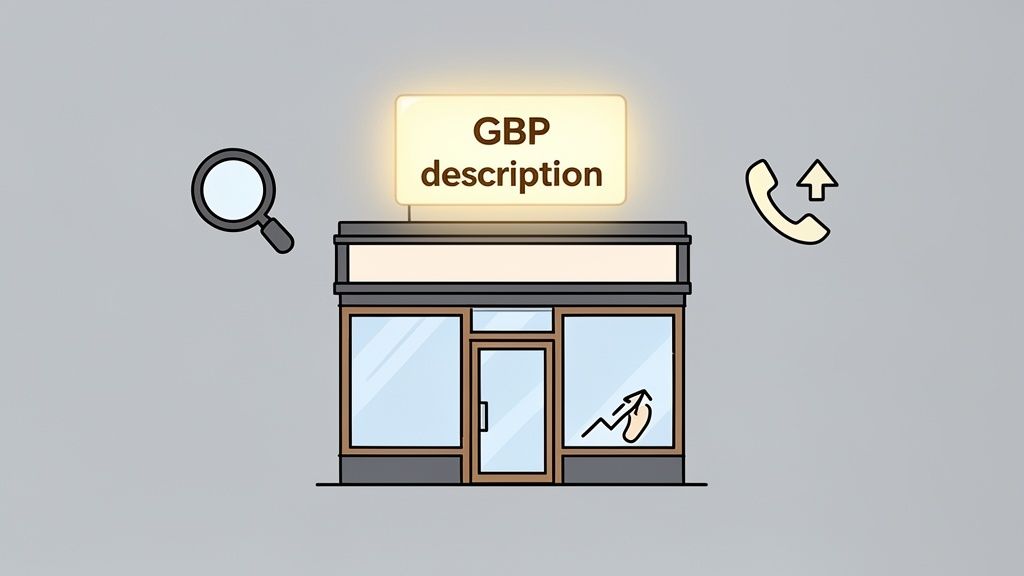
Your Google Business Profile (GBP) description is, for all intents and purposes, your digital shop window. It's very often the first thing a potential local customer sees. A blank or rushed description is like having a "Closed" sign hanging on the door—it tells people nothing and sends them scurrying to your competitors.
On the flip side, a thoughtfully written description sends powerful signals to both search algorithms and real people. It instantly confirms you’re a match for their local search, builds a quick sense of trust, and gives them a solid reason to choose you. This small block of text can make all the difference between someone clicking through to your site, asking for directions, or simply scrolling on by.
The Connection Between a Full Profile and Higher Rankings
In today's local SEO landscape, having a complete profile isn't just a good idea—it's essential. The data speaks for itself: an incredible 75% of businesses ranking in the top three local search spots have a fully completed GBP description. That's a huge advantage.
This isn't just a box-ticking exercise. Google’s whole mission is to provide the most helpful and comprehensive information to users. A detailed description, packed with relevant keywords and clear, persuasive language, helps Google understand precisely what you do and who you serve. The result? You rank higher for the local searches that matter most.
Your GBP description is your opportunity to answer a potential customer's unspoken questions: "What do you do?", "Why should I trust you?", and "Are you the right fit for me?" Answering these effectively within 750 characters is the key to turning a searcher into a customer.
Before we dive into the 'how-to', let's break down the essential components you'll be working with. This table gives a quick overview of what a high-performing description looks like.
Anatomy of a High-Impact GBP Description
| Component | Its Purpose in Local SEO | Example Snippet (UK Context) |
|---|---|---|
| Opening Hook | Grabs attention and immediately states your core service and location. Critical for the first ~250 characters that are always visible. | "Award-winning artisan bakery in the heart of Bristol's Old City, specialising in handmade sourdough and fresh pastries daily…" |
| Unique Selling Points (USPs) | Differentiates you from the competition. Answers the "Why you?" question. | "…We're the only local bakery using 100% organic, stone-ground flour from the Cotswolds. Voted Bristol's best coffee shop 2023…" |
| Keyword Integration | Naturally includes terms people are searching for, signalling relevance to Google for queries like "bakeries near me" or "sourdough Bristol". | "…Visit us for authentic sourdough bread, custom celebration cakes, and delicious vegan pastries. Find our bakery just off Corn Street…" |
| Call to Action (CTA) | Tells the user what to do next, encouraging engagement and conversion. | "…Pop in for a coffee and a croissant, or call us to order your bespoke celebration cake today!" |
Each of these elements plays a vital role in creating a description that works hard for your business, attracting both search engines and customers.
Turning Clicks into Customers
Beyond pleasing the algorithm, your description is your front-line sales tool. It's where you stand out on the crowded UK high street. Does your café use locally sourced ingredients? Is your plumbing service available 24/7 with no call-out fee? These are the crucial details that turn a casual search into a real-world action.
When done right, a strong description delivers tangible results:
- Increased Footfall: Clearly stating what you offer and where you are encourages local customers to pop in.
- More Phone Calls: Mentioning a unique service or special offer prompts people to get in touch straight away.
- Higher Website Traffic: A compelling summary makes users want to click through to your site and find out more.
For any local business, mastering the essentials of SEO for small business starts right here. Getting this description right is a foundational piece of any effective Google Business Profile management strategy. In the next few sections, we'll walk through exactly how to write a description that nails all of this and more.
Your Pre-Writing Strategic Checklist
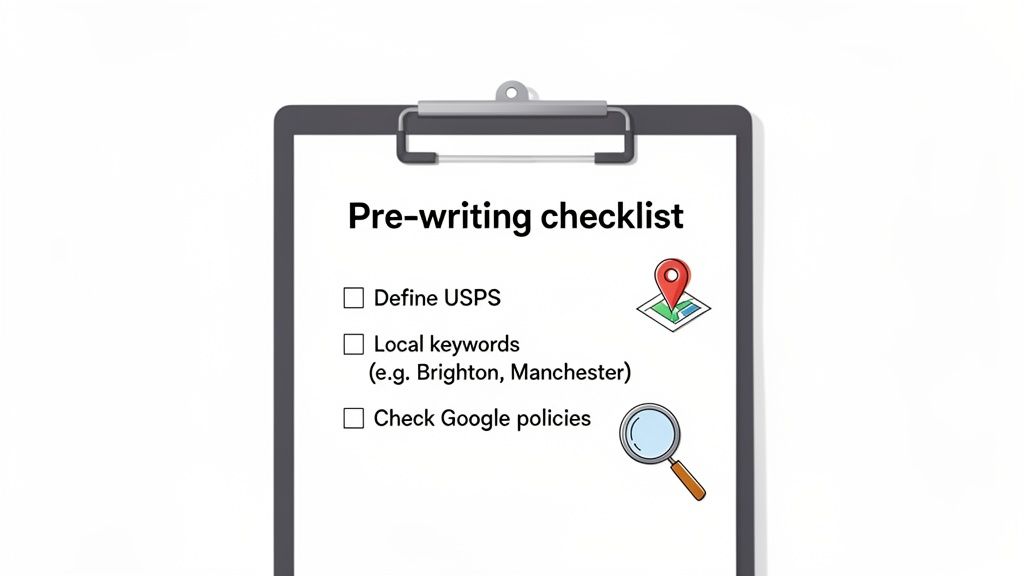
Before you type a single word, it pays to do a bit of homework. A powerful Google Business description doesn't just happen; it's built on a solid foundation. Rushing this stage is a common mistake that leads to generic, forgettable text that does nothing to attract local customers or rank for the right searches.
This is where you lay the groundwork for a description that actually performs. Think of it as your strategic brief—it’s about pinpointing what makes you special, figuring out the exact phrases your customers are using, and getting familiar with Google's rules so your hard work doesn't get rejected.
Pinpoint Your Unique Selling Propositions
First things first: what truly sets you apart from the competitor just down the road? Your Unique Selling Propositions (USPs) are the soul of your description. Don't just give a bland list of services; dig into the specific value you offer.
Maybe you're a family-run café in York that’s been part of the community for 50 years, or a plumber in Birmingham who promises a no-call-out-fee guarantee. These are the nuggets of gold that build trust and convince someone to pick up the phone.
To really nail down your USPs, ask yourself a few direct questions:
- What problem do we solve better than anyone else? (e.g., "We offer emergency 24/7 call-outs for electricians in Manchester.")
- What are our most loved services or products? (e.g., "Famous for our award-winning vegan sausage rolls.")
- Do we have special qualifications or guarantees? (e.g., "All our technicians are Gas Safe registered for your peace of mind.")
- What do customers always compliment us on? (e.g., "Known for our friendly, no-jargon advice.")
Get at least three solid USPs written down. These will be the pillars of your description, making it persuasive, not just informative.
Define Your Tone and Voice
How you say something is just as crucial as what you say. Your brand's voice should match your business's personality and click with your ideal customer. Are you a formal, high-end solicitor's office in London, or a relaxed, friendly dog groomer in Brighton?
Before writing, defining your brand voice is an essential part of the checklist. It guides your word choice and keeps your messaging consistent everywhere, including your GBP description. A consistent tone builds brand recognition and helps people feel like they know you before they even walk through the door.
Research Hyper-Local Keywords
To show up in local searches, you have to think like a local. People don't just search for "plumber"; they look for an "emergency plumber in Clapham" or the "best sourdough in the Northern Quarter." Your description absolutely needs to feature these geographically-specific keywords.
Start by brainstorming your core services combined with your town, city, or even a specific neighbourhood. Think about what makes your location unique and weave those details into the text.
Pro Tip: Don't just stuff keywords in. The aim is to make them sound natural. Instead of "We offer plumbing, boiler repair, emergency plumbing in Bristol," try something like, "For reliable emergency plumbing and boiler repair across Bristol, our expert team is here to help."
Understand Google's Content Policies
This is the big one. You have to play by Google's rules. Ignoring their guidelines is the fastest route to getting your description rejected or, even worse, your profile suspended. The main takeaway is to be helpful and honest, not overly salesy.
Here’s a quick list of what you cannot include:
- Special Offers or Prices: Things like "20% off this month" or "services from £50" are a no-go. Use Google Posts for promotions instead.
- Misleading Information: Don't make false claims or exaggerate what you can do.
- Links or URLs: Your description cannot contain any website links.
- Inappropriate Content: This is a professional snapshot of your business, so keep the language clean and respectful.
Spending a few minutes reviewing the rules now will save you a massive headache later. It’s particularly important if you manage multiple locations—ensuring each profile is compliant is a vital first step, right after learning how to get your Google Business Profile verified correctly. With this prep work done, you're ready to start writing a description that gets results.
Crafting Your Compelling Business Description
Right, you’ve done the strategic groundwork. Now it's time to stitch those keywords and unique selling points into a narrative that actually connects with people. This is where you move from a list of ideas to sentences that show customers (and Google) exactly what you're about. The aim is to be clear, engaging, and genuinely helpful.
Keep in mind, you have a total of 750 characters to play with. But the real magic needs to happen in the first 250 characters or so. That’s all a user sees before they have to click 'more'. This snippet is your digital shopfront; it has to grab their attention and prove you’re the right choice, instantly.
Nail the Opening Line
Your first sentence is the most valuable real estate in your entire profile. It has to answer two fundamental questions straight away: "What do you do?" and "Where are you?" A strong opener weaves your core service and your primary location together seamlessly.
Think of it as your elevator pitch for the digital age. It must be sharp and specific. An opener like "We are a professional company offering a range of services" is a complete waste of space.
Get straight to the point instead.
- For a local service: "Your trusted, family-run electricians in Sheffield, specialising in emergency call-outs and consumer unit upgrades."
- For a retail shop: "Discover unique, handmade gifts and homeware at our independent boutique in the heart of Edinburgh's Old Town."
- For a restaurant: "Authentic, wood-fired Neapolitan pizza and fresh pasta served daily in our cosy restaurant in Manchester's Northern Quarter."
Each of these examples immediately tells a local searcher what the business is and where it is, making it instantly relevant.
Talk About Benefits, Not Just Features
This is one of the most common missteps I see. Businesses list their features, writing things like "We have certified technicians," or "Our solicitors have 20 years of experience." While these are decent points, they don't really resonate with a customer’s actual needs.
To make your description truly compelling, you need to translate those features into tangible benefits. Just ask yourself one simple question: "So what?" What does this feature actually do for my customer? This shift in perspective makes a huge difference.
Let's look at how this works in practice:
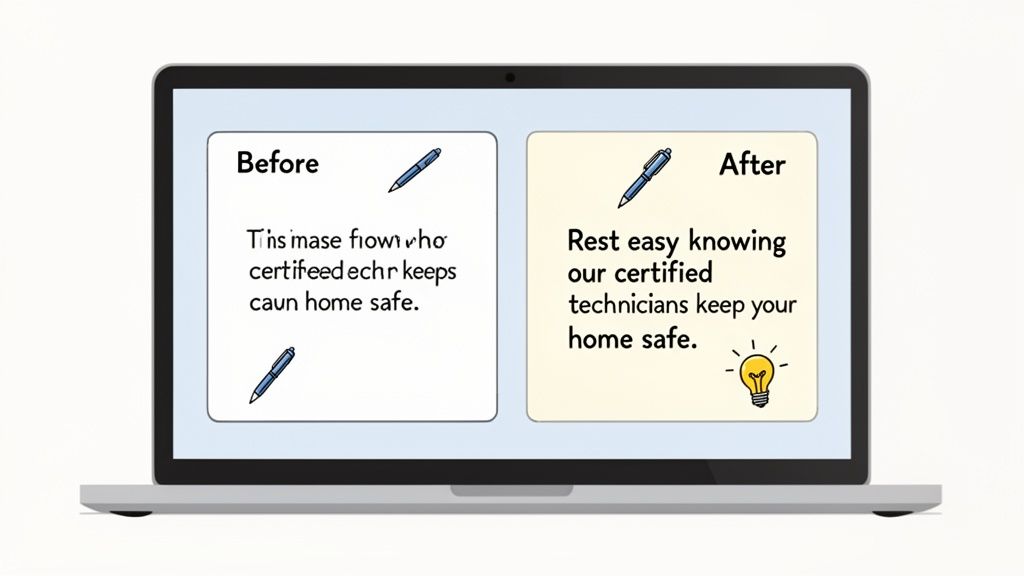
Before (Feature): "We have certified technicians."
After (Benefit): "Rest easy knowing our certified technicians ensure every job is completed to the highest safety standards."
Before (Feature): "We offer bespoke financial planning."
After (Benefit): "Achieve your financial goals sooner with a personalised financial plan designed to build and protect your wealth."
The 'after' versions connect directly with what the customer wants—peace of mind, security, and achieving their ambitions. It’s an approach that builds trust and makes your services feel far more valuable.
Writing with benefits in mind turns your description from a dry business listing into a persuasive solution to a customer's problem. You're no longer just selling a service; you're selling an outcome.
Weave in a Subtle Call to Action
While Google's guidelines are very clear about banning shouty promotional language like "50% off!" or "Sale on now!", you absolutely should guide the user towards their next step. A gentle, well-placed call to action (CTA) can make a real difference, prompting more calls, website clicks, or requests for directions.
The trick is to make it sound like a natural invitation, not a hard sell. I always recommend placing your CTA towards the end of the description, once you’ve already demonstrated your value.
Here are a few effective examples that won't get you into trouble:
- "Pop in to browse our latest collection."
- "Call our friendly team today to discuss your project."
- "Visit our website to see our full menu and book a table."
- "Get in touch for a no-obligation quote."
These simple phrases encourage the customer to take that next step without breaking any of Google's rules. It’s the final touch that transforms your description from a passive bit of text into an active tool for winning new business.
Optimising your Google Business Profile description is a proven way to boost engagement. This is especially true for UK businesses, where profiles with complete information—including detailed descriptions—convert 3.2 times more often than those with gaps. This is vital in competitive sectors like retail and food service, which make up over 45% of global listings. A vivid description, like 'family-run boutique with sustainable fashion since 2010' for a shop in Edinburgh, can capture a huge share of views from discovery searches. You can discover more about the impact of GBP optimisation on SQ Magazine.
UK Industry Examples and Practical Templates
Theory is one thing, but seeing how these principles work in the real world is where it all clicks.Let's move past the theory and look at what a great Google Business Profile description actually looks like in practice. I find the best way to get a feel for this is to see examples from different UK sectors. Each one is designed to catch the eye, build immediate trust, and get local customers to take that next step.
We'll break down a few examples, looking at why they work—the specific keywords they use, the tone they strike, and what makes them stand out. You can borrow these ideas to craft your own, no matter what industry you're in.
Example for a Birmingham Plumbing Service
First, let's tackle a local plumber in Birmingham. When someone's boiler is on the blink or a pipe has burst, they're looking for three things: trust, speed, and professionalism. The description has to deliver that in a heartbeat.
Description Example:
"Your trusted Gas Safe registered plumbers in Birmingham, providing rapid 24/7 emergency call-outs and reliable boiler repairs. As a family-run business with over 20 years of experience serving the Jewellery Quarter and surrounding areas, we pride ourselves on honest, no-nonsense service with no hidden call-out fees. From routine boiler servicing to complete bathroom installations, our certified engineers ensure every job is done right, keeping your home safe and warm. For a fast, friendly, and professional plumbing service in Birmingham, give our expert team a call today."
Why It Works:
- Keywords: It’s packed with high-intent local search terms like "Gas Safe registered plumbers in Birmingham," "24/7 emergency call-outs," and "boiler repairs." This is exactly what people type in when they need help.
- Unique Selling Points (USPs): The description is loaded with trust signals: "Gas Safe registered," "family-run," and the brilliant "no hidden call-out fees." Highlighting 20 years of experience is a masterstroke for building instant credibility.
- Tone: The language is professional, reliable, and reassuring—perfect for someone in a stressful situation.
This example nails it by telling a potential customer that they’re qualified, experienced, and won't rip them off. That's a powerful message when you're in crisis mode.
Example for a York Café
Now, let's switch gears to a cosy, independent café in historic York. The goal here is completely different. It's about creating a warm, inviting vibe and making your food and drink sound irresistible.
Description Example:
"Discover your new favourite cosy corner at The Shambles Coffee House, an independent artisan café in the heart of York. We proudly serve locally roasted coffee, loose-leaf teas, and a delicious selection of homemade cakes and pastries, baked fresh every morning. Famous for our award-winning Yorkshire curd tart and vegan-friendly lunch options, we're the perfect spot to relax after exploring the city. All our ingredients are sourced from local Yorkshire suppliers because we believe in supporting our community. Pop in for a flat white and a friendly chat—we're just a stone's throw from York Minster."
Why It Works:
- Keywords: Phrases like "Independent artisan café in York," "locally roasted coffee," and "homemade cakes" target what customers are actively searching for. Mentioning "vegan-friendly lunch options" is a smart move that caters to a specific, growing audience.
- USPs: The description doesn't just sell coffee; it sells an experience. It highlights unique offerings like the "award-winning Yorkshire curd tart" and its commitment to "local Yorkshire suppliers."
- Tone: It’s friendly, warm, and has a real sense of community, setting it apart from the big, generic coffee chains.
By blending local charm with specific, desirable products, this description appeals directly to both tourists looking for an authentic experience and locals seeking a quality independent café.
Example for a London Solicitor's Office
Writing for a professional service, like a solicitor in a hyper-competitive market like London, requires a different approach. The description needs to project authority, expertise, and specialisation, all while being approachable.
Description Example:
"Expert legal guidance from authorised solicitors in Canary Wharf, London. Our firm specialises in residential conveyancing, commercial property law, and will writing services. With a focus on providing clear, straightforward advice, our experienced team is dedicated to navigating complex legal matters on your behalf. We offer personalised, fixed-fee consultations to ensure transparency and peace of mind for our clients across London. As accredited members of the Law Society, we are committed to upholding the highest professional standards. Contact our office today to schedule your initial consultation."
Why It Works:
- Keywords: It targets specific, high-value legal needs in a defined area with terms like "Solicitors in Canary Wharf," "residential conveyancing," and "will writing services."
- USPs: It's full of essential trust signals: "authorised solicitors," "accredited members of the Law Society," and the very appealing "fixed-fee consultations."
- Tone: The voice is professional, authoritative, and trustworthy. It's exactly what you want when seeking legal advice.
This description quickly communicates expertise and reassures potential clients that they are dealing with qualified, regulated professionals who won't waste their time or money.
GBP Description Best Practices at a Glance
Writing a great description comes down to following a few key principles and avoiding some common pitfalls. I've put together this quick-scan table to help you stay on track.
| What You Should Do ✅ | What You Should Avoid ❌ |
|---|---|
| Lead with your most important keywords and location. | Stuffing keywords unnaturally or creating a list of terms. |
| Highlight what makes you unique (your USPs). | Making claims you can't back up (e.g., "the best in London"). |
| Use all 750 characters if you can, focusing on the first 250. | Wasting space with unnecessary jargon or filler words. |
| Maintain a consistent, authentic brand voice. | Using links, HTML, or ALL CAPS. |
| End with a clear call to action (CTA). | Forgetting to tell the customer what to do next. |
| Focus on benefits for the customer, not just features. | Only talking about yourself and your business's history. |
| Mention key accreditations or awards to build trust. | Posting promotional content or time-sensitive offers. |
Think of this table as your checklist. A quick glance before you publish can save you from making a simple mistake that could undermine all your hard work.
A Versatile Template to Get You Started
Feeling ready to have a go? Here’s a simple, adaptable template you can use to structure your own description. Just fill in the blanks with your business's unique details, and remember to keep the tone consistent with your brand personality.
[Your Core Service] in [Your City/Neighbourhood]
"Your leading [Your Business Type] in [Your Location], specialising in [Service 1], [Service 2], and [Service 3]. As a [Your USP 1, e.g., family-run, award-winning] business, we are proud to offer [Your Benefit 1, e.g., exceptional customer service]. All our [Products/Work] is [Your USP 2, e.g., locally sourced, fully guaranteed]. Visit us for [What customers can do] or contact our friendly team to [Your Call to Action]."
Testing and Refining Your Description for Peak Performance
Hitting 'publish' on your Google Business Profile description is a great start, but it’s definitely not the end of the road. The most successful local businesses I've seen treat their description as a living, breathing marketing asset, not some static text you just set and forget. To really get the best results, you need to keep an eye on its performance, dig into the data, and be ready to tweak your approach.
Think of it like this: your description is an ongoing chat with your local customers. By listening to how they react, you can make small, smart changes that lead to big wins—more calls, more clicks, and more people walking through your door. This constant process of refinement is what separates the good profiles from the truly great ones.
Using GBP Insights to Measure Impact
Before you can improve anything, you first need a clear picture of what's actually working. Your best friend here is Google Business Profile Insights, the built-in analytics tool that shows you exactly how people are interacting with your profile.
Don't get lost in a sea of data. Instead, zoom in on the handful of metrics that are most directly tied to how clear and persuasive your description is.
These are the core numbers I always watch:
- Profile Views: How many people are even seeing your profile? A well-written description, packed with the right keywords, can get you in front of more relevant searchers, giving this number a healthy boost.
- Website Clicks: Is your description compelling enough to make someone want to find out more? This tells you if your call to action is actually working.
- Direction Requests: This is a huge signal of real buying intent. A strong description that sells your value can directly lead to more foot traffic.
- Phone Calls: For any service business, this is often the money metric. A clear, benefit-driven description gives people a reason to pick up the phone right away.
I recommend tracking these metrics monthly. Keep an eye out for trends after you’ve updated your description. Did calls suddenly spike? Did website clicks drop off? This data gives you the proof you need to make decisions based on evidence, not just guesswork.
The Art of Simple A/B Testing
You don't need fancy, expensive software to test your description. The core idea of A/B testing—changing one thing at a time to see what happens—is easy to apply here.
For your GBP description, you could try testing different opening sentences. For one month, you might lead with an award you've won. The next month, you could switch it up and highlight a specific, high-demand service.
A Real-World A/B Test Example:
Imagine a bakery in Manchester. They could test two different opening lines over two months:
Version A: "Award-winning artisan bakery in Manchester's Northern Quarter, specialising in handmade sourdough."
Version B: "Your local source for freshly baked sourdough, vegan cakes, and barista coffee in Manchester's Northern Quarter."By comparing the engagement metrics (calls, clicks, direction requests) for each month, the bakery can see which message really connected with their local audience.
The trick is to only change one significant thing at a time—like the opening hook or the call to action. If you rewrite the whole thing, you’ll never know which change actually made the difference. Keep your tests simple, be patient, and let the numbers tell you what to do next.
Managing Descriptions for Multiple Locations
If you're an agency or a business with multiple branches, you’ve got a bigger challenge: keeping your brand message consistent while still making each location feel local. A copy-and-paste description just won’t work. While your core brand values should shine through everywhere, each description needs a local touch.
This customisation is absolutely vital for local SEO. Here’s a simple framework I use:
- Start with a Core Template: First, write a master description that perfectly captures your brand's main services and what makes you special.
- Add Some Local Flavour: For each individual branch, weave in location-specific details. Mention a nearby landmark, a specific neighbourhood, or a service that’s unique to that spot. For example, "…our Edinburgh branch, just a short walk from the Royal Mile…"
- Showcase Local Wins: If one location has won a local award or gets involved in community events, shout about it! Put that information right in their description.
This strategy ensures every single profile feels genuine and connected to its community—which is exactly what Google and your customers are looking for. It turns what could be a logistical headache into a massive competitive advantage.
Answering Your Google Business Description Questions
Even with a solid plan, a few questions always pop up when you're putting the final touches on your Google Business description. I get asked these all the time by UK business owners, so I've put together some straightforward answers to help you get it right.
Think of this as your quick-fire FAQ for making sure your description is not just well-written, but also effective and playing by Google's rules.
How Often Should I Update My Google Business Description?
This is probably the most common question I hear, and the answer is: less often than you’d think. Your business description should be an "evergreen" summary of who you are and what you do. Constantly fiddling with it can actually be counterproductive.
As a rule of thumb, a quick review every quarter or even twice a year is plenty. The key is to only make an update when something significant changes in your business.
So, when should you update it?
- You’ve launched a major new service or product line.
- You’ve won a big industry award or a well-known local prize.
- Your business has gone through a complete rebrand.
- There's been a fundamental shift in your business model.
A clever tactic can be to make subtle seasonal mentions – a pub might reference its "sunny beer garden" in summer or its "cosy fireplace" in winter – but don't overdo it. The aim is long-term relevance, not a flurry of constant activity.
Can I Put Prices or Special Offers in My Description?
Let me be crystal clear on this one: no, you can't. Google's guidelines are very strict here. The business description is not the place for promotional language, sales pitches, or specific prices.
Adding things like "20% off this month" or "services from just £99" is a direct violation of their policies. Best case scenario, your edits will be rejected. Worst case, repeated attempts could even put your entire profile at risk of suspension.
Your business description is for telling people who you are and what makes you special. Promotions belong in the dedicated 'Posts' and 'Offers' sections of your profile. These tools are built specifically for that kind of timely content and won't land you in hot water.
Think of it like this: your description is the permanent sign above your shop door. Your Posts are the temporary posters you stick in the window.
Should I Use the Same Description for All My Locations?
While copying and pasting might seem like a time-saver, it’s a massive missed opportunity for your local SEO. It's far, far better to customise the description for each location.
A good way to approach this is to start with a core brand template. This should cover your main services and what makes you unique, ensuring consistency across the board. From there, you can add a local spin to each one.
What does that look like in practice? You could mention:
- Local Landmarks: "…our shop is just a short walk from The Shard…"
- Specific Neighbourhoods: "…proudly serving the Leith community for over 10 years."
- Unique Local Services: "…our Bristol store is the only branch offering specialist bike fittings."
This little bit of extra effort pays off in two ways. First, it helps your local SEO by weaving in geographically relevant keywords. Second, it makes your business feel more connected to the community it's in, which is a huge trust-builder for potential customers.
What Happens If I Go Over the 750 Character Limit?
It's simple: Google just won't let you save it. The 750-character limit is a hard stop, and there's no getting around it. As you type into the description box, you’ll see a character counter that helps you stay on track.
But here's the number you really need to care about: around 250 characters. That’s roughly how much of your description people see in the search results before they have to click 'more'.
This means you absolutely have to front-load your most important information. Your core service, primary location, and what makes you the best choice have to be in that first sentence or two. You need to make an immediate impact to convince someone to click and find out more.
Ready to take control of your local SEO and turn your Google Business Profile into a customer-generating machine? LocalHQ offers a powerful, AI-driven platform to manage and optimise your presence across all your locations from a single dashboard. Streamline your posts, manage reviews, and get actionable insights to rank higher and drive more footfall. Discover how LocalHQ can grow your business today.