Local SEO for Lawyers A Complete Guide to Winning Clients

When someone in your town has a legal problem, what's the first thing they do? They pull out their phone and search for help. Local SEO for lawyers is all about making sure your firm is the one they find. It’s the process of fine-tuning your online presence so you show up prominently when potential clients in your specific city, county, or neighbourhood search for legal services on Google.
Why Local SEO is Crucial for UK Law Firms
Let's be honest, the days of relying solely on a Yellow Pages ad or word-of-mouth are long gone. The way people find and choose a solicitor has completely changed. When faced with a divorce, a property dispute, or a will to be written, their first port of call is the internet. They aren't looking for a massive national firm; they're looking for the best, most trusted solicitor near them.
This is why getting a handle on local SEO for lawyers isn't just a "nice-to-have" anymore. It's become the single most important channel for bringing new clients through the door.
The New Client Journey Begins Online
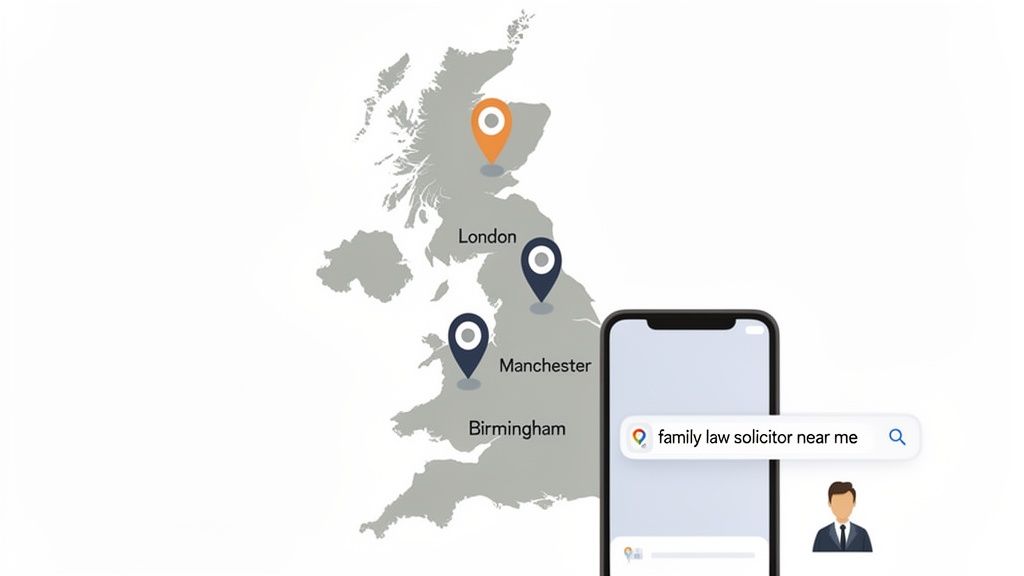
Picture this: someone in Manchester is urgently searching for a "family law solicitor near me," or a first-time buyer in Birmingham is looking for a "conveyancing solicitor." These aren't casual browsers; these are people with a specific, immediate need. Being the firm that appears at that exact moment is how you win their business.
The data backs this up completely. In the UK, a huge 57% of law clients find their solicitors through search engines. Think about the volume of searches like 'solicitor near me' every single month. What's more, an incredible 68% of UK internet users click on the Google Local 3-Pack—that little map with three business listings at the top of the page. That prime real estate gets 44% more clicks than the standard organic results below it.
The reality is simple: if your firm isn't showing up in the local map pack and the top organic search results, you're invisible to the vast majority of potential new clients in your area.
Turning Visibility into Enquiries
Getting local SEO right does more than just make you visible; it turns those searches into actual client enquiries. It ensures your firm shows up with a high star rating, compelling reviews, and easy-to-find contact details. This builds immediate trust before a potential client has even clicked through to your website.
To really get to grips with the mechanics, this complete guide to local search optimisation is a fantastic resource. It lays the groundwork for transforming your online presence from a simple brochure into your most powerful tool for generating new business.
Where Do You Stand? Auditing Your Firm's Digital Footprint
Before you start overhauling your online strategy, you need a clear, unvarnished picture of where you are right now. Think of it as the essential groundwork before building anything new. Kicking off with an honest audit of your firm's digital footprint will show you exactly what potential clients see and highlight the quick wins and more significant problems you need to tackle.
This isn't about running complex diagnostics with expensive software. It’s about putting yourself in a potential client's shoes and seeing your firm through their eyes. The goal is to create a simple baseline. You'll quickly spot the glaring issues, like an old phone number floating around on a major directory or the fact that your last client review was from two years ago.
See What a Client Sees
The best place to start is by doing what a potential client does: they search. But to get a true picture, you must open an 'incognito' or 'private' browser window. Why? Because it stops your own search history from skewing the results, giving you the same unbiased view a new prospect would have.
Now, start searching for the services you offer, just like a real person in need of legal help would. Get specific and add your location.
- "Family law solicitor in Bristol"
- "Commercial property lawyer near me" (if you're physically at your office)
- "Criminal defence solicitor [Your Postcode]"
Take a hard look at what comes back. Where are you? Do you show up in that all-important 'Local 3-Pack' map section at the top? Are you on the first page of the organic results, or are you buried on page three? This simple test tells you more than you'd think.
Pay close attention to the firms that consistently appear above you for your most valuable services. The point isn't to copy them, but to understand who your real digital competitors are and what they're doing right.
Nail Down Your Core Information
If there's one golden rule in local SEO, it's consistency. Conflicting details about your firm scattered across the web don't just confuse Google; they erode trust with potential clients who see them. The absolute non-negotiables are your Name, Address, and Phone Number—what we call NAP.
Your Google Business Profile is the first place to check. Is the firm's name exactly correct? Is the address perfect, right down to the postcode and floor number? Is that the main phone line you want new enquiries coming through?
Next, take a few minutes to manually check some of the big UK directories like Yell and maybe a few legal-specific ones you know you're on, such as The Law Society. It’s amazing how often you find small but damaging errors. Things like "Ltd" in one place and "Limited" in another, or an old address that was never updated, are the kinds of red flags you need to fix immediately.
To help you get organised, a simple checklist is the best way to keep track of what you find.
Local SEO Audit Checklist for Law Firms
This checklist is a quick and effective way to gauge your firm's local SEO health. Run through these points to pinpoint exactly where you need to focus your efforts first.
| Audit Area | Checklist Item | Status (Good/Needs Improvement) |
|---|---|---|
| Google Search | Do you appear in the Local 3-Pack for your main service? | |
| Google Search | What is your ranking in organic results for top keywords? | |
| Google Business Profile | Is your firm's name 100% accurate? | |
| Google Business Profile | Is the address and map pin correct? | |
| Key Directories | Is your NAP consistent on Yell and The Law Society? | |
| Client Reviews | What is your average star rating? | |
| Client Reviews | How many reviews do you have compared to competitors? | |
| Client Reviews | When was your most recent review published? |
Once you've completed this, you'll have a much clearer understanding of your starting point. These findings will guide every other step you take, ensuring your efforts are directed where they'll have the most impact.
Optimising Your Google Business Profile
When a potential client in your area searches for a solicitor, what do they see first? Nine times out of ten, it’s the Google Business Profile (GBP) listing, complete with its map pin, star rating, and phone number. This isn't just an online business card; it’s the digital front door to your firm. Treating it as a "set it and forget it" task is one of the biggest mistakes I see law firms make. Your GBP should be a living, breathing showcase of your expertise and your best tool for generating immediate enquiries.
Getting this right goes so much deeper than just plugging in your name and address. It demands a thoughtful approach to every field and feature, ensuring each part works together to signal to both Google and prospective clients that your firm is the most credible and relevant choice.
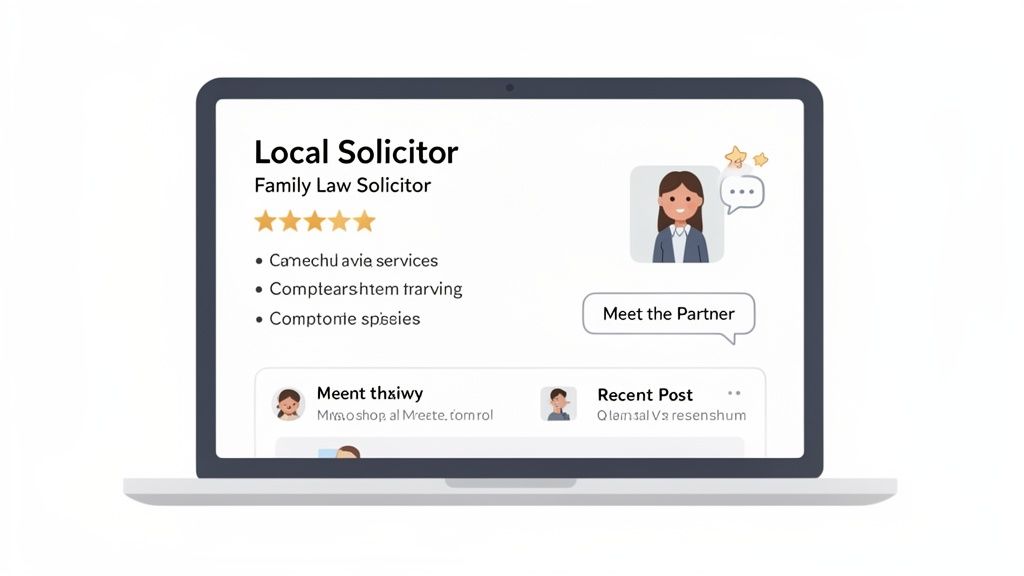
Nail Your Categories and Services
Let's start with a quick win. The fastest way to boost your local relevance is by choosing the most specific categories for your practice. Your primary category will likely be 'Law Firm' or 'Solicitor', but the real power lies in the secondary categories. You absolutely must use them.
Think about what you actually do. Instead of stopping at a generic label, get granular:
- Family Law Solicitor
- Criminal Justice Attorney
- Property Solicitor
- Personal Injury Solicitor
Once you’ve set your categories, head over to the 'Services' section and mirror that same level of detail. This is your chance to list out every single thing you offer. Don’t just put ‘conveyancing’; list 'Commercial Leases', 'Residential Property Sales', and 'Equity Release'. Each service you add is another direct signal to Google, helping you show up for those highly specific, long-tail searches that high-intent clients make.
Craft a Compelling Business Description
Your business description is valuable real estate. Don't waste it with a dry, corporate summary pulled from your website's 'About Us' page. This is your opportunity to speak directly to a potential client who is likely stressed and searching for help.
Write with empathy. Someone looking for a family law expert isn't just buying a service; they're looking for a trusted guide during a difficult time. Your description should convey both compassion and competence. Talk about your firm's years of experience, your connection to the local community, and what a client can expect when they pick up the phone to call you.
Pro Tip: Your GBP description is the perfect place to naturally work in your most important keywords. Weave in phrases like "expert divorce solicitor in [Your Town]" or "property law specialists in [Your Borough]" to reinforce your local authority without it sounding forced.
Leverage Google Posts and Q&A
Google loves activity. An updated, active profile is seen as a more trustworthy one. Two of the best, and most underused, features for showing this activity are Google Posts and the Q&A section.
Google Posts are essentially mini-updates that appear directly on your GBP. Get into a regular rhythm of using them to share things like:
- Firm News: Did you sponsor a local charity event or bring a new partner on board? Share it.
- Legal Updates: Briefly explain a recent change in legislation that might affect your clients.
- 'Meet the Team' Features: Put a face to the name. Introduce your solicitors with a professional headshot and a short, personable bio.
The Q&A section is a goldmine. Potential clients can ask questions right on your profile, and it’s critical that you are the one answering them. Better yet, be proactive. Think about the common questions you get during initial calls and add them yourself, then provide the answers. Things like, "Do you offer a free initial consultation?" or "What areas of family law do you cover?" are perfect starting points.
Juggling all these elements can feel like a full-time job, but it's what separates the top-ranking firms from the rest. If you're struggling to keep up, dedicated Google Business Profile management tools can be a massive help, allowing you to schedule posts, monitor questions, and track performance far more efficiently.
Building Authority Through Citations and Reviews
In the legal world, trust is everything. It’s the very bedrock of your client relationships. But online, that trust-building process starts long before a potential client ever picks up the phone. It's built piece by piece through signals of credibility, and two of the most powerful signals you have are citations and reviews.
These two elements are a potent combination. They work together to prove your law firm is real, reputable, and the right choice for someone searching for legal help in your area. Getting this right isn't just a box-ticking exercise; it's a cornerstone of any serious local SEO strategy for solicitors.

Mastering Citations for Local Authority
What exactly is a citation? It’s simply an online mention of your law firm's name, address, and phone number—what we in the industry call NAP. Every time Google finds your correct NAP on a reputable website, it's like another vote of confidence confirming your firm's legitimacy and physical location.
Consistency is the name of the game here. If you use "Ltd." on one directory and "Limited" on another, it creates confusion for search engines and weakens the signal. Your NAP data has to be a perfect match everywhere it appears.
Your first port of call should be locking down your listings on the most important UK directories:
- Legal-Specific Directories: These are absolutely non-negotiable. Get your firm listed accurately on sites like The Law Society and Find a Solicitor. This is where your peers and discerning clients will look.
- General UK Directories: Don't underestimate the power of major players. Yell, Thomson Local, and Scoot carry a lot of authority in the UK and are essential for a robust citation profile.
If you want to dig a bit deeper into the nuts and bolts, our guide on what local citations are breaks it down even further.
The Power of Client Reviews
If citations build trust with Google, reviews build it directly with potential clients. Think about it: a steady stream of recent, positive reviews is often the final nudge someone needs to choose your firm over another.
The secret is to make leaving a review as effortless as possible. Timing is everything. The perfect moment to ask is usually right after a successful case resolution when your client is feeling most grateful for your help. A simple, personal email at that point can make all the difference.
Pro Tip: Don't just collect reviews—engage with them. A quick, thoughtful reply to a positive review shows you appreciate your clients. And a calm, professional response to a negative one demonstrates accountability and can actually win you new business.
Managing your feedback, good and bad, transforms your reviews from a static rating into an active marketing tool. It proves you're engaged, responsive, and genuinely care about client satisfaction.
And on that note, a negative review isn't a disaster. It's an opportunity. Address the person's concerns calmly in your public reply and offer to take the conversation offline to resolve it. This shows everyone else reading that you take feedback seriously, which can be just as powerful as another five-star rating.
Creating Hyper-Local Content for Your Website
To really nail your local search performance, you need to go beyond just polishing profiles and chasing reviews. The goal is to prove to Google that your firm is the go-to legal authority in your specific patch. And the single most effective way to do that is by creating genuinely local content on your own website.
This content does two crucial things at once. First, it directly targets the exact phrases potential clients are typing into Google, like "divorce solicitor in Chelsea" or "commercial property lawyer in Leeds." Second, it shows you have a deep understanding of the local legal scene, building trust with people before they’ve even picked up the phone.
This timeline gives you a bird's-eye view of how to roll out an effective local content plan, from building the core service pages to getting the technical side right with schema.
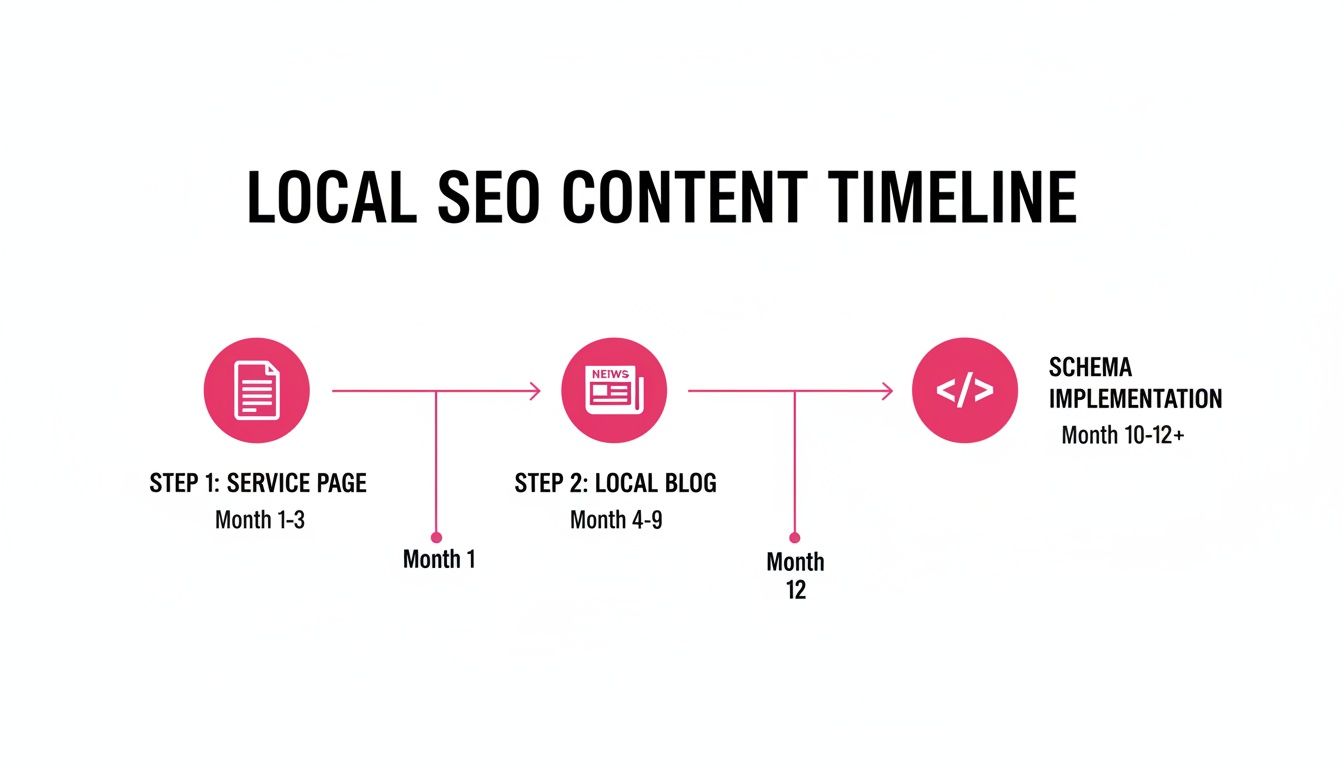
The main takeaway? A winning local content strategy isn't a one-off task. It's a layered process, where you build from broad service pages up to highly specific blog content, with solid technical SEO holding it all together.
Build Dedicated Local Service Pages
Your starting point should always be creating a unique page on your website for each service and location pairing you want to rank for. A single "Family Law" page just won't cut it anymore.
Instead, you need distinct, optimised pages for things like:
- Family Law Solicitor in Manchester
- Family Law Solicitor in Salford
- Family Law Solicitor in Stockport
Each of these pages needs to be packed with unique content. Don't just copy and paste. Talk about your experience handling cases in that specific borough, mention local landmarks to help people get their bearings, and discuss any quirks of the local courts or council. It’s this level of detail that Google’s algorithms are looking for.
Write Content That Answers Local Questions
With your core service pages live, the next move is to create blog content that answers the real-world questions your local clients have. This is how you position your firm as a helpful expert and capture search traffic from people who are still in the research phase.
Think about writing articles on topics like:
- A Guide to the [Local Town] Family Court: You could walk readers through the process, mentioning specific building names, where to park, and what to expect on the day.
- Recent Changes to [Local Council] Planning Regulations: If you're a property solicitor, this kind of hyper-relevant update is invaluable to local developers and homeowners.
- Navigating a DUI Charge in [Your County]: Break down the specific local procedures and potential outcomes people might face.
This type of content is pure gold for local SEO. It’s highly specific, genuinely useful, and something your bigger, national competitors simply cannot replicate with any real authenticity.
Sharpen Your On-Page SEO Signals
Creating brilliant content is only half the job. You also need to send crystal-clear signals to search engines telling them what each page is about. This all comes down to on-page optimisation.
For every local page you create, make sure you've tailored these key elements:
- Title Tag: Be explicit. Something like
Expert Conveyancing Solicitor in Bristol | Your Firm Name. - Meta Description: This is your sales pitch in the search results. Write a compelling summary that includes your location and service to encourage that click.
- Headings (H1, H2): Use headings within your content to break up the text and weave in local keywords in a natural, readable way.
When you combine detailed local service pages with helpful, area-specific blog content and sharp on-page SEO, you create a powerful machine for attracting the right kind of local clients.
Your 90-Day Local SEO Action Plan
Theory is great, but it's consistent action that gets results. Let's break down everything we've covered into a practical, week-by-week roadmap. Think of this as your checklist for methodically building real, lasting momentum for your firm's local visibility.
This isn't about trying to boil the ocean. It's about focusing on the highest-impact tasks in the right order to turn your online presence into actual client enquiries.
Month 1: The Foundational Blitz
The first month is all about getting your house in order. We’re going to correct any existing problems and build a rock-solid base for everything that comes next. Frankly, without this clean foundation, any other marketing you do will be less effective.
- Weeks 1-2: Kick things off with the full digital footprint audit we detailed earlier. While that’s underway, perform a deep-dive optimisation of your entire Google Business Profile. I’m talking about everything from your primary and secondary categories to your services, business description, and photos. This is priority number one.
- Weeks 3-4: Now, identify your top 10-15 most important local citations, starting with the big legal-specific directories like The Law Society. You need to manually check and correct every single one to ensure your name, address, and phone number (NAP) data is 100% consistent. At the same time, get your new review acquisition process off the ground. Create your email template and pick the first group of recent, happy clients to contact.
Month 2: Building Content and Authority
With your core profiles looking sharp, it’s time to show Google (and potential clients) that you’re the local expert. This month is all about creating the hyper-local content that attracts people in your specific service areas who are actively looking for a solicitor.
The whole point of this content is to answer the direct questions that people in your community are asking. This proves your local relevance to both Google and your future clients, setting you apart from generic, national firms.
Here are your key tasks for this period:
- Weeks 5-6: Research, write, and publish your first two hyper-local landing pages. Think "Divorce Solicitor in Camden" or "Commercial Property Lawyer in Islington." Make sure they're fully optimised with local title tags, headings, and genuinely unique content that speaks to that specific area.
- Weeks 7-8: It’s time to publish your first locally-focused blog post. This could be anything from a practical guide to the local family court to an analysis of a recent council decision affecting property law. This is the kind of content that positions you as a true local authority.
Month 3: Measurement and Refinement
The final month is all about looking at the data and setting a sustainable pace for the future. You’ll start tracking key metrics to see what’s working, spot opportunities for improvement, and ensure your efforts are leading to measurable growth.
A crucial part of this is making sure you actually capture the new leads you're generating. Consider a specialised law firm phone answering service to ensure no enquiry falls through the cracks. Keep a close eye on your Google Business Profile Insights to track the increase in calls, website clicks, and direction requests. This data is the ultimate proof that your local SEO strategy is paying off.
Ready to stop guessing and start ranking? LocalHQ provides the AI-powered tools and geo-grid rank tracking you need to manage, optimise, and measure your firm's local SEO performance with confidence. See how we can help you win more local clients at https://localhq.io.