
Dental Practice SEO Your Complete Guide to Attracting More UK Patients
When someone in your area needs a dentist, what's the first thing they do? They Google it. Dental SEO is all about making sure your practice shows up right when they're searching for services you offer, like 'emergency dentist in Bristol' or 'Invisalign specialist near me'. It’s the art and science of connecting your clinic with the local patients you want, so you can keep your appointment book full.
Why UK Dental Practices Can't Afford to Ignore SEO
Not so long ago, a dental practice could get by on word-of-mouth and a small advert in the local paper. Those days are gone. Today, the path to your chair almost always starts with a search engine. A solid SEO strategy isn't just a "nice-to-have" anymore; it's the engine that drives patient acquisition and helps you grow, especially in a crowded market.
Think of it in real-world terms. A young professional in Manchester is looking for "teeth whitening Manchester." A worried parent is frantically searching for a "paediatric dentist in Leeds." SEO is what puts your practice front and centre in those critical moments, making you the clear and trusted choice.
The Modern Patient's Path to Your Practice
Patients today are savvy. They don't just pick the closest clinic on a map. They do their homework—they research treatments, compare practices, and pore over reviews before they even think about booking.
The data backs this up. In the UK, a massive 72% of patients check out dental services online before making an appointment. This completely changes the game. If you're not on the first page of Google, you're practically invisible to the vast majority of potential patients. You can dig deeper into these dental SEO statistics on DominateDental.com.
This playbook is designed to give you a no-nonsense, practical guide to getting your dental SEO right. We'll focus on three core pillars:
- Your Google Business Profile: How to turn this free listing into your most powerful tool for attracting new patients.
- A Patient-Focused Website: Building a site that's not only fast and easy to use but also expertly designed to turn visitors into appointments.
- Content That Builds Trust: Creating helpful articles and guides that answer patient questions and position you as the local authority.
When you nail these key areas, you're doing more than just chasing a #1 ranking on Google. You're building a dependable, long-term system that brings a steady stream of high-value patients through your door and secures the future of your practice.
Mastering Your Google Business Profile for Local Dominance
Think of your Google Business Profile (GBP) as the digital front door to your practice. For many potential patients, it’s the very first interaction they have with you, popping up in Google Search and on Maps the moment they start looking for a dentist. Getting this free tool right isn't just good practice; it's the bedrock of a solid local SEO strategy for any dental clinic.
Your GBP listing is your chance to make a brilliant first impression. It’s where patients find your phone number, check your opening hours, read reviews from others, and see photos of your clinic. An incomplete or neglected profile can signal a lack of attention to detail. On the other hand, a fully fleshed-out profile builds immediate trust and encourages that all-important click or call.
Choosing The Right Business Categories
The first, and arguably most important, step is to select the right categories for your practice. This is how you tell Google exactly what you do, which helps you show up for the most relevant searches. Your primary category carries the most weight, so it needs to reflect your main service.
For most clinics, this will simply be ‘Dentist’. Simple and effective.
But don't stop there. Secondary categories are where you can really shine, allowing you to list all the other services you provide. This is crucial for capturing patients who are looking for specific treatments.
- Cosmetic Dentist: Perfect for practices focusing on aesthetics like veneers and teeth whitening.
- Orthodontist: Essential if you offer braces or Invisalign.
- Paediatric Dentist: Helps you attract families looking for children’s dental care.
- Endodontist: A must if you are a root canal specialist.
- Dental Implants Provider: For clinics with a focus on restorative dentistry.
By choosing precise categories, you ensure you appear in searches for both general and specialised dental care. It’s a simple way to widen your net and attract more high-value patients.
Crafting a Compelling Business Description
Your business description is your elevator pitch. You get 750 characters to explain what makes your practice unique and why a patient should choose you over the clinic down the road. This is no place for a dry list of services; it's a place to tell your story.
Focus on what sets you apart. Do you have a knack for treating nervous patients? Do you use state-of-the-art CEREC machines? Highlight these aspects. For example, instead of saying, "We offer general and cosmetic dentistry," try something more engaging like, "Our friendly team in Leeds provides compassionate dental care, specialising in anxiety-free treatments and beautiful smile makeovers using the latest technology."
This is your opportunity to connect with potential patients on a human level before they even step through your door.
This simple visualisation shows how a patient's online search directly translates into a booking when your dental SEO is firing on all cylinders.
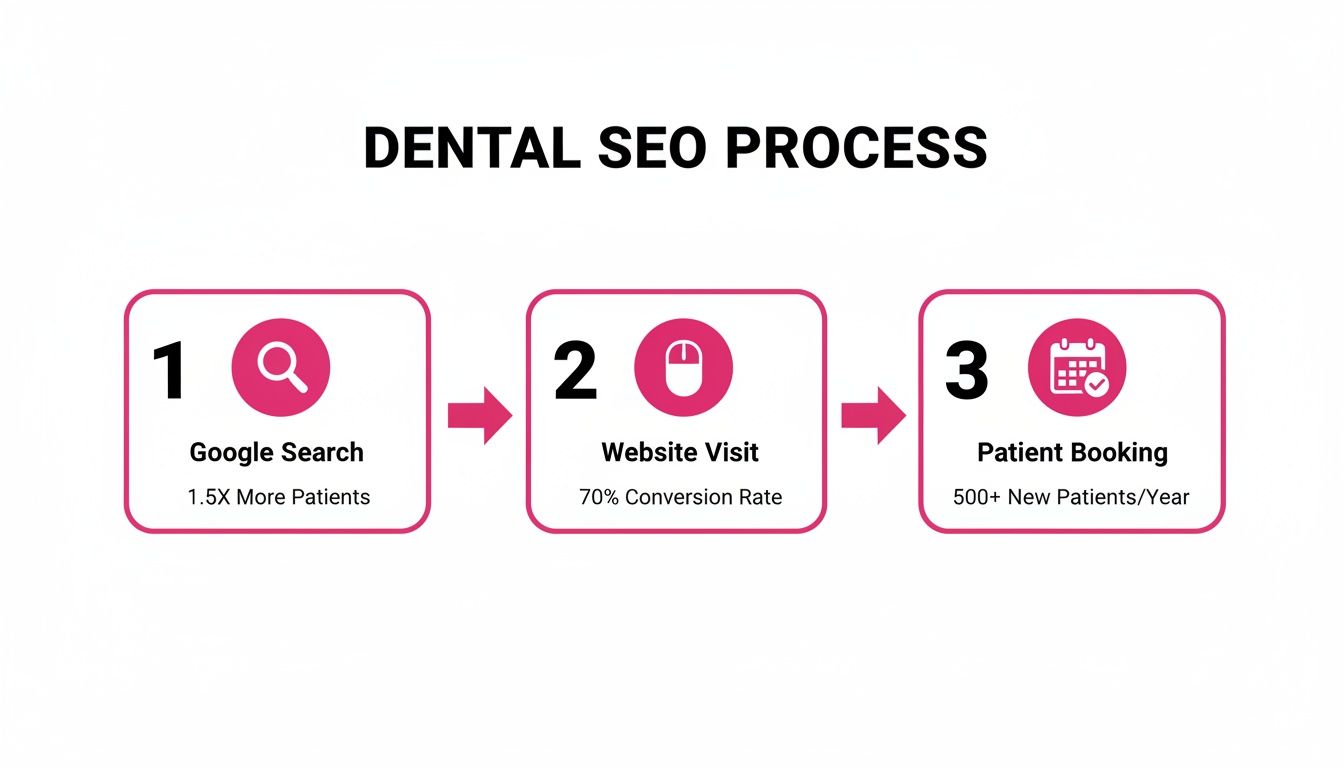
The journey from a "dentist near me" search to a filled appointment slot is surprisingly short. It’s proof that high visibility on Google is directly linked to practice growth.
The Cornerstone of Consistency: NAP
One of the most critical elements for local SEO is ensuring your Name, Address, and Phone number (NAP) are identical across your entire online presence. Consistency is a huge trust signal for Google. Any variation, no matter how small—like "St." versus "Street" or "Ltd" vs "Limited"—can create confusion and hurt your local rankings.
Your GBP should be the ultimate source of truth. Double-check that the NAP details here match your website, social media profiles, and any other online directories perfectly. To really get a grip on this, understanding What is Google My Business, a UK guide is a fundamental step.
Think of NAP consistency as the foundation of your digital reputation. If Google sees the same, accurate information everywhere, it trusts that you are a legitimate, established local practice and is more likely to show your profile to searchers.
I can't overstate the impact of this. For UK dental practices, local SEO delivers 300% more enquiries than paid advertising at a fraction of the cost, making it the highest-impact channel you can invest in. With 78% of local mobile searches leading to an offline visit within 24 hours, an optimised and consistent online presence is your key to turning searchers into patients.
Leveraging Photos and Google Posts
Photos bring your practice to life. They offer a behind-the-scenes look that helps potential patients feel more comfortable before their first visit. You'll want to upload high-quality, professional images of:
- Your team: Introduce your dentists, hygienists, and reception staff with friendly headshots.
- The clinic interior: Show off your clean, modern, and welcoming reception area and treatment rooms.
- The exterior: Help patients find you easily with a clear shot of your building and entrance.
- Technology: Showcase any advanced equipment you use, like digital scanners or lasers.
Beyond static photos, Google Posts are a fantastic way to share timely updates, offers, and news directly on your GBP listing. Use them to promote a teeth whitening special, introduce a new team member, or share a recent blog post. Posts only last for seven days, so keeping a steady stream of updates shows Google (and patients) that your profile is fresh and active.
This makes it clear that effective Google Business Profile management is an ongoing process, not a one-and-done setup.
To help you stay on track, I've put together a quick checklist of the essential GBP elements you should be reviewing regularly.
GBP Optimisation Checklist for Dental Practices
This quick-reference table breaks down the key areas of your Google Business Profile that need your attention. Working through these points is a surefire way to make an immediate impact on your local search visibility.
| GBP Section | Optimisation Action | Why It Matters |
|---|---|---|
| Business Name | Ensure it's your exact, real-world practice name. No extra keywords. | Builds trust and avoids Google penalties. |
| Categories | Select 'Dentist' as primary, then add all relevant secondary categories. | Helps you appear in specific service searches (e.g., "orthodontist near me"). |
| Address & Service Area | Verify your pin location is precise. Define your service area by postcode or city. | Crucial for "near me" searches and map pack visibility. |
| Phone Number | Use your primary, local phone number. Ensure it's consistent everywhere. | Makes it easy for patients to contact you and supports NAP consistency. |
| Website | Link directly to your website's homepage. | Drives traffic and allows patients to learn more and book online. |
| Opening Hours | Keep them 100% accurate, including holidays and special hours. | Prevents patient frustration and negative reviews from a wasted journey. |
| Description | Write a compelling, 750-character summary of your practice's unique benefits. | Your "elevator pitch" to persuade potential patients to choose you. |
| Photos & Videos | Regularly upload high-quality images of your team, clinic, and technology. | Builds trust, showcases your practice, and increases engagement. |
| Google Posts | Post weekly updates with offers, news, or blog articles. | Keeps your profile fresh and signals to Google that you are an active business. |
| Q&A | Proactively add and answer common patient questions. | Addresses patient concerns upfront and allows you to control the narrative. |
Running through this checklist at least once a quarter ensures your digital front door is always open, accurate, and welcoming to new patients.
Turning Clicks into Patients with a High-Converting Website
Getting a potential patient to click from your Google Business Profile is a huge win, but the journey isn't over. Your website is where that initial interest either solidifies into a booking or evaporates in seconds.
Think of it as the digital front door to your practice. If it's slow, confusing, or looks dated, that potential patient is hitting the back button and heading straight to your competitor down the road. Your website is the one place online where you have total control over your practice's narrative. It needs to be more than just a pretty brochure; it has to be a well-oiled machine designed to answer questions, build trust, and make booking an appointment the easiest decision they'll make all day.
Structure Your Site Around Your Patients, Not Just Your Services
The best dental websites are built with the patient's mindset at their core. A messy, disorganised site just creates confusion. A clear, intuitive structure, however, does two things brilliantly: it guides visitors effortlessly to the information they need, and it sends strong signals to Google about what your most important services are.
Start by mapping out dedicated pages for your high-value treatments. Someone searching for ‘dental implants in Leeds’ doesn't want to land on a generic ‘services’ page and have to hunt for information. They expect—and deserve—a page focused entirely on implants.
Your core service pages should be clearly organised. A great structure often looks something like this:
- Cosmetic Dentistry (with individual sub-pages for teeth whitening, veneers, etc.)
- General Dentistry (for check-ups, fillings, and hygiene appointments)
- Orthodontics (covering treatments like Invisalign and traditional braces)
- Dental Implants
- Emergency Dentistry
This approach is a cornerstone of effective on-page SEO because it lets you pack each page with highly specific, relevant content that matches exactly what patients are searching for.
Getting the On-Page Details Right
With a solid site structure in place, it’s time to zoom in on the on-page elements. These are the small but powerful details that tell Google precisely what each page is about, helping you show up for the right searches.
Title Tags: This is the clickable headline people see in the search results. Keep it under 60 characters and make sure it includes your main keyword and location. For example: 'Dental Implants in Glasgow | City Smiles Dental'.
Meta Descriptions: This is the short description under the title. It doesn't directly influence your rank, but a good one convinces people to click. Summarise the page and add a call to action. Something like: 'Discover our gentle dental implant process. Book your free, no-obligation consultation with our expert team today.'
Headings (H1 & H2): Every page needs one, and only one, H1 heading at the top that clearly states the page's topic (e.g., 'Professional Teeth Whitening in Bristol'). Then, use H2 subheadings to break up the content and answer related questions.
Think of your on-page elements as signposts for both Google's crawlers and human visitors. Clear, descriptive signposts create a better experience for everyone, making it obvious where they are and what to expect next.
The Technical Foundations You Can't Afford to Ignore
Behind the beautiful design and compelling copy, your website's technical health is doing a lot of the heavy lifting for your SEO. You could have the most persuasive content in the world, but if your site is slow, insecure, or unusable on a phone, you'll never rank where you need to.
There are three technical pillars that every modern dental practice website must be built on:
- A Mobile-First Design: It’s no secret—most patients are looking for a dentist on their phones. Your site absolutely has to work flawlessly on a small screen, with text that's easy to read and buttons you can actually tap.
- Blazing-Fast Loading Speed: If your site takes more than three seconds to load, you’re losing people. Speed is a major ranking factor precisely because Google knows how impatient users are.
- Local Business Schema: This is a snippet of code added to your website’s backend. It spoon-feeds search engines critical information about your practice—name, address, phone number, opening hours—in a language they understand perfectly. It’s a simple but incredibly effective way to confirm your local credentials.
Ultimately, a fantastic dental practice website design is what ties everything together, ensuring that every click has the potential to become a new patient.
Don't forget the power of social proof. Weaving in patient testimonials, before-and-after galleries, and transparent pricing information on your service pages builds instant credibility. When a nervous patient sees a glowing review from someone who had the same fears, it breaks down barriers and builds the trust they need to book an appointment. Your website should be your hardest-working employee, turning digital interest into real-world patients 24/7.
Creating Content That Builds Trust and Attracts Patients
Great content is the real engine behind any dental SEO strategy. It’s so much more than just filling up a blog section; it’s about getting inside the heads of your ideal patients, answering their questions before they even ask them, and positioning your practice as the go-to local authority.
Your website needs to be a genuine resource, not just a digital brochure. When someone in your area is anxiously Googling, "Is Invisalign painful?" or "What are the alternatives to a root canal?", you want your content to be the first, and best, answer they find. That’s how you build instant trust and stay top-of-mind.
Brainstorming Patient-Focused Topics
Forget trying to guess what people want to read. The best content ideas come straight from the mouths of your patients—literally. Think about the questions you and your team get asked every single day in the practice.
Every one of those real-world queries is content gold. Each question is a search someone is typing into Google, and by creating a dedicated blog post or FAQ page that answers it thoroughly, you’re perfectly aligning your website with what potential patients are looking for.
Here are a few topic areas I've seen work wonders:
- Go Deep on Treatments: Don't just list your services. Create detailed articles like, "How Much Do Dental Implants Cost in the UK?" or "A Patient's Complete Guide to Teeth Whitening." Be the expert.
- Address Fears Head-On: Many people avoid the dentist out of fear. Reassure them with content like "Sedation Dentistry: Your Options for Anxious Patients" or "What to Really Expect During a Root Canal."
- Solve Their Problems: Focus on the symptoms they're actually experiencing. Think along the lines of "Why Are My Gums Bleeding?" or "Practical Solutions for Sensitive Teeth."
This patient-first approach means your content strategy will always be driven by genuine demand, not just a dry list of keywords.
Crafting Hyper-Local Content
To truly dominate your local area, your content needs to feel local. You aren't just a dentist; you are the dentist in Manchester, or Bristol, or wherever you are. Your content should reflect that, making your practice feel familiar and part of the community.
This is a seriously effective way to boost your dental practice SEO. It sends strong signals to Google that you’re a genuine local business, which can give you a real advantage in the local search results.
Try creating content that a big national chain simply couldn't replicate:
- 'Meet the Dentist' Profiles: People want to know who will be looking after them. Introduce your team with personal bios—share their philosophy, their connection to the local area, maybe a hobby. It builds a human connection.
- Local Cost Guides: Transparency wins trust. An article on "The Average Cost of Invisalign in Liverpool" is infinitely more helpful to a local than a generic price range.
- Community Involvement: Sponsoring the local kids' football team or taking part in a charity fun run? Share a few photos and a quick write-up. It shows you care about more than just teeth.
When you create content that speaks directly to the needs, worries, and interests of your local community, you're doing more than just climbing search rankings. You’re building a foundation of trust that turns online searchers into loyal, long-term patients.
Showcasing Results and Building Confidence
At the end of the day, patients need to see proof. While informative articles are crucial, it’s often the visual and social proof that gives someone the final nudge they need to pick up the phone. These assets build the confidence someone needs to click that 'Book Consultation' button.
You should be weaving these powerful trust signals right into your service pages and blog posts:
- Before-and-After Galleries: For any cosmetic work like veneers or teeth whitening, a high-quality gallery is your best salesperson. The results speak for themselves.
- Video Testimonials: There's nothing quite like a short, genuine video of a happy patient sharing their experience. It feels far more authentic and relatable than written text ever could.
- Case Studies: Walk potential patients through a real journey. Detail the initial problem, the treatment process, and the fantastic final outcome. This showcases your expertise and helps people visualise their own success story.
When you combine empathetic, informative articles with compelling visual proof, your website becomes an unstoppable patient-attraction engine. You stop selling dental services and start providing real solutions and peace of mind.
Building a Sterling Reputation with Reviews & Local Citations
While your website and Google Business Profile are the foundations of your online presence, a huge chunk of your local reputation is built elsewhere. It’s the third-party validation—what other platforms and people say about you—that really seals the deal for both Google and prospective patients.
This digital word-of-mouth comes down to two key things: local citations and patient reviews. Getting these right isn't just a "nice-to-have" in modern dental marketing; it's absolutely essential for building the kind of trust that turns a searcher into a patient in your chair.
What Are Local Citations, Really?
In simple terms, a local citation is any online mention of your practice's Name, Address, and Phone number (often called your NAP). Think of directories like Yell.com, the NHS website, or industry-specific registers like the General Dental Council.
Every time Google finds your practice listed with perfectly consistent details, it's like another tick in the "trust" box. It helps the search engine become more confident that you are a legitimate, established practice, physically located where you claim to be. This confidence is a major factor in getting you ranked in the coveted local map pack.
The flip side? Inconsistent or outdated information spells trouble. An old phone number floating around on one directory or a slight variation in your address on another creates confusion. It erodes Google's trust and can actively harm your visibility. When it comes to citations, accuracy and consistency are everything.
If you want to dig a bit deeper, we've got a full guide on what local citations are and how they work.
Your Game Plan for Flawless Citations
Building a strong citation profile doesn't need to be a massive headache. The main goal is simple: make sure your core business information is correct and identical everywhere it appears online.
Here’s a practical way to tackle it:
- Get Your House in Order First: Before you do anything else, make sure the NAP on your own website and Google Business Profile is 100% correct. This is your source of truth.
- Find Your Current Footprint: Use a simple Google search (e.g., "Your Practice Name" + "Your Postcode") to see where you're already listed. Pop everything into a spreadsheet to track what you find.
- Claim, Clean, and Correct: This is the manual part. Log into major directories where you're listed, claim the profile as your own, and meticulously correct any errors you found in your audit. It takes time, but it's worth it.
- Build Out Your Presence: Identify the most important UK business directories and healthcare-specific sites where you don't yet have a listing. Create new, perfectly accurate profiles on these platforms.
Getting this process right ensures every digital signpost pointing to your practice is clear, consistent, and trustworthy.
Top Local Citation Sources for UK Dentists
To get you started, here's a list of essential online platforms where UK dental practices should have a presence. Prioritising these will give you a solid foundation for your local visibility.
| Directory/Platform | Category | Importance for Local SEO |
|---|---|---|
| Google Business Profile | Core Business Listing | Critical. The single most important profile for local search. |
| Apple Maps | Core Business Listing | High. Essential for iPhone users searching for local services. |
| Bing Places for Business | Core Business Listing | High. The primary source of data for the Bing search engine. |
| Yell.com | General UK Directory | High. One of the most well-known and trusted UK directories. |
| NHS Website | Healthcare Specific | High. A highly authoritative source for UK healthcare providers. |
| General Dental Council (GDC) | Professional Register | High. A crucial, authoritative industry-specific citation. |
| Social Media/Directory | Medium. Important for social proof and basic business info. | |
| Thomson Local | General UK Directory | Medium. A long-standing and reputable UK business directory. |
| Cylex UK | General UK Directory | Medium. A popular directory that can drive relevant traffic. |
| Foursquare | Social/Location Data | Medium. Provides location data to many other apps and services. |
Focusing on these key directories first will deliver the biggest impact for your efforts. Consistency across these platforms sends a powerful signal to search engines about your practice's legitimacy.
A Sustainable Plan for Generating Patient Reviews
Reviews are the lifeblood of any local service business, especially a dental practice. Think about it from a patient's perspective: choosing a new dentist is a big decision. What’s the first thing they do? They look for social proof.
In fact, research shows that over 75% of patients use online reviews as a primary factor when choosing a new healthcare provider. A steady stream of recent, positive reviews is pure gold. It tells Google you’re an active, well-regarded business and shows potential patients that others have trusted you and had a great experience.
The most effective way to get more reviews is also the simplest: just ask. Don’t overcomplicate it. Train your front-desk team to make it a natural part of the check-out process. A simple, friendly, "We'd be so grateful if you could take a moment to share your experience on Google" works wonders.
To make it even easier, you can send a polite follow-up email or SMS a day or so after an appointment. The crucial part is to include a direct link to your Google review page, removing any friction. The easier you make it, the more likely happy patients are to leave feedback.
The Art of Responding to Every Single Review
Getting reviews is only half the battle. Responding to them—both glowing and critical—is just as important. It shows you're engaged, you value feedback, and you're committed to providing the best possible care.
When you get a positive review, a simple, personalised thank you goes a long way. Try to mention something specific they said in their comment; it shows you’ve actually read it and aren't just using a template.
Handling a negative review requires a bit more finesse. The key is to stay professional and calm.
- Thank them for their feedback (even if it stings).
- Acknowledge their concern without getting defensive.
- Offer to take the conversation offline to resolve the issue properly.
This public response shows everyone else that even when things don’t go perfectly, you are a practice that listens and is dedicated to making things right.
Got Questions About Dental SEO? We’ve Got Answers
Even with a solid plan, it’s completely normal to have questions pop up as you start putting your dental SEO strategy into action. Let’s tackle some of the most common ones we hear from practice managers, so you can move forward with a bit more clarity.
How Long Does SEO Actually Take to Work in the UK?
This is always the big one, isn't it? While you might see some early movement from quick fixes, like a fully optimised Google Business Profile, meaningful, lasting results don't happen overnight.
For most dental practices in the UK, especially if you're up against stiff competition in a city like Birmingham or Manchester, you should start seeing significant, measurable progress within 6 to 12 months.
A few things can speed this up or slow it down:
- Where you're starting from: A brand-new website is like starting from a standstill. An established site, even if it needs work, has a bit of a head start.
- The local competition: Trying to rank in a sleepy village is a very different game from battling for visibility in central London.
- Your consistency: This is crucial. SEO is a marathon, not a sprint. The practices that win are the ones that consistently create content, build links, and encourage reviews month after month.
Think of SEO as building an asset for your practice. It’s not a quick-fix marketing tactic for instant bookings; it's a long-term investment that steadily increases in value and brings you patients for years to come.
Should We Do Our Own Dental SEO or Hire an Agency?
Honestly, this comes down to two things you probably don't have enough of: time and specialised expertise.
Many of the foundational SEO tasks are definitely manageable in-house. A sharp practice manager can absolutely handle keeping the Google Business Profile updated, asking patients for reviews, and maybe even writing a blog post here and there.
But you'll hit a ceiling. Hiring a specialist dental SEO agency is a game-changer when you need to get serious. They bring a level of expertise you just can't develop on the side, especially in areas like:
- Technical SEO: Sorting out site speed problems, implementing complex schema markup, and running deep technical audits.
- Competitor Analysis: They can dig into what your local rivals are doing right and, more importantly, find the gaps you can exploit.
- Scaling Your Content: An agency has the resources to consistently produce high-quality, optimised content that actually attracts and converts new patients.
So, what's the right call? If you're just starting out and have plenty of time to learn, a DIY approach can get you off the ground. But if you want to grow faster and keep your focus on your patients, bringing in the experts is almost always the smarter move.
What's the Single Most Important SEO Task for a New Practice?
For any new dental practice, the mission is simple: get on the local map. Forget about blogging or complex website tweaks for now.
Your absolute number one priority is to claim, verify, and completely fill out your Google Business Profile. I can't stress this enough—it's non-negotiable.
Once that's done, your next two jobs are to start generating a steady stream of positive patient reviews and to make sure your practice's Name, Address, and Phone number (what we call 'NAP') are perfectly consistent across the main UK business directories. Get these fundamentals right, and you've built a solid foundation for everything else.
What’s a Realistic SEO Budget for a Dental Practice?
SEO investment can really vary across the UK. You might find a basic service for a few hundred pounds a month, but a proper, comprehensive campaign for a high-value treatment like dental implants in a major city could easily run into several thousand.
Instead of getting hung up on a monthly fee, it’s much healthier to think of it as a percentage of your turnover. A good rule of thumb is to allocate 5-10% of your practice's revenue to marketing as a whole, with a decent chunk of that going towards SEO.
The real trick is to stop thinking about it as a cost and start measuring the return on investment (ROI). When you can directly trace new patient enquiries—and the value of the treatments they book—back to your SEO efforts, the budget question starts to answer itself.
Ready to take control of your local SEO and attract more patients? LocalHQ gives you the AI-powered tools you need to manage your Google Business Profile, track your local rankings, and build a stellar online reputation, all from one simple dashboard. See how you can fill your appointment book by visiting https://localhq.io today.