What Are Local Citations? what are local citations for Local SEO

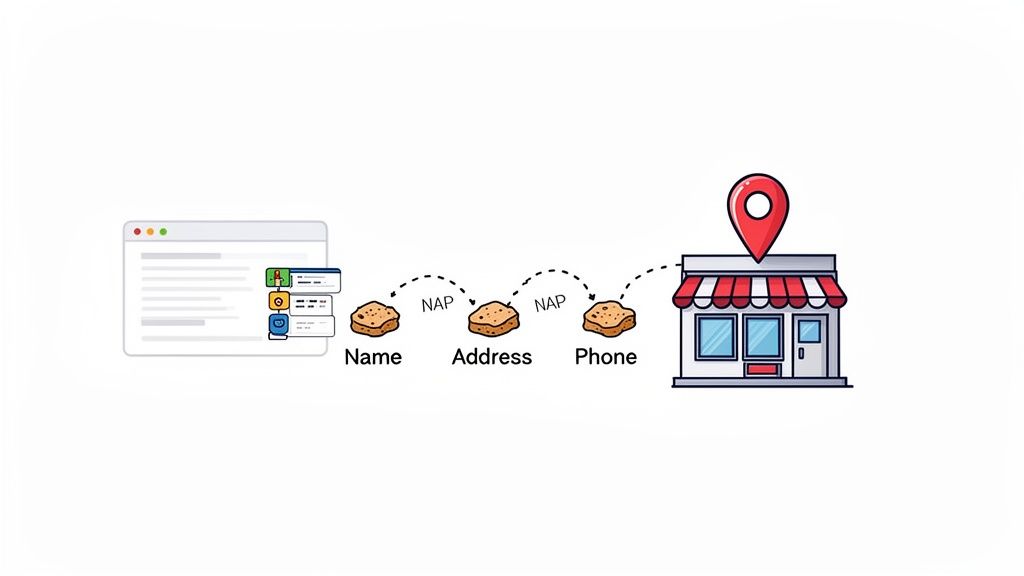
Let’s cut to the chase: local citations are simply online mentions of your business’s key information. We’re talking about its Name, Address, and Phone number—often called ‘NAP’ for short.
Think of them like digital breadcrumbs. Each time your business details appear online, it’s another crumb dropped on the path that leads both customers and search engines right to your front door.
Understanding the Foundation of Local SEO
If your business has a physical location, getting your head around local citations is the first real step to winning at local search. These online mentions act as independent verification for search engines like Google. Every time your accurate NAP details show up on a trustworthy website, it signals to Google that you are who you say you are, you’re located where you claim to be, and you’re a genuine part of the local scene.
This trust is the bedrock of local search engine optimisation (SEO). The more consistent and widespread your citations are, the more confidence Google has in your business. This directly improves your chances of appearing in the highly sought-after ‘Local Pack’ and on Google Maps when someone nearby searches for what you offer. For UK businesses, that kind of visibility means more than just clicks—it means real customers.
The link between a local search and a customer taking action is incredibly strong. One well-known industry study found that a staggering 88% of consumers who search for a local business on their phone will either call or visit within 24 hours. That single statistic shows just how vital it is for your contact details to be accurate and easy to find. It’s the difference between a potential customer finding you or a competitor. For more UK-specific insights, BrightLocal's industry analysis is a great resource.
The Two Main Types of Citations
Local citations aren't all the same. They generally fall into two categories, and both play a different but equally important role in building your online presence.
- Structured Citations: These are your classic business directory listings. Think of sites like Yell, Thomson Local, or trade-specific directories like Checkatrade. They present your NAP data in a neat, organised format, creating a clean and reliable foundation for search engines to follow.
- Unstructured Citations: These mentions are more organic and can pop up anywhere. You might find them in a local newspaper article, a blog post reviewing your services, or even on social media. They don't follow a rigid structure, but they send powerful signals to Google that your business is relevant and being talked about in the community.
Both types work in tandem to build a complete picture of your business online. For more ideas on boosting your online footprint, check out the LocalHQ blog.
A consistent citation profile is not just an SEO tactic; it's a fundamental aspect of digital customer service. It ensures that when someone decides they need your business, they can find you without friction or frustration.
To see what goes into a high-quality citation, let's break down its individual parts.
Anatomy of a Local Citation
This table highlights the key pieces of information that form a complete and trustworthy local citation. While NAP is the core, these extra details add more context and value.
| Component | Description | Example |
|---|---|---|
| Business Name | Your official, registered business name. Consistency is key. | e.g., "The Corner Cafe" not "Corner Cafe" |
| Address | Your full, physical street address, including postcode. | e.g., 123 High Street, London, SW1A 1AA |
| Phone Number | Your primary, local business phone number. | e.g., 020 7946 0000 |
| Website URL | A direct link to your website's homepage. | e.g., https://www.thecornercafe.co.uk |
| Business Category | The industry or niche your business operates in. | e.g., Cafe, Coffee Shop, Restaurant |
| Opening Hours | Your correct trading hours for each day of the week. | e.g., Mon-Fri: 9am-5pm, Sat: 10am-4pm |
| Description | A brief summary of what your business offers. | e.g., "A cosy cafe serving artisanal coffee and homemade cakes." |
| Photos/Videos | Visuals of your storefront, products, or team. | e.g., An image of the cafe's interior |
Getting these components right across the web is the first major step towards building a citation profile that actively works for your business.
Alright, let’s dig into the two main flavours of local citations. Think of them as different ways people find and talk about your business online. Both are crucial for proving to Google that you’re a legitimate, active local business in the UK, but they work in slightly different ways.
Structured Citations: The Digital Business Card
First, you have structured citations. These are the clean, organised listings you’ll find on business directories. We’re talking about sites like Yell, Thomson Local, or more specialised platforms like Checkatrade for tradespeople. Here, your business Name, Address, and Phone number (your NAP) are neatly filed away in specific boxes.
It’s like having a stack of perfectly printed business cards distributed all over the internet. Each one is identical, with your details presented in a predictable, easy-to-read format. This consistency is gold for search engines because it gives them unambiguous, reliable data to cross-reference and confirm who you are and where you are.
These structured listings are the bedrock of your local SEO. Their uniform layout makes it a piece of cake for Google’s web crawlers to scan and understand your business information. For any UK business, the essential platforms include:
- General Directories: Big names like Yell, Scoot, and FreeIndex are the modern-day Yellow Pages where customers look for just about anything.
- Mapping Services: Having a spot-on listing on Google Business Profile and Apple Maps is non-negotiable, especially if you have a physical location.
- Industry-Specific Sites: Think Houzz for home renovation or TripAdvisor for hospitality. Being listed here proves you're a real player in your specific field.
Getting these right creates a solid foundation, anchoring your business’s identity online. But that’s only half the picture.
Unstructured Citations: The Word-of-Mouth Mentions
Then there are unstructured citations. These are the more organic, free-flowing mentions your business gets across the web. Instead of a tidy listing, your NAP details might pop up in a blog post, a story from a local newspaper online, a forum thread, or even a social media update.
You can think of these as the digital equivalent of local word-of-mouth. The conversation isn't neatly formatted into fields, but the mention itself is a powerful vote of confidence that signals your relevance and connection to the community.
A mention of your business on a popular local blog or in an online newspaper article can carry just as much weight as a formal directory listing. It shows Google that you're an active, talked-about part of the local scene.
These organic mentions prove your business is more than just data in a spreadsheet; it's a real entity that people are actively discussing. A healthy mix of both structured and unstructured citations builds a well-rounded and trustworthy online footprint, signalling to Google that your business is not only legitimate but also genuinely relevant to local customers.
How Citations Affect Your Google Business Profile
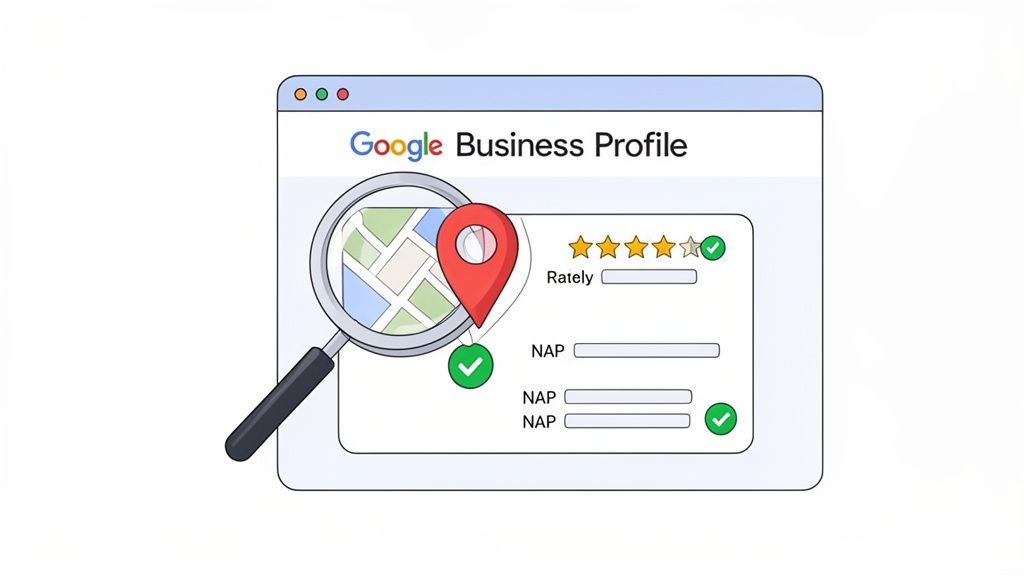
Think of Google as a detective piecing together a case file on your business. Your Google Business Profile (GBP) is the main document, but a good detective always looks for corroborating evidence. That's where local citations come in.
Every time a trusted website, like a local chamber of commerce or a directory like Yell, lists your business with the exact same Name, Address, and Phone number (NAP), it’s another piece of proof. This consistency acts as a powerful trust signal to Google, confirming that your business is real, active, and located precisely where you claim.
This trust directly fuels your local search performance. The more confidence Google has in your business information, the more likely you are to show up in the coveted Google Local Pack and on Maps. For UK customers, these are the go-to tools for finding businesses right on their doorstep.
Building Trust Through Corroboration
A stellar Google Business Profile is the foundation of your local SEO, but it can't stand alone. It needs the rest of the web to back it up.
It’s a bit like building a reputation in real life. If you say you’re the best baker in town, that’s one thing. But if dozens of other people independently confirm it, your claim becomes far more credible. Local citations do exactly this for Google—each accurate mention is another "vote of confidence" for your GBP.
Google's algorithm is built around rewarding businesses that show E-E-A-T (Experience, Expertise, Authoritativeness, and Trustworthiness). Consistent citations are a direct line to building that crucial 'Trustworthiness' pillar, proving your data is solid.
This process of validation helps Google link your profile to very specific local searches. For instance, strong, consistent citations cement the connection between your business and its neighbourhood, which is vital for ranking in those all-important "near me" searches. It means that when a potential customer is just around the corner, your verified profile is much more likely to be the one they see.
The Damaging Effect of Inconsistency
Now, let's flip that coin. Inconsistent or just plain wrong information creates confusion and chips away at that trust you've worked to build. If Google's detective finds conflicting clues—an old address here, a wrong phone number there, a slightly different business name somewhere else—it starts to doubt everything.
This uncertainty is toxic for your online authority. Google will think twice before recommending your business, worried it might send a customer to a closed location or provide a disconnected phone number. The result? A slide down the local rankings, making you invisible to the very people you want to reach. A well-written Google Business Profile description is a great start, but it loses its punch if the data across the web doesn't back it up.
At the end of the day, keeping your citations clean and consistent isn't just an SEO chore. It’s about making sure the digital front door to your business is always accurate, open, and trustworthy for both Google and your future customers.
The Critical Importance of NAP Consistency
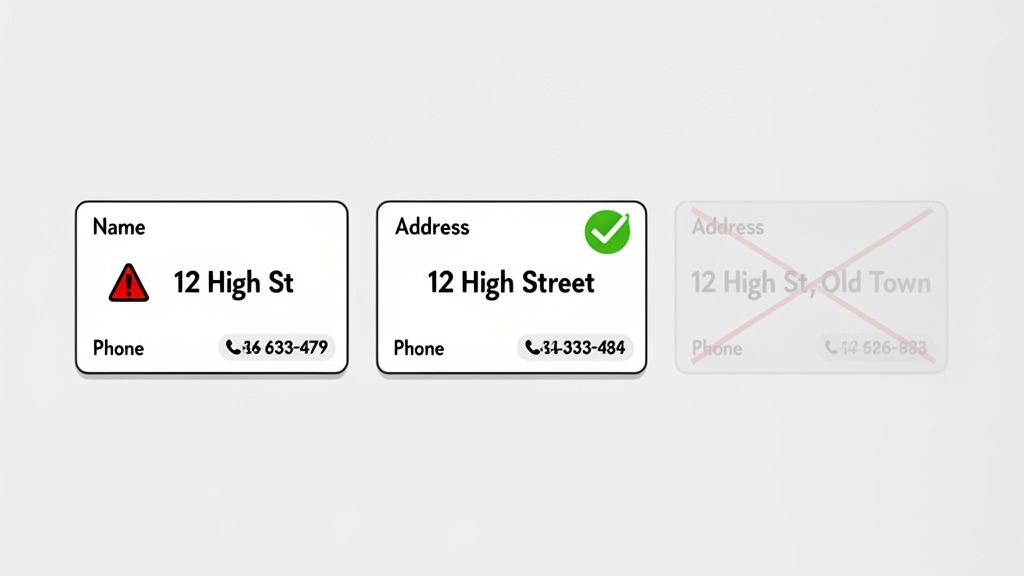
When we talk about local citations, consistency isn't just a nice-to-have; it's the absolute golden rule. Think of it like trying to get a new passport, but your birth certificate, driver's license, and utility bills all show slightly different addresses. The whole process would grind to a halt because of the confusion and lack of trust.
That’s exactly how search engines like Google see your business information.
Even small, seemingly harmless differences—like using "St" on one directory and "Street" on another—send mixed signals. An old phone number floating around on a forgotten listing, or even a missing suite number, can seriously water down your online authority.
These little inconsistencies tell Google that it can't be 100% certain about who you are, where you are, or how customers can reach you. That doubt is poison for local SEO. It pushes you down the rankings and, worse, might send a potential customer to the wrong place.
The Problem with Digital Ghosts
One of the toughest parts of managing citations is that old, incorrect information doesn't just vanish. If your business has ever moved, changed phone numbers, or even just tweaked its name, those old details can hang around online for years. They become digital ghosts, haunting your current SEO efforts.
And these "ghost listings" aren't just harmless echoes. They actively compete with your correct, up-to-date information. This can lead to nasty duplicate listings being created, splitting your authority and creating a confusing mess for both search algorithms and people.
Every inconsistent citation is a crack in your local SEO foundation. Too many cracks, and the entire structure becomes unstable, making it impossible to rank reliably for the local search terms that matter most.
The history of UK business directories really highlights how deep this problem goes. When platforms like the Yellow Pages went digital, millions of business records were created, often with duplicates. In fact, industry audits have found duplicate listing rates as high as 20–40% for small businesses in major UK regions. What's more, up to 25% of listings contained the wrong phone number or address.
On the bright side, we know that fixing this works. Focused citation clean-ups have been shown to boost actions on Google Maps by 15–35% in just 90 days. You can dig into more of these UK citation findings on igniteseo.co.uk.
This data is proof that you can't just set and forget your citations. Regularly auditing and cleaning up your business listings isn't just another task to tick off a list—it's essential maintenance. It's how you make sure your business stays visible and trustworthy, both to Google and to your local community.
Finding Top UK Citation Sources for Your Business
Alright, now that we’ve covered what citations are and why they matter, let's get down to the practical side of things. Building a strong citation profile isn't about blasting your business details across every website you can find. It’s about being present and, most importantly, accurate on the platforms that UK customers and search engines actually trust. A focused, strategic approach will always beat a scattergun one.
The best way to tackle this is to think in tiers. Start with the most important sources and work your way down. This ensures you’re putting your effort where it will make the biggest difference first, creating a solid foundation for your local search presence from the get-go.
Foundational and Major UK Directories
First, let's talk about the absolute essentials. These are the platforms that form the bedrock of your online visibility. Getting these listings right should be your number one priority.
- Google Business Profile: This is the undisputed centre of the local SEO universe. It's what feeds Google Maps and the Local Pack, so perfecting this listing is non-negotiable.
- Apple Maps: With so many people using iPhones in the UK, having an accurate listing here is crucial for helping customers navigate directly to your front door.
- Major UK Directories: Think of these as the modern Yellow Pages. They are big, established, and highly trusted by Google. For UK businesses, the key players are Yell, Thomson Local, Scoot, and FreeIndex.
Here’s a look at what a typical structured citation on Yell looks like, presenting all the key business details in a clean, clear format.
As you can see, a complete profile with the correct NAP, website, opening hours, and photos makes for a trustworthy and helpful entry for both potential customers and search engine crawlers.
Niche and Industry-Specific Platforms
Once you've got those foundational citations locked down, it's time to dig deeper into your specific industry. Niche directories are a fantastic way to signal to Google that you're a genuine authority in your field.
For instance, a restaurant really needs to be on TripAdvisor. A plumber or electrician would gain huge credibility from a listing on Checkatrade. If you're in home design, you should be on Houzz, and a law firm would want to be listed on platforms like The Law Society.
Think of it this way: Major directories confirm where you are, while niche directories confirm what you do. Having both sends a powerful, combined signal to Google about your business's legitimacy and expertise.
Getting listed on these industry-specific sites does more than just boost your authority; it puts your business right in front of people who are actively looking for exactly what you offer. You can find more strategies for enhancing your visibility in our guides on local SEO.
By prioritising these sources, you create a robust citation portfolio that systematically builds trust, improves your local rankings, and ultimately connects you with more customers.
How to Audit and Manage Your Local Citations
Getting a grip on your online presence starts with one deceptively simple task: creating a single, master version of your business's Name, Address, and Phone number (NAP). Think of this as your "single source of truth". It's the one, exact set of details you'll use everywhere, without any deviation.
With your master NAP decided, it's time to play detective and find out where your business is already listed online. A good starting point is a few manual searches on Google. Try your business name plus your town, or your business name plus your postcode, and see what comes up. You’re looking for directory listings, social media profiles, and any other website that mentions you.
Identifying and Fixing Inconsistencies
As you uncover your existing citations, you need to check them against your master NAP. Keep a running list of every single error you find, no matter how tiny it seems. We're talking about a typo in the street name, a lingering old phone number, or a slightly off postcode. The aim here is to spot every bit of conflicting information that could be sending confusing signals to search engines.
Once you have your list of errors, the real work begins. You'll have to go to each site, claim the listing if you haven't already, and manually correct the details. Honestly, this can feel a bit like a game of digital whack-a-mole; you fix one, and another incorrect one seems to pop up out of nowhere.
Managing citations by hand is an incredibly time-consuming job. The endless cycle of finding, claiming, and updating listings is precisely why so many businesses opt for an automated solution to lock in that consistency for the long haul.
The diagram below gives you a solid framework for which citation sources to tackle first during your audit.
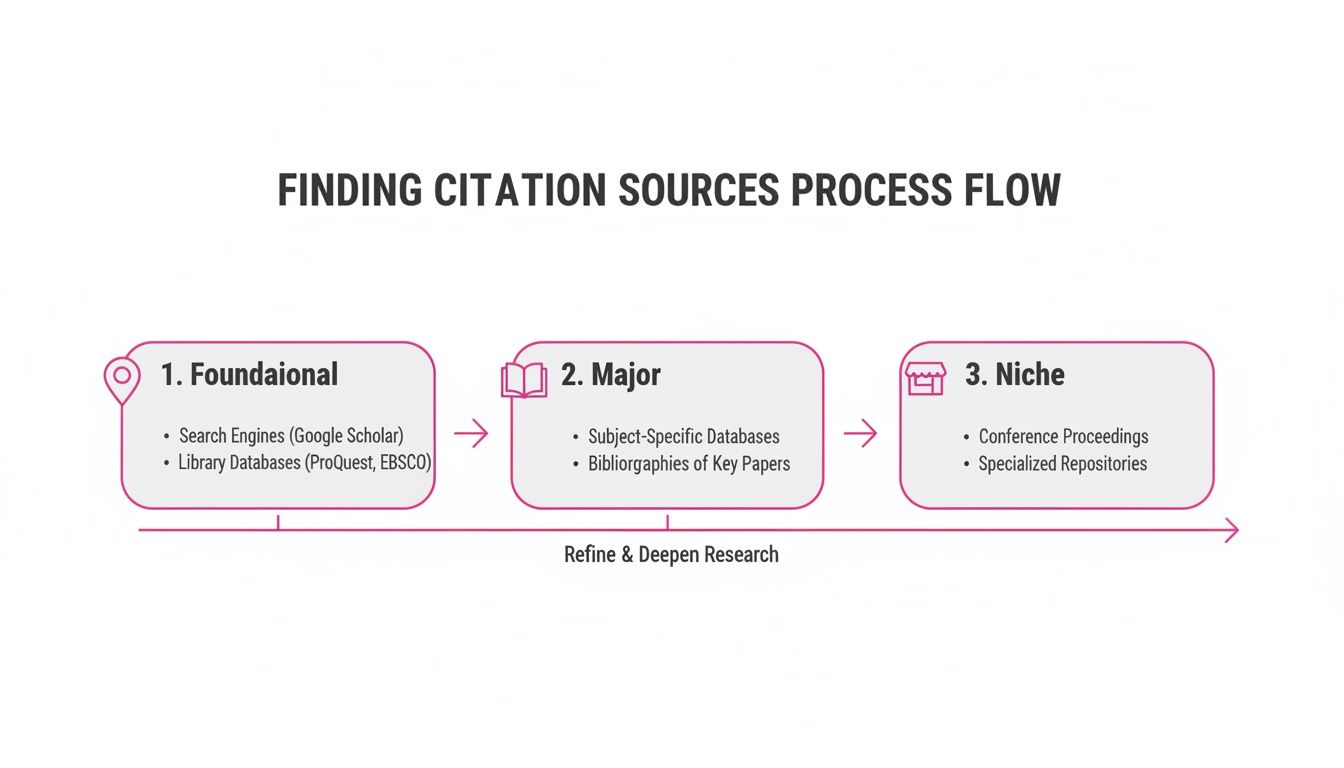
As you can see, the most effective approach is to start with the foundational directories, move on to the major players, and then fill in the gaps with niche, industry-specific sites.
Thankfully, modern tools can take the entire audit, cleanup, and building process off your plate. With the right software, like a dedicated citation manager, you can push your correct NAP out to dozens of directories all at once. It not only saves a huge amount of time but also acts as a 24/7 guard for your online accuracy. This sort of automation is a key part of effective Google Business Profile management, making sure all your local marketing efforts are pulling in the same direction.
Got Questions About Local Citations? We've Got Answers.
When you're trying to get your head around local SEO, a few questions always seem to pop up about citations. Let's tackle the most common ones we hear from UK business owners so you can get your strategy sorted.
How Many Citations Does My Business Actually Need?
This is one of those times where quality truly trumps quantity. There isn't a magic number that guarantees you'll hit the top spot. The best approach is to start with the essentials.
Make sure your business is listed perfectly on the big players for the UK: Google Business Profile, Apple Maps, and Yell. Once those are sorted, focus on getting listed in directories that are genuinely relevant to your specific industry and local area. A dozen rock-solid, consistent citations will do you far more good than hundreds of mismatched or irrelevant listings.
Should I Build Citations Myself or Use a Service?
You can definitely go the DIY route, but be warned: it’s a proper time-sink. Building citations manually means hunting down each directory, setting up an account, and painstakingly entering your details over and over again. It can easily eat up hours of your day.
Citation management services and tools take that manual grind off your plate. They automate the process, pushing your correct details out to dozens of sites at once, which saves a massive amount of time and ensures everything stays consistent. For most busy business owners, a managed service is simply a more efficient and reliable way to keep things accurate long-term.
What’s the Plan if I Move to a New Address?
Moving your business location requires a bit of digital legwork, and it's crucial to get it right. Your very first port of call should always be updating your Google Business Profile. Think of it as the foundation of your entire local online presence.
After that, make a list of your most important existing citations (like Yell and Thomson Local) and start working your way through them, updating each one with the new address. This is what we call a citation cleanup, and it's vital for preventing confused customers and avoiding issues that could hurt your search rankings. This is another situation where a citation management tool is a lifesaver, as it can update multiple directories simultaneously, making the transition seamless.
Ready to take control of your online presence without the headache? LocalHQ can help. Our upcoming Citation Manager is designed to automate the entire audit, cleanup, and building process, making sure your business information is accurate everywhere it needs to be. See how LocalHQ makes local SEO simple at https://localhq.io.