A Guide to Managing Online Reviews and Boosting Your Brand
Managing online reviews isn't just about damage control; it's a fundamental process of monitoring, responding to, generating, and understanding the customer feedback you receive across all digital platforms. Done right, this proactive strategy builds trust and drives sales. When negative feedback inevitably appears, handling it well protects your reputation and hands you incredibly valuable insights into your operations.
Why Managing Online Reviews Is a Non-Negotiable Strategy
Let's get past the idea that "reviews are important" and talk about what that really means for your business. For UK businesses in retail, hospitality, or local services, a solid review management plan directly impacts your bottom line. Today's customers don't just glance at reviews as a final check—they often start their entire decision-making process there.
Your digital reputation really boils down to three key factors:
- Rating: Your overall star score, the quick-glance measure of your quality.
- Frequency: The consistent flow of new reviews you're getting over time.
- Recency: How new your latest reviews are, which tells customers you're still relevant.
These aren't just vanity metrics. They're powerful signals that influence everything from a customer's trust in your business to how visible you are in local search results.
The Impact on Customer Trust and Revenue
The link between a steady stream of positive reviews and your revenue is crystal clear. UK consumers, in particular, rely heavily on recent feedback to feel confident in their choices. Think about it: a recent survey showed that just over 50% of UK adults check online reviews first before trying a new retailer.
Even more telling? Fewer than 1 in 10 would buy from a new business without consulting online sources first.
This is where the recency of your reviews becomes so critical. Industry data shows that companies with more than nine reviews posted in the last 90 days can earn roughly 52% more than average. That figure jumps to a staggering 108% more for businesses with over 25 recent reviews. A continuous flow of fresh, verified feedback is worth far more than a one-off burst of great comments from a year ago.
The Four Pillars of an Effective Programme
A truly successful review management programme isn't just a marketing task; it's a core business operation. I've found it's best to build it on four distinct pillars. Each one tackles a critical part of the customer feedback loop, turning what could be passive comments into a real strategic advantage.
Here's a breakdown of what those pillars look like in practice:
The Four Pillars of Effective Review Management
| Pillar | Primary Objective | Key Activities |
|---|---|---|
| Monitoring | To maintain complete awareness of all customer feedback in real-time. | Setting up alerts, tracking multiple platforms, using a central dashboard. |
| Responding | To engage with customers, protect brand reputation, and show you care. | Replying to positive and negative reviews, using templates, personalising replies. |
| Generating | To ensure a steady stream of fresh, relevant social proof. | Asking for reviews via email/SMS, using QR codes, making the process easy. |
| Analysing | To extract actionable business intelligence from feedback. | Tagging reviews, identifying trends, spotting operational issues or successes. |
When these pillars work in harmony, they create a system that does more than just protect your reputation—it actively improves your visibility. The signals from your reviews, like your average rating, the frequency of new feedback, and even the keywords customers use, are a huge factor in how Google ranks local businesses. In short, strong review management is a key component of what is local search optimisation, helping you climb higher on Google Maps and pull in more local customers.
Building Your Review Monitoring System
Let’s be honest: manually checking a dozen different review sites every single day is a recipe for disaster. It’s not just tedious; it’s how you miss that one critical piece of feedback that blows up overnight. To get a real handle on your online reputation, you need a system—a solid operational blueprint that ensures nothing ever slips through the cracks. This isn't just about playing defence; it's about building a structure for immediate awareness, which is the cornerstone of any great response strategy.
The first move is to centralise everything. Relying on a chaotic flood of email notifications from Google, Trustpilot, Facebook, and all those niche industry sites just doesn't work. The goal is to funnel every single review into one unified dashboard. This gives you that crucial bird's-eye view, turning a scattered mess of alerts into a clean, organised stream of customer feedback.
This is where a dedicated tool becomes non-negotiable, especially as your review volume grows. Platforms built specifically for this, like a comprehensive review manager, act as your command centre, pulling in feedback from every source that matters to your business.
Setting Up Real-Time Alerts
Once you’ve got all your reviews in one place, the next step is to set up smart, real-time alerts. A few hours' delay in seeing a scathing review can turn a small customer service hiccup into a public relations fire. When a customer is upset enough to post online, speed is your greatest ally.
Your alert system needs to do more than just send a generic email to a shared inbox. Modern systems let you create sophisticated, rules-based notifications that get the right information to the right person, instantly.
- Urgency-Based Alerts: A 1-star or 2-star review should trigger an immediate notification—think SMS or a dedicated Slack channel—to a senior manager or team lead who can act on it fast.
- Positive Feedback Alerts: Glowing 4-star or 5-star reviews can be routed into a daily email digest for the marketing team. This gives them a constant supply of fresh testimonials to showcase.
- Keyword Alerts: You can even create alerts for specific keywords that signal a serious problem. A review mentioning "food poisoning" or "unsafe" needs to be escalated to the highest level immediately, and keyword alerts make that happen automatically.
This transforms monitoring from a passive, manual chore into an active, automated defence mechanism. You’ll always be the first to know what people are saying, good or bad. This process fits into a wider, continuous cycle of reputation management.
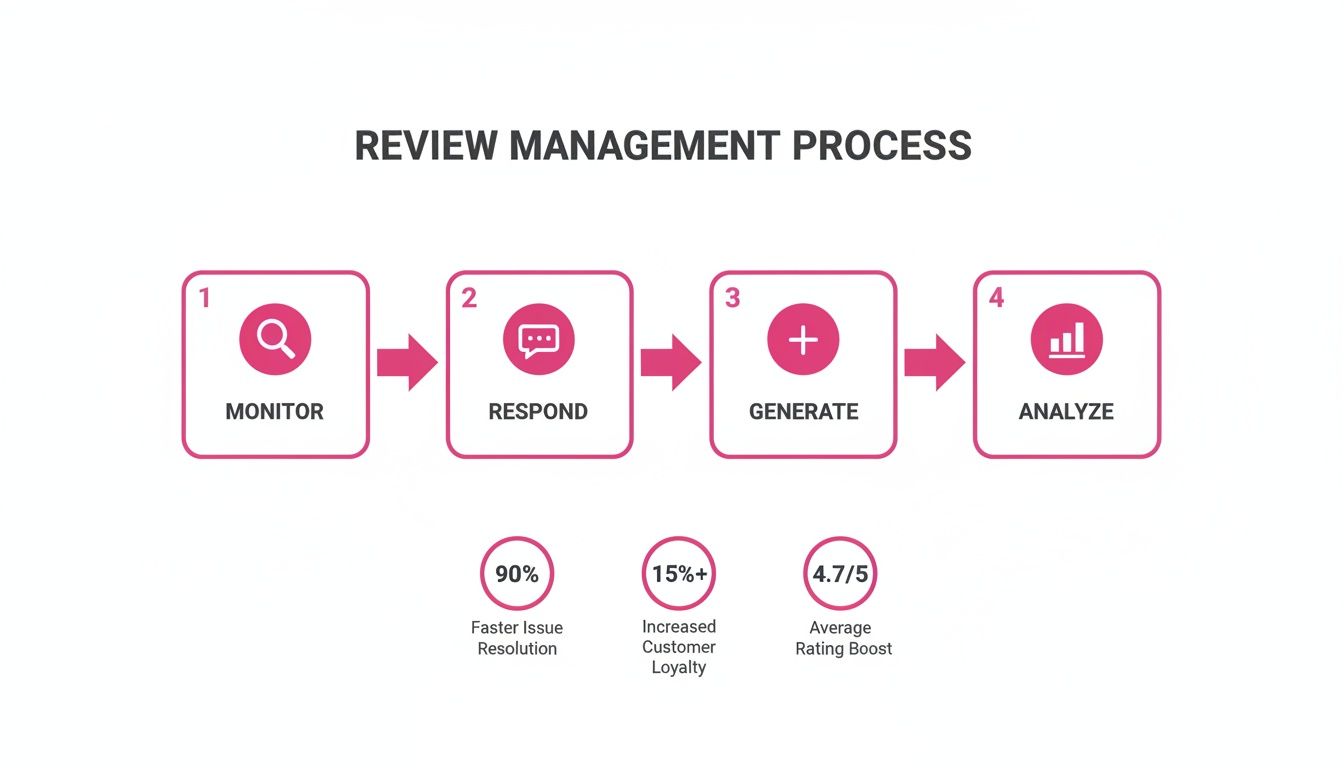
As you can see, it's a loop. Effective monitoring triggers a response, which feeds into generating more reviews and analysing the data, creating a powerful cycle of improvement.
Defining Roles and Workflows for Multi-Location Businesses
For any business with more than one location, a clearly defined workflow is absolutely critical. Without one, you're inviting inconsistent responses, missed reviews, and a whole lot of internal confusion. You have to answer one simple question: Who owns the response?
There are generally two schools of thought on this, and the right one for you really depends on your company’s structure.
The Centralised Model
A corporate or central marketing team handles every single review response. This approach is fantastic for brand consistency, ensuring the tone of voice is always on-point. It's often the preferred model for franchises where a uniform brand image is paramount. The trade-off? The responses can sometimes feel a bit generic and lack that local, on-the-ground context.
The Decentralised Model
Here, local managers are empowered to respond directly to reviews for their own locations. This often results in more personal and authentic replies, as the manager might remember the customer or the specific situation. The risk, of course, is a potential free-for-all in terms of tone, quality, and response time.
In my experience, a hybrid model is usually the sweet spot. The corporate team provides the guardrails—setting up approved templates and clear guidelines—while local managers are trained to personalise the responses.
For example, a 1-star review at a specific branch could trigger an alert to both the local manager and the regional head office. The workflow might state that the local manager is responsible for the initial reply within 24 hours using a pre-approved template, while the corporate team monitors the situation and ensures it’s fully resolved.
This kind of structure creates crystal-clear accountability. The moment a review lands, everyone knows exactly what their role is. It eliminates delays and ensures every single customer feels heard, no matter which location they visited. An organised system like this is the engine that powers a truly successful review management programme.
Crafting Your Authentic Response Strategy
Anyone can reply to a review, but doing it with an authentic, on-brand voice at scale is where you really start to see the magic happen. A solid response strategy is both efficient and deeply personal, turning what could be a simple comment into a powerful piece of marketing. It's about much more than just a quick "thank you" or "we're sorry"; it's a public demonstration that you genuinely care about your customers' experiences.
And this isn't just about feeling good—it's a serious driver for business growth. Research focused on the UK market found that a staggering 91% of businesses agree positive online reviews directly boost their revenue. On top of that, 83% of UK consumers are more likely to trust a business that takes the time to engage with unhappy customers. For any business with multiple locations, that kind of engagement is absolutely vital for building a solid brand reputation and reaching new customers.
Building Your Response Playbook
The backbone of any effective response strategy is a playbook built on templates. Now, I know what you’re thinking—"template" sounds robotic. But think of them more like starting points or frameworks. They ensure you hit all the key points while leaving plenty of room for that crucial personal touch.
Your playbook should cover the most common scenarios you come across. I'd recommend starting with frameworks for these core categories:
- The Glowing 5-Star Review: Don’t just drop a generic "Thanks!" Pick out something specific from their review. If they raved about your "amazing flat white," make sure your reply mentions it. It shows you're actually listening.
- The Vague Negative Review: These are the trickiest. A 2-star review with no text doesn't give you much to go on. Your goal here is to be proactive. A great response invites them to get in touch offline to share more details, proving you’re committed to making things right.
- The Detailed Critical Review: This is your chance to shine. Thank them for taking the time to give detailed feedback, offer a sincere apology for the specific things that went wrong, and—most importantly—explain what you’re doing about it. That level of transparency can turn a critic into your biggest fan.
The Power of AI in Personalisation
Let's be realistic. Creating and managing these responses manually, especially when you're juggling dozens of locations, can become a huge time-sink. This is where modern tools can be a game-changer, saving your team countless hours without sacrificing that authentic feel.
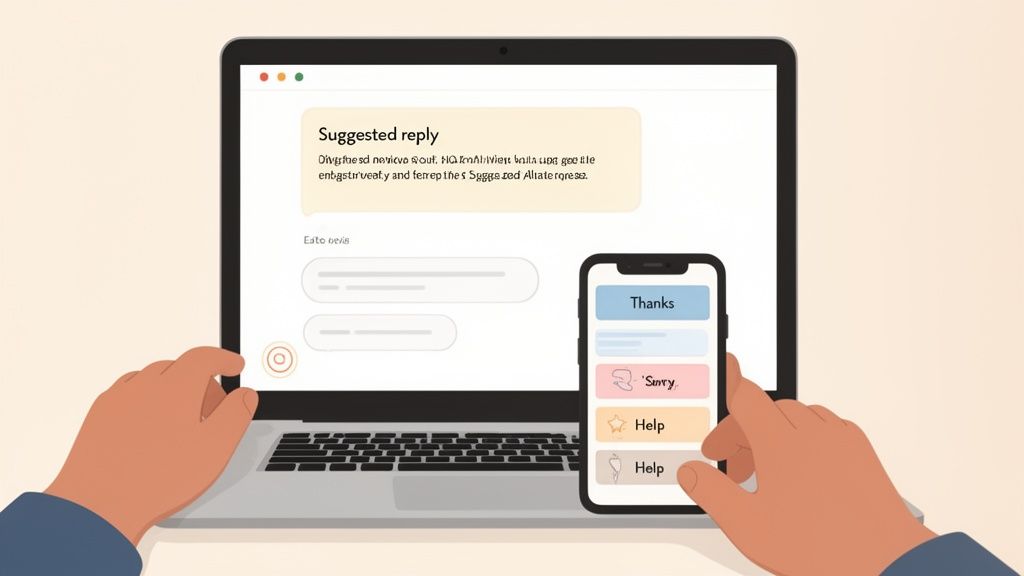
AI-powered features, like the Review Autoresponder in LocalHQ, do more than just paste in a canned reply. They analyse the review's sentiment and specific language to generate a smart, on-brand draft. The AI is sharp enough to pick up on keywords like "friendly staff" or "long queue" and craft a relevant starting point for your team.
This gives your team a massive head start. Instead of staring at a blank screen, they can quickly edit and tweak the AI-generated draft, adding the human touch that makes all the difference. It’s the perfect balance of efficiency and the genuine connection customers crave. You can learn more about how to use AI for local SEO and see how this technology can support your broader strategy.
Key Takeaway: The goal of using AI isn't to replace your team, but to empower them. It handles the repetitive heavy lifting, freeing them up to focus on what matters most: making genuine, personal connections with your customers.
Real-World Response Examples
Let's see how this works in practice. Imagine your local café gets a 2-star review that just says, "Coffee was cold and the barista seemed rushed."
A Terrible, Generic Response:
"We are sorry you had a bad experience. We value your feedback and hope you visit us again."
This is awful. It's impersonal, unhelpful, and feels like a complete brush-off. It does nothing to fix the problem.
A Great, Personalised Response:
"Hi [Customer Name], thank you for taking the time to share this. I'm so sorry to hear your flat white wasn't up to our usual standard and that our team seemed rushed. That's definitely not the experience we aim for. We've already spoken with our morning crew to reinforce our quality checks. Please feel free to reach out to me directly at manager@cafe.com—I'd love to make this right for you."
This response is a clear winner. It's personal, it addresses the specific issues, it's genuinely apologetic, and it offers a clear path to a solution. You've just turned a negative comment into a public display of excellent customer service. This builds trust not only with the original reviewer but with every single potential customer who reads it.
Keeping a Fresh Stream of Reviews Coming In
Having a great star rating is one thing, but if your most recent review is from a year ago, it doesn't build much trust. You need to be proactive. Think of generating new reviews as the engine that keeps your online reputation feeling current, relevant, and trustworthy. While you absolutely have to respond to the feedback you get, it's that consistent flow of new reviews that really moves the needle on local SEO and convinces new customers to give you a try.
The trick is to weave the 'ask' into the customer journey so it feels completely natural, not like a chore. You're looking for that sweet spot—the moment of peak happiness when a customer is most likely to want to share their great experience. Your goal is to build a system that makes review generation a regular, measurable part of how you do business.
Timing is Everything
Honestly, the single biggest factor in getting more reviews is when you ask. Get the timing wrong, and it can feel awkward or even a bit desperate. Get it right, and it’s the perfect end to a fantastic experience. That perfect moment is different for every business, of course.
If you sell products online, you might want to wait a week after delivery. That gives the customer a chance to actually use what they bought. But for a local coffee shop? The best time is probably seconds after they've paid, while they're still savouring that perfectly made flat white.
Think about these high-impact moments for your own business:
- Right after a purchase: For quick, simple transactions, a QR code on the receipt or a friendly, verbal request from a team member works brilliantly.
- Following up after a service: If you run a service business, an automated email or text message a day after the job is complete is a fantastic way to catch people when the great service is still fresh in their minds.
- After a positive support interaction: Did a customer service agent just solve a problem for a customer who is now singing their praises? That’s a golden opportunity to gently ask for feedback on their experience.
Make it Incredibly Easy
Look, even your most loyal, ecstatic customer isn't going to jump through hoops to leave you a review. Your job is to remove every single obstacle between their good intentions and them hitting that 'submit' button. Every extra click you make them perform tanks your conversion rate.
Expert Tip: Don't just send people to your Google Business Profile homepage and make them hunt for the review button. The best review request links go directly to the pop-up window where they can write the review. It should be a one-click process.
Here are a few practical ways to make it dead simple for them:
- QR Codes: Put them everywhere. On tables, receipts, invoices, delivery boxes. A quick phone scan can take a customer straight to your review page.
- Email & SMS Links: Send automated follow-ups with a direct link embedded. A little personalisation, like using their first name, can make a big difference to your response rate.
- The In-Person Ask: Train your team to make it a simple, low-pressure request. Something as easy as, "So glad you enjoyed everything today! If you get a second, we'd really appreciate you sharing your experience on Google."
Getting Your Whole Team on Board
For businesses with more than one location, consistency is the name of the game. You can't just hope for a superstar manager at one branch to carry the review generation for the entire brand. The strategy needs to be scalable and simple enough for every local manager to use, all while you keep an eye on things from a central point.
This is where a platform like LocalHQ really shines. You can set up standardised email and SMS templates for review requests, keeping the brand voice consistent. Then, local managers can send these requests right from their own dashboards. Suddenly, every single one of your locations is actively working to bring in fresh feedback.
This approach gives local teams a real sense of ownership over their reputation, but you never lose control. From a central hub, you can see which locations are hitting their targets and which ones might need a bit of extra coaching. It turns what could be a messy, inconsistent effort into a cohesive, data-driven programme that builds your reputation across every single place you operate.
Turning Review Insights into Business Intelligence
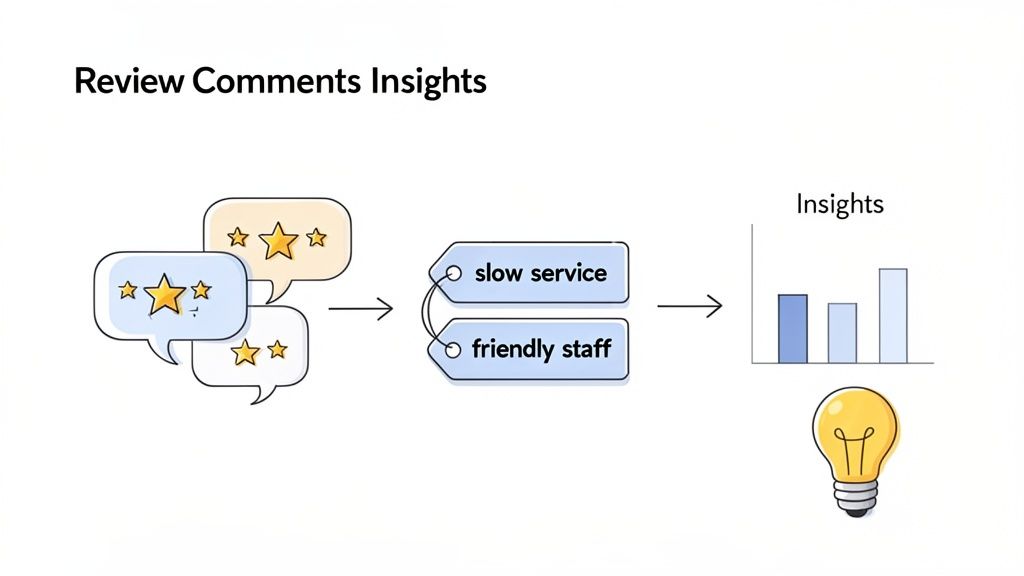
Managing your online reviews is about so much more than just chasing a five-star rating. Every single piece of feedback—good, bad, or indifferent—is a nugget of raw data. When you start to collect and analyse this data systematically, it stops being just customer opinion and becomes powerful business intelligence that can steer your entire organisation.
Think of your reviews as a constant, free-flowing focus group. Your customers are telling you, in their own words, exactly what they love, what frustrates them, and what they wish you offered. Listening is crucial, of course, but the real magic happens when you turn those scattered comments into concrete, actionable insights.
This isn't just a task for the marketing team; it's a feedback loop for the whole business. The patterns you uncover can inform everything from operational changes and staff training programmes to future product development.
From Individual Comments to Actionable Trends
A single review gives you a snapshot. Analysing hundreds of them reveals the bigger picture. The key is to shift from a reactive, one-by-one approach to proactively spotting recurring themes. This is where a smart system of tagging and categorisation becomes your most valuable tool.
By tagging reviews with specific keywords, you can start to quantify what customers are really saying about different parts of your business. For instance, a multi-location restaurant chain could create tags like:
- Service: "friendly staff," "slow service," "order accuracy"
- Product: "cold coffee," "fresh ingredients," "portion size"
- Atmosphere: "cleanliness," "loud music," "comfortable seating"
With these tags in place, you can suddenly ask much smarter questions. Is "slow service" a complaint across the board, or is it popping up at one specific branch during the weekend lunch rush? Are people consistently raving about the "fresh ingredients" in your salads?
This is how you pinpoint exactly where your operational strengths and weaknesses lie. Instead of guessing why one location's sales are dipping, the data can show you a direct correlation with a spike in negative reviews mentioning cleanliness.
This process transforms subjective feedback into objective data that drives strategic decisions. It gives you the "why" behind your performance metrics.
Connecting Review Data to Business Outcomes
The true power of this analysis is unlocked when you connect it to tangible business outcomes. The link between reviews and revenue is well-documented. Multiple UK analyses show that over 80-90% of consumers read online reviews before making a purchase. What's more, customers are willing to spend around 31% more with businesses that have excellent reviews, which can lead to an average sales uplift of about 18%.
These aren't just abstract numbers; they directly influence the footfall, phone calls, and direction requests that drive a local business. And since Google factors review signals—like rating, quantity, and response frequency—into its local pack rankings, a proactive approach pays double dividends. You improve both your customer experience and your search visibility at the same time.
Using Technology to Scale Your Analysis
Let's be realistic: manually reading and tagging thousands of reviews just isn't feasible, especially for multi-location businesses. This is where a centralised platform becomes absolutely indispensable for managing online reviews effectively.
Tools like LocalHQ are designed to do this heavy lifting for you. They can automatically analyse the sentiment of incoming reviews and suggest relevant tags, uncovering trends you might have otherwise missed entirely. Imagine having a dashboard that instantly shows you:
- The top three positive themes customers mentioned this month.
- A sudden spike in complaints about "parking" at your city-centre location.
- Which branch is getting the most praise for "customer service."
This aggregated data can be visualised in easy-to-digest reports, making it simple to share crucial findings with operations, marketing, and leadership. By exploring powerful review analytics tools, you can transform review management from a reactive chore into a proactive source of strategic insight, helping you make smarter decisions that improve customer satisfaction and strengthen your bottom line.
Common Questions About Managing Online Reviews
As you start putting your review management programme into practice, you're bound to run into some tricky situations. It's one thing to have a plan on paper, but it’s another to deal with a furious, and potentially fake, one-star review on a Friday night.
Let's walk through some of the most common questions that pop up. Think of this as your field guide for those real-world moments. Having a clear answer ready before you need it is the secret to handling these scenarios with confidence and professionalism.
How Should I Handle a Fake or Malicious Negative Review?
First, take a deep breath. The absolute worst thing you can do is fire back an emotional, defensive reply. That kind of knee-jerk reaction can cause far more damage than the review itself. A calm, methodical approach is always better.
Your first move should be to check the review platform's terms of service. Does the review contain hate speech, spam, or a clear conflict of interest? Most platforms have policies against this sort of thing. If it's a clear violation, flag it for removal straight away. That's your first line of defence.
While you wait for the platform to do its thing, you should still post a public response.
Here's What We Recommend:
Post a polite, professional reply. You can say something like, "We take all feedback seriously, but we don't have a record of this customer or the incident described." Then, invite them to contact you directly with more details so you can look into it. This simple act shows other potential customers that you're reasonable and attentive, all without validating a false claim. Never, ever get into a public argument or offer compensation.
This strategy keeps your reputation intact in the eyes of genuine customers. They're often smarter than we give them credit for and can usually spot a fake review, especially when your response is measured and professional.
How Quickly Should I Respond to a New Review?
Speed definitely matters, but not all reviews demand the same urgency. The key is to have a clear policy so your team knows exactly what's expected.
For negative reviews (1 or 2 stars), you really need to aim for a response within 24 hours. Getting back to someone quickly shows you take their concerns seriously and are committed to fixing things. This can instantly de-escalate a tense situation and signals to everyone else reading that you're on top of your game.
When it comes to positive reviews (4 or 5 stars), responding within a few days is perfectly fine. It's a fantastic habit to thank people for their kind words and reinforce that great experience, but it doesn't need to happen overnight. This is where a tool with real-time alerts becomes invaluable, particularly if you're dealing with a lot of reviews or managing multiple locations.
Is It Ever Okay to Not Respond to a Review?
While aiming to reply to every review is a great goal, there are a few rare instances where you can let one slide. It's all about focusing your energy where it'll have the biggest impact.
You can generally skip responding to:
- Obvious Spam: Reviews that are just gibberish, full of links, or clearly abusive. Just flag them for removal and move on.
- Simple Star Ratings: A 5-star rating with no text is great to see, but there isn't much to say in return. A quick "Thanks!" is a nice touch if you have time, but it's not as crucial as replying to a detailed comment.
The golden rule is this: always respond to any negative, mixed, or detailed positive review. These are the comments that offer you real feedback and hold the most sway with potential customers.
Can I Ask a Customer to Remove a Negative Review?
This is delicate territory, so tread very carefully. Your number one goal should never be just getting the review taken down; it has to be about genuinely solving the customer's problem. If you pressure them, you're almost guaranteed to make a bad situation even worse.
Start by taking the conversation offline. Call or email the customer, listen to what they have to say, and do what you can to make it right.
Only after you've truly resolved the issue to their satisfaction should you even think about mentioning the review. You could say something gentle like, "We're so glad we were able to sort this out for you. If you feel your experience now reflects it, we'd be grateful if you'd consider updating your review."
Ultimately, the choice has to be theirs. This customer-first approach won't always get the review changed, but it does something more important: it rebuilds trust and can turn a vocal critic into a loyal fan.
Ready to take control of your online reputation with a system that actually works? LocalHQ gives you the tools to monitor, respond to, and generate reviews with AI-powered efficiency. Turn customer feedback into your greatest asset and start winning more local business today.