Local SEO for Restaurants: A Complete UK Guide
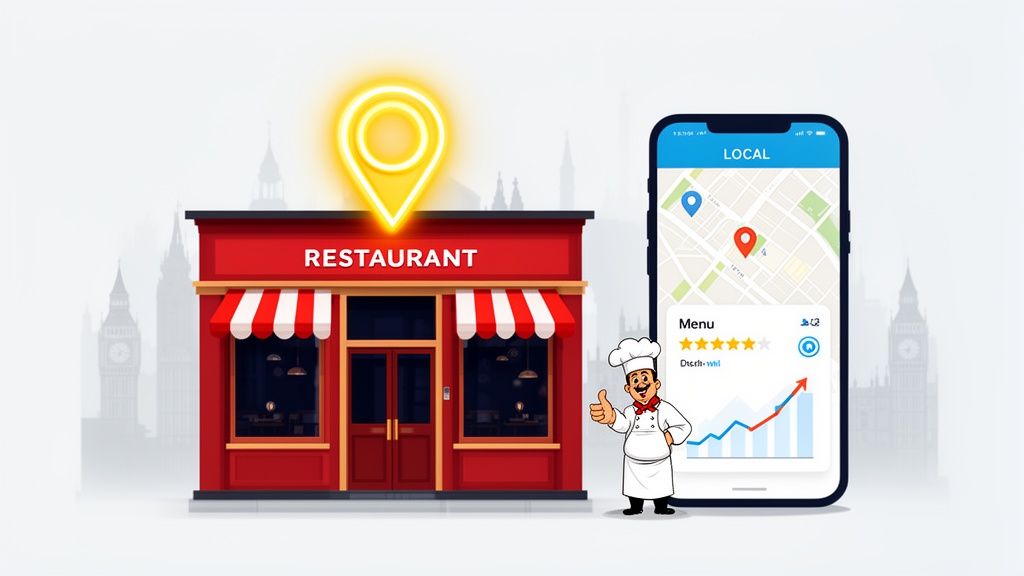
Local SEO for restaurants is all about making sure that when someone nearby gets hungry and searches for "best pizza near me" or "Sunday roast in Bristol", your restaurant pops up first. It’s the art and science of turning those online searches into actual bums on seats.
This isn't just about being seen; it's about being chosen. It's how you convert a high-intent search directly into a booking or a walk-in.
Why Local SEO Is Your Restaurant's Most Powerful Tool
Think about how people find restaurants these days. The journey to your dining table almost always starts with a search on a smartphone. The days of flicking through the Yellow Pages or relying purely on word-of-mouth are long gone. If you're not visible in those "I'm hungry now" moments, you might as well be invisible.
Good local SEO makes your restaurant the easiest, most appealing choice for someone looking for a meal right now. It's a strategy built on a few core elements that all work together to win over both potential diners and search engines like Google.
The Foundations of a Winning Strategy
A solid local SEO plan is more than just having a website. It’s a multi-pronged effort to build trust and authority online.
Here's what really matters:
- Your Google Business Profile (GBP): This is your digital shopfront and, honestly, the most important piece of the puzzle. A well-managed profile with accurate hours, mouth-watering photos, and a full menu can dramatically boost your visibility on Google Search and Maps.
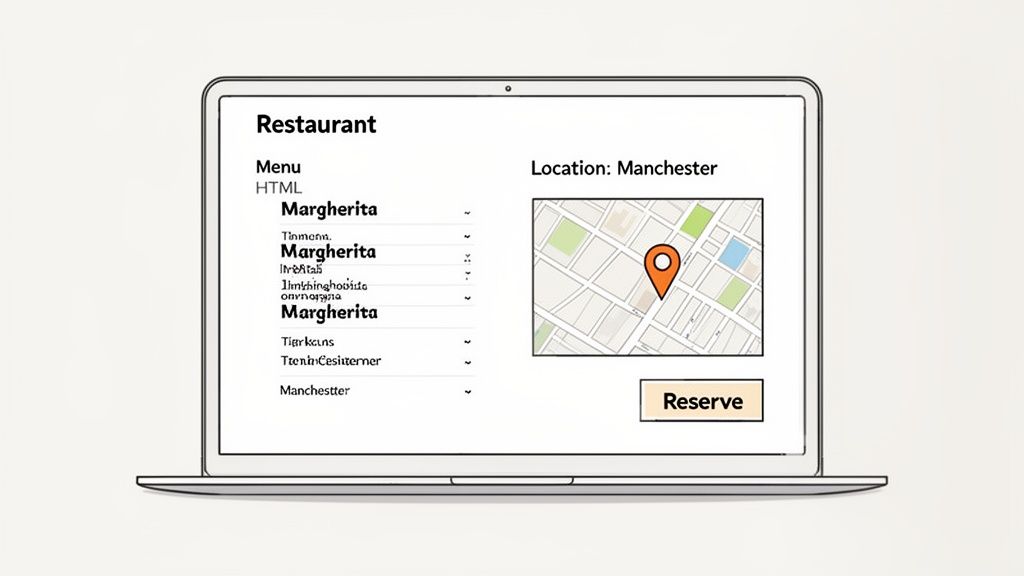
- A Mobile-Friendly Website: Your website needs to give diners what they want, fast. That means a menu they can actually read on their phone (an HTML page, not a clunky PDF), clear contact details, and maybe an easy booking button. If you have multiple locations, each one needs its own dedicated page.
- Reputation and Reviews: Online reviews are the new word-of-mouth, plain and simple. Encouraging a steady flow of positive reviews and responding professionally to all feedback (even the not-so-great ones) builds huge trust. It influences diners and your search rankings.
This simple flow shows how local SEO turns a hungry searcher into a happy customer.
As you can see, the path is direct: people search, they visit, and they buy. Being visible at that first step is everything.
The Direct Impact on Your Bottom Line
The link between a local search and a customer walking through your door is undeniable. Consider this: a staggering 76% of people who search for something local on their phone visit a related business within 24 hours.
What’s more, searches including "near me today/tonight" have shot up by over 900% in recent years. This isn't just browsing; it's a clear signal of intent to buy. When someone is searching locally, they're ready to make a decision. Your restaurant needs to be the one they find. You can dig into more of these local SEO findings and trends to see the full picture.
Optimising Your Google Business Profile To Win Diners
Think of your Google Business Profile (GBP) as your restaurant's digital front door. It’s often the very first interaction a potential diner has with your brand, and in the cut-throat world of local search, first impressions are everything. A neglected profile isn't just a missed opportunity; it's a gift to your competition. A fully optimised one, on the other hand, is your most powerful magnet for attracting new customers.
This is about so much more than just listing your address and phone number. It's about transforming a simple business listing into a vibrant, interactive showcase that answers questions, makes mouths water, and, most importantly, drives bookings. When someone searches for "best pizza near me," your GBP is what stands between them and the restaurant down the road.
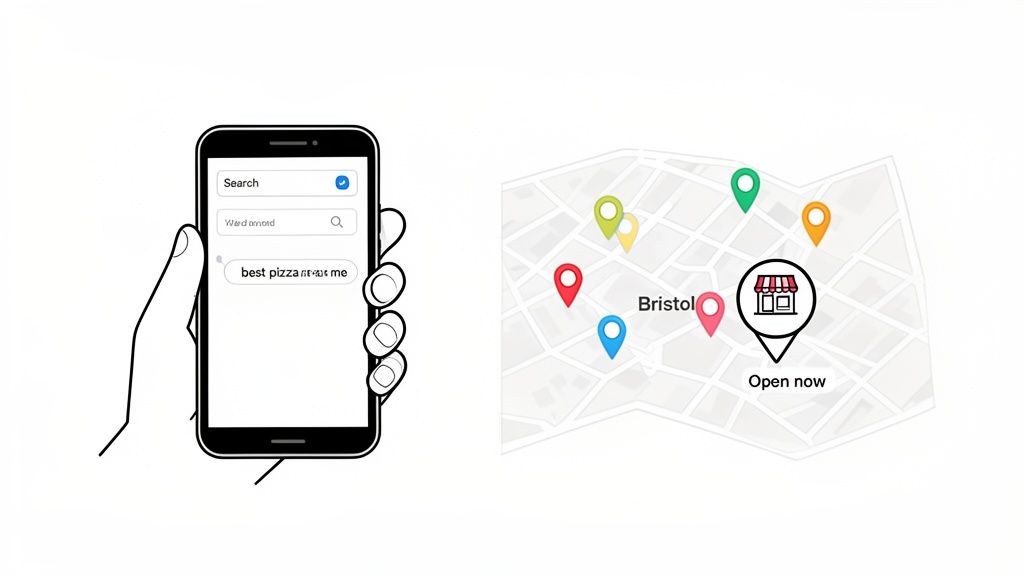
The battle for local diners is fierce, and it's usually won or lost in the top few search results. The data doesn't lie: businesses in the top three local search results snag 60% of all clicks. This means if you're not in that coveted 'Map Pack', you're effectively invisible to the majority of potential customers. This winner-takes-all dynamic is hammered home by the fact that 42% of users click on results appearing directly in the Google Map Pack.
Choosing Categories That Capture Intent
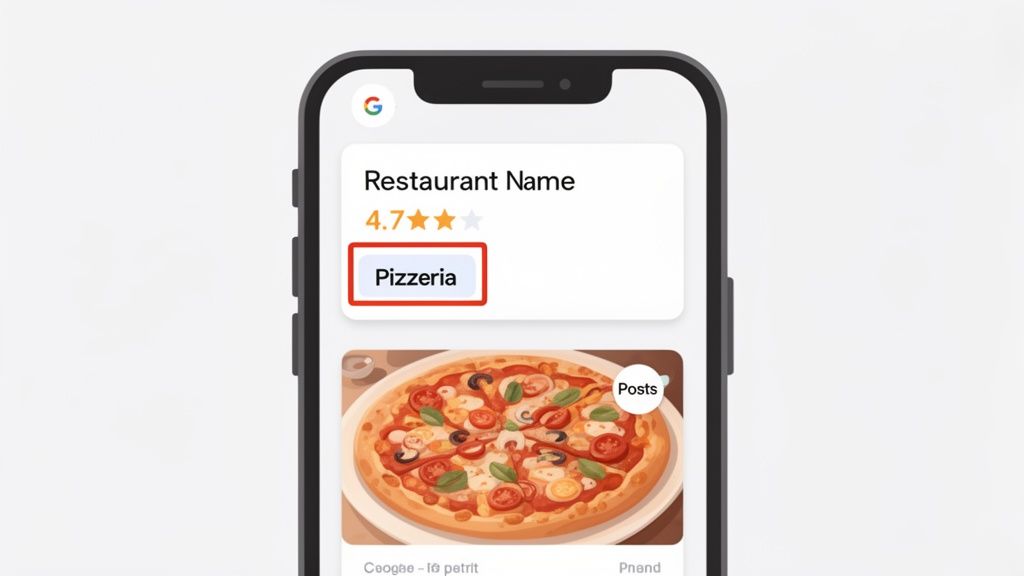
Your choice of categories is, without a doubt, one of the most critical ranking factors for your GBP. It's how you tell Google precisely what you do and which searches you should show up for. Just picking 'Restaurant' is nowhere near enough.
You have to get specific. Think like your customer. If you’re known for your authentic Neapolitan pizzas, your primary category should be 'Pizzeria', not the generic 'Italian Restaurant'. You can absolutely add 'Italian Restaurant' as a secondary category, but leading with your speciality helps you capture those high-intent, ready-to-book searches.
Let's break it down with a real-world example. Say you run a gastropub in Manchester. A smart category setup would look something like this:
- Primary Category: Gastropub
- Secondary Categories: Pub, Restaurant, Sunday Lunch Restaurant, Bar
This combination gives you a fighting chance to appear for a whole range of relevant searches, from a broad query like "pubs in Manchester" to something as specific as "best Sunday lunch near me." Getting this right is the foundation of your entire local SEO strategy.
Crafting a Compelling Business Description
You have 750 characters for your business description. Treat it like your elevator pitch. This is your chance to tell your story, highlight what makes you special, and naturally weave in important local keywords. Don't just list your dishes; create a narrative that draws people in.
Talk about your commitment to local suppliers, your unique atmosphere, or your signature cocktails. For our Manchester gastropub, a compelling description might read:
"Welcome to The Ancoats Arms, a modern gastropub in the heart of Manchester's vibrant Northern Quarter. We pride ourselves on serving classic British fare with a contemporary twist, using locally sourced ingredients. Join us for our famous Sunday lunch, after-work drinks, or a memorable meal in our cosy, welcoming atmosphere. We're the perfect spot for any occasion."
Notice how it includes key terms like "gastropub," "Manchester," "Northern Quarter," "Sunday lunch," and "after-work drinks" without sounding stuffed or robotic. It’s authentic and inviting.
To help you get started, here's a quick checklist of the most important elements to get right on your profile.
Google Business Profile Optimisation Checklist for Restaurants
This table is a quick-reference guide to the essential elements you should review and optimise on your GBP listing. Nailing these basics can have an immediate and noticeable impact on your local visibility.
| GBP Feature | Optimisation Action | Why It Matters |
|---|---|---|
| Categories | Select a specific primary category (e.g., 'Pizzeria') and relevant secondary ones (e.g., 'Italian Restaurant'). | Tells Google exactly what you offer, matching you to high-intent searches. |
| Business Description | Write a compelling 750-character summary including local keywords and what makes you unique. | Your "elevator pitch" to entice customers and provide context for search engines. |
| Photos & Videos | Upload high-quality, recent photos of food, interior, exterior, and team. Add a 360° tour if possible. | Visuals are crucial for diners. They build trust, showcase your atmosphere, and increase engagement. |
| Menu | Upload your full menu directly to GBP, either manually or via a connected service. Keep it updated. | Answers a primary customer question directly in the search results, reducing friction. |
| Google Posts | Regularly publish posts about offers, events, or new menu items. Posts expire after 7 days. | Keeps your profile looking active and fresh, and allows you to promote directly to searchers. |
| Q&A | Proactively add and answer frequently asked questions (e.g., parking, dietary options). | Manages customer expectations and provides helpful information upfront, saving time. |
Working through this list is your first step towards turning your GBP into a customer-generating machine. Once these fundamentals are in place, you can focus on the more dynamic elements.
The Power of High-Quality Photos and Videos
We’ve all heard it: people eat with their eyes first. On your GBP, your photos are your menu. Grainy, poorly lit phone snaps just won’t cut it in today's market. Investing in professional photography is non-negotiable if you want to showcase your food, your interior, and your team in the best possible light.
Here’s a quick-fire list for visual content that actually converts:
- Food Photography: Bright, vibrant shots of your most popular dishes. They need to look irresistible.
- Interior and Exterior: Show off your ambiance. Capture the buzz of a busy dining room, the cosy corners for a quiet meal, and a clear shot of your storefront so people can spot you from the street.
- Team Photos: Happy, smiling staff add a human touch and build instant trust.
- 360° Virtual Tour: This is a fantastic tool that allows potential customers to "walk through" your restaurant before they even visit.
Adding new photos regularly sends a strong signal to Google that your profile is active and well-maintained. Don't forget to encourage your customers to upload their own photos too; that user-generated content adds a layer of authenticity that you just can't buy.
Pro Tip: Before you upload your images, rename the files with descriptive keywords. Instead of
IMG_1234.jpg, use something likemanchester-gastropub-sunday-roast.jpg. It's a small detail, but it's an effective little SEO tactic that many people miss.
Engaging Diners with Google Posts and Q&A
Think of Google Posts as mini-adverts that appear right on your profile. They are perfect for shouting about special offers, new menu items, or upcoming events. The catch? A post is only live for seven days, so you need to be consistent with your updates to keep your profile looking fresh and engaging.
The Questions & Answers (Q&A) section is another goldmine that’s often overlooked. Potential customers can ask questions directly on your profile, and anyone can answer them. It is absolutely vital that you monitor this section and provide prompt, accurate answers yourself.
Even better, get ahead of the game by adding your own common questions and answers:
- "Do you have vegan options?"
- "Is there parking nearby?"
- "Are you dog-friendly?"
By controlling the conversation, you provide valuable information right away and manage customer expectations before they even think about picking up the phone. For multi-location restaurants, staying on top of these features for every single branch can be a huge time-sink. This is where specialised platforms that offer efficient Google Business Profile management become invaluable, allowing you to keep every profile dynamic, engaging, and consistently winning over new diners.
Your Website: The Digital Heart of Your Restaurant
Think of your website as your restaurant's digital flagship. Your Google Business Profile might be the front door that gets people’s attention, but your website is the main dining room where they get a real taste of what you offer. For local SEO to truly work its magic, your site needs to be built for both hungry diners and search engine bots.
One of the most common—and costly—mistakes I see restaurants make is simply uploading a PDF of their menu. It seems easy, but it’s a killer for SEO. Google can’t read the text inside an image or a PDF, which means all those carefully crafted, delicious dish descriptions are completely invisible. You'll never show up for specific searches like "best wood-fired pizza in Bath" or "vegan Sunday roast in Leeds."
A thoughtful overall web design strategy is the foundation for pulling in local customers online. The goal is simple: guide someone from a curious Google searcher to a confirmed booking with as little friction as possible.
From PDF to Web Page: Why Your Menu Needs to Be Text
If you do just one thing to your website after reading this, make it this: ditch the PDF menu and build it as a proper HTML web page. This single change unlocks an incredible amount of SEO potential.
An HTML menu is made of real text that Google can crawl, index, and understand. Instead of just listing "Margherita," you can describe it as a "Classic Margherita Pizza with San Marzano tomatoes, fresh mozzarella, and basil." Suddenly, you’ve given Google a handful of valuable keywords that help you show up in those specific, high-intent searches.
Put yourself in Google's shoes. It wants to give users the most relevant answer. A website with a detailed, text-based menu offers far more context and information than one with an unreadable PDF, giving you a serious edge over the competition.
Building the Perfect Local Landing Page
For restaurants with more than one location, creating a dedicated page for each branch is an absolute must. A generic "Our Locations" page just won't cut it anymore. Each branch serves a unique community, and to compete effectively, it needs its own optimised space online.
A top-tier local landing page needs these key ingredients:
- Location-Specific Titles and Headings: The page title and main H1 heading should scream location. Think "Our Shoreditch Restaurant & Bar" or "Best Italian Food in Bristol City Centre."
- Unique Local Flavour: Don't just copy and paste the same description across all pages. Talk about what makes that branch special. Mention nearby landmarks, its unique atmosphere, or its connection to the local neighbourhood.
- Full NAP Details: Display the full Name, Address, and Phone number for that specific location, front and centre. Critically, this info must match your Google Business Profile listing exactly.
- An Embedded Google Map: This isn't just for helping customers find you. Embedding a Google Map of the specific location sends a powerful local signal back to Google itself.
- Local Testimonials: Feature reviews and testimonials from customers who have actually dined at that particular branch. It adds powerful social proof and builds trust with potential visitors.
By treating each restaurant as its own unique entity with a dedicated landing page, you create a hyper-relevant experience for local searchers. This targeted approach dramatically improves your chances of ranking for "near me" searches in all of your locations.
Getting to Grips with Local Schema Markup
Schema markup might sound technical, but think of it as a "secret language" you add to your website's code. It helps search engines like Google understand your content on a much deeper level by translating your information into a structured format it can easily digest.
For restaurants, two types of schema are particularly important.
Restaurant Schema: This markup explicitly tells Google the nuts and bolts of your business.
- Cuisine type (e.g., Italian, Thai, British)
- Price range
- Opening hours
- Accepted currencies (£)
Menu Schema: This lets you mark up individual menu items, complete with their names, descriptions, and prices.
When you implement this schema correctly, Google might reward you with "rich results"—things like menu highlights or your opening hours appearing directly on the search results page. This extra visibility makes your listing far more enticing and can seriously boost the number of people clicking through to your website. Don't worry, many modern website platforms have plugins or tools that make adding schema much simpler than it sounds.
Building a Reputation That Fills Tables
In the restaurant game, you could have the best food in town, but it’s your online reputation that often decides whether a new customer walks through your door or scrolls right past. What other people say about you online—that social proof—is a huge factor for diners and a critical signal for Google's local search algorithm.
A strong reputation isn't just about a few five-star ratings. It’s about actively managing the entire digital conversation around your restaurant. This means encouraging happy customers to share their experiences and ensuring your basic business details are rock-solid consistent everywhere online. If you're not managing your reputation, you're letting strangers write your story, and that's a risk no restaurant can afford to take.
Encouraging a Steady Stream of Positive Reviews
Let’s be honest: a constant flow of recent, positive reviews is one of the most powerful things you can have in local SEO. It tells Google that your business is not only active but genuinely valued by the community. The catch? Most happy customers simply forget to leave a review unless you give them a gentle nudge.
The secret is to make it incredibly easy for them.
- Subtle Staff Prompts: Train your team to plant the seed. As they're dropping the bill, a simple, "We'd be so grateful for a review on Google if you enjoyed your meal" can make a massive difference.
- QR Codes: Put a QR code on receipts, menus, or table talkers that links straight to your Google review page. It removes all the hassle for the customer.
- Email and SMS Follow-ups: If you're using a booking system, a polite follow-up email the next day is a brilliant and highly effective way to ask for feedback.
And if you want to turn those happy diners into regulars, looking into the best loyalty programs for restaurants is a smart move that builds both repeat business and your reputation.
The Art of Responding to Every Review
How you respond to a review is just as visible—and just as important—as the review itself. It’s a public showcase of your customer service. By responding to every single review, whether it’s glowing, critical, or somewhere in between, you show that you're listening and that you care.
For positive reviews, a personalised 'thank you' is great. Mention a specific dish they loved to show you’ve actually read it. For negative reviews, your approach is everything.
Always respond professionally and with empathy. Never, ever get into a public spat. Acknowledge their complaint, apologise that their experience wasn't up to scratch, and offer to resolve it with them offline. This protects your brand and shows potential customers you take service seriously.
Mastering Citations for Local Authority
Beyond reviews, another cornerstone of your online reputation is your collection of citations. A citation is simply any online mention of your restaurant's key details: its Name, Address, and Phone number (what we call 'NAP'). You'll find these on directories like TripAdvisor, Yelp, Zomato, and countless others.
Think of every consistent citation as a vote of confidence for Google. When it sees the exact same NAP details plastered across dozens of reputable sites, it becomes much more confident that your restaurant is real and located where you claim. This confidence directly boosts your local authority and, ultimately, your search rankings.
The reverse is also true. Inconsistent or wrong information is a major red flag for search engines. An old address, a typo in the phone number, or even a slight name variation ("The Queen's Head" vs. "Queens Head") creates confusion and can seriously damage your visibility.
Regularly auditing and cleaning up your citations is a vital, if tedious, part of local SEO. Start by searching for your restaurant and checking the main directories. Fixing any errors you find will immediately strengthen your digital footprint and help you build the kind of reputation that keeps your tables full.
Weaving Your Restaurant into the Local Fabric
Truly powerful local SEO goes beyond just ticking boxes on your Google Business Profile. It's about making your restaurant part of the local conversation, a genuine fixture in the community. When you create content that speaks directly to your neighbours, you’re not just optimising for search engines; you’re building real connections.
This isn’t about pumping out generic blog posts. It’s a smart way to pull in search traffic from people looking for more than just a meal—they’re looking for a local experience. The aim is to become the go-to answer when someone searches for anything dining-related in your specific patch.
More Than Just Food Photos
Gorgeous shots of your signature dishes are a must, but your content needs to dig deeper. What makes your restaurant special in this specific location? This is your chance to tell stories that forge a bond with potential customers before they even step through the door.
A simple blog post can become a serious SEO powerhouse when you give it a local spin. Instead of just announcing a new menu, why not craft a story around the local suppliers you work with?
Here are a few ideas to get you started:
- Spotlight Your Suppliers: Feature the local businesses you partner with. A post titled, "Meet the Farmer: The Story Behind Our Sussex Lamb," or "Why We Source Our Cheese from This Cotswolds Creamery" instantly roots your restaurant in the region.
- Create Neighbourhood Guides: Position yourself as the local authority. A guide like, "The Perfect Pre-Theatre Dinner in the West End," or "Where to Find Bristol's Best Coffee Near Clifton Village" captures people planning an outing, putting you right at the heart of their plans.
- Piggyback on Local Events: Is there a big festival or market in your town? Create content around it. Something like, "What to Eat During the Edinburgh Fringe Festival," featuring your own specials, is a brilliant way to tap into that buzz.
When your content genuinely serves the local community, you stop selling meals and start offering an authentic local experience. This builds a loyal following and sends strong signals to Google that you're a major player in your specific area.
How Local Keywords Fit In Naturally
The great thing about this approach is that it makes using local keywords feel completely effortless. You're not trying to awkwardly shoehorn "best restaurant in Manchester" into every other sentence. Instead, you'll find yourself naturally targeting the specific, high-intent phrases that real people are typing into Google.
Imagine you're launching a new seasonal menu at your Edinburgh spot. A post about the story behind the new dishes could naturally target long-tail keywords like "best seasonal menu in Edinburgh" or even "restaurants near Edinburgh Castle with local produce".
This strategy is so effective because it matches what people are actually looking for. The person searching for a "pre-theatre dinner" isn't just hungry; they have a very specific need tied to a place and an activity. By giving them the perfect solution, you connect with a high-quality potential customer right when they're ready to book. This community-first mindset turns your local SEO for restaurants from a technical checklist into a powerful way to build your brand.
Measuring The Metrics That Actually Matter
All the effort you put into perfecting your categories, content, and citations is for one simple reason: to get more bums on seats. But how can you be sure your local SEO strategy is actually working? Vanity metrics like impressions might look good on a report, but they don't pay the bills. It’s time to cut through the noise and focus on the data that proves your online presence is driving real-world business.
Tracking the right key performance indicators (KPIs) is everything. These are the numbers that show your work is turning into paying customers. Forget getting lost in a sea of analytics and zero in on the actions that signal a diner is on their way.
From Clicks To Customers
Your Google Business Profile is a goldmine of this kind of data, found in its 'Insights' section. Think of it as your main dashboard for understanding how customers find you and what they do next.
Here are the core metrics you should be watching like a hawk:
- Clicks to Call: This is as direct as a lead gets. Someone found you and was motivated enough to pick up the phone, probably to book a table or ask about a special.
- Direction Requests: This is arguably the strongest buying signal you can get. A person asking for directions to your restaurant is very, very likely on their way over.
- Website Clicks: This tracks how many people jump from your Google Profile to your website. It’s a crucial step where they can explore your full menu, read your story, and most importantly, make a booking online.
- Booking Conversions: If you’ve connected a booking system to your GBP, this is the ultimate prize. It measures the exact number of reservations generated directly from your local search presence.
By focusing on these action-based metrics, you get a crystal-clear view of your return on investment. A steady, month-on-month increase in calls and direction requests is a concrete sign your local SEO is successfully filling your tables.
Visualising Your Local Search Footprint
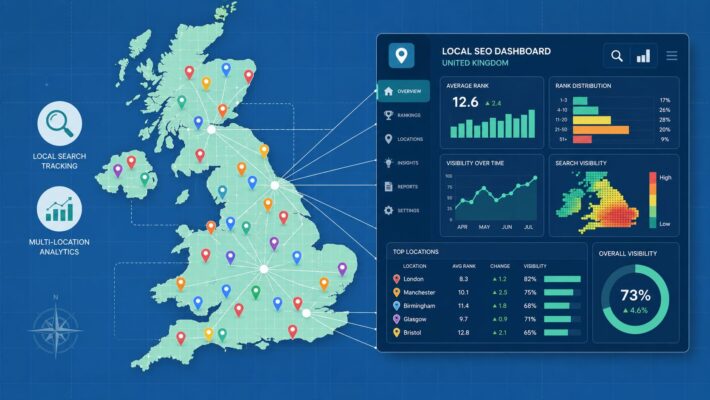
Standard rank tracking is a good start, but it doesn't give you the full picture for a restaurant. Your rank for "best pizza" can be number one for someone standing on your street and completely invisible to someone two miles across town. This is exactly why geo-grid rank tracking is a game-changer.
Instead of one single, often misleading, ranking number, a geo-grid shows you how you rank for a keyword from multiple points on a map covering your local area. You can learn more about the specifics of rank tracking for local keywords and see why this granular view is so vital for restaurants.
This visual map instantly shows you where you're strong and, more importantly, where you're weak. You might find you're dominating your own postcode but are a ghost to potential diners just a short drive away. That's pure gold. This kind of insight allows you to fine-tune your local SEO for restaurants by creating content or even running ads that target the specific neighbourhoods where your competitors are currently winning.
Got Questions? We've Got Answers
Diving into local SEO for your restaurant can feel a bit daunting at first. It's only natural to have a few questions. We hear a lot of the same ones from restaurateurs across the UK, so let's clear up some of the most common queries.
How Long Does This Actually Take?
It’s the question on every owner's mind: when will I see a return? While you can get some quick wins, think of local SEO as a slow-cooker, not a microwave.
Getting your Google Business Profile details spot-on and adding some fresh, high-quality photos can give you a noticeable bump in a matter of days. But for the kind of deep-rooted success that consistently brings people through the door, you're looking at a three to six-month timeframe. That’s how long it takes to build a solid review profile, create meaningful local content, and establish your authority. Consistency is everything.
If I Only Do One Thing, What Should It Be?
Your Google Business Profile (GBP). No contest. This is the absolute cornerstone of your local online presence.
Your GBP is what gets you into the coveted Google 'Map Pack'—that little box of three local businesses you see right at the top of the search results. Since that's where most of the clicks go, getting your GBP right from the very beginning will give you the biggest bang for your buck, and fast.
Think of your Google Business Profile as your new front door. For many potential customers, it’s the very first interaction they'll have with your restaurant. It's your chance to make a brilliant first impression and convince them you're the right choice, right now.
Do I Really Need a Blog on My Restaurant Website?
Strictly speaking, no. But should you have one? Absolutely. A blog is a secret weapon for any restaurant that's serious about winning at local search.
Your main service pages are great for targeting broad terms like "Italian restaurant in Manchester." But what about all the other things people search for? A blog lets you target hundreds of specific, long-tail keywords. We're talking about things like "best dog-friendly pubs in Bristol" or "where to find the best Sunday roast in Yorkshire." It’s your space to connect with the community, tell your story, and build the kind of authority that Google absolutely loves.
How Do I Handle SEO for Multiple Locations?
Managing SEO for a restaurant group is a different beast, but it just requires a bit more structure. The golden rule is that each location needs its own dedicated digital footprint.
That means creating a unique, fully-optimised local landing page on your website for every single branch. Don't just copy and paste! Each location also needs its own separate and meticulously managed Google Business Profile. To keep your sanity, using a multi-location tool is a game-changer. It helps you maintain brand consistency, schedule posts efficiently, and see how every site is performing from one central dashboard.
Ready to stop worrying about local search and start seeing more customers? LocalHQ gives you all the tools to manage one location or one hundred with total confidence—from AI-powered GBP management to pinpoint geo-grid rank tracking. See how LocalHQ can help you get started.