A Guide to Fighting Fake Reviews on Google

Fake Google reviews are exactly what they sound like: bogus testimonials posted on a business profile. They're designed to do one of two things – either artificially boost a company's own reputation or, more maliciously, to tear down a competitor's. These can be anything from dodgy five-star ratings that have been paid for to coordinated one-star attacks from people who were never customers. Either way, they break Google's rules and destroy customer trust.
The Real Impact of Fake Reviews on UK Businesses
For any business here in the UK, a solid collection of Google reviews is more than just a nice-to-have. It’s a huge factor in building trust and showing up in local searches. Think of it as digital word-of-mouth; genuine, positive feedback tells new customers you’re the real deal. But this whole system is being exploited, and it’s a serious threat to the reputation you’ve worked so hard to build.
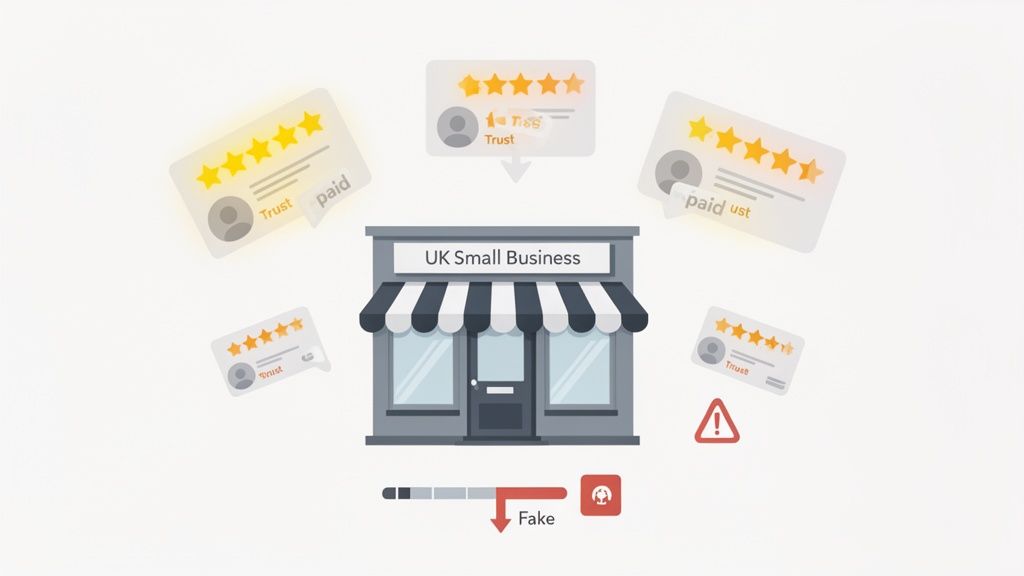
The problem of fake reviews on Google isn't some minor headache; it's a critical business risk. A sudden wave of baseless one-star ratings can tank your average score overnight. That drop can push you down in local search results and make potential customers hesitate before even considering you.
The Different Forms of Review Fraud
Deceptive reviews aren't always obvious and can pop up in a few different disguises. Getting to know them is the first step in defending your business profile.
- Competitor Attacks: This is when a rival business deliberately leaves negative reviews on your profile to make theirs look better by comparison. It’s dirty tactics, pure and simple.
- Paid Positive Reviews: Some businesses try to game the system by buying fake five-star reviews from so-called "review farms." It's a shortcut meant to inflate their reputation and fool customers.
- Disgruntled Ex-Employees: A former staff member with a grudge might leave a nasty review as a form of revenge, often filled with false or misleading claims about how you run your business.
- Customer Extortion: This is when someone threatens to post a string of negative reviews unless you give them a discount, a refund, or a freebie. It's straight-up blackmail.
A business's online reputation is one of its most valuable assets. Fake reviews directly attack this asset, creating a false narrative that can take significant time and effort to correct.
The Financial Cost of Deception
The sheer scale of this problem is staggering. According to the Competition and Markets Authority (CMA), a mind-boggling £23 billion of UK consumer spending is potentially influenced by online reviews every single year. That number alone shows how much financial clout these opinions have.
When fake reviews muddy the waters, honest businesses lose real money, and consumers get duped into making bad choices. You can dive deeper by reading the full government report on the impact of online reviews. It’s this enormous financial sway that explains why tackling review fraud has become such a high-stakes issue for businesses and regulators.
How to Spot a Fake Google Review
Telling a real customer story from a made-up one can feel like a bit of detective work. But once you know what to look for, spotting fake reviews on Google gets a whole lot easier. It's rarely one single giveaway; it's usually a pattern of suspicious signals you’ll find in the reviewer's profile, the words they use, and even when they post.
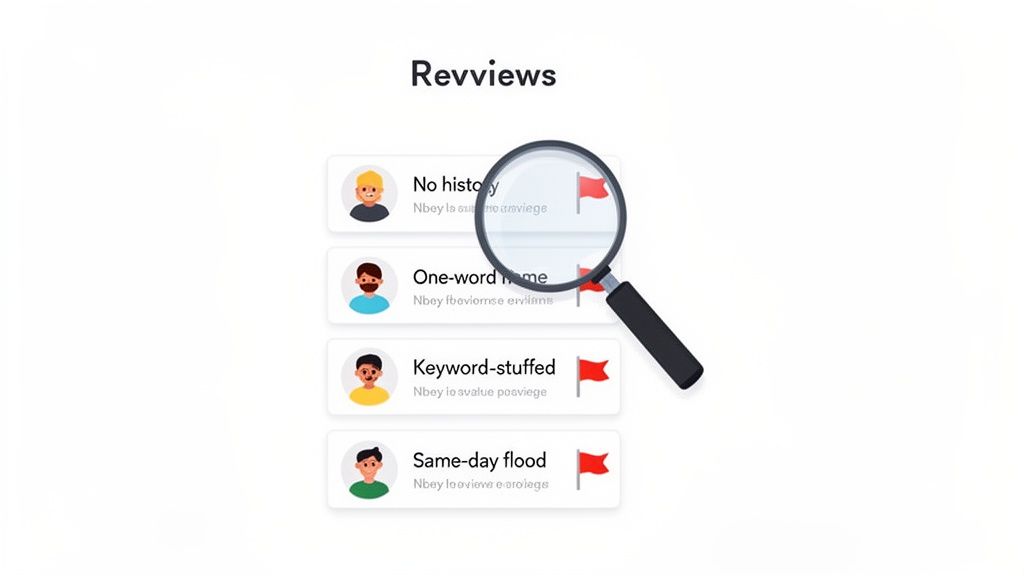
Let's break down the key areas to investigate when a review just doesn't feel right. By looking closely at these three pillars—the profile, the content, and the context—you can build a solid case to get it removed.
Analyse the Reviewer's Profile
Your first stop should always be the profile of the person who left the review. A real customer’s profile usually paints a picture of their experiences, but a fake one is often just a flimsy, quickly-made facade.
Keep an eye out for these red flags:
- Generic or Odd Names: Be wary of profiles with very common names (like "John Smith") that have no profile picture. Jumbles of letters and numbers are also a big warning sign.
- No Review History: Is this the only review they've ever left? A profile with a single, extreme one-star or five-star rating is highly suspicious. Genuine users tend to review multiple places over time.
- Impossible Geography: Check their other reviews. If a user has supposedly visited a cafe in London, a plumber in Manchester, and a dentist in Glasgow all in the same afternoon, you've likely found a fake account.
- Blank Profile Picture: This isn't a smoking gun on its own, but a blank avatar combined with any of the other red flags makes a much stronger case that the profile isn't legitimate.
Scrutinise the Language and Content
Often, the biggest clues are hiding in plain sight within the text itself. Fake reviews typically lack the specific, nitty-gritty details you’d expect from someone who has actually used your services. They either try way too hard to sound authentic or don't try at all.
For instance, a genuine negative review might say, "The chicken korma was disappointingly bland and the service was slow; we had to wait 20 minutes just for drinks." The fake version is more likely to be a vague, emotional outburst like, "This place is a disaster! Worst service ever! AVOID AT ALL COSTS!"
The hallmark of a fake review is often its lack of substance. It focuses on extreme emotion—either over-the-top praise or furious condemnation—without providing the specific, verifiable details of a real interaction.
These days, another challenge is spotting AI-generated text. To help tell the difference between overly polished machine writing and a real person's words, you can explore the best AI content detection tools available.
To help you get a clearer picture, here’s a quick-reference guide to what you should be looking for.
Red Flags for Identifying Fake Google Reviews
This table breaks down the common differences between suspicious reviews and the real feedback that helps your business grow.
| Signal Category | Signs of a Fake Review | Signs of a Genuine Review |
|---|---|---|
| Profile Credibility | Anonymous name, no photo, single review left. | Established profile with a name, photo, and varied review history. |
| Language & Tone | Vague, overly emotional, lots of jargon or CAPITALS. | Specific details, balanced tone, describes a personal experience. |
| Specifics | Lacks names, dates, or details about the product/service. | Mentions staff members by name, specific dishes, or project details. |
| Timing | A sudden burst of reviews appearing at once. | Reviews appear at a natural, steady pace over time. |
| Content Intent | Mentions a competitor by name or stuffs keywords. | Focuses solely on their experience with your business. |
Keep this table handy. When a new review comes in that feels off, running it through these checks is a great first step in figuring out if it’s legitimate.
Examine the Timing and Context
Finally, think about when the reviews were posted. A malicious attack is often a coordinated effort, and that creates unusual patterns that stand out from your normal flow of feedback.
Watching for these trends is a vital part of managing your reputation. In fact, you can dive deeper into how to effectively monitor your online reputation in our comprehensive guide.
Here are the key timing signals to watch for:
- A Sudden Flood of Reviews: Does your business normally get a couple of reviews a week? If you suddenly get 20 one-star ratings in a single day, it’s a classic sign of a coordinated attack.
- Competitor Name-Dropping: Be cautious of reviews that slam your business while conveniently recommending a specific competitor. This is a common and shameless tactic.
- Keyword Stuffing: Both fake positive and negative reviews sometimes try to manipulate search rankings by stuffing keywords into the text (e.g., "Best plumber in Bristol" or "Worst roofing company in Bristol"). This always sounds unnatural and forced.
Understanding Google's Fight Against Review Fraud
When you're hit with a wave of suspicious feedback, it's easy to feel like you're fighting this battle alone. But the truth is, Google invests a massive amount of resources into protecting its review ecosystem. They have powerful systems in place to maintain the integrity of the platform and combat the rise of fake reviews on Google. Getting to grips with their approach is the first step toward feeling more in control.
Google's policies are refreshingly straightforward: if a review isn't based on a real experience, it’s not allowed. This covers everything from a competitor leaving a one-star review to a business buying a batch of fake five-star feedback from some shady third-party service.
The Role of Automated Detection Systems
Let's be realistic—Google isn't manually checking every single review that gets posted. The scale is just too immense. Instead, it relies on sophisticated automated systems that work 24/7. These systems use machine learning to crunch billions of data points, constantly scanning for patterns that smell fishy.
Think of it like the fraud detection on your credit card. Your bank knows your typical spending habits. If a strange transaction suddenly pops up in another country just minutes after you bought a coffee down the road, it gets flagged. Google’s system works in a similar way, identifying behaviour that just doesn't fit the pattern of a genuine customer.
This automated defence is the first and most important line of protection. It's incredibly good at spotting things like a sudden, unnatural spike in reviews for one business, identical or oddly similar wording across multiple reviews, or a flurry of activity from accounts with a history of suspicious behaviour.
Google's proactive defence is all about stopping fraudulent content before it ever goes public. Their machine learning models are constantly evolving to keep up with the new tricks that people use to try and manipulate the system.
It's a bit of a technological arms race. As the fraudsters get more clever, Google’s algorithms have to get smarter to recognise and block their new methods. This constant back-and-forth is what keeps the platform trustworthy for both businesses and the customers who rely on it.
How Google's AI Fights Review Spam
The whole process of spotting and stopping fake reviews has become incredibly advanced. Google's AI is now the main tool for identifying these suspicious patterns. In fact, their systems have become remarkably effective, blocking or removing millions of reviews that break the rules. The vast majority of these are zapped before anyone even sees them. You can get a sense of the sheer scale of this operation by reading up on Google's 2024 spam-fighting efforts on Search Engine Roundtable.
And it's not just about the reviews. This AI-driven approach is also used to block millions of fake Business Profiles and stop people from making dodgy edits to legitimate listings. It’s all part of a wider effort to keep Google Maps reliable.
The Consequences for Rule-Breakers
Google doesn't just delete the bad content and call it a day. They also take action against the accounts behind it. The consequences for anyone caught breaking the rules can be pretty severe, sending a clear message that trying to game the system won't be tolerated.
Here’s what can happen to people and businesses caught engaging in review fraud:
- Content Removal: The most common and immediate action is simply deleting the offending reviews.
- Account Suspension: Users who repeatedly break the rules can have their Google accounts suspended, stopping them from leaving any more reviews.
- Business Profile Penalties: If a business is caught buying or soliciting fake reviews, Google can hit them with penalties, such as making them less visible in search results. In really serious cases, they might even remove the Business Profile altogether.
These measures exist for a reason: to create a level playing field where businesses thrive based on genuine customer satisfaction, not on how well they can manipulate reviews.
Your Step-by-Step Plan to Remove Fake Reviews
It’s incredibly frustrating to see a fake review pop up on your profile. The good news is you don’t have to just sit there and take it. The trick is to be methodical and use Google's own reporting channels to make your case clearly and effectively. Think of this as your playbook for fighting back and getting those bogus reviews taken down.
First, it helps to understand what happens behind the scenes. When a review is posted, it doesn't just go live without any checks. It first passes through Google’s own moderation system, which is largely automated.
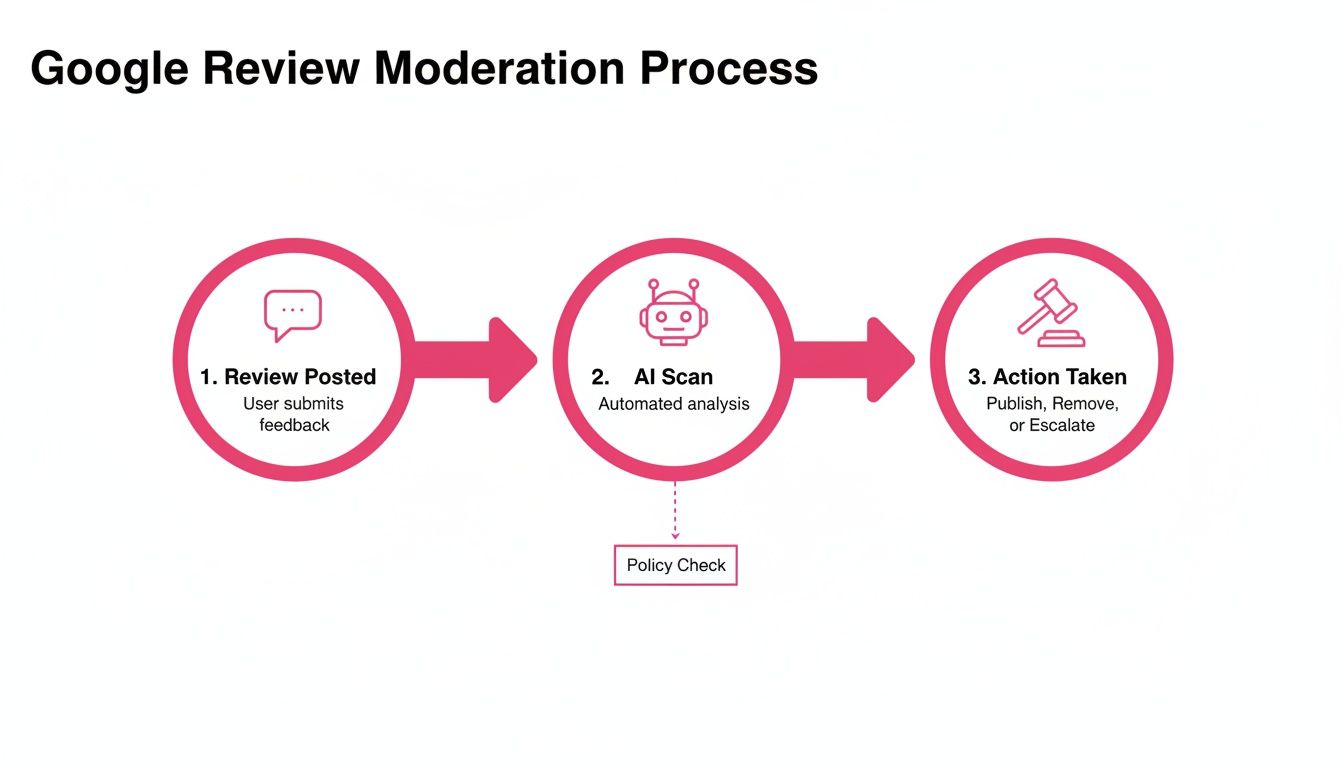
As you can see, that initial AI scan is the first line of defence. That's why your report needs to be spot-on—it helps Google’s system (and potentially a human reviewer) quickly grasp why the review breaks the rules.
The Initial Reporting Process
Your first move is always to flag the review directly on Google. It’s a straightforward process you can do from either Google Search or Maps. This is your direct line to the moderation team, so it pays to do it right the first time.
Here’s the simple workflow:
- Find the Review: Go to your Google Business Profile and scroll to the review in question.
- Click the Three-Dot Menu: You'll spot a small menu icon (three vertical dots) right next to the reviewer’s name. Give it a click.
- Select "Report Review": A dropdown menu will appear. Choose the report option, which will then ask you to explain why you're flagging it.
This is the most critical part of the whole process. Choosing the right violation gives the moderation team the context they need to investigate properly. A vague report is an ignored report.
Choosing the Correct Violation Type
When Google asks why you're reporting the review, don't just pick the first option you see. Be precise.
Here are the most common reasons and what they actually mean:
- Off-topic: The review has nothing to do with an actual experience at your business. It might be a rant about something else entirely.
- Spam: This is for blatantly fake reviews, content from bots, or if you suspect you're under a coordinated attack from a review farm.
- Conflict of interest: The review was left by a competitor, a disgruntled ex-employee, or anyone else with an obvious axe to grind.
- Hate speech, Harassment, etc.: Use this for any content that is abusive, discriminatory, or makes threats.
After you submit your report, you'll get an email from Google confirming they've received it. From there, it's a waiting game. You should get a decision within 3 to 7 working days. If a week goes by and that fake review is still sitting there, it's time to escalate.
Escalating a Denied or Ignored Report
So, what happens if your report gets denied or you hear nothing back? Don't lose hope. This is where you take it to the next level by using the Google Business Profile support system to appeal the decision. This is your chance to build a much stronger case with more evidence.
The escalation process is where you get to tell the whole story. It lets you provide screenshots, customer records (or the lack thereof), and a proper explanation of why the review is a clear policy violation.
To kick things off, you'll need to find the "Review Management Tool" in your Google Business Profile help section. It shows the status of every review you've already reported. From here, you can select any that weren't removed and ask for a second look.
When you submit an appeal, come prepared with more ammo. This could include:
- The reviewer's name and a direct link to their profile.
- A clear, concise explanation of why you believe the review is fake, pointing to the red flags we talked about earlier (e.g., "This user reviewed businesses in three different countries on the same day").
- Screenshots of the review and the user’s profile, especially if their review history looks dodgy.
- A simple statement confirming you have no record of this person in your sales system, CRM, or booking records.
If you find yourself dealing with a flood of fake reviews, it's worth learning more about how to remove negative reviews on Google to get a handle on different strategies. At the end of the day, persistence and solid evidence are what will get that fake review taken down and protect the reputation you've worked so hard to build.
Building a Reputation That Resists Fake Reviews
While knowing how to report and remove fake reviews on Google is a vital defensive skill, the best long-term strategy is actually a strong offence. Think of it this way: building a resilient online reputation isn’t about swatting away individual fake reviews one by one. It’s about making them totally irrelevant.
The aim is to cultivate such a strong and steady stream of genuine customer feedback that a single fraudulent one-star review barely makes a scratch on your overall rating. A business with 200 glowing, detailed reviews is in a completely different league than a business with only five when it comes to weathering a malicious attack. This proactive approach shifts your focus from damage control to building a solid foundation of trust.
Make Leaving a Review Effortless
Let's be honest, the single biggest reason happy customers don’t leave feedback is hassle. People are busy. Even a tiny bit of friction in the process is enough to make them give up. Your job is to make it as seamless as possible, capturing their positive feelings while the great experience is still fresh in their mind.
Here are a few proven methods to get more genuine feedback:
- Create a Direct Review Link: Head into your Google Business Profile dashboard and generate your unique, direct review link. This takes customers straight to the review form—no searching, no fumbling around.
- Use QR Codes In-Store: If you have a physical location like a café or shop, a QR code on a receipt, menu, or at the till is incredibly effective. A quick phone scan, and they’re right where they need to be.
- Time Your Email or SMS Requests: For service businesses, a follow-up message a day or two after the job is done works wonders. A simple, personalised note asking for their thoughts is often all it takes.
The secret to getting a high volume of genuine reviews is surprisingly simple: ask for them, and make the process incredibly easy. When you remove the effort, you massively increase the odds that a satisfied customer will actually share their experience.
Turn Feedback into a Continuous Cycle
Building a robust review profile isn't a one-off campaign; it needs to be part of your daily operations. You want to create a continuous cycle of service, feedback, and improvement. This approach not only strengthens your defence against fake reviews on Google but also gives you invaluable insights into what your customers truly value.
A more organised approach means consistently keeping an eye on your online presence. To really protect your brand's image and build a reputation that can shrug off the impact of fake reviews, it's worth looking into specialised online reputation management tools that can help automate some of this work.
Engaging With All Genuine Feedback
Responding to every single genuine review—the good and the bad—is a cornerstone of great reputation management. When potential customers see you actively engaging with feedback, it sends a clear signal that you genuinely care about the customer experience.
A simple "Thank you so much for your kind words!" on a positive review shows you’re grateful. A thoughtful, non-defensive reply to a critical review shows professionalism and a real willingness to sort things out. This level of engagement builds a powerful story of a business that listens, which makes any out-of-place fake reviews look even more suspicious by comparison. At the end of the day, it’s this authentic interaction that future customers will trust most.
How UK Regulations Are Cracking Down on Review Fraud
If you’re a UK business, you’re no longer fighting the battle against fake reviews on your own. You’ve now got some serious regulatory muscle on your side. Official bodies are finally stepping in, making platforms accountable and pushing for a fairer, more transparent online market for everyone.
This is a massive shift. It means review fraud is being treated as more than just an annoyance—it's now seen as a serious threat that damages fair competition and destroys consumer trust.
The CMA Steps In
The main force behind this change is the Competition and Markets Authority (CMA), the UK’s watchdog for competition and consumer rights. The CMA recognised just how much reviews influence where people spend their money and launched a deep dive into how major platforms were dealing with the flood of fake reviews on Google and other sites.
That investigation wasn't just for show. It resulted in Google making legally binding promises to get better at spotting, removing, and blocking fake reviews. This isn't just a friendly suggestion; it's a formal commitment that puts the onus directly on Google to clean up its own backyard.
This regulatory pressure gives UK businesses a powerful ally. It creates formal expectations and real consequences, pushing for systems that genuinely protect your reputation and are actively enforced.
What This Means for UK Businesses
The CMA's involvement has forced tangible changes, creating real-world penalties for anyone trying to cheat the system. A huge milestone was reached when Google agreed to a specific set of actions to tackle review fraud head-on. Under this agreement, people who repeatedly post fake reviews for UK businesses will have their content wiped and can be banned entirely.
And what about businesses caught paying for fake positive feedback? Google has committed to slapping a prominent 'warning' label on their Business Profiles, making their shady tactics obvious to potential customers. You can read more about these new UK regulatory undertakings on Global Banking & Finance Review.
These measures give honest businesses an extra layer of protection and a clearer path for recourse. They also create a strong deterrent. The key takeaways for you are:
- You've Got Backup: The CMA is actively fighting to level the playing field.
- Platforms Are on the Hook: Google is now legally bound to improve its fraud detection.
- Cheats Face Penalties: Individuals and businesses caught gaming the system will be publicly flagged and restricted.
Ultimately, this regulatory framework makes your position stronger and helps ensure the review platforms you depend on are becoming safer and more trustworthy.
Frequently Asked Questions
Dealing with fake Google reviews can be confusing, and it's natural to have questions. Here are some straightforward answers to the things UK business owners ask us most often.
How Long Does It Take for Google to Remove a Fake Review?
After you flag a review, Google typically takes around 3 to 7 days to make a decision. It’s a bit of a waiting game.
If the review is particularly tricky or your first report gets rejected, you’ll need to escalate it through Google Business Profile support. This can add another week or two to the process. The best thing you can do is provide clear, solid evidence to support your claim—it really does speed things up.
Should I Reply to a Fake Review?
It really depends. If the review is just blatant spam—like a jumble of random words or an advert for something else—don't bother replying. Just report it and move on.
On the other hand, if it looks like it's from a real person but you know the claims are false, a careful public reply is a smart move. Keep it calm and professional. A simple, "We can't seem to find any record of you as a customer, but we'd love to help. Please get in touch with us directly" works wonders. This shows everyone else reading it that you’re reasonable and take feedback seriously, even when it’s unfair. The golden rule: never get dragged into a slanging match online.
A professional response to a fake review isn't for the reviewer; it's for every future customer reading it. Your calm and helpful tone demonstrates confidence and a commitment to genuine customer service.
Can I Sue Someone for a Fake Review in the UK?
Technically, yes. In the UK, you can take legal action under defamation law (specifically, libel). If a review contains false statements that have caused serious harm to your business's reputation, you might have a case.
But let's be realistic: it’s a long, expensive road that can easily cost thousands of pounds. It's almost always better to try all of Google's reporting and removal options first. If you’ve hit a brick wall with Google, then it might be time to chat with a solicitor who specialises in defamation to see if it’s a fight worth having.
Keeping your online reputation in check is a full-time job, but it doesn't have to be a manual one. LocalHQ uses AI to keep an eye on your reviews, write on-brand replies, and give you the tools you need to build a strong, authentic presence that can shrug off fake attacks. Take control of your local SEO and reputation at https://localhq.io.