Local SEO for Dentists: Attract More Patients in Your Area
When we talk about local SEO for dentists, we're really talking about one thing: making sure your practice shows up when a potential patient nearby searches for dental care online. The goal is simple – to get your practice in front of people in your community who are actively looking for a dentist, driving more calls, online bookings, and new patients through your doors, straight from Google and Google Maps.
Why Local SEO Is a Game-Changer for UK Dental Practices
Remember when a local newspaper ad or a leaflet drop was enough to keep the appointment book full? Those days are long gone. Today, the search for a new dentist starts with a tap on a smartphone.
Someone’s sitting at their desk with a sudden toothache and types “emergency dentist near me” into Google. Or they’re thinking about cosmetic work and search for “teeth whitening in Manchester.” Instantly, a map pops up with the top-rated local clinics. If your practice isn’t on that list, for all intents and purposes, you don’t exist to that potential patient.
This is precisely why local search engine optimisation (SEO) has become absolutely essential for UK dental practices. It's not some abstract digital marketing tactic; it's the most direct and effective way to attract new patients today. To really get a handle on the benefits, it's worth understanding what Local Search Optimization is and how it helps people find businesses in their immediate area.
The Modern Patient Journey
The way people find a new dentist today is a fast, three-step dance of need, search, and decision, driven entirely by convenience and trust.

This journey makes one thing crystal clear: being highly visible in those initial local search results is the crucial first step to winning a new patient.
This isn’t just a hunch; the data backs it up completely. In the UK, over 50% of all searches for dentists now include "near me" or a location. Think about that for a second. It highlights just how critical local SEO is for any dentist wanting to capture this high-intent traffic.
To put a number on it, the search term 'dentist near me' alone gets an incredible 19,700 searches every month in the UK. That’s a huge number of potential patients actively looking for a practice just like yours.
By focusing on local SEO, you aren't just chasing rankings; you are placing your practice directly in the path of motivated patients at the exact moment they need care. It's about being the most convenient and trusted answer to their urgent problem.
While traditional advertising still has its place, the shift to digital is undeniable. Local SEO offers a targeted, measurable, and often more cost-effective way to reach patients who are already looking for you.
Local SEO vs Traditional Advertising for Dentists
| Feature | Local SEO | Traditional Advertising |
|---|---|---|
| Targeting | Hyper-local; reaches users actively searching for dental services now. | Broad; targets a general local audience, many of whom may not need a dentist. |
| Measurability | Highly measurable (calls, clicks, direction requests, website visits). | Difficult to track direct ROI; relies on anecdotal feedback. |
| Cost-Effectiveness | Higher upfront investment but delivers long-term, compounding returns. | Ongoing high costs for continued visibility (e.g., monthly ad placements). |
| Patient Intent | Captures high-intent leads who are ready to book an appointment. | Aims to build general brand awareness over time. |
| Trust Building | Builds trust through reviews, detailed business info, and high rankings. | Builds familiarity, but trust is not inherently established by the ad itself. |
Ultimately, a well-executed local SEO strategy delivers tangible results you can see and measure: more phone calls, more people asking for directions to your clinic, and most importantly, more appointments in your diary. It builds your practice's authority and trust before a patient even steps foot inside, making it the foundational engine for sustainable growth.
Optimising Your Google Business Profile to Attract Patients
Think of your Google Business Profile (GBP) as the digital front door to your practice. For many potential patients, it's the very first impression they'll have of your clinic. Getting this right is probably the single most impactful thing you can do for your local SEO, turning a simple online listing into a powerful patient magnet.
This isn't just about ticking a box to say you exist online. A properly filled-out, active profile gives Google all the signals it needs to show your practice for those crucial local searches, like "emergency dentist in Bristol" or "cosmetic dentist near me."
Choose Categories That Get You Found
First things first, let's talk categories. "Dentist" is your primary, no-brainer choice, but don't stop there. Google lets you add secondary categories, and this is where you can really start to stand out for specific, high-value treatments.
Think about what you want to be known for.
- Cosmetic Dentist: Perfect if you're big on veneers and smile makeovers.
- Dental Implants Periodontist: Essential for attracting patients looking for this specific, high-revenue procedure.
- Emergency Dental Service: A must-have for capturing those urgent, high-intent searches.
- Paediatric Dentist: Helps you connect directly with families looking for child-friendly care.
By adding these, you’re not just a general dentist anymore; you're telling Google exactly what you specialise in, which helps you rank for a much wider range of patient searches.
Craft a Compelling Business Description
Your business description is your opportunity to speak directly to a potential patient. Don’t just list your services in a dry, clinical way. Tell your story. Are you a family-run practice that’s brilliant with nervous patients? Say so. Do you use the latest pain-free technology? That’s a huge selling point—highlight it.
You can weave in keywords here, but the real goal is to address a patient's worries and needs. This builds a foundation of trust before they've even booked an appointment.
The image below shows exactly what we're aiming for: a prominent spot in the local search results, complete with a map, glowing reviews, and easy-to-find contact details.

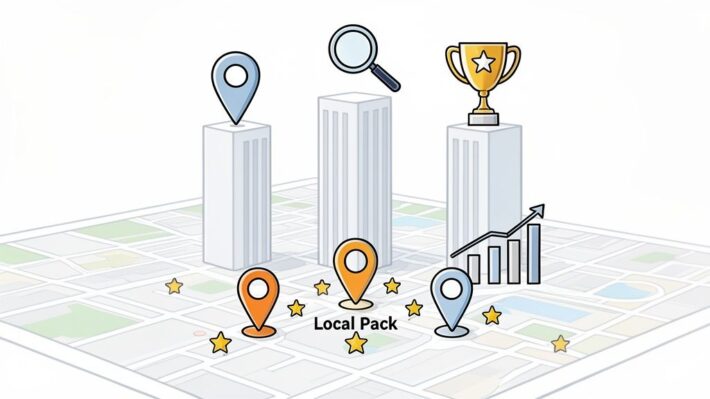
Getting into this "map pack" is the top prize. It’s where the majority of local clicks, calls, and direction requests come from.
The Non-Negotiable Rule: NAP Consistency
Your practice's Name, Address, and Phone number (NAP) must be absolutely identical everywhere online. I mean everywhere—your website, your GBP, and every single online directory. A tiny difference like "St." versus "Street" can confuse Google and hurt your local authority.
Use Photos and Posts to Build Trust
Never underestimate the power of good visuals. Get professional, high-quality photos of your clinic's exterior and interior, your welcoming team, and some shots of happy patients (with their permission, of course). A little-known tip is to geotag these images with your practice's location, which can give Google another small but helpful local signal.
Think of Google Posts as mini-adverts that sit right on your profile. They’re perfect for promoting a teeth-whitening offer, introducing a new hygienist, or sharing a quick blog post on dental health. Posting regularly signals to Google that your practice is active and engaged, which can only help your rankings.
To really get this right, you need to optimize your Google Business Profile for local success. It's also worth reading our guide on how to verify your Google Business Profile at https://localhq.io/how-to-verify-google-business/ to make sure you've got the fundamentals sorted from day one.
Earning Trust with Patient Reviews and Local Citations
In dentistry, your reputation is everything. Online, that reputation isn't just about your qualifications; it's built on social proof. We're talking about patient reviews and something called "citations." These two things are the bedrock of local SEO for dentists, signalling to both Google and potential patients that your practice is a trusted, established part of the local community.
A consistent flow of positive reviews is arguably one of the most powerful signals for ranking in the local map pack. But more than that, it’s often the first thing a nervous patient looks for when choosing a new dentist.

Making Reviews a Natural Part of Your Practice
Actively asking for reviews doesn't have to feel awkward. The key is to make it incredibly simple for happy patients to share their experience. A friendly follow-up email or text message after their appointment, with a direct link to your Google review page, works wonders.
Replying to every single review? That’s non-negotiable.
- For glowing reviews: A brief, personalised "Thank you" shows you're listening and makes the patient feel valued.
- For negative reviews: This is your chance to shine. A swift, professional, and understanding response is critical. It shows you’re committed to patient care and can often turn a negative situation around, demonstrating to anyone reading that you take feedback seriously.
Responding to reviews—both the good and the bad—is a very public demonstration of your practice's commitment to patient satisfaction. It transforms your Google profile from a static listing into a dynamic conversation about your excellent service.
What on Earth Are Local Citations?
Beyond reviews, Google is constantly cross-referencing information across the web to confirm your practice is legitimate. This is where local citations play a crucial role. A citation is simply any online mention of your practice's Name, Address, and Phone number (often called NAP).
Think of them as digital breadcrumbs. The more consistent these citations are on reputable websites, the more confident Google becomes in your location data. This directly helps your local rankings. The keyword here is 100% consistency. A tiny difference, like using "Rd" on one site and "Road" on another, can muddy the waters and weaken your authority.
Where to Build Your UK Citations
You'll want to focus your efforts on high-quality, relevant UK directories and health-specific websites. This cements your geographical relevance and builds a solid local SEO foundation.
Some key places to start include:
- Core UK Directories: Yell, Thomson Local, and Scoot are the big ones.
- Healthcare Portals: Making sure your details are correct on the NHS website and private healthcare directories is vital for credibility.
- Hyper-Local Websites: Don't overlook your local chamber of commerce website or community business directories.
Building a clean citation profile is a meticulous process, but the payoff is huge. It's no coincidence that practices ranking in the top three map pack positions get a staggering 67% of all clicks. I worked with one London-based practice that saw a 40% increase in dental implant enquiries in just three months, simply by cleaning up their NAP inconsistencies and optimising their business categories.
Combine a proactive review strategy with a meticulous citation profile, and you'll build an online reputation that wins over both search engines and the local patients you want walking through your door. To get a head start, you might find our free UK business directory list helpful.
Creating Website Content That Connects with Local Patients
Think of your Google Business Profile as the digital front door to your practice. It gets people's attention. But your website? That's your reception area. It's where you make your first real impression.
Once a potential patient clicks through from your profile, your website has to do the heavy lifting. It can't just be a brochure listing your services. It needs to speak directly to them, answer their unspoken questions, and give them every reason to feel confident that your practice is the right choice for them and their family. This is where sharp, focused on-page SEO makes all the difference.

We're moving beyond generic descriptions of procedures. The goal is to create content that resonates with people living in your town, city, or neighbourhood. This approach is what builds trust and, crucially, signals to Google that you are the most relevant local answer for their search.
Develop Hyper-Local Service Pages
Let's get practical. Think about your most valuable treatments—implants, Invisalign, cosmetic bonding. Simply having a single "Teeth Whitening" page just won't cut it in today's competitive local search results. You need dedicated, location-specific pages that zero in on the exact phrases real people are typing into Google.
A patient isn't just searching for "dental implants." They're looking for "dental implants in Birmingham" or maybe "emergency dentist near me in Leeds."
Your job is to have a specific, optimised page ready for each of those core service and location combinations.
- Page Title: This is your most powerful on-page element. Keep it clear and local, something like "Expert Teeth Whitening in Manchester | Bright Smile Dental".
- Headings (H1, H2): Use your headings to break up the page and naturally weave in variations like "Your Local Manchester Teeth Whitening Specialists".
- Body Copy: Don't just describe the treatment; put it in a local context. You could mention serving families from a well-known local school or being just around the corner from a major landmark.
This focused approach does more than just help you rank for those high-value local searches. It instantly reassures a prospective patient that you're part of their community.
To help you nail this for every page, here's a quick checklist to follow. Getting these elements right consistently is a cornerstone of effective on-page SEO.
Essential On-Page SEO Checklist for Dental Service Pages
| SEO Element | Optimisation Tactic | Example |
|---|---|---|
| Page Title Tag | Include Primary Keyword + Location + Practice Name. Keep it under 60 characters. | `Dental Implants in Bristol |
| Meta Description | Write a compelling, 155-character summary including the keyword, location, and a call-to-action. | Looking for dental implants in Bristol? Avon Dental offers expert care for a lasting smile. Book your free consultation today! |
| H1 Heading | Use one unique H1 per page that clearly states the page's topic. | Restore Your Smile with Dental Implants in Bristol |
| H2/H3 Headings | Break up content with subheadings. Include keyword variations naturally. | The Dental Implant Process, Are You a Candidate for Implants?, Implant Costs in Bristol |
| Body Content | Write at least 500 words of unique, helpful content. Weave in the keyword and location naturally 3-5 times. | "Our Bristol dental practice has helped hundreds of patients regain their confidence with high-quality dental implants…" |
| Internal Links | Add 2-3 links to other relevant pages on your site (e.g., contact page, main services page). | "…you can learn more about our team or contact us to schedule a visit." |
| Image Alt Text | Describe images for screen readers and search engines. Include the keyword and location if relevant. | alt="Patient smiling after receiving dental implants at our Bristol clinic" |
By systematically applying these tactics to each service page, you create a powerful, locally-optimised foundation that Google and your patients will love.
Go Beyond Services with Helpful Blog Content
Service pages are brilliant for capturing patients who are ready to book an appointment now. But what about all the people who are still in the research phase? That’s where a good practice blog comes in. By creating genuinely helpful articles that answer common local questions, you build your reputation as a trusted authority.
Put yourself in a potential patient's shoes. What might they be searching for? It could be anything from "How to choose a family dentist in Glasgow?" to "What are the average costs for Invisalign in Cardiff?".
By answering these questions, you're not just selling a service; you're providing real value. This builds trust long before they even think about picking up the phone, positioning your practice as the go-to expert in your area.
This strategy pays off in a big way. In fact, data shows that patients who discover a practice through this kind of educational content have a 35% higher treatment acceptance rate compared to those who click on a paid ad. Why? Because the trust is already there. You can dig deeper into the research about these valuable patient journeys.
Finally, don't forget your contact page. It's a critical piece of the local SEO puzzle. It must feature your full NAP details (Name, Address, Phone Number), an embedded Google Map for easy directions, and crystal-clear opening hours. Make it as simple as humanly possible for a local patient to find you and get in touch.
Pushing Ahead: Advanced Tactics and Local Link Building
Once you've nailed the fundamentals, it's time to pull away from the competition. These next-level strategies are where you can really build a moat around your practice, moving from basic optimisation to technical precision and genuine community involvement. This is how you send powerful trust signals to Google that your rivals simply can't match.
First up, let's talk about local schema markup. This is essentially a hidden chunk of code you add to your website that acts like a digital name tag for Google. It explicitly tells search engines you're not just any business; you're a 'Dentist' or 'DentalClinic' at a specific address, with specific opening hours and offering particular dental services.
Speaking Google's Language with Schema
Think of schema as translating your website's key information into a language that search engines understand perfectly. It removes all the guesswork for them, which can give you a real, tangible edge in local search results. No more hoping Google figures it out – you’re telling it directly.
Here’s a look at the 'Dentist' schema type, straight from the folks at Schema.org who set the standards.
This might look a bit technical, but its job is simple: to help search engines categorise your practice with absolute precision. This ensures you show up when local patients are searching for exactly what you offer. It’s a simple addition that powerfully reinforces your local authority.
Earning Links by Being a Good Neighbour
The other piece of the advanced puzzle is building high-quality local backlinks. A backlink is just a link from another local website pointing back to yours. Every single one acts as a vote of confidence, telling Google that your practice is a known, trusted, and respected part of the local community.
Forget any old, spammy ideas you might have about link building. Today, the most effective way to earn these links is through real-world relationships and activities. This isn't just about SEO; it's about weaving your practice into the very fabric of your neighbourhood.
Here are a few practical ideas to get you started:
- Sponsor a local team or event: Think about the local school's summer fete, a charity 5k run, or the kids' football team. These organisations are almost always thrilled to add a link to their sponsors' page, giving you a highly relevant local backlink.
- Team up with other local businesses: Could you partner with a nearby pharmacy on a health awareness day? Or a local private GP for cross-referrals? Co-writing a blog post or getting featured on their partners page is a brilliant way to earn a valuable link.
- Offer a local discount: Providing a small discount for students from the local university or staff at a large nearby company can often get you a mention (and a link) on their intranet or local perks page.
Remember, a single link from a well-respected local organisation is worth more than a hundred generic directory listings. It's a powerful signal that you're a genuine local authority.
These community-focused efforts do so much more than just improve your local SEO for dentists. They build real goodwill, generate word-of-mouth referrals, and create a foundation for sustainable, long-term growth.
Measuring What Matters: Proving Your Local SEO ROI
It’s an old saying, but it’s true: what gets measured, gets managed. After you've put in the hard work on your local SEO, the final piece of the puzzle is tracking what's actually working. We're not talking about vanity metrics here; we need to connect the dots between your online activity and new patients walking through your practice doors.
Your first port of call for this is your Google Business Profile (GBP) Insights dashboard. Think of it as your window into how local patients are actually finding and interacting with your practice online.
What to Look for in Your GBP Insights
Get comfortable with this dashboard, because it tells you the story of your local visibility. Pay close attention to a few key areas:
How customers search for your business: This is a goldmine. It shows you the difference between ‘Direct’ searches (people who typed in your practice name) and ‘Discovery’ searches (people who searched for something like “dentist near me” and found you). A steady increase in ‘Discovery’ searches is a fantastic sign that your SEO is pulling in brand new patients who hadn't heard of you before.
Actions taken on your profile: This is where you see genuine patient intent. The dashboard tracks the most important interactions: website clicks, requests for directions, and phone calls. When these numbers go up, you know patient interest is growing.
Of course, your GBP dashboard only tells part of the story. To get a true picture, you need to see your rankings from a patient's point of view. This is where tools like geo-grid rank trackers come in. They show you exactly where you rank on Google Maps for your most important search terms (like "emergency dentist" or "Invisalign Stockport") across every postcode in your local area. This gives you a visual map of where you're dominant and where competitors are sneaking ahead, letting you fine-tune your strategy with precision.
Ultimately, the goal is to tie these digital signals back to real-world results. By tracking how many phone calls from your GBP actually convert into booked appointments, you can calculate a concrete return on investment (ROI).
This is the data that justifies your marketing budget. For example, we consistently see that local SEO delivers an exceptional ROI for UK dental practices, with many seeing returns of 300-500% within the first year. This is because the leads are incredibly high-quality; the average cost per lead from SEO is often around £4.55, a fraction of the £25+ you might pay for a lead from paid advertising. For a deeper dive into these numbers, you can check out more stats on dental marketing performance in the UK.
When you measure consistently, local SEO stops being a 'hope and see' marketing tactic and becomes a predictable engine for growing your practice.
Ready to stop guessing and start measuring your local SEO performance with confidence? LocalHQ provides an all-in-one platform with geo-grid rank tracking, AI-powered optimisation, and clear reporting to show you exactly what’s working. See how you can attract more local patients and calculate your ROI with ease. Learn more at LocalHQ.