
Local SEO ranking factors: Boost Your UK Business Online
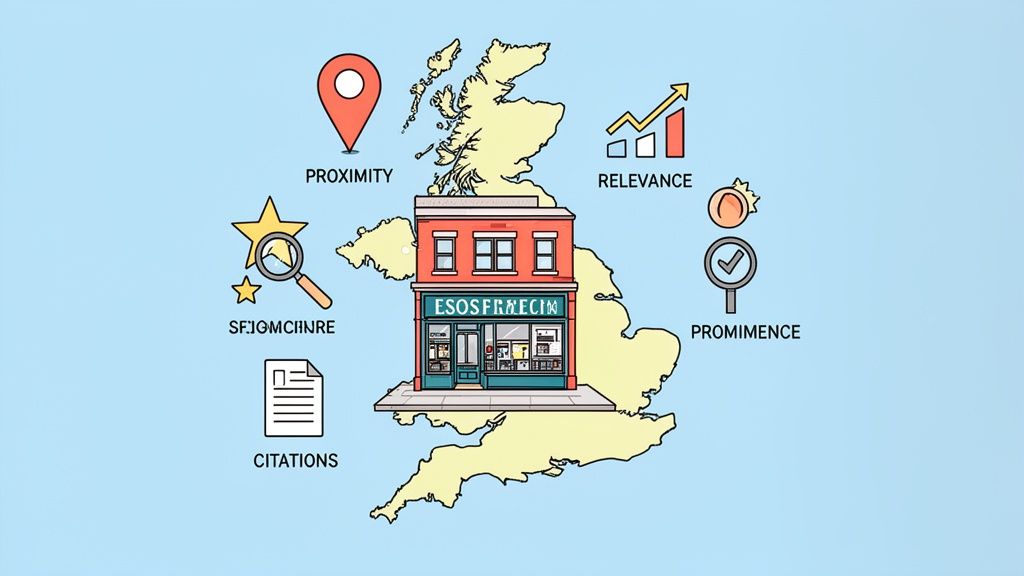
The secret to getting found by local customers isn't some mystical SEO formula. It’s actually pretty straightforward. Think of it like this: Google is trying to be the most helpful local guide imaginable. To do that, it looks for signals that point to Relevance, Distance, and Prominence.
A fully fleshed-out Google Business Profile, a steady stream of happy customer reviews, and simply being near the person searching are the big-ticket items that move the needle in local search.
Understanding How Local Search Actually Works
Before we get into the nitty-gritty tactics, let’s take a step back and look at the big picture. What is Google really trying to do when someone searches for a local business?
Imagine you ask a friend for the best nearby pizza place. They’ll instantly filter their recommendations based on three things: Is it actually a pizza place (Relevance)? Is it close enough to you right now (Distance)? And is it any good, with a great reputation (Prominence)?
That's precisely how Google’s local algorithm thinks. Every single optimisation you make—from updating your opening hours to asking for a review—is about sending stronger signals to Google across these three core pillars. Get this framework right, and you'll understand exactly why some SEO efforts pay off while others fall flat.
This diagram shows how it all fits together:
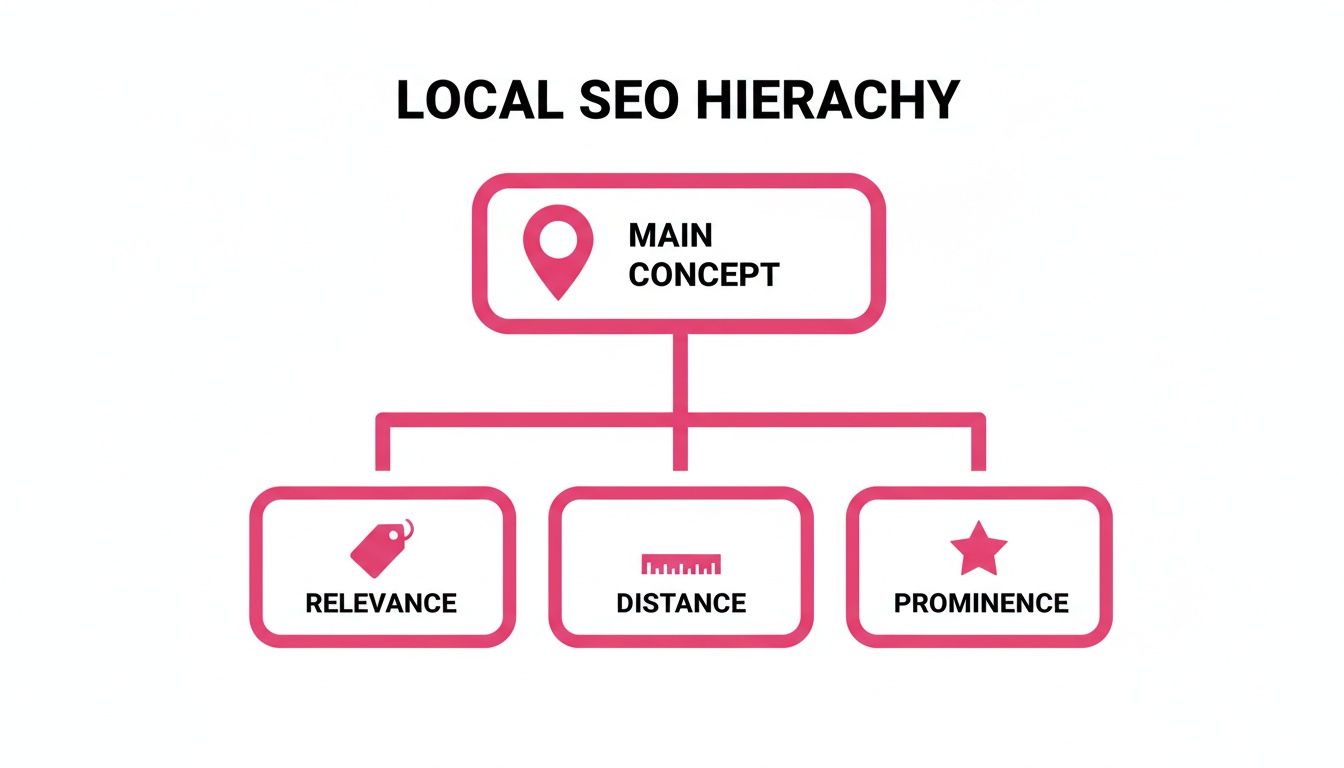
It’s clear from this that you can't just focus on one area. A truly effective local SEO strategy needs to tick all three boxes to consistently land those top spots in the search results.
The Three Pillars of Local Ranking
Getting your head around these three pillars is the key to demystifying why Google shows one business over another. Let’s quickly break down what each one really means for your business.
This table gives you a quick at-a-glance summary:
The Three Pillars of Local SEO Rankings
| Pillar | What It Means for Your Business | Key Signal Examples |
|---|---|---|
| Relevance | How well your business matches what someone is looking for. | Primary GBP category, services listed, business name, on-page content. |
| Distance | How close your business is to the searcher's physical location. | GPS data from the searcher's device, location names used in the search query. |
| Prominence | How well-known and respected your business is in its local area. | Number of Google reviews, your average star rating, links from other local websites. |
Let's dig a little deeper into each of these.
Relevance is all about making sure Google understands exactly what you do. If someone searches for "emergency plumber in Bristol," Google is on the hunt for businesses clearly identified as plumbers in that specific area. Everything from your business categories and services list to the content on your website helps build this picture.
Distance is exactly what it sounds like. It measures how far your business is from the person searching or the location they typed in. With the explosion of "near me" searches, this has become a hugely powerful factor. Being just down the road from a potential customer gives you a massive advantage.
Prominence is essentially your business's local reputation, both online and off. Google pieces this together by looking at information from all over the web. It considers links from other local sites, mentions in articles, and listings in directories. But most importantly, it leans heavily on the quantity and quality of your customer reviews.
A well-established business with hundreds of glowing reviews will often be seen as more prominent than a brand-new competitor, even if that new business is physically closer to the searcher.
At the end of the day, Google’s mission is to serve up the most useful and trustworthy results. By proving you’re relevant, showing you’re a prominent local name, and being physically convenient for your customers, you’re giving the algorithm everything it wants to see. Nail this balanced approach, and you'll secure lasting visibility everywhere that matters, from Google Maps to the coveted "Local Pack".
Mastering Your Google Business Profile
Think of your Google Business Profile (GBP) as your digital shopfront. It’s not just another listing; for most local customers, it’s the very first, and sometimes only, interaction they’ll have with your business online. Get it right, and it becomes a powerful magnet for local searches. Get it wrong, and you might as well be invisible.
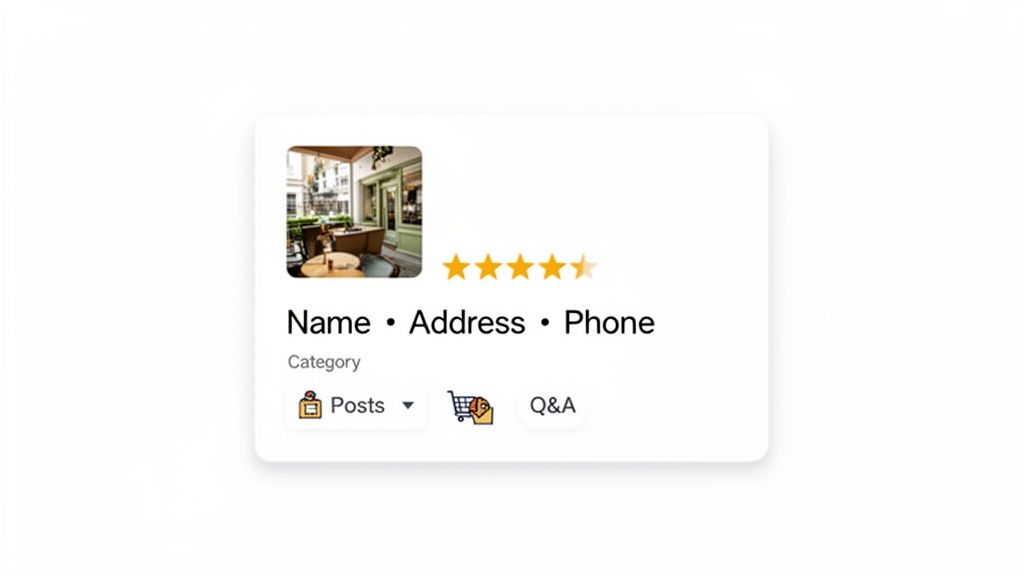
Turning that basic profile into a high-performance asset is all about the details. Every single field needs to be complete, accurate, and genuinely helpful. Why? Because Google’s main job is to give its users the best, most reliable answers, and it heavily rewards businesses that help it do that.
Here in the UK, the quality of your GBP is a massive ranking factor, directly impacting how often you show up in the coveted Local Pack and on Google Maps. A 2023 analysis found that 32% of UK local SEO experts picked a complete GBP as the single most critical factor for Local Pack rankings. The stats back it up: customers are 70% more likely to visit a business and 50% more likely to consider buying from them if their profile is filled out properly. Explore more local SEO statistics from Reboot Online.
Nailing the Fundamentals: Your Name, Address, and Phone Number
The bedrock of a strong GBP is absolute consistency with your Name, Address, and Phone Number (NAP). This core information must be a perfect match everywhere it appears online—from your website’s footer to every single local directory.
Even a tiny mismatch, like using "St." on your profile but "Street" on your website, creates friction. It makes Google hesitate, and that hesitation can cost you visibility. Consistency acts as a powerful trust signal, confirming to search engines that you are who you say you are, and you’re located where you claim to be. It’s fundamental to proving your legitimacy.
Do a quick audit right now:
- Business Name: Is it your actual, official business name? No sneaky keywords or location tags stuffed in.
- Address: Is the format identical everywhere, right down to the postcode and any suite numbers?
- Phone Number: Are you consistently using the same primary local number across the web?
Fixing NAP inconsistencies is one of the fastest, highest-impact tweaks you can make. It’s a simple fix that pays huge dividends in building local trust.
Choosing Your Business Categories Wisely
Picking the right business categories is one of the most crucial decisions you'll make on your GBP. Your primary category is your main pitch to Google. It’s how you tell the algorithm, "I am a plumber," not just "I am a business." This single setting has a massive influence on the types of searches you’ll appear for.
But don't stop at the primary category. Secondary categories are your chance to grab more specific, long-tail search traffic. For instance, a "Plumber" could add secondary categories like "Boiler Repair Service" or "Drainage Service" to show up for those more specific customer needs.
Top Tip: Specificity wins. "Restaurant" is okay, but "Italian Restaurant" is infinitely better if that's your niche. This precision connects you with searchers who have a much higher intent to buy, leading straight to more qualified leads.
Bringing Your Profile to Life with Rich Content
A static, neglected profile sends a clear signal to Google: this business might not be active or engaged. To stand out, you need to use the tools Google gives you. Regularly adding photos, creating Google Posts, and managing your Q&A section shows both customers and algorithms that you’re open and ready for business.
High-Quality Photos and Videos
People buy with their eyes. Photos build instant trust and give potential customers a real feel for your business before they even set foot inside. Regularly upload clear, well-lit images of your premises, your team at work, your products, and your services in action. Good visuals aren't just for show—they can boost requests for directions by over 40% and clicks to your website by over 30%.
Google Posts
Think of Google Posts as free, bite-sized ads that appear right on your profile in search results. Use them to announce special offers, share updates, highlight events, or feature new products. Each post is a fresh signal to Google that your profile is actively managed, which is a key indicator for relevance and prominence.
Questions & Answers
The Q&A section is a goldmine for engagement that too many businesses ignore. Don't wait for customers to ask questions—get in there first. You can proactively post and answer the most common queries about your business. This lets you control the narrative, handle potential objections upfront, and naturally weave in important keywords.
Building Trust with Reviews and Engagement
Customer reviews are the digital world’s version of word-of-mouth, and they pack a serious punch for local SEO. Think of them as real-world votes of confidence. Every single positive review tells Google that your business isn’t just relevant for a search query, but that it's also a trusted and prominent part of the local community.
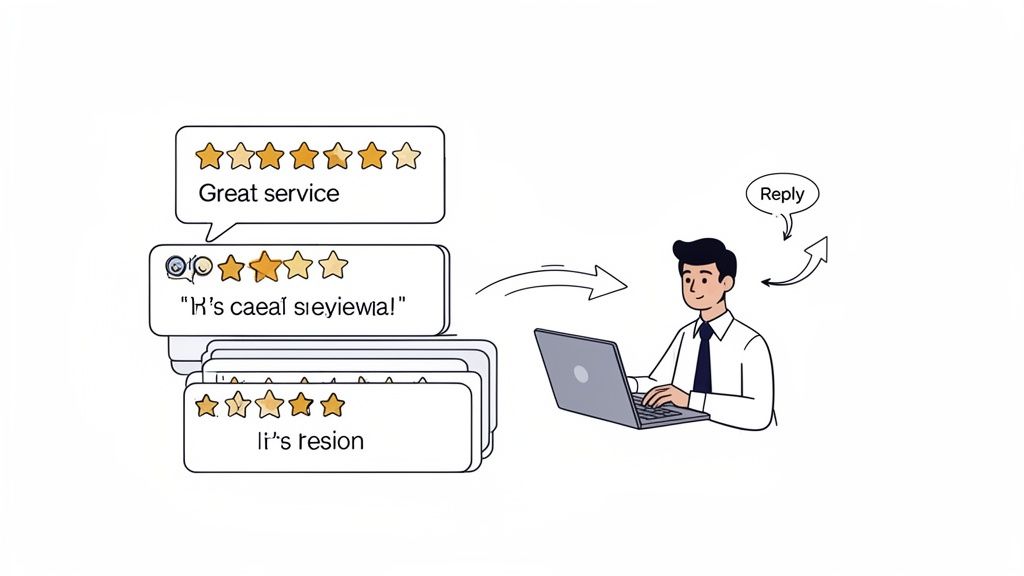
This whole process of gathering and managing feedback directly impacts your chances of appearing in the Local Pack. It’s simple, really: Google wants to show its users businesses that other people genuinely love, and your review profile is the most direct proof it has.
In the UK, reviews are a cornerstone of local SEO, influencing both where you rank and whether a customer chooses you. Research shows that high numerical Google ratings (think 4–5 stars) are the sixth most important factor for getting into the Local Pack. The numbers don't lie: 51% of consumers need to see at least a 4-star rating before they'll even think about using a business, and a massive 77% won't bother with a business that has fewer than 3 stars. This makes managing your reviews a non-negotiable for both your ranking and your revenue. Discover more insights on local SEO statistics from SOCi.
The Anatomy of a Powerful Review Profile
It’s a common myth that you just need a perfect 5-star rating. While your average score is definitely important, Google’s algorithm is much smarter than that. It dives deeper, analysing a mix of signals to work out how trustworthy and high-quality your review profile really is.
A healthy review profile is built on three pillars:
- Quantity: The total number of reviews you've collected. More reviews suggest you're an established and popular choice.
- Velocity: How often you get new reviews. A steady trickle of recent feedback proves your business is active and relevant right now.
- Diversity: Having reviews across different platforms (Google, Yelp, industry-specific sites) paints a much fuller picture of your reputation.
In essence, a business with 100 recent 4.5-star reviews is often seen as more prominent than one with 10 perfect 5-star reviews from two years ago. Recency and volume build a compelling case for your ongoing relevance.
How to Encourage a Steady Stream of Reviews
Actively asking for feedback isn't pushy; it's essential for building a strong review profile. The trick is to make it incredibly easy for your happy customers, slotting the request naturally into your workflow.
Here are a few simple but effective ways to do it:
- Personalised Email or SMS Requests: After a great transaction or service, send a follow-up message with a direct link to your Google review page. A personal touch, like mentioning the specific service, works wonders.
- In-Store Signage: Pop a QR code on receipts, flyers, or at your till that takes customers straight to your review page.
- Website Integration: Add a clear "Review Us" button or section on your website. Don’t make people hunt for it.
- Verbal Prompts: Train your team to ask satisfied customers directly. A simple, "We'd be grateful if you could share your experience on Google" can be surprisingly effective.
The golden rule is to make it effortless. The fewer clicks it takes, the more likely you are to get that review. A platform like LocalHQ can automate this outreach, sending review requests at just the right moment to get the best response rates.
The Critical Importance of Responding to Reviews
Getting reviews is only half the job. Responding to them—both good and bad—is a huge engagement signal that so many businesses miss. When you reply, you’re not just talking to that one customer; you’re showing every potential customer who reads your reviews that you care.
Responding to Positive Reviews
A simple "thank you" goes a long way. It shows you appreciate their time and validates their positive experience. To take it up a notch, personalise your reply by mentioning something specific from their review.
Responding to Negative Reviews
This is where you can really shine. Dealing with negative feedback thoughtfully and professionally can turn a bad situation around and prove to prospects that you take concerns seriously.
Follow these steps for a solid response:
- Acknowledge their frustration and thank them for the feedback.
- Apologise for their poor experience without making excuses.
- Offer to take the conversation offline to fix the problem directly.
- Never, ever get into a public argument. Keep it professional and to the point.
By actively managing and replying to all feedback, you build a resilient online reputation. This engagement is a key local SEO ranking factor that proves to Google your business is active, attentive, and fully deserves a spot at the top.
Connecting Your Website to Your Local Strategy
Getting your Google Business Profile spot-on is a huge win, but it’s only half the battle. Think of your GBP as the perfect shop window display – it grabs attention and gets people to the door. Your website is the shop itself. It has to deliver on the promise that your profile made. On-page SEO is the bridge that connects these two, proving your local relevance to Google in a way your profile simply can't on its own.
When your website content and your GBP are singing from the same hymn sheet, you create a consistent, authoritative presence that Google rewards. This synergy reinforces all the right signals, making it crystal clear what you do and where you do it. Your website suddenly becomes a powerhouse for ranking in both the Local Pack and the regular organic search results.
Creating Dedicated Pages for Services and Locations
One of the most powerful on-page tactics you can use is building out dedicated pages for each of your key services. And if you have more than one branch, a unique page for each location is non-negotiable. A vague "Our Services" page just doesn't have the muscle to compete anymore. You need to get specific with pages like "Boiler Repair in Manchester" or "Emergency Electrical Services in Sheffield."
Why does this work so well? It lets you:
- Target Specific Keywords: You can naturally weave in the exact phrases high-intent customers are searching for, like 'tax accountant in Birmingham' or 'best coffee shop in Shoreditch'.
- Provide Detailed Information: This is your chance to go deep. Explain what each service entails, answer common questions, and really showcase your expertise. That’s how you build trust.
- Create Clear Signals for Google: A dedicated page makes it incredibly easy for search engine crawlers to understand that you are the go-to authority for a specific service in a specific place.
This isn’t just a hunch; the data backs it up. UK experts rate having a 'dedicated page for each service' as the single most important factor for boosting local organic rankings—even above backlinks or citations. This clear structure, held together with smart internal links, is fundamental to helping Google connect your website with specific towns and neighbourhoods. Discover more insights about UK ranking factors at flyinglobo.com.
Technical Essentials That Prove Local Relevance
Beyond the words on the page, a few technical elements on your website send strong, unmistakable signals to Google about your local identity. These aren't just for show; they provide structured data that helps search engines categorise your business with complete certainty.
Nailing these technical details gives Google the hard evidence it needs to validate the information on your GBP and rank you with confidence.
Embed a Google Map
It sounds simple, but embedding a Google Map on your contact or location page is one of the most effective signals you can send. It visually confirms your physical address and makes it dead simple for customers to find you. It’s a direct link between your website and Google’s own mapping service—a trust signal you can't afford to skip.
Use LocalBusiness Schema Markup
Schema markup is basically a vocabulary you add to your website's code to help search engines make sense of your content. For any local business, LocalBusiness schema is absolutely essential. It lets you spell out your:
- Business Name
- Address
- Phone Number
- Opening Hours
- Geo-coordinates
By adding this structured data, you aren’t leaving anything up to interpretation. You're literally spoon-feeding Google the exact information it needs, in a language it understands perfectly. This can lead to richer search results and a stronger local ranking.
Think of it as filling out a detailed form directly for Google's benefit. This data reinforces your NAP consistency across the web, ensuring the details search engines find on your site are a perfect match for your GBP and other online listings. At the end of the day, a technically sound, locally-focused website is the foundation that supports and amplifies every other local SEO effort you make.
Growing Your Authority with Citations and Links
So, beyond your own website and Google Business Profile, how does Google really know your business is a legitimate, respected player in the local area? It scours the web for digital breadcrumbs: things like citations and local backlinks. Think of these as powerful, independent votes of confidence that boost your business's reputation online.
It's a bit like this: imagine you're new in town and you need a good plumber. If the local newspaper, a community group, and a business directory all recommend the same one, you'd feel pretty confident calling them. Citations and links work the exact same way for search engines. They are vital local SEO ranking factors that prove you're the real deal.
Understanding the Power of Local Citations
A local citation is really just any online mention of your business’s Name, Address, and Phone number (often called 'NAP' for short). You'll find them on business directories like Yell, on websites specific to your industry, or on your local Chamber of Commerce page. They might seem like small details, but their combined effect is massive.
Every time Google finds a consistent citation, it reinforces your business’s identity and location. It removes any doubt. The crucial word here, though, is consistency. Tiny differences—like using "Ltd" on one site and "Limited" on another, or "St." instead of "Street"—can muddy the waters and confuse the search engine. Getting your NAP details painstakingly accurate across every single platform is absolutely essential. For a deeper dive into this, you can learn more about what local citations are and why they matter so much.
Each accurate citation acts as a small but crucial verification point. When dozens of these points align perfectly, Google gains a high degree of confidence in your business's data, which is directly rewarded with better visibility.
A Practical Roadmap for Building Citations
Building a strong citation profile doesn’t need to be a huge headache. Your goal is simply to be listed in all the places your customers and Google would expect to find you. It's much better to focus on quality over sheer quantity.
A solid citation-building strategy should include:
- Major Data Aggregators: Start with the core data providers that feed hundreds of other directories. This is the most efficient first step to get your information out there.
- Top-Tier Directories: Make sure you have listings on the big, well-known sites like Yell, Thomson Local, and other major national directories.
- Industry-Specific Sites: Hunt down directories that are directly relevant to your niche. A restaurant, for example, absolutely needs to be on TripAdvisor, whereas a tradesperson might focus on getting listed on Checkatrade.
- Local Community Sites: Getting listed on your local Chamber of Commerce website, the town council page, or even local neighbourhood blogs sends incredibly powerful, geographically relevant signals to Google.
Earning Valuable Local Backlinks
While citations confirm who you are and where you are, local backlinks tell Google how important you are in your community. A backlink is simply a clickable link from another website pointing to yours. Getting links from relevant, local sources is pure SEO gold because it shows Google that other respected local organisations are vouching for you.
Instead of just trying to "build" links, focus on earning them through genuine involvement in your community. Here are a few proven ways to do it:
- Sponsor a Local Event: Sponsoring a local charity run, school fete, or community festival almost always gets you a link from the event’s website.
- Partner with Nearby Businesses: Team up with a non-competing local business on a joint promotion. They can easily link to your website from a blog post or a partners page.
- Host a Workshop or Event: Offer a free workshop at your location and share the details with local news outlets and community calendars. They will often link back to your sign-up page.
These 'off-page' signals are absolutely critical for getting ahead of competitors, especially in crowded UK markets. They build digital proof of your real-world prominence, helping Google connect the dots and cementing your status as a trusted local leader.
How to Measure Your Local SEO Success
So, you've put in the work. You've optimised your Google Business Profile, tidied up your citations, and built some great local links. But how do you know if any of it is actually working? Without clear metrics, your optimisation efforts are just a shot in the dark.
Investing time and money into local SEO is pointless if you can't see the return. This final section gives you a straightforward way to monitor your results, helping you move past vanity metrics and focus on the numbers that signal real business growth. The goal is to connect the dots between your visibility and tangible customer actions—like phone calls, website clicks, and, most importantly, people walking through your door.
Key Performance Indicators That Really Matter
To get a true picture of your success, you need to track the metrics that reflect what actual customers are doing. These KPIs show that your efforts aren't just boosting rankings but are genuinely driving profitable actions for your business.
Here are the essential metrics to keep an eye on:
- Clicks-to-Call from GBP: This tracks how many users clicked the call button right from your Google Business Profile. It’s one of the clearest signs of a high-intent lead.
- Direction Requests: How many people are asking Google Maps for directions to your physical location? This is a direct measure of your online presence driving real-world footfall.
- Website Clicks: This measures the traffic your GBP is sending to your website. It’s a great indicator that customers want more detailed information before they commit.
- GBP Impressions and Searches: Keep track of how often your profile shows up. You'll want to distinguish between "Discovery" searches (where people looked for a category, like "coffee shop near me") and "Direct" searches (where they searched for your business name specifically).
Tracking these core actions draws a clear line between your SEO activities and actual business outcomes. A spike in calls and direction requests is a far stronger signal of success than a simple jump in impressions.
Visualising Your Local Footprint with Geo-Grid Tracking
Traditional rank tracking can be seriously misleading for local businesses. A number one ranking when you search from your office desk means very little if you're invisible to customers just a few streets away. This is exactly why geo-grid rank tracking is so important.
Geo-grid tools show you how you rank from multiple points across your entire service area. Picture a grid laid over a map of your town; the software then checks your ranking for a specific keyword (like "plumber in Bath") from the centre of each square on that grid.
This gives you a true, visual map of your local footprint, revealing precisely where you’re strong and—more importantly—where you have blind spots. Understanding these geographical gaps is the key to fine-tuning your strategy. To get a better feel for it, you can explore guides on rank tracking for local keywords to see these tools in action.
By using this kind of data-driven approach, you can stop guessing and start making informed decisions. It gives you the confidence to put your budget where it will have the biggest impact, ensuring your local SEO efforts are always moving your business forward.
Your Local SEO Questions, Answered
Getting to grips with local SEO can feel like a bit of a minefield, especially when you're trying to figure out what really matters for your UK business. Let's tackle some of the most common questions that pop up time and time again.
How Long Until I See Local SEO Results in the UK?
It's the million-pound question, isn't it? Generally, you can expect to see the first signs of progress within three to six months of consistent work. Think of it like getting fit – you don't see results after one trip to the gym, but with steady effort, the changes become obvious.
Now, this isn't set in stone. The timeline really depends on where you're starting from, how competitive your local market is, and how consistently you're putting in the work.
Some things move the needle faster than others. Getting your Google Business Profile completely filled out and looking sharp can produce quick wins. But building up a strong reputation with great reviews and earning quality local links? That's more of a long game that builds a solid foundation for years to come.
What’s the One Thing I Absolutely Must Get Right?
If you're going to focus your energy on one thing, make it your Google Business Profile (GBP). Seriously, a fully optimised and active GBP is the absolute cornerstone of local search. It's your digital shop front for anyone searching on Google Maps or in the "Local Pack" results – which is where most of your potential customers are looking.
Getting this right is your biggest lever for immediate impact. Make sure every single detail – your business category, service areas, opening hours, phone number – is spot-on accurate. This one asset feeds into almost every other local ranking factor, so it’s the best place to start.
Do I Really Need a Physical Address to Rank Locally?
Yes, for the most part, you do. To show up in those coveted Local Pack results, you need a verifiable physical address in the area you're targeting. One of Google's biggest signals is proximity – how close are you to the person searching? Without a local address, you're essentially invisible.
But what if you're a service-area business, like a plumber or a mobile dog groomer, and you travel to your customers? You can (and should) hide your address on your public GBP listing. However, you still need to verify a real address with Google behind the scenes. That address acts as your "home base" for Google to calculate your relevance for nearby searches, so it's just as vital.
Ready to stop guessing and start seeing real results from your local SEO? LocalHQ gives you the tools to perfect your Google Business Profile, track your rankings with pinpoint accuracy using geo-grids, and handle customer reviews without the headache. Find out how LocalHQ can put your business on the local map.


