Multi-Location Content Strategy: Localisation at Scale
Running a business across multiple locations presents a unique challenge: how do you maintain a strong, consistent brand while still connecting with customers on a local level? The answer lies in a smart multi-location content strategy.
It’s all about creating a central brand message and then giving it a local flavour. Think of it as a core recipe that each of your local teams can season to perfection for their specific market. This isn't just a "nice-to-have"—it's fundamental for any business with more than one branch, franchise, or service area looking to win.
Laying the Groundwork for a Winning Multi-Location Strategy
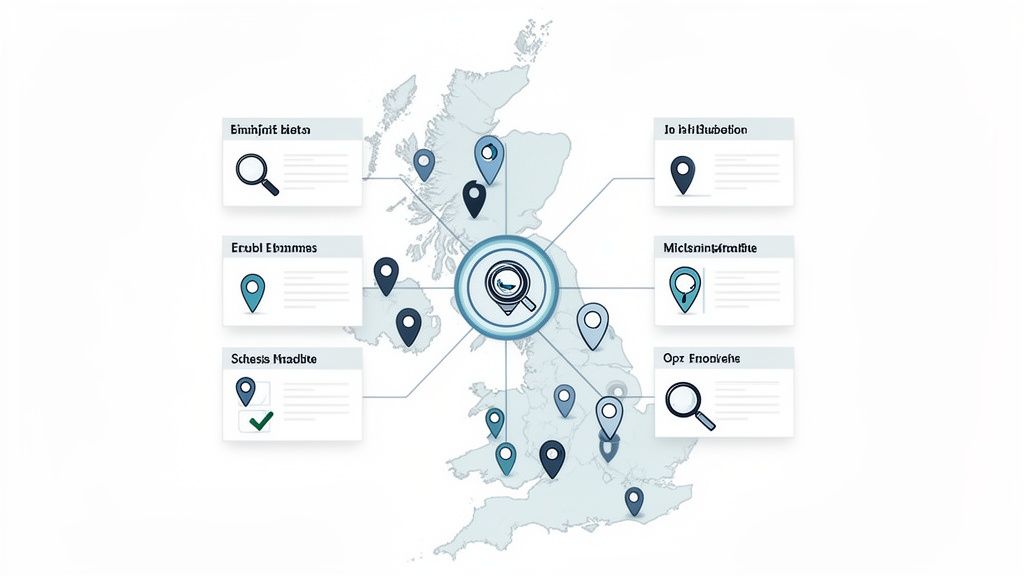
Expanding your business across the UK is about more than just opening new doors. You need a digital voice that’s unified yet resonates in every single town and city you operate in. Without that cohesion, you end up with messy messaging, a watered-down brand, and a whole host of missed opportunities in local search.
When each location does its own thing, you create a confusing and fragmented experience for your customers. It’s a common pitfall.
But what happens when you get it right? Aligning content across all your Google Business Profiles (GBPs) and local pages doesn’t just make life easier internally. It builds incredible customer trust and gives your visibility in local search a massive boost.
The Problem with a Siloed Approach
Letting each location manage its own content without any central guidance almost always ends in chaos. It’s a decentralised free-for-all that can do real damage to your reputation and your bottom line.
We see the same issues crop up time and time again:
- Inconsistent Branding: Different tones of voice, clashing visuals, and conflicting offers across your locations will inevitably confuse customers and erode your brand identity.
- Wasted Resources: Imagine five different teams creating nearly identical content from scratch. It’s a huge drain on time, money, and creative energy.
- Poor Customer Experience: A customer sees a great promotion online for your Bristol branch, only to find it’s not honoured in Birmingham. That leads to frustration and, you guessed it, negative reviews.
- Missed SEO Opportunities: Inconsistent business details (Name, Address, Phone number) and a lack of coordinated keyword targeting can sabotage your search rankings everywhere. For a deeper dive, check out our guide on local SEO for multiple locations.
This lack of coordination is a serious handicap. For service-based businesses expanding across multiple locations, a staggering 41% fail within two years, often because they couldn't nail their local presence. The competition in dense UK markets is fierce; in 2026, London alone has 982,905 registered businesses, with the South East not far behind at 907,025. You can’t afford to be disjointed.
To better understand the impact, let's compare the two approaches directly.
Centralised vs Siloed Content Strategy at a Glance
This table breaks down the real-world business impact of having a unified content strategy versus letting each location operate in a silo.
| Aspect | Siloed (Location-by-Location) | Centralised (Unified Strategy) |
|---|---|---|
| Brand Identity | Diluted and inconsistent; confuses customers. | Strong and cohesive; builds trust and recognition. |
| Operational Efficiency | High duplication of effort; wasted time and budget. | Streamlined workflows; resources are used effectively. |
| Customer Experience | Fragmented and frustrating; inconsistent offers. | Seamless and reliable; consistent service and messaging. |
| SEO Performance | Weak local signals; poor overall search visibility. | Amplified local authority; improved rankings across all locations. |
| Scalability | Difficult and chaotic to manage growth. | Simple and structured to add new locations. |
As you can see, the siloed approach creates friction at every turn, whereas a centralised strategy builds momentum and drives sustainable growth.
The Benefits of a Centralised Content Framework
Putting a unified framework in place gives you the structure you need to scale your content effectively. The goal is to establish a single source of truth for your brand while still giving local managers the freedom to add that authentic, community-specific touch.
A centralised strategy doesn’t mean creating bland, one-size-fits-all content. It’s about building a strong brand core and then giving your local teams the templates and tools they need to adapt it for their unique audience.
This strategic shift transforms your digital presence from a scattered collection of outposts into a powerful, cohesive network. By setting clear goals from the top and auditing your existing content for inconsistencies, you pave the way for a seamless brand experience.
Ultimately, it ensures that whether a customer finds you in Manchester or Margate, they get the same high-quality, trustworthy experience every single time.
Crafting Content That Captures Local Nuances
The old "think globally, act locally" mantra gets thrown around a lot, but for multi-location brands, it's the absolute golden rule. The problem is, most businesses get it wrong. Simply finding and replacing a city name in your web copy isn't localisation. It’s just substitution, and your customers can smell it a mile off.
Real connection is forged when your content feels like it was written for a specific community, not just dropped into it. This "glocal" mindset—maintaining brand consistency while embracing local flavour—is what separates a forgettable chain from a beloved neighbourhood staple. It’s about moving past the boilerplate and getting granular.
Beyond Basic City Name Swapping
True localisation is an art form. It means adapting everything from your tone of voice and promotions to your actual service offerings to fit the local culture. It’s about understanding the subtleties that make each place tick.
Think of a national DIY retailer. During a summer heatwave in London, they might heavily promote portable air conditioners and garden sprinklers. Meanwhile, their branch in a rain-soaked Manchester could be running offers on dehumidifiers and indoor paint, with content focused on cosy weekend projects.
That's the level of detail that shows you're paying attention. It proves you understand the customer's immediate reality, turning a simple transaction into a genuine community presence. This is the bedrock of a winning multi-location content strategy.
A brand that understands local nuances doesn't just sell to a community; it becomes part of it. This shift from a transactional relationship to a relational one is where authentic loyalty is built.
So, how do you get there? It all starts with a bit of detective work.
Uncovering Local Search Intent
To write content that hits home, you need to know what people in each area are actually looking for. And let me tell you, local keyword research is a completely different beast from a broad, national campaign. While "emergency plumber" is a solid general term, local intent gets far more specific.
Someone living in a historic part of York, for example, is probably searching for "listed building plumbing specialists". In a brand-new London development, the query is more likely to be "smart home boiler installation". Spotting these differences is where the magic happens.
Here are a few practical ways I’ve learned to dig up these local search opportunities:
- Mine Google's "People Also Ask": Run a few searches for your services using different city and neighbourhood names. The questions that pop up are a direct line into the specific worries and priorities of that local audience.
- Talk to Your People on the Ground: Your local teams are an absolute goldmine. They hear the questions, complaints, and compliments every single day. They know the local pain points far better than anyone in a central office ever could.
- Eavesdrop on Local Community Groups: Facebook groups and neighbourhood forums are treasure troves of unfiltered local chatter. Pay close attention to the problems people are trying to solve and, crucially, the exact words they use.
This research doesn't just give you a list of keywords. It gives you the raw material to tailor the entire substance of your content—from blog posts to your Google Business Profile—to what local customers actually need. To really nail this, check out our guide on how to write the perfect Google Business Profile description that hooks and converts.
Tailoring Content for Maximum Local Impact
Armed with these local insights, you can finally start creating content that feels genuinely personal and relevant. Don't panic—this doesn't mean you need a completely unique content plan for every single location. The trick is to focus your customisation efforts where they'll have the biggest impact.
Localised Landing Pages:
Ditch the single, generic "Services" page. Instead, build out dedicated pages for each major location you serve. These pages should be packed with local proof: testimonials from local customers, case studies of projects in that area, and even shout-outs to partnerships with other local businesses. It sends a powerful signal to both users and search engines that you’re a serious local player.
Google Posts and Offers:
Use Google Posts as your local noticeboard. It's the perfect tool for sharing timely, location-specific information.
- Promote local events: "Join our free workshop this Saturday at our Leeds branch!"
- Share team news: "Say hello to Sarah, our new store manager in Brighton!"
- Announce community involvement: "We're proud to sponsor the Cambridge Youth Football Club this season."
Social Media Content:
Empower your local managers to become community storytellers. A real photo of a happy customer at your Edinburgh café, shared with their permission, is infinitely more powerful than a glossy stock image. This user-generated content (UGC) builds incredible social proof and fosters a true sense of community around each individual branch.
Scaling Content Production With Smart Templates and Automation
Let’s be honest, creating unique, engaging content for every single one of your locations is a brilliant idea in theory. But when you’re managing dozens, or even hundreds, of sites, it quickly becomes a logistical nightmare. The real secret isn't about creating more content; it's about creating a smarter system to manage it.
This is where a tiered content approach comes in. By blending brand-wide messaging with local flavour, you can scale content creation effectively. You build a framework of smart templates and let automation do the heavy lifting, which frees up your local teams to focus on what they do best—connecting with their community.
Building a Tiered Content System
A tiered system is all about organising your content. It helps you separate the big, company-wide announcements from the local updates that really need a personal touch. This structure creates clarity, keeps your core message consistent, and still leaves room for that all-important local personality to shine through.
I’ve found this three-tier model works wonders for bringing order to the chaos:
Tier 1: Brand-Level Content
This is your foundational content. Think major campaigns, new product launches, or company-wide news. It’s typically created by a central marketing team and rolled out to all locations, no changes needed.Tier 2: Template-Based Content
This is your happy medium. You create pre-approved templates for recurring activities like local events, special offers, or holiday hours. Local managers can then fill in the blanks with specific details—dates, staff names, or a local photo—adding a touch of customisation while staying on-brand.Tier 3: Location-Specific Content
This is the pure, authentic stuff that really resonates. It’s the behind-the-scenes photos from a local charity bake sale, a post celebrating a team member’s work anniversary, or a quick heads-up about nearby roadworks. This content should come directly from your team on the ground.
It's no surprise that technology is at the heart of this. A Deloitte study found that 78% of successful multi-location businesses credit technology for their ability to scale, reporting 2.1x greater efficiency. For sectors like restaurants or marketing agencies, this means keeping everything from Google Posts to customer reviews perfectly synchronised. After all, 81% of consumers expect a consistent experience, no matter which location they visit.
This 'glocal' approach—blending global strategy with local execution—is a simple but powerful concept.
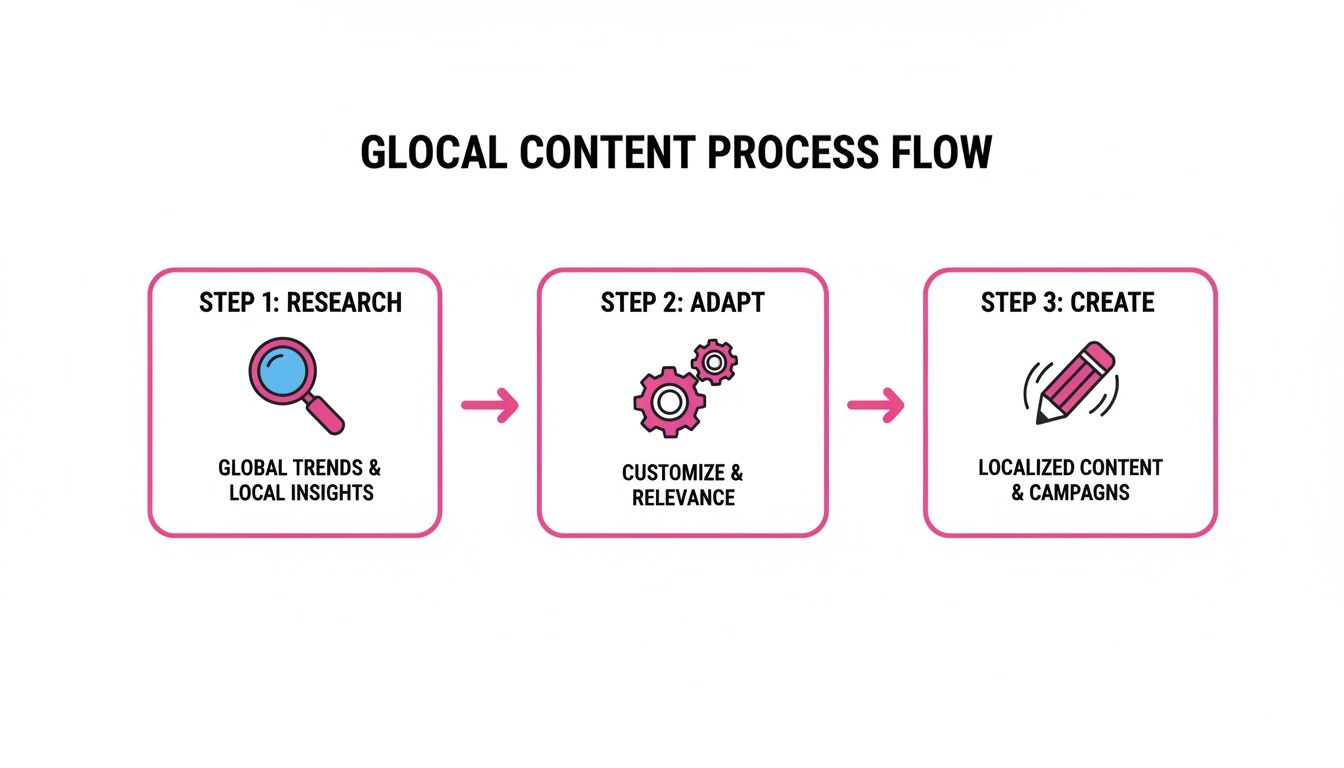
As you can see, great local content starts with solid central research, gets refined with on-the-ground knowledge, and ends with creative, community-focused posts.
The Power of Smart Content Templates
Templates are your single best asset in a multi-location strategy. And no, this isn't about churning out robotic, copy-paste posts. It’s about giving your local managers—who aren't always marketing pros—a structured starting point that saves time and prevents mistakes.
Think of templates as a fill-in-the-blanks exercise for your local teams. You provide the brand-approved structure, and they add the local colour.
So, what does a good Google Post template look like? For a new product, it might include:
- A few pre-written headline options to grab attention instantly.
- A placeholder for a local image, like: "[Insert Photo of Product in our [City] Store]".
- A customisable description, such as: "It's finally here! The new [Product Name] is now available at our [City] location. Come and see it for yourself at [Local Address]."
- A clear call-to-action, like "Learn More" or "Buy Now," linking to the correct local landing page.
This approach guarantees every post is on-brand yet feels genuinely relevant to the person seeing it.
Using Automation to Streamline Distribution
Once you have your templates sorted, automation is what makes it all work seamlessly. Manually posting updates across hundreds of Google Business Profiles is more than just a drain on resources; it’s a recipe for human error and missed opportunities.
This is exactly where platforms like LocalHQ come into their own. From a single, central dashboard, you can:
- Schedule content in advance, planning your brand-level and templated posts weeks or even months ahead of time.
- Distribute updates at scale, pushing a single post to all your locations (or just a select group) in a couple of clicks.
- Empower your local teams with guardrails, giving them a library of pre-approved templates and images so they can create their own posts safely.
By automating distribution, you make sure no location is ever neglected. Every profile stays active, sending strong signals to Google that your business is thriving across its entire network. To take it a step further, our guide explains how to use AI for local SEO and simplify these workflows even more.
Advanced Google Business Profile Optimisation
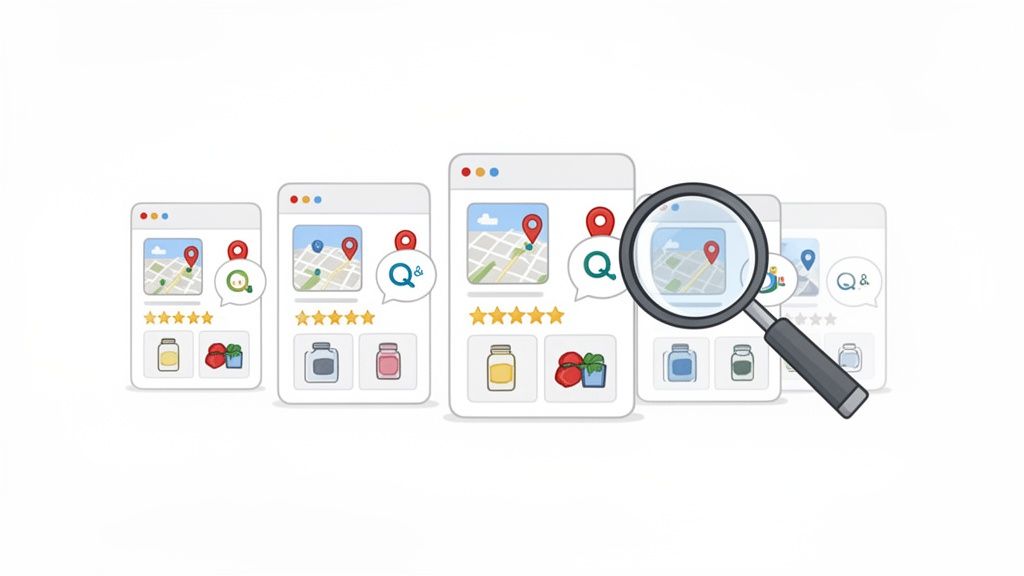
Think of your Google Business Profiles (GBPs) as the digital front doors to each of your physical locations. They're so much more than just a name and address in a directory. While getting the basics right is essential, it’s the advanced optimisation that turns these profiles from static listings into active, lead-generating machines.
This is about taking a proactive, data-informed approach to every single feature Google puts at your disposal. You need to constantly signal relevance, authority, and trust to both the search algorithm and your potential customers.
Find Your Competitive Edge with AI
Let's be realistic: manually trawling through competitors' profiles across dozens or hundreds of postcodes is a non-starter. This is where modern AI-powered tools come into their own, giving you the detailed insights needed to sharpen your multi-location content strategy.
These platforms dig into what’s working for the top-ranking businesses in each specific local market. They can pinpoint the exact primary and secondary categories that are driving success. For example, a competitor in central Manchester might be winning with categories like "Coffee Shop," "Cafe," and "Espresso Bar." Meanwhile, a similar business in a leafy suburb might get more traction with "Family-Friendly Restaurant." Spotting these subtle differences at scale allows you to fine-tune your own profiles and quickly gain ground.
Make Your Content Work Harder with Rich Media
A few standard photos are fine, but it’s rich media that truly grabs attention and builds trust. To give your content a real local SEO boost, every single image and video should be geo-tagged with the specific coordinates of that branch before you upload it. This is a direct, technical signal to Google that your content is genuinely from that location.
A geo-tagged photo of your team inside your Manchester branch sends a much stronger local signal to Google than a generic stock image. It’s a simple yet powerful way to ground your digital presence in a physical place.
Don't just stop at storefront shots. Get creative! Use short videos to offer a virtual tour, introduce the local manager by name, or show a product being used. This kind of dynamic content keeps your profile fresh and engaging, encouraging users to stick around—a great behavioural signal that Google pays attention to.
Master Your Q&As, Products, and Services
The Q&A section is one of the most overlooked and valuable parts of a GBP. It’s a direct line to what your customers are really thinking and a golden opportunity to get ahead of the conversation. Proactively populate this section by asking and answering the common questions your local teams field every single day. This not only prevents misinformation but also lets you naturally include important keywords.
Your Products and Services sections are just as powerful, acting as a mini-catalogue right there in the search results. Make the most of them:
- Showcase specific offerings with high-quality images and clear, detailed descriptions.
- Include prices or price ranges to help pre-qualify customers.
- Link directly to the relevant product or service page on your local site to close the loop.
For a deeper dive into making every part of your listings work for you, our dedicated guide on Google Business Profile optimisation has plenty more practical tips.
Why Reviews Are a Critical Ranking Factor
A solid review management strategy is simply non-negotiable. It’s not just about reputation; Google has confirmed that responding to reviews is a local ranking factor. Quick, on-brand responses show you're engaged and value your customers. Every reply is another chance to reinforce your brand voice and even work in relevant local terms naturally.
This is especially true in crowded markets. In the UK, for instance, London has a staggering business density of 1,436 businesses per 10,000 resident adults. In such a competitive environment, a superior review strategy can be what pushes you to the top. This is where platforms like LocalHQ can be a lifesaver, allowing you to manage content and reviews across hundreds of profiles from one place, ensuring you never miss a beat. You can learn more about how business density impacts local strategy from recent industry analysis.
Measuring Your Strategy and Proving ROI
You’ve done the hard work. You’ve planned, created, and published content across all your locations. But now comes the real test: proving it all actually worked.
Without solid measurement, you’re just guessing. You can’t tell which ideas are driving customers through the door and which are a waste of time and money. The goal here is to connect the dots between your content and real-world business results. This is how you justify budgets and get everyone on board for the long haul.
Defining Your Key Performance Indicators
To properly measure your multi-location content, you need to focus on metrics that show genuine customer interest and impact your bottom line. While brand awareness is nice, the most valuable KPIs are the ones that lead directly to revenue.
For each of your locations, keep a close eye on these essential metrics:
- Google Business Profile Actions: These are pure gold. Track the clicks to your website, requests for driving directions, and phone calls coming directly from your GBP listings. A steady climb in these numbers is a fantastic sign that your local content is hitting the mark.
- Local Search Rankings: Your visibility in local search is everything. You need to know if your optimisation efforts are actually getting you seen when local customers search for your services.
- Website Traffic and Engagement: Look at the traffic flowing to your individual location pages. Are people sticking around? More importantly, are they taking action, like filling out a form or clicking to call? This tells you if your content is truly persuasive.
- Review Volume and Velocity: A sudden increase in new reviews is a brilliant signal. It shows that your business is creating a buzz and that customers are engaged enough to share their experience.
Proving return on investment (ROI) isn't about finding one magic number. It's about connecting a series of data points—higher rankings, more phone calls, increased footfall—to show how your content strategy is systematically driving business growth at a local level.
By consistently tracking these KPIs across all your locations, you’ll start to see a clear picture of what’s working and, just as importantly, where you need to adjust your approach.
Visualising Performance with a Geo-Grid Rank Tracker
Here’s a hard truth: standard rank trackers often give a false sense of security for multi-location businesses. They usually check your ranking from one central server, which tells you nothing about what a real customer searching from a few miles away actually sees. This is where a geo-grid rank tracker becomes absolutely essential.
A geo-grid tool overlays a grid on a map and runs a search from each point, showing you exactly where you rank in different parts of a town or city.
This screenshot shows you what I mean. It’s a geo-grid visualisation for a specific keyword.
The colour-coded grid instantly gives you a feel for your ranking strength. You can spot the "blind spots" where your visibility is weak and see the neighbourhoods where you’re dominating the local pack.
This kind of granular insight is a game-changer for a multi-location content strategy. It allows you to find underserved areas within a single location’s catchment area and then sharpen your content or run targeted ads to boost your presence exactly where it’s needed.
Building Reports That Tell a Story
Finally, you need to present your findings in a way that’s clear, insightful, and persuasive. Ditch the overwhelming spreadsheets nobody reads. Your reports need to tell a story by connecting your actions to tangible outcomes. For some practical tips on this, our article on creating compelling SEO reports for customers is a great starting point.
Make sure your reports show trends over time. For example, show how consistently publishing localised Google Posts led to a 25% increase in phone calls. Draw a clear line from how optimising your GBP services list correlates with a jump in direction requests. By making these connections, you can prove the ROI of your content strategy without a shadow of a doubt.
Frequently Asked Questions
When you're juggling content across multiple locations, a lot of questions pop up. It’s a common challenge. Here are some straightforward answers to the queries I hear most often from businesses trying to get this right.
How Much Content Should Be Brand-Level Versus Location-Specific?
A good starting point is the 80/20 principle. Think of it this way: about 80% of your content can be created centrally. This is for your big-picture stuff – core brand messaging, major product announcements, and evergreen articles that apply to everyone. This approach keeps your brand consistent and saves a huge amount of time.
The other 20% is where you bring the local flavour. This content should be genuinely tied to the specific location. We’re talking about introducing the local team, shouting about a community festival you’re sponsoring, highlighting a local customer, or running a promotion only available in that town. This balance protects your brand while building a real connection on the ground.
Of course, this isn't a hard-and-fast rule. A national retail chain might stick close to 80/20. But a group of locally-owned franchise restaurants? They might find a 70/30 or even 60/40 split works better to show off their deep community roots. The trick is to find the right mix that fits your business.
What Is the Best Way to Manage Content Approvals With Local Managers?
Ah, the approval bottleneck. It’s a classic problem. The most effective way I’ve seen this handled is with a tiered system that gives you central control without micromanaging your local teams into a standstill.
Set up a central content hub where you can create pre-approved templates. Your local managers can then grab these templates and add their specific details – a photo of their team, the date of a local charity event, you name it. This keeps the core message and visuals on-brand while making local customisation quick and painless.
A simple approval workflow is a must. Let local managers 'submit' their customised content for a quick check by a central marketing manager or regional lead. This final glance ensures everything is on-brand before it goes live, without grinding the process to a halt.
This kind of setup builds trust and gives your local teams a sense of ownership, which is absolutely vital for getting them actively involved in your content strategy.
How Can I Ensure Our Brand Voice Stays Consistent Across All Locations?
A consistent brand voice is what makes you recognisable and trustworthy. The first, most crucial step is to create a clear and simple brand style guide that everyone can actually find and use.
This document needs to be more than just logos and colours. It should clearly define:
- Tone of Voice: Are you witty and informal, or professional and authoritative? Give real examples.
- Key Messaging: What are the non-negotiable points you always want to get across about your business?
- 'Do's and Don'ts': Show a side-by-side example of a great, on-brand post versus a poor, off-brand one. This makes the standard tangible.
Back this guide up with short, regular training sessions and treat it as a living document you update as the brand evolves. Making it practical and easy to digest is far more important than making it a 100-page masterpiece nobody reads.
How Do I Prove That This Strategy Is Actually Working?
This is the question that really matters. A strategy without clear results is just a collection of good ideas. Proving your work's value comes down to tracking the right metrics and connecting them to real-world business outcomes. To do this, you have to understand the ROI of Content Marketing inside and out.
Focus on Key Performance Indicators (KPIs) that show genuine customer action, such as:
- Google Business Profile Actions: Keep a close eye on the number of website clicks, requests for directions, and phone calls coming directly from each GBP listing.
- Local Ranking Improvements: Use a geo-grid rank tracker to literally see how your visibility for key search terms is improving street by street.
- Conversion Rates: Track form submissions, calls, or sales that come from your location-specific landing pages.
When you present this data, you can draw a straight line from your content efforts—like those consistent local posts—to a measurable increase in leads and footfall for each individual location. Suddenly, your marketing efforts are no longer abstract; they're a clear story of business growth.
Ready to stop guessing and start seeing exactly where your content is making an impact? The Geo-Grid Rank Tracker from LocalHQ provides the visual proof you need to measure performance, identify opportunities, and prove the ROI of your multi-location content strategy with confidence.
See Your Local Rankings with Geo-Grid Rank Tracker