What is Local SEO Marketing? A Practical Guide to Local Growth

Local SEO marketing is all about making sure your business pops up when people in your neighbourhood are searching for the products or services you offer. Think of it this way: when someone nearby pulls out their phone and types "best coffee near me," local SEO is what gets your café to the top of the list on Google Search and Maps. It’s designed to capture customers right when they’re ready to walk through the door.
Understanding Local SEO Marketing
Imagine your business is the go-to spot on the local high street, the one everyone recommends. Local SEO is simply the digital version of earning that reputation. It’s a specific strategy for businesses with a physical location or a defined service area—like a local dental practice, a popular restaurant, or even a mobile car valeter—to connect with customers who are right on their doorstep and actively looking for what they do.
To really get what local SEO marketing is all about, you have to understand the importance of Local SEO and how it taps into modern buying habits. The main difference between local and traditional SEO boils down to what the searcher wants. A query like "how to fix a leaky tap" is purely informational (that's traditional SEO's territory). But a search for "plumber near me" is a cry for help—it signals an immediate need and a desire to hire someone. That "near me" part is exactly where local SEO shines.
The Power of Proximity
This focus on geography is non-negotiable because customer behaviour has completely changed. An incredible number of searches today are local. In fact, a staggering 46% of all Google searches have local intent, a figure that shows just how people across the UK find businesses these days. When you consider that the Google "Local Pack" (the map and three listings at the top) gets around 42% of all clicks from these searches, it’s clear that being in those top spots is vital for survival. You can find more UK-specific insights over at searchhog.co.uk.
Local SEO isn’t just about being found; it’s about being chosen. It uses geography to connect your business with the most qualified, high-intent customers—the ones who are physically close and ready to buy.
To help you see the difference clearly, here's a quick comparison.
Local SEO vs Traditional SEO At a Glance
| Aspect | Local SEO | Traditional SEO |
|---|---|---|
| Primary Goal | Drive in-person foot traffic or local service calls. | Increase website visibility and traffic on a national or global scale. |
| Target Audience | Geographically defined (e.g., customers in Manchester). | Broad, based on interests or topics, not location. |
| Key Ranking Signals | Proximity, Google Business Profile, local citations, reviews. | Backlinks from authority sites, domain authority, broad content relevance. |
| Typical Keywords | "Best Indian restaurant near me", "emergency plumber in Bristol". | "How to bake sourdough bread", "best running shoes for beginners". |
This table shows how each strategy targets a different kind of customer with a completely different goal in mind.
Key Components of Local SEO
A solid local strategy isn't just one thing; it's several moving parts all working in concert. Later in this guide, we'll dive deep into the pillars that support any successful local campaign. Getting these right is essential for building trust with both Google and your future customers.
- Google Business Profile (GBP): This is your digital front door and the single most important element.
- Customer Reviews: Great reviews provide social proof and are a massive ranking factor.
- Local Content Strategy: Writing about topics and events that matter to your local community.
- Citations and NAP Consistency: Making sure your business Name, Address, and Phone number are identical everywhere online.
Ultimately, getting these elements right helps your business show up when and where it matters most. To explore this topic further, check out our detailed guide on what is local search optimization.
The Core Pillars of a Winning Local SEO Strategy
To really get what local SEO marketing is, you need to break it down into its essential parts. A winning strategy isn't one single action, but more like a sturdy house built on several core pillars. Each one supports the others, and if you neglect even one, you risk weakening your entire digital presence.
Let's walk through these foundational elements one by one, starting with your digital shopfront and moving all the way to the technical signals that help search engines understand exactly what you do and where you do it.
This concept map helps to visualise how all these pillars connect your business to local customers, using search engines as the bridge.
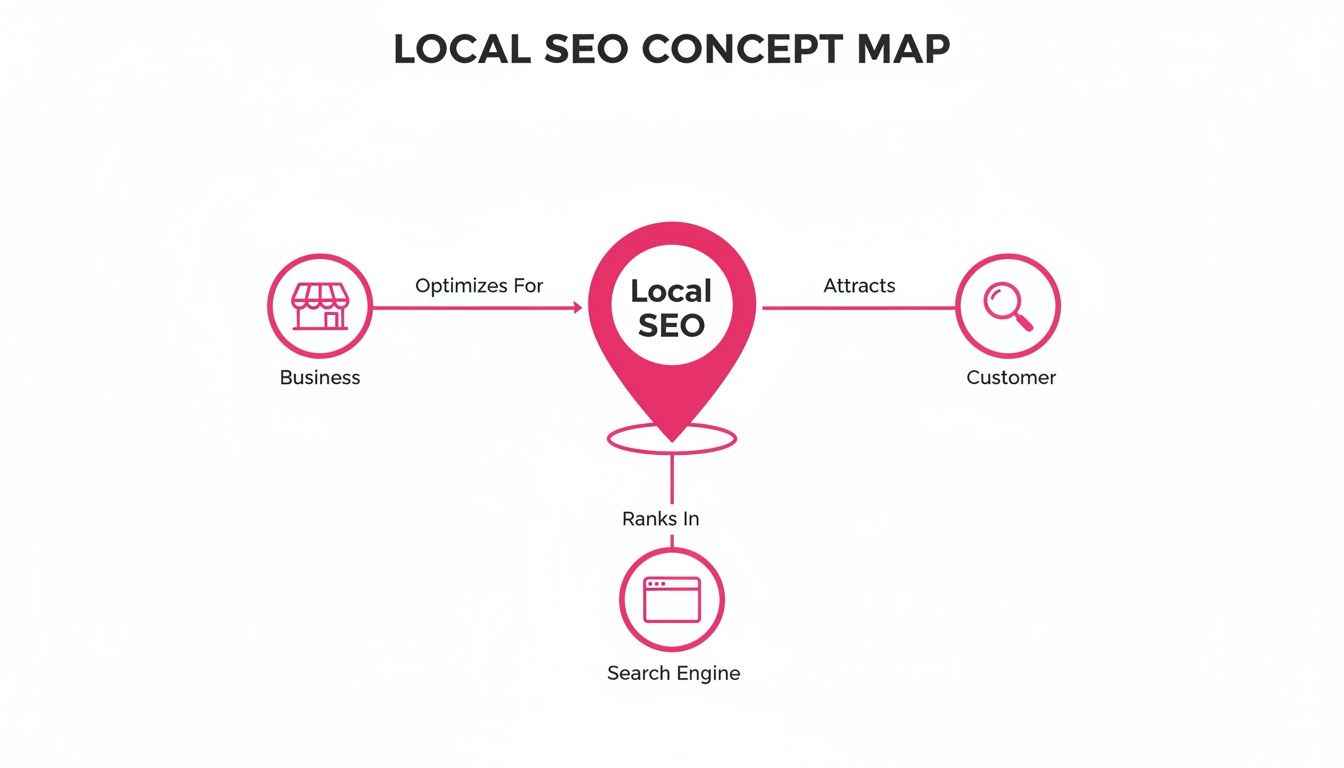
As you can see, local SEO sits right in the middle, linking what your business offers with what real customers are searching for, which directly influences how search engines show them the results.
Google Business Profile: Your Digital Shopfront
Your Google Business Profile (GBP) is, without question, the most critical pillar in your local SEO strategy. It’s that information-packed box you see in Google Search and on Google Maps—your virtual front door. For many potential customers, it's the first and sometimes only interaction they'll have with your business online.
A badly managed or incomplete profile is like a shop with a broken sign and boarded-up windows; it just doesn't inspire confidence. A fully optimised profile, on the other hand, gives customers everything they need to make a decision right there and then: your hours, services, photos, and what other people think of you.
The data for UK businesses is crystal clear: GBP optimisation is non-negotiable. It's estimated to contribute a massive 19.2% of local search ranking factors in 2025. What's more, businesses that actively manage their profiles with keyword-rich descriptions see a significant 31% improvement in their local pack visibility. To get a real sense of its power, you can explore the latest Google My Business statistics. If you want to get started on the right foot, a solid guide on effective Google Business Profile management is a great place to begin.
Local Keywords and On-Page SEO
Once your GBP is sorted, the next pillar is your website itself. Local on-page SEO is all about fine-tuning your website's content to shout about your geographic relevance to search engines. This means you have to go beyond general service terms and start weaving in local keywords.
Just think about how real people search. They don't just type in "plumber"; they look for a "plumber in Camden" or "NW1 emergency plumber".
- Service Pages: Build out dedicated pages for each service you offer, and make sure to mention the specific towns, neighbourhoods, or postcodes you cover.
- Homepage Content: Your homepage needs to state clearly who you are, what you do, and—most importantly—where you do it.
- Title Tags and Meta Descriptions: Weave your main location into the title tags and meta descriptions of your key pages. For instance, "Expert Boiler Repairs in Manchester | Call Us Today" is miles better than just "Boiler Repairs".
This whole process tells Google that your business is a highly relevant answer for people searching in a specific area, directly connecting what you offer to local demand.
A well-optimised website acts as a powerful confirmation of the information in your Google Business Profile. When both are perfectly aligned, Google sees your business as a credible and authoritative local entity.
Citations and NAP Consistency
Imagine you moved house but gave everyone a slightly different forwarding address. It would create chaos, and nobody would know where to find you. The exact same principle applies to your business information online. This is where citations come in.
A citation is any online mention of your business's Name, Address, and Phone number (NAP). You'll find them on online directories like Yelp, Thomson Local, and countless other industry-specific sites. The absolute key to this pillar is NAP consistency.
Even a tiny variation—like listing "Street" on one site and "St." on another—can confuse search engines and erode trust. Inconsistent data makes Google less confident about where your business is and whether it's legitimate, which can seriously hurt your rankings. Regularly auditing and cleaning up your citations is a fundamental bit of housekeeping in local SEO.
Online Reviews and Reputation
In today's world, reviews are the digital version of word-of-mouth, and they are incredibly powerful. This pillar isn't just about collecting stars; it's about building social proof. You're showing both customers and Google that your business is trustworthy and valued by the local community.
Google pays very close attention to review signals, including:
- Review Quantity: The total number of reviews you have.
- Review Velocity: How quickly you're getting new reviews.
- Review Diversity: Getting reviews across different platforms (Google, Facebook, industry sites).
- Review Rating: Your average star rating. It's a fact: listings with over 50 reviews and a 4.5+ average rating have a 57% higher chance of ranking in the top local results.
- Owner Responses: Actively replying to reviews shows you're engaged and that you value customer feedback.
Having a proactive strategy to encourage happy customers to leave feedback is vital. And responding to all reviews—the good and the bad—is just as important for managing your online reputation.
Local Content and Link Building
Creating content that speaks directly to your local audience is a brilliant way to establish your authority and relevance. This isn't about generic blog posts; it's about becoming a go-to local resource. For example, a plumber in Leeds could write a guide on dealing with the area's hard water issues. A café in Brighton could post about its involvement in the Brighton Fringe festival.
Hand-in-hand with this is earning local links, which is a huge signal to Google. When another local business, a local newspaper, or a community event website links to your site, it’s a massive vote of confidence. This could happen by sponsoring a local football team, partnering with a neighbouring business, or getting featured in a local blog. These links anchor your business firmly within the local digital ecosystem.
Finally, there are technical elements like LocalBusiness schema markup, which acts as a translator for search engines. This special bit of code helps Google clearly understand your NAP, opening hours, and what services you offer, leaving no room for guesswork. By strengthening each of these pillars, you build a robust and highly visible local presence that naturally attracts customers and drives growth.
The Tangible Business Benefits of Local SEO
Knowing the theory behind local SEO is great, but what really matters is how it helps your business in the real world. Why should a busy owner like you invest time and money into this stuff? The answer is simple: it delivers tangible, measurable results that directly boost your bottom line.
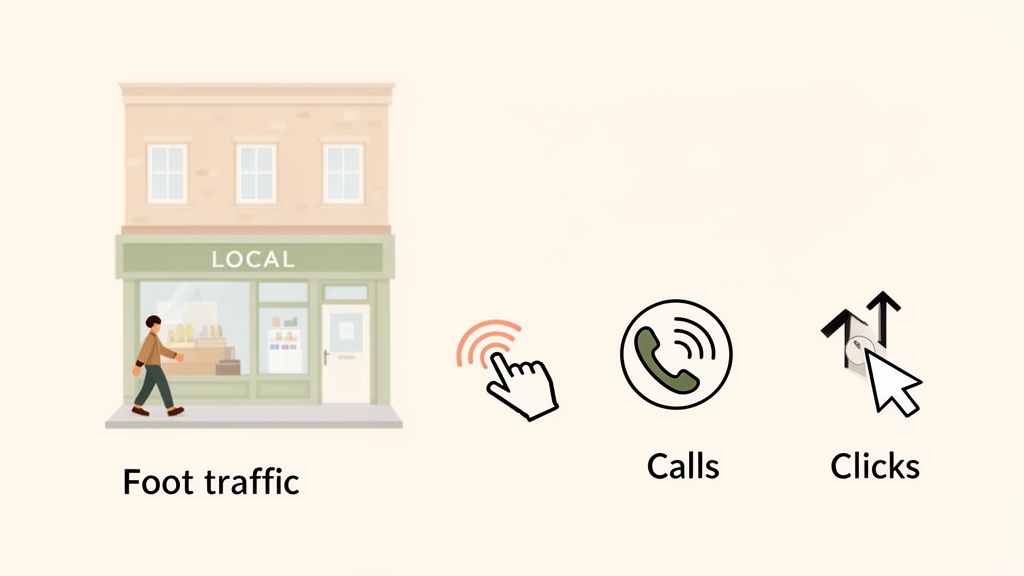
Local SEO isn't about chasing rankings for the sake of it. It’s about being there at the exact moment a potential customer needs you. It’s about generating the most valuable leads a local business can get—people who are physically nearby and ready to buy.
Attract High-Intent Customers and Drive Footfall
Think about it. When someone searches for "emergency plumber near me" or "best fish and chips in Brighton," they aren't just browsing. They have a problem that needs solving, right now. Local SEO puts your business squarely in their path at that crucial moment.
This visibility leads directly to real-world actions. By showing up at the top of local search results, you can expect a sharp increase in:
- More phone calls: Customers see your number on your Google Business Profile and can call you with a single tap.
- Increased website traffic: People click through to your site to check your services, opening hours, or menu.
- More foot traffic: They get driving directions straight to your front door from Google Maps.
These aren't just empty clicks. These are qualified leads walking through your digital and physical doors, ready to become paying customers.
Dominate the Google Local Pack
Appearing in the Google Local Pack—that map and list of three businesses you see at the very top of the search results—is the holy grail of local visibility. This is prime digital real estate. Securing a spot here gives you a massive advantage over competitors who are lost on page two.
The impact of the Local Pack can't be overstated. It's the first and often only place a potential customer will look. Outranking your direct competitors here means you grab their attention—and their business—before they even know anyone else exists.
Fresh statistics for 2025 show that over 60% of all local search clicks go to the businesses featured in that Local Pack. For the top performers, the click-through rate can be as high as 15–20% on mobile devices. This makes a fully optimised Google Business Profile an absolute must-have. UK consumers, in particular, now expect this kind of localised result, a trend that’s only getting stronger. You can dig deeper into these UK-specific local SEO statistics on key-g.com.
Build Trust and Credibility
A solid local SEO presence does more than just get you seen; it builds trust. When a customer finds a complete profile, sees your details are consistent everywhere, and reads a stream of positive reviews, it screams credibility.
Think of it as today's word-of-mouth. Great reviews are social proof, reassuring new customers that others have had a fantastic experience with you. That trust is often the final push someone needs to choose you over a competitor with a patchy online reputation.
Ultimately, local SEO marketing delivers an incredible return on investment. By focusing your marketing spend on people who are actively looking for local solutions, you target the most likely buyers and generate real, measurable growth.
Your Actionable Local SEO Implementation Checklist
Knowing what local SEO is all about is one thing, but actually putting that knowledge into practice is where you’ll see the results. This checklist isn’t just a list of tasks; it’s a practical, step-by-step roadmap that any business can follow. Think of it as the blueprint for building a rock-solid local presence, starting with the actions that give you the biggest bang for your buck.
We've broken the whole process down into three manageable phases. This way, local SEO feels less like a mountain to climb and more like a series of achievable steps. By tackling these items one by one, you’ll be methodically building a powerful local marketing engine from the ground up.
Phase 1: Foundational Setup
First things first. This initial phase is all about claiming your patch of digital turf and making sure your core business information is spot-on. Getting these fundamentals right isn't just important—it's non-negotiable. They form the very bedrock of your entire local SEO strategy.
-
Claim and Verify Your Google Business Profile (GBP): This is your single most important local asset, period. Head over to Google Maps, find your business listing, and follow the prompts to claim and verify ownership. This one action literally puts you on the map.
-
Complete Every Single Section of Your GBP: Don't be lazy here. Leaving fields blank is a missed opportunity. Fill out your business name, address, phone number (NAP), website, and opening hours. Write a compelling "from the business" description, add your service menus or product catalogues, and tick all the relevant attributes (like "Wi-Fi available" or "outdoor seating"). The more detail, the better.
-
Select a Super-Specific Primary Category: This is a big one. You need to choose the most specific category that describes your business. For instance, pick "Italian Restaurant" instead of just "Restaurant." This is a critical signal that tells Google exactly what you do. After that, add secondary categories to cover everything else you offer.
-
Upload High-Quality Photos and Videos: A lifeless profile won't attract anyone. Your profile needs to look the part. Add your logo, a great cover photo, and at least 10 high-resolution images showing off your premises (inside and out), your team at work, and your products or services in action. Better yet, make a habit of uploading new photos regularly to keep things fresh.
Your Google Business Profile isn't a "set it and forget it" task. Treat it like your main social media profile, with regular updates, new photos, and active engagement. It's the central hub of your local online identity.
Phase 2: Website and Content Optimisation
With your GBP looking sharp, the next job is to get your website aligned with your local focus. This phase is all about making sure your own digital home base reinforces the signals you're sending to Google, creating a consistent and trustworthy online footprint.
-
Create Location-Specific Service Pages: If you serve more than one town or neighbourhood, don't lump them all together. Create dedicated pages on your website for each one. A page titled "Boiler Repairs in Manchester" is going to be far more effective at attracting local searchers than a generic "Services" page.
-
Plaster Your Name, Address, and Phone Number (NAP) on Your Website: Make sure your NAP is clearly visible, usually in your website's footer and on a dedicated contact page. The crucial part? It must match the information on your GBP exactly, down to the last comma.
-
Brainstorm Your First Local Content Pieces: Start thinking like a local journalist. Plan a blog post about a community event you're sponsoring. Write up a case study featuring a well-known local client. Create a helpful guide relevant to your area, like "Best Walking Trails Near Our Dog-Friendly Café." This shows you're part of the community, not just in it.
Phase 3: Building Authority and Trust
Alright, you've laid the foundation and optimised your site. This final phase is about building social proof and making sure your business details are consistent across the web. This is what solidifies your reputation and signals to search engines that you are a legitimate, well-regarded local business.
-
Kick-off a Review Generation Campaign: It's time to ask for feedback. Start by asking your most recent happy customers to leave a review on Google. You can do this easily via an email or text message, or even by using a simple QR code at your place of business. The goal here is to create a steady, ongoing stream of new, positive reviews.
-
Audit Your Top 10 Local Citations: Go and search for your business on the big online directories like Yelp, Thomson Local, and Facebook. Check if your NAP is 100% consistent with your GBP. If you spot any discrepancies, make a list and get them fixed. This simple audit stops Google from getting confused, which can otherwise really harm your rankings.
How to Streamline and Scale Your Local SEO
Following a manual checklist is a decent starting point, but what happens when you're juggling more than one location? Or when you’re simply running out of hours in the day? The constant loop of updating profiles, replying to every single review, and trying to make sense of performance data can quickly become a massive headache.
This is where you need to think smarter about what local SEO marketing can really do for your business. To manage local SEO at scale, you have to move past the grind of manual tasks and embrace tools that automate the repetitive work. This frees you up to actually focus on growing the business.
Overcoming Common Local SEO Pains
For businesses with multiple branches or agencies handling a portfolio of clients, the challenges stack up fast. Just the time spent logging in and out of different Google Business Profiles can be a huge drain on your resources. Manually posting updates or responding to reviews across ten, fifty, or even a hundred locations just isn't sustainable.
This is exactly where a dedicated platform becomes a necessity, not a luxury. A smart solution can directly solve these all-too-common pain points:
- Time-Sucking Updates: Instead of updating each profile one by one, you can schedule posts, offers, and photos across all your locations from a single dashboard.
- Inconsistent Branding: You can ensure every location has the same core information, branding, and messaging, getting rid of the inconsistencies that can damage your rankings.
- Overwhelming Review Volume: Keeping on top of customer feedback is crucial but nearly impossible at scale. Automation can help you manage responses efficiently without letting anything slip through the cracks.
- Clunky Performance Tracking: Manually pulling data from individual profiles into spreadsheets is slow and rarely gives you the clear, actionable insights you actually need.
Using an AI-Powered Platform
An AI-powered platform like LocalHQ is built from the ground up to tackle these challenges head-on. By bringing all your local marketing efforts under one roof, it turns a complex, time-consuming process into something clear and manageable.
This is what a unified dashboard looks like, pulling all your location data into one place for straightforward management and analysis.
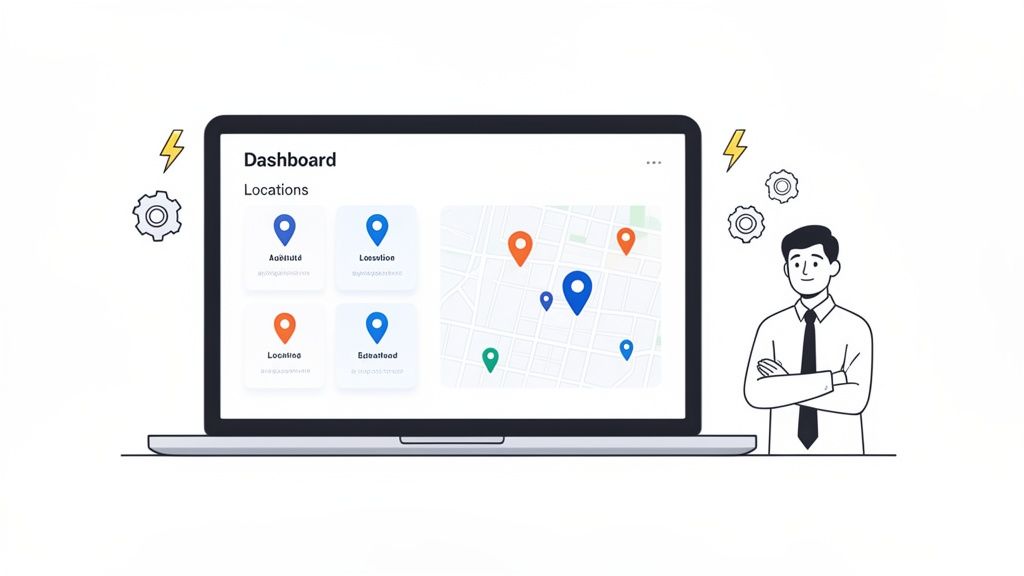
This centralised view lets you see performance at a glance, spot underperforming locations, and roll out changes across your entire network in minutes, not hours.
For example, an AI Optimisation Wizard can analyse your profiles against the competition and suggest specific improvements, like adding more relevant business categories or fine-tuning your service descriptions. This data-first approach takes the guesswork out of optimisation. In the same way, a Review Autoresponder can instantly draft on-brand replies to customer feedback, making sure no review goes unanswered while saving your team a ton of time. You can learn more about how to use AI for local SEO in our dedicated guide.
Using a platform isn't about replacing your strategy; it's about amplifying it. Automation handles the repetitive tasks, giving you the data and bandwidth to make smarter decisions that drive real growth and prove your return on investment.
One of the most powerful tools you'll find is a geo-grid rank tracker. Instead of just showing you an average ranking position, it shows you exactly where your business appears on the map for key search terms, block by block. This gives you a true picture of your local visibility, revealing opportunities to target specific neighbourhoods where your presence is weaker. By using these kinds of tools, you can transform local SEO from a manual chore into a strategic, scalable engine for growth.
Tracking and Measuring Local SEO Success
So, you’ve put in the work on your local SEO strategy. But is it actually working? How do you know if all that effort is leading to real growth for your business? The key is to look past vanity metrics and zero in on the Key Performance Indicators (KPIs) that really matter.
Your goal is to draw a clear line from your online activity to tangible results—more phone calls, more people walking through your door, and ultimately, more revenue. It's about moving beyond just checking your rank and digging into data that shows genuine customer interest. A solid grasp of measuring marketing effectiveness and maximizing ROI is what separates a good strategy from a great one, helping you prove the value of your work.
Key Metrics to Monitor
Don't get bogged down in a sea of spreadsheets. Instead, focus on a few powerful metrics that give you a crystal-clear picture of your performance. These are the numbers that show how potential customers are actually interacting with your business online.
-
Google Business Profile Insights: This is your command centre. Keep a close eye on phone calls, website clicks, and requests for driving directions. These aren't just clicks; they represent real people with high intent, ready to connect with you.
-
Local Organic Traffic: Pop open Google Analytics and filter your organic traffic to see visitors from your specific service areas. If you see a steady rise in local visitors, you know your on-page optimisation and content are hitting the mark.
-
Review Velocity and Sentiment: It's not just about your average star rating. How often are new reviews coming in? A consistent stream of positive feedback tells both potential customers and Google that your business is active, trusted, and delivering a great experience.
Visualising Your Local Rankings
Here's something a lot of people miss: a standard rank tracker can be pretty misleading for local SEO. Your ranking isn't a single, fixed position. It changes drastically depending on where the search is being made. Someone searching from a mile away could see completely different results than someone just down the street.
This is exactly why a geo-grid rank tracker is so essential. It overlays your rankings on a map, showing you a grid of specific points. You can see precisely where you’re dominating and where competitors have the edge, almost block by block.
This kind of detail is gold for fine-tuning your strategy. You can dive deeper into this granular approach by learning more about rank tracking for local keywords. When you focus on these tangible metrics, you can measure your local SEO success with confidence and make smart, data-backed decisions that drive real business growth.
Common Questions About Local SEO Marketing, Answered
Getting started with local SEO always brings up a few questions. It’s a new discipline for many business owners, so that's completely normal. We've gathered some of the most common queries we hear to give you the clear, straightforward answers you need to move forward with confidence.
How Long Does It Take to See Results from Local SEO?
This is the big one, isn't it? While you can see some quick wins within a few weeks—especially after a thorough Google Business Profile optimisation—real, lasting local SEO is a marathon, not a sprint. It's about building momentum over time.
Think of it this way: you’re building trust with Google. For significant, stable improvements in your local rankings, web traffic, and footfall, you should realistically expect to see results within three to six months. This gives enough time for your new citations to be found, for a steady stream of reviews to come in, and for your local content to start signalling your authority to search engines.
Can I Do Local SEO Myself, or Should I Hire an Agency?
You can absolutely get your hands dirty with the fundamentals of local SEO. For a single-location business, tackling the basics is a fantastic starting point. Claiming your Google Business Profile, ensuring your details are correct, and making a habit of asking customers for reviews are all high-impact tasks you can manage yourself.
However, once you start juggling multiple locations or want to get into the more technical side of things, the workload can quickly become overwhelming. That's when bringing in an agency or using a specialised platform can be a game-changer. It helps you scale your efforts, saves a huge amount of time, and ensures the complex bits are handled correctly.
What Is the Single Most Important Part of Local SEO?
If you could only focus your energy on one thing, it has to be your Google Business Profile (GBP). Hands down. Think of it as your digital front door—it's often the very first interaction a potential customer has with your business online.
A complete, active, and well-reviewed GBP is the foundation of your entire local marketing strategy. Without a strong profile, all your other efforts—from content to link building—will never reach their full potential.
Ready to take control of your local presence and turn searchers into customers? With LocalHQ, you can manage all your locations, automate review responses, and get AI-driven insights to outrank the competition. Start streamlining your local SEO today by visiting https://localhq.io.