Enterprise Local SEO: Managing 1,000+ Locations Without a 1,000-Person Team

Enterprise local SEO is a different beast altogether. It’s the specialised practice of optimising the online presence for a business with a huge number of physical locations—often stretching into the hundreds or even thousands.
The real challenge isn't just optimising each location individually. It’s about building a scalable, largely automated system to manage data, content, and reputation consistently across the entire network, without needing a massive team to do it.
The Enterprise Local SEO Scalability Problem
Let's be honest, managing local SEO for a handful of shops is fairly straightforward. A small team can manually update Google Business Profiles, jump on new reviews, and make sure business details are correct. But what happens when you’re dealing with 500, 1,000, or more locations? That manual approach doesn’t just get harder; it becomes completely impossible.
This is the heart of the enterprise local SEO scalability problem. The hands-on methods that work for a small business simply crumble under the weight of a vast location network. What was once manageable quickly descends into a logistical nightmare, sparking a chain reaction of costly issues that hurt your brand and local performance.
The Breakdown of Manual Management
Without a central system, chaos takes over fast. I've seen it happen time and again. The common pitfalls include:
- Inconsistent NAP Data: Name, Address, and Phone number (NAP) details become a mess. One location has the old phone number on a directory, another has the wrong closing time. This not only confuses customers but also seriously erodes trust with search engines.
- Outdated Google Business Profiles: Simple things get missed. Temporary hour changes aren't made, new services aren't added, and bank holiday hours are forgotten. The result? A terrible customer experience and lost sales.
- A Patchwork Customer Experience: A customer in Manchester might find a perfectly polished online presence, while someone in Bristol stumbles upon a neglected, barren profile for the same brand. This inconsistency is a brand killer.
At an enterprise scale, managing things by hand isn't just inefficient; it's a direct threat to your brand's reputation and local market share. Every inconsistency is another crack in your customer's trust.
When we visualise the two approaches, the difference becomes stark. A manual workflow is a tangled web of disconnected tasks, whereas an automated system brings clarity and control.
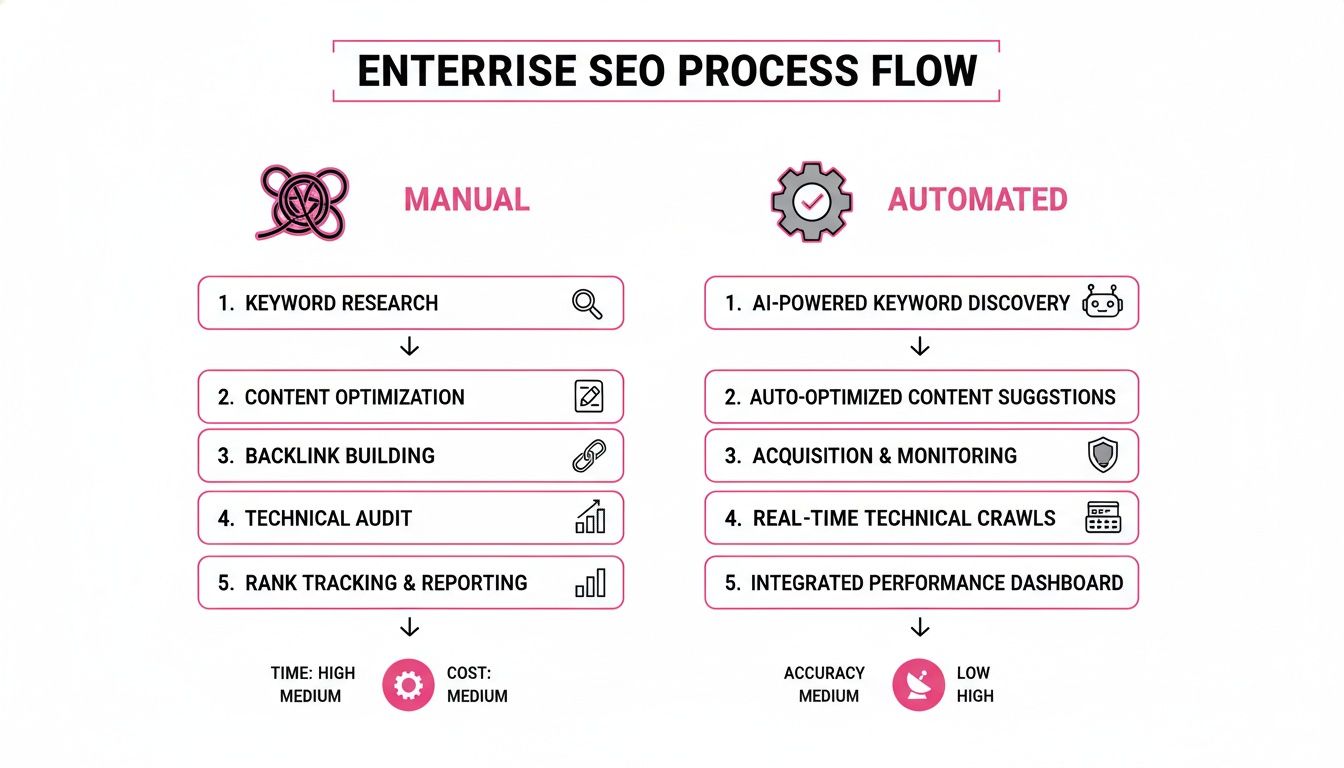
The flowchart above really drives the point home. Automation takes all those chaotic, separate jobs and funnels them into a single, efficient process. This doesn't just save time—it massively improves accuracy.
To really get a feel for the day-to-day difference, let’s compare the two approaches side-by-side.
Manual vs Automated Enterprise Local SEO
This table breaks down the reality of managing a multi-location brand the old way versus the smart way.
| Aspect | Manual Management (The Old Way) | Automated Management (The Smart Way) |
|---|---|---|
| Data Updates | Hours of manual data entry for each location, one by one. Prone to human error. | A single update pushed out to all locations in minutes. Ensures 100% consistency. |
| Review Management | Someone has to log into each profile to respond. Slow response times are common. | A central dashboard for all reviews. AI-assisted responses speed things up. |
| Reporting | Manually pulling data from dozens of sources into messy spreadsheets. | Automated, customisable dashboards showing KPIs for the entire network. |
| Team Size | Requires a large, dedicated team just to keep up with basic maintenance. | A small, strategic team can manage thousands of locations effectively. |
| Cost | High overheads due to labour-intensive tasks and lost revenue from errors. | Lower operational costs and higher ROI through efficiency and accuracy. |
The takeaway is clear: clinging to manual methods is not only unsustainable but also a significant competitive disadvantage.
Shifting from Chaos to Control
The whole point of this guide is to help you move away from that reactive, chaotic model. It’s about building a solid, centralised system that turns this scalability problem into your biggest competitive advantage in the UK market. Crafting the right strategy requires a deep dive, and this practical guide to local SEO for multiple locations offers some great foundational knowledge.
The solution isn't hiring an army of marketers. It’s about embracing the right technology and strategic automation. By doing so, a small, focused team can expertly manage an entire network of locations, making sure every single one is perfectly positioned to attract and convert local customers. This shift turns local SEO from a defensive chore into a powerful engine for growth.
For agencies juggling multiple enterprise-level clients, mastering this process is essential. If that's you, our insights on delivering effective white-label local SEO services at scale might be just what you need.
Laying the Groundwork for Local SEO at Scale
Before you even think about optimising your local SEO across hundreds or thousands of locations, you have to get your house in order. Trying to scale a strategy on top of messy, inconsistent data is like building a skyscraper on sand – it's only a matter of time before it all comes crashing down. This first phase is all about creating a rock-solid foundation for everything that follows.
The core objective here is simple: establish a single source of truth for all your location data. This clean, accurate, and centralised database will be the engine for your entire local SEO programme. Every listing, every location page, and every campaign will pull from this master file, ensuring absolute consistency across the board.
Kicking Off With a Full Portfolio Audit
First things first, you need to conduct a full-scale audit of your entire digital footprint. This isn't just a quick check-up; it's a deep dive to find every single error that could be dragging down your local visibility. We’re hunting for three main culprits:
- NAP Inconsistencies: You need to scour the web for any variations in your Name, Address, and Phone number (NAP). Even tiny differences, like "Ltd" versus "Limited" or a single wrong digit in a phone number, can confuse search engines and damage the trust they have in your business information. These errors effectively dilute your authority and split your ranking power.
- Rogue and Duplicate Listings: Over the years, especially through staff turnover or company acquisitions, rogue listings inevitably pop up. These can be created by well-meaning employees or even automatically generated by data aggregators. They end up competing with your official profiles, spreading misinformation, and creating a confusing experience for customers.
- Performance Benchmarking: You can't improve what you don't measure. A proper audit means benchmarking the current performance of every single location. You’ll want to look at key metrics like local search rankings, average review ratings, Google Business Profile completeness, and customer engagement signals (clicks, calls, and requests for directions).
Think of this audit as a digital census for your business. You have to account for every online mention of every location to get a true picture of where you stand before you can map out a path forward.
This process will almost certainly uncover hundreds, if not thousands, of issues. Don't panic. The goal isn't to fix everything at once, but to prioritise intelligently.
How to Prioritise Your Efforts for Maximum Impact
With a complete audit in hand, you can finally shift from constantly fighting fires to executing a proactive strategy. Trying to tackle every problem across 1,000 locations at the same time is a surefire way to get nowhere. The smarter approach is to segment your locations and focus your resources where they’ll make the biggest difference.
I recommend grouping your locations based on a mix of factors:
- Business Priority: Your high-revenue stores, flagship branches, or locations in key strategic markets should always come first. Boosting their visibility delivers the most immediate and significant impact on the bottom line.
- Performance Gaps: Pinpoint the locations that are seriously underperforming compared to their peers or local competitors. These are often the low-hanging fruit where foundational fixes can produce quick, satisfying wins.
- Market Opportunity: Look for locations in areas with high search demand but surprisingly low competition. A concentrated effort here can help you dominate the local search results and quickly steal market share.
Once you’ve sorted your locations into priority groups, the real work of data cleansing begins. This means methodically correcting all the NAP inconsistencies in your master file, then moving on to claiming and merging all those duplicate listings you found. This is also the perfect time to enrich your data with extra details like specific services offered, opening hours, or accessibility information.
For a large-scale operation, exploring how to use AI for local SEO can be a game-changer, offering powerful ways to automate parts of this heavy-duty data analysis and clean-up.
This meticulous prep work sets the stage for everything to come. With a clean, prioritised, and centralised data set, you're finally ready to plug into a management platform and start the exciting work of bulk optimisation and automation.
Mastering Google Business Profile At Scale
For any business with multiple locations, Google Business Profile (GBP) isn't just another listing—it's the digital front door for every single site. Think of it as the first handshake a potential customer has with your brand in their local area. But when you’re managing hundreds, or even thousands, of these profiles, the challenge shifts from simple upkeep to strategic, large-scale management.
This is about more than just keeping the lights on. It’s about turning each profile into its own localised marketing engine. The secret lies in moving past manual updates and embracing tools that let you push out changes, schedule content, and run sophisticated optimisations across your entire network without burning out your team.

From Manual Tedium to Automated Efficiency
Let’s be honest: logging into each profile individually is a complete non-starter at the enterprise level. Can you imagine trying to update the bank holiday hours for 800 different retail stores one by one? It’s not just slow; it’s a surefire way to make costly mistakes. This is where automation comes in.
With the right platform, you can completely change the game.
- Bulk-Verify New Profiles: Get new locations verified and showing up on Google Search and Maps far more quickly than doing it manually.
- Push Simultaneous Updates: Instantly change opening hours, add a new service, or update business descriptions across your entire portfolio. One click, total consistency.
- Schedule Localised Content: Plan and schedule your Google Posts, photos, and event announcements weeks or even months ahead. You can even target specific regions, ensuring your content truly speaks to each local community.
This shift to automation frees up your team from mind-numbing data entry. Instead, they can focus their energy on high-value strategic work. If you're looking for a deeper dive into this, our guide on managing multiple Google Business listings has you covered.
AI-Driven Optimisation For A Competitive Edge
Real mastery of GBP at scale goes beyond just pushing out updates. It's about using smart, data-driven insights to make sure every single profile is perfectly tuned for its specific local market. This is where AI-powered optimisation becomes indispensable for enterprise brands.
Modern platforms can now analyse competitor data right down to the postcode level, giving you concrete, actionable recommendations. For example, an AI tool might spot that the top-ranking competitors in a specific town are all using a secondary category that your profile is missing. It can then flag this, helping you capture more relevant local searches you were previously missing out on.
A platform with AI optimisation capabilities turns your GBP strategy from reactive to proactive. It continuously analyses the local search environment for each location, ensuring you never miss an opportunity to gain an edge.
This data-first approach also works wonders for attributes. The AI can identify which attributes—like "Outdoor seating" or "Click-and-collect"—are most common among the top performers in a given area. It then prompts you to add them to your own profiles where they apply, making your listings more complete and competitive, which in turn boosts your visibility in the local pack.
The Impact On Customer Engagement And Conversions
A network of well-managed GBP profiles is a direct pipeline to customer engagement. You really can’t overstate how important this is, especially in the UK market. Recent data shows that a staggering 96% of people find local businesses through online searches, making a powerful local presence non-negotiable.
The 2026 UK State of Digital Marketing Report found that for multi-location brands, verified profiles generate an average of 200 clicks and 105 website visits every month. What's more, 52% of businesses surveyed cited GBP management as their single most important service, proving its massive role in driving real-world footfall and revenue.
To truly scale your presence, you also need to get inside the head of the searcher. Understanding how to rank for broad queries like "SEO Service Near Me" can provide valuable lessons for your wider strategy. By using technology to keep your profiles accurate, optimised, and engaging across the board, you build a trustworthy experience that consistently turns local searchers into loyal customers.
Your Engine for Local Content and Reviews
For any large business, keeping the brand message consistent is vital. But when it comes to winning on the ground, local relevance is what truly moves the needle. You can't just plaster the same corporate message across every location and expect it to work.
The real magic happens when you build a system that can produce content that feels personal to each community while also managing the constant flow of customer feedback. This isn't just about having a location finder; it's about turning every local touchpoint—from your website to your Google reviews—into a genuine connection that builds trust.
Going Beyond the Basic Location Page
Think of your location pages as your digital shop fronts. For an enterprise, this is where so many fall down, creating hundreds of thin, cookie-cutter pages that are identical apart from the address. That’s a massive missed opportunity.
Each location page needs to be a rich, standalone resource for the local community it serves. It has to answer the questions local people are actually asking Google. This means going way beyond just listing your name, address, and phone number.
Pack your pages with details that prove you’re part of the neighbourhood:
- Local Colour: Mention nearby landmarks, transport links, or even shout out partnerships with other local businesses. A restaurant in Shoreditch might mention being "just around the corner from Boxpark."
- Local Lingo: Use the keywords people in that area actually use. Think neighbourhood names or even well-known local slang. For instance, a gym might target "fitness classes in The Lanes" rather than just "Brighton."
- Real-World Imagery: Ditch the stock photos. They kill conversions. Show real pictures of your actual storefront, the team who works there, and products on the shelves in that specific location.
- Customer Voices: Embed positive reviews directly onto the page. This is powerful social proof and provides a constant stream of fresh, user-generated content that search engines love.
An effective location page doesn't just tell customers where you are; it shows them who you are in their community. It proves you get their local context, building instant rapport.
This attention to detail signals to Google that each of your locations is a distinct and valuable entity, worthy of its own spot in local search results. Crafting unique content for each location can feel like a lot, but you can get more mileage by integrating efforts like your Google Business Profile posts, which perfectly complement your on-page strategy.
Turning Customer Feedback into a Growth Engine
In local search, reviews are your reputation. Full stop. When you're managing hundreds or even thousands of locations, the sheer volume of customer feedback can feel like a tidal wave. But you simply can't afford to ignore it.
The data speaks for itself. In the UK, a staggering 46% of all Google searches are for local information. Reputation is everything. Research shows that businesses featured in Google's Local Pack get 126% more traffic, and with 75% of consumers reading reviews regularly, your response strategy is non-negotiable. Yet, a surprising 58% of UK businesses still aren't optimising for local search, leaving a huge opening for you to dominate. You can see the full picture with these local SEO statistics and realise just how big the opportunity is.
A steady stream of positive reviews boosts your rankings, while a swift, thoughtful response to a negative one can turn a bad experience into a story of incredible customer service. The key to handling this at scale is a smart mix of automation and a human touch.
Setting Up an Automated Review Response System
Let's be realistic: nobody can manually reply to every single review across 1,000+ profiles. It's just not possible. This is where an AI-powered review autoresponder becomes your best friend, providing instant, on-brand, and contextually aware replies 24/7.
Here’s how this works in practice:
- For Glowing Reviews (4-5 stars): The AI can generate varied, enthusiastic thank-you messages. It can even pick up on keywords in the review—like "friendly staff" or "clean store"—and weave them into the reply to make it feel more personal.
- For Neutral Feedback (3 stars): The system can offer a balanced response, thanking the customer for their honesty and gently probing for more detail on how you could have earned that extra star.
- For Negative Reviews (1-2 stars): This is about damage control and de-escalation. The system can issue an immediate, empathetic acknowledgement that shows you’re listening. This initial response buys you time while automatically flagging the review for a human—like a regional or store manager—to follow up personally.
This automated first line of defence ensures no customer ever feels ignored. It dramatically improves public sentiment and shows Google that you're an engaged, reputable business. More importantly, it frees up your team to stop firefighting and start focusing on solving the root causes of complex issues, turning review management from a chore into a powerful engine for building your reputation.
Measuring What Matters Across Your Enterprise
If you're not tracking the right data, your entire local SEO strategy is just a shot in the dark. It’s so easy to get fixated on vanity metrics like raw impressions, but for an enterprise, that just doesn't cut it. You have to focus on the key performance indicators (KPIs) that actually prove a return on investment.
At this scale, you can’t be wrestling with spreadsheets. You need consolidated reporting dashboards that pull data from all your locations—hundreds or even thousands of them—into one clear, compelling story. This is how you show stakeholders the real-world value of your work and make smart, data-driven decisions.

Beyond Vanity Metrics: The KPIs That Actually Count
For any multi-location business, the most telling metrics are the ones that measure genuine customer actions. These are the numbers that connect your online visibility directly to in-store footfall and revenue. This is what your reporting should be laser-focused on.
Your dashboards should highlight these core indicators:
- Search Impressions & Visibility: This shows how often your locations are appearing in local searches. By itself, it’s not a game-changer, but its true power lies in trend analysis. Are you gaining or losing visibility in your key markets over time?
- Clicks-to-Call: This is a high-intent signal. A customer who clicks to call a specific branch is often ready to book an appointment or ask a buying question, making it a brilliant metric for lead generation.
- Direction Requests: This is one of the strongest indicators of footfall. Someone asking for directions is very likely on their way to your physical location. It’s about as close as you can get to tracking a direct path from search to store.
- Website Visits from GBP: This tracks how well your Google Business Profiles are funnelling qualified traffic to your location pages. It’s a great measure of how your local listings support your main digital assets.
At the enterprise level, the goal isn't just to see these numbers, but to segment them. The real magic happens when you can compare performance across regions, store formats, or even down to individual postcodes to see what’s really moving the needle.
For example, you might find that your locations in Scotland are generating tons of direction requests, while your London sites get more clicks-to-call. This kind of segmented data lets you adapt your strategy to local user behaviour instead of forcing a one-size-fits-all approach. For those looking to get this done without the manual headache, a dedicated Google Business Profile reporting tool can automate all the data aggregation and segmentation for you.
Visualising Your Local Dominance with Geo-Grid Tracking
Standard rank tracking might tell you where you rank nationally or in the centre of a city. But for an enterprise with multiple locations, that’s nowhere near granular enough. That’s where geo-grid rank tracking becomes an absolutely essential part of your toolkit.
Geo-grid tracking paints a picture of your search visibility for target keywords across a specific area, point by point. It lays a virtual grid over a map, checks your ranking from each point, and shows you exactly where you’re strong and, more importantly, where competitors are eating your lunch.
Imagine you're a retail chain in Manchester. A geo-grid report could reveal you rank #1 for "shoe shop near me" right around your Arndale Centre store, but you plummet to #8 just a mile away in the Northern Quarter, where a local rival is dominating. This is incredibly actionable intelligence. It tells you precisely where you need to focus your efforts—whether it’s building local links, running hyper-targeted ads, or creating neighbourhood-specific content.
This level of detailed, visual reporting changes the conversation with stakeholders. You move away from abstract numbers and start presenting tangible, map-based evidence of your market position. It directly answers the questions that matter: "Where are we winning?" and "Where are our biggest opportunities?"
Your Blueprint for Enterprise SEO Governance
When you're scaling local SEO across dozens or hundreds of locations, strategy alone won't cut it. You need control. Without a solid governance model, you're practically inviting chaos. This is your blueprint for holding the entire programme together, ensuring consistency and preventing things from spiralling out of control.
The real trick is finding that sweet spot between tight central control over your brand and giving local teams the freedom to connect with their own communities. You need a system that stops unauthorised changes in their tracks, automates compliance where possible, and makes sure brand standards are upheld at every single location.
Establishing Roles and Permissions
This all comes down to defining who can do what. A proper local SEO platform is essential here, as it allows you to set up specific user roles with incredibly granular permissions.
Think of it this way:
- Corporate Admins: They hold the master keys. Their job is to lock down the most critical profile fields – the business name, primary category, and website URL. This single action prevents a well-meaning (or disgruntled) employee from making a change that damages brand consistency across the board.
- Regional Managers: These users can be given oversight for a specific group of locations. They’re the ones approving content from their patch, analysing regional performance reports, and keeping an eye on the bigger picture for their area.
- Local Managers: We want these folks on the ground, engaging with customers. Give them limited access to handle the day-to-day stuff, like responding to reviews, uploading fresh photos, or creating Google Posts using templates you’ve already approved.
By assigning clear roles, you create an organised structure that ensures brand safety while still allowing for necessary local engagement. It’s about building guardrails, not roadblocks.
This structure means a local manager in Leeds can't accidentally change the official brand name, but they can post about a local charity event they’re sponsoring. And to make this foolproof, you can set up approval queues. Any content a local team wants to publish first gets routed to a regional or corporate manager for a quick check, ensuring everything is on-brand and high-quality before it ever sees the light of day.
Ultimately, this whole governance model is managed from a single, powerful dashboard. It gives you the bird's-eye view and the hands-on control you need to manage your entire network efficiently and securely, without needing an army of people to do it.
Common Questions from a Growing Enterprise
As you scale your local presence, some familiar challenges start to pop up. Let's tackle a few of the big questions we hear all the time from businesses managing hundreds or even thousands of locations.
How Can We Possibly Keep NAP Consistent Across 1,000+ Locations?
Honestly, you can't—at least not manually. Trying to track your Name, Address, and Phone number (NAP) details for that many locations with spreadsheets is a recipe for disaster. It’s simply not scalable.
The only way to win this game is with a centralised enterprise local SEO platform. Think of it as your 'single source of truth'. You enter and verify the correct data for every single location once, and the platform takes it from there. It pushes that information out to all the critical directories, especially your Google Business Profiles, and locks it in. Even better, it stands guard, constantly monitoring for any rogue changes and either fixing them on the spot or flagging them for you to review. It’s your automated defence against the data chaos that plagues so many large brands.
What's the Smartest Way to Handle Negative Reviews at Scale?
When you're dealing with a high volume of reviews, the best approach is a smart blend of automation and genuine human intervention. It’s about being both fast and effective.
Your first move should be an AI-powered review autoresponder. This isn't about faking a personal response; it's about providing an immediate, on-brand acknowledgement. This shows the customer you're listening and buys your team valuable time to investigate.
For a large brand, a timely automated response is far better than a slow human one. It de-escalates the situation and shows every customer they are heard, 24/7.
While the auto-response is working, you need a system for real problem-solving. Set up automated alerts for any reviews that drop below a certain threshold—say, one or two stars. These alerts should go directly to the person who can actually fix the problem, like a regional manager or a dedicated customer service rep, so they can deliver a personal, human-led resolution. This two-pronged strategy gives you the best of both worlds: speed and substance.
Should We Have One Big Website or Individual Sites for Each Location?
Stick with one central website. It’s a question that comes up a lot, but the answer is almost always the same: build out dedicated, beautifully optimised 'location pages' on your main corporate site. This strategy pools all your SEO authority into one powerful domain, lifting the performance of the entire site, including every single location.
The temptation to create separate websites or subdomains for each branch is a classic multi-location mistake. It seems logical, but you end up splitting your SEO authority, cannibalising your own traffic, and creating an absolute nightmare to manage. A clean parent-child page structure isn't just a suggestion; it's the proven, industry-standard approach because it works for users and search engines alike.
Ready to stop wrestling with spreadsheets and take command of your local presence? LocalHQ gives you a single, powerful dashboard to manage everything. See how our AI Optimisation Wizard can give you the competitive edge in every market you serve.