Master Your Local SEO with a Google My Business Reporting Tool
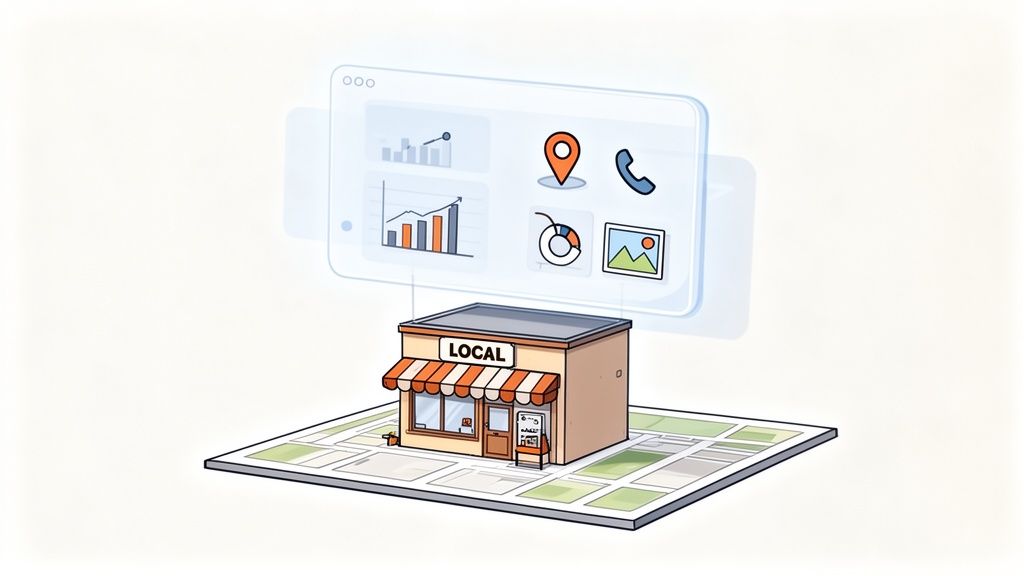
So, what exactly is a Google My Business reporting tool? Think of it as a specialised software platform that pulls in all the performance data from your Google Business Profile, organises it, and presents it in a way you can actually use. Instead of getting bogged down in confusing spreadsheets, these tools give you a clear, actionable picture of how customers are finding and interacting with your business online.
From Data Overload to Clear Business Decisions
Trying to make sense of the raw data from your Google Business Profile (GBP) can feel a bit like navigating London with a map of the stars. Sure, you see numbers for clicks, views, and calls, but what do they actually mean for your daily operations or your bottom line? This is precisely where a dedicated reporting tool steps in to act as your local guide.
These platforms take those jumbled numbers and turn them into intuitive, easy-to-read dashboards. It's the difference between being handed a random pile of ingredients and getting a step-by-step recipe for success. They're built to translate abstract metrics into genuine business intelligence.
A restaurant, for instance, might discover which photos of its new menu items are getting the most attention, helping shape its next promotion. A local retail shop could spot a spike in direction requests on Saturdays, prompting them to schedule an extra staff member. A plumber could analyse call data to realise which neighbourhoods are bringing in the most valuable jobs.
A great reporting tool doesn’t just show you data; it tells you a story about your customers. It reveals their search habits, what they find engaging, and their intent to visit or buy.
This shift from just passively looking at data to actively analysing it is crucial. A google my business reporting tool helps you move beyond simply seeing the numbers to truly understanding them. The core benefits are pretty clear:
- Understanding customer behaviour: Pinpoint exactly how potential customers discover your profile and what actions they take next.
- Identifying growth opportunities: Discover which search terms drive the most traffic or which of your posts generate the most engagement.
- Improving operational efficiency: Use insights on peak call times or direction requests to optimise staffing and inventory.
Ultimately, these tools equip you to make smart, informed decisions that lead to more foot traffic and revenue. By exploring a platform with powerful Google Business Profile analytics, you can turn raw data into a clear roadmap for local growth.
The Metrics That Actually Drive Local Growth
If you want to nail your local SEO, you have to start tracking the right numbers. A solid Google My Business reporting tool cuts through the noise of vanity metrics to show you the real story behind customer behaviour. It’s not just about how many people saw your profile, but what they did next.
This is more important than ever for UK businesses. A 2023 report revealed that 79% of businesses see their Google Business Profiles as a highly effective way to connect with customers. In fact, these profiles are estimated to contribute a staggering £118 billion to the UK's economic activity. Your profile isn't just a listing; it's a powerful economic engine.
This process of turning raw data into clear, actionable insights is exactly what a dedicated reporting tool is built to simplify.

As you can see, it’s all about collecting performance data, running it through a specialised tool, and uncovering strategic insights that guide your next move.
Essential GBP Metrics and What They Mean for Your Business
To truly understand performance, we need to break down the key metrics. Think of each one as a piece of a puzzle, telling you something specific about your customers’ journey and what they're looking for. A good reporting tool makes these puzzle pieces easy to find and fit together.
The table below breaks down the most important metrics, what they measure, and the real-world business insights they provide.
| Metric | What It Measures | Business Insight Example |
|---|---|---|
| Search Queries | The exact search terms customers used to find your business profile. | A local cafe sees a spike in "vegan breakfast near me." They can create a GBP Post highlighting their new plant-based menu to capture this demand. |
| Direction Requests | The number of times users clicked the "Directions" button on your profile. | A multi-location retailer notices one branch gets 50% more direction requests on Saturdays, allowing them to adjust staffing for the weekend rush. |
| Phone Calls | The volume of calls initiated directly from your business profile's call button. | A plumbing service tracks calls and realises "emergency boiler repair" is their most frequent call driver in winter, prompting a targeted ad campaign. |
| Photo Views | How often your photos are viewed compared to photos from other businesses. | A hotel discovers its "poolside" photos get double the views of "conference room" photos, guiding their decision to feature leisure imagery more prominently. |
| Post Engagement | Clicks on your GBP Posts, including views, offers, and event RSVPs. | An art gallery finds that posts announcing new artist exhibitions get far more clicks than general gallery updates, helping refine their content strategy. |
By focusing on these specific KPIs, you get a much clearer picture of what's working and what isn't. You move from guesswork to a data-backed strategy.
Understanding the Customer Journey and Brand Health
These metrics do more than just count clicks; they give you a direct line into your customers' thinking.
Direction Requests and Phone Calls are powerful indicators of intent. When someone asks for directions, they're not just browsing—they're planning a visit. A call is often the final step before a purchase, especially for service-based businesses. Tracking these actions tells you how effectively your profile is converting discovery into real-world customers.
Metrics like Photo Views and Post Engagement act as a health check for your brand and content. Are your images resonating? Is your messaging compelling enough to make people click? A restaurant might see that photos of a new dish outperform pictures of the interior, giving them a clear signal on what to showcase next.
By monitoring these core actions, you start answering the most important questions: Who are my customers? What do they need right now? And how can I make it easier for them to choose my business?
To see how this all connects to your visibility in local search results, take a look at our complete guide on rank tracking for local keywords.
What to Look For in a Great Reporting Tool
Not all reporting platforms are created equal. While the standard Google Business Profile insights give you a starting point, a proper Google My Business reporting tool is what turns raw data into a genuine strategic advantage. These tools are built with features designed to save you time, give you much deeper insights, and ultimately, drive real growth.
Think of it like this: Google provides the raw ingredients. A great reporting tool gives you the professional kitchen, the recipes, and the head chef needed to turn those ingredients into a Michelin-star meal. It helps you move past just looking at numbers and lets you understand the story behind them, so you can make smarter, faster decisions.
Let's break down the core features that separate a basic data dashboard from a truly indispensable business tool.

Automated and Scheduled Reports
Let’s be honest, manually pulling reports every week or month is a grind. It’s a tedious, inefficient use of valuable time. The best tools completely solve this problem with automated and scheduled reporting, making sure you and your key stakeholders get consistent updates without you having to lift a finger.
You can set them up to generate and email reports on a schedule that works for you—whether that’s a weekly performance snapshot for your team or a high-level monthly overview for management. This kind of automation frees you up to focus on strategy instead of getting bogged down in admin.
White-Label and Multi-Location Reporting
For marketing agencies and businesses with multiple locations, how you present your data is everything. White-label reporting is a game-changer here. It allows you to generate slick, professional reports branded with your own logo and company colours. This small touch reinforces your brand every time you send an update, turning a simple data summary into something that looks polished and professional.
Just as critical is multi-location data aggregation. Instead of trying to wrangle dozens of separate profiles, this feature rolls up performance data from all your locations into one, easy-to-read dashboard. You can quickly compare your top-performing branches, spot regional trends, and make sure your brand is represented consistently across the board.
A powerful reporting tool doesn't just show data; it helps you communicate value. For agencies, white-label reports build trust and showcase results professionally. For franchises, aggregated data provides the high-level view needed for strategic oversight.
Geo-Grid Rank Tracking
To really understand how visible you are in local search, you need more than a single ranking number. Geo-grid rank tracking is a vital feature that gives you a visual map of your keyword rankings across your actual service area. It’s a complete eye-opener.
Imagine you're a plumber in Manchester. A geo-grid report would show you a map of the city divided into a grid. Each point on that grid shows your ranking for "emergency plumber." You might find you're number one right in the city centre but practically invisible in the southern suburbs.
This level of granular detail allows you to:
- Pinpoint weaknesses: See exactly where your competitors are eating your lunch.
- Target your local content: Create GBP Posts or landing pages aimed at the specific areas where your visibility is low.
- Measure real-world impact: Watch how your optimisation efforts improve your rankings, literally block by block.
AI-Driven Insights and Recommendations
The most advanced tools are now using AI to do the heavy lifting for you. Instead of just throwing graphs and charts at you, these platforms actually analyse your data and provide proactive, actionable recommendations.
For example, an AI engine might spot that your profile is missing key attributes that all your top competitors have, or it might suggest new service categories based on emerging search trends. This is the difference between reporting what happened and getting advice on what to do next to improve. This also ties into your online reputation, as customer feedback often contains keywords and sentiments that an AI can use to suggest profile improvements. You can learn more about managing this feedback loop with a dedicated review management platform.
Turn Reporting Insights Into Real-World Results
A powerful Google Business Profile reporting tool does more than just throw charts and figures at you. It acts as a vital bridge, connecting the dots between your digital data and what actually happens in your business day-to-day. This is where abstract metrics become a clear roadmap for improving your local SEO and making your operations run smoother.
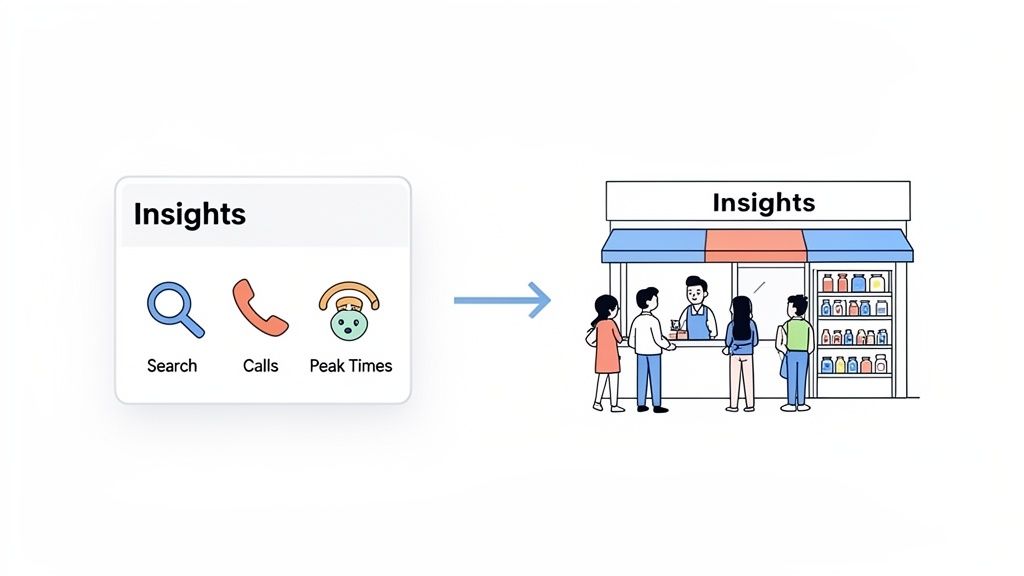
Think of the search queries report as a direct peek into your customers' minds. When you see the exact phrases people are using to find you, you can fine-tune your profile’s descriptions, services, and categories to match their language. For instance, if a local bakery notices a surge in searches for "gluten-free celebration cakes," that's a signal. They can immediately create a GBP Post showcasing their gluten-free range, grabbing the attention of customers who are ready to buy.
This kind of targeted optimisation is crucial, especially in the UK where Google has held over 90% of the search market share since 2018. While this massive user base is what makes GBP so effective, it also means competition is fierce. A good reporting tool cuts through the noise, breaking down complex data—like views per photo or top search terms—into simple, visual dashboards. You can dig deeper into Google's UK market position on Statista.
From Digital Clicks to Operational Efficiency
The real value here goes way beyond just online rankings. By keeping an eye on trends in phone calls and direction requests, you get solid intelligence to make smarter operational decisions. Imagine a restaurant that sees a consistent spike in direction requests between 6 PM and 7 PM every Friday. That’s not just a statistic; it’s a data-backed reason to put an extra host on the floor during that peak time.
Likewise, a home services business can analyse call data to see which services are most popular during different seasons. This kind of insight helps with everything from stocking up on the right parts to scheduling more technicians when you know demand will be high, ultimately preventing lost business and keeping customers happy.
A great reporting tool connects what happens online to what needs to happen in your physical business. It aligns your digital strategy with your operational reality, ensuring you're always prepared to meet customer demand.
Scaling Success Across Multiple Locations
For franchises or businesses with several locations, this is a game-changer. Having all your data in one central dashboard is essential for keeping your brand consistent and figuring out what works so you can do more of it.
- Spot Your Top Performers: Instantly see which branches are getting the most calls, clicks, or glowing reviews.
- Copy What Works: Dive into the profiles of your high-performing locations. Are their photos better? Are their service descriptions more detailed? You can take these winning tactics and apply them across your entire network.
- Catch Problems Early: Easily flag locations with low engagement or a drop in direction requests. This allows you to step in with targeted help before a small issue becomes a big problem.
By turning raw data into concrete actions, a reporting tool becomes the command centre for a smarter, more efficient local growth strategy. It ensures that every insight you gather has a purpose, driving both your online visibility and your real-world bottom line.
How to Choose the Right GBP Reporting Tool
Picking the best Google Business Profile reporting tool isn't about grabbing the one with the longest feature list. It's about finding the one with the right features that actually match what you need to do. You've got to look past the shiny sales pitches and figure out if a tool will genuinely help you save time, grow your agency, or just get more people walking through your door.
Think of it like choosing a vehicle. A local coffee shop might just need a zippy scooter for quick local deliveries. A national retail chain, on the other hand, needs a fleet of lorries to handle its complex logistics. The principle is the same here. A great place to start is the user interface—is it clean and straightforward, or will you need a PhD to figure out where anything is?
Once you've got a feel for the basics, it's time to dig into the core functionality. A side-by-side comparison of a free tool versus a more powerful platform is often the most revealing way to start.
Evaluating Core Functionality and Fit
When you start sizing up your options, focus on the things that will make a real difference to your daily work and your long-term strategy. Here are the deal-breakers to keep in mind:
- Depth of Data: Does the tool just skim the surface with top-level numbers? Or can you actually dive deep into the details, like the exact search terms people are using to find you, how your photo views are trending, or when your phones are ringing off the hook?
- Scalability: Think about where you'll be in a year or two. A tool that's a dream for a single location can quickly turn into a waking nightmare when you're managing ten. Look for something built for multi-location management from the get-go.
- Integration Capabilities: A reporting tool shouldn't live on an island. Check if it connects smoothly with your other marketing software, like your CRM or analytics platforms. A unified view of your performance is the goal.
- Customer Support: What happens when you hit a snag or have a question? Can you get a quick, helpful answer from someone who knows what they're talking about? Good support is non-negotiable.
Choosing a reporting tool is an investment in efficiency and clarity. The goal is to find a platform that not only presents data but also helps you understand it, act on it, and communicate your successes with ease.
Feature Comparison Free vs Advanced GBP Reporting Tools
To really see the difference, it helps to put the standard, free insights from Google next to what a specialised platform can do.
| Feature | Standard Google Insights | Advanced Reporting Tool |
|---|---|---|
| Reporting | Manual data export, basic charts. | Automated, scheduled, and white-label reports. |
| Rank Tracking | Not available. | Geo-grid rank tracking to visualise local visibility. |
| Insights | Raw data points (clicks, views). | AI-powered recommendations and performance alerts. |
| Multi-Location | Requires viewing profiles one-by-one. | Aggregated dashboards for easy comparison. |
While Google's free tools are a fantastic starting point, an advanced platform pays for itself through huge time savings and much deeper strategic insights. Features like AI-driven recommendations or automated review responses are key parts of a complete Google Business Profile management strategy, helping you grow in ways basic tools simply can't support.
In the end, the right tool should feel less like a chore and more like a strategic partner in your corner.
Got Questions About GBP Reporting Tools? We’ve Got Answers.
Diving into more advanced tools for local SEO can feel like a big step, and it's natural to have a few questions. Even when you grasp the features, sorting out the practical details is what gives you the confidence to move forward. Let’s tackle some of the most common queries we hear about Google Business Profile reporting tools.
Getting these answers sorted is the key to unlocking the real value in your local data. Let's clear up the confusion so you can build a strategy that actually works.
How Accurate Is the Data, Really?
This is probably the most important question, and the answer is refreshingly simple. Any reputable reporting tool gets its data straight from the source: the official Google Business Profile API. The impressions, direction requests, and phone calls you see are the exact same raw numbers Google itself provides.
The real value isn't in changing the data, but in making sense of it. A good tool takes those raw numbers and organises them into easy-to-read dashboards, charts trends over time, and helps you compare performance across all your locations. It’s about turning Google’s data into your roadmap for growth.
Are These Tools Overkill for a Single-Location Business?
Not at all. While some features, like multi-location dashboards, are clearly built for chains and agencies, a powerful reporting tool is a game-changer for a single-location business. Think of it as having your own local marketing expert on call.
For a single shop or service provider, the benefits are huge:
- You save a ton of time. Automated reports mean you can stop wasting hours manually pulling numbers from your profile.
- You get much deeper insights. Geo-grid rank tracking shows you exactly where your customers find you on the map, and more importantly, where they don't.
- You gain a real competitive edge. AI-powered recommendations can give you strategic advice your local rivals almost certainly aren't getting.
Can I Look at Performance Data from Last Year?
Yes, and this is one of the biggest reasons to use a dedicated tool. The standard Google interface can be clunky when you want to look back more than a few months. A proper reporting platform, on the other hand, diligently stores your performance data month after month.
This creates a long-term historical record, making it easy to track year-over-year growth, spot seasonal patterns, and measure the true impact of that SEO campaign you ran six months ago. The clarity it provides is unmatched.
How Secure Is My Data?
Security should always be a top priority. Legitimate platforms connect to your Google Business Profile using secure, authorised methods like OAuth. In plain English, this means they never need to ask for or store your Google password.
A non-negotiable rule: only use a tool that connects via the official Google API. This ensures your account stays secure and the tool plays by Google's rules, protecting your profile from any risk.
The tool is granted permission to view your performance data, but it doesn't get the keys to your entire Google account. As Google's own platform changes, so do the metrics. A prime example was the major update in early 2023, where Google ditched older metrics to focus on more meaningful data like impressions and views—a shift that any modern reporting tool is built to handle seamlessly. You can read more about Google's 2023 updates on dacgroup.com.
Ready to turn your local data into your biggest competitive advantage? LocalHQ delivers all the advanced reporting, AI-driven insights, and smart automation you need to win at local search. See how our platform can completely change your Google Business Profile performance. Start your journey with LocalHQ today.