Franchise SEO Strategy That Actually Scales: From 5 to 500 Locations
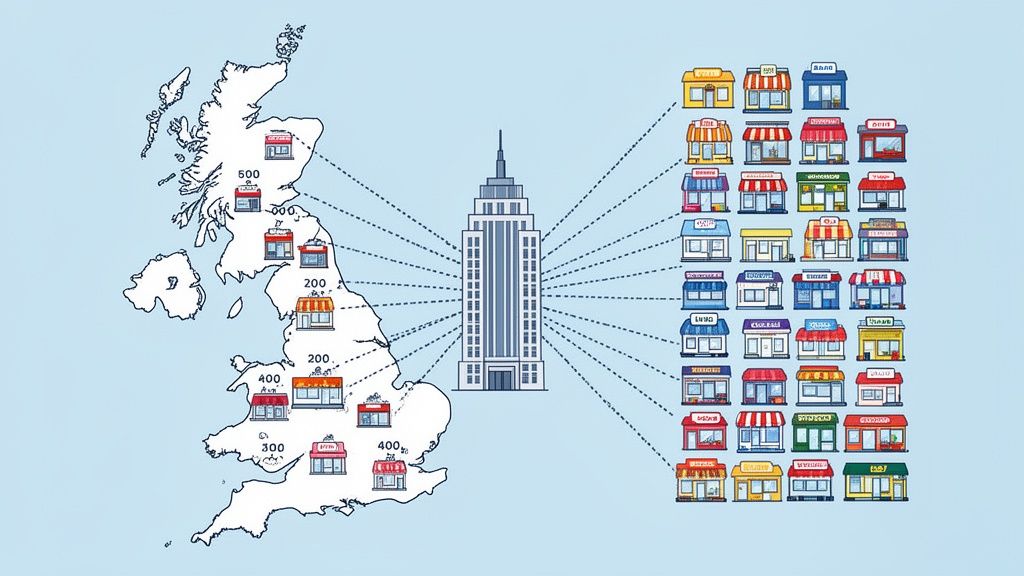
Franchise SEO is all about walking a tightrope. On one side, you have your central brand, which needs to be consistent and strong. On the other, you have individual franchise locations that need to stand out and attract customers in their own neighbourhoods. It’s a specialised approach that helps you manage both, ensuring each location thrives locally without getting in each other's way.
Why Generic SEO Fails for UK Franchises
If you've ever tried to apply a standard SEO plan across your entire franchise network, you've probably felt the frustration. It just doesn't work. Trying to treat a multi-location business like a single-location one is a surefire way to get disappointing results.
Think of your franchise as a fleet of ships. Each franchisee is the captain, navigating their own local waters and dealing with unique local challenges. A generic SEO plan is like telling every captain to sail in the exact same direction, regardless of the winds or currents they face. At best, it’s inefficient; at worst, it’s a recipe for chaos.
When there’s no coordinated strategy, several big problems bubble to the surface:
- Keyword Cannibalisation: Suddenly, your Manchester and Liverpool locations are fighting each other for the same search terms on Google. This confusion hurts everyone's rankings.
- Diluted Brand Voice: Without clear brand guidelines, franchisees might create their own marketing messages or content, muddying the waters and weakening your overall brand identity.
- Inconsistent Customer Experience: Imagine a customer finding different opening hours or promotions for two nearby locations. It’s a frustrating experience that erodes trust.
The Shift to a Coordinated Framework
The way we approach franchise marketing in the UK has changed. The old days of simply stuffing keywords into a webpage are long gone. Today, it’s about a more intelligent, entity-based optimisation. And while recent data shows 41% of UK businesses have an SEO strategy, many are still stuck in the past.
We still see franchises making the same mistakes: creating dozens of location pages that are just copy-pasted with the city name changed, or letting franchisees edit their own listings without any oversight. This is exactly what causes the cannibalisation issues mentioned earlier. To get ahead in 2026, the most successful UK franchises are building their online presence from a single, central domain using a structured SEO framework.
Franchise SEO is the specialised discipline that provides this essential framework. It balances corporate brand integrity with the crucial need for local relevance and performance.
This isn't the same as just doing SEO for a business with a few addresses. You can learn more by reading our complete guide on local SEO for multiple locations. Instead of a one-size-fits-all approach, a proper franchise SEO strategy creates a unified system. The franchisor provides the brand governance, the tools, and the templates, while the franchisee injects the authentic, local flavour that resonates with customers in their area.
By getting this right, you turn what could be a massive headache into a serious competitive advantage. It aligns every location, from London to Liverpool, ensuring they all work together to make the entire brand stronger.
The Four Pillars of a Scalable Franchise SEO Strategy
Running a successful SEO programme for a franchise isn't about just trying hard; it's about having a structured, repeatable framework. Think of it like building a house. You need solid foundations to support the structure, whether you're building a small bungalow or a towering skyscraper. Without that core structure, your efforts will be scattered, inefficient, and ultimately, they just won't work at scale.
These four pillars are the bedrock of any high-performing franchise SEO strategy. Get them right, and you'll have the stability you need to grow from five locations to five hundred.
1. Centralised Brand Governance
The first pillar is all about control and consistency. Your brand is your most valuable asset, and a cohesive digital presence is non-negotiable for protecting its integrity. Centralised governance simply means the franchisor sets the "rules of the road" for all digital marketing.
This isn't about micromanaging. It's about creating clear brand guidelines that cover everything from logo use and tone of voice to the exact messaging for online promotions. It also means setting up smart user permissions for digital platforms. A franchisee, for example, should absolutely have the power to respond to local reviews on their Google Business Profile, but they probably shouldn't be able to change the business name or primary service category.
This approach strikes a crucial balance: it empowers local owners to engage with their community while preventing well-intentioned mistakes that could dilute the brand's overall SEO strength.
A strong governance model ensures that every location, whether in central London or a small town in the Highlands, presents a unified brand front. This consistency builds trust with both customers and search engines, creating a stronger foundation for everything else you do.
2. A Hyper-Local Digital Presence
While governance provides control from the centre, this second pillar is all about winning on the ground, street by street. A hyper-local digital presence means treating each franchise location as its own distinct business with a unique online footprint. This is where you actually connect with the people who walk through the doors.
There are two non-negotiable parts to this:
Unique Location Pages: Every single franchise needs its own dedicated page on the corporate website (e.g.,
yourbrand.co.uk/locations/manchester). These can't be flimsy, copy-and-paste pages. They need unique, local content: photos of the local team, area-specific testimonials, a list of services available at that branch, and an embedded map.Perfectly Optimised Google Business Profiles (GBPs): Each location's GBP is its digital shopfront. It must be meticulously managed. That means 100% accurate NAP (Name, Address, Phone number), correct opening hours, local photos, and location-specific questions and answers.
Of course, none of this matters if Google can't find or understand your site in the first place. That's why a solid grasp of Technical SEO is fundamental. Ensuring search engines can efficiently crawl and index every one of your location pages is critical for scaling, otherwise even your best local content will remain invisible.
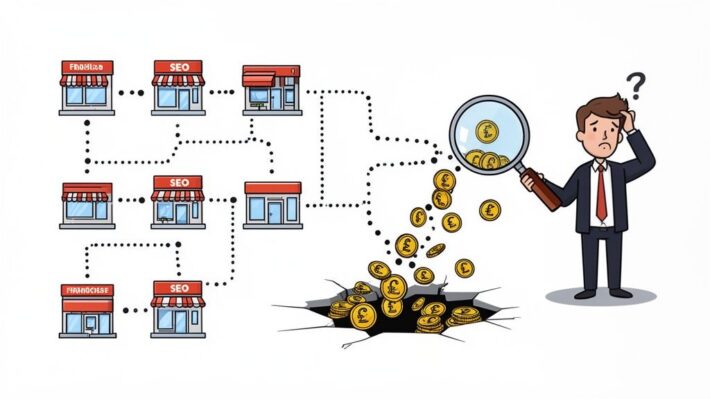
This diagram shows what happens when you get this wrong. A generic approach quickly leads to chaos.
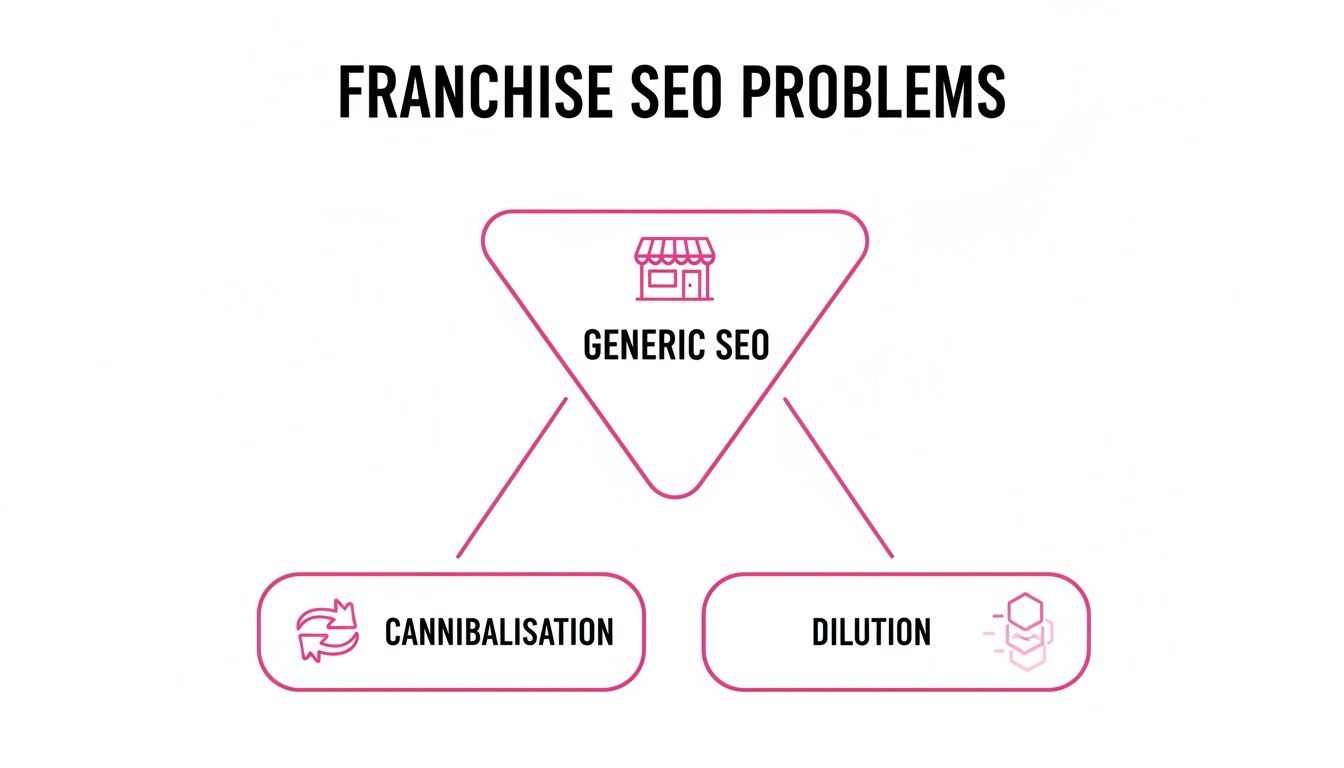
As you can see, without a proper hyper-local strategy, locations end up competing against each other for the same keywords, diluting the brand's authority and confusing search engines.
3. Scalable Content Systems
The idea of creating unique content for hundreds of locations can sound overwhelming, but it's entirely possible with the right systems. This pillar is about building a content "engine" that produces locally relevant material without sacrificing brand consistency.
Instead of asking every franchisee to become a marketing expert overnight, you build templates and frameworks they can easily adapt. For example, the franchisor could create a blog post template for a summer promotion, complete with approved brand messaging and images.
The local franchisee can then take that template and add their own flavour—mentioning a local festival, highlighting a recent customer success story from their branch, or featuring a photo of their team. This empowers them to be local marketers without the risk of going off-brand.
4. Unified Performance Measurement
The final pillar is all about proving it works. A great franchise SEO strategy needs a single, unified way to track performance and show the return on investment (ROI) to everyone involved, from the boardroom to the local branch manager.
This means moving past vanity metrics and focusing on the numbers that actually matter.
For the Franchisor: You're looking at the big picture. Think aggregate growth in organic traffic across the network, the total number of phone calls from all GBPs, and the brand's overall share of voice in search results.
For the Franchisee: They care about their bottom line. They need to see their local search rankings, how many people clicked for driving directions, the number of phone calls to their specific location, and the leads generated from their location page.
By using a centralised dashboard, you can deliver clear, transparent reports that prove the value of the SEO programme to everyone. This justifies the investment and keeps franchisees bought in and engaged.
Franchisor vs Franchisee SEO Responsibilities
Deciding "who does what" is a common stumbling block. While every franchise system is different, a clear division of labour prevents confusion and ensures crucial tasks don't get missed. Here’s a typical breakdown of responsibilities:
| SEO Task | Franchisor Responsibility | Franchisee Responsibility | Notes |
|---|---|---|---|
| Website Technical SEO | ✔️ | This is a core corporate function to ensure the entire site is healthy. | |
| Brand-Level Keyword Strategy | ✔️ | Corporate defines the primary terms the brand should be known for. | |
| Location Page Template Creation | ✔️ | The franchisor builds the foundation for franchisees to customise. | |
| Google Business Profile Setup & Verification | ✔️ | Corporate ensures initial setup is consistent and follows best practices. | |
| Responding to Customer Reviews | ✔️ | ✔️ | This is often a shared task. Franchisees provide the local insight. |
| Uploading Local Photos/Videos to GBP | ✔️ | The best, most authentic content comes directly from the local team. | |
| Creating Local GBP Posts (Offers, Events) | ✔️ | Perfect for the franchisee to add a timely, local touch. | |
| NAP & Citation Management | ✔️ | Central management is crucial for maintaining data consistency across the web. | |
| Network-Wide Performance Reporting | ✔️ | The franchisor reports on the overall health and growth of the brand online. | |
| Local Performance Reporting | ✔️ | ✔️ | The franchisor provides the data, and the franchisee uses it to understand local impact. |
This table serves as a solid starting point. The key is to document these roles clearly in your operations manual so that everyone understands their part in the bigger picture.
Mastering Your Local Listings and Citations at Scale
For any franchise, the foundation of getting found locally is having accurate, consistent information everywhere your customers look. With a single location, that’s easy enough. But when you’re managing tens or even hundreds of branches, it becomes a monumental task where even small mistakes can tank your local search rankings.
Picture this: a potential customer in Birmingham is looking for your brand. On Google, they see one phone number. On Yelp, the address is slightly different. On another local directory, the opening hours are from last year. This isn't just a frustrating experience for the customer; it's a massive red flag for search engines. This is the damage that inconsistent NAP (Name, Address, Phone number) data can do.
Trying to manually update every listing for every location is a recipe for disaster. The only way to win is with a centralised management approach, giving you firm control over these vital digital assets to ensure consistency across the entire brand.
Optimising Your Google Business Profiles for Maximum Impact
Think of your Google Business Profile (GBP) as your digital front door. For a franchise, this means you’re the landlord for dozens, or even hundreds, of front doors. Each one needs to be perfectly polished to welcome local customers. To truly dominate the local search results, you need to know how to optimise your Google Business Profile.
A fully optimised profile is about so much more than just a correct address. It's an active, living representation of each branch.
Here’s where to focus your efforts:
- Get Your Categories Right: Choose the most specific primary category that fits the business, then add several secondary categories. This tells Google exactly what services that particular branch offers.
- Use Real, Local Photos: Encourage your franchisees to regularly upload high-quality pictures of their storefront, their team, and their work in action. Authentic photos build trust in a way that generic stock images never can.
- Create Location-Specific Posts: Use Google Posts to announce local offers, events, or news. A post about a Bristol community fete will always outperform a bland corporate update.
- Manage Your Q&A Section: Don't wait for the public to ask and answer questions. Proactively add frequently asked questions and post your own official answers. This stops misinformation in its tracks and positions your brand as an authority.
Here in the UK, getting this right is more critical than ever. Recent research shows that 64% of UK businesses with an SEO strategy now prioritise local search. That's because around four out of five searches have local intent, and an incredible 93% of customers read online reviews before buying.
Building Citations as Powerful Trust Signals
Beyond Google, your franchise's information is scattered across hundreds of other online directories, mapping apps, and websites. Each one of these listings is what we call a citation.
Every consistent citation acts like a vote of confidence for your location's data. It tells search engines that the information they have for your branch is correct and can be trusted.
The more well-regarded UK directories that list your local branch's NAP correctly, the more confident Google becomes in showing that branch in local search results. Think of key players like:
- Yell
- Thomson Local
- The Independent
- Yelp
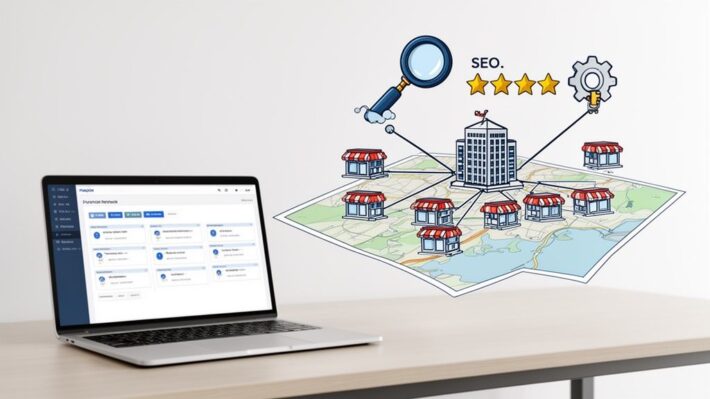
Let's be realistic: managing this manually across an entire franchise network is impossible. This is where a central platform becomes non-negotiable. Using a dedicated tool allows you to sync and lock your business data, pushing out accurate information to all major directories from one dashboard while preventing rogue edits. For a deeper dive, our guide on managing multiple Google Business listings breaks this down further.
This platform-based approach turns a logistical nightmare into a streamlined, powerful advantage for your franchise SEO.
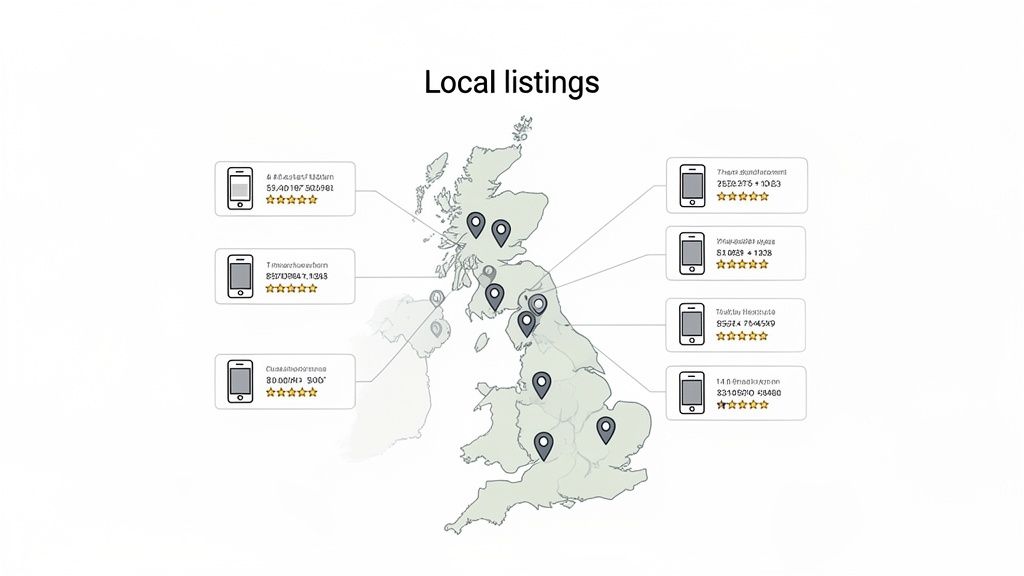
Having this kind of unified view means you can spot inconsistencies, track performance, and push out updates across the entire network in just a few clicks. It’s the key to maintaining both brand integrity and local accuracy at scale.
How to Build High-Performing Franchise Location Pages
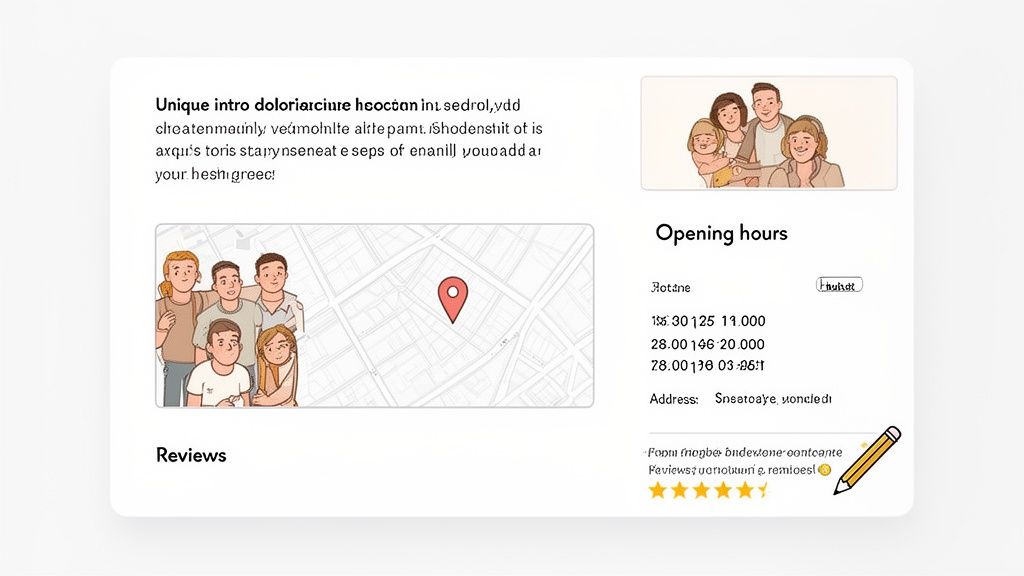
Let’s talk about one of the most common—and damaging—mistakes in franchise SEO: the cookie-cutter location page. Simply copying a block of text and swapping out the city name is a huge missed opportunity. It signals to both customers and search engines that you aren't truly invested in the local community.
Think of a great location page as more than just an address. It's the digital storefront for that specific branch.
These pages are your single best chance to prove your local credentials. When done right, they become powerful assets that rank for local searches (like "mechanic in Bristol") and stop your own locations from competing against each other. The secret is to develop a solid, scalable template that you can then customise with genuine local flavour.
By getting a handful of core components right, you can ensure each page delivers real value to your customers and sends all the right signals to Google.
Crafting the Essential Components
An effective location page perfectly marries brand consistency with local personality. From the moment someone lands on it, they should know they’re in the right place and find everything they need to take the next step. To get there, every page needs a non-negotiable set of elements.
A winning blueprint includes:
A Unique Local Introduction: Ditch the boilerplate copy. This is your space to tell a short story about that branch. Mention the manager by name, talk about the local team, or even reference a nearby landmark to show you're a real part of the neighbourhood.
Embedded Google Map: Don't make people work to find you. An interactive, embedded map is a fantastic user-friendly feature that also helps reinforce the location's physical address for search engines.
Location-Specific Opening Hours: This seems obvious, but it's absolutely critical. Displaying accurate hours, including any changes for public holidays, is a fundamental sign of trustworthiness.
Local Testimonials and Reviews: Social proof is everything. Featuring reviews from actual customers of that specific branch builds instant credibility and trust like nothing else.
Making Each Page a Local Powerhouse
With that basic framework in place, it's time to layer in the details that make each page stand out. These elements are what turn a simple listing into a rich local resource that attracts both customers and search engine crawlers, cementing its role in your wider franchise SEO strategy.
Consider weaving in these details:
Photos of the Local Team and Premises: Real photos of your actual staff and the storefront are infinitely more engaging than stock images. They humanise your brand and make the local branch feel much more approachable.
Franchisee Bio or Message: A short biography or a personal welcome from the franchisee adds a wonderful human touch. It creates a direct connection between the local owner and the community they serve.
Services Available at That Location: If your branches offer slightly different services, make sure you list them clearly on their individual pages. This level of detail is brilliant for capturing long-tail keyword searches.
Treat each location page as a mini-homepage for that branch. When you do, you create assets that rank independently for local searches. This approach avoids keyword cannibalisation and ensures Google always shows the most relevant page to a user.
Adding Structured Data for Search Engines
The final piece of the puzzle is a technical but crucial one: implementing structured data, often called schema markup. This is a snippet of code that’s invisible to your users but speaks directly to search engines in their native language.
Specifically, you need to use LocalBusiness schema on every location page. This markup explicitly tells Google the business name, address, phone number (NAP), opening hours, and geographic coordinates for that specific branch. It removes any guesswork and helps Google feature your information in rich results, like the map pack or knowledge panels.
While "schema markup" might sound intimidating, it’s actually quite straightforward to put into practice. You can easily create the code you need with tools like this free LocalBusiness schema markup generator. This simple step is one of the single most effective technical SEO boosts you can give your franchise location pages.
Empowering Franchisees to Boost Local Content and Reputation
Your franchisees are so much more than just operators running a local branch. They are your eyes and ears on the ground—and your most authentic voice in the community. A truly effective franchise SEO strategy hinges on empowering them, turning their local knowledge into the kind of genuine content and customer interactions that a central marketing team simply can't manufacture.
The goal isn't to turn them into SEO experts overnight. It's about giving them the right tools and training so they can easily contribute to their own location's success, all while keeping everything perfectly on-brand. This boils down to two key areas: creating hyper-local content and managing their local online reputation.
Turning Local Knowledge into SEO Power
Think about it: your franchisees know their towns inside and out. They know which charities are making a difference, they sponsor the local kids' football team, and they understand what truly matters to their community. Your SEO programme should give them a simple, controlled way to share that unique insight online.
Instead of an uncontrolled free-for-all, you can provide straightforward tools that let them publish pre-approved local content. This could look like:
- Templated News Updates: Give them easy-to-use templates for announcing local news, events, or staff achievements. They just fill in the local details, and the system publishes it in the right format and brand voice.
- Success Story Submissions: Create a simple form where a franchisee can submit a great customer story or testimonial, complete with photos. Your corporate team can then give it a final polish and get it published.
- Local Event Calendars: Allow them to add local events they’re attending or sponsoring directly to their location page, transforming it from a simple business listing into a proper community hub.
Mastering Online Reputation Management
Online reviews are the lifeblood of any local business. Responding to every single one—good or bad—is absolutely non-negotiable. It proves to potential customers that you are listening and that you care. For a franchise, this is where local insight is priceless, but brand consistency is critical.
The competitive world of franchise SEO has become incredibly sophisticated. Organic search now drives around 53.3% of all website traffic, and the top result gets a massive 39.8% of all clicks. With 68% of online experiences beginning with a search engine, and many searches ending without a click at all, your visibility in Google Business Profiles and the local map pack is everything. You can discover more insights about these SEO statistics on intergrowth.com.
A timely, professional, and on-brand response to a review can turn a detractor into a loyal customer and amplify positive sentiment for everyone to see. In contrast, an ignored complaint can do lasting damage.
To manage this at scale, start by providing clear guidelines on tone of voice and what to say (and what not to say). Even better, give them smart tools to make it easier. A Review Autoresponder, for example, can ensure every review gets an immediate, personalised, and brand-approved acknowledgement. This buys the franchisee time to follow up with a more detailed, human response later, ensuring no customer ever feels ignored.
To really get this part of your strategy firing, check out our deep dive on how to get more Google reviews and build up that positive reputation.
Measuring SEO Success and Proving ROI to Stakeholders
So, you’ve put all this effort into a sophisticated franchise SEO strategy. How do you actually know if it’s working? An investment like this is meaningless unless you can prove its return, and that’s what this final, crucial step is all about. It’s about measuring what matters and showing undeniable value to everyone from the corporate office to the individual franchisee.
A proper measurement framework isn't about chasing vanity metrics. It’s about focusing on the key performance indicators (KPIs) that directly affect the bottom line. The goal is to translate clicks and impressions into things that actually grow the business, like phone calls, foot traffic, and sales.
Defining Your Core Metrics
To prove ROI, you need to track the right things. The franchisor will care about the big picture—the performance of the entire network. But each franchisee wants to know what’s happening on their local patch. A unified dashboard is the only way to pull all this together and create a single source of truth.
The most important metrics for franchise SEO typically include:
- Google Business Profile Performance: Keep a close eye on impressions, clicks, phone calls, and direction requests for every single location. This is the frontline of your local presence.
- Local Pack & Organic Rankings: Track how each location ranks for its most valuable local keywords (e.g., “plumber in Sheffield”). This is a direct measure of your visibility gains.
- Location Page Traffic: Measure the organic traffic hitting individual franchise pages. This shows how well you’re capturing local search interest.
- Lead & Conversion Data: This is where the rubber meets the road. Connect your tracking to actual business goals like form submissions, quote requests, and online bookings that come from search.
Visualising Performance with Geo-Grid Tracking
Traditional rank tracking has a major flaw for local businesses. It checks your position from a single, central point. But a customer searching from the north side of a city will see completely different results from someone in the city centre. This is where a more advanced technique like geo-grid rank tracking becomes invaluable.
Geo-grid tracking works by plotting your rankings on a map, showing you exactly where you stand across an entire service area. It gives you a much truer picture of your real-world performance, highlighting where you’re strong and, just as importantly, where competitors are beating you.
This level of detail is a game-changer when you need to prove value to franchisees. You can literally show them a map of how their visibility is improving in the neighbourhoods that matter most to their business. For a deeper dive into this technology, you can explore the benefits of local rank tracking tools.
Ultimately, effective measurement closes the loop on your entire strategy. By presenting clear, consolidated reports that connect SEO activity to real-world results like phone calls and shop visits, you eliminate guesswork. It gives every stakeholder the actionable insights they need, builds trust, and justifies the investment across the whole franchise network.
Answering Your Top Franchise SEO Questions
When you're juggling a national brand with dozens of local outlets, a lot of questions come up. It's a unique setup, and the standard SEO playbook doesn't always apply. Here are answers to a few of the most common questions we hear from franchise leaders.
Should Every Franchisee Have Their Own Website?
Our straightforward advice is almost always no. Think of your brand's online presence like a tree. You want one strong, central trunk—your main brand.co.uk website—with sturdy branches for each location page, like brand.co.uk/locations/london.
When franchisees launch their own separate websites, they end up competing against each other and the main brand for attention from Google. This splits your authority and weakens everyone. A single, powerful domain with well-built location pages is far more effective for ranking and much, much easier to manage.
What Do We Do About a Franchisee Going Rogue with Their Own SEO?
This happens all the time. A franchisee is eager to grow, so they hire a local agency or start dabbling in SEO themselves. The key here isn't to shut them down, but to channel that energy constructively.
Your franchise agreement should have clear guidelines on digital marketing from day one. But more importantly, you need to show them how the corporate strategy helps them win locally. Give them a simple platform where they can add local updates, post photos, and respond to reviews. This makes them part of the process, using their local knowledge to boost the official, brand-approved profiles instead of creating chaos.
What’s the Single Most Important Metric to Track?
If we had to pick just one, it wouldn't be a single number but a collection of them: the combined performance of your Google Business Profiles. You should be looking at the total clicks for directions, phone calls, and views across all your locations. That’s your high-level view of how the entire network is performing.
But for the franchisee on the ground, the most meaningful metric is their local rank on a geo-grid. It shows them exactly where they are—and aren't—showing up on the map for their most important search terms. It’s a visual scorecard of their visibility in the specific neighbourhoods they serve.
This kind of tracking goes way beyond a simple "you rank #3 for 'pizza near me'". It shows real-world impact and helps prove the value of your SEO efforts.
At LocalHQ, we believe giving franchisees the right tools is the secret to scaling your brand’s local footprint. Our Geo-Grid Rank Tracker was built to give both the corporate team and the local owner clear, visual proof of SEO performance. It turns abstract data into a simple success map. Stop guessing and start seeing precisely where you stand.