

Franchise SEO Strategy: Balancing Brand Control with Local Relevance
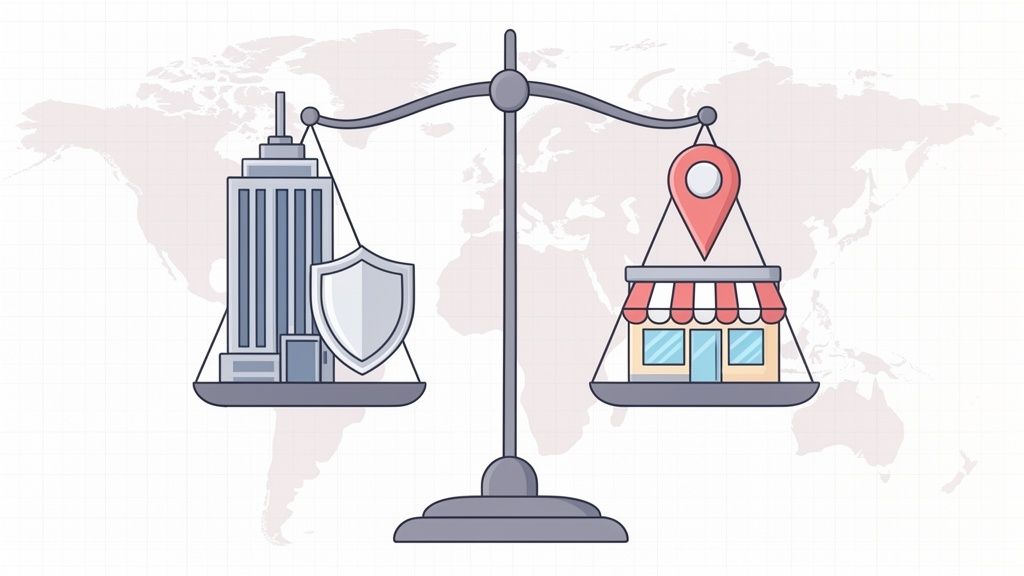
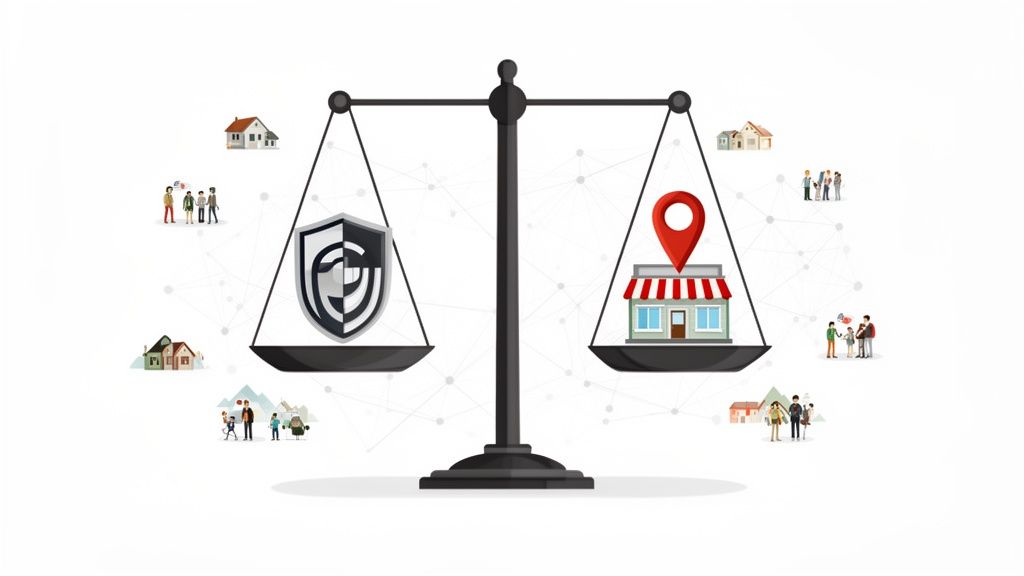
Getting franchise SEO right is a delicate dance. You're constantly balancing the need for corporate brand consistency against the local flavour each franchisee needs to actually win customers. A one-size-fits-all strategy just doesn't cut it. What you need is a structured system where brand control and local freedom don't just coexist—they actively support each other to drive real growth across every single location.
This playbook is all about building that system.
The Franchise SEO Balancing Act
Here’s the classic franchise marketing dilemma: how do you maintain a strong, unified brand identity while still letting local franchisees connect with their communities in a meaningful way? A generic, top-down SEO approach almost always falls flat, leaving a huge amount of local opportunity untapped. It's simple, really. Customers search for services differently in Manchester than they do in Cornwall, and your strategy has to reflect that.
The answer lies in a centralised governance model. Now, this isn't about micromanaging your franchisees. It’s about empowering them with the right tools and clear guardrails. Think of it as handing them a pre-approved "marketing toolkit" that ensures quality and consistency but still leaves room for local customisation.
Why a Centralised Model Is a Game-Changer
Let's be honest, without a unified framework, franchise marketing can descend into chaos. You'll have individual locations using off-brand messaging, targeting completely irrelevant keywords, or worse, neglecting their online presence entirely. This doesn't just hurt one location; it dilutes the brand and weakens the entire network.
A centralised model brings order to that potential chaos by setting clear rules of engagement. In practice, this usually involves:
- Brand Guidelines: Defining the brand’s voice, tone, and visual identity so every customer touchpoint feels consistent and professional.
- Keyword Strategy: Separating core brand terms (managed by the franchisor) from local, long-tail keywords that franchisees are free to target.
- Content & Asset Library: Providing pre-vetted templates for local landing pages, blog posts, and social media updates that franchisees can easily personalise.
- Centralised Reporting: Using a single platform to monitor performance across all locations, ensuring compliance and proving ROI without endless spreadsheets.
This structure allows you to move beyond chasing franchisees through email and start building a scalable system for everything from Google Business Profile management to local content creation. For a deeper dive, our guide on multi-location management breaks down the specific tactics you'll need to manage your brand across dozens or hundreds of postcodes.
A successful franchise SEO strategy isn't about control versus freedom. It’s about creating a system where centralised governance provides the foundation, and local execution provides the relevance needed to win in each unique market.
The following table breaks down how this balance works across the core pillars of your SEO strategy.
Core Pillars of a Balanced Franchise SEO Strategy
| Strategic Pillar | Centralised Governance (Franchisor) | Local Execution (Franchisee) |
|---|---|---|
| GBP Management | Sets up profiles, defines core categories, controls key info. | Manages reviews, posts local updates & photos, answers Q&A. |
| Content Strategy | Creates national campaign content and core service pages. | Develops local case studies, team bios, and community news. |
| On-Page SEO | Optimises site structure, manages technical SEO, and targets brand keywords. | Optimises local landing pages with geo-specific keywords and content. |
| Reputation Management | Defines response guidelines and provides review request templates. | Responds to customer reviews and engages with local feedback. |
| Reporting & Analytics | Tracks network-wide KPIs, identifies trends, and reports on overall ROI. | Monitors local rankings, traffic, and leads for their specific location. |
Ultimately, the goal is to create a symbiotic relationship. The franchisor protects and grows the brand’s overarching authority, which gives every franchisee a leg up. In turn, franchisees use their ground-level knowledge to connect with customers, drive footfall, and generate revenue—strengthening the entire network from the bottom up. This playbook will show you exactly how to build that system.
Getting Everyone on the Same Page: Your SEO Governance Framework
Let’s be honest: managing SEO across dozens or even hundreds of locations can feel like herding cats. Without clear rules of engagement, you get chaos. One franchisee goes rogue with a discount that undercuts a national campaign, another starts targeting bizarre keywords, and a third just lets their online presence gather dust.
This is exactly why you need an SEO governance framework. Think of it less as a restrictive rulebook and more as an agreed-upon playbook. It’s your best defence against brand dilution, ensuring consistency while still giving franchisees the room they need to connect with their local community.
Defining Your Brand and Content Guidelines
Your first job is to create a crystal-clear set of brand and content guidelines that every single franchisee can easily find and use. This document becomes the “source of truth” for all their marketing, creating a unified voice and look across the entire network.
And this goes way beyond just logos and colour palettes. You need to get specific about the language you use to describe your products and services.
Make sure your guidelines explicitly cover:
- Tone of Voice: Are you professional and authoritative, or more casual and friendly? Show, don’t just tell, with plenty of examples.
- Brand Messaging: What are the core values and mission statements that need to appear everywhere?
- Visual Identity: Lay out the law on correct logo usage, approved fonts, and the style of photography or graphics that fit the brand.
- Prohibited Content: What’s completely off-limits? Be clear about topics, claims, or promotions that could cause compliance headaches or damage the brand.
A solid framework like this doesn’t just protect the brand; it gives franchisees the confidence to know their marketing efforts are pulling in the same direction as the head office.
Creating Approved Keyword Lists
One of the biggest friction points in franchise SEO is always keyword targeting. The franchisor wants to own the big-picture brand terms, while the franchisee is fighting to win business on their local high street. The solution is to create a tiered keyword list that gives everyone their own turf.
You’ve got to balance the weight of your national brand with the agility of hyper-local tactics. That’s the sweet spot for franchise SEO.
The key takeaway here is that you’re not just running one SEO strategy; you’re running several at once, from the national level right down to a specific neighbourhood.
Here’s how to structure your keyword governance to reflect that:
- Core Brand Keywords (Franchisor-Managed): These are your crown jewels—the high-value, high-competition terms for your brand name and main services (e.g., “Speedy Lube,” “oil change service”). The corporate team owns SEO for these on the main website.
- Local Service Keywords (Franchisee-Targeted): This is the franchisee’s bread and butter. These are the geo-modified terms they should be aiming for on their local pages and Google Business Profiles (e.g., “car service in Bristol,” “Speedy Lube Manchester”).
- Hyper-Local & Long-Tail Keywords (Franchisee Freedom): Give your franchisees the flexibility to get creative here. They can target ultra-specific queries that only a local would know, like “MOT test near Old Trafford” or “winter tyre check South London.” This lets them tap into their unique community knowledge.
By setting up these distinct keyword zones, you stop the franchisor and franchisees from competing against each other. Instead, their efforts start to stack up, creating a much stronger overall presence.
Developing Content Templates and Compliance Workflows
The final piece of the puzzle is figuring out how content gets made, approved, and published without creating a bottleneck. You want to make it easy for franchisees to do the right thing. The most effective way I’ve seen this done is by providing pre-approved templates.
Build out a library of templates for the most common local content needs: local landing pages, “meet the team” bios, or simple blog post formats like “5 Tips for…” These templates should have locked-down sections for brand messaging alongside open areas where franchisees can add their local flavour—customer photos, testimonials, or news about a local sponsorship.
This blend of corporate structure and local input creates a scalable content machine that actually works. If you’re an agency managing this for clients, our guide on white-label local SEO services digs deeper into how you can apply these same structured principles to get great results.
Taming Your Google Business Profiles at Scale
With a solid governance framework locked in, your next big challenge is wrestling all those Google Business Profiles (GBPs) into submission. For any multi-location business, these profiles aren’t just online listings; they’re the digital front door for every single one of your locations. Trying to manage dozens, or even hundreds, of them can feel like utter chaos, but getting consistency and quality right across the board is absolutely essential if you want to dominate local search.
The only way to win this game is to ditch the manual, one-by-one updates and adopt a centralised management approach. Just picture it: trying to update your holiday hours or roll out a national promotion by logging into 50 different GBP accounts. It’s not just a massive time sink; it’s a surefire way to introduce errors and brand inconsistency. Using a single platform to oversee all your profiles is the only practical way to scale your efforts.
Centralising Control for Unshakeable Consistency
A central platform is your command centre, bringing order to the beautiful complexity of multi-location GBP management. It allows you, the franchisor, to enforce brand standards while still giving franchisees the room they need to connect with their local audience. This is where you lock down the most critical information to stop well-meaning but misguided changes from happening.
Here are the key areas you should control from the centre:
- NAP Data: Your Name, Address, and Phone number (NAP) must be perfectly accurate and identical everywhere online. A central dashboard stops this crucial data from drifting.
- Primary Category: This has a huge impact on your rankings. You need to set this at the corporate level based on proper keyword research, ensuring every location is fighting in the right weight class.
- Core Business Description: Your main business description carries your core brand message. Managing this centrally keeps your voice unified and strong.
This structure is your first line of defence against the common GBP mistakes that weaken brand authority and confuse search engines. We cover the specific challenges and fixes in more detail in our guide to managing multiple Google Business listings.
Empowering Franchisees with the Right Tools
Once that core information is locked and secure, you can start empowering your franchisees to handle the parts of the profile that build local connection. This is the delicate balancing act. Your franchisees are on the ground. They know their community, their customers, and their local rivals better than anyone at head office ever could.
The smartest franchise SEO strategies use technology to automate brand consistency. This frees up franchisees to do what they do best: build local relationships and drive sales.
For instance, a restaurant chain can schedule posts to promote weekly specials across all its locations automatically. A home services franchise can use the Q&A feature to proactively answer the questions they get asked every day. These aren’t just vanity metrics; they are real actions that lead directly to more calls, requests for directions, and clicks to your website.
The data backs this up. A 2026 report revealed that businesses with a properly optimised local presence get 73% more calls and direction requests from Google Search and Maps. In the hospitality sector, a survey of 500 UK franchises found that those using automated GBP management tools saw engagement metrics jump by 55%, which translated into 42% higher profile views.
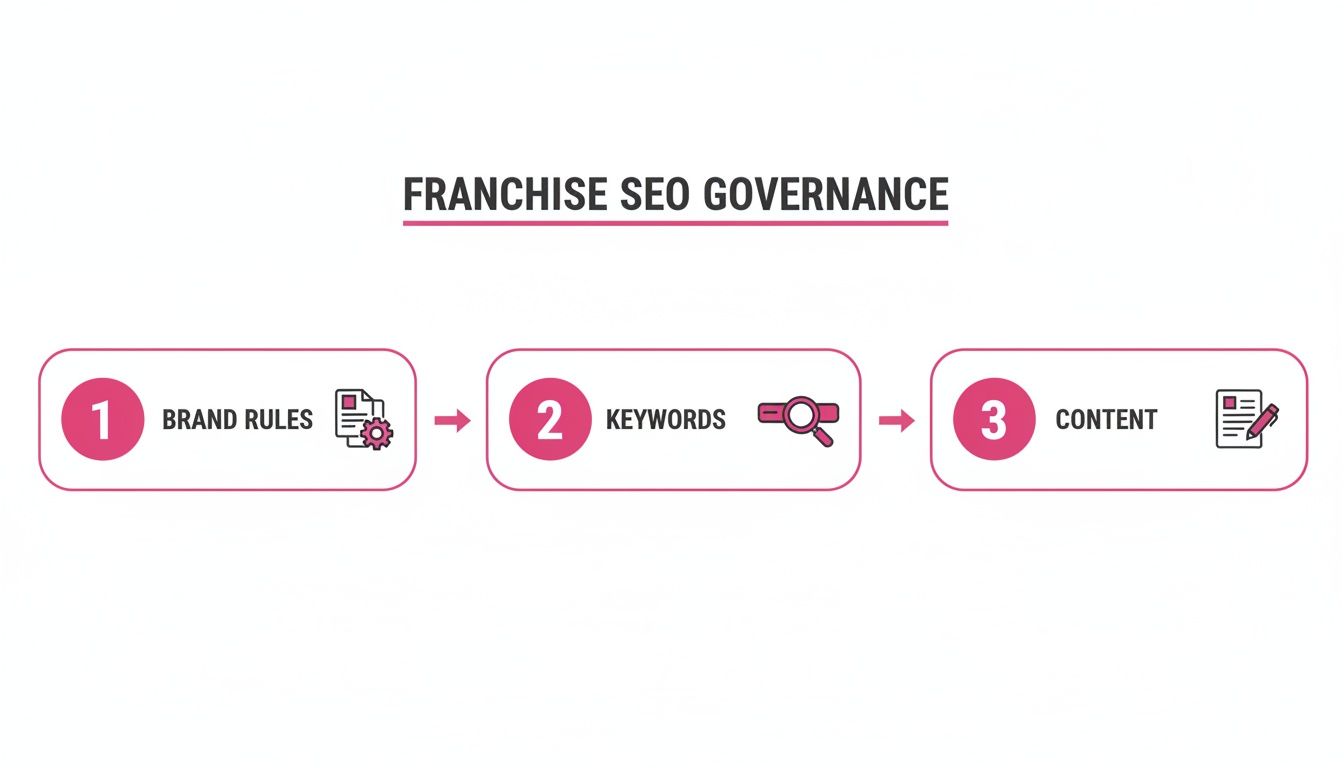
As you can see, a robust strategy starts with those high-level brand rules and funnels down into targeted keyword and content execution for each individual location.
Automating Reviews and Driving Real Engagement
Customer reviews are a powerhouse for local rankings and one of the biggest drivers of consumer trust. But trying to manage them across a large network is a monumental task. You absolutely need an automated workflow.
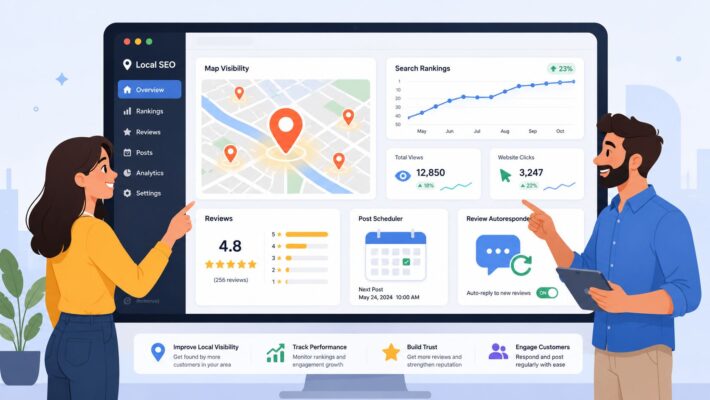
Using a tool with a feature like a Review Autoresponder, you can create a bank of pre-approved, on-brand response templates. When a new review pops up, the system can instantly generate a reply that feels personal and appropriate. This guarantees every customer gets a quick response that reinforces your brand’s commitment to service, all without burning out your franchisees.
If you want scalable local growth, mastering your Google Business Profiles is non-negotiable, and a huge piece of that puzzle is understanding how to rank higher on Google Maps. This blend of central control, local empowerment, and smart automation is what transforms your collection of individual GBPs into a coordinated, powerful network that dominates local search and drives real, measurable business to every single one of your franchise locations.
Creating Local Landing Pages That Convert
Your corporate website is your brand’s mothership, but it’s the local landing pages that do the real work on the ground. For any serious franchise SEO effort, a unique, optimised page for every single location is an absolute must-have. It’s what separates a generic, one-size-fits-all approach from a powerful network of local hubs that actually connect with customers.
Too many franchises just create a simple page with an address and phone number and call it a day. That’s a huge missed opportunity. To win in local search, these pages need to be built from the ground up to scream “local relevance” to Google and to the person searching. Think of it as giving each franchisee their own piece of digital real estate, all while staying true to the main brand.
What Every High-Performing Local Page Needs
A great local page does more than list facts; it builds confidence and gets people to act. It has to convince someone searching for “emergency plumber in Leeds” or “best coffee shop near me” that your specific location is their best bet. This comes down to including a rich mix of hyper-local ingredients.
The page template you provide from head office should have clear sections for franchisees to fill out with their own unique details. From what I’ve seen work time and again, the essentials are:
- Location-Specific NAP: The business Name, Address, and Phone number for that outlet, displayed exactly as it is on its Google Business Profile. Consistency is king.
- Embedded Google Map: An interactive map showing the precise location. It sounds simple, but it removes a major point of friction for customers trying to find the place.
- Local Business Schema: This is code that speaks directly to search engines, spoon-feeding them critical details like the address and opening hours. It’s your ticket to appearing in those valuable rich results.
- Location-Specific Reviews: Showcasing positive feedback from local customers is powerful social proof. It builds instant trust in a way no corporate marketing slogan ever could.
This structure turns a basic webpage into a hard-working asset designed to convert online traffic into footfall for that specific franchisee.
Bringing Pages to Life with Authentic Local Flavour
This is where you strike the balance between corporate control and local expertise. The franchisor provides the template and brand rules, but it’s the franchisee’s job to inject genuine local personality into the page. This is their chance to show they’re part of the community, not just a faceless chain.
The most successful franchise networks are those that empower franchisees to be the local storytellers for the brand. A landing page isn’t just about keywords; it’s about showcasing a genuine connection to the community it serves.
Encourage your franchisees to add content that actually means something to their neighbours. This could be anything from:
- A quick blog post about a local festival the business is sponsoring.
- A case study featuring a well-known client in the area.
- Photos of the team volunteering at a community clean-up day.
- Details on promotions or offers exclusive to that one location.
This way, the core brand message stays solid, but each location’s page feels distinct and authentically part of the neighbourhood. This isn’t just a nice-to-have; the numbers prove it’s essential.
A 2026 UK Franchise Marketing Report showed that a massive 65% of franchise leads now come from digital channels. Digging deeper, local SEO was responsible for 52% of those. With 97% of UK consumers searching online for local services every week, you simply can’t afford to ignore this. You can see more on this trend by checking out the full findings on franchise marketing statistics.
Connecting Local Pages Back to Your Governance Model
For all this to work without creating a chaotic mess, your local page strategy has to be plugged directly into the governance framework we talked about earlier. The franchisor’s job is to provide the tech and the “guardrails” that make it easy for franchisees to do the right thing.
This usually means an easy-to-use content management system (CMS) with pre-built, locked-down templates. Franchisees should be able to log in and quickly update a section for local news, add team photos, or post new testimonials, but not be able to change the logo, the core brand copy, or the page’s technical setup.
As you grow, you can even explore how to use AI for local SEO to help franchisees generate on-brand, localised content ideas without going off-piste. This kind of system gives them the freedom to be effective local marketers while protecting the brand’s overall integrity.
Measuring Performance and Proving SEO ROI
That old business saying, “If you can’t measure it, you can’t manage it,” has never been more true than for franchise SEO. Without a solid tracking system, you’re essentially flying blind. You can’t justify your budget, prove value to franchisees, or figure out what’s actually working. The real trick is to look past the vanity metrics and zero in on the key performance indicators (KPIs) that genuinely translate to growth for each and every location.
This means it’s time to ditch the clunky, manual spreadsheets. Modern, integrated reporting dashboards are no longer a nice-to-have; they’re essential. They don’t just spit out data; they surface real, actionable insights that make sense to everyone, from the C-suite to the franchisee running a single shop. What you’re aiming for is a transparent system that clearly shows the return on your SEO investment.
Pinpointing the KPIs That Truly Matter
For any local business, some metrics are just more important than others. Sure, overall website traffic is interesting, but it doesn’t tell you if people are actually calling you or walking through the door. A smart franchise SEO strategy must track the specific actions that signal real customer intent at the local level.
Your main focus should always be the performance of your Google Business Profiles. This is where you’ll find the metrics that prove your online presence is driving real-world business.
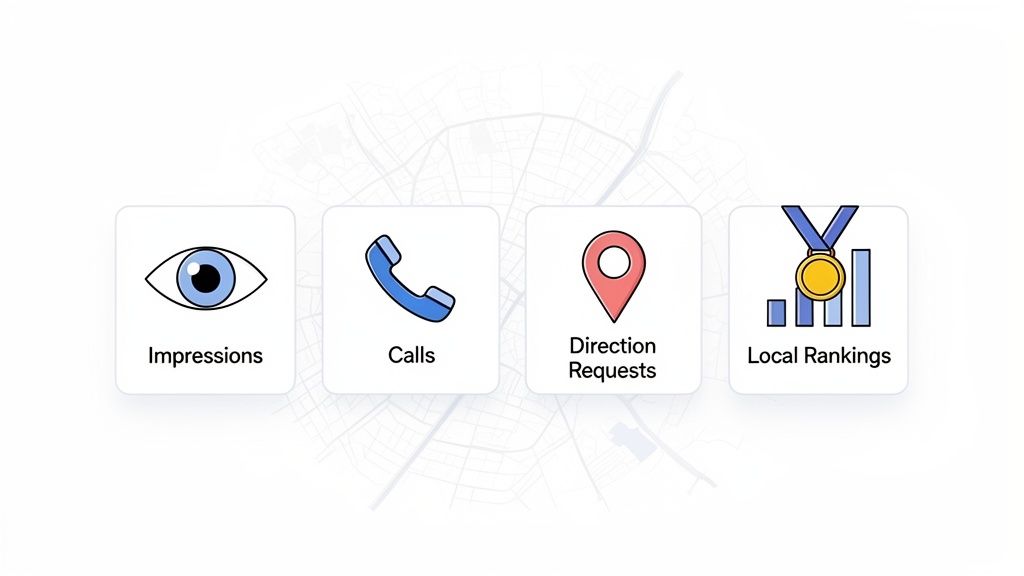
- Impressions & Local Pack Rankings: How often are your locations showing up in searches? Crucially, are they appearing in the coveted ‘local pack’ map results where most of the clicks happen?
- Clicks-to-Call: This is a pure lead-gen metric. It shows you exactly how many potential customers tapped the ‘call’ button directly from a search result.
- Direction Requests: A fantastic indicator of intent. This tracks how many people asked Google Maps for directions to one of your locations.
- Website Clicks (from GBP): This shows how many users clicked through from the GBP listing to a local landing page, signalling they want more information before they commit.
By tracking these KPIs for every single location, you can quickly see which franchisees are crushing it and which ones might need a bit more support. It gives you concrete proof that your SEO work is putting more customers on the phone and more feet in the door.
Visualising Performance with Geo-Grid Rank Tracking
Standard rank tracking is fine, but it only tells part of the story for a multi-location brand. A plumbing service might rank #1 for its own postcode, but what about three miles down the road in a key residential area? They could be completely invisible. This is exactly why geo-grid rank tracking is a game-changer.
A geo-grid tracker works by laying a virtual grid over a map and checking your search ranking for a keyword (like “emergency plumber”) at every single point on that grid. The result is a powerful, visual heat map of your search performance across an entire service area, not just a single pinprick on a map. You can see at a glance:
- Where you’re dominant and where competitors have the edge.
- “Ranking deserts” – untapped areas with huge potential.
- The direct impact of your local optimisation efforts in specific neighbourhoods.
A geo-grid report turns abstract ranking data into a clear battlefield map. It gives you and your franchisees the intelligence needed to make smarter, more targeted decisions to win local market share.
This granular insight is what makes a franchise SEO strategy so powerful. In the UK, we’ve seen franchise businesses using dedicated local SEO strategies achieve a remarkable lift in visibility. A 2026 study showed that 68% of multi-location franchises reported a 45% increase in organic Google Maps rankings within six months of implementing hyper-local optimisation. This is vital for sectors like hospitality, where a massive 82% of UK consumers use ‘near me’ searches on their mobile.
Communicating Value to Stakeholders
Once you have all this brilliant data, the final piece of the puzzle is presenting it in a way that resonates. Corporate stakeholders want the big-picture ROI. Franchisees just want to know how many leads and customers their specific location is getting. To get a firm handle on the financials, it’s worth learning how to measure marketing ROI without getting lost in jargon.
Customised dashboards are the perfect solution here. You can build a high-level view for the franchisor that shows network-wide growth, alongside individualised reports for each franchisee that highlight their calls, direction requests, and local ranking wins. This kind of transparency builds immense trust and proves the central SEO programme is a powerful investment, not just another corporate expense. With the right platform, you can effortlessly create and share compelling SEO reports for customers and stakeholders, justifying your strategy and securing buy-in for the long haul.
Bringing It All Together: Your Blueprint for Local Growth
Putting together a winning franchise SEO strategy isn’t about just one thing; it’s about creating a powerful partnership between the central brand and each local operator. Think of it as a system where everyone is pulling in the same direction, built on a foundation of smart governance, the right tools, and mutual trust.
The key is to establish a clear framework that sets the brand standards but still gives franchisees the room they need to connect with their own communities. This means getting a firm grip on your Google Business Profiles across the board for consistency, while also empowering local managers to handle the day-to-day engagement that builds loyalty.
When you pair this with genuinely local content that speaks to neighbourhood customers and, crucially, track the metrics that actually prove its worth, you’re no longer just managing locations. You’re building a scalable engine for real, sustainable growth across your entire network.
The hurdles in multi-location management are certainly real, but the right platform makes a cohesive franchise SEO strategy feel almost effortless. It masterfully bridges the gap between central brand control and authentic local relevance, turning what was once a massive headache into a serious competitive advantage.
Ready to see how you can consolidate control and put this playbook into practice? Take a look at how our dashboard simplifies multi-location management. It’s time to get your entire network coordinated and firing on all cylinders.
Common Franchise SEO Questions Answered
When you’re wrangling a multi-location SEO strategy, a few tricky questions always seem to pop up. These are the classic sticking points where the need for central brand control clashes with the franchisee’s desire to connect with their local community. Let’s walk through some of the most common ones I’ve encountered.
Who Should Be Managing Reviews for Franchisees?
This is a classic tug-of-war. The most successful approach I’ve seen is a true partnership.
The franchisor’s job is to set the stage. This means providing brand-approved response templates and using a central platform to keep an eye on everything. But the day-to-day responses? That has to come from the franchisee. They’re the ones with the direct customer relationship.
This hybrid model gives you the best of both worlds: every reply is on-brand, but it’s also personal and authentic. It allows for a quick response that actually addresses what the customer said, all while protecting the brand’s hard-earned reputation. A platform with a Review Autoresponder can be a massive help here, suggesting pre-approved replies that a franchisee can quickly tweak and post.
What Do You Do About Off-Brand Marketing?
This is exactly why having a rock-solid governance model from day one is non-negotiable. It all starts with onboarding—making sure every franchisee has read and agreed to crystal-clear marketing guidelines.
If a location does go rogue, don’t jump straight to penalties. The first step should always be a conversation. Try to understand why they’ve gone off-piste. More often than not, a franchisee goes “off-brand” because they’re genuinely trying to engage their local market but feel like they don’t have the right tools.
Instead of being punitive, use it as a coaching moment. Guide them back to the approved content templates and keyword lists you’ve provided. Explain how the centralised strategy is designed to lift the entire brand, which in turn drives more business to their specific location.
Should Franchisees Have Their Own Social Media Accounts?
This really comes down to the governance model you choose. Some brands lock it down completely, banning separate social media accounts to maintain absolute control. Others swing the other way and encourage it, but only with very strict oversight.
I’ve found a successful middle ground works best for most. Provide a library of pre-approved social media content through a central hub. Franchisees can then pull from this library to schedule and post high-quality, on-brand material to their local pages. This gives them a consistent stream of content, satisfying their need for a local voice without creating brand chaos.
What’s the Single Most Important Metric to Track?
While it can vary a bit by industry, if I had to pick just one, it would be Actions on Google Business Profile (GBP).
Think about it. This single metric bundles together clicks-to-call, website visits, and—crucially—requests for directions. It’s the clearest, most direct measure of user intent you can get. It shows you exactly how well your online presence is translating into real people planning to walk through the doors of a specific location.
Ready to unify your local marketing and get your multi-location strategy humming? LocalHQ includes a powerful Review Autoresponder that helps you maintain brand consistency while empowering franchisees to manage their local reputation. See how you can automate your review management and turn customer feedback into your next growth opportunity.
For more detailed information about franchise SEO, read our Franchise SEO Strategy That Actually Scales: From 5 to 500 Locations.