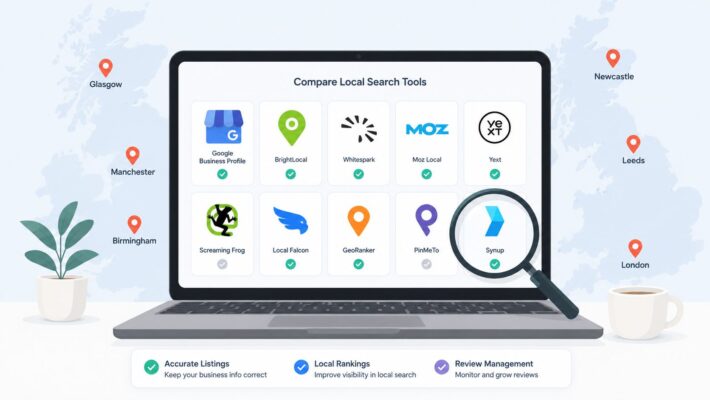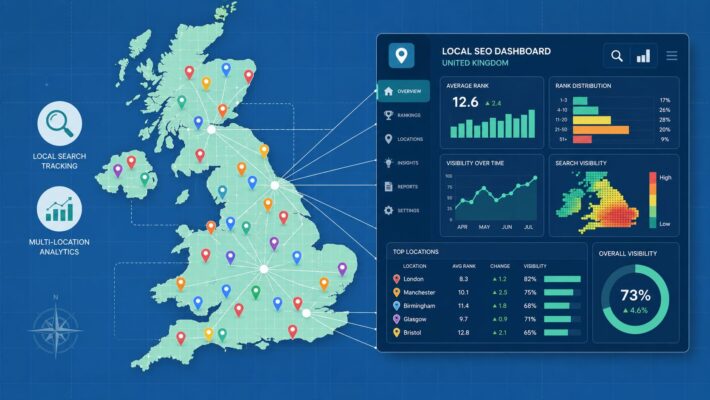
Unlock 2026 Local SEO Services Pricing

For most UK small businesses, local SEO services pricing usually sits between £400 and £1,500 per month per location, and the final figure swings hard based on competition, scope, and how much manual work your provider is doing. If you're looking at quotes right now, don't judge them by the monthly retainer alone. Judge them by total cost, deliverables, and whether you're paying for strategy or for repetitive admin dressed up as expertise.
If you've asked three providers for a quote, you've probably seen three completely different answers. One freelancer says they can do it for a few hundred pounds. One agency wants a four-figure monthly retainer. Another sends a proposal so vague you still don't know what you're buying.
That confusion isn't accidental. Local SEO is one of the easiest services to package badly. Plenty of firms bundle together Google Business Profile updates, citation work, location page edits, reporting, and review responses, then price it in a way that makes comparison nearly impossible. Some are fair. Some are expensive but justified. Some are charging premium rates for low-value admin.
The problem is that most business owners are asking the wrong question. They ask, “What does local SEO cost?” The better question is, “What am I paying for, and what will this really cost me once the extras start appearing?”
If you want a useful external benchmark before you commit, Reviews To The Top local marketing offers a practical small-business view of local SEO services. Pair that with the LocalHQ guide to ranking factors and you'll have a much clearer picture of what affects local visibility before you compare proposals.
Why Is Local SEO Pricing So Confusing
Local SEO pricing is confusing because providers sell the same outcome in completely different ways. One agency prices by location. Another prices by hours. A consultant quotes for an audit first, then adds implementation later. A low-cost provider includes “management” but implicitly excludes content, reviews, and citation cleanup.
That's why you'll see wide variation even when the business need sounds simple. “I want to rank better on Google Maps” can mean anything from basic profile tidy-up work to a full local search programme involving technical fixes, content, citations, reviews, and reporting.
The same label often hides very different work
A “local SEO package” should never be judged by name alone. Two packages with the same monthly fee can be wildly different in value.
One might include:
- Google Business Profile management with real optimisation and regular updates
- Citation work to fix inconsistent business information
- On-page local SEO across key service and location pages
- Monthly reporting tied to calls, direction requests, and local visibility
Another might include:
- A dashboard login and little else
- Generic ranking reports with no action behind them
- Minimal account activity once onboarding is done
- No real support when performance stalls
Practical rule: If a provider can't explain exactly what gets done each month, the quote is too vague to trust.
UK buyers have another problem
Most pricing advice online is built around the US market, which makes it less useful for a British business owner trying to benchmark a quote in Leeds, Birmingham, Glasgow, or London. That gap matters. The cost pressure, market competition, and service expectations are different, and a lot of online content doesn't reflect that.
Good local seo services pricing should make sense in your market, not in somebody else's. A single-site trades business in a regional town doesn't need the same budget or service depth as a hospitality brand competing across major UK cities.
The confusion clears up when you stop treating SEO like a mystery and start breaking it into cost drivers. First, how the provider charges. Second, what's included. Third, what extra costs show up later. Fourth, whether the work genuinely needs human input or could be handled faster and more consistently by software.
The Four Common Local SEO Pricing Models
A plumber in Manchester gets two quotes on the same day. One agency wants a monthly retainer. Another offers a cheap setup fee plus hourly support. A third promises payment only after rankings improve. The wrong choice does not just waste budget. It raises total cost, slows execution, and drags out the time it takes to see a return.
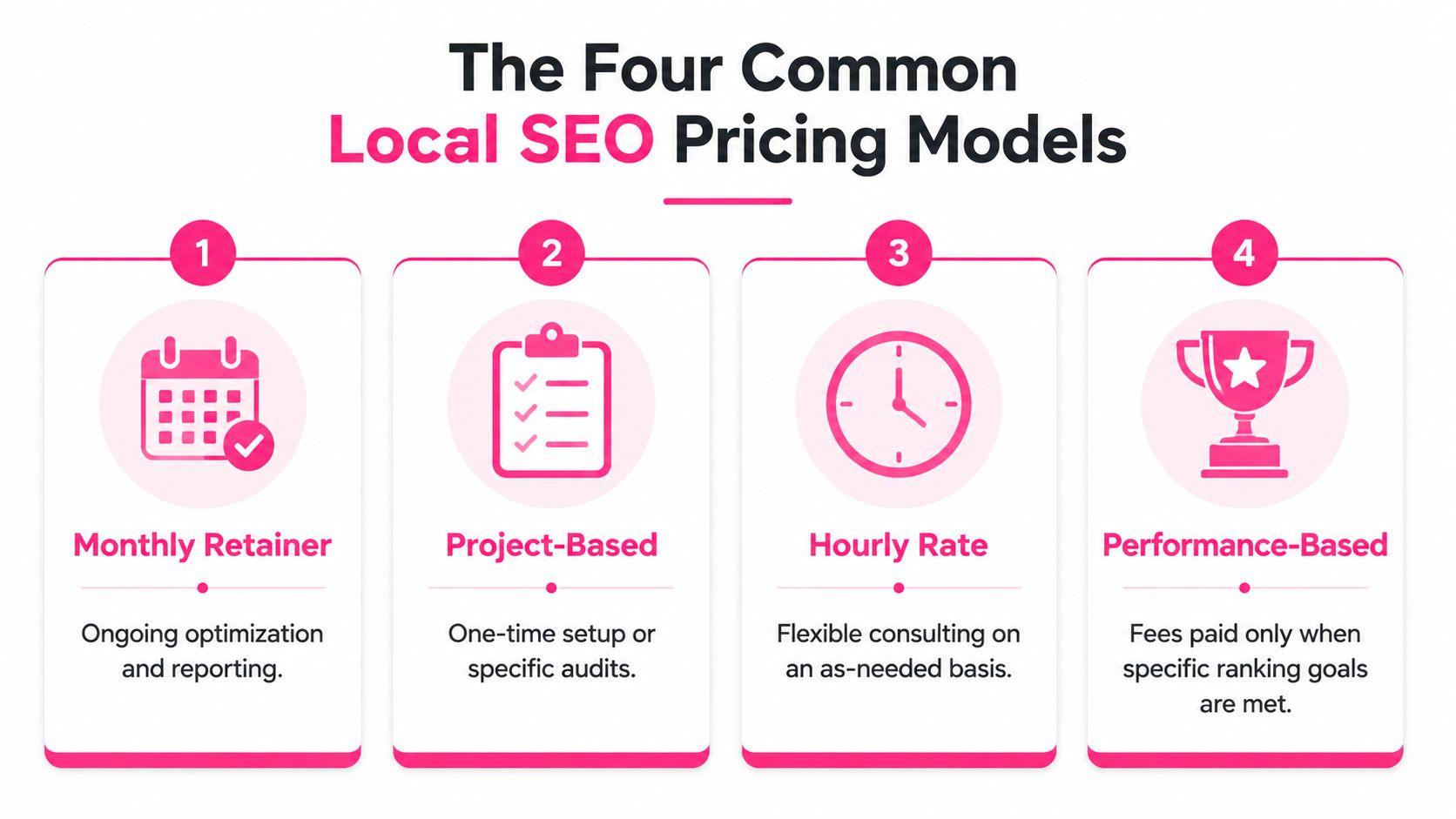
Pricing model matters because it shapes how work gets done, how fast problems get fixed, and how easy it is to hold the provider accountable. Do not judge a quote by the monthly number alone. Judge it by total cost of ownership. That means setup fees, meeting time, approvals, reporting overhead, contract length, and whether the work can scale without adding more human hours.
Monthly retainer
This is the default model for local SEO agencies. You pay a fixed monthly fee for ongoing work across Google Business Profile, local landing pages, citations, reviews, and reporting.
Retainers work well when you need steady execution and someone to own the account. They work badly when the agency sells "ongoing optimisation" but cannot show what gets done each month. That is where margins get fat and results get thin.
I like retainers only when the scope is clear, the account activity is visible, and the expected business outcome makes sense. If you are paying for one location in a moderate market, a bloated retainer is a rip-off. If software can handle large parts of the workflow faster and more consistently, paying for manual hours every month is often the expensive option, not the safer one.
Project-based pricing
Project pricing fits one-off work. Common examples include an audit, citation cleanup, Google Business Profile setup, review strategy setup, or a rebuild of key local pages.
This model is useful when the foundation is broken and you need to fix it before deciding on ongoing support. It is also a smart choice if your internal team can maintain the work after the initial cleanup. Business owners often overlook that second point. A well-scoped project can produce a better return than a six-month retainer if the issue is narrow and the fix is clear.
The catch is simple. Once the project ends, progress usually stops unless someone keeps the account moving.
Hourly consulting
Hourly pricing is best for advice, oversight, and troubleshooting. It is usually a poor way to buy execution.
If your team can implement recommendations, hourly consulting can be cost-effective. You get senior input without committing to a long contract. If your team cannot execute, hourly support turns into a slow leak. Every call, review, and follow-up adds cost, and the stop-start pace kills momentum.
Use hourly consulting for:
- Second opinions on an agency proposal
- Audits of a stalled local SEO campaign
- Short-term strategic input for an in-house team
Do not use it as your main delivery model if you need someone to manage local SEO every week.
Performance-based pricing
This model sounds attractive because it feels low risk. In practice, it creates bad incentives.
A provider paid on rankings will chase rankings. That does not guarantee leads, booked jobs, or profitable visibility. A provider paid on leads will argue about lead quality, attribution, and what counts. The cheaper the offer sounds, the more carefully you should read the small print.
I rarely recommend performance pricing for local SEO. It creates more debate than clarity, and business owners usually end up paying in other ways through long contracts, weak reporting, or selective goal-setting.
Local SEO Pricing Models Compared
| Pricing Model | How You Pay | Best For | Main Advantage | Main Risk |
|---|---|---|---|---|
| Monthly Retainer | Fixed monthly fee for ongoing work | Businesses that need steady execution | Predictable budgeting and continuous account management | Easy to hide weak delivery behind vague monthly activity |
| Project-Based | One fee for a defined scope | Setup, cleanup, audits, specific fixes | Clear deliverable and easier cost control | No ongoing follow-through after the project ends |
| Hourly Rate | Pay for time used | Strategy, reviews, expert oversight | Flexible access to senior advice | Unpredictable costs and weak execution rhythm |
| Performance-Based | Pay against agreed outcomes | Rarely the right fit for local SEO | Can look lower risk at first glance | Incentives are easy to game and hard to measure fairly |
For agencies reselling fulfilment, outsourcing local SEO through LocalHQ often produces a better return than stacking manual service hours onto every account. That is the core pricing question. Not which model sounds cheapest, but which one gives you the best result after time, labour, software, and management costs are all included.
What to Expect in a Typical Local SEO Package
You get a proposal for £600 a month from one provider and £1,800 from another. Both promise “local SEO.” One sends a list of activities. The other sends a glossy deck and a call schedule. The key question is simple. What are you truly buying, how much management overhead comes with it, and what return should that work produce?

A local SEO package should map to a clear job. Clean up the basics, improve visibility in the map pack, strengthen location pages, build trust signals, and report progress in a way an owner can verify. If the package is vague, the cost of ownership rises fast because you end up paying for extra calls, extra fixes, and add-ons that should have been in scope from day one.
What a starter package should include
A starter package is for a single location with manageable competition. It should cover the core work that gets a business into decent shape and keeps it there.
A decent starter package should include:
- Google Business Profile setup, optimisation, and ongoing updates
- Citation building, cleanup, or suppression of duplicate listings
- On-page fixes for key local pages, including titles, headings, and local relevance signals
- Local keyword targeting tied to actual service and location terms
- Basic review monitoring or response guidance
- Monthly reporting with rankings, profile actions, traffic trends, and leads where possible
Anything weaker is a maintenance plan dressed up as SEO.
If a provider charges a monthly retainer and excludes profile management, citations, or on-page fixes, you are paying for supervision, not progress.
What a stronger package should include
Higher-priced packages should do more than add meetings and prettier reports. They should solve a harder problem and create a clearer path to revenue.
At that level, expect:
- Optimisation across multiple pages, services, or locations
- Location-specific content creation
- Internal linking and page structure improvements
- Local link acquisition or outreach
- Active Google Business Profile posting and update management
- Review strategy support
- Reporting that connects work to calls, form fills, bookings, or store visits
For multi-location businesses, coordination matters as much as the work itself. A package that covers ten locations but still relies on manual spreadsheets, back-and-forth approvals, and one-off listing edits will consume staff time on your side too. That time is part of the price, even if it never appears on the invoice.
What should never be vague
Before you sign, get specific answers in writing.
Ask:
- How many locations are included
- How many pages will be optimised each month
- Whether content creation is included or billed separately
- Whether citation work is a one-time cleanup or ongoing management
- How review responses are handled
- What gets reported, and how results tie to leads or sales
- Which tasks are done manually, and which are handled through software
That last point matters more than many owners realise. Repetitive local SEO work done by hand is slow, expensive, and prone to inconsistency. If your main need is listing accuracy and distribution, an AI-powered local citation platform often gives you a better return than paying agency rates for routine submission and update work.
Good packages are specific. Bad packages hide behind activity lists. Buy the outcome, the process, and the operating model together. That is how you judge the cost.
Key Factors That Drive Your Final Quote
The quote changes because the workload changes. Local SEO isn't priced like a commodity. It's priced according to how hard your market is, how messy your online presence is, and how many moving parts the provider has to control.

Competition changes everything
A roofer in a quieter town and a cosmetic clinic in central London are not buying the same service, even if both ask for “local SEO”. One market may reward solid basics. The other may demand stronger content, faster review management, more advanced page work, and tighter profile optimisation.
This is the biggest mistake buyers make. They compare quotes without comparing the market difficulty behind them.
Scope can quietly multiply the fee
A single location is straightforward. Multiple locations create operational drag very quickly.
Costs usually rise when you need:
- Several Google Business Profiles managed together
- Location-specific landing pages with unique content
- Central brand control across branches or franchises
- Reporting split by location, not just one blended dashboard
- Ongoing content and profile updates at scale
A multi-location retail or hospitality business should expect a more complex quote because consistency becomes part of the work.
Your starting point matters
If your business information is already accurate, your pages are serviceable, and your profile is active, the provider can start optimising. If your listings are inconsistent, reviews are unmanaged, and your location pages are thin, they have to spend time fixing the basics first.
That distinction matters because some providers price only the monthly work and leave the cleanup to “onboarding” or one-off add-ons. Others bury the cleanup inside a bigger retainer.
Businesses don't just pay for growth work. They often pay to undo years of neglected local search hygiene first.
Agency calibre and operating model matter too
Some agencies charge more because they bring senior strategic ability. Others charge more because their cost base is higher and their process is slower.
That's why you need to ask how they work, not just what they charge. A provider doing everything manually will always have a ceiling on efficiency. A provider using modern systems should be able to handle recurring tasks faster and with less inconsistency.
If you want a sharper sense of the operational side, these local SEO pillars for UK businesses are useful to review before you compare proposals. They'll help you spot whether a quote reflects real ranking work or generic account management.
Beyond the Retainer Uncovering Hidden Costs
Monthly retainers are rarely the full price. They represent the headline number. Most expenses often sit underneath that figure.

According to WebFX local SEO pricing guidance, many pricing guides ignore hidden costs such as one-time setup fees of £500 to £2,000, separate software subscriptions, and content overages, which can lift total cost of ownership for a multi-location business by 40 to 60 per cent above the quoted retainer.
Where the extra costs show up
These are the usual culprits:
Setup and onboarding fees
Some are fair. If a provider is auditing assets, fixing data, and restructuring locations, setup work is real. But if the onboarding fee pays for a kickoff call and a templated checklist, you're being overcharged.Software charged separately
Rank tracking, review management, listing tools, call reporting, and dashboards are sometimes excluded from the retainer. That doesn't make the retainer cheaper. It makes the proposal less honest.Content overages
The package may include “content support”, but once you need additional location pages, Google posts, or review responses, extra fees appear.Scaling charges
Adding locations often triggers a fresh round of fees, not just a neat extension of the current work.
The contract itself can be a cost
A long lock-in is a financial risk, especially when the scope is vague. If you can't leave without penalty, the provider has less pressure to perform well after the first few months.
Watch for:
- Long notice periods
- Ownership issues over listings or reporting access
- Transition fees
- Dependency on the agency's internal tools
Cheap-looking retainers often become expensive programmes once the exclusions start piling up.
The better way to evaluate local seo services pricing is to ask for the full operating cost over time. Not just the monthly invoice. The total cost to launch, run, scale, and if needed, leave.
Evaluating Value Is It a Service or a Platform You Need
Business owners usually make the wrong call here. They hire an expensive service when what they need is consistent execution, visibility, and control.
If your challenge is strategic, messy, or highly competitive, a strong consultant or agency can be worth the money. If your challenge is operational, repeatable, and spread across one or many locations, software often gives you the better return.
Pay humans for judgement, not for repetitive admin
You should pay premium rates for:
- Market strategy
- Technical diagnosis
- Complex page planning
- Brand positioning in difficult local markets
You should be very cautious about paying premium rates for:
- Routine Google Business Profile updates
- Content scheduling
- Review response workflows
- Repetitive multi-location management
- Reporting assembly
That work still matters. It just doesn't always need to be done manually.
A simple ROI test
Use a blunt test. Ask the provider to break the monthly fee into activities. Then separate strategic tasks from recurring admin.
If a large share of the fee goes towards repeatable tasks, the proposal may be structurally inefficient. You're not paying for brilliance. You're paying for labour.
As noted earlier, experienced local SEO labour can be expensive. That makes automation attractive when the work is process-heavy and needs to happen reliably across many profiles or locations. For businesses comparing options, these local SEO tools for UK businesses are a smarter place to start than another generic agency pitch.
Choose the model that matches the job
A service is usually the better fit when:
- You need expert diagnosis
- The site has technical problems
- You're entering a highly competitive local market
- You need bespoke strategic direction
A platform is usually the better fit when:
- You need speed and consistency
- You manage multiple profiles or locations
- You want direct visibility into activity
- You're tired of paying for low-value manual tasks
The right decision isn't about finding the cheapest route. It's about refusing to overpay for work that can be systemised.
Your Pre-Hiring Checklist Questions to Ask Any Provider
A local SEO proposal can look reasonable at first glance, then turn expensive once the extra labour, add-on tools, and weak execution show up after month one. That is why the sales call matters. Your job is to find out whether you are buying expertise, buying admin time, or buying software wrapped in agency language.
Use a checklist. The same way buyers use something like the HomeProBadge contractor screening guide to vet tradespeople, you should vet local SEO providers with questions that expose process, accountability, ownership, and total cost.
Ask these on every call:
What exactly will you do each month
Ask for a task list with frequency. If they stay vague and talk only about rankings, walk away.What part of the work is strategic, and what part is repeatable admin
This gets to the true ROI. Strategy can justify a premium. Routine posting, listing updates, review monitoring, and reporting often should not.What is included in onboarding
Setup fees are fine if they cover real work such as audits, tracking, access fixes, location cleanup, and baseline reporting. A vague onboarding charge is often just a margin booster.Which tools cost extra
Ask about reporting, rank tracking, review management, citation tools, call tracking, and content approvals. A cheap retainer with multiple add-ons is not cheap.How will you report results in business terms
Rankings are not enough. Ask how they connect activity to calls, leads, bookings, store visits, or revenue.How do you handle multi-location consistency
If you have more than one location, this answer matters fast. If their process sounds manual and messy, your costs will rise every time you add a branch.Who owns the accounts, assets, and data
You should keep access to your Google Business Profiles, listings, reporting, and content. If leaving the provider means rebuilding everything from scratch, that is a bad deal.What happens in month three if results are flat
Good providers have a diagnosis process and a plan. Weak ones buy time with jargon.
One sharp question cuts through a lot of nonsense. Ask: Why is your model better than using a platform for the repeatable work and paying a specialist only for strategy? If they cannot answer that clearly, they probably have not earned the retainer.
The best providers give direct answers, show you where the time goes, and explain the expected return. The worst ones hide behind custom packages, long contracts, and activity reports full of low-value tasks.
Good local SEO pricing holds up under scrutiny. You can see what you are paying for, what could be automated, what still needs expert judgment, and how the spend turns into commercial return.
If you want a cleaner way to manage local visibility without paying agency rates for repetitive tasks, take a look at LocalHQ. It's built for businesses and agencies that need one place to manage Google Business Profiles, reviews, posts, reporting, and multi-location consistency at scale, with automation that cuts wasted admin and makes ROI much easier to track.