White Label SEO Reporting: A UK Agency Guide (2026)

Most agencies don't lose clients because the work is poor. They lose them because the client can't clearly see what's happening, why it matters, or what comes next. A monthly PDF full of screenshots from third-party tools doesn't build confidence. It often does the opposite.
That problem gets sharper when you manage local SEO for restaurants, retailers, hospitality groups, clinics, trades, or franchise networks. One location might be climbing in Maps while another slips on reviews, duplicate listings, or site speed. If your reporting can't explain those differences in a simple, branded way, your strategy ends up looking messier than it is.
An Introduction to White-Label SEO Reporting
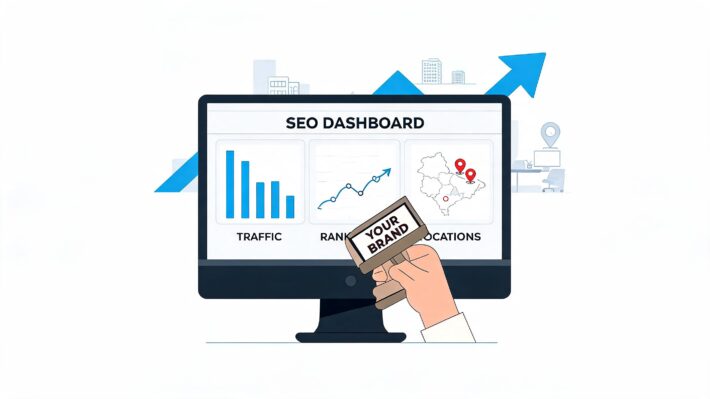
White label seo reporting means delivering SEO performance updates under your agency's own brand rather than the branding of the software that collected the data. That includes the obvious pieces, such as logos, colours, layout, and domain, but its true value is bigger than presentation.
A white-label report lets the agency own the explanation. Instead of handing over raw charts from a rank tracker or analytics platform, you turn activity into a client-facing narrative. What changed. Why it changed. What the business should do next.
That distinction matters in the UK local market because reporting complexity rises quickly once a business has more than one location. A 2025 UK reporting guide notes that 68% of multi-location businesses in hospitality and retail struggle with consistent reporting across profiles, while only 22% use white-label tools. That gap is where many agencies either look highly organised or visibly stretched.
Why generic reporting falls short
Generic reports usually create three problems:
- They advertise the tool, not the agency. The client remembers the platform interface, not your strategic judgement.
- They confuse busy stakeholders. Operations teams, regional managers, and owners rarely want ten disconnected dashboards.
- They weaken local decision-making. If reporting isn't grouped by branch, postcode area, or profile, the client can't act on it.
Practical rule: If a client needs you on the call just to translate the report, the report isn't doing enough work.
For UK agencies, this is also where localisation stops being a nice extra and becomes part of the service itself. Reporting often needs to reflect Google Business Profile activity, local pack visibility, calls, direction requests, review trends, and differences between sites or branches. Generic reporting templates rarely handle that well.
If you're building this capability for location-based clients, the white label local search optimisation guide is a useful reference point because it frames reporting as part of the local SEO service rather than a separate admin task.
The Core Benefits for Your Agency and Clients
A strong white-label report changes the client relationship because it changes what the client thinks they're buying. They stop seeing a list of SEO tasks and start seeing managed business performance.

The biggest commercial upside is retention. Agencies using white label SEO reports typically see 20-30% higher retention rates than agencies relying on generic reporting methods, according to Reportr's overview of white label SEO reporting. That doesn't happen because the logo looks nicer. It happens because the report feels like a considered service deliverable rather than exported software output.
Better reports create better conversations
When the reporting is branded and properly structured, monthly meetings become easier to run. You don't spend half the time explaining what each chart means or why the dashboard looks different from last month. You can go straight into priorities, blockers, and opportunities.
That shift matters more than many junior account managers realise. Clients rarely judge SEO on one metric alone. They judge whether the agency appears in control. Reporting is where that impression is either reinforced or lost.
A clean report reduces defensive conversations. A messy report creates them.
The agency benefits aren't just cosmetic
White-label reporting improves internal operations as well as client perception. It creates consistency across account managers, locations, and service lines. It also makes QA easier, because the agency can define a standard reporting structure instead of letting each person improvise.
Useful support systems matter here. If your reporting depends on accurate tracking, naming conventions, and clean data collection, Trackingplan's agency observability solutions are worth reviewing because they focus on catching measurement issues before they distort what a client sees.
A practical way to think about the benefits is this:
| Area | What generic reporting does | What white-label reporting does |
|---|---|---|
| Brand perception | Highlights the software | Highlights the agency |
| Client meetings | Forces explanation of charts | Supports strategic discussion |
| Account management | Varies by team member | Standardises delivery |
| Scaling | Adds manual work | Supports repeatable processes |
Why clients respond to it
Clients want confidence, not just access. They want to know that someone has interpreted the data and decided what matters. That's why a report with commentary, prioritised insights, and next actions nearly always lands better than a data dump.
For agencies that need an example of what that looks like in practice, how LocalHQ proves SEO value shows the reporting angle clients usually respond to best. Clear visibility, business actions, and a next-step story.
Key Metrics That Actually Demonstrate SEO Value
Many SEO reports fail because they include too much measurement and not enough judgement. The answer isn't to remove detail. It's to group metrics by the job they do.

A useful white label seo reporting framework has three layers: visibility, engagement, and business outcomes. If you only show one layer, the client gets an incomplete picture.
Visibility
Start with whether the business is being found.
For local clients, this usually includes keyword rankings, local pack presence, Google Business Profile visibility, and location-level movement. For multi-location brands, I'd also separate brand and non-brand performance because they answer different questions. Brand visibility shows whether the branch is getting found by people already aware of it. Non-brand visibility shows whether SEO is expanding discovery.
Geo-grid views and location comparisons prove useful. A broad “average ranking” often hides the reality that one part of a city performs differently from another.
Engagement
Once visibility improves, the next question is whether the traffic is useful.
That means looking at organic users, landing page behaviour, profile interactions, and page experience. Technical signals belong here too, because clients need to understand that a slow site doesn't just frustrate developers. It affects visibility and conversion potential.
As of late 2025, only 54.6% of websites meet overall Core Web Vitals thresholds, according to RankAI's guide to white-label SEO reports. If your report includes a technical health area, you can translate those issues into practical consequences rather than leaving them as developer jargon.
A simple way to frame technical metrics for clients is:
- Site speed affects whether users stay long enough to act
- Layout stability affects trust and usability
- Interaction responsiveness affects whether the site feels reliable
What works: Tie technical metrics to user experience and lost enquiries.
What doesn't: Drop in PageSpeed screenshots with no explanation.
Business outcomes
This is the section that proves SEO is more than traffic acquisition.
The strongest reports connect search performance to business events such as calls, direction requests, bookings, form submissions, and ecommerce actions. If the client runs multiple locations, show those outcomes at branch level whenever possible. A board-level stakeholder may care about the aggregate result, but a regional manager needs to know which sites are underperforming.
A useful example comes from Search to Sale's white-label SEO dashboard case study, which reported a 64% year-over-year increase in organic traffic for targeted topics and a 120% surge in adds-to-cart from organic search after optimisation. That's the kind of reporting connection clients understand immediately. It links SEO work to commercial behaviour, not just rankings.
A practical reporting stack
When building the metrics layer, keep it tight:
For discovery
Rankings, Maps visibility, GBP impressions, and keyword groups by service or location.For on-site quality
Organic landing pages, engagement by page type, technical health, and mobile experience.For outcomes
Calls, forms, bookings, direction requests, transactions, or other defined lead actions.For interpretation
Commentary on what changed, what caused it, and what the team will do next.
If you need one place to centralise those inputs and visualise them by location, LocalHQ analytics is designed around local performance signals rather than a generic analytics view.
How to Structure Your Report for Maximum Impact
Good reporting is editorial work. The structure determines whether the client reaches the insight quickly or gets buried in detail.

The strongest format I've used is not the most complicated one. It's the one that answers five questions in order: what happened, why it happened, where it happened, what needs attention, and what happens next.
A structure clients actually read
Use a report flow like this:
Executive summary
One page. Key movements, major wins, notable risks, and the most important action for the next period.Top-line KPI snapshot
A simple dashboard with the few metrics the client already cares about. Not every metric you can pull.Location or channel breakdown
Separate local pack, organic search, Google Business Profile activity, and conversion actions where relevant.Technical health
Flag issues that limit performance and explain the likely business effect.Insights and recommendations
The agency earns its fee through these. Prioritised actions, not generic observations.
Why Technical Health deserves its own section
Many agencies bury technical issues in an appendix. That's a mistake. If a client's site is slow, unstable, or difficult to interact with, those issues affect every other result in the report.
Because only 54.6% of websites meet overall Core Web Vitals thresholds in the late-2025 benchmark cited earlier, a dedicated technical section helps agencies show they're solving real constraints rather than just listing them. Within it, you explain what the issue is, why it matters to visibility or conversion, and whether the client needs content, development, or platform fixes.
Don't label this section “technical” and leave it there. Translate each issue into business language.
The presentation rule most agencies ignore
Never give every client the same report depth. The structure should stay consistent, but the emphasis should change.
A franchise marketing director may want branch comparisons and reporting consistency. A hospitality owner may care far more about calls, direction requests, review trends, and mobile performance. A legal or healthcare client may focus more on lead quality and service-page visibility.
That's why the best white label seo reporting feels standardised behind the scenes and personalised at the surface. Clients should recognise a reliable format without feeling they received a generic template.
Implementing Your White-Label Reporting Solution
Most agencies start reporting manually. That's normal. It's also where reporting quality usually starts to drift.
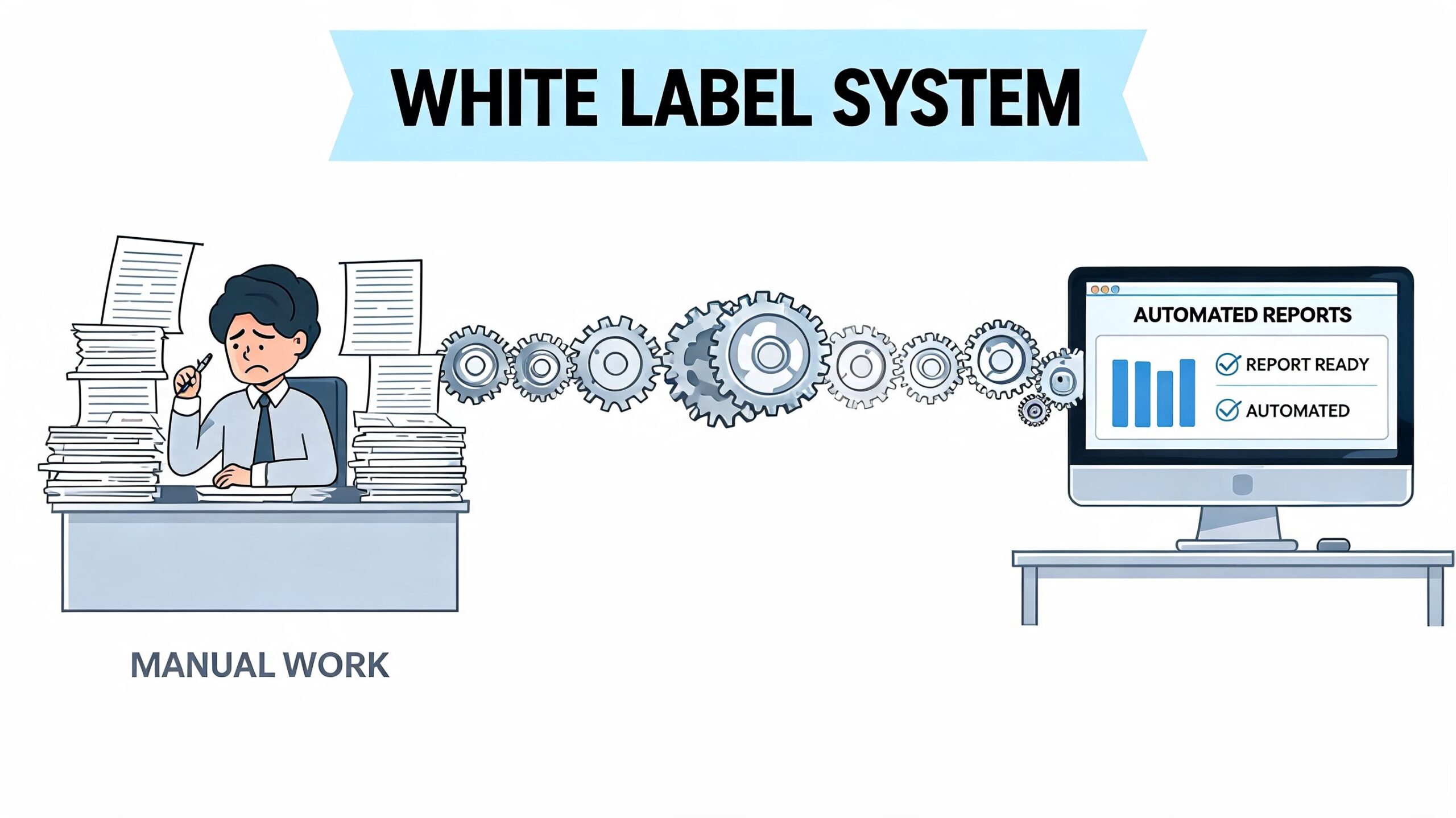
One person exports Search Console data. Another pulls Google Analytics. Someone else screenshots rankings, checks Google Business Profile actions, copies notes from a spreadsheet, and pastes everything into Slides or Canva. It works for a while, especially with a small client list. Then an account manager goes on leave, labels change, dates get mixed up, and the report becomes a production process instead of a strategic one.
Manual versus semi-automated versus integrated
Here's the practical trade-off.
| Approach | Strength | Weakness |
|---|---|---|
| Manual spreadsheets and decks | Full control over commentary | Slow, inconsistent, hard to scale |
| Semi-automated dashboard tools | Faster data collection | Often limited branding and local nuance |
| Integrated reporting platforms | Better repeatability and automation | Needs setup discipline and source alignment |
Manual reporting still has one advantage. It forces people to think. That can produce excellent commentary. The problem is that it doesn't scale cleanly across many locations or many clients.
Semi-automated tools improve speed, but many stop short of true white-labelling or local reporting depth. They often look polished at first glance but become restrictive when you need postcode-level visibility, location grouping, or branch-specific action metrics.
Integrated platforms are usually the right fit once reporting volume grows. They reduce copy-and-paste work, support scheduled delivery, and give clients a consistent presentation layer.
What to look for during setup
The implementation work matters as much as the software choice. In practice, most reporting problems come from poor setup rather than the reporting tool itself.
Focus on these areas first:
Data source alignment
Make sure Google Analytics, Search Console, and Google Business Profile naming conventions line up with how the client organises locations.Template logic
Build one reusable structure by client type, then tailor the commentary and metric emphasis.Branding controls
Check logos, colours, report headers, and whether the client portal or exported format matches your agency identity.Commentary ownership
Automation should pull data. Your team should still own the recommendations.
One option built around local, multi-location visibility is LocalHQ software for local search visibility. It combines reporting with profile management, geo-grid tracking, and local performance views, which is useful when agencies need one workflow for branches rather than a stack of disconnected local tools.
What works and what usually fails
What works is a blended model. Automate the collection and delivery. Keep human interpretation at the centre.
What usually fails is trying to automate everything, including judgement. Clients can tell when the report commentary is little more than templated filler. They may not say it directly, but they'll stop reading closely.
A good implementation removes admin friction and protects the strategic layer. That's the balance to aim for.
Choosing the Right White-Label Reporting Partner
Choosing a reporting partner isn't really about prettier dashboards. It's about whether the platform fits the way UK local SEO work gets done.
If your clients are single-location businesses with simple needs, many tools can probably cover the basics. If you serve hospitality groups, retailers, franchise networks, clinics, or service brands with several branches, the shortlist gets smaller very quickly.
The shortlist criteria that matter
Start with how the platform handles local complexity.
Can it separate reporting by location, region, or profile group? Can it show Google Business Profile activity alongside site performance? Can it support local rankings in a way that reflects real search geography rather than a national average?
Then look at workflow fit. A platform might look impressive in a demo and still create headaches if the branding options are weak, exports are clumsy, or commentary fields are too limited.
Use this checklist:
Multi-location handling
The platform should organise data cleanly across branches without forcing awkward workarounds.Local metric depth
Look for support around Maps visibility, profile actions, reviews, and local search signals.Branding control
Reports should look like your agency's deliverable, not a rebadged software template.Operational fit
Scheduled delivery, permissions, and repeatable templates matter more than flashy charts.
Why future-facing features matter now
Local SEO reporting is shifting beyond rankings and traffic. Voice-led discovery, review sentiment, and citation quality are becoming more relevant to how local businesses get chosen.
A guide to white-label local SEO notes that UK local voice searches surged 42% year on year and that 76% of agencies still report manual processes that hinder scaling. That combination matters. Agencies need reporting that can absorb new local signals without adding another manual layer to the workflow.
That's where AI-assisted review handling and citation audits become useful selection criteria, not just product extras. If the platform can surface review patterns, reputation issues, and local consistency problems inside the same reporting environment, the agency can keep the client conversation in one place.
Selection principle: Buy for the reporting questions clients will ask next year, not only the ones they ask today.
If you're comparing broader tooling choices around crawling, analytics, monitoring, and delivery, this SEO agency tech stack guide is a practical companion resource because it helps place reporting software in the wider agency stack rather than treating it as a standalone purchase.
For agencies serving regional brands, hospitality groups, and franchises, the decision should also reflect the realities of optimising local search for British companies. UK location data, profile consistency, and local intent behaviour need to show up in the reporting layer. If they don't, the platform may still look polished while missing what your clients focus on.
Conclusion: Transform Data into Dialogue
White label seo reporting works when it stops being a monthly export and starts acting as part of the service itself. That's the key shift. You're not just sending charts under your own branding. You're giving clients a clear explanation of performance, constraints, and next actions in a format they can trust.
For agencies, that means stronger retention, cleaner delivery, and better client conversations. For multi-location businesses, it means less confusion between branches and more confidence that local SEO activity is producing real business outcomes.
The practical standard is simple. Automate the collection. Curate the metrics. Explain the meaning. Recommend the next move.
If you're refining the commercial side of your reports, this guide to call detail reporting is useful because it shows how call data can become part of a more complete ROI story, especially for service-led local businesses where phone enquiries still matter.
If you want reporting that turns local visibility, calls, direction requests, and Google Business Profile activity into branded client-ready dashboards, take a look at LocalHQ. It's built for agencies and multi-location businesses that need clearer local SEO reporting without running everything through spreadsheets.