Franchise SEO Checklist: A Marketing Operations Manual
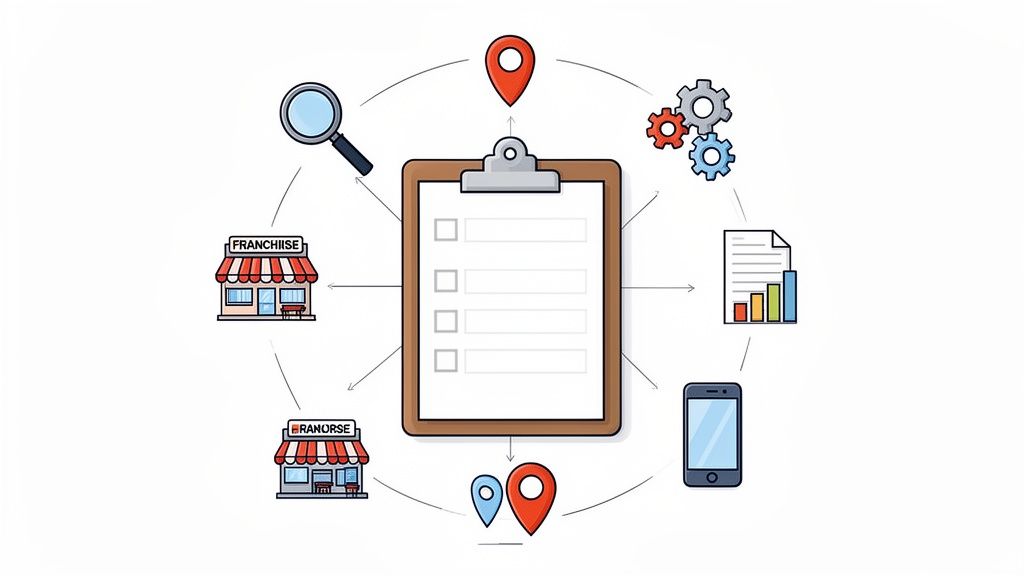
A franchise network rarely loses local visibility because of one dramatic mistake. It slips through routine failures across dozens of branches. Head office approves the brand direction, but a location manager changes profile details, another branch keeps an outdated phone number live, and a copied location page goes up without review. The result is familiar. Rankings flatten, Maps coverage becomes inconsistent, and the team wastes time arguing about whether the issue sits with SEO, operations, or franchise compliance.
Franchise SEO needs tighter operating rules than single-location SEO. A checklist on its own is not enough. Large networks need assigned owners, approval workflows, reporting cadences, and clear rules on what local teams can change without creating brand drift.
The commercial case is straightforward. UK customers check reviews, compare nearby options, and make decisions fast. If a franchise is not visible at the branch level, demand does not disappear. It goes to the competitor that shows up with cleaner local signals and fewer operational mistakes.
This checklist is built as a repeatable operating manual, not a loose set of tips. The focus is scale. Monthly tasks keep listings, pages, and reviews under control. Quarterly reviews catch drift before it spreads across the network. Annual audits reset standards, fix structural issues, and give leadership a clear view of performance and accountability.
That is how franchise SEO becomes manageable. It stops being a collection of one-off fixes and starts working like a governed system.
1. Google Business Profile optimisation and standardisation across all locations
A franchise can lose local visibility without any obvious failure at head office. One branch edits its opening hours, another swaps categories, a third points the profile to the wrong landing page. None of that looks serious in isolation. Across 20, 50, or 200 locations, it creates inconsistent signals that are hard to trace and harder to clean up.
Google Business Profile is usually the first operational system I audit because it exposes governance problems fast. If profile ownership is loose, standards drift. If standards drift, local rankings and conversion quality follow.
Build one operating standard for every profile
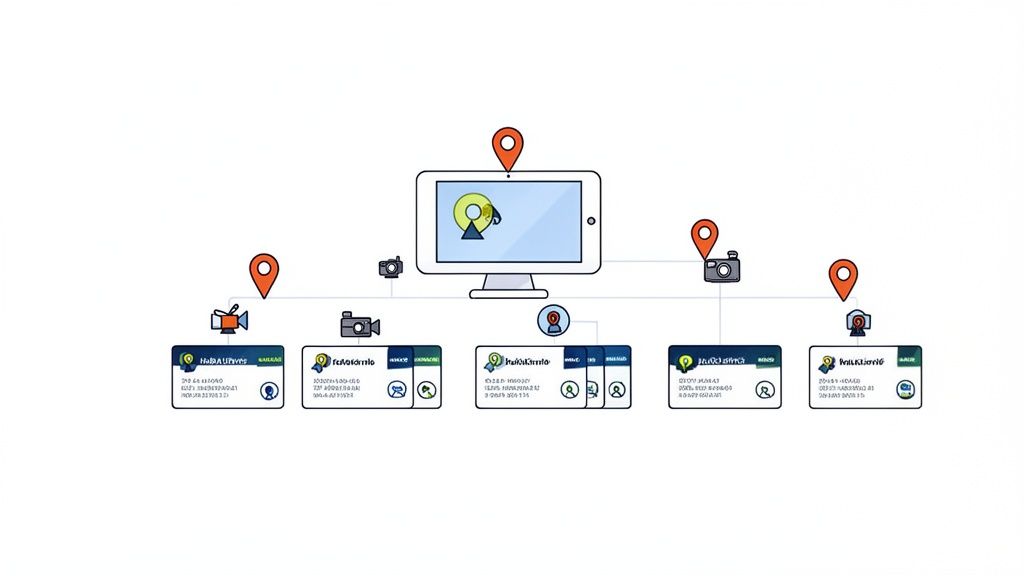
Every location should start from the same approved profile framework. That framework needs documented rules, a named owner, and an exception process. Otherwise branch teams fill the gaps themselves.
Corporate should define:
- Business naming rules. Use the approved trading name only.
- Primary and secondary categories. Set these centrally and document when an exception is allowed.
- Image standards. Specify the minimum required set, such as exterior, interior, staff, services, and products.
- Description format. Keep brand language consistent, with limited room for branch-specific detail.
- Link handling. Send users to the correct location page, booking URL, or tracked call line for that branch.
The trade-off is simple. Tight central control protects consistency, but it can slow local updates if the process is too rigid. The answer is not to give every branch full editing freedom. It is to separate fixed brand elements from editable operational fields. Local teams can update short-term hours, temporary closures, and fresh photos. Head office should control categories, naming, descriptions, and destination URLs.
Large franchise networks already work this way. They standardise profile structure first, then allow controlled local input inside those rules.
Monthly tasks that prevent profile drift
Run a monthly GBP review across the full network, not just the locations that complain.
- Check core data. Confirm name, address, phone number, opening hours, and landing page.
- Review categories. Reverse unauthorised changes and log who approved any valid exception.
- Audit images. Remove poor or outdated uploads and replace them with current branch assets.
- Check for duplicates. Escalate merges quickly so authority does not split across listings.
- Review posts and Q&A. Keep content useful and on-brand. Do not let profiles turn into a stream of random branch notices.
I also recommend a quarterly governance review. Check who still has profile access, which locations are repeatedly failing audits, and whether your standards still match how the business operates. Annual reviews should cover profile ownership, bulk update processes, and escalation paths for suspensions, duplicates, and re-verifications.
One rule saves a lot of time. If a branch cannot explain why a field changed, revert it and record it.
The profile also depends on the page behind it. As noted earlier, location pages need to load properly, stay stable on mobile, and match the profile details exactly. The profile often sends users to a location page, and if that page is slow or unstable, the profile is doing half the job.
For teams managing this centrally, platforms like LocalHQ help by handling standardised profile updates, post scheduling, and asset control across the network from one dashboard, instead of relying on separate branch logins.
2. Local citation building and consistent NAP distribution
A branch relocates, the front desk number changes, and nobody updates the old listings outside Google. Three months later, calls are still going to the wrong line, aggregator feeds are split, and the location page is being undercut by stale third-party data. That is how citation problems usually show up in franchise SEO. Not as a theory problem. As an operations failure.

Standardise the record before distributing it
Citation work starts with governance, not submissions. Every franchise network needs one approved location record for each branch, maintained centrally and used everywhere. If teams skip that step, they end up pushing conflicting versions of the same business across directories and data suppliers.
Set the format once and document it clearly:
- whether “Road” is written in full or abbreviated
- how suite, unit, or floor details appear
- which local phone number is published
- how the brand name appears if the branch trades under a parent or sub-brand
- which landing page URL is tied to the listing
This matters more in franchise systems than in single-location businesses because local edits tend to come from several directions at once. Corporate updates one feed. A branch manager edits Apple Maps. An agency fixes a directory profile. Without a controlled format, inconsistency becomes routine.
Prioritise citation sources by operational value
Do not build citations as if every directory deserves equal effort. They do not.
Start with the platforms that feed discovery, trust, and customer actions:
- Core map ecosystems. Google, Apple Maps, Bing Places.
- Primary review platforms. The sites customers in your category use.
- Sector directories. Healthcare, legal, hospitality, trades, automotive, and similar verticals.
- Local authority and regional listings. Chambers, local business indexes, trusted city or county directories.
A franchise network with 20, 50, or 200 locations needs a tiered model here. Monthly maintenance should cover the high-impact listings. Quarterly audits should check secondary directories and vertical sites. Annual review should reassess the source list itself, because some directories stop mattering while others become important in your category.
Build a repeatable update process
Citation management fails when it sits outside normal business operations. Location data changes should trigger listing updates automatically through the same workflow used for branch openings, moves, phone changes, temporary closures, or rebrands.
Use a simple rule set:
- every branch has one source record
- corporate approves structural changes to name, address, phone, and URL
- branch-level edits are logged, reviewed, and either accepted or reversed
- any relocation, call routing change, or trading name update creates a citation task
- audits happen on a schedule, not only after complaints
That process is what keeps citation work scalable. Otherwise, networks spend half their time cleaning up after exceptions.
What scales, and what breaks
What scales:
- central ownership of citation standards
- one source of truth for every location record
- scheduled audits after operational changes
- coverage based on sector relevance and local trust
What breaks:
- franchisees claiming listings independently without oversight
- bulk submissions using outdated spreadsheets
- low-quality directory volume with no maintenance plan
- treating citations as a launch task instead of an ongoing control process
I usually treat citation accuracy like financial data. One branch can have a justified exception, but it should never have its own formatting rules.
If you are managing this across a large estate, LocalHQ is relevant because it supports the one-source-of-truth model franchise teams need. Central teams can manage approved location data and updates from one platform instead of relying on scattered branch logins and manual checks.
3. Multi-location rank tracking and local visibility mapping
A franchise CMO looks at a national ranking dashboard and sees stable performance. Two franchisees are still calling the same week because map visibility has dropped in their catchments and lead volume is down. That gap is why multi-location SEO needs branch-level tracking, not rolled-up averages.
Local visibility is uneven by default. A branch can rank well near its postcode and fall out of the local pack a few miles away. Another can hold organic positions for service terms while map results weaken because reviews, categories, or proximity signals changed. If reporting only shows national or domain-wide trends, those failures stay hidden until revenue teams escalate them.
Build a reporting model that matches how a franchise operates
Rank tracking for a franchise network should run at three levels:
- Location level. Core terms for each branch, tracked from that branch's actual market.
- Regional level. Groups of branches in similar territories, useful for spotting market-wide issues and outliers.
- Corporate level. Network trends, template impacts, and performance by service line or brand segment.
The keyword set should also be layered. Track brand queries, non-brand service terms, and local-intent combinations tied to each branch. That keeps reporting tied to real search behaviour instead of a master spreadsheet full of terms nobody uses.
A gym network might track brand searches, category terms such as 24-hour gym, and local variants tied to each club. The same logic applies to coffee chains, clinic groups, estate agents, and home service franchises. Search demand is shared at network level, but visibility is won and lost branch by branch.
Use geo-grid mapping to find causes, not just report positions
Good local visibility mapping answers operational questions.
Typical patterns include:
- a Google Business Profile category edit triggers a local pack drop
- two nearby location pages split relevance for the same service
- weak reviews reduce visibility at the edges of a branch's service area
- a newly launched branch page is not receiving enough internal authority from the main domain
- one branch starts outranking a neighbouring branch in an overlap zone, which creates cannibalisation
For this reason, local pack reporting should sit alongside calls, direction requests, form leads, and booked appointments in the same branch scorecard. SEO teams need rankings. Operations teams need to know which visibility change affected commercial performance, where it happened, and whether the fix belongs to listings, content, reviews, or site architecture.
Set a repeatable review cadence
This works best as an operating routine, not a one-off audit.
- Monthly. Check movement by branch, review local pack coverage, flag sharp drops, and assign likely causes.
- Quarterly. Revisit the tracked keyword set, refresh geo-grids for priority markets, and review branch overlap zones.
- Annually. Rebuild the measurement framework if the network has expanded, merged territories, changed templates, or restructured location pages.
That cadence matters more as the estate grows. A ten-location network can get away with manual reviews for a while. A hundred-location network cannot. Without governance, reporting turns into a pile of screenshots and disconnected ranking exports.
A geo-grid tool is useful here because it shows where visibility is strong, weak, or leaking into another branch's territory. LocalHQ fits that operating model well. Central teams can review location-level gaps and cannibalisation patterns without relying on broad rank summaries that flatten local reality.
4. Location-specific content strategy and geo-targeted page optimisation
A franchise adds 20 new pages in a quarter. Every page uses the same copy block, the same service text, and the same calls to action with a town name swapped in. Six months later, half the pages barely rank, two branches compete for the same query set, and the central team has no clear rule for what to fix first.
That is usually a content operations problem, not a publishing problem.
Location pages need to be built as a managed system. The goal is not to make every branch page look different for the sake of it. The goal is to give each page enough local substance, enough structural consistency, and enough governance that the network can scale without creating duplication, cannibalisation, or thin content.
Build templates that control quality without producing clones
A good franchise template sets the sections once and defines which fields must be localised by branch. That keeps production efficient while preventing the "same page, different town" pattern that drags down performance.
A page for Foxtons in one area should not read like another branch page with a postcode changed. A clinic page should cover the practitioners, treatments, and booking details that apply to that branch. A Kwik Fit-style location page should explain local service coverage, access, parking, and branch-specific availability, not just repeat national sales copy around a map.
The fixed parts of the template should handle structure, compliance, and conversion elements. The variable parts should carry the local proof.
Use inputs such as:
- branch-specific opening copy
- services delivered at that location
- staff or practitioner information where relevant
- local testimonials, if your approvals process allows them
- nearby landmarks, transport routes, parking, or service area references
- branch FAQs based on real customer questions
- local images instead of stock assets
- clear contact details, opening hours, and map data
Franchise teams often get the trade-off wrong in this area. Too much freedom and the pages drift off-brand. Too much central control and every page becomes interchangeable. The workable middle ground is a governed template with required local fields and a QA step before publishing.
Map keywords to page purpose, not just location names
One location page should serve one clear search intent cluster.
That usually means aligning each page to a core service plus geography pattern, then supporting it with secondary modifiers that match the branch offer. A pharmacy branch, for example, may need separate treatment or service pages if the main location page cannot cover those intents clearly without becoming bloated. A legal franchise may need the branch page to target the office query set, while service pages handle practice-area terms for that same city.
The decision depends on scale and overlap. If every branch targets every service in the same way, the site creates internal competition fast. If the information architecture is too thin, the network leaves demand uncaptured. The fix is a page-type model that defines what belongs on the branch page, what belongs on a local service page, and what stays on national service hubs.
For large estates, document that model centrally. Do not leave it to whichever agency, freelancer, or franchisee publishes the next batch of pages.
Write rules that teams can enforce
Content standards need to survive turnover, expansion, and uneven branch participation. Loose guidance does not hold up across 50 or 200 locations.
Use clear publishing rules:
- every location page must include unique local introduction copy
- every service claim must match the branch's delivery capability
- every page must answer practical visit questions, not just promotional ones
- every image set should include local assets where possible
- every branch page must be linked from the right regional or service pathways
- every page should be reviewed before launch for duplication against nearby branches
That last point matters more than teams expect. Neighbouring territories often share service areas, landmarks, and wording. Without an editorial check, two branches end up targeting the same modified queries with near-identical copy. Then performance stalls and nobody can tell whether the issue sits in content, internal linking, or territory design.
A strong location page helps a customer decide whether this branch is relevant, reachable, and credible. A weak one just proves the CMS can swap place names.
Run this as a repeating workflow
This work benefits from cadence. It should not be treated as a one-time rewrite project.
- Monthly. Review newly published and underperforming location pages. Check for thin copy, duplicated sections, broken branch details, and missing local proof points.
- Quarterly. Refresh branch FAQs, update service availability, test internal linking paths, and review whether any nearby branches are overlapping on the same intent set.
- Annually. Rebuild templates if the franchise has added new service lines, changed territory structures, updated compliance requirements, or expanded into new city types that need different page components.
That cadence is what turns content from a backlog into an operating model. Smaller networks can manage this with a spreadsheet and a disciplined editor. Larger networks usually need a central owner, a local input process, and page-level QA criteria that are simple enough to apply every time.
5. Review management, response, and reputation monitoring
A branch manager misses three negative reviews on Google during a busy week. Another location keeps asking happy customers for feedback but never responds once the reviews come in. Head office sees the average rating slip a month later, after clicks have already dropped and complaints have spread across branded search results.
That is how reputation problems usually start in franchise systems. Not with one dramatic failure, but with inconsistent local handling and no central control.
Reviews affect visibility, conversion, and brand trust at the same time. For a franchise network, they also create a governance problem. One location can lower confidence in the wider brand, especially when customers compare nearby branches before choosing where to book, visit, or call.
Treat reviews as an operating process
Review management works best when head office sets the rules and locations handle the day-to-day execution. Without that split, one of two things happens. Either every branch improvises and quality falls apart, or central marketing tries to answer everything and creates a backlog.
The workable model is simple:
- Head office owns policy. Set response standards, escalation rules, tone, legal boundaries, and reporting.
- Locations own first-line action. Ask for reviews, monitor new feedback, and respond within the agreed window.
- Regional or central teams handle exceptions. Step in for complaints involving safety, discrimination, refunds, regulated services, media risk, or legal exposure.
This is less about etiquette than control. Franchises need a system that can survive staff turnover, territory growth, and uneven branch discipline.
Build response rules people can use
Loose guidance produces slow, risky replies. Overwritten scripts produce robotic ones. The middle ground is a response framework with clear limits.
Use standards such as:
- Positive reviews. Thank the customer, reference the location or service naturally, and confirm the good experience without stuffing keywords.
- Negative reviews. Acknowledge the issue, apologise where appropriate, state the next step, and move account-specific details offline.
- No arguments in public. Do not dispute timelines, payment details, or internal records in the review thread.
- Named escalation paths. Staff should know exactly when to send a case to operations, HR, compliance, or legal.
I have seen good franchises cut response time quickly once they stopped chasing perfect wording and started using approved patterns with local context fields.
Make review generation predictable
Review volume becomes uneven when branches rely on memory or enthusiasm. The fix is process design.
Common collection points include:
- post-visit email requests
- SMS prompts after completed service
- QR codes at reception, tills, or exit points
- follow-up requests tied to closed jobs or confirmed appointments
The trade-off is straightforward. Push too hard and reviews look forced or operationally messy. Ask too passively and only extreme experiences get recorded. The right system asks consistently, at the right moment, and applies the same rules across every territory.
Monitor reputation at three levels
Franchise teams usually need reporting in three views.
- Location level. New reviews, average rating, response time, unresolved complaints, recurring service issues
- Regional level. Clusters of weak branches, training gaps, staffing issues, review velocity differences
- Brand level. Overall rating trend, platform coverage, recurring complaint themes, risk categories
At this point, review monitoring stops being a customer service task and becomes a management input. If five branches in one region are getting the same complaint, that is not a copy issue or a profile issue. It is an operations problem with local SEO consequences.
Run this as a repeating workflow
Reputation management needs the same cadence as the rest of franchise SEO. Otherwise standards drift.
- Weekly. Check for new reviews, overdue responses, unresolved escalations, and duplicate or suspicious feedback.
- Monthly. Review branch-level performance by rating, response time, sentiment trends, and review volume. Flag locations that need coaching or intervention.
- Quarterly. Audit response quality, update templates, review escalation categories, and compare reputation patterns against leads, bookings, or store performance.
- Annually. Rewrite policy documents, retrain branches, update compliance guidance, and reassess whether your tooling still fits the size of the network.
If review management is the bottleneck, a platform can help keep monitoring and response queues under control. LocalHQ’s Review Manager and Review Autoresponder are built for teams that need central oversight with branch-level execution, which is often what turns an inconsistent process into one that scales.
6. Technical SEO audit and site infrastructure optimisation
A franchise adds 40 new locations, publishes 40 new pages, and sees no lift. The usual cause is not page count. It is infrastructure. If the template is bloated, the internal linking is weak, or indexing rules are off, every new page inherits the same problem.
That is why technical SEO for franchises needs an operations model, not a one-off cleanup. Large networks repeat the same page patterns, data fields, and CMS rules across hundreds of URLs. Small defects spread fast.
Audit the template system before auditing individual pages
Start with the components that scale across the estate. A single location page rarely fails on its own. The failure usually sits in the template, the CMS logic, or the deployment process.
Check these first:
- Indexation controls. Confirm the right location, service, and support pages are indexable. Review noindex rules, canonicals, XML sitemaps, redirects, and robots directives.
- Template duplication. Compare location pages side by side. If only the town name changes, expect weak differentiation and crawling inefficiency.
- JavaScript dependency. Test whether key content, internal links, reviews, FAQs, and location details render properly without relying on delayed scripts.
- Mobile performance. Heavy sliders, map embeds, consent tools, booking widgets, and tag stacks often slow the pages that matter most.
- Structured data output. Validate that schema is present, accurate, and mapped consistently across every branch template.
- Internal linking paths. Make sure authority can flow from top-level brand and regional pages into location pages, and back into relevant service content.
Such situations usually stem from governance issues as much as technical ones. If every region can install its own widgets, tracking scripts, or page modules, page speed and consistency will drift within a quarter.
Prioritise by business risk, not by audit spreadsheet size
Teams waste time fixing low-impact warnings while core location pages stay slow or partially indexed.
Use a simple order of operations:
- Can search engines crawl and index the right URLs?
- Can users load and use core location pages on mobile without friction?
- Is each page distinct enough to deserve its place in the index?
- Is structured data valid and aligned with on-page location information?
- Can internal links support discovery and authority flow across the network?
That sequence keeps the team focused on revenue pages first. It also stops technical audits turning into long defect logs with no delivery plan.
Core Web Vitals matter because franchise pages carry too much weight
Location pages are often asked to do everything at once. They carry local content, maps, forms, booking tools, click-to-call actions, reviews, and tracking scripts. If the page is slow, users feel it before analytics does.
Google’s current benchmarks still apply as practical targets: LCP within 2.5 seconds, INP within 200 milliseconds, and CLS below 0.1. Use those numbers as operating thresholds, not vanity metrics. A location page can pass lab tests and still feel slow if third-party tools load badly on mobile networks.
I usually test three page sets every quarter: the highest-traffic locations, a sample of average branches, and newly launched pages. That mix catches both systemic template issues and launch mistakes.
Schema helps, but only if the source data is clean
Structured data is useful for franchise sites because the same business attributes repeat across the estate. It also fails in predictable ways. Wrong opening hours, mismatched URLs, duplicate schema types, and missing coordinates are common on multi-location sites.
For branch pages, check that schema matches the visible page content for:
- business name
- address and phone
- opening hours
- geo coordinates where relevant
- service area or service types where relevant
- primary URL and location page URL
- review or FAQ markup only when it is supported on the page
Do not treat schema as a rescue job. It cannot compensate for thin local content, poor architecture, or conflicting branch data.
Put the audit on a fixed operating cadence
Franchise technical SEO breaks when nobody owns the repeat checks.
A workable rhythm looks like this:
- Monthly. Review Search Console coverage changes, indexation anomalies, broken internal links, redirect errors, and new template issues introduced by CMS updates.
- Quarterly. Crawl the site, test representative location pages for mobile performance, validate schema output, review canonical logic, and compare page-template variants across regions or brands.
- Annually. Reassess site architecture, URL structure, regional hub strategy, platform limitations, and migration risk. Do this before expansion pushes the CMS past what it can handle.
The point is consistency. A franchise network does not need a dramatic technical rescue every year. It needs controlled checks, clear thresholds, and a process that catches defects before they spread across hundreds of pages.
7. Franchise SEO governance, guidelines, and performance accountability
A regional manager updates Google Business Profile categories on Friday. A franchisee launches a side microsite on Monday. The central team spots the problem three weeks later, after rankings split, reporting gets messy, and nobody agrees on who approved what.
That is a governance failure, not an SEO mystery.
Franchise SEO breaks down when permissions, approval routes, and reporting rules are vague. Central teams end up cleaning up duplicate assets, inconsistent branch edits, and local experiments that conflict with brand standards. Large networks need an operating model that scales, not a loose set of recommendations.
Put rules in writing and assign ownership
Every network should document who controls each high-risk SEO asset and what level of local discretion is allowed.
Start with the questions that usually cause friction:
- Who owns Google Business Profile edits?
- Who approves new location pages?
- Who can change categories, service lists, or NAP data?
- Who checks branch-level compliance each month?
- What happens when a franchisee creates unauthorised SEO assets?
These rules need named owners, approval steps, and service-level expectations. If category changes sit with local teams, define which fields they can edit without approval and which changes must go through central review. If location pages are centrally managed, set a turnaround target so branches do not bypass the process out of frustration.
Digital Web Magnate’s franchise SEO discussion points to a common failure point: franchisees deviating from brand SEO standards by creating unauthorised microsites or changing Google Business Profile categories without approval. In practice, those actions create duplicate entity signals, split authority, and make troubleshooting far slower than it should be.
Build a compliance workflow that runs every month
Governance fails when it lives in a handbook nobody uses. It works when it shows up in routine operating checks.
A workable setup includes:
- a monthly branch compliance scorecard
- a change request process for profile or page edits
- an escalation route for unauthorised changes
- a training pack for branch managers or local marketing staff
- a central approval workflow for new pages, citations, and major profile updates
Use a fixed cadence. Monthly checks should catch unauthorised profile edits, missing brand fields, and overdue change requests. Quarterly reviews should cover recurring policy breaches, training gaps, and locations that keep slipping outside standards. Annual reviews should revisit the governance model itself, especially after acquisitions, rebrands, or rapid expansion.
Scale changes the answer in such cases. A 15-location network can handle some exceptions manually. A 300-location network cannot.
Make accountability visible in the same report as performance
Compliance reporting should sit beside branch performance, because the trade-off is real. Locations that ignore standards sometimes move faster in the short term. They also create more inconsistency, more cleanup work, and weaker data quality for the whole network.
Track a small set of measures that managers can act on:
- profile completeness
- review response coverage
- location page quality
- local visibility trends
- unresolved compliance issues
- turnaround time on approved change requests
I prefer internal league tables for this. Used properly, they are not about naming and shaming. They show which branches follow process, which ones need support, and where central systems are slowing teams down. If a branch is compliant but underperforming, the issue is likely market, competition, or content quality. If a branch is underperforming and non-compliant, the first fix is operational discipline.
The KPI mix will vary by network, as noted earlier in the article. The important point is simple. Performance and compliance should be reviewed together, by the same people, on the same cadence.
If a franchisee can launch a microsite, alter profile categories, or publish duplicate copy without anyone noticing, the network does not have an SEO problem first. It has a control problem.
Good franchise SEO governance sets permissions, defines approval routes, documents exceptions, and gives local teams a way to request changes without breaking standards. That is how SEO becomes repeatable across monthly, quarterly, and annual operating cycles, instead of turning into a constant repair job.
8. Link building and omnichannel ROI tracking
A branch sponsors three local events, gets covered by a regional paper, and earns a link from the chamber of commerce. Rankings improve. Calls do not. That usually means the team measured authority gain but missed the rest of the path from discovery to conversion.
For franchise networks, link building works best as an operating process, not a one-off campaign. The job is to earn local authority signals that a branch would want even without SEO, then review those efforts on the same monthly and quarterly cadence used for performance reporting. That keeps outreach tied to market reality and stops central teams from chasing placements that look good in a spreadsheet but do little for branch revenue.
Build links from real local activity
The strongest franchise links usually come from relationships that already exist in the business:
- local chambers of commerce
- trade associations
- community sponsorship pages
- local press coverage
- supplier and partner directories
- local charities and non-profit organisations
- industry directories with editorial review
The pattern matters more than volume. A restaurant group might earn links through food writers, event partnerships, and neighbourhood guides. A healthcare franchise might appear on local health organisation sites, community resource pages, and relevant association directories. A home services brand often gets better results from manufacturer listings, trade bodies, and local sponsorships than from generic outreach.
Weak guest post placements on irrelevant sites create reporting noise. Relevant local mentions usually produce better authority, better referral traffic, and fewer clean-up problems later.
Track branch outcomes, not link counts
Link reporting should sit inside a wider ROI model. At branch level, review whether stronger local authority is associated with improvements in:
- calls
- booking requests
- form submissions
- direction requests
- in-store or branch visit indicators
- assisted conversions from organic search
As noted earlier in the article, local search often drives offline action quickly. That is why branch teams need to connect earned links, landing page performance, and lead handling. A link that sends qualified local traffic to a weak page will underperform. A good page with no local authority often stalls before it reaches enough visibility.
Omnichannel measurement also matters in this context. If a local PR mention drives branded search, direct traffic, phone enquiries, and assisted conversions, the value did not come from SEO alone. Franchise operators should still count it. The point is to understand total branch impact, not to force every result into a single channel box.
Use a reporting cadence that scales
Monthly reporting should help local managers act. Quarterly reporting should help central teams allocate budget.
A useful monthly branch dashboard includes:
- top landing pages by location
- local visibility trend by branch
- calls and forms by location
- pages with engagement but weak conversion
- recent local links or PR activity and the timing of any uplift
Then review the same data quarterly across the network. Look for patterns by region, franchisee group, and campaign type. Some markets respond well to community sponsorships. Others get more value from trade associations or regional press. That trade-off only becomes clear when link activity and commercial results are reviewed together over time.
For operators managing many branches, a reporting platform can reduce manual work. LocalHQ’s reporting suite is designed to surface calls, direction requests, impressions, and engagement trends by location, which is more useful for franchise decision-making than a generic SEO dashboard.
8-Point Franchise SEO Checklist Comparison
| Item | Implementation Complexity 🔄 | Resource Requirements ⚡ | Expected Outcomes 📊 | Ideal Use Cases 💡 | Key Advantages ⭐ |
|---|---|---|---|---|---|
| Google Business Profile Optimisation & Standardisation Across All Locations | High initial setup + ongoing coordination; centralised workflows 🔄🔄🔄 | Platform + data ops + franchise coordination; moderate staffing ⚡⚡ | Strong Maps visibility, higher CTRs and calls; reliable local rankings ⭐⭐⭐ | Franchises needing consistent public listings and Map presence | Consistency across locations; saves time; reduces duplicates |
| Local Citation Building & Consistent NAP Distribution | Time-intensive build and upkeep; many sources to manage 🔄🔄🔄 | Citation tools + manual verification; ongoing maintenance ⚡⚡⚡ | Improved local relevance and trust; better local-pack placement ⭐⭐ | Competitive local markets and industries reliant on directories | Strengthens verification signals; reduces conflicting data |
| Multi-Location Rank Tracking & Local Visibility Mapping | Ongoing monitoring and analysis; geo-grid setup 🔄🔄 | Tracking tools + analyst time; monthly cadence ⚡⚡ | Clear visibility metrics and trends; prioritised actions and benchmarking ⭐⭐⭐ | Large multi-location brands requiring performance insight | Identifies underperformers; informs resource allocation |
| Location-Specific Content Strategy & Geo-Targeted Page Optimisation | Content-heavy and scalable setup; risk of duplication 🔄🔄🔄 | Content team + SEO + CMS templates; high production effort ⚡⚡⚡ | Increased local relevance, engagement and organic clicks; topical authority ⭐⭐⭐ | Locations needing differentiation and high organic intent queries | Unique local value propositions; better local snippet CTRs |
| Review Management, Response, & Reputation Monitoring | Process driven; requires rapid response workflows 🔄🔄 | Monitoring tools + trained staff; messaging templates ⚡⚡ | Improved ratings, trust and CTRs; generates user content for SEO ⭐⭐ | Service and consumer-facing franchises where reviews drive choice | Boosts reputation; signals engagement to search engines |
| Technical SEO Audit & Site Infrastructure Optimisation | Technical fixes often require developers; recurring audits 🔄🔄🔄 | Dev resources + audit tools; possible hosting investments ⚡⚡⚡ | Better crawlability, speed, mobile indexability and rich snippets ⭐⭐⭐ | Large sites with many location pages or slow performance | Foundational fixes with site-wide ROI; prevents indexing issues |
| Franchise SEO Governance, Guidelines & Performance Accountability | Organisational change; policy and training rollout 🔄🔄🔄 | Training programs, reporting dashboards, compliance checks ⚡⚡⚡ | Network-wide consistency, fewer SEO errors, measurable accountability ⭐⭐ | Franchises with many independent owners needing standardisation | Ensures best practices adoption; enables scalable growth |
| Link Building & Omnichannel ROI Tracking | Strategic outreach and attribution complexity; long timelines 🔄🔄🔄 | Outreach/PR, content creation, advanced analytics ⚡⚡⚡ | Increased domain authority and measurable conversions; ROI attribution ⭐⭐ | Brands pursuing authority and conversion tracking across channels | High-impact ranking signals; ties SEO to revenue outcomes |
Your blueprint for scalable franchise SEO success
A franchise network usually feels healthy until one quarterly review exposes the pattern. Half the locations are missing recent reviews, a cluster of profiles has drifted from brand standards, local pages are out of date, and no one can say which fixes belong to head office and which belong to franchisees. Rankings slip long before the reporting deck makes the problem obvious.
A useful Franchise SEO checklist works as an operating calendar. Monthly work covers profile checks, citation corrections, review response oversight, rank tracking, and page refreshes. Quarterly work covers technical audits, compliance reviews, and market-by-market performance analysis. Annual work covers site architecture decisions, ownership changes, policy updates, and expansion planning.
That operating rhythm is what keeps a large network stable.
Franchises rarely lose visibility because of one dramatic mistake. They lose it through repeated local variation: a manager changes business categories without approval, duplicate listings stay live for months, location pages reuse the same copy, or reviews sit unanswered. Head office sees weaker performance. The underlying issue is inconsistent execution across dozens or hundreds of locations.
The practical goal is not to chase every ranking fluctuation. It is to build a system that survives staff turnover, new openings, acquisitions, and uneven franchisee capability. Strong central standards matter, but they only work if local teams know what they control, what requires approval, and what gets audited on schedule.
Technology should reduce admin load. Marketing teams need one place to check profile accuracy, review activity, local rankings, and branch-level outcomes, then act on exceptions before they spread. LocalHQ is one option built for that workflow, combining Google Business Profile management, geo-grid rank tracking, review response tools, and reporting for multi-location search operations.
For teams rolling this out across a growing network, start where control and visibility improve fastest: profile standardisation, citation accuracy, location page quality, and review workflows. Add technical audits, governance controls, and ROI tracking once the core operating routine is in place.
Treat franchise SEO like shared infrastructure. Assign owners. Set review dates. Document exceptions. Fix drift early. That is how a network keeps local search performance stable while it scales.
If review response volume is slowing your team down, start with the most operationally valuable fix. Explore LocalHQ to centralise review monitoring, keep responses on-brand, and manage reputation across every location without turning it into a manual daily chase.
For more detailed information about franchise SEO, read our Franchise SEO Strategy That Actually Scales: From 5 to 500 Locations.