

How to Get More Google Reviews: Ethical Growth

A restaurant group I worked with served great food, had loyal regulars, and still kept losing map visibility to weaker operators nearby. The problem was not quality. It was that their competitors had a steady stream of recent Google reviews, while they asked for feedback only when someone on shift happened to remember.
That pattern is common. Businesses do the hard part well, then leave reviews to chance.
Why Most Businesses Fail at Getting Google Reviews
Most businesses are not short on happy customers. They are short on a repeatable review process.
One local operator can deliver brilliant service for months and still look second best on Google because another business built review collection into daily operations. Google users do not see your effort behind the scenes. They see stars, recency and volume.
The three failures I see most often
The first is simple. They never ask. Staff feel awkward, owners do not want to seem pushy, and the moment passes.
The second is timing. They ask days too late, when the emotional peak has gone. A happy customer at the till, at handover, or just after a job is complete is very different from that same customer a week later.
The third is inconsistency. One manager cares, another forgets. One branch asks, another never does. One technician sends a follow-up, another does not. That creates uneven review flow, which is exactly the kind of pattern that weakens local visibility over time.
Good service is not enough on its own
A lot of owners think reviews should arrive naturally if the business is good enough. In practice, customers need a prompt. Not a bribe. Not pressure. Just a clear ask at the right time with a simple path to leave feedback.
That is why I treat review generation as an extension of customer experience, not a separate marketing gimmick. If the experience was strong, asking for feedback is the natural next step.
For teams trying to improve the customer experience before they tighten their review process, this guide on secrets to positive online feedback is worth reading because it tackles the service behaviours that often create review-worthy moments in the first place.
The businesses that win more reviews are not more aggressive. They are more organised.
There is one more trap worth avoiding. Some owners panic when review growth stalls and start cutting corners with bad tactics, including risky schemes that can backfire. If you want to understand where the line is, read this breakdown of fake reviews on Google.
Laying the Groundwork When and Where to Ask
Timing matters more than wording. A decent request sent at the right moment will outperform a polished message sent too late.

When businesses ask me how to get more google reviews, I start with one question. Where in your customer journey is satisfaction highest and friction lowest?
According to Semrush, point-of-purchase review requests demonstrate a 25% conversion rate when implemented strategically, and that performance improves when businesses reduce friction with tactics like QR codes on receipts and invoices at the moment of peak satisfaction (Semrush).
The best moments to ask
Different sectors have different review windows. The principle stays the same. Ask when the customer has just felt the value.
| Business type | Best moment | Why it works |
|---|---|---|
| Restaurants and cafés | After a compliment, at bill payment, or shortly after the visit | The experience is still fresh and customers are already using their phone |
| Retail | At checkout or after a smooth repeat purchase | The buying decision has been validated and the transaction is complete |
| Home services | At job completion, after the customer signs off, or once the issue is solved | Relief is high and the result is visible |
| Healthcare, legal, professional services | After a positive outcome or a clearly helpful interaction | Trust is strongest once uncertainty drops |
| Hospitality | At check-out or after staff resolve a request well | The service memory is strongest before travel attention shifts |
What the ask should feel like
The request should sound like service, not sales.
A front-of-house team member can say:
- Simple version: “If you’ve had a good experience today, we’d really appreciate a Google review.”
- With a prompt: “You can scan the code on the receipt. It takes less than a minute.”
- For service teams: “If everything looks good, I’ll send over a quick link so you can share feedback.”
None of that feels forced if the experience was positive.
Remove every bit of friction
You lose reviews when customers have to search for your business themselves. Every extra click costs you.
Use:
- Direct review links: Pull the direct link from your Google Business Profile and use that exact destination.
- QR codes: Put them on receipts, invoices, table talkers, window stickers, packaging inserts and service completion forms.
- Short follow-ups: If someone cannot leave a review on the spot, send a brief text or email while the visit is still recent.
A surprising number of businesses still send customers to the homepage, Instagram, or a generic contact page. That kills intent.
If a customer has to search for your listing, choose the right branch, and then find the review button, most of them will not finish.
Train staff around moments, not scripts
Rigid scripts sound awkward. Instead, train staff to recognise a few clear triggers:
- A customer gives praise: Ask then.
- A repeat customer returns: Ask because trust already exists.
- A problem gets solved well: Ask once the relief is obvious.
- A customer thanks a team member by name: Ask because the emotional temperature is high.
This works well when your profile itself is well maintained. If your hours, categories, photos and business details are weak, fix those at the same time. Review generation performs better when the listing converts attention properly, and this guide to Google Business Profile optimisation is a useful starting point.
The Perfect Ask Crafting Templates That Convert
A weak template fails in one of two ways. It is too vague, or it sounds automated in the worst possible sense.
The best requests are short, personal, and easy to act on.
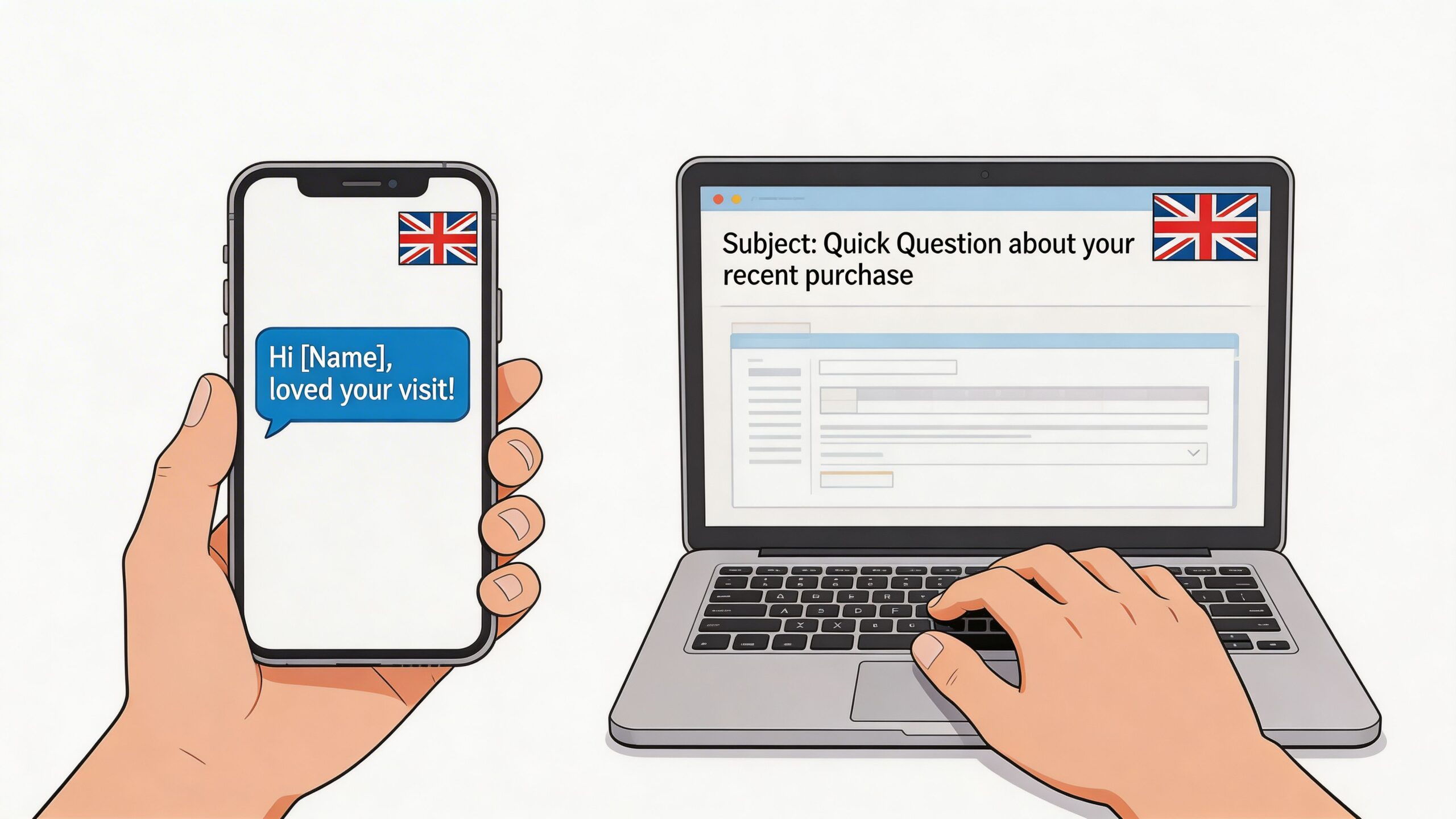
There is also a structural point many businesses miss. Referrizer reports that a customer survey funnel that identifies happy customers first and then sends them to the Google review link can achieve survey-to-review conversion rates of 18-22%, compared with 5-8% from blind requests (Referrizer). That means wording matters, but the flow behind the wording matters even more.
What every good review request includes
Before the templates, get the components right.
- Use the customer’s name: “Hi Sarah” will almost always beat “Dear customer”.
- Reference the interaction: Mention the meal, appointment, repair, delivery, or visit.
- Keep the ask direct: Do not bury it in a long paragraph.
- Use one link only: Too many options lower response.
- Write like a human: No “valued customer” language unless your brand sounds like that.
SMS templates that work effectively
SMS is best when the service has just finished or the customer has recently visited.
Template for retail or hospitality
Hi [First name], thanks for visiting [Business name] today. If you have a moment, we’d really appreciate an honest Google review: [Review Link]
Why this works:
- It is short.
- It references the visit.
- It asks for an honest review, not a positive one.
Template for trades or home services
Hi [First name], thanks for choosing [Business name] for your [job or service]. If everything went well today, would you mind leaving a quick Google review? It helps other local customers find us: [Review Link]
Why this works:
- It anchors the request to the completed job.
- It feels natural after sign-off.
- It avoids sounding needy.
Template for repeat customers
Hi [First name], thanks again for coming back to [Business name]. We appreciate your support. If you’d like to share your experience, here’s our Google review link: [Review Link]
Why this works:
- Repeat customers are often easier asks.
- The message rewards loyalty without offering an incentive.
Email templates for more considered asks
Email suits businesses where the customer may want a little more context, such as professional services, healthcare, legal, or higher-consideration purchases.
Short email template
Subject: Thanks for choosing [Business name]
Hi [First name],
Thank you for choosing [Business name]. We hope you were pleased with your experience.
If you have a minute, we’d be grateful if you shared your feedback on Google:
[Review Link]
Thanks again,
[Name]
[Business name]
Softer email for service businesses
Subject: A quick favour after your recent appointment
Hi [First name],
It was a pleasure helping you with [service].
If you found the experience helpful, we’d appreciate an honest Google review. It helps other people in [town or area] choose with confidence.
Leave a review here:
[Review Link]
Kind regards,
[Name]
A better way to personalise without sounding robotic
Do not overdo token replacement. Customers can spot it.
Good personalisation:
- Their first name
- Service type
- Branch or area
- Team member name if relevant
Bad personalisation:
- Long purchase summaries
- Forced references to product SKUs
- Clunky merge fields that fail and show raw code
The strongest template reads like something a good manager would send, not something a marketing platform generated.
What not to include
A lot of review requests underperform because they contain avoidable clutter.
Avoid:
- Multiple calls to action: Review us, follow us, visit the website, join the newsletter.
- Over-explaining: Customers do not need a paragraph on why reviews matter to your business.
- Manipulative wording: Never ask specifically for five stars.
- Apologetic language: “Sorry to bother you” weakens the ask before the customer even clicks.
If you want more google reviews, keep the message light, clean and timely. Strong businesses do not chase. They ask clearly, then make it easy.
Automating Your Review Engine for Consistent Growth
Manual review collection breaks as soon as the business gets busy. The day gets hectic, the follow-up never gets sent, and momentum disappears.
That is why the durable answer to how to get more google reviews is not “ask more”. It is build a review engine.
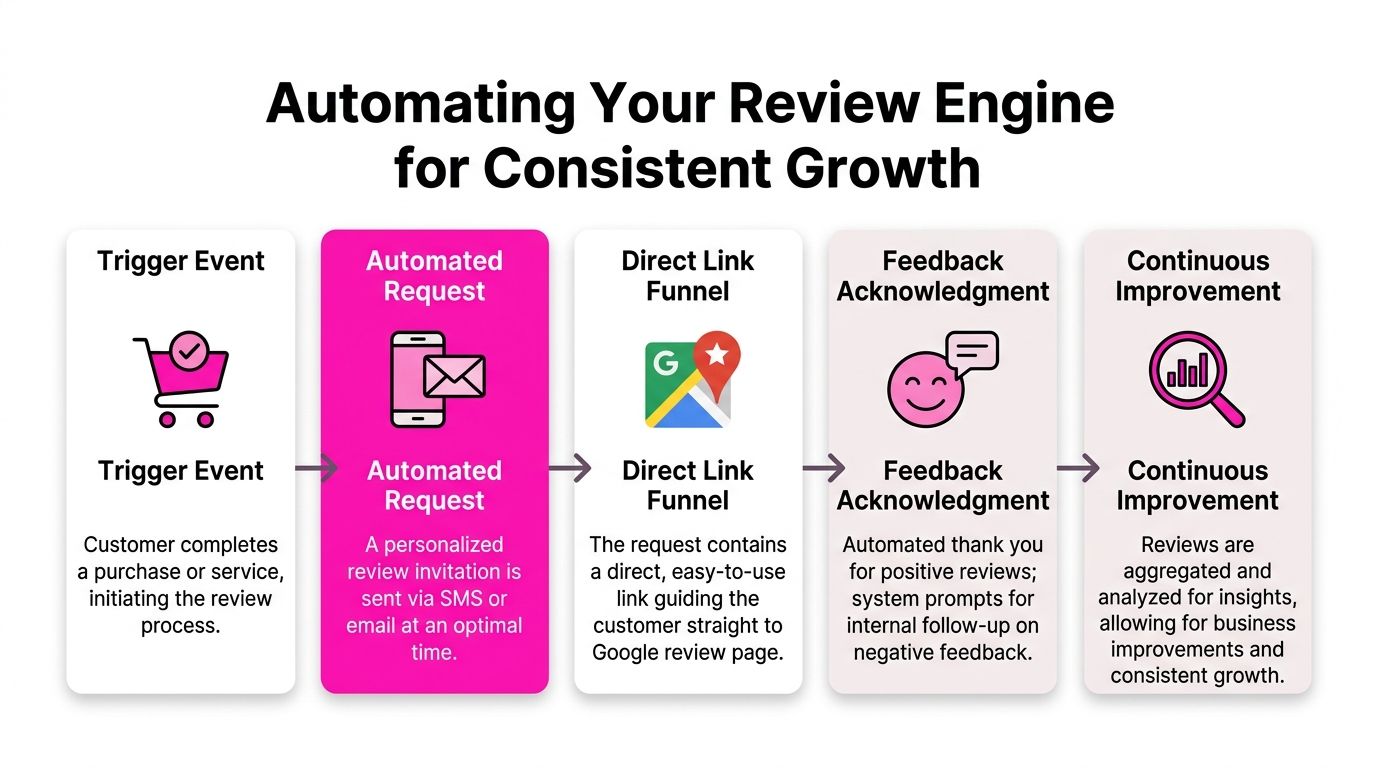
The practical review engine
A strong system looks like this:
- A customer completes a visit, purchase or service
- A follow-up sends automatically by SMS or email
- The customer gives quick satisfaction feedback first
- Happy customers get the Google review link
- Unhappy customers go into a private recovery path
- The team monitors results and adjusts timing, wording and routing
This is the setup that stops review generation depending on memory.
Why the survey funnel works better
Blindly sending every customer straight to a public review form is sloppy. Some customers are delighted and ready to post. Others need support first.
A simple satisfaction step lets you separate those paths cleanly. In practice, that means you can thank happy customers and direct them to Google, while privately handling complaints before they turn into public damage.
This is not about suppressing honest criticism. It is about giving customers an immediate route to resolution instead of forcing every frustrated person into a public channel first.
Automation creates consistency across locations
This becomes much more important for multi-location businesses. Hatch reports that 68% of multi-location hospitality chains rank lower on Google Maps because of uneven review volumes, and that centralised tools that automate post-service SMS requests can boost reviews by 35% while helping businesses maintain the review recency velocity Google now prioritises (Hatch).
That finding matches what operators see on the ground. One branch manager may be brilliant. Another may never ask. Without central rules, timings and templates, review flow becomes random.
Build the workflow once, then standardise it
For a single location, automation is a time-saver. For multiple locations, it is governance.
Use a central process for:
- Triggering sends: After checkout, after invoice payment, after appointment completion, or after job sign-off.
- Channel choice: SMS for immediacy, email for more considered follow-up.
- Message control: Shared templates, with room for local branch details.
- Routing: Positive responses to Google, service issues to the team.
- Oversight: One place to see which locations ask consistently and which do not.
What to automate and what to keep human
Not everything should be automatic.
Automate:
- sending review requests
- routing customers based on survey response
- logging feedback
- alerting the team to issues
- sending a thank-you after a review lands
Keep human:
- fixing service issues
- replying to sensitive complaints
- updating templates when tone feels off
- coaching underperforming branches or staff
This balance matters. Businesses get into trouble when they automate badly and remove judgement entirely.
Good automation removes admin. It should not remove accountability.
A simple operating rhythm for teams
Many businesses ask for a workflow and then overcomplicate it. Keep the rhythm tight.
| Stage | Action | Owner |
|---|---|---|
| After interaction | Trigger review request automatically | System |
| If customer is happy | Send direct Google review link | System |
| If customer is unhappy | Create internal follow-up task | Team |
| Daily | Check unresolved feedback | Manager |
| Weekly | Review message performance by location | Marketing or ops lead |
If you need inspiration for spacing and sequencing automated follow-ups, this email drip campaign template gives a useful framework for thinking about cadence without turning messages into spam.
For businesses that want to centralise this type of review request workflow, response handling and timing logic, an AI Google review autoresponder can help keep brand voice consistent while removing a lot of repetitive admin.
Navigating Incentives and Responding Like a Pro
The fastest way to damage a review strategy is to mix it with bad incentive ideas.
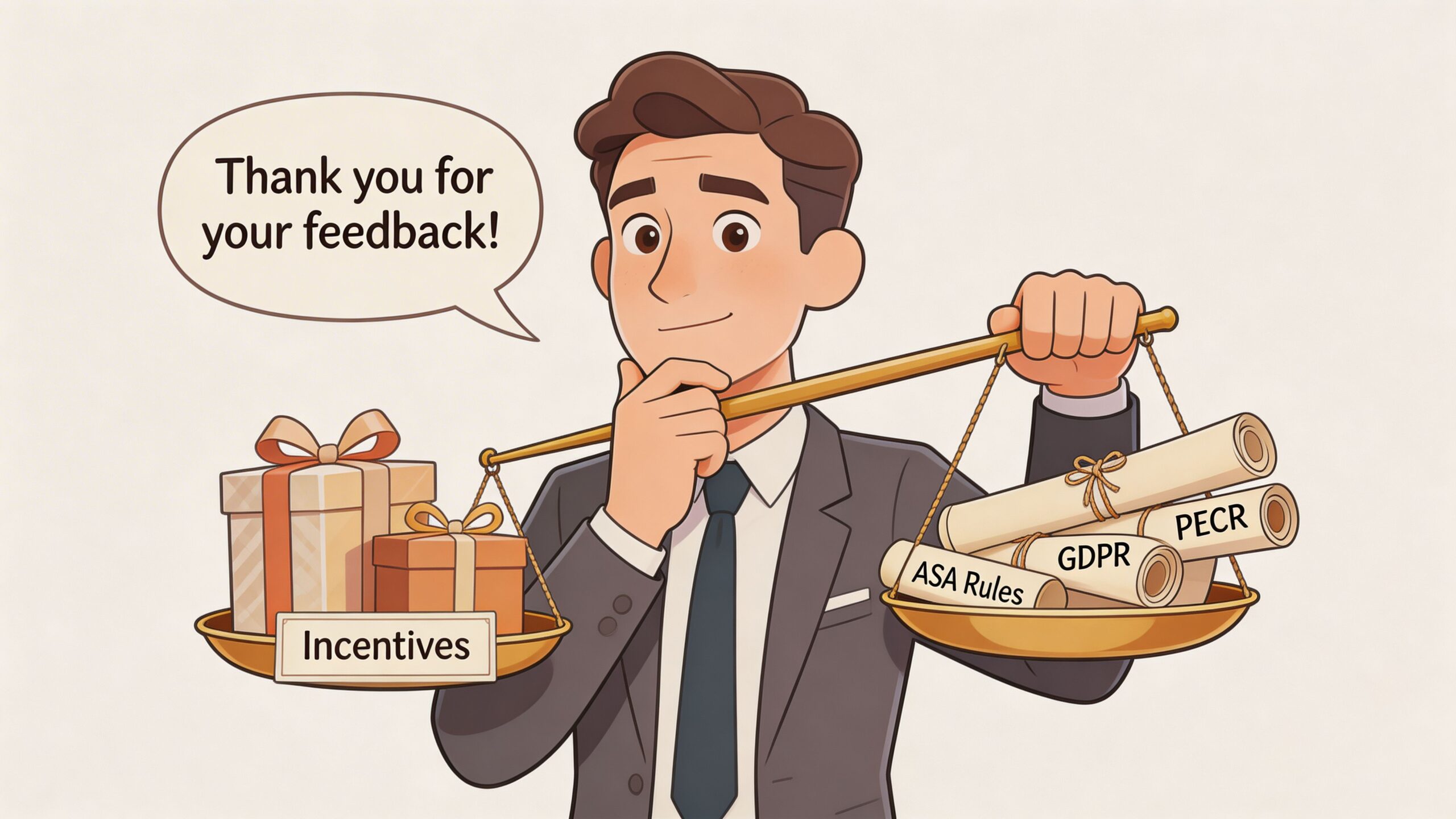
In the UK, this is not just an ethics issue. It is a compliance issue.
Driver Research reports that ICO audits in 2025 flagged 41% of local businesses for unsolicited review emails or SMS, leading to average fines of £12,000, and that compliant, consent-based automated requests increased positive reviews by 52% (Driver Research).
Incentives that create more problems than they solve
A lot of generic advice online still suggests discounts, freebies or prize draws tied to reviews. That is risky territory.
Do not:
- Offer rewards for positive reviews
- Ask specifically for five-star ratings
- Send review requests to people without proper consent
- Pressure customers at the point of complaint
Even where a tactic seems common, that does not make it safe or smart. In UK markets, consent and transparency matter.
What to do instead
The clean approach is straightforward.
- Ask for honest feedback: This is safer and more credible.
- Use consent-based messaging: Make sure your contact process aligns with GDPR and PECR expectations.
- Send review requests after genuine service moments: That gives you better quality feedback without artificial pressure.
- Keep the message neutral: Invite feedback, do not steer it.
Responding to positive reviews
Most businesses either ignore good reviews or reply with the same one-line thank-you every time. Both are weak.
A good positive reply should:
- thank the customer by name if visible
- mention the service, product or visit
- sound specific to the branch or interaction
- stay concise
Template
Hi [Name], thank you for taking the time to leave a review. We’re glad you had a great experience with [service, team or branch]. We appreciate your support and hope to welcome you again soon.
Responding to negative reviews
Negative reviews are not just complaints. They are public proof of how the business handles pressure.
A poor response gets defensive, argues facts, or blames the customer. A strong response acknowledges the experience, offers an offline route, and shows future customers that someone competent is paying attention.
Template
Hi [Name], thank you for your feedback. We’re sorry your experience did not meet expectations. We take this seriously and would like the chance to look into it properly. Please contact us at [contact method] with your details so we can help.
That format does three things well. It stays calm. It protects privacy. It creates a path to resolution.
Future customers read your replies as closely as they read the reviews themselves.
If your team tends to leave responses too late, this guide on why you should respond to Google reviews quickly is useful because speed shapes how fair and attentive the business appears.
Measuring Success and Tracking Review Velocity
A review strategy is not working just because the star rating looks healthy. You need to track the pace and freshness of reviews as well.
Widewail notes that businesses should aim for a minimum of 20 reviews per month to maintain competitive visibility, and that 68% of consumers form an opinion after reading just one to six reviews. It also points to the value of tracking rolling 30 and 90-day freshness metrics because review velocity directly correlates with sustained local search ranking improvements (Widewail).
Metrics that matter
Do not stop at total review count.
Focus on:
- Review velocity: How many new reviews you are generating consistently
- Review recency: How recent the latest reviews are
- Review volume: The overall count, especially at location level
- Response rate and speed: Whether reviews are being acknowledged properly
A listing with strong historic reviews but weak recent activity looks less convincing than a listing with a steady flow of fresh, credible feedback.
What healthy tracking looks like
For a single location, you can review performance weekly.
For multiple locations, you need a dashboard that shows:
- which branches are collecting reviews steadily
- which locations have gone quiet
- whether certain channels perform better than others
- where response delays are building up
Spreadsheets fall apart once more than one person owns the process. Reporting needs to be visible and easy to act on.
Connect reviews to business outcomes
Review growth matters because it affects actual visibility and customer action.
Watch for movement in:
- map visibility for target searches
- calls from your profile
- website clicks from your listing
- direction requests
- branch-level performance gaps
If one location improves review velocity and starts pulling more profile engagement, that is not a coincidence worth ignoring. It is an operational signal.
For teams that want a clearer picture of profile engagement trends, Google Business Profile Insights can help you connect review activity with actions like calls, clicks and direction requests.
Start Building Your Review System Today
The businesses that collect reviews consistently do not rely on luck, charm or occasional reminders. They build a system.
That system starts with the right moment, uses a clean ask, routes feedback properly, avoids risky incentive tactics, and measures review flow over time. Done well, it feels easy for the customer and manageable for the business.
If you have been wondering how to get more google reviews without annoying customers or creating compliance risk, the answer is to make the process ethical, simple and repeatable. That is what produces steady growth.
Ready to stop chasing reviews and start building an automated engine for customer feedback? See how LocalHQ helps you centralise review requests, responses and reporting in one simple dashboard with its Review Manager.