Franchisee SEO Support: Training, Resources & Systems
Most franchise teams do not struggle because they lack effort. They struggle because head office, regional support, agencies, and franchisees all touch local SEO in different ways, with no shared operating model.
One location updates opening hours. Another ignores review replies. A third rewrites page copy in a way that weakens the brand. The result is familiar: uneven visibility, duplicate work, internal tension, and a lot of chasing.
Franchisee SEO support fixes that when it is treated as a system, not a set of ad hoc tasks. The strongest networks do not leave local visibility to chance. They define who owns what, train people properly, give franchisees usable resources, and measure performance at location level without losing central control.
That balance matters. Too much centralisation and local teams disengage. Too much freedom and the brand fragments. For most UK franchise networks, the right answer is not ideology. It is disciplined governance, practical enablement, and local execution within clear guardrails. If you are building or repairing that model, a good starting point is this guide to franchise SEO strategies.
Laying the Foundation for Franchise SEO Success
A franchise network cannot scale local search with goodwill alone. It needs rules, tools, and routines that work when the estate grows.
The core tension is simple. The franchisor wants consistency. The franchisee wants relevance in their market. Both are right. Problems start when nobody defines the boundary between the two.
A formal support model is essential once you have multiple locations competing in nearby markets, shared brand assets, and central reporting requirements. Without that structure, local SEO becomes reactive. Teams fix listings after complaints. They update pages when rankings dip. They answer reviews when someone remembers.
That approach does not hold together across a large estate.
What a workable support system includes
A durable programme usually has four parts:
- Governance: Written rules for who controls profiles, pages, reviews, local content, and reporting.
- Training: A repeatable onboarding path so new franchisees understand both brand standards and local responsibilities.
- Resources: Templates, approved copy blocks, image libraries, contact lists, and escalation paths.
- Measurement: Reporting that shows each location what actions matter and shows head office where support is needed.
When those parts are missing, local SEO turns into a brand risk. When they are in place, it becomes operational.
Key takeaway: Franchisee SEO support works best when head office owns the framework and franchisees own approved local execution.
The rest of the playbook is practical. It focuses on what teams can standardise, what they should leave local, and where UK franchise networks need tighter control because compliance and platform changes add extra complexity.
Defining Your Franchise SEO Governance Model
Governance is the part most brands skip. They jump straight to listings, content, and reviews. That is usually why support breaks later.
Before a new location touches a Google Business Profile, publishes a local page, or responds to reviews, you need a documented operating model. Not a broad principle. A real one with named owners.
Choosing the right model
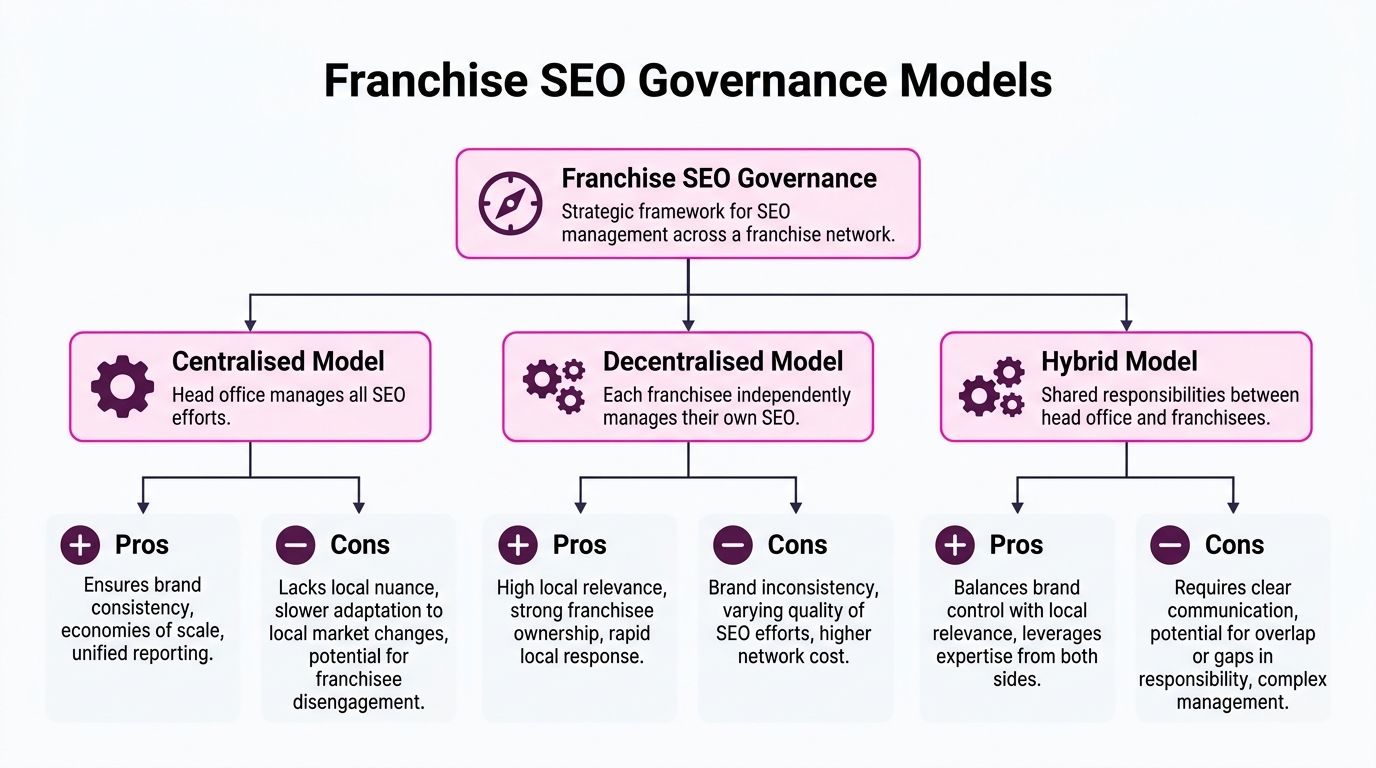
Most franchise SEO structures fall into three camps.
Centralised
Head office controls local SEO execution across the full network. That usually includes profile updates, content publishing, review policies, reporting, and agency management.
This works well when brand compliance is strict, locations are still maturing, or internal marketing capability sits centrally. It also reduces variation in execution quality.
The weakness is speed and local nuance. Local teams often know about temporary hours, community events, staff updates, and local service demand before anyone at head office does.
Delegated
The franchisee manages local SEO with light brand supervision.
This gives locations more ownership. It can also make local content and community engagement feel more genuine. But it comes with obvious risks: inconsistent NAP formatting, mixed review tone, poor quality updates, and duplicated effort across the network.
Hybrid
Most established UK franchise systems do best here. Head office controls the framework, systems, permissions, and standards. Franchisees contribute local inputs within approved boundaries.
That usually means central control of brand fields, platform access, taxonomy, templates, and escalation rules. Local teams then handle approved updates such as photos, local offers, event notes, operating changes, and first-draft review responses if trained.
A practical comparison
| Aspect | Centralised Model (Franchisor-Led) | Delegated Model (Franchisee-Led) |
|---|---|---|
| Brand consistency | Strong | Variable |
| Speed of local updates | Slower unless workflows are mature | Faster |
| Local market nuance | Limited | Stronger |
| Compliance control | Easier to enforce | Harder to monitor |
| Reporting quality | More unified | Often fragmented |
| Franchisee buy-in | Can weaken if too restrictive | Usually higher |
| Risk of uneven execution | Lower | Higher |
For many operators, the hybrid model is the only one that scales without constant friction.
Add compliance at the governance stage
UK franchise networks have a local SEO issue that many generic guides ignore. UK-specific data protection laws and the Online Safety Act 2025 create real operational hurdles for multi-location SEO, and 68% of UK multi-location businesses report compliance gaps as a significant barrier to digital growth, according to the UK-focused franchise SEO analysis.
That matters in routine workflows, not just policy documents.
Review handling may involve customer data. Shared dashboards may expose more information than a franchisee should access. Local teams may copy customer details into notes, spreadsheets, or messaging tools. All of that needs rules.
The minimum governance checklist
Use this when onboarding any new franchisee:
- Define profile ownership: Decide who owns Google Business Profile access, who can edit fields, and who approves major changes.
- Lock brand-critical elements: Business naming conventions, categories, service labels, and official contact details should not be edited casually.
- Set review permissions: Clarify who can reply, who approves sensitive responses, and how complaints are escalated.
- Document data handling: Customer information from reviews, forms, calls, and messages should be handled under a written process.
- Assign reporting roles: Head office should see network trends. Franchisees should see local actions and outcomes.
- Create a support route: Franchisees need one place to ask for help, request changes, or flag issues.
Tip: Write governance so a new location can follow it on day one without needing verbal context from three different people.
If you want an outside perspective on how multi-location programmes are structured, teams often find it useful to compare their setup against guidance from multi-site SEO experts who work on similar coordination challenges across distributed brands.
A governance model only works if it is operational. That means log-ins, approval paths, naming standards, and support responsibilities are all visible. For agencies supporting franchise networks, a structured white-label local SEO workflow can make those responsibilities clearer for both head office and each location.
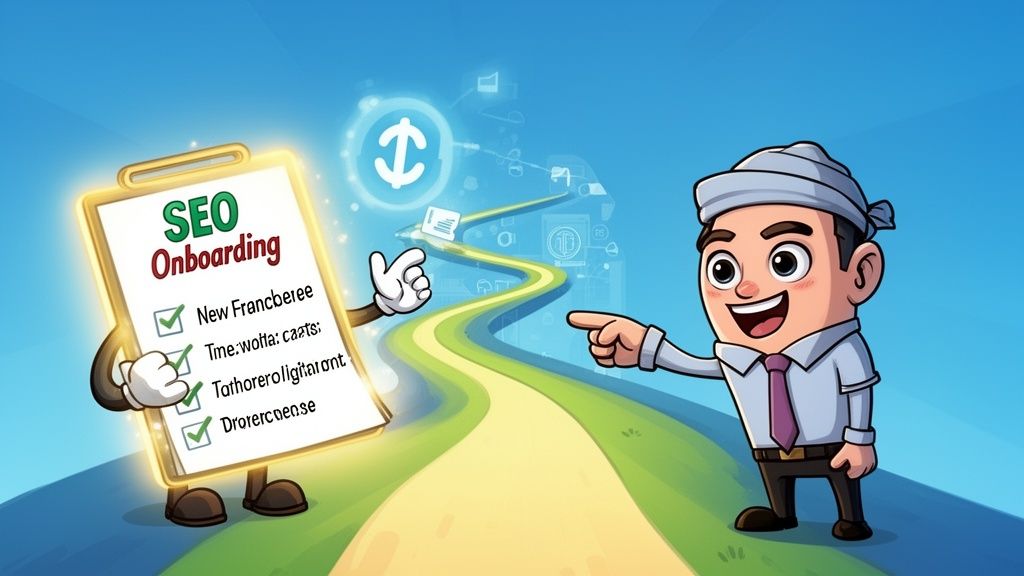
The Essential Franchisee SEO Onboarding Checklist
New franchisees rarely fail because they refuse to follow the system. More often, nobody gave them a system worth following.
Good onboarding removes guesswork early. It tells the franchisee what they control, what they must never edit, where assets live, and who to contact when something breaks.
Week one tasks that should never be skipped
The first mistake many brands make is treating onboarding as a password handover. It should be a controlled launch process.
Use a checklist that covers access, training, and approved assets.
- Grant platform access: Give the franchisee the right level of access to Google Business Profile, analytics, call tracking if used, and internal systems. Avoid shared credentials.
- Confirm the canonical NAP format: Decide the exact business name, address formatting, primary phone number, and URL structure before any listings work begins.
- Issue the brand pack: Include approved logos, service descriptions, business categories, image guidance, and tone of voice examples.
- Share local content rules: Make it clear what they can write locally, what must be submitted for approval, and what is prohibited.
- Provide a support map: Name the people or teams responsible for listings, website changes, reviews, and technical issues.
Train for behaviour, not just knowledge
A useful training programme teaches action.
Franchisees do not need a lecture on every ranking factor. They need to know how to submit a holiday hours update correctly, how to spot a duplicate profile, how to ask for a location page amendment, and how to respond to a review without creating a compliance issue.
That training normally works better in short modules than long manuals.
Core modules to include
- Google Business Profile basics: Ownership, editing boundaries, categories, hours, services, posts, and photos.
- NAP discipline: Why consistency matters and how errors creep in across directories.
- Review response standards: Tone, escalation, complaint handling, and privacy risks.
- Local page requests: How to submit local offers, event details, and market-specific content ideas.
- Reporting basics: What each KPI means and what actions the franchisee should take.
Give franchisees a usable resource library
A support system becomes much easier to follow when the resource library is organised.
A strong library includes:
- approved response templates
- location page copy prompts
- image specifications
- opening hours update forms
- local promotion request forms
- FAQ guidance
- escalation contacts
Many teams benefit from a documented local SEO checklist that franchisees can use without waiting for head office.
Practical tip: If a process depends on memory, it will fail under pressure. Turn repeated requests into forms, templates, and approval paths.
The onboarding hand-off that matters most
Before the onboarding period ends, check whether the franchisee can complete routine tasks correctly.
Ask them to do three things:
- submit a mock profile update
- draft a review response using the brand standard
- request a local content change through the approved workflow
If they can do that cleanly, the support system is working. If not, the problem is usually the process, not the person.
Optimising Google Business Profile and NAP Consistency
For most franchise locations, the Google Business Profile is the first real test of whether your support model works.
One well-run profile can generate calls, direction requests, and high-intent visits. A messy profile does the opposite. It confuses customers, weakens trust, and leaves rankings exposed.
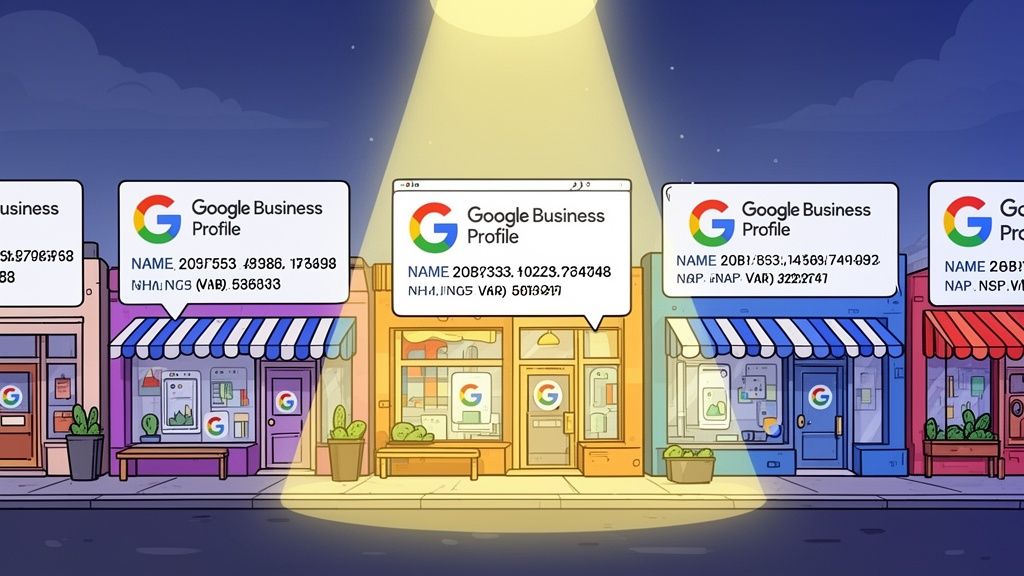
In UK franchise search, the operational basics still carry a lot of weight. Complete and verified Google Business Profiles appear in the local pack up to 3x more frequently than incomplete ones, and 87% of top-ranking franchise locations maintain verified profiles with consistent NAP data, leading to 25-40% higher click-through rates from Google Maps, according to Authority Specialist’s franchise SEO statistics.
Those numbers are useful because they reflect something practitioners see every week. The locations that perform best tend to be the locations with the least ambiguity in their local data.
What profile completeness means
Completeness is not just filling every visible field once.
For a franchise location, it usually means:
- the profile is verified
- the business name follows the approved naming convention
- primary and secondary categories are correct
- opening hours are current
- service descriptions reflect the local offering
- photos are recent and on-brand
- products, menus, or service items are populated where relevant
- Q&A is monitored
- posts or updates are maintained through an agreed workflow
The category structure deserves extra attention. If each franchisee improvises categories, the network starts sending mixed relevance signals. The same is true of service labels and business descriptions.
NAP consistency is not a minor tidy-up task
In practice, NAP consistency is one of the first places a network drifts off course.
A small variation can come from anywhere. A franchisee edits the street format in one directory. An agency adds a tracking number in another. A legacy listing keeps the old phone number live. Someone publishes a local landing page with an outdated postcode.
Individually, these look harmless. Across dozens of locations, they become a trust problem.
The operating rule
Keep one master record for every location and treat it as the source of truth. Do not let each department maintain its own version.
A useful master record typically includes:
| Field | Example of control needed |
|---|---|
| Business name | Approved naming convention only |
| Address | Exact formatting used everywhere |
| Phone | Primary customer-facing number |
| URL | Correct location page |
| Hours | Standard plus temporary changes |
| Categories | Centrally approved list |
| Attributes | Defined by brand and service type |
Managing profiles across a large estate
Once you move past a handful of locations, manual management becomes fragile.
A practical way to run this at scale is to separate updates into three buckets.
Centrally controlled changes
These include brand name, core categories, location URLs, official service taxonomy, and structural profile fields.
Locally submitted changes
These include temporary opening hours, fresh interior or team photos, local events, and approved service highlights.
Escalated changes
These include rebrands, relocations, closures, duplicate listings, suspensions, and review disputes that may involve legal or compliance issues.
That split stops local teams from editing the wrong fields while still letting them contribute useful local detail.
Key takeaway: The best franchise profiles feel locally alive without becoming locally improvised.
Reviews and posts across many locations
At 50 or more locations, the workload gets uneven fast. One site may receive steady review volume and need daily attention. Another may need only weekly checks. Some managers write helpful updates. Others publish nothing unless pushed.
Templates are what make this manageable.
A good template does not create robotic profiles. It creates consistency in structure. For example, a weekly post framework can include a headline pattern, approved offer language, local proof point, and image requirement. Review templates can define greeting style, apology language, escalation wording, and sign-off rules.
That leaves room for local detail, but not for brand drift.
If your team needs a stronger process for listings, categories, and profile workflows, a dedicated approach to Google Business Profile optimisation usually delivers more stability than relying on ad hoc edits across email chains and spreadsheets.
Scaling Localised Content and Review Management
Local content is where many franchise systems become either too generic or too chaotic.
Head office often pushes safe, reusable copy. Franchisees then complain that it sounds like every other location. When local teams take over entirely, pages and responses drift off-brand, quality varies, and compliance problems creep in.
The fix is not choosing one side. It is building a content system that separates what must be standardised from what should be local.
Build local pages with controlled variation
A scalable location page framework usually has three layers.
Layer one is fixed brand content
This includes core service descriptions, brand positioning, regulated claims, legal wording, and any copy that must stay identical.
Layer two is location-specific proof
Here, local relevance thrives. Include neighbourhood references, location-specific service detail, local team information, nearby landmarks where appropriate, and genuine operational differences.
Layer three is fresh operational content
This covers event updates, seasonal changes, community activity, local offers, FAQs, and image refreshes.
That structure helps every page feel connected to the parent brand without reading like a clone.
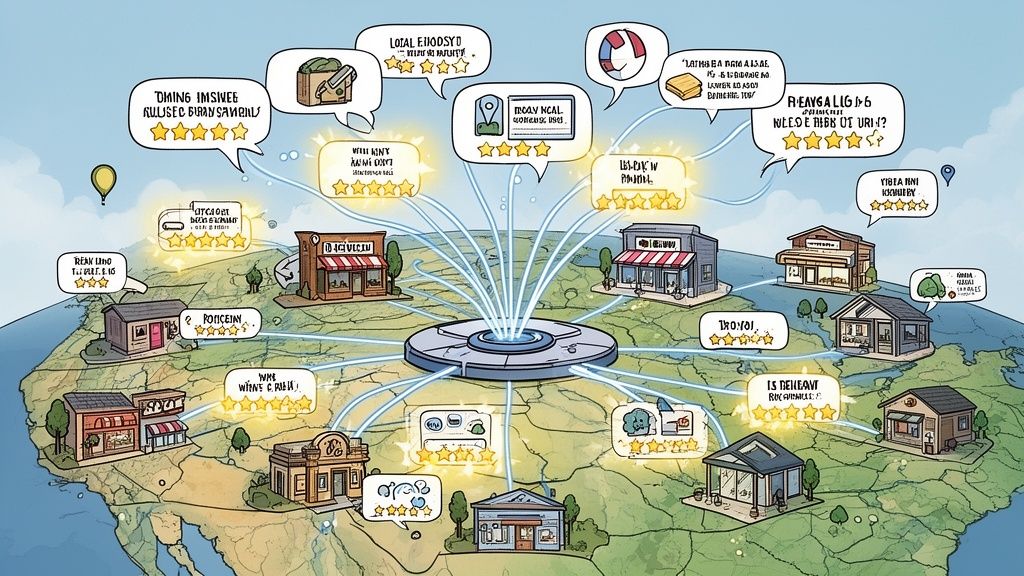
Reviews are not just a reputation task
Review management has direct local SEO value, but the process often breaks because nobody defines the response model.
One location replies warmly and quickly. Another ignores feedback. A third copies and pastes identical replies that sound automated in the worst way.
The stronger approach is to create response bands.
- Positive reviews: Thank the customer, reference the service or visit naturally, and reinforce the brand voice.
- Mixed reviews: Acknowledge the issue, invite offline follow-up where needed, and avoid defensiveness.
- Negative reviews with operational complaints: Escalate when refund, safety, or staff conduct is involved.
- Sensitive cases: Route them away from local improvisation immediately.
This is especially important in a franchise environment because one careless reply can create both brand and compliance problems.
Practical tip: Templates should guide tone and escalation. They should not force every location to sound identical.
The KPI view franchisees need
Most local teams do not need a dense marketing dashboard. They need to know which actions are tied to local visibility and customer intent.
The most useful local SEO KPIs tend to be:
- review volume and response coverage
- profile engagement trends
- website clicks from local search
- calls and direction requests
- local landing page performance
- keyword visibility by area, not just one ranking position
Spreadsheets often fail here, flattening local visibility into a single number and hiding the difference between ranking strongly around the store and disappearing a few streets away.
Why geo-grids change the conversation
A geo-grid shows where a location is visible across its actual trading area. That matters more than a generic average rank because customers search from different parts of town.
For franchise teams, this changes reporting in two ways.
First, head office can spot patterns across regions. Second, franchisees can see practical gaps. For example, a location may be strong near the branch but weak in a nearby estate where a competitor has stronger category relevance or review presence.
That gives local content and review work a clearer purpose. You are no longer telling a franchisee to “post more” or “get more reviews” in the abstract. You are showing where visibility is thin and which local signals may help.
A structured response workflow also makes automation safer. If your team wants to reduce response time without losing control, an approach built around a Google review autoresponder can help standardise tone while still leaving room for human oversight on sensitive cases.
Tracking Success with Geo-Grids and Reporting KPIs
Franchisee SEO reporting often fails for one reason. It reports what is easy to collect instead of what people need to act on.
Head office gets broad traffic trends. Franchisees get vague ranking snapshots. Nobody gets a clean picture of what is happening in the actual service area around each location.
That is a problem after platform shifts and local algorithm changes. Following recent Google updates, 45% of UK franchises with non-optimised multi-locations saw a visibility drop. At the same time, 73% of UK SMB franchises struggle with tracking geo-specific rankings, and only 15% use AI-powered geo-grids, according to HigherVisibility’s franchise SEO guidance.
What to measure at network level
Head office should focus on KPIs that reveal where support, intervention, or replication is needed.
A strong network report usually includes:
- visibility by location and region
- profile engagement trends
- calls, direction requests, and website clicks
- review response coverage
- top and weak-performing locations, and changes after major operational updates.
This helps leadership decide where training is needed, where a profile needs repair, or where a high-performing location’s process should be copied elsewhere.
What to measure at franchisee level
Franchisees need a smaller, action-oriented view.
They should be able to answer:
- Are we visible across our target area?
- Are customers clicking, calling, and requesting directions?
- Are reviews being answered on time?
- Which local pages or profile elements need updating?
- Where is a nearby competitor outperforming us?
That is why geo-grids are more useful than a single ranking line in a report. A geo-grid turns local search visibility into a map of opportunity.
Reporting cadence matters as much as the metrics
Monthly reporting is usually enough for network oversight. Local action checks may need to happen more frequently where review volume is high or where profile changes are common.
A good reporting rhythm often looks like this:
| Audience | Focus | Cadence |
|---|---|---|
| Head office | Network patterns, exceptions, support priorities | Monthly |
| Regional support | Location comparisons, operational gaps | Monthly or fortnightly |
| Franchisee | Local actions, review handling, profile updates, visibility changes | Fortnightly or monthly |
Key takeaway: Governance sets the rules, execution creates the signal, and reporting tells you where the system is holding or failing.
When reporting is built this way, franchisee SEO support stops being a vague promise from head office. It becomes a managed operating system.
Building a System for Continuous SEO Success
A franchise network does not win local search because it completed a launch checklist once. It wins because support continues after launch.
That means governance stays current, training is refreshed, resources are updated, and reporting leads to action. When those pieces stay connected, franchisees feel supported rather than policed. Head office gains consistency without smothering local initiative.
The practical model is straightforward:
- keep central control over brand-critical and compliance-sensitive elements
- give franchisees approved ways to contribute local relevance
- review workflows when platform rules or business operations change
- retrain on the tasks that repeatedly cause errors
- use reporting to coach, not just to audit
For training design, many teams find it useful to review examples of training program templates before building a repeatable support curriculum for new and existing franchisees.
The best franchisee SEO support systems feel boring in the right way. People know the process. The assets are easy to find. Ownership is clear. Exceptions are handled fast. That is what scale looks like.
Frequently Asked Questions about Franchisee SEO Support
Who should own local SEO in a franchise
Usually, head office should own standards, access control, approvals, and reporting. Franchisees should own approved local inputs such as photos, local trading updates, and market context. If one side owns everything, the system usually becomes either too slow or too inconsistent.
How much freedom should a franchisee have
Enough to keep the location locally relevant, but not enough to alter brand-critical fields, regulated claims, or core business data without approval. Good support gives freedom inside boundaries.
What is the biggest mistake in franchisee SEO support
Leaving responsibilities implied instead of documented. Most recurring issues come from unclear ownership, not bad intent.
How do you support franchisees without overwhelming them
Give them a short action set, not a full SEO manual. Focus on the tasks they influence: profile updates, review handling, local content inputs, and issue escalation.
How often should training be refreshed
Refresh when processes change, when platform behaviour changes, or when recurring errors appear across the network. A once-only training session is rarely enough.
What should a franchisee do first if local visibility drops
Check operational accuracy first. Confirm profile details, hours, categories, review handling, and location page accuracy. Then compare visibility across the service area rather than relying on one ranking snapshot.
If you want a simpler way to run franchisee SEO support across multiple locations, LocalHQ helps teams manage profiles, reviews, reporting, and geo-grid visibility from one place. For franchise networks that need a practical starting point, the Review Manager is a strong first move because it helps franchisees respond faster, stay on-brand, and reduce manual workload across every location.
For more detailed information about franchise SEO, read our Franchise SEO Strategy That Actually Scales: From 5 to 500 Locations.