
How Do You Respond to a Google Review: A UK Business Guide

Replying to Google reviews is about more than just being polite. Think of it as a public conversation that puts your brand's personality and commitment to customer service on full display. When you engage with feedback, you transform a simple business listing into a lively forum for building real relationships.
Why Responding to Google Reviews Is a Game Changer
Engaging with reviews on Google isn't just some minor admin task—it's a core part of your business strategy. For any UK business, whether it's a local pub in Peckham or a tech startup in Manchester, every single reply is a public demonstration of your values. It’s your opportunity to double down on a great experience or professionally resolve a negative one, all while potential new customers are looking on.
This kind of active engagement has a direct impact on how much people trust you. When they see you taking the time to thank customers or offer solutions to problems, it builds genuine confidence in your brand. It shows you're a business that listens, cares, and stands by the quality of its service.
Boost Your Local SEO Visibility
Google’s algorithm notices how businesses interact with their customers online. Responding to reviews sends a clear signal that your business is active and values its community, which can give your local search rankings a nice lift. In fact, consistent engagement is a crucial part of what is local search optimisation, helping you show up more often in map searches and the coveted "local pack."
Imagine this common scenario: someone searches for "best fish and chips in Brighton" and finds two shops with nearly identical ratings.
One of the shops has replied to every single review, thanking happy customers and addressing complaints. The other one has a wall of silence. The engaged business immediately comes across as more trustworthy and customer-focused, making it the obvious choice.
Build Trust and Manage Your Reputation
In the UK, how you handle your Google reviews plays a massive role in how local customers find and perceive your business. A 2023 report revealed that 79% of UK businesses see their Google Business Profiles as a valuable tool for connecting with customers, which just goes to show how visible your responses really are.
A thoughtful response doesn’t just solve one person’s problem; it shows every potential customer that you’re committed to getting it right. It’s public proof of your customer service in action.
This isn't just true for one type of business. The same principles apply across the board. For example, looking at guides on mastering Airbnb reviews for hosts shows just how vital review management is in any service-based industry. By actively joining the conversation, you take control of your brand's story and turn customer feedback into one of your most powerful assets.
Crafting the Perfect Response for Any Star Rating
Every Google review is different, so your replies should be too. A bland, copy-and-paste "thanks for your feedback" just doesn't cut it. The real art is in matching your response to the reviewer's sentiment, which turns every comment—good, bad, or indifferent—into a powerful marketing moment.
Think of it this way: a glowing 5-star review is an opportunity to amplify what you do best. Don't just thank them; echo the specific compliments they gave you. This reinforces your strengths for every potential customer who reads it.
For those tricky 3-star reviews, your goal is investigation. These are often your most valuable pieces of feedback because they come from customers who could go either way. Your response should be a genuine invitation to talk more, showing you're eager to turn a so-so experience into a brilliant one.
And when that dreaded 1-star review lands, your mission is de-escalation. Remember, you’re not just talking to one unhappy person; you’re performing for an audience of future customers. A calm, professional, and solution-focused reply shows everyone that you take accountability seriously.
This flowchart maps out the simple, yet crucial, decision you face with every new review.
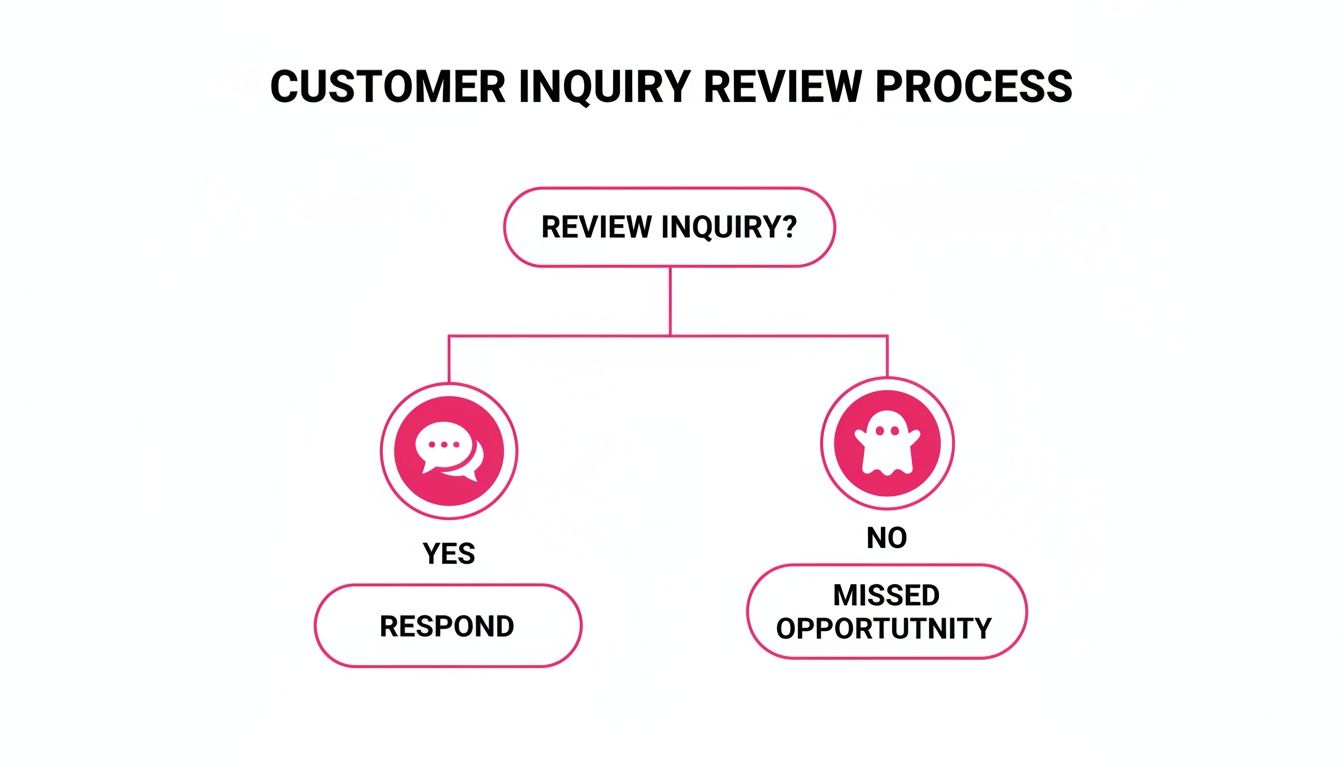
As you can see, choosing not to respond is a massive missed opportunity to engage, learn, and steer your public reputation in the right direction.
To make this easier, here’s a quick-reference guide to help you frame your replies based on the star rating.
Review Response Framework at a Glance
| Review Type | Primary Goal | Key Elements | Example Phrase |
|---|---|---|---|
| 5-Star (Positive) | Amplify & Reinforce | Thank, personalise, mention specifics, invite back. | "We're so glad you loved the [specific dish/service]!" |
| 3-Star (Neutral) | Investigate & Improve | Thank, acknowledge mixed feelings, ask for details offline. | "We'd love to learn more about how we could have made it a 5-star experience." |
| 1-Star (Negative) | De-escalate & Recover | Apologise, show empathy, offer a solution, take it offline. | "We're very sorry to hear this. Please contact us at [email] so we can fix it." |
This framework helps ensure every response is strategic, whether you're celebrating a win or managing a crisis.
Responding to Negative Reviews: The A.P.O.L.O. Method
Negative feedback can sting, but having a clear process helps you respond constructively instead of emotionally. We’ve found the A.P.O.L.O. method is a brilliant framework for handling criticism with grace.
- Acknowledge their frustration. Always start by thanking them for taking the time to share their experience.
- Personalise the reply. Mention specific details from their review so they know a real person is listening.
- Offer a path forward. Propose a concrete solution or a way to make things right.
- Offline. This is key. Move the detailed conversation to a private channel like email or a phone call.
- Learn from what happened. Use the feedback to identify and fix any underlying issues in your operations.
Taking the conversation offline is non-negotiable. It protects the customer's privacy and stops a public back-and-forth. More importantly, it shows you’re serious about solving the problem, not just winning an argument online.
This approach turns a complaint into a constructive dialogue. It shows you respect the customer's experience and are committed to making it right.
The Nuance of Near-Perfect Ratings
Here's something interesting: perfection isn't always the goal. In the UK, the average Google rating is 4.42 stars, with most businesses falling somewhere between 4.0 and 4.7. What often sets a great Birmingham café or Leeds dental clinic apart isn't a flawless record, but how they respond to all feedback.
In fact, research shows that most conversions happen for businesses rated between 4.2 and 4.7. Why? Because customers are often suspicious of a perfect score. They actively look for the occasional hiccup to see how the business handles it.
This is where your replies become invaluable, providing the context that a simple star rating can't. For businesses handling a lot of reviews, exploring how to use AI for local SEO can help you respond at scale without losing that crucial personal touch. A thoughtful, human response to a 4-star review can often be far more persuasive than a dozen 5-star ratings left hanging without a reply.
Response Templates You Can Actually Use
Staring at a blank text box, wondering what to say? Knowing how to respond to a Google review doesn't have to be a head-scratcher. The secret isn't some magic formula, but having a solid, flexible starting point that you can tweak to fit the situation and your brand's voice.
Forget those robotic, copy-and-paste replies. These are practical templates built for the real-life scenarios that UK businesses face every day. The trick is to personalise every single one. Mention a specific detail from their comment—a dish they loved, a staff member who went the extra mile—and you show you’re actually listening. It’s that small touch that turns a generic ‘thank you’ into a real connection.
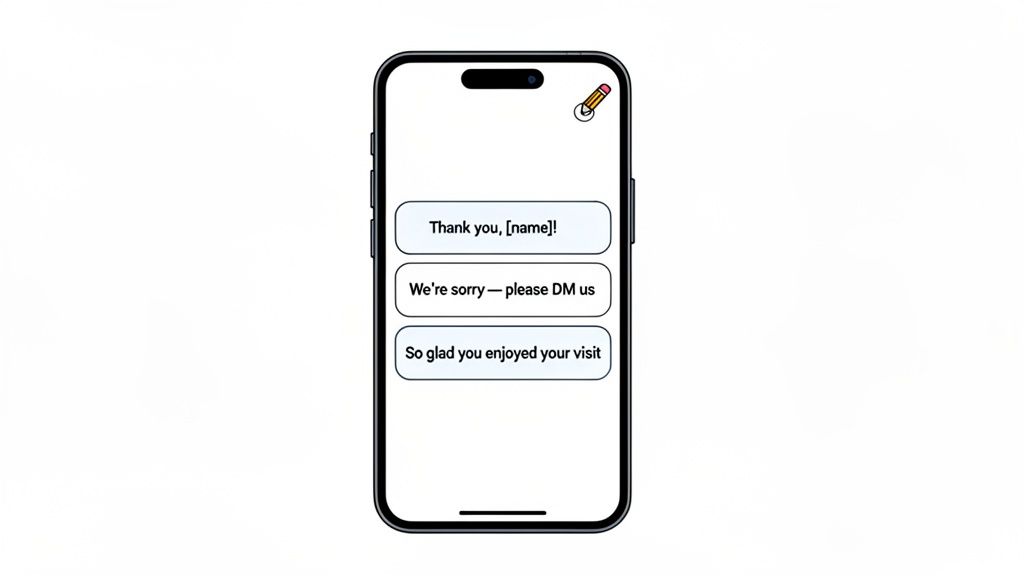
Templates for Positive Reviews
A glowing review is gold dust—treat it that way. Your reply doesn't just thank the reviewer; it amplifies their great experience for everyone else who reads it and makes the original customer feel genuinely appreciated.
1. For General Praise (5 Stars)
- Template: "Thanks so much for the wonderful review, [Reviewer Name]! We're thrilled you had a great experience with us. We work hard to deliver the best, and it's fantastic to know it's paying off. Hope to see you again soon!"
- Why it works: It’s warm, appreciative, and ends with a gentle nudge to come back, encouraging repeat business.
2. Highlighting a Specific Team Member
- Template: "Thank you, [Reviewer Name]! We're so glad to hear that [Team Member's Name] provided such excellent service. I'll be sure to pass along your kind words—it will make their day! We look forward to your next visit."
- Why it works: This is a fantastic way to acknowledge great work publicly. It’s a huge morale booster for the team and shows potential customers that you value your staff.
Templates for Negative or Mixed Reviews
Handling public criticism is a balancing act. You need to mix empathy with professionalism, and the goal is always to acknowledge the problem and immediately show you’re moving towards a solution. This demonstrates accountability to everyone reading.
1. Addressing a Service Complaint
- Template: "Hi [Reviewer Name], thank you for bringing this to our attention. We're very sorry to hear that your experience didn't meet your expectations. This is not the standard we aim for, and we'd like to understand what happened. Please could you contact us directly at [email address or phone number]?"
- Why it works: It gives a sincere apology without getting defensive. Crucially, it provides a clear next step to take the conversation offline and away from public view.
Key Takeaway: Always provide a direct, private channel for follow-up. This prevents a public back-and-forth and shows you're serious about resolving the issue, not just managing perception.
2. Responding to Feedback on Pricing
- Template: "Thanks for your feedback, [Reviewer Name]. We're sorry to hear you were disappointed with our pricing. We always aim to provide great value by using high-quality [ingredients/materials/parts], and we'd be happy to discuss this further with you. Please feel free to reach out to us at [contact details]."
- Why it works: It calmly explains the value behind your pricing without coming across as argumentative, while still offering a direct line to discuss things privately.
Keeping on top of all these responses can be a real time-sink, especially for busy teams. If you’re a multi-location business or just get a lot of feedback, a dedicated review manager can be a game-changer. It can help automate initial replies while making sure every response stays on-brand, freeing you up to personally handle the more complex issues that need a human touch.
Building Your Review Response System
Knowing the right words to say in a review response is half the battle. The other half? Actually doing it, every single time. If your approach is to just reply whenever you remember, you’re guaranteed to miss things. What you really need is a simple, repeatable workflow that ensures every customer gets a timely, on-brand reply.
This isn't about creating more busywork. It's about being smarter with your time. A solid system turns reputation management from a reactive chore into a proactive way to build your business. It makes sure every customer feels heard and, just as importantly, shows potential customers that you're a business that genuinely listens.
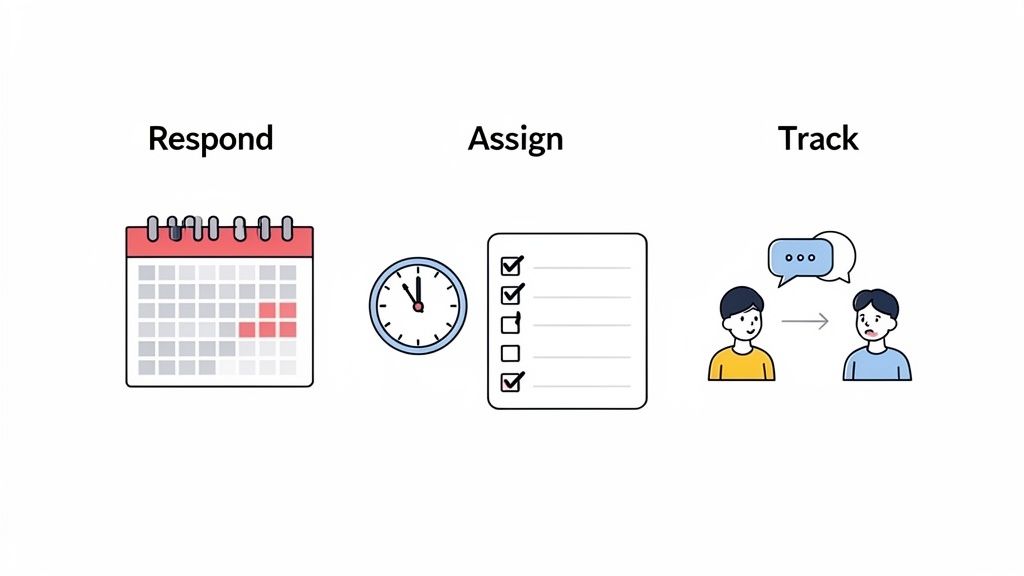
Defining Your Response Timeline
Let's be honest, timing is everything. In the UK, how fast you get back to someone on Google directly shapes their perception of your business. A recent analysis of over 72,000 business locations found that retailers upped their response game from 48% to 59% between 2021 and 2023. The trend is clear: systematic engagement is becoming the norm.
The customer expectation is there, too. A huge 53% of consumers expect a business to reply to a negative review within a week. So, what’s a realistic target for your team?
- The Gold Standard: Aim for 24 hours. For any review, good or bad, replying within a day shows you’re on the ball and value customer feedback.
- The Absolute Maximum: Never go past 72 hours. If 24 hours just isn't happening, make sure you respond within three days. Any longer, and it starts to look like you just don't care.
A prompt reply to a negative review can stop a customer’s frustration from boiling over. It’s your first, best chance to show you’re taking their complaint seriously and de-escalate the situation before it gets worse.
This kind of speed shows you respect the customer’s time and effort, which sends a powerful, positive signal to anyone else reading your reviews.
Assigning Clear Ownership
For any of this to happen consistently, someone has to own it. Who that person is depends entirely on the size and structure of your business.
For a solo operation or small business:
Most of the time, the owner or a senior manager is the best fit. They have the deepest knowledge of the business and the authority to fix any problems raised in a negative review.
For a multi-location business or franchise:
Here, you've got a couple of ways to play it.
- Centralised Model: A head office marketing or customer service team handles every single review. The big win here is a perfectly consistent brand voice, but you might lose that local, on-the-ground insight.
- Decentralised Model: Individual location managers are trained and empowered to respond to their own reviews. This brings genuine local expertise to each reply, but you’ll need rock-solid guidelines to keep the brand voice consistent.
Once you’re managing more than a handful of locations, trying to do this manually becomes a nightmare. This is where dedicated tools for Google Business Profile management become non-negotiable. A good platform pulls all your reviews into one dashboard, letting you assign tasks, track response times, and make sure no location is dropping the ball. It’s how you move from chaos to a scalable, organised system that grows with you.
Navigating Difficult and Fake Reviews
Let's face it, not every review you get will be glowing. Some will be genuinely tough, and others might be completely fake. These are the moments that truly test your reputation management skills. A carefully considered, strategic approach is your best defence.
The absolute first rule? Don't panic. Firing back with an emotional, defensive reply is the fastest way to make a bad situation ten times worse. Before you even think about writing a response, take a breath. Step back and do a little digging internally. Do you have any record of this person? Is there any truth to what they're saying? This initial pause is crucial.
Identifying and Reporting Fake Reviews
Sometimes you just get a feeling a review isn't right. After a while, you start to spot the patterns. Fake reviews often lack specific details ("terrible service" but no mention of who, when, or why), use over-the-top aggressive language, or come from a profile with just one or two reviews – often for you and a direct competitor. These are big red flags.
If you're confident a review breaks Google's policies – maybe it's spam, completely off-topic, or contains hate speech – you should report it right away.
- Find the review on your Google Business Profile.
- Click the three little dots next to it.
- Choose 'Report review' and select the reason that fits best.
A word of warning: Google's review process isn't exactly speedy, and there's no guarantee they'll take it down. While you're waiting for them to make a decision, it’s a good idea to post a calm, professional reply.
Here's a good way to phrase it:
"Thank you for sharing this. We take feedback very seriously, but we can't seem to find any record of a customer or transaction that matches your details. We'd appreciate it if you could contact us directly at [your email address] so we can look into this properly."
This does two things perfectly. It shows everyone else that you're on the ball and professional, while also gently questioning the review's legitimacy.
Handling Legitimate but Sensitive Feedback
Then there are the reviews that are from a real customer but contain sensitive complaints or are just plain wrong about certain facts. How you handle these can make or break your reputation. Resist the urge to start a public argument or nit-pick every little detail they got wrong. Your goal is simple: de-escalate and take the conversation offline.
This is a skill in itself, and for a deeper dive, this guide on how to respond to customer complaints effectively has some brilliant, practical advice.
The core strategy is to publicly acknowledge their frustration and apologise that their experience fell short. Then, immediately give them a direct way to contact you, like a specific manager's email or a dedicated phone number. This public display of accountability shows you care, but it moves the messy details into a private space, protecting both the customer's privacy and your business from a public slanging match.
Got Questions About Responding to Google Reviews? We’ve Got Answers
Even with a solid game plan, you're bound to run into some tricky situations. Let's tackle some of the most common questions that pop up when business owners start getting serious about managing their Google reviews.
How Long Should My Google Review Response Be?
Aim for short, sweet, and to the point. In my experience, the magic number is usually somewhere between two and four sentences.
That gives you just enough room to thank the customer, touch on something specific they mentioned, and add a friendly sign-off. You want to show you've actually read their feedback, not just copy-pasted a generic reply. A quick, "Thanks for the feedback! We’re so glad you enjoyed the Sunday roast. We hope to see you again soon!" feels genuine and is far more powerful than a long-winded paragraph nobody will read.
Should I Weave Keywords into My Responses?
You can, but do it with a light touch. It only works if it sounds completely natural. Sneaking in a mention of a specific service or your location can give your local SEO a little nudge.
Think along these lines:
- "We're delighted you enjoyed the deep tissue massage during your visit."
- "It was a pleasure to welcome you to our Bristol coffee shop."
But please, don't force it. A reply crammed with keywords just looks strange and insincere. It screams "marketing" when you should be aiming for "conversation".
Authenticity trumps algorithms. A genuine, helpful response that builds trust is always more valuable than one awkwardly stuffed with keywords for a minor SEO gain.
What if a Negative Review Is Just Plain Wrong?
This is a tough one, but the key is to stay cool and professional. Your reply isn't just for that one person; it's for every single potential customer who might see it. The goal is to correct the record without starting a public argument.
Politely point out the inaccuracy and then immediately pivot to taking the conversation offline. For example: "Thanks for your feedback. Our records show the booking was for 3 PM, not 2 PM, but we'd be happy to discuss this further with you directly at [email]." This shows you're on top of things and focused on finding a solution, not on winning a debate.
Can I Offer Someone a Freebie to Delete a Bad Review?
Absolutely not. This is a massive no-go and a fast track to getting into trouble with Google. Offering a direct incentive to remove a review violates their policies and can lead to penalties.
Instead, shift your focus from the review to the problem. By all means, offer a refund, a discount, or a complimentary service to make it right. If you resolve their issue and they feel genuinely satisfied, they might decide to update or remove their review on their own. That's their call. Your job is to solve the problem, not to manipulate your rating.
Keeping up with your online reputation is a full-time job, but it doesn’t have to be a manual one. LocalHQ uses AI to help you draft on-brand, personalised replies to every single review, making sure you never miss a chance to connect with a customer. Discover how LocalHQ can streamline your review management today.


