A UK Playbook for Local SEO for Multiple Locations

If your UK business operates from multiple locations, a generic, one-size-fits-all digital strategy is a recipe for being ignored. To win at scale, you need to master local SEO for multiple locations. This isn't about just listing your addresses; it's about transforming each site into a local hub that pulls in nearby customers, converting online searches into real-world footfall.
Why Multi-Location SEO is Non-Negotiable for UK Businesses
For any UK franchise, retail chain, or service-based business, a single corporate website simply doesn't cut it anymore. Your customers aren't just looking for your brand; they're looking for a solution right around the corner. This is where a sharp, multi-location SEO strategy moves you from being just another national brand to being the go-to local expert in every town you operate in.
The real prize here is Google's Local Pack—that map and trio of business listings that dominate the top of local search results. Think of it less as a feature and more as the main event for winning local business.
The Decisive Power of the Google Local Pack
Here in the UK, where Google's dominance is absolute, appearing in that Local Pack is everything. The numbers speak for themselves: a staggering 42% of all clicks on local search results go straight to the listings in the Google Local Pack. It's the most valuable digital real estate for driving phone calls, direction requests, and walk-in customers.
This statistic highlights a massive opportunity for businesses that get it right, but it's also a serious warning. If your individual locations don't have perfectly optimised Google Business Profiles, you're effectively invisible for high-intent searches like 'Italian restaurant near me in Manchester' or 'plumber London open now'. You simply won't show up.
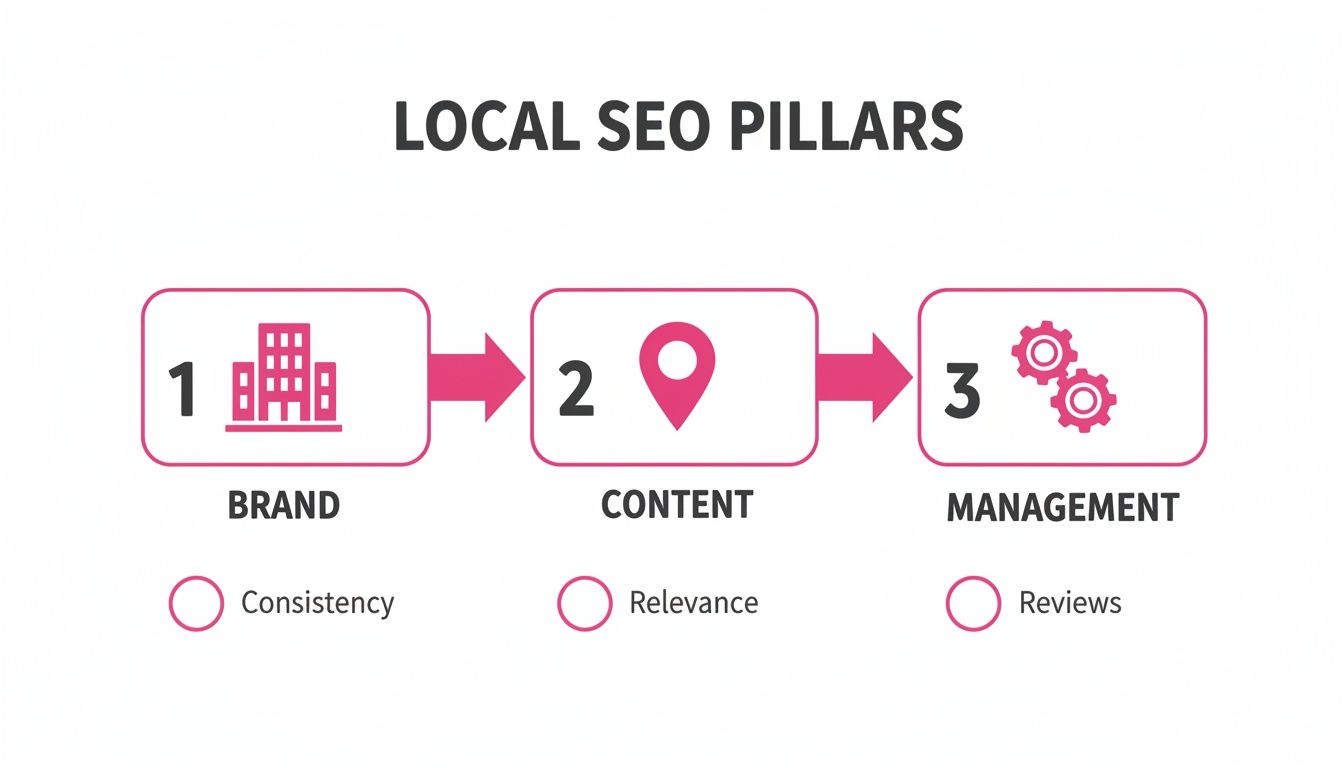
A winning multi-location strategy boils down to three core pillars: unwavering brand consistency, genuinely localised content that speaks to each community, and scalable processes to manage it all without descending into chaos. Get this right, and you're not just visible—you become the most relevant choice for customers in every single neighbourhood you serve.
We’re building a playbook here that’s about more than just climbing the rankings. It’s about making a measurable impact on your company's bottom line, location by location. To get a deeper understanding of what this involves, these essential local marketing strategies for franchises are a great starting point.
Before we dive into the nitty-gritty, let's break down the foundational elements of a robust multi-location strategy.
Core Components of a Multi-Location SEO Strategy
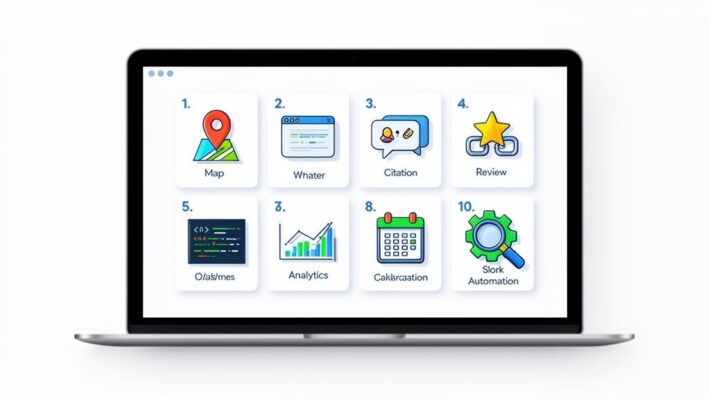
This table summarises the key pillars we'll be building on. Each component is critical for creating a cohesive and effective local presence across all your business sites.
| Component | Why It Matters | Key Action |
|---|---|---|
| GBP & Account Setup | The foundation of local visibility. A well-managed structure prevents ownership conflicts and ensures data accuracy. | Create a single, unified Google Business Profile account with location groups to manage all listings centrally. |
| NAP & Citation Management | Consistency builds trust with both search engines and customers. Inaccurate data erodes authority. | Use a citation management tool to standardise Name, Address, and Phone number (NAP) across all directories. |
| Localised Landing Pages | Generic pages don't rank for local searches. Each location needs its own unique, optimised digital storefront. | Develop unique landing pages for each location with local content, contact details, and relevant keywords. |
| Review & Reputation | Reviews are a massive local ranking factor and influence customer decisions more than almost anything else. | Implement a system to actively request reviews for each location and respond to all feedback promptly. |
| Tracking & Reporting | You can't improve what you don't measure. Granular tracking reveals what's working and where to focus. | Use geo-grid tracking tools to monitor local rankings accurately for each specific service area. |
Understanding these components is the first step. Now, let's get into the practical, step-by-step process for putting them into action.
Building a Scalable Foundation for Your Locations
Look, managing local SEO for a handful of locations is one thing. But when you're dealing with tens, or even hundreds, of storefronts, the game changes completely. If you don't build a solid framework from the very beginning, you're setting yourself up for a world of pain – think brand inconsistencies, ownership chaos, and countless wasted hours.
Let's get that groundwork right. The goal here is to shift from a messy collection of individual profiles into a single, organised command centre. This is how you make managing a large portfolio not just possible, but genuinely efficient.
Unifying Your Empire with a GBP Organisation Account
First things first: get all your locations under a single Google Business Profile Organisation account. This is non-negotiable. This type of account is built specifically for businesses like yours, acting as a master key for your entire property portfolio.
Why is this so critical? It stops well-meaning (but often inconsistent) store managers from creating rogue profiles. I've seen it happen time and time again, and it always leads to ownership disputes and a fractured brand message.
Creating an Organisation account centralises everything. It becomes the single, authoritative home for your brand online. This means that no matter who joins or leaves your team at a local level, you retain full control over your core digital assets.
A GBP Organisation account isn't just a tidy admin feature; it's your primary defence against brand fragmentation. You’re creating a stable ecosystem where you can safely delegate tasks to local teams without ever risking control of the parent account.
With this central hub in place, you can start organising your properties in a way that actually makes sense for how you run your business.
Structuring Your Portfolio with Location Groups
Once all your profiles are under one roof, it’s time to create location groups. Think of them as digital filing cabinets for your businesses. You can group them by region ('Scotland Branches', 'London Sites'), by brand, or any other way that mirrors your operational structure.
This simple act of organisation makes everything easier. Need to update holiday hours for 50 stores? Instead of a mind-numbing, one-by-one task, you can manage them as a cohesive group.
Here’s why this is a game-changer for local SEO at scale:
- Streamlined Updates: Push out new posts, photos, or business info to an entire group of locations in one go.
- Targeted Performance Analysis: Easily compare how one region is performing against another, helping you spot local trends or identify areas that need a bit more love.
- Controlled User Access: Give a regional manager access only to the locations they're responsible for. It empowers them without putting the rest of your portfolio at risk.
The ability to manage locations in bulk is what separates the pros from the amateurs. It bypasses the tedious, error-prone manual setup and ensures all your sites get online consistently right from the start.
Establishing Your Single Source of Truth
Consistency is the currency of local SEO. It’s that simple. Search engines trust and reward businesses that present the same, accurate information everywhere online. To do this across multiple locations, you must create a single source of truth for your core business data.
We’re talking specifically about your Name, Address, and Phone number (NAP). This 'source of truth' is usually a master spreadsheet or a database inside a specialised platform like Outrank. It needs to contain the canonical, perfectly formatted details for every single one of your locations.
This document becomes the definitive reference point for your team and any tools you use, guaranteeing that every citation and listing built is an exact match. Even a tiny discrepancy, like "St." vs. "Street," can dilute your local authority in the eyes of Google.
The UK's SEO market is now valued at a staggering £19.2 billion (2023), and multi-location businesses are reaping the rewards of getting this right. Properly optimised brands are hitting 65.7% 3-Pack visibility, which drives 126% more traffic than their lower-ranking competitors. Those kinds of numbers don't happen by accident; they're built on a foundation of absolute data accuracy. You can dive deeper into these local SEO findings if you're curious.
Crafting Hyper-Local Landing Pages That Convert
Let’s be honest: that generic "locations" page on your website just isn't cutting it. It’s a classic missed opportunity. If you really want to make a dent in local search, you have to stop thinking of your business as one big entity and start treating each site like its own digital shop front. This means rolling up your sleeves and creating a dedicated, hyper-local landing page for every single branch you operate.
These pages are the beating heart of your local SEO efforts. They're where you point your Google Business Profiles and all those local citations. They are precisely what Google is looking for when someone searches for "solicitor in Leeds city centre." Without them, you're just sending high-intent local traffic to a generic page that doesn’t speak to them at all.
The Anatomy of a High-Performing Local Page
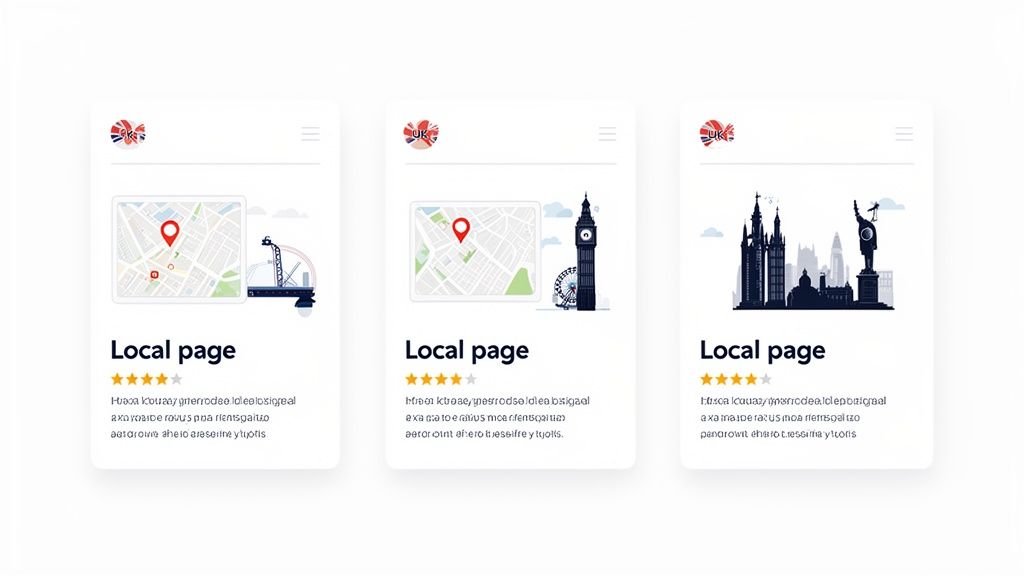
When you're creating these pages at scale, you need a solid, repeatable template grounded in what actually works. Each page has to contain a core set of elements that scream "local relevance" to both search engines and your potential customers. Think of it as your checklist for establishing local authority.
Your entire goal is to build a page that is unmistakably about that one specific location. This is about so much more than just swapping out the town name in the page title. It’s about building a rich, contextually relevant experience that builds immediate trust and pushes people to act.
So, what are the absolute must-haves for every local page?
- Location-Specific Title Tag & Meta Description: These need to be precise. Think "Emergency Plumber in Bristol | Your Brand" and a description that mentions specific areas you serve nearby.
- Consistent NAP Data: Your Name, Address, and Phone Number (NAP) must be front and centre, matching your GBP listing perfectly.
- Embedded Google Map: Pop an interactive, embedded map right on the page. It's great for users and sends a massive geographic signal to Google.
- Unique Local Content: This is where the real work comes in, and it's the most important part. Write about the local area, mention nearby landmarks, talk about your community involvement, or highlight services unique to that branch.
"A great local landing page does more than just list an address. It tells a story about your business in that community. It mentions the local team, showcases reviews from local customers, and proves you're a genuine part of the neighbourhood, not just a pin on a corporate map."
This kind of attention to local detail is what transforms a bland, generic page into a powerful conversion tool.
Bringing Your Local Community to Life
The real magic happens when you get past the technical SEO basics and start weaving content into the page that truly resonates with the local community. This is how you stop being a faceless national brand and become a trusted local neighbour.
For instance, a chain of estate agents could have a section on their Manchester page dedicated to the Northern Quarter's booming property market. A restaurant in Edinburgh could write about sourcing their ingredients from local Scottish suppliers.
This is the kind of content that's impossible to fake and provides enormous value. It tells Google your page is the most relevant result for local searches, and it shows potential customers that you actually understand their world.
Essential Elements for a High-Converting Local Landing Page
To really nail this, you need to ensure every page has the right mix of elements for both search engines and users. This table breaks down the critical components that will help you rank effectively and, crucially, persuade visitors to take that next step.
| Element | Description | SEO Impact |
|---|---|---|
| Local Schema Markup | Code that explicitly tells search engines about your location, including address, hours, and geo-coordinates. | High – It helps Google understand your location's context, increasing your chances of appearing in the Local Pack. |
| Location-Specific Reviews | Displaying genuine reviews from customers who have visited that particular site. | High – Provides social proof and fresh, user-generated content that search engines love. |
| Photos of the Location | High-quality images of the shopfront, the interior, and the team members who work there. | Medium – Builds trust with users and provides visual context. Geo-tagged images can offer an extra SEO benefit. |
| Clear Call-to-Action | Prominent buttons or links for "Call Now," "Get Directions," or "Book an Appointment" for that specific location. | Medium – Improves user experience and conversion rates, which are positive behavioural signals for SEO. |
| Internal Links | Linking from your location page to relevant service pages on your main site, using location-specific anchor text. | Medium – Spreads link equity and helps Google understand the relationship between your local and national content. |
By systematically building out these hyper-local landing pages, you create a powerful network of digital assets. Each page acts as a magnet for relevant local traffic, funnelling it straight towards a conversion. It's truly a cornerstone of any effective local SEO for multiple locations strategy.
Getting Your Local Signals Right: Citations and Reviews
Your digital footprint is much bigger than just your website and Google Business Profiles. If you really want to make a mark in local search, you have to get a handle on two critical signals that Google pays a lot of attention to: citations and customer reviews.
Think of these as digital proof that your business is a legitimate, active, and trusted part of the local community. Consistent citations across the web act like a verification stamp for your business details. At the same time, a healthy stream of positive reviews shows both Google and potential customers that you're relevant and doing good work. Nailing this is non-negotiable for any serious local SEO for multiple locations strategy.
The Golden Rule: Keeping Your NAP Consistent
The absolute foundation of local authority is NAP consistency. This simply means making sure your Name, Address, and Phone number are perfectly identical everywhere they appear online. It sounds straightforward, but tiny inconsistencies—think "St" vs "Street" or "&" vs "and"—can seriously muddy the waters for search engines.
When Google’s crawlers find conflicting information for your Manchester branch, it creates doubt. That confusion can directly damage your local rankings because Google will always prefer businesses whose details it can confirm without any guesswork. For a business with multiple locations, this problem gets bigger with every new site, which is why you need a system.
First things first, you need to run a proper audit. Hunt down every mention of your business online and check it against your official, master record. This is how you find all the little discrepancies that need fixing. To get a deeper understanding of how these online mentions affect your rankings, check out this guide on what local citations are and why they matter so much.
Building a Strong Citation Profile for Every Location
Once you've cleaned up your existing listings, it's time to start building new, high-quality ones for each of your locations. The aim here is to get listed in well-respected UK-based and industry-specific directories.
You need to think beyond the usual suspects. Of course, listings on Yelp and Bing Places are important, but the real magic often happens in the niche directories.
- A chain of solicitors? You need to be on legal directories like The Law Society.
- A group of restaurants? Listings on TripAdvisor or Zomato are a must.
- Tradespeople, like a network of plumbers or electricians? You should be targeting sites like Checkatrade.
These specialised citations send strong relevance signals to Google, confirming that your business is a genuine player in its field and its local area. Using a citation management tool can take this entire process off your hands, ensuring every submission is accurate and saving you from hundreds of hours of mind-numbing manual work.
Trying to manage citations by hand across dozens of locations isn't just slow—it's practically asking for mistakes. A centralised platform ensures every new listing matches your master data perfectly, systematically building your local authority without the risk of human error.
Getting this consistent digital presence sorted is half the battle. The other half is all about what your customers have to say about you.
Turning Customer Feedback into a Ranking Powerhouse
In the world of local search, your reputation really is everything. Customer reviews are a massive ranking factor, directly influencing how visible you are in the Local Pack. Even more importantly, a staggering 93% of consumers say that online reviews shape their buying decisions.
For businesses juggling multiple locations, managing reputation at scale demands a proper workflow. You can't just sit back and hope for good reviews to trickle in. You need an active system to encourage a steady flow of positive feedback for every single branch.
A simple way to do this is with automated emails or texts sent out after a purchase, guiding happy customers straight to your Google Business Profile. The trick is to make it dead simple for them to leave a review while the great experience is still fresh in their mind.
Responding to every review—the good and the bad—is just as crucial. A thoughtful reply shows that you're listening and that you care about your customers. This not only builds trust with people reading the reviews but also sends positive signals back to Google. You can even use tools to automate replies to simple positive reviews, freeing up your team to give personal attention to more complex or negative feedback and protect your brand's reputation around the clock.
Streamlining Operations with Automation and AI
Trying to manually manage dozens, let alone hundreds, of locations is a recipe for disaster. It's not just inefficient; it’s a process riddled with potential for human error. This is where technology becomes your most valuable player in executing a flawless local SEO for multiple locations strategy. Moving away from manual tasks isn't simply about saving time—it's about implementing your strategy with a speed and precision that's impossible to match by hand.
To really get the most out of technology across all your locations, you need a solid grasp of workflow automation. Think of it as the engine that powers scalable local marketing, letting you standardise processes and maintain consistency without watering down local relevance.
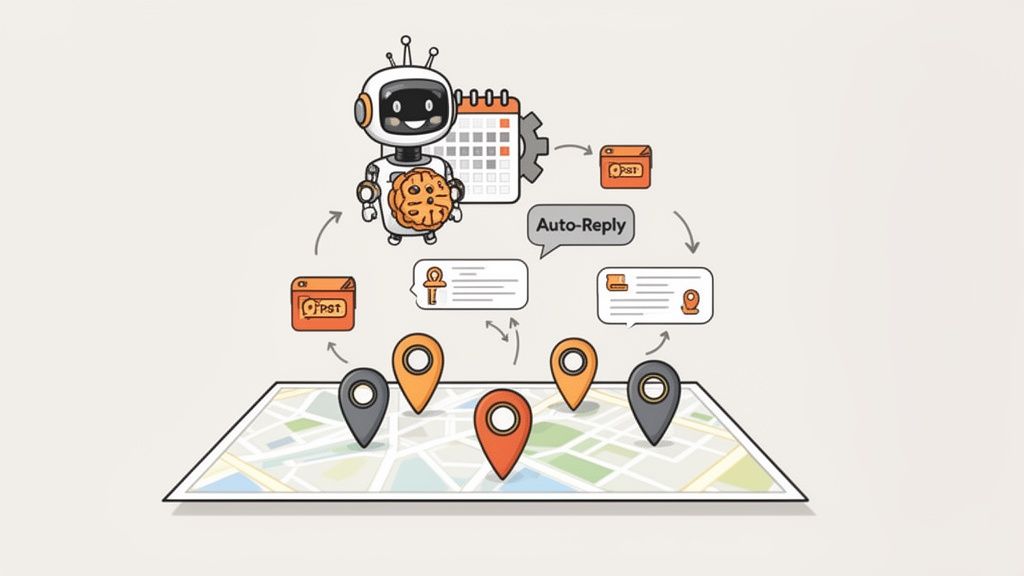
Automating Your Google Business Profile Content
We all know that keeping your Google Business Profiles active with fresh content is a fantastic way to boost engagement and local rankings. But realistically, who has the time to craft and publish unique posts for every single location, every single day? It’s a logistical nightmare.
This is where AI-powered platforms can be a complete game-changer. Instead of that daily grind, you can sit down and schedule an entire month's worth of localised GBP posts in one go. These tools let you build content templates that automatically pull in location-specific details, like the town name, a local special offer, or even a nearby landmark.
With this approach, you can guarantee a steady stream of relevant content for every one of your profiles. They stay active, they stay engaging for local searchers, and your team isn’t completely drained of resources.
AI-Driven Profile Optimisation
Guesswork has no place in a competitive local SEO strategy. AI optimisation tools remove the ambiguity from improving your Google Business Profiles by using hard data to drive your decisions.
These systems get to work by analysing what your competitors are doing in each specific local market. They can pinpoint the exact categories your top-ranking rivals are using, identify the keywords driving the most traffic in that area, and highlight where your own profiles are falling short.
Based on this analysis, the AI serves up concrete, actionable recommendations. For instance, it might suggest adding "emergency plumbing services" as a secondary category for your Bristol branch or tweaking your service descriptions to include terms that are trending in Manchester. This data-backed approach means you’re making smarter, more effective enhancements across your entire portfolio. For a deeper dive, you can learn more about how to use AI for local SEO in our detailed guide.
Automation and AI don’t replace your strategy; they execute it at a scale and speed that humans cannot match. This frees up your team to focus on high-level initiatives like community engagement and business growth, rather than getting bogged down in repetitive tasks.
This shift allows your team to evolve from reactive administrators into proactive strategists.
Intelligent Review Management at Scale
As we’ve already covered, managing reviews is non-negotiable. But responding to feedback across hundreds of locations can get overwhelming, fast. This is where AI-powered review auto-responders offer a seriously powerful solution.
Forget simple, robotic template replies. These tools are far more sophisticated. They can analyse the sentiment of a review and craft a unique, on-brand response that genuinely sounds human. For a five-star review, it can generate an enthusiastic thank you. For more complex feedback, it can provide an empathetic starting point for your team to then follow up on personally.
This ensures timely engagement around the clock, acknowledging every customer and protecting your brand's reputation without chaining someone to a desk 24/7. By automating the routine responses, you make sure every customer feels heard while giving your team the bandwidth to personally handle the most critical feedback.
Proving Your Local SEO Is Working
You know the old saying: if you can't measure it, you can't improve it. This is gospel when you're juggling local SEO for a whole portfolio of locations. To keep the budget flowing and prove your strategy is more than just smoke and mirrors, you need to look past vanity metrics. The real goal is to track the numbers that show genuine growth and a solid return on your investment.
Proper measurement means looking at the big picture—how the business is doing as a whole—but also zooming in on each individual location. This way, you can quickly spot the high-flyers that can teach the rest a thing or two, and you can also pinpoint the stragglers that need a bit of extra help. It’s all about turning a spreadsheet of data into a clear story about how your work is bringing more customers through the door.
The KPIs That Actually Matter
Let’s be honest, obsessing over keyword rankings alone is a fool's errand. For a business with multiple locations, the only metrics that really count are the ones that reflect what a real customer does. We're talking about the numbers that lead directly to phone calls, foot traffic, and sales.
Your reports should be built around these core KPIs from your Google Business Profile Insights:
- Discovery Searches: This shows how many people found you by searching for a category or service ("mechanic near me") instead of your actual business name. It's a fantastic measure of how many brand-new customers you're reaching.
- Direction Requests: A click on the "Directions" button is one of the strongest signals of intent you can get. It's someone who is very, very likely planning to visit you. Tracking this is the closest you can get to linking your online presence to actual footfall.
- Phone Calls: This is another direct line to a potential customer who's ready to ask a question, make a booking, or place an order. It's immediate, high-intent engagement.
- Website Visits: This tracks clicks from your GBP listing through to your local landing page. These are people who want to dig a little deeper before they commit.
When you focus on these action-based metrics, the conversation with stakeholders shifts. It's no longer about "are we ranking #1?" but "how much business are we driving?". That's a language everyone understands.
Seeing Your True Visibility with Geo-Grid Tracking
Standard rank tracking can be wildly inaccurate for local SEO. Your ranking for "emergency plumber" can change completely from one street to the next. That’s why geo-grid rank tracking is so important. It plots your rankings for key search terms on a map, showing you exactly how visible you are across a specific town or city.
Imagine seeing a colour-coded map of Bristol for that "emergency plumber" search. The grid would instantly show you the postcodes where you're the top dog and, more importantly, the areas where your competitors are eating your lunch. This kind of detailed insight is gold. It lets you diagnose problems at a neighbourhood level and fine-tune your strategy, making sure your local SEO for multiple locations is actually working where it counts.
Got Questions? We've Got Answers
When you're wrestling with local SEO across multiple sites, a few common questions always seem to pop up. Let's tackle them head-on, drawing from years of experience in the trenches.
How Can I Possibly Keep NAP Consistent for Hundreds of Locations?
This is the big one, isn't it? The secret is to stop thinking about manual updates and start thinking about a central 'source of truth'. This is usually a meticulously maintained spreadsheet or, even better, a dedicated platform built for this exact purpose.
Your first port of call should always be your Google Business Profiles. Get them perfect. Once that's sorted, use a citation management service to syndicate that flawless data across the web. Honestly, trying to do this by hand is a recipe for disaster; automation is your best friend when you're operating at scale.
Should Every Single Location Have its Own Social Media?
In most cases, absolutely not. It's far more practical and powerful to run a central brand social media account. You can then use location tagging in your posts to connect with local audiences without spreading your resources too thin.
The only real exception is for businesses where hyper-local community engagement is everything—think local estate agents or community-focused franchises. Even then, you'd want location-specific Facebook Pages that are professionally managed and linked back to the main brand page. Don't go down this route unless you have the team to support it properly.
When it comes down to proving value, nothing beats the 'Actions' data from your Google Business Profile Insights. We're talking about direction requests, phone calls, and website clicks. These are the closest you'll get to tracking genuine leads and footfall directly from your SEO work.
What's the Single Most Important Metric to Track?
While it’s tempting to look at rankings, the metrics that really move the needle are the ones that show high-intent customer actions. Forget vanity metrics and zero in on what's happening inside your Google Business Profile dashboard.
Are people clicking for directions? Are they calling your locations directly from the search results? Are they clicking through to your local landing pages? These actions—calls, clicks, and direction requests—tell the real story. They're tangible proof that potential customers are engaging with your business, providing the clearest line to your return on investment.
Ready to stop juggling spreadsheets and start automating your local SEO? LocalHQ provides a single, AI-powered platform to manage profiles, schedule content, and track performance across all your locations. Discover how LocalHQ can streamline your multi-location strategy today.