The Multi-Location SEO Checklist: 47 Points for Enterprise Success
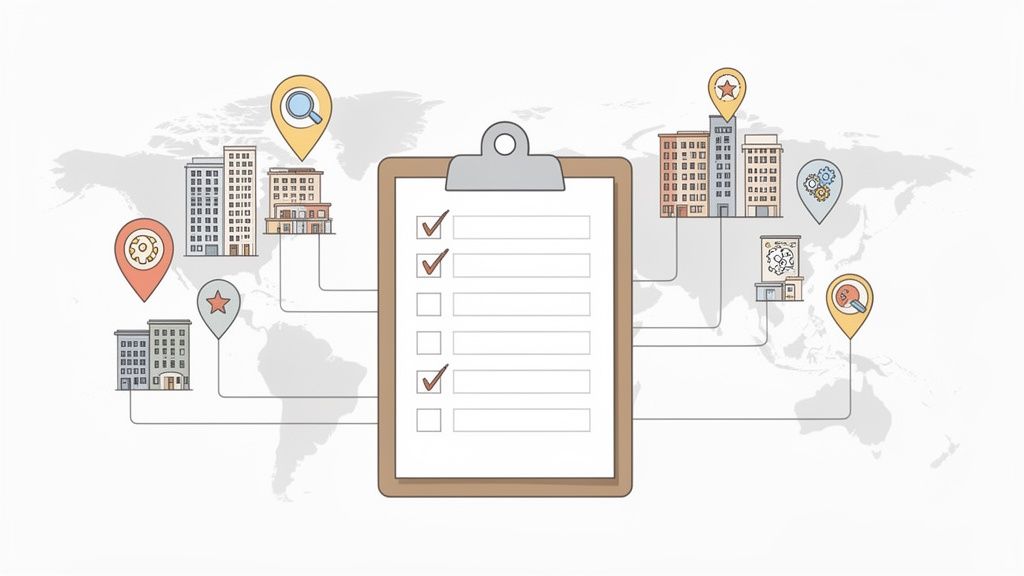
Managing the online presence for a business with ten, a hundred, or even a thousand locations presents a monumental challenge. Minor inconsistencies multiply into major SEO headaches, and missed opportunities in one market become systemic failures across the board. Success in multi-location SEO is not about doing more; it is about doing the right things consistently, at scale.
This comprehensive multi-location SEO checklist is designed for enterprise and franchise businesses, providing a 47-point, actionable blueprint to turn complexity into a competitive advantage. It provides a structured process for scaling your local search efforts effectively. For a comprehensive guide on implementing these strategies across various sites, delve into specifics on how to do local SEO for multiple locations.
We will break down every critical area, from foundational Google Business Profile synchronisation to advanced geo-targeted reporting, giving you a strategic framework to drive visibility, customer engagement, and measurable growth across every single one of your locations. You will gain a clear, repeatable system to manage:
- Foundational Profiles: Google Business Profile optimisation and NAP consistency.
- On-Page SEO: Location-specific pages, content creation, and schema markup.
- Off-Page Authority: Review management workflows and local link building.
- Measurement & Operations: Geo-targeted tracking, reporting, and process management.
This guide moves beyond generic advice to provide the specific, tactical steps needed to achieve dominance in local search results. Let’s get started.
1. Google Business Profile Optimisation & Synchronisation
Managing and optimising Google Business Profiles (GBP) is the cornerstone of any successful multi-location SEO strategy. For businesses operating across multiple postcodes, consistency is king. This process involves ensuring every single listing features accurate and uniform core information: Name, Address, and Phone number (NAP). Beyond the basics, it means selecting precise business categories, crafting compelling descriptions, and synchronising updates across all profiles from a single, centralised dashboard. This foundational step is crucial because GBP listings directly influence visibility in local search results and on Google Maps.
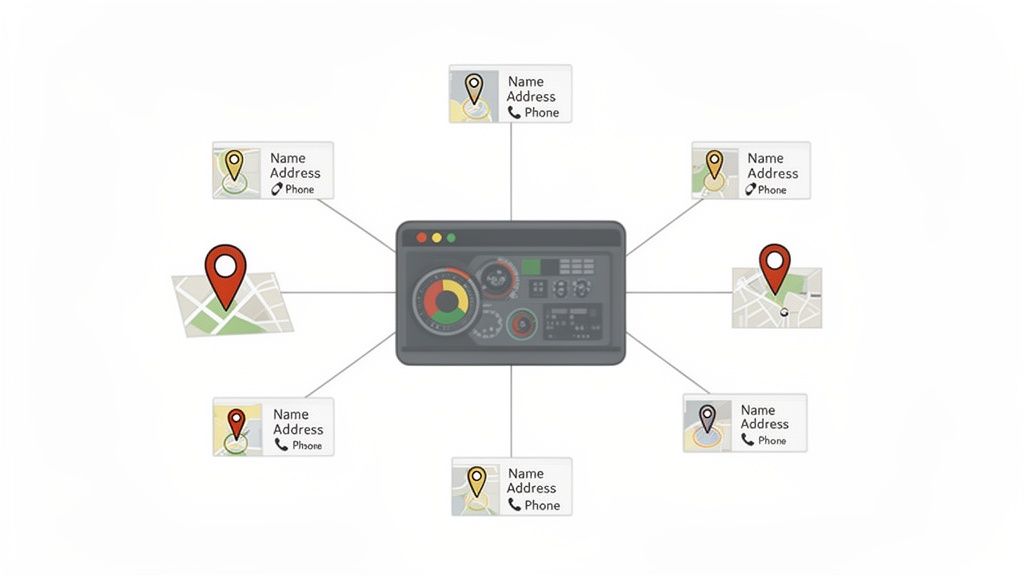
This task becomes exponentially more complex with each new location. For instance, a national fast-casual restaurant chain must maintain consistent branding while allowing individual branches to update specific opening hours or local specials. Similarly, a network of medical clinics needs to synchronise service offerings and practitioner details across dozens of sites. The goal is to avoid fragmentation, where outdated or conflicting information erodes customer trust and harms search rankings. Centralised management prevents this, ensuring a unified brand presence. If you're managing multiple Google Business listings, establishing a single source of truth is the first and most important step.
Actionable Tips for GBP Synchronisation
- Conduct a Pre-Launch Audit: Before implementing any new system, perform a comprehensive audit of all existing GBP listings. Identify and document every inconsistency, rogue profile, or duplicate listing that needs to be claimed or corrected.
- Use a Bulk Editor: Employ a management tool with a bulk editor, such as LocalHQ, to apply standardised NAP data, categories, and business descriptions across all locations simultaneously. This eliminates manual errors and saves considerable time.
- Assign Granular Permissions: Grant location managers specific user permissions. This allows them to handle local tasks like responding to reviews or creating Google Posts for their branch, without giving them access to alter core business information, thereby maintaining brand consistency.
- Keep Content Fresh: Regularly update photos, publish Google Posts with local offers, and use the Q&A feature. Consistent activity signals to Google's algorithm that your listings are active and relevant, which can positively impact rankings.
2. Local Citation Building & NAP Consistency
Beyond your Google Business Profile, consistent business information across the web is vital. Local citations are mentions of your business's Name, Address, and Phone number (NAP) on other websites, directories, and data aggregators. For a business with multiple branches, maintaining precise and uniform NAP details across every high-authority citation source, like Yelp, Apple Maps, and key industry directories, is a non-negotiable part of a robust multi-location SEO checklist. Inconsistent information creates conflicting signals for search engines and can erode customer trust, directly harming your local search performance.

The complexity of this task scales with your growth. A home services franchise must ensure every one of its locations is accurately listed on platforms like the Better Business Bureau (BBB) and local trade directories. Similarly, a chain of private healthcare clinics needs to manage its presence on Healthgrades and Zocdoc, ensuring every practitioner's details are correct for their specific clinic. The primary goal is to build a web of trustworthy, consistent data that corroborates the information on your GBP and website. Neglecting this leads to a fragmented online identity, where outdated phone numbers or incorrect addresses penalise your rankings and frustrate potential customers. To understand the foundational role they play, you can learn more about what local citations are and why they matter.
Actionable Tips for Citation Management
- Prioritise High-Authority Directories: Focus your efforts on major data aggregators and directories that are frequently crawled and trusted by search engines. These form the backbone of your citation profile.
- Create a Master Data Sheet: Before submitting to any platform, compile a master spreadsheet containing the verified, canonical NAP information for every single one of your locations. This document becomes your single source of truth.
- Target Niche & Industry-Specific Sites: Go beyond the general directories. For instance, a restaurant chain should be listed on OpenTable and Zomato, while a legal firm should target solicitor-specific directories. These niche citations carry significant authority.
- Conduct Monthly Audits: Use a monitoring tool to regularly scan for NAP inconsistencies, new rogue listings, or changes to existing citations. Catching and correcting these errors quickly is key to maintaining your local authority.
- Find and Remove Duplicates: Actively search for and remove or merge duplicate listings for your locations. Duplicates dilute your authority and confuse both search engines and customers, often leading to ranking penalties.
3. Location-Specific Keyword Research & Optimisation
Beyond universal brand terms, a robust multi-location SEO strategy must account for the unique search behaviours in each geographic area. This means researching and targeting keywords specific to each location. The process involves identifying local search intent, analysing competitor keywords by area, and mapping service-specific terms to individual branches. Proper optimisation at this granular level is essential for appearing in high-intent searches like 'emergency plumber near me' or 'Italian restaurant in Manchester'.
This detailed approach ensures your business is visible when local customers are actively seeking your services. For example, a pet grooming franchise might discover that 'mobile dog grooming in Islington' is a high-value term for its London branch, while 'dog daycare near me' performs better for its suburban locations. Similarly, a national law firm would benefit by targeting 'family law solicitor in Bristol' and 'personal injury lawyer near Leeds' with dedicated, location-specific content. This is a critical part of any multi-location SEO checklist, as it connects your brand directly to local customer needs.
Actionable Tips for Location-Specific Keyword Research
- Analyse Search Console Data: Use Google Search Console to filter performance by page or query. Look for search terms that include local modifiers (e.g., city, postcode, neighbourhood) to understand what is already driving traffic to specific location pages.
- Create a Keyword Matrix: Develop a spreadsheet that maps your core services to each of your business locations. This helps you systematically identify content gaps and opportunities for every service in every market you serve.
- Investigate Local Competitors: Use tools like SEMrush or Ahrefs to analyse the keywords that top-ranking local competitors are targeting for each of your locations. This can reveal valuable, high-intent phrases you may have missed.
- Use a Geo-Grid Rank Tracker: Monitor keyword rankings by specific geographic coordinates with a geo-grid tool like LocalHQ’s Rank Tracker. This provides a precise view of how you perform for 'near me' searches block by block, helping you pinpoint areas for improvement.
4. Location Landing Pages & Localised Content Creation
Creating unique, valuable landing pages for each business location is a critical component of any effective multi-location SEO checklist. These pages act as dedicated digital storefronts, helping you rank for geographic keywords and providing users with genuinely relevant local information. Unlike generic, one-size-fits-all service pages, bespoke location pages demonstrate direct relevance to local search intent, which can significantly improve visibility and conversion rates. Each page becomes a hub for its specific community, tailored with local details.
This strategy is about more than just listing an address. For example, a national fitness studio chain can create unique pages highlighting local trainers, community-specific classes, and even neighbourhood characteristics. A home services company can develop location pages featuring photos from local projects, testimonials from nearby customers, and area-specific service offerings. This approach proves to both search engines and potential customers that your business is an integrated part of the local community, not just a faceless national brand.
Actionable Tips for Location Pages
- Create a Scalable Template: Design a master location page template to maintain brand consistency and speed up the creation process. This ensures all pages have a uniform structure while allowing for unique content in designated sections.
- Include Unique Local Content: Go beyond basic details. Incorporate locally-relevant information such as mentions of nearby landmarks, local events your branch sponsors, or statistics specific to the area to make the content feel authentic and valuable.
- Optimise for Local Keywords: Naturally weave location-specific keywords (e.g., "plumbers in Islington," "personal trainers near Angel") into page titles, headers, and body content. This directly targets users searching for services in that specific area.
- Implement Location Schema Markup: Add
LocalBusinessschema markup to your pages. This structured data helps search engines like Google better understand your page's geographic relevance, including its address, opening hours, and phone number, which can enhance your appearance in search results. - Use High-Quality Local Imagery: Feature genuine, high-quality photos and videos of the specific location, its staff, and its work in the community. Stock photos feel impersonal; authentic visuals build trust and local connection.
5. Review Management & Strategic Response Automation
Customer reviews significantly influence local search rankings and consumer purchasing decisions. For multi-location businesses, it's vital to monitor, respond to, and encourage reviews across all locations while maintaining brand voice and addressing concerns promptly. This process involves a strategic blend of automation to manage volume and personalisation to keep responses authentic, building trust and strengthening customer relationships. This element is a key part of any modern multi-location SEO checklist.
This task is essential for protecting and enhancing brand reputation at scale. For example, a national home services franchise can track review trends across all its locations to identify systemic issues, such as punctuality problems in specific regions, and address them operationally. Similarly, a dental practice group managing over 100 clinics can respond to reviews by mentioning specific doctors and procedures, reinforcing their commitment to personalised patient care and demonstrating active management. Without a cohesive strategy, reviews can become a liability instead of an asset.
Actionable Tips for Review Management
- Automate Review Requests: Set up automated campaigns to encourage customers to leave reviews shortly after a purchase or service. This helps generate a consistent flow of fresh feedback, which Google's algorithm favours.
- Respond Promptly: Aim to respond to all reviews, especially negative ones, within 24-48 hours. Quick responses show you value customer feedback and can positively influence how potential customers perceive your brand.
- Maintain Brand Voice: Use a tone that matches your brand identity. Even when using templates for efficiency, personalise responses by mentioning specific details from the customer's review to show genuine engagement.
- Address Concerns Constructively: In negative reviews, address the specific concerns raised and offer a clear path to a solution. Avoid making excuses and focus on demonstrating your commitment to resolving the issue.
- Use Automation Strategically: Employ tools that can handle the initial response workload while maintaining quality and speed. For instance, LocalHQ’s Google Review Autoresponder helps businesses craft on-brand replies instantly, reducing the manual effort required from location managers.
6. Local Link Building & Geographic Authority Development
Building location-specific backlinks from local websites, news outlets, and community organisations signals authority to search engines and improves rankings for geographic queries. For multi-location businesses, this involves a two-pronged approach: securing brand-wide links that lift the entire domain and acquiring specific local links that establish relevance in each market. High-quality, contextually relevant local links are far more valuable than a large volume of low-quality ones, forming a critical part of any serious multi-location SEO checklist.
This strategy anchors your brand within the local digital ecosystem of each branch. For example, a home services company gains significant authority by being featured in local business directories, earning press from community involvement, and sponsoring local events. Likewise, a healthcare network can build a powerful local backlink profile by fostering links from regional health organisations, hospital partners, and community wellness initiatives. The aim is to create a web of trust that tells Google your business is a legitimate and important part of that specific community.
Actionable Tips for Local Link Building
- Conduct Local Outreach Research: For each location, research and compile a list of local websites, influential blogs (e.g., food or parent bloggers), and news outlets. Prioritise your outreach efforts based on their relevance and domain authority.
- Sponsor Local Groups: Sponsoring local youth sports teams, charity events, or community organisations is an excellent way to earn natural links. These websites often have a "Sponsors" page, providing a high-quality, geographically relevant backlink.
- Create Newsworthy Content: Develop press releases or content about local hiring sprees, charity partnerships, or company milestones. Distribute this to local media outlets, as they are often looking for stories about businesses contributing to their area.
- Engage with Business Associations: Build relationships with local Chambers of Commerce and business improvement districts. Membership often includes a listing in their directory, which provides a valuable local citation and link.
- Analyse Competitor Backlinks: Use tools to monitor the local link profiles of your competitors in each area. This can reveal missed opportunities, such as directories or event sponsorships you haven't yet explored.
7. Geo-Targeted Rank Tracking & Competitive Market Intelligence
Tracking keyword rankings across specific geographic locations and understanding competitor strategies are essential parts of a complete multi-location SEO checklist. Geo-grid rank tracking reveals exactly where you rank for key search terms across different service areas or regions, highlighting gaps and opportunities. This process involves analysing where competitors are succeeding, identifying keyword opportunities, finding content gaps, and recognising ranking patterns on a location-by-location basis. Combined, these insights drive strategic decisions about content, optimisation, and where to allocate resources.
This level of detail is vital for large-scale operations. For instance, a home services franchise tracking 'emergency plumber near me' rankings across its 200 locations can pinpoint which specific markets require paid advertising support to gain visibility. A national restaurant chain might discover its main competitors dominate searches for 'fast casual lunch' in major cities but are weak in secondary markets, presenting a clear opportunity for expansion. The goal is to move beyond general performance metrics and obtain a granular view of how each location performs in its unique local market.
Actionable Tips for Geo-Tracking and Competitor Analysis
- Focus on High-Value Keywords: Instead of tracking thousands of terms, concentrate on 20-30 business-critical keywords per location. These should include high-intent terms that directly relate to your core services and drive conversions.
- Establish a Baseline: Before starting any optimisation campaign, establish baseline rankings for each location. This allows you to accurately measure progress over a 3 to 6-month period and connect ranking changes to specific actions.
- Automate Reporting: Set up automated rank tracking reports to monitor performance weekly or monthly. Using a tool with a local rank tracker gives you a visual representation of your search visibility and helps you spot trends without manual effort.
- Analyse Competitor Profiles: Regularly monitor the Google Business Profiles of 2-3 key competitors in each location. Look for changes in their keywords, photo uploads, Google Posts, and review response patterns to understand their local strategy.
8. Structured Data (Schema Markup) Implementation
Implementing schema markup, or structured data, is like giving search engines a detailed blueprint of your business information. It translates your website content into a language that Google, Bing, and other platforms can instantly understand and categorise. For multi-location businesses, applying specific schema types such as LocalBusiness, PostalAddress, and Review to each location page is vital for standing out in search results. This code helps search engines recognise your locations, services, opening hours, and ratings, which can lead to enhanced visibility through rich snippets and knowledge panels.
This task is essential for any business wanting to improve click-through rates from local search. For example, a restaurant chain can use schema to show its menu, cuisine type, and specific contact number for each branch directly in the search results. Likewise, a network of dental clinics can use it to display patient ratings and specific services offered at each practice. Properly implemented structured data provides clear, unambiguous signals to search engines, helping them present your locations accurately to potential customers and making this a key part of any multi-location SEO checklist.
Actionable Tips for Schema Markup Implementation
- Start with
LocalBusinessSchema: UseLocalBusinessschema as the foundational layer for all your location pages. Ensure it includes core details like your official business name, full address, phone number, opening hours, and business categories. - Validate Your Markup: Before and after deployment, use tools like Google's Rich Results Test to validate your code. This ensures it is correctly formatted and eligible for rich snippet display, preventing errors that could harm your visibility.
- Include Location-Specific Details: Go beyond the basics by adding schema for location-specific attributes. For a retail store, this could be
makesOfferfor products available at that branch. For a service business, it could behasOfferCatalogfor the services provided. - Add
ReviewandAggregateRatingSchema: Showcase your hard-earned customer ratings by implementingReviewschema. This allows star ratings to appear directly in search results, building trust and encouraging clicks. - Test in a Staging Environment: Always test schema changes on a staging or development site first. This allows you to catch and fix any implementation issues without affecting your live website’s performance or user experience. For a simple way to get started, you can use a free LocalBusiness schema markup generator to create the initial code.
9. Multi-Location Reporting, Insights & ROI Measurement
Effective reporting translates multi-location SEO efforts into tangible business outcomes. It’s the process of collecting and analysing performance data across all your locations to understand what’s working, what isn’t, and what the return on investment (ROI) is. For any business serious about its local marketing, clear analytics are crucial. This goes beyond simple rank tracking to connect search visibility with real-world results like phone calls, direction requests, website clicks, and ultimately, attributed revenue. Without this, your strategy is based on guesswork rather than data.
This measurement is essential for justifying marketing spend and making informed decisions. For example, a national retail chain can use detailed reporting to identify that optimising location pages in three underperforming regions led to a 50% increase in foot traffic after 60 days. Likewise, a marketing agency can use white-label reports to show a client how their 50 locations generated thousands more map impressions and hundreds of direct calls in Q4. This level of insight proves the value of your SEO work and is a core component of any complete multi-location SEO checklist.
Actionable Tips for Reporting and ROI Measurement
- Establish Clear KPIs First: Before starting any optimisation, define what success looks like. Set specific Key Performance Indicators (KPIs) such as a target number of monthly calls, a percentage increase in website clicks, or a specific revenue goal.
- Set a Baseline: Track performance for at least 30 days before implementing changes. This baseline provides a clear point of comparison to accurately measure the impact of your efforts.
- Automate Stakeholder Reports: Use a platform with automated reporting to send monthly or quarterly updates to regional managers and leadership. This ensures everyone is aware of progress and keeps your team accountable without manual effort.
- Correlate SEO with Business Metrics: Don’t just report on rankings. Connect improved search visibility to concrete business results like calls, bookings, and in-store visits to demonstrate the true financial ROI of your local SEO strategy.
10. Consistent Branding & Localised Marketing Asset Management
Maintaining consistent brand messaging while enabling location-specific customisation is a critical organisational challenge. This process involves centralising the management of marketing assets like logos, brand photos, videos, descriptions, and messaging guidelines. From there, you can schedule location-specific content and automate its distribution, ensuring brand integrity while empowering local relevance. This approach builds strong brand recognition while respecting the nuances of different local markets.
For example, a multi-location restaurant chain can schedule weekly posts promoting national offers, while using templates that allow local chefs to showcase their own unique dishes. Similarly, a franchise fitness studio can sync class schedules and trainer biographies across 30 locations from one dashboard, while still allowing each studio to post about its local community involvement. This balance is a key part of any effective multi-location SEO checklist, as it ensures a brand appears both professional and authentically local.
Actionable Tips for Brand & Asset Management
- Create Detailed Brand Guidelines: Develop a comprehensive guide that includes strict rules for logo usage, defined colour palettes, tone of voice, and core messaging pillars. This document is the foundation for brand consistency.
- Develop Content Templates: Build templates for common content types such as daily specials, event promotions, or educational posts. This speeds up content creation for local managers while keeping it on-brand.
- Implement Approval Workflows: Establish clear approval workflows to ensure all locally created content is compliant before it goes live. This empowers local teams without risking brand damage.
- Train Location Managers: Provide thorough training on brand guidelines and the available tools. Encourage them to create localised content that fits within the established guardrails to maintain authenticity.
- Regularly Audit Local Content: Schedule periodic audits of all location-specific content, including social media posts and Google Business Profile updates, to check for brand consistency and compliance.
Multi-Location SEO: 10-Item Comparison
| Strategy | Complexity 🔄 | Resources 💡 | Expected Outcomes ⭐📊 | Ideal Use Cases ⚡ | Key Advantages |
|---|---|---|---|---|---|
| Google Business Profile Optimisation & Synchronisation | Moderate–High: verification and centralised sync | Moderate: GBP tools, location managers, ongoing monitoring | High: improved map rankings, CTR, local visibility | Franchises, retail, healthcare with many locations | Consistent NAP, automation, location-specific performance |
| Local Citation Building & NAP Consistency | Moderate: audit, submission, duplicate cleanup | Moderate–High: citation platforms or manual outreach, continuous upkeep | Moderate–High: trust signals, directory referral traffic, ranking support | Home services, healthcare, local-focused franchises | Improves credibility, reduces duplicate issues, boosts local referrals |
| Location-Specific Keyword Research & Optimisation | High: per-location research and ongoing updates | High: keyword tools, analysts, monitoring | High: targeted local intent traffic and better conversion | Professional services, legal, niche service areas | Identifies local intent, content opportunity, quick-win keywords |
| Location Landing Pages & Localised Content Creation | High: content scale, architecture, duplicate-risk | High: content creators, developers, media assets | High: stronger local rankings and higher conversions | Retail, healthcare, fitness, service providers with local demand | Unique local relevance, improved conversion, schema-ready pages |
| Review Management & Strategic Response Automation | Moderate: monitoring, sentiment analysis, automation rules | Moderate: review platforms, staff oversight, automation tools | High: improved reputation, faster responses, SEO lift | Restaurants, clinics, high-review-volume businesses | Faster response times, sentiment insights, scalable personalisation |
| Local Link Building & Geographic Authority Development | High: outreach, relationship building, PR work | High: outreach team, PR resources, time investment | High (long-term): authority gains, referral traffic, rankings | Competitive markets needing local authority, community-focused brands | Quality local backlinks, community trust, referral sources |
| Geo-Targeted Rank Tracking & Competitive Market Intelligence | Moderate–High: data setup and analysis | Moderate–High: rank-tracking tools, analysts, reporting | High: visibility patterns, prioritisation, competitor gaps | Enterprises, agencies managing many locations | Geo-grid insights, competitor benchmarking, prioritisation signals |
| Structured Data (Schema Markup) Implementation | Moderate: technical implementation and validation | Low–Moderate: developer time and validators | Moderate–High: rich results, CTR uplift, better SERP display | Any site with location pages seeking rich snippets | Enables rich snippets, voice search readiness, low-effort impact |
| Multi-Location Reporting, Insights & ROI Measurement | High: data integration and attribution challenges | High: analytics stack, integrations, analysts | High: measurable ROI, performance-driven decisions | Franchises, agencies, multi-site enterprise reporting | Unified KPIs, attribution insights, automated stakeholder reports |
| Consistent Branding & Localised Marketing Asset Management | Moderate: governance, templates, approval workflows | Moderate–High: DAM, templates, training, schedulers | Moderate–High: brand consistency and faster local publishing | Franchise systems, chains balancing brand + local flavour | Brand compliance, scalable content, centralised asset control |
From Checklist to Action: Executing Your Multi-Location Strategy
You now possess a detailed blueprint for dominating local search across multiple territories. This extensive multi-location SEO checklist moves beyond theory, offering 47 distinct, actionable points designed to build a powerful and consistent presence for every single one of your business locations. From the foundational accuracy of your Google Business Profiles and NAP citations to the sophisticated execution of localised content and schema markup, each step is a crucial component in constructing a formidable local search engine authority.
We have explored the nuances of creating unique location landing pages that speak directly to local customers, the importance of a proactive review management strategy, and the technical precision required for geo-targeted rank tracking. Mastering these elements in isolation is an achievement; synchronising them across an entire network of stores, offices, or service areas is what separates market leaders from the competition. The goal is not merely to be present, but to be the definitive local choice, everywhere.
The Shift from Theory to Tangible Results
The real challenge lies in execution at scale. A checklist is a static guide, but the world of local search is dynamic, with customer behaviour and competitor tactics shifting constantly. Applying these principles consistently across tens or hundreds of locations is where many well-intentioned strategies falter. Manual updates, inconsistent data entry, and fragmented reporting create gaps that erode customer trust and search visibility.
This is why operational efficiency is the secret ingredient. To truly succeed, your organisation needs:
- Centralised Control: A single source of truth for all location data, from opening hours to service descriptions, preventing the data decay that plagues multi-location brands.
- Scalable Workflows: Repeatable processes for content creation, review responses, and citation management that can be deployed across new and existing locations with minimal friction.
- Actionable Insights: Reporting that goes beyond vanity metrics, connecting local search performance directly to foot traffic, phone calls, and revenue to prove ROI.
- Operational Integration: Your digital efforts must be supported by your physical operations. For example, effective customer service is a cornerstone of positive reviews. Similarly, ensuring seamless communication across all sites is paramount. Integrating solutions like multi-location PBX systems can unify your internal and external contact points, ensuring a consistent and professional experience for customers no matter which location they call.
Building Your Engine for Local Growth
Think of this checklist not as a one-time project to be completed, but as the foundational programming for a continuous engine of local growth. Your Google Business Profiles are not 'set and forget' assets; they are dynamic digital storefronts. Your location pages are not static brochures; they are living resources that should be updated with local news, events, and customer stories.
By moving from a reactive, location-by-location approach to a proactive, system-wide strategy, you build a competitive moat that is incredibly difficult for others to replicate. You create an organisation that learns from performance data, adapts to market changes, and consistently delivers a superior local experience, both online and off. This is how you transform a list of tasks into a sustained strategic advantage, turning each location into a powerful magnet for local customers.
Executing on this multi-location SEO checklist requires powerful, purpose-built tools. LocalHQ’s local rank tracker provides the hyper-local insights you need to pinpoint ranking opportunities, street by street. Stop guessing where you stand and start making data-driven decisions.