Multi-Location SEO Strategy: The Enterprise Implementation Framework
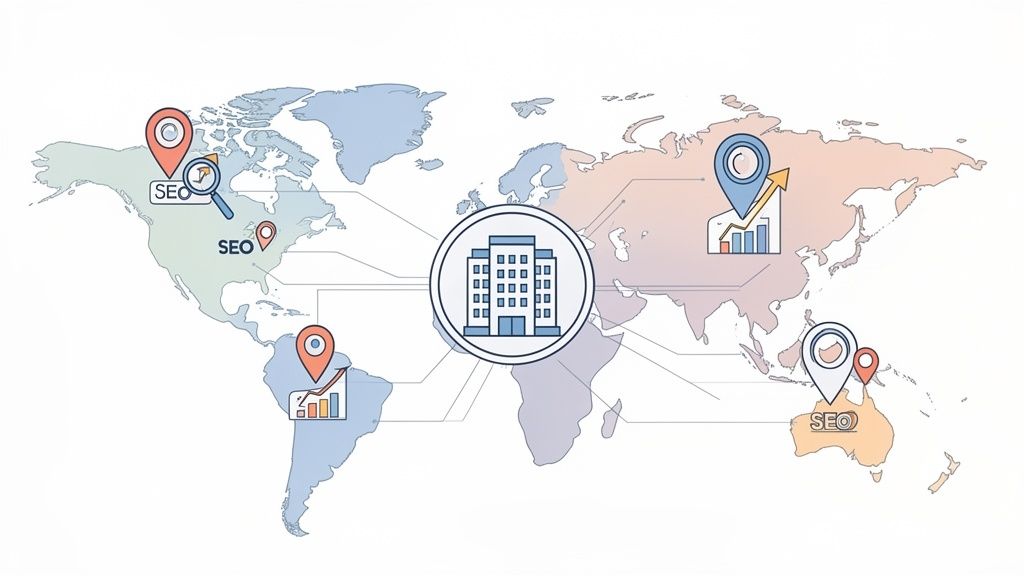
When you’re running a business with multiple physical locations, your online presence can get messy, fast. A solid multi-location SEO strategy isn't just about showing up online; it's about creating a unified plan that boosts the visibility of every single branch, from London to Manchester. It’s a balancing act: you need to standardise brand-critical information while also tailoring your approach to connect with each local community.
The goal is to make every location easily discoverable when a potential customer searches nearby.
Foundations Of A Scalable Multi-Location SEO Strategy
Building an effective SEO strategy for an enterprise with dozens or hundreds of locations requires a framework that’s both consistent and flexible. This isn't about simply copying and pasting your efforts across every branch. Without a clear structure, you risk your own locations competing against each other, which ultimately confuses customers and dilutes your brand's authority in search results.
Everything starts with a deep dive into your current digital footprint. This discovery phase is the bedrock of your entire strategy, designed to uncover the hidden issues that are quietly undermining your performance.
Auditing Your Digital Presence
Before you can build anything new, you have to understand exactly where you stand. A comprehensive audit means systematically checking your Name, Address, and Phone number (NAP) data across every single directory, social profile, and online listing tied to your brand.
You’d be surprised how often we see small inconsistencies create big problems. Something as minor as using "St." on one listing and "Street" on another can be enough to confuse search engines and damage your local rankings.
Many large businesses make the mistake of assuming their data is clean. The reality is that outdated listings, rogue profiles from former staff, and errors from data aggregators are incredibly common, and they are actively working against your SEO efforts.
A proper audit should pinpoint:
- NAP Inconsistencies: Every instance where your core business information is wrong or varies between platforms.
- Duplicate Listings: Finding and flagging multiple profiles for a single location on sites like Google or Yelp.
- Ownership Gaps: Identifying any business profiles that are unclaimed or not managed centrally.
- Performance Baselines: Establishing current rankings, traffic, and engagement metrics for each location so you can accurately measure future growth.
Deciding On Your Governance Model
Once you have a clear picture of your digital health, the next critical decision is how you're going to manage it all. This choice comes down to striking the right balance between central control and local autonomy. Will head office dictate everything to maintain brand consistency, or will you empower local managers to engage directly with their communities?
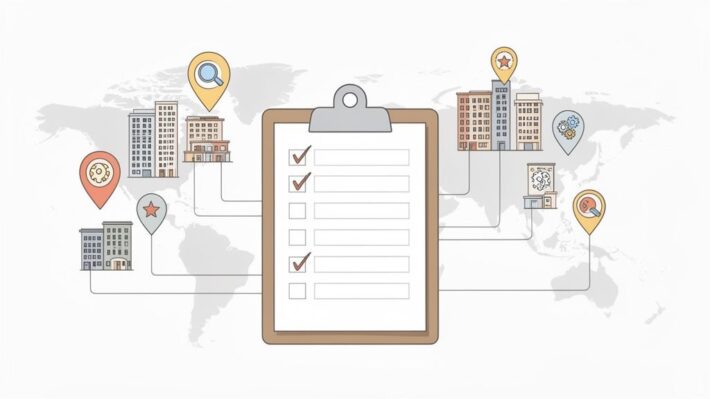
The diagram below shows how this process flows, moving from audit to modelling and finally to structuring your operational plan.
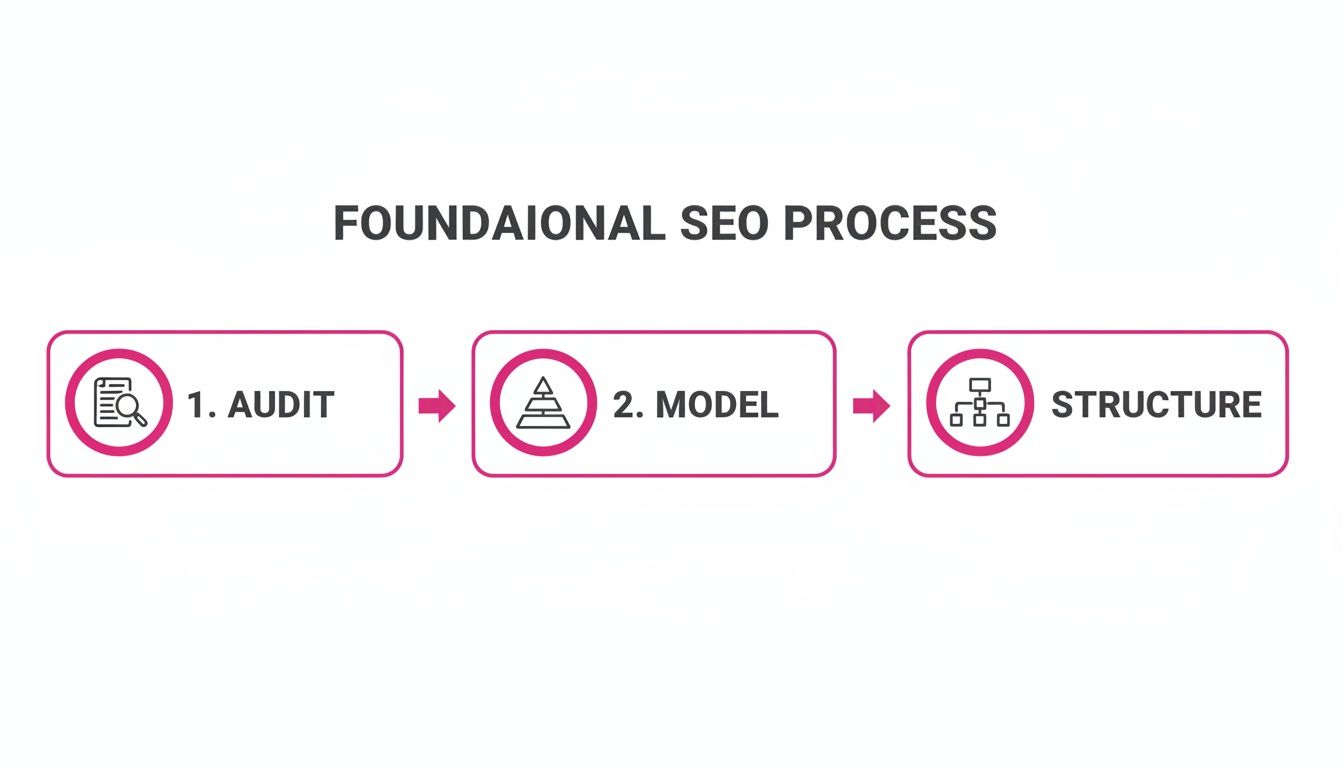
Choosing the right governance model is vital for long-term success. The table below breaks down the most common approaches to help you decide what fits your organisation.
Centralised Vs Localised SEO Management Models
| Aspect | Centralised Model | Localised Model | Hybrid Model |
|---|---|---|---|
| Control | HQ has full control over all SEO activities, branding, and messaging. | Local managers or franchisees have full autonomy over their digital presence. | HQ sets brand guidelines and strategy; local teams manage day-to-day engagement. |
| Consistency | High. Brand messaging and data are uniform across all locations. | Low. Can lead to brand dilution and inconsistent customer experience. | Moderate. Balances brand consistency with authentic local flavour. |
| Speed & Agility | Slower to react to local trends; changes require corporate approval. | Fast. Local teams can respond immediately to community events or feedback. | Agile. Local teams can act quickly within pre-approved brand frameworks. |
| Best For | Brands where consistency is paramount (e.g., regulated industries, luxury retail). | Franchise models where local market knowledge is the primary driver of success. | Most large enterprises, service-area businesses, and retail chains. |
For most large organisations, a hybrid model works best. It gives you the brand integrity that comes from central oversight while tapping into the invaluable, on-the-ground knowledge of your local teams. We explore this concept in more detail in our guide to franchise SEO strategies.
Ultimately, a strong foundation leads directly to commercial success. In the UK, Google Business Profile actions like calls and direction requests have become crucial performance indicators, especially in competitive urban centres like London and Manchester. In fact, businesses with a solid local SEO footing can see 28% of local searches result in a same-day purchase. This shows a clear, powerful link between a well-audited presence and real-world revenue.
Designing Your Technical SEO Architecture For Scale
Getting the technical foundations right is everything in multi-location SEO. Without a smart, scalable architecture, you'll end up with a mess of pages competing against each other, confusing search engines and diluting your brand’s authority. The goal is to build a system where both people and Google can instantly grasp how your individual branches fit into your wider national presence.
It all begins with your location pages. These can't be flimsy, carbon-copy pages; they need to be genuine digital storefronts for each branch. This is where you connect with local customers and capture that high-intent "near me" traffic.
Building Optimised Location Pages
The classic mistake I see businesses make is spinning up dozens of location pages that are identical, save for a different city name and address. Search engines see this "thin content" for what it is: low-effort and not very helpful. To stand out, each page needs to be packed with unique, genuinely local information.
A truly effective location page should feel like a mini-website for that specific branch. It needs to have:
- A unique page title and meta description, including the location (e.g., "Your Brand Name in Bristol City Centre").
- The full address, a local phone number (not a generic 0800 number), and up-to-date opening hours.
- An embedded Google Map to help people find you.
- Real photos of the storefront, the team, and the inside of the building. Stock photos just don't build the same trust.
- Details on services or products that are unique to that particular branch.
When you treat each page this way, you're not just ticking an SEO box. You're creating a valuable resource that converts local searchers into actual customers.
Implementing A Logical Site Structure
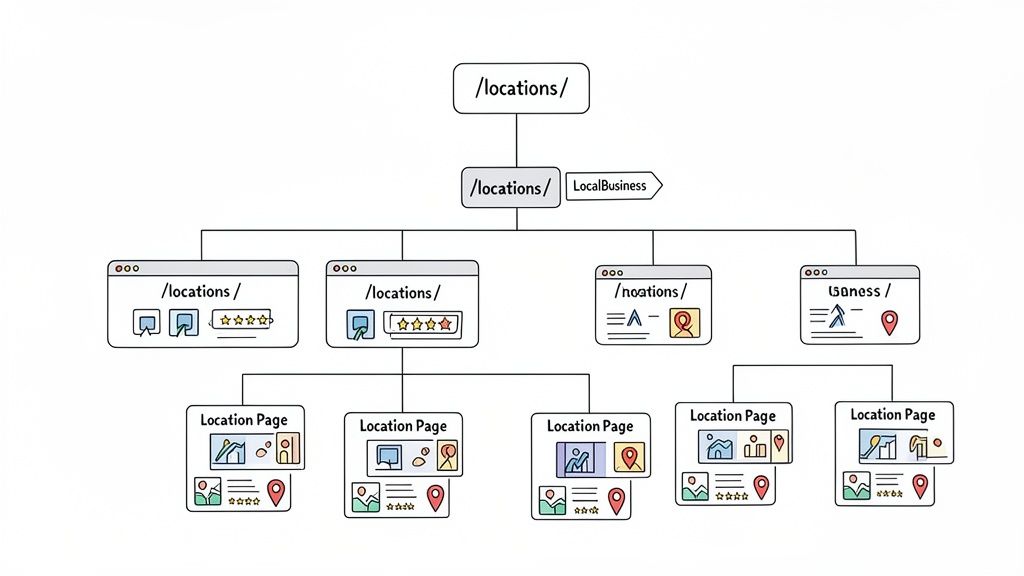
How these pages are arranged on your website matters—a lot. A disorganised or flat structure confuses crawlers and makes for a poor user experience. What you need is a clear hierarchy that signals the relationship between your locations and the parent brand.
The best practice here is a clean, hierarchical structure using subdirectories. It’s logical for users, and it helps Google understand how your main brand authority should flow down to each local outpost.
For instance, a structure like yourbrand.co.uk/locations/london/ and yourbrand.co.uk/locations/manchester/ is vastly better than using messy parameters or having pages scattered all over the site. You can then use the /locations/ page as a main "store finder," linking out to every individual branch.
This creates a tidy internal linking structure that channels authority from your homepage down to your local pages, giving them the power they need to rank for those valuable local searches like "solicitor in Leeds."
The Critical Role Of Local Schema Markup
While visitors read the content on your page, search engines need a little extra help to understand the context. This is where LocalBusiness schema comes in. It's a piece of code you add to your location pages that explicitly spells out the key details of your physical branch for search engines.
It’s like giving Google a perfectly filled-out form, communicating essential information like:
- The exact business name
- The address and its geographic coordinates
- Current opening hours
- The correct phone number
- Customer review scores
Getting this right is non-negotiable. It's what helps you earn those prominent spots in the map pack and ensures your information appears correctly in Google's Knowledge Panel. It removes all guesswork for the search engine, making it one of the most important technical signals for local SEO. To get started, you can generate this code with our handy free LocalBusiness Schema Markup Generator.
Achieving Total Control Over Your Google Business Profiles
Think of your Google Business Profiles (GBPs) as your digital front doors. For any business with more than one location, they're not just listings; they are your single most important local marketing asset. They're what determines if a customer sees you in the map pack and decides to call or visit.
But when you’re juggling dozens, or even hundreds, of locations, managing them becomes a huge operational headache. Without a centralised system, you open the door to rogue edits from well-meaning local managers, inconsistent branding, and out-of-date information. All of this erodes customer trust and, crucially, your search rankings. The bedrock of good management is NAP (Name, Address, and Phone number) consistency, not just on Google, but everywhere online.
Centralising Your GBP Management
The first hurdle is getting everything under one roof. You have to claim and verify every single one of your locations within a single, company-owned Google account. It can be a real grind, especially when you’re hunting down profiles created years ago by former employees, but it’s a non-negotiable first step.
Once they're all in one place, you can create a 'single source of truth' for all your business data. This means when you need to update holiday hours or roll out a new service, the change is pushed to every profile instantly. Manually, this would take hundreds of hours. This is where a dedicated management platform becomes your best friend.
The core principle here is simple: centralise to standardise, then localise to personalise. You must build a uniform foundation of accurate data before you can add the unique details that make each location feel genuinely local.
To make sure your central data is clean from the start, implementing strategic database clean-up practices is essential. This ensures the information you're pushing out to your profiles is reliable and accurate from day one.
Standardising Core Profile Elements
With all your profiles under your control, the next job is standardisation. This isn’t about making every location look identical; it’s about making sure your brand is presented consistently, no matter where a customer finds you.
Here are the key elements to lock down:
- Business Name: Settle on a consistent naming convention. Something like "Brand Name – Neighbourhood" (e.g., "The Coffee House – Covent Garden") works wonders for helping both users and Google tell your locations apart.
- Primary Category: This is a big one. Choose the single best category that describes your core business. You can add secondary ones later, but this one carries the most ranking weight.
- Brand Description: Craft a compelling, keyword-rich description that you can use across all profiles. You can always add a little local flavour later, but the core message should be the same.
This systematic approach stops the brand dilution that inevitably happens when local teams go off-piste. To learn more about this process, explore our detailed guide on managing multiple Google Business listings.
Optimising For Local Relevance
Once the foundations are solid, it's time for the fun part: adding the local details that help a profile connect with its community. This is where a hybrid approach works best—maintaining central control over the essentials while empowering local teams to add their valuable, on-the-ground knowledge.
Here’s how you can start layering in that local relevance:
- Hyper-Local Secondary Categories: Look beyond your primary category. Add others that reflect what's unique to that branch, like "Outdoor Seating," "Click and Collect," or "EV Charging."
- Attributes: Don't skip these. Go through the list and tick every attribute that applies, from "Wi-Fi" and "Wheelchair-accessible entrance" to the payment types you accept. These are powerful filters in local search.
- High-Quality, Localised Photos: Ditch the corporate stock photos. Get real pictures of the storefront, the team at work, the interior, and popular products. Authenticity builds trust.
- Local Posts and Q&As: Use Google Posts for local promotions, events, or community news. Pre-emptively add common questions and answers to the Q&A section to help customers and manage the narrative.
By combining tight central control with smart, localised details, your GBPs transform from a set of static listings into a dynamic tool that actively drives people through your doors.
Right, you’ve sorted out the technical foundations and your Google Business Profiles are in good shape. Now for the fun part: making each of your locations feel like it truly belongs to its local community.
Getting the technical SEO right puts you on the map, literally. But it’s your hyper-local content and reputation that will make people walk through the door. This is where you graduate from simply having consistent data to building real, neighbourhood-level connections.
It all boils down to two things: creating content that speaks directly to the people in a specific town or city, and methodically managing your online reputation. When you get this right, you turn customer feedback into one of your most powerful marketing tools.
Weaving a Scalable Hyper-Local Content Plan
The biggest mistake I see multi-location brands make is falling for the old "find and replace" trick with their local content. Just swapping out a city name in a generic blog post fools no one – least of all your customers and Google.
Authentic hyper-local content shows you’re actually part of the fabric of the area. Forget bland, templated articles. Instead, think about creating content that only a local would know or care about.
For example, you could:
- Showcase your team's community spirit: Post a quick story about your Manchester team volunteering at a local charity run.
- Get involved in local events: Write about your experience sponsoring a stall at a small community fair in a specific London borough.
- Create genuinely helpful neighbourhood guides: A guide to "The Best Coffee Shops Near Our Bristol Office" proves you know the area and gives people a reason to visit your site.
- Share location-specific news: Announce a recent store refurbishment in Leeds or welcome a new manager joining the team in Birmingham.
The objective here is to build up signals of local authority. You're proving that you are an active, engaged member of the community, not just another faceless chain.
The most effective hyper-local content feels real because it is real. Give your local teams the power to share stories and updates from their community. They are, by far, your best source for content that truly hits the mark.
This approach also pays huge dividends in search visibility. As Google's algorithms get smarter, businesses that establish this kind of hyper-local authority are seeing fantastic results. In competitive UK cities like London or Manchester, businesses near landmarks like Northampton Guildhall can gain an 'inherent findability'. With 76% of mobile local searchers visiting a business within 24 hours, you can see how physical relevance directly drives footfall. You can read more about these trends and their impact on local search over at loop-digital.co.uk.
Building a Bulletproof Review Management Workflow
Your online reputation is built one review at a time. When you’re managing hundreds of locations, trying to keep up with feedback can feel impossible without a clear, organised system. A reactive, chaotic approach is a recipe for missed opportunities and potential brand damage.
A scalable review strategy has to be proactive. It's built on two pillars: consistently encouraging positive feedback and responding to all feedback in a timely, on-brand way.
How to Get a Steady Stream of Positive Reviews
Honestly, the easiest way to get more reviews is simply to ask. The key is to do it systematically.
Here are a few effective methods:
- Post-Purchase Email/SMS: An automated message sent 24-48 hours after a purchase works wonders. Politely ask for feedback and include a direct link to that specific location's Google Business Profile.
- In-Store Prompts: Use simple QR codes on receipts, table talkers, or posters at the till. Make it effortless for a happy customer to leave a review right there and then.
- Team Encouragement: You can't bribe customers for reviews, but you can certainly incentivise your staff for being mentioned positively. This naturally encourages excellent service, which is the best way to earn great feedback.
Why You Must Respond to Every Single Review
Responding to reviews is just as important as gathering them. It shows you’re listening and that you actually care. When handled correctly, your responses turn both glowing praise and sharp criticism into a marketing asset.
- For Positive Reviews: A simple "Thank you!" is fine, but a personal touch is much better. If they praise a specific team member or product, mention it in your reply. It shows you've taken the time to read their comment properly.
- For Negative Reviews: The key here is to respond quickly and publicly. Start with an apology for their poor experience, then immediately offer to take the conversation offline by providing a manager’s contact details. This shows other potential customers that even when things go wrong, you’re committed to making it right.
Managing this at scale requires the right tools and a clear plan. Your central marketing team can create the brand voice and response templates, but local managers should be empowered to add that personal touch that makes the interaction feel genuine. To get a deeper look at building this kind of system, check out our comprehensive guide on managing online reviews.
Measuring Performance And ROI Across Every Location
So, you’ve put in the hard work and rolled out a multi-location SEO strategy. Now for the crucial question: is it actually working? You can have the best framework in the world, but if you can’t prove its value to stakeholders, it's all for nothing. This means cutting through the noise of vanity metrics and focusing on what truly matters.
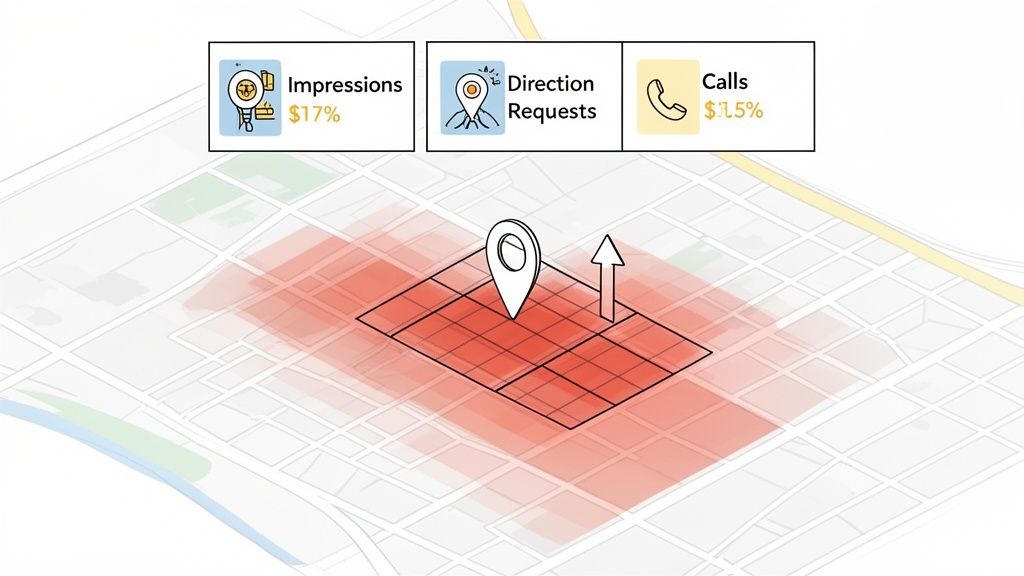
Forget about fixating on national keyword rankings. Real success is measured in local conversions—phone calls to your Birmingham branch, direction requests to your Manchester store, and website clicks from customers in a specific London postcode. These actions signal genuine commercial intent and are the true markers of a strategy that's delivering.
Defining Your Core Local KPIs
While every business has unique goals, any solid multi-location SEO strategy should centre on a core set of metrics that tie directly to customer acquisition. These are the numbers that prove your local presence is translating into real-world business.
Your reporting should revolve around these key data points from your Google Business Profiles:
- Clicks to Call: This is a golden metric. It's a direct lead from someone actively looking to speak with your local team.
- Direction Requests: A powerful indicator of footfall. A person asking for directions is very likely on their way to your physical premises.
- Website Clicks: This tracks users moving from your GBP to your local landing page, pushing them further down the conversion path.
- Search Impressions vs Map Views: This helps you understand your visibility, showing how often you appear in search results (discovery) versus on Google Maps (consideration).
The whole point is to shift your mindset from tracking rankings to measuring actions. A steady increase in direction requests for your Bristol location is far more valuable than hitting number one for a vague, non-local keyword.
This focus on hyper-local engagement is more critical than ever. In the UK's crowded market, businesses in hubs like London and Manchester are finding that granular local optimisation can boost visibility by as much as 46% for searches with local intent. Securing a top-three spot in the Local Pack can lead to 126% more actions like calls and directions for profiles that are properly dialled in.
Visualising Performance With Geo-Grid Tracking
Here’s the thing about traditional rank tracking: it's often too broad to be useful for a multi-location business. Knowing you rank third nationally for a keyword doesn’t help if you're invisible to a customer searching just three streets away from one of your stores.
This is exactly where geo-grid rank tracking comes in. These tools are a game-changer, letting you see your search visibility for core keywords across a grid of specific points on a map—think different postcodes or neighbourhoods within a single city.
This incredibly granular view shows you precisely what's happening on the ground:
- Visibility Gaps: Instantly pinpoint the exact areas where competitors are beating you.
- Local Opportunities: Discover neighbourhoods where your visibility is strong and ripe for further amplification.
- Competitive Threats: See which rivals are dominating search results, block by block.
Consolidating Data Into Actionable Reports
The final piece of the puzzle is bringing all this data together into clear, meaningful reports. Your stakeholders don't have time to wade through massive spreadsheets; they need to understand the bottom-line impact of your work. Beyond simply tracking data, knowing how to improve marketing ROI across all your sites is what separates a good strategy from a great one.
A powerful report should tell a simple story with complex data. It needs to show trends over time, benchmark performance between different locations, and draw a straight line from your SEO activities to tangible business outcomes like phone calls and in-store visits. To see how you can streamline this, explore how a dedicated Google Business Profile reporting tool can automate the heavy lifting and deliver clear, stakeholder-ready insights.
Frequently Asked Questions About Multi-Location SEO
When you're wrangling SEO for a business with multiple locations, a few tricky questions always seem to pop up. Let's tackle some of the most common ones I hear from enterprise teams trying to build and scale their local presence.
How Do I Stop My Own Locations From Competing Against Each Other?
Ah, the classic keyword cannibalisation problem. This happens all the time when different location pages inadvertently go after the same general search terms, like "emergency plumber". You end up with Google not knowing which page to rank, so none of them perform well.
The fix is to create a clear hierarchy. Your main corporate website should target the broad, high-level terms. Your individual location pages, on the other hand, need to get hyper-local. Think "emergency plumber in Bristol city centre" or "24-hour plumber near Clifton". By giving each page a distinct, geo-specific job, you're sending clear signals to Google and stopping your pages from fighting each other for visibility.
Is It Okay to Have Some Duplicate Content on Location Pages?
Yes, and honestly, it's unavoidable. Some content should be consistent across all your location pages to maintain a strong, unified brand identity.
Things that are perfectly fine to repeat include:
- Your standard brand story or boilerplate text.
- Core lists of products or services that are available everywhere.
- Company-wide trust signals, like national accreditations or major awards.
- Standard legal footers and calls to action.
The goal isn't to hit some magical percentage of "unique" text. The real test is whether you're adding genuine local value. Focus on incorporating unique local testimonials, photos of the actual branch and team, and details about community involvement.
Don't get hung up on a uniqueness score. A better question to ask is: "Does this page give a customer in Manchester a genuinely better, more relevant experience than our generic corporate site?" If it does, you're on the right path.
What’s More Important: Central Control or Local Freedom?
This isn't an either/or question. The most successful strategies I've seen use a hybrid model that blends both. You absolutely need central oversight to keep the brand and data consistent.
Your head office or central marketing team should own the technical SEO framework, manage the core business information (NAP), and control the main brand messaging. This prevents chaos.
But you also need to empower your local managers. They have the on-the-ground knowledge that makes your brand feel authentic. Let them handle things like responding to local reviews, posting updates about community events on Google, and snapping photos of their team and premises. This combination of central governance and local flair is where the magic happens.
How Do I Choose the Right Tools for My Organisation?
Trying to manage hundreds, or even just dozens, of locations by hand is a recipe for disaster. It's just not scalable. You need a solid tech stack to automate the grunt work and give you a clear view of performance.
When evaluating platforms, look for one that brings these key functions under one roof:
- Listing Management: To automatically sync your correct name, address, and phone number across every single Google Business Profile.
- Review Management: To track feedback from all locations in one place and respond efficiently.
- Performance Reporting: To easily measure vital KPIs like calls, website clicks, and requests for directions for each branch.
The right tool does more than just save time; it becomes the single source of truth for your entire multi-location strategy, freeing you up to focus on work that actually moves the needle.
Let's be honest: handling reviews for one business is tough enough. Now imagine doing it for fifty, or five hundred. The sheer scale of managing your reputation across that many locations can feel overwhelming.
You're stuck in a constant balancing act. On one hand, you need a consistent brand voice. On the other, every response has to feel personal and relevant to a customer in a specific town or city. It’s a huge challenge, and getting it right is what separates the leaders from the pack.
This is where a centralised approach to review management becomes your secret weapon. By bringing everything under one roof, you put a stop to inconsistent, off-brand replies. More importantly, you start turning customer feedback into a genuine asset for local growth.
Every single review—good, bad, or indifferent—is a chance to show you’re listening. When managed well, that feedback builds local credibility and trust far more effectively than any big-budget ad campaign ever could.
This isn't just about damage control. It’s about building a solid framework where every location, from a major city centre branch to a small town outlet, reinforces your brand's reputation. You create a powerful loop where happy customers fuel your visibility, which in turn brings in more customers.
Ready to get a firm grip on your online reputation across all your locations? Our Review Manager gives you a central command centre to gather feedback, craft perfect, on-brand responses, and ensure you never miss a chance to connect with your customers.