How to Remove Negative Reviews on Google A Practical Guide
A single one-star review can feel like a punch to the gut, but the damage goes far beyond hurt feelings. Let's be real: negative reviews directly torpedo your local SEO, shatter customer trust, and can genuinely hurt your revenue. Getting your head around this connection is the first step to building a resilient online reputation and figuring out when you need to remove negative reviews on Google.
The True Cost of a Negative Google Review
Look, a bad review stings. But the consequences ripple outwards, touching almost every part of your local business's health. It’s not just about watching your star rating dip; it’s about visibility, credibility, and ultimately, your bottom line.
A sudden wave of negative feedback can shove your business down in Google Maps and local search results, making it that much harder for new customers to even find you.
Imagine this: a popular local café gets hit with a coordinated attack of fake one-star reviews. Almost overnight, their top spot in "cafés near me" searches could vanish. This drop in visibility means fewer clicks, fewer people asking for directions, and a real, noticeable decline in the morning coffee rush. This isn't just a theory; it happens to businesses every single day.
The Financial and SEO Impact
The link between what people are saying online and your real-world performance is crystal clear. Study after study shows that businesses with higher average ratings get more organic traffic and more enquiries. A negative review acts like a digital roadblock, turning potential customers away before they even think about visiting your website.
Here’s a breakdown of the damage:
- Sinking Local SEO Rankings: Google’s algorithm pays close attention to review quantity, velocity, and overall sentiment. A pattern of negative feedback signals to Google that your business might not be up to scratch, which leads to lower rankings. Understanding these signals is vital, which is why regularly using tools for rank tracking for local keywords can help you spot trouble early on.
- Lower Click-Through Rates: Picture your business in the search results with a low star rating, right next to competitors with higher scores. It’s human nature to be drawn to the better-rated option. Even if you rank well, a poor rating kills your chances of getting that all-important click.
- Erosion of Customer Trust: For 87% of customers, online reviews are as trustworthy as a recommendation from a friend. A single, nasty review can plant a seed of doubt that stops a customer from choosing you.
A business risks losing as many as 22% of its customers when just one negative article is found by users considering buying their product. This figure rises to 59.2% with three negative articles.
This direct line between your online reputation and financial stability is exactly why you need a clear, proactive strategy. This isn't just about damage control; it's about protecting your business's future. The following sections will give you the actionable playbook you need to identify, flag, and handle the reviews that threaten your hard-earned reputation.
Identifying Reviews You Can Actually Remove
First things first, let’s get one thing straight: Google won't take down a review just because it’s negative or you disagree with it. To successfully remove negative reviews on Google, you have to play by their rulebook. This means getting good at spotting the difference between a genuinely unhappy customer and a review that flat-out violates Google's policies.
Your time and energy are precious. Don't waste them fighting every single negative comment. Instead, focus on flagging the reviews that actually stand a chance of being removed. It's all about knowing which battles you can realistically win.
Understanding Google’s Prohibited Content Policies
Google designed its review platform for authentic customer experiences, and they have strict rules to stop people from abusing it. A review has to break one or more of these specific policies to even be considered for removal. A customer saying "the service was slow" or "the food was cold" isn't a violation—it's just feedback, no matter how much it stings.
Let's break down the most common violations you're likely to see.
- Spam and Fake Content: This is the most obvious one. Think reviews posted by bots, fake accounts, or anything created just to manipulate your rating. A classic sign is getting a sudden flood of one-star reviews with no text from brand-new accounts.
- Off-Topic Rants: Reviews have to be about a customer's experience at your specific location. If someone starts ranting about industry politics, a social issue, or another company entirely, it's off-topic and you can flag it.
- Conflict of Interest: This is a big one. Current or former employees are not allowed to review their own workplace. The same goes for competitors who leave bad reviews just to tank your reputation—that’s a clear violation.
This flow chart really drives home how quickly a single bad review can spiral, hurting both your SEO and your sales.
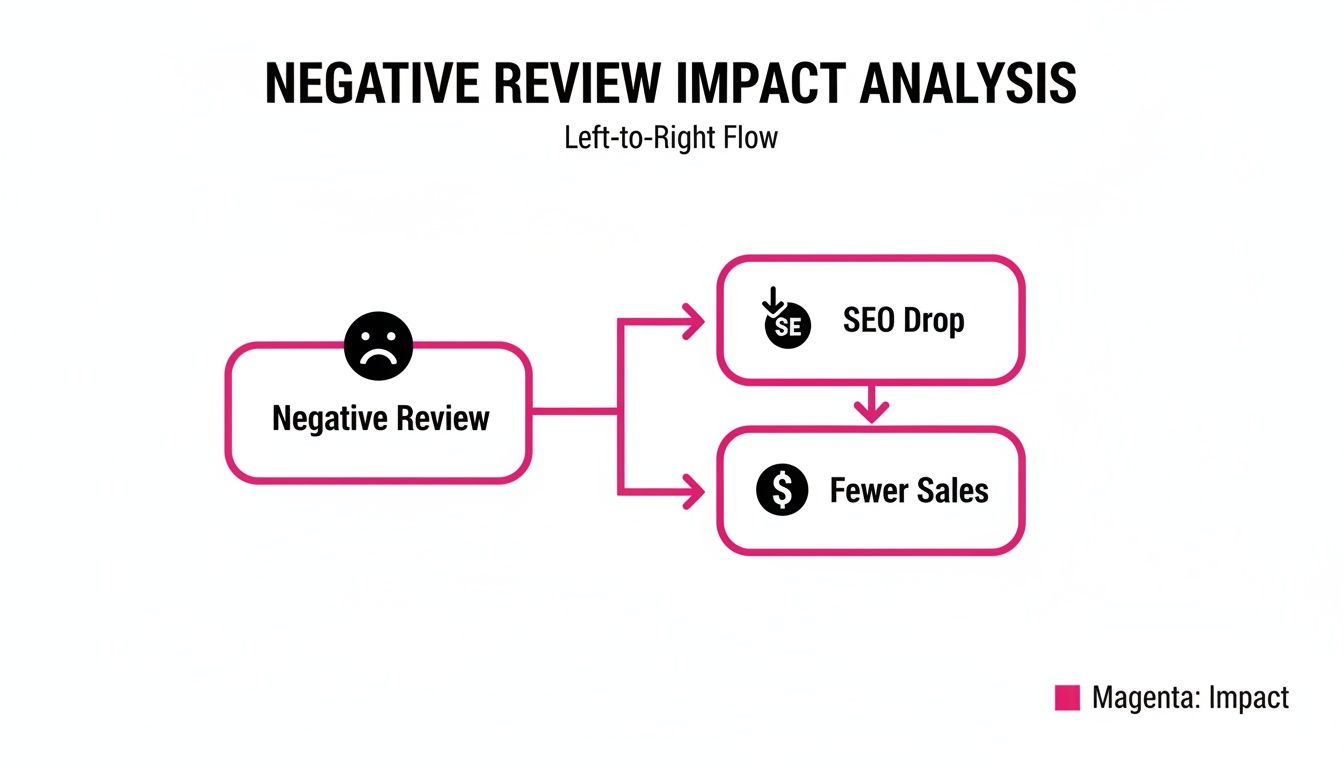
As you can see, the damage isn't just about feelings; it hits your visibility in search results and your actual bottom line.
Review Violation Checklist: Can This Review Be Removed?
Use this quick reference to see if a negative review violates Google's policies and qualifies for a removal request.
| Review Content Example | Potential Google Policy Violation | Removal Likelihood |
|---|---|---|
| "This place is awful! The manager, Sarah (the one with red hair), is a complete idiot." | Harassment (Personal attack on an employee) | High |
| "I never went here but I hate this company. 1 star." | Off-Topic (Not based on a real experience) | High |
| "Best plumber in town! From your friends at [Competitor Plumbing Co.]" (Posted with 1-star) | Conflict of Interest (Review from a competitor) | Medium to High |
| "The soup was cold and the waiter was rude." | None (Negative but legitimate opinion) | Very Low |
| "★★★★★ Visit my website for cheap loans! myfakewebsite.com" | Spam (Advertising/Promotion) | High |
Knowing these distinctions is crucial. Google's moderators are looking for clear-cut violations, not just general negativity.
Recognising Actionable Violations
Beyond the basics, there are several other serious violations that can get a review removed quickly. Google takes these very seriously as they often involve harmful or illegal content.
Get familiar with these less common but critical categories:
- Hate Speech: Any content that promotes violence or incites hatred against people based on their race, religion, gender, age, or other protected characteristics will be removed. No exceptions.
- Harassment: Using reviews to personally attack or bully someone is strictly forbidden. A review that targets a specific employee with personal insults is a prime example.
- Impersonation: If someone is pretending to be you, one of your staff, or anyone else to post misleading information, that’s a clear-cut violation.
- Restricted Content: Reviews can't be used to sell or promote regulated products like alcohol, gambling, pharmaceuticals, or weapons.
By focusing your efforts on clear policy violations, you dramatically increase your chances of success. The Google review teams deal with a massive number of requests, so making your case as clear and evidence-based as possible is the only way to get their attention.
Spotting these violations is the first step, but managing your entire review ecosystem is part of a much bigger picture. For a deeper dive, our guide on Google Business Profile management covers how to maintain a healthy and robust online presence from top to bottom.
Ultimately, your goal is to become an expert at telling which reviews are just negative opinions and which ones cross the line. This skill is your most powerful tool in protecting your business's reputation. Once you can confidently categorise a review, you're ready to move on to the flagging and escalation process.
The Playbook for Flagging and Escalating Reviews
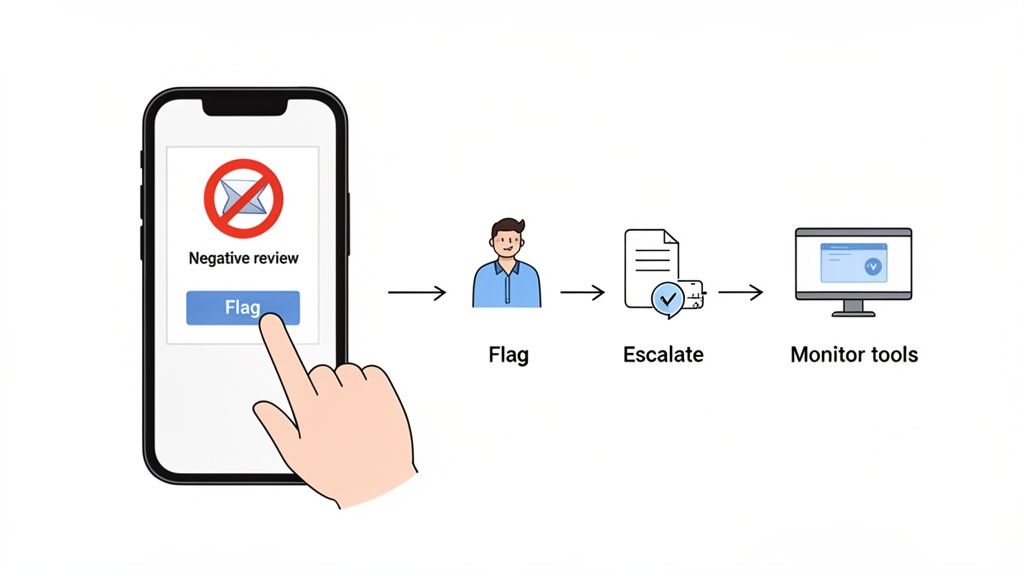
So, you've identified a review that clearly crosses the line and violates Google's policies. Now what? It’s time to take action.
The first step is always to flag the review directly through your Google Business Profile. This is your way of raising a hand and telling Google's moderation team, "Hey, I think this breaks the rules."
But let's be honest, just clicking "flag" and hoping for the best is a long shot. To actually remove negative reviews on Google, you need a solid game plan. It’s less about getting emotional and more about building a clear, factual case that fits neatly into Google's own content guidelines.
Mastering the Initial Flagging Process
Your first move is the simplest one. You can flag a review right from Google Search or Maps, and it’s the official starting point for getting it taken down.
Here’s how to do it right:
- Find the review in question: Pull it up on your Google Business Profile, either by searching for your business or finding it in Google Maps.
- Report it: Click the three little dots next to the review and hit "Report review."
- Choose the exact violation: You'll see a list of reasons for reporting. This is where most people go wrong. You have to pick the one that perfectly describes the problem. Is it a disgruntled ex-employee? That's a "Conflict of interest." Is it a political rant that has nothing to do with your business? That's "Off-topic."
Being precise is everything. Google's first line of defence is often automated, and its human moderators are looking for obvious violations. A vague report will almost always get rejected. Think of it as giving the moderator a clear signpost—the easier you make their job, the better your odds.
When Your First Attempt Fails: Escalation Tactics
What happens when you flag a review and… crickets? It’s an incredibly common and frustrating situation. This is where most business owners give up, but persistence is key. If your initial flag gets denied or you hear nothing back, it’s time to escalate.
Your next stop is the "Review Management Tool" inside your Google Business Profile dashboard. This is where you can check the status of reviews you've already reported and, more importantly, appeal the decision if it didn't go your way.
To build a stronger case for an appeal, you need to bring receipts.
- Conflict of interest? Find the reviewer's LinkedIn profile showing they work for your competitor and take a screenshot.
- Harassment? Pinpoint the exact phrases that use personal insults to target one of your staff members.
- Spam? Show that the review is part of a pattern, like several negative reviews from brand-new accounts popping up in a short space of time.
Document everything. This isn't the time for a long, emotional essay. You need to present concise, factual evidence that proves a specific policy was broken. The goal is to turn your simple flag into a well-documented report that a human support agent can’t ignore.
Here's the bottom line: The burden of proof is on you. Google’s default position is to keep reviews live to maintain transparency. To get one removed, you have to build an undeniable case that a specific rule has been breached.
The reality is that moderating online content is a huge task, and even governments are getting involved. In the UK, authorities have submitted over 2,200 content removal requests to Google since 2020. Even more telling is the 248% increase in these requests from 2020 to 2023, showing just how seriously malicious online content is being taken.
Streamlining Removal Requests for Multiple Locations
If you're managing more than one business location, trying to monitor and flag reviews manually across different profiles is a logistical nightmare. A single fake review can slip through the cracks and sit there doing damage for weeks before anyone even notices.
This is where dedicated tools become absolutely essential.
A proper reputation management platform brings everything into one place. Instead of juggling dozens of individual profiles, you get a single view of all your reviews. These systems can send instant alerts for new negative reviews, letting you assess and flag them immediately.
For any multi-location brand, this isn't just a nice-to-have; it's a necessity for protecting your reputation at scale. Platforms like LocalHQ's review manager give you the power to monitor feedback, flag dodgy content instantly, and manage all your responses from one dashboard. Nothing gets missed. This kind of organised approach saves countless hours and makes your efforts to remove harmful reviews far more effective, turning a chaotic chore into a proactive strategy.
What To Do When Flagging Just Isn't Enough: Your Legal Options
Let's be realistic. Sometimes, a bad review isn't just a disgruntled customer venting. It crosses a line. We're talking about content that's more than just negative—it’s defamatory, libellous, or a calculated attack designed to seriously damage your business.
When you've tried flagging it, escalated it, and the harmful review is still sitting there, it might be time to think about your legal options. This isn't a path you take lightly. Pursuing legal action is a major step, one you reserve for the most extreme cases where a review is provably false and causing you real, measurable harm.
Think of a rival business posting fake horror stories to poach your clients, or someone maliciously fabricating claims about illegal activity at your company. This is the territory where legal intervention becomes necessary.
First, Build Your Arsenal: Gathering Rock-Solid Evidence
Before you even dream of dialling a solicitor, your number one job is to collect evidence. Meticulously. This isn't just paperwork; it's the entire foundation of your case. Your aim is to assemble a file so thorough it leaves no doubt about the review's malicious intent and its impact.
When it comes to getting negative reviews on Google removed through legal channels, your argument is only as strong as your proof. A vague sense of injustice won’t cut it. You need facts.
Here’s what you should start gathering immediately:
- Complete Screenshots: Don't just grab the text. Capture the entire review—the reviewer's name, their profile picture, the date, the star rating, and every single word.
- A Clear Timeline: Note the exact date and time the review appeared. If you're facing a coordinated attack with multiple reviews, map them out on a timeline. This can reveal a pattern.
- The Reviewer's Profile: Click on their name and see what else they've been up to. Fake accounts often have zero other reviews, or they’ve left a string of identical nasty comments for other businesses. Screenshot that profile page.
- Proof of Damage: This is the clincher. Can you show a direct link between the review and a sudden drop in phone calls, website visits, or bookings? Pull the data from your Google Business Profile Insights, CRM, or sales reports. This turns a complaint into a quantifiable business injury.
Think of yourself as an investigator building a case file. The more evidence you have proving a review is not just false but a deliberate attempt to sabotage your reputation, the stronger your position will be when you approach Google's legal department or your own solicitor.
Taking the Formal Route: The Legal Removal Request
With your evidence file properly organised, you can now submit a formal Legal Removal Request to Google. This is a world away from simply clicking the 'flag' button. Here, you are making a formal legal argument that the content is unlawful, usually on the grounds of defamation.
You'll need to fill out a specific web form, explaining in detail why the review breaks the law. Get specific. Pinpoint the exact statements that are false and explain why they are false. Citing specific laws is helpful, but a clear, compelling explanation of the defamatory content is what truly matters.
This is where a good solicitor can be worth their weight in gold. They know how to frame the argument in precise legal language that gets the attention of Google’s legal team. Google isn’t a court of law, but they have a legal obligation to remove content that is demonstrably illegal.
And the good news? The authorities are finally catching up. Following a probe by the UK's Competition and Markets Authority (CMA) that started in 2021, Google has committed to a major crackdown on fake reviews. This means repeat offenders now risk having all of their reviews deleted across the UK and getting hit with permanent posting bans. This adds serious weight to your case. You can get the full story on these new measures by reading about Google’s updated pledges to the watchdog.
It's a lot of work, no doubt. But the legal route gives you a powerful final tool to defend your business against the most damaging and unfair attacks on your reputation.
Building a Bulletproof Online Reputation

While knowing how to remove negative reviews on Google is a vital defensive skill, the best long-term strategy is always a powerful offence. Chasing down every bad comment is exhausting and, frankly, often a losing battle. A far better approach is to build an online reputation so solid that the odd negative review becomes a minor blip, not a five-alarm fire.
This means shifting your mindset from reactive damage control to proactive reputation building. The aim is to create such a powerful wave of positive, authentic feedback that it naturally drowns out the negativity. After all, a single one-star review looks a lot less scary when it’s surrounded by dozens of glowing five-star experiences.
The Art of Encouraging Positive Feedback
The foundation of a healthy online profile is getting your happy customers to share their experiences. The trick is to do this without straying into territory that violates Google’s policies, like offering discounts or freebies for reviews. The real key is to make leaving feedback as easy and natural as possible.
Here are a few proven, policy-friendly ways to do it:
- Timing is everything. Ask for a review right at the peak of a customer's happiness. For a restaurant, that might be just after they’ve settled the bill for a fantastic meal. For a plumber, it could be a day after a successful, leak-free repair.
- Make it ridiculously simple. No one wants to jump through hoops. Use QR codes on receipts, send a polite follow-up email with a direct link, or pop a link into your text message confirmations. The fewer clicks it takes, the more likely you are to get a review.
- Personalise the request. A generic "leave us a review" blast is easy to ignore. Something more personal, like, "Hi Jane, we hope you’re enjoying your new garden. We’d love to hear about your experience with our team," feels genuine and is much more compelling.
The most powerful defence against negativity is a wellspring of positivity. By systematically encouraging feedback from your happiest customers, you build a resilient reputation that can withstand isolated criticism. This isn't just about your star rating; it’s about creating a true reflection of your business's quality.
Turning Responses into a Reputation Asset
Responding to every single review—good, bad, and neutral—is one of the most underrated tactics in reputation management. A thoughtful public reply shows potential customers you're engaged, professional, and genuinely care about customer service. It can completely reframe the narrative.
For positive reviews, a simple, "Thanks so much, Sarah! We're thrilled you enjoyed the new menu and hope to see you again soon" shows you’re listening and encourages others. But it’s your responses to negative reviews where you can truly shine. A calm, professional reply that acknowledges the issue, apologises, and offers to resolve it offline can completely neutralise a bad comment. It shows everyone else that even when things go wrong, you’re there to make it right.
Automating Your Reputation Defence
Manually keeping track of and replying to every review just isn't practical, especially as your business grows or if you manage multiple locations. This is where automation becomes a real game-changer. Modern tools can provide instant, on-brand replies, ensuring no customer ever feels ignored.
The review landscape is more volatile than ever. Recent data shows that review deletions on Google Business Profiles soared by over 600% in 2025 across English-speaking markets, including the UK. At its peak, nearly 2% of monitored locations had at least one review removed every single week, often due to Google’s crackdown on fake or incentivised content. For some sectors, like home services in the UK, deletion rates hit an incredible 3.4%, highlighting the constant battle against fake negatives from competitors.
This volatility makes automated monitoring and response systems invaluable. They help you:
- Craft Instant Replies: AI-powered auto-responders can generate personalised, on-brand replies in seconds, maintaining a consistent and professional tone for every piece of feedback.
- Maintain Consistency: Ensure every customer receives a timely acknowledgement, reinforcing your commitment to service and building trust.
- Boost Local Rankings: Google’s algorithm rewards engagement. Actively responding to reviews is a positive signal that can contribute to better visibility in local search and Maps.
Ultimately, the goal is to develop a complete strategy for Search Engine Reputation Management (SERM), blending proactive review generation with smart response management. By using the right tools, you can build a resilient online presence that not only defends against negative attacks but actively attracts new customers. For a deeper look into how this works, check out our guide on https://localhq.io/how-to-use-ai-for-local-seo/ to see how automation can transform your entire strategy.
Got Questions About Dealing with Bad Reviews? We’ve Got Answers
Let’s be honest, navigating the world of online feedback can feel like walking through a minefield. You’ve got questions, and the answers aren’t always cut and dry. This section gets straight to the point, offering practical advice for the trickiest situations you'll face when trying to remove negative reviews on Google.
How Long Does It Really Take for Google to Remove a Review?
This is the million-pound question, isn't it? Unfortunately, there's no single, satisfying answer. The timeline can swing wildly, from a few short days to several weeks—and sometimes, the review never comes down.
What’s behind the delay? It usually boils down to a few key factors:
- The Obviousness of the Breach: If a review is packed with clear-cut hate speech or a direct personal threat, it’s often zapped quickly. I’ve seen these disappear in as little as 24 to 72 hours. That’s because it's an open-and-shut case for both automated systems and human moderators.
- The Nuance of the Claim: Things get trickier with subtle violations. A review from a suspected competitor claiming a "conflict of interest" requires a proper investigation from Google’s side. They need to verify the claim, which can easily stretch the process out for weeks. You absolutely need solid proof to back up these kinds of flags.
- The Sheer Volume of Reports: Google is drowning in removal requests every single day. Your report is just one in a very long queue, and when things get busy, delays are pretty much guaranteed.
My best advice is to be patient but persistent. If you've heard nothing but radio silence for a couple of weeks after your initial flag, it's time to escalate. Use the Review Management Tool to appeal the decision and arm yourself with any extra evidence you’ve gathered.
What if a Negative Review Is Factually Wrong but Doesn’t Break Any Rules?
This is probably one of the most maddening scenarios for any business owner. A customer might claim you’re closed on Sundays when you’re open, or that you don’t offer a service that’s plastered all over your website. While totally incorrect, these statements don’t usually violate Google's policies against things like harassment or spam.
In these situations, forget the "flag" button—your most powerful weapon is your public response.
A polite, professional, and factual correction can do far more to win over future customers than getting the review taken down. For instance:
"Hi [Customer Name], thanks for your feedback. We're sorry for any confusion. Just to clarify for you and other customers, our correct Sunday hours are 10 am – 4 pm, as listed here on our profile. We hope you'll give us another try soon."
This simple reply does two things brilliantly: it sets the record straight for everyone reading, and it shows you're an attentive and helpful business owner.
How Should I Handle a Review From a Real but Unhappy Customer?
Sooner or later, it happens. Your team dropped the ball, and a customer had a genuinely bad experience. Their negative review is legitimate. Trying to remove these reviews is almost always a waste of your time. Worse, it can completely backfire if the customer catches on that you're trying to silence them.
Here, your strategy needs to shift entirely to resolution and reputation repair. It’s not just about removal; knowing how to effectively respond to negative feedback is a vital skill for winning back trust and protecting your image.
A great response really just follows a simple, human formula:
- Acknowledge and Apologise: Kick things off by thanking them for bringing it to your attention and apologising for their experience. Something like, "We're so sorry to hear we didn't meet your expectations."
- Take it Offline: Give them a direct path to a solution. "We'd like to learn more and make this right. Please could you contact our manager, Sarah, at [email/phone number]?"
- Show Accountability: This one simple move shows everyone reading that you take customer service seriously and don't hide from mistakes.
Once you sort out the problem privately, you might find the customer is willing to update or even remove their review. It's okay to ask politely, but never, ever pressure them. A sincere resolution is your most powerful tool.
Managing your online reputation can feel like a full-time job. LocalHQ gives you back your time with AI-powered tools that monitor reviews, craft instant on-brand replies, and provide the insights you need to build a bulletproof presence on Google. See how you can automate your reputation management and drive real growth at https://localhq.io.