Tracking Google Rankings (tracking google rankings) for Local UK Visibility
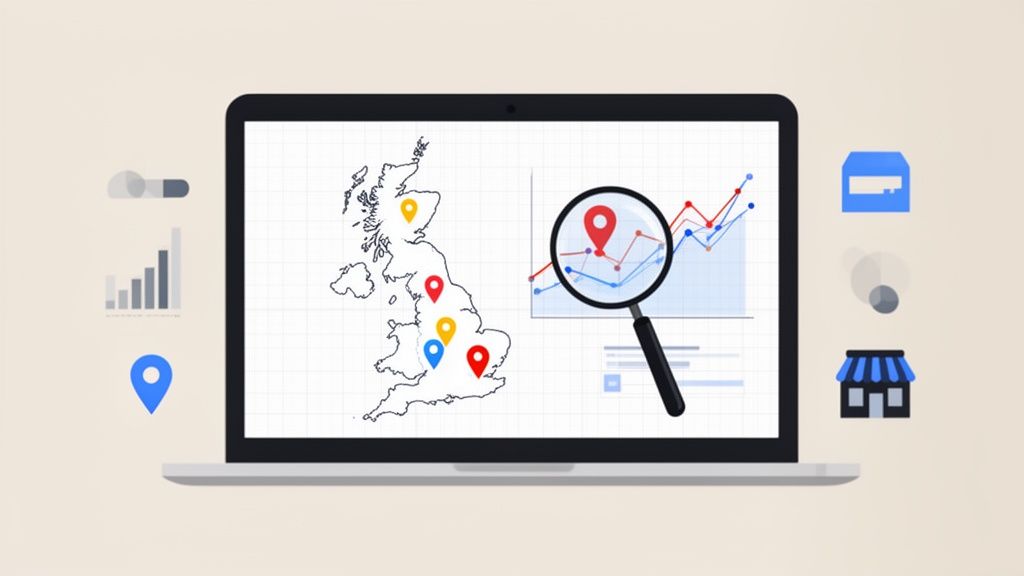
Tracking your Google rankings means keeping a close eye on where your website shows up on Google's search results pages for the keywords that matter most to your business. For any UK business, let's be blunt: if you're not visible on Google, you're practically invisible to potential customers. This isn't just a technical task; it's a core business activity.
Why Tracking Google Rankings Is Crucial for UK Businesses
For local shops, service providers, and restaurants scattered across the UK, search visibility isn't an abstract metric. It directly translates into real-world results: more footfall through the door, more phone calls, and more online orders. We're talking about connecting your position on a search results page directly to your revenue.
The sheer dominance of Google in the UK makes this connection impossible to ignore. Google Search holds a massive 93.35% market share here, making it the undisputed king of how Brits find local businesses. It's been the source for over 90% of search referrals since 2018, cementing its role as the main gateway to your customers.
Connecting Rankings to Real-World Results
Just think about how people behave every day. When someone needs an emergency plumber in Bristol or is hunting for the best Sunday roast in York, their first instinct is to pull out their phone and search on Google. Showing up in those top results is the modern-day equivalent of having the best spot on the high street.
This is why a systematic approach to tracking your Google rankings is non-negotiable for survival, let alone growth. It allows you to:
- Measure SEO Performance: You can actually see if your optimisation efforts are paying off and delivering a return on your investment.
- Keep an Eye on Competitors: Notice when rivals are creeping up the rankings and figure out what they’re doing differently to inform your own tactics.
- Spot Opportunities and Threats: Proactively find keywords where you're losing ground and, just as importantly, discover new terms you could be targeting for growth.
Understanding the SERP Landscape
Before we get into the nuts and bolts of local rank tracking, it’s worth getting your head around exactly what is SERP tracking is and why it forms the backbone of any solid SEO strategy. This foundational knowledge is key to making sense of the data you'll be collecting.
By consistently monitoring your positions, you move from guessing to knowing. You can pinpoint which marketing activities drive results and make data-backed decisions that directly impact your bottom line. It’s the difference between navigating with a map and driving blind.
Ultimately, tracking your rankings gives you the critical feedback loop needed to refine your strategy. Without it, you're just throwing time and money at local SEO without any real idea if it's making a difference. To climb higher, it's also vital to understand the key https://localhq.io/local-seo-ranking-factors/ that Google uses to rank businesses like yours.
Building Your Local Rank Tracking Foundation
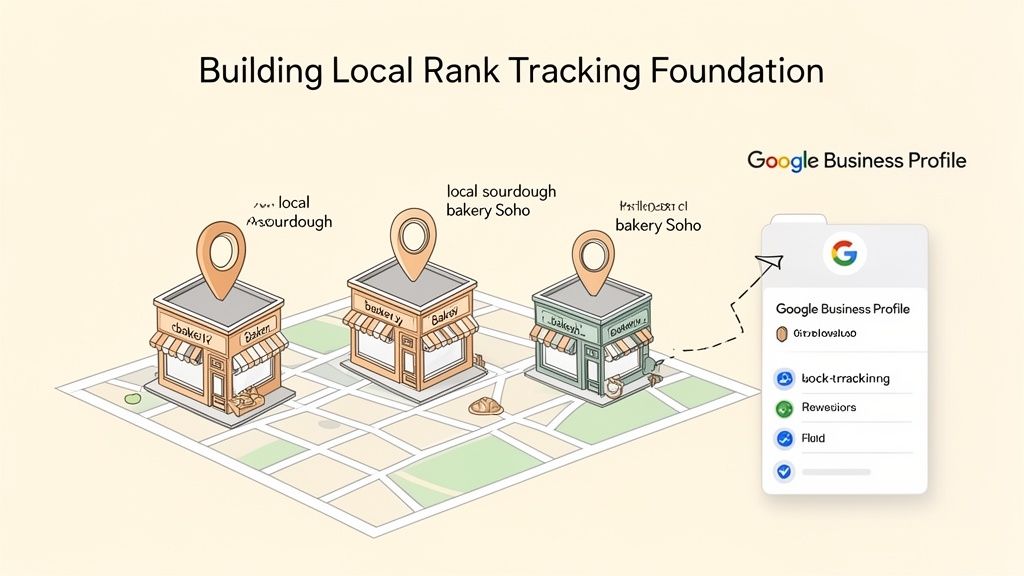
Jumping into rank tracking can feel a bit overwhelming at first, but if you get the foundations right from the start, everything else falls into place much more easily. The real goal here isn't just to watch a list of keywords go up and down; it's about getting inside your customers' heads and tracking the exact phrases they type into Google when they need what you offer.
This all begins with choosing the right keywords. Forget about generic terms like "bakery" or "electrician"—they're just too broad to give you any real insight. You need to zero in on high-intent, localised phrases that scream 'I need this now!' Think 'artisan sourdough delivery in Islington' or '24-hour emergency electrician in Manchester'.
These are the terms that capture the voice of a customer on the verge of making a purchase. Getting this right is absolutely vital because Google is, without a doubt, the front door for local businesses. Since 2018, it has completely dominated UK search referrals, and its influence now fuels an eye-watering £118 billion in economic activity through Search, Maps, and Business Profiles. You can dig into more of the numbers on Google's impact in the UK over on Statista.
Organising Keywords for Actionable Insights
Right, so you’ve got your list of high-value keywords. What next? A massive, jumbled list is a recipe for a headache and won’t tell you much. You need to group your keywords logically. This is the secret to turning raw data into something you can actually use to make smart decisions.
Here are a few ways I've seen work really well for clients:
- By Service or Product: A local bakery, for instance, might create separate groups for 'Wedding Cakes', 'Vegan Pastries', and 'Corporate Catering'. Simple.
- By Location or Neighbourhood: A plumbing firm covering a big city could split their keywords into 'Plumbing services in Camden', 'Boiler repair in Hackney', and 'Drain unblocking in Greenwich'.
- By Customer Intent: It's also smart to separate informational searches (like 'best coffee shops near me') from transactional ones where someone is ready to buy (e.g., 'order coffee beans online London').
This kind of structure turns a chaotic spreadsheet into a clean, organised dashboard. You can see at a glance which services are flying high in the search results and which ones need a bit of a push.
Connecting Your Google Business Profile
For any business that relies on local customers, this next bit is non-negotiable: you absolutely must connect your Google Business Profile (GBP) to your rank tracking tool. This is the key that unlocks genuinely accurate, hyperlocal data. Without it, you're flying half-blind.
Connecting your GBP gives your tracking software the exact business details it needs to mimic searches from different points on a map, just like a real customer would. This is how you find out how you really rank on the streets surrounding your business.
Let's take our bakery again. Imagine it has shops in Notting Hill, Shoreditch, and Brixton. A general, London-wide ranking is pretty much useless to them. What they need to know is how they're performing in each of those unique neighbourhoods.
By connecting each location's GBP, they can track rankings for 'croissants near me' as if they were standing on a street corner in each of those distinct areas. It’s this granular, street-level view that provides the most valuable insights for driving real footfall, turning abstract data into a clear plan of action.
Seeing Your Business Through Your Customers’ Eyes with Geo-Grid Tracking
Let’s be honest: checking your Google ranking from the office computer tells you almost nothing. Why? Because your customers aren't searching from your desk. They're searching from their homes, their workplaces, and on their phones while walking down the street. This is where geo-grid tracking comes in, and it's a game-changer for any local business.
Instead of giving you a single, often misleading, rank, a geo-grid simulates searches from dozens of different points across your service area. It then paints a picture—a "visibility heatmap"—of where you actually show up. Think of it as seeing your rankings on a street-by-street level.
Suddenly, you can pinpoint the exact neighbourhoods where you’re invisible, even if they're only a few miles away. These are the hidden growth opportunities that standard rank tracking will never show you.
Setting Up Your Grid for Meaningful Data
The trick to a useful geo-grid is making it mirror your real-world service area. Don’t just plonk a square on a map and hope for the best. You need to think strategically about the postcodes, towns, and specific communities you want to win over.
Your setup should answer real business questions. Here’s what to consider:
- Grid Size: How far do your customers travel? A small 3×3 grid might be perfect for a local coffee shop, but a plumber covering an entire city will need something much larger, like a 13×13 grid, to get a true picture.
- Grid Centre: Pinpoint the heart of your operation. This could be your physical shop front or the epicentre of your most valuable customer base.
- Scan Points: Each point on the grid is a virtual searcher. More points mean more detail, but it can also cost more. It’s often best to start with a balanced grid and add more detail later if you spot a problem area.
Let’s take a real-world example. Imagine you’re an estate agent in central Leeds. A quick search from your office shows you’re ranking #1 for 'estate agents in Leeds'. Fantastic, right?
But the geo-grid tells a different story. You discover that for anyone searching from Horsforth—a key, affluent suburb—you’re languishing on the second page. That single piece of information is gold. It tells you exactly where to focus your marketing, maybe by creating a "Horsforth Property Guide" or running a highly targeted ad campaign for that postcode.
How to Interpret Your Geo-Grid Rank Tracker Results
Once the data starts rolling in, you need to know what it means. The heatmap's colours make it incredibly intuitive: green is good, red is bad. But turning that insight into action is what really matters. This table breaks down how to read the results and what to do next.
Here’s a simple way to translate those colourful dots into a concrete action plan.
| Grid Colour or Ranking | What It Means for Your Business | Recommended Action |
|---|---|---|
| Top 3 (Green) | You're a top player here. Customers in this zone will find you easily. | Keep doing what you're doing. Now’s the time to actively ask for reviews from customers in this area to solidify your position. |
| Positions 4-10 (Amber) | You’re on the map, but you’re not the first choice. Competitors are likely being clicked on before you. | Get specific. Optimise your Google Business Profile with mentions of this neighbourhood and consider creating content about local projects you've completed here. |
| Page 2+ (Red) | You're basically invisible. This is a huge gap in your local market coverage. | This is your priority. Launch a focused local SEO push for this area, targeting local keywords, building links from nearby businesses, and creating neighbourhood-specific pages on your website. |
By checking your geo-grid regularly, you move from guesswork to strategy. It stops being about abstract numbers and becomes a visual roadmap for winning customers, one neighbourhood at a time.
Analysing Trends and Benchmarking Against Competitors
Gathering all that ranking data is one thing, but turning it into smart business decisions is where the magic really happens. Look, tracking your Google rankings isn't about having a meltdown every time a keyword dips for a day. It’s about learning to spot the real patterns—the shifts that tell you something important is happening with your visibility.
A single keyword dropping a couple of spots overnight? That’s usually just statistical noise. But if you see a whole group of your most profitable service keywords start a slow, steady slide over three weeks, that’s a trend. That’s a fire you need to put out.
This is the fundamental difference between simply having data and actually gaining insight.
This flow diagram breaks down the process of turning raw geo-grid data into something you can actually use.
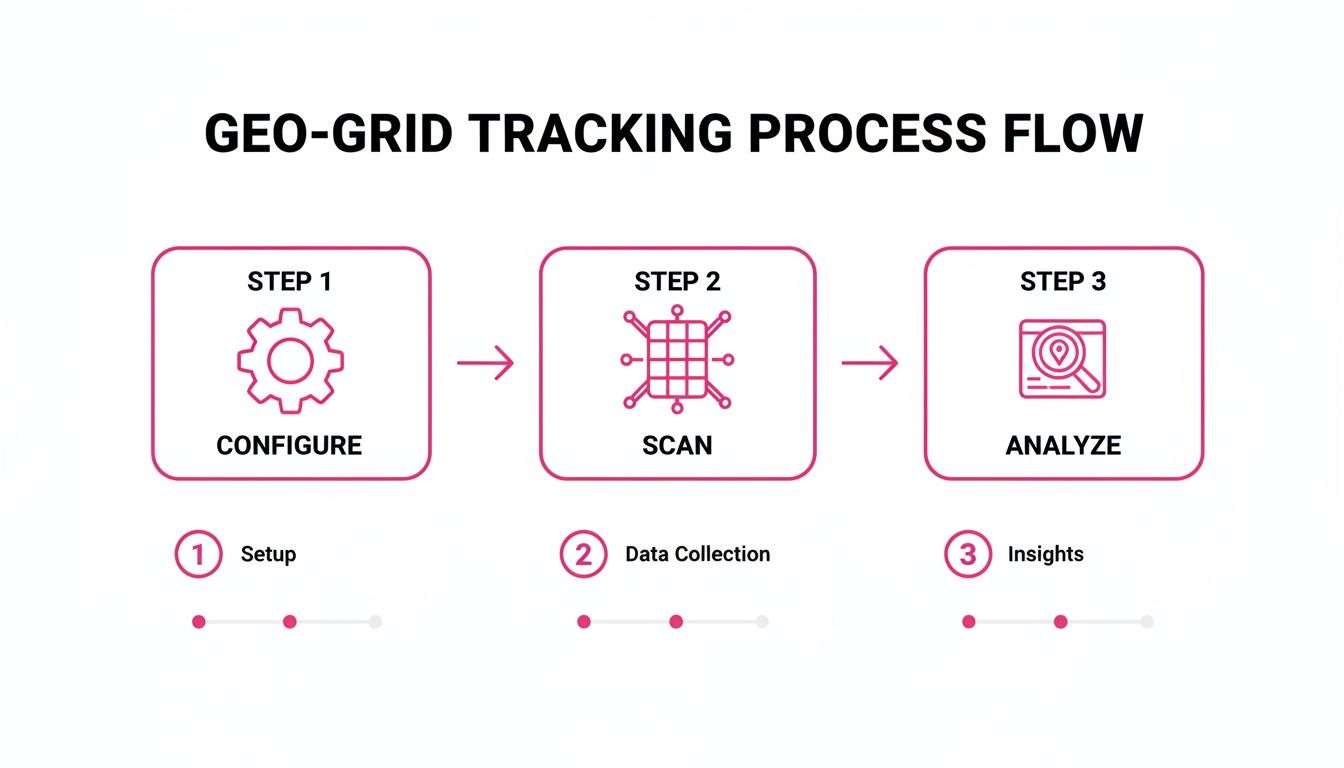
It really just boils down to a simple loop: configure, scan, analyse. Get this right, and you've nailed the foundation of any solid local rank tracking strategy.
Adding Context to Your Ranking Data
Your rankings don't just fluctuate for no reason. A sudden drop or an unexpected surge is almost always tied to something specific, and it's your job to put on your detective hat. The story behind the numbers is everything.
Think about these real-world examples:
- Your Own Marketing Efforts: Did your rankings for ‘emergency boiler repair’ suddenly improve? Maybe it was that detailed blog post you published last month, or perhaps that local ad campaign finally kicked in. You need to connect your actions to the results.
- Google Algorithm Updates: Google is always tinkering. In 2025, we saw some huge updates that created chaos in the search results. Data from Sistrix revealed that a staggering six in ten (60%) of the biggest news sites saw their visibility tank. We see the same volatility in local search, too. A core update can completely reshuffle the local pack overnight, changing your ‘near me’ rankings even if you haven’t touched a thing. Press Gazette covered these dramatic ranking shifts in detail if you want to dig deeper.
- What Your Competitors Are Doing: Have you spotted a local rival suddenly jump ahead of you for one of your most important keywords? It’s time to find out what they did.
Your ranking data tells you what happened. Your analysis needs to tell you why. This is the step that separates businesses that are always reacting from those who are actively shaping their own success.
Benchmarking Against Local Rivals
Honestly, one of the most powerful things you can do with a rank tracker is keep tabs on the competition. Adding your top three or four local rivals into your tracking tool gives you a vital benchmark to measure your own performance against.
Let’s say a competitor suddenly shoots to the top for ‘best flat white in Soho’. The first thing you should do is dive into their online presence. Have they just been hit with a wave of new five-star reviews all talking about their amazing coffee? Did they upload a bunch of new, professional-looking photos of their café and latte art to their Google Business Profile?
This kind of side-by-side comparison gives you the clues you need to sharpen your own local SEO strategy and fight back.
Turning Insights into Action with Reports and Alerts
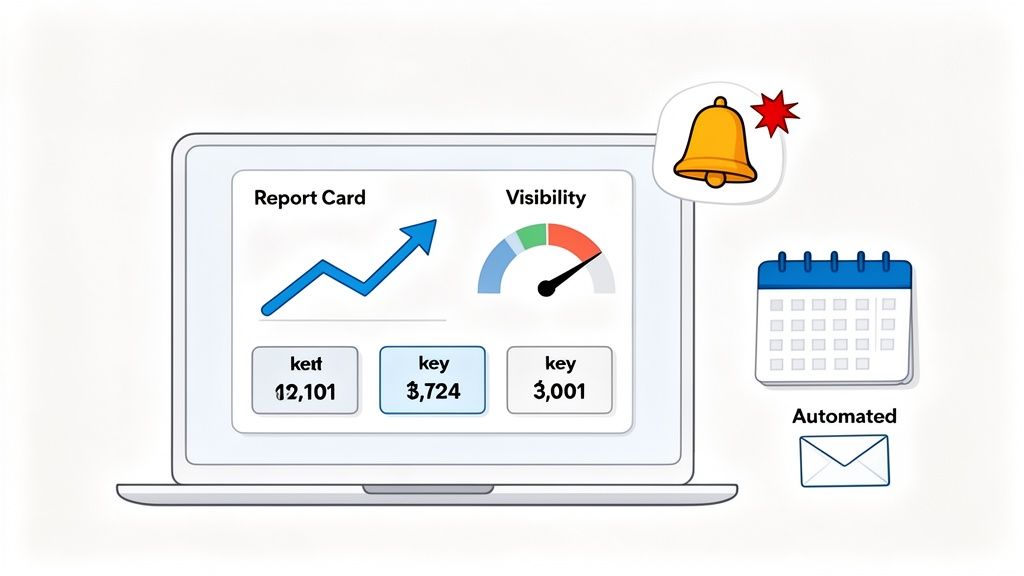
All this data you’ve collected is fantastic, but it’s essentially worthless until you actually do something with it. This is where the rubber meets the road—turning your rank tracking insights into a system that proactively protects and grows your local search presence.
The first move is to ditch the overwhelming spreadsheets. No one wants to squint at endless rows of numbers. The goal is to translate complex data into clean, simple reports that tell a clear story about what's working and what isn't.
To get this right, you’ll want to lean on good local SEO reporting tools. They’re built specifically to take the headache out of data visualisation and automate getting the right information to the right people.
Building Reports That Matter
A great report doesn't just present data; it tells a story. Instead of just listing out keyword positions, you want to focus on metrics that give a fuller picture of your visibility. This makes it far easier to communicate progress and value to your team or clients.
A truly powerful report should always highlight:
- Average Rank: This gives you that high-level, birds-eye view of how your entire keyword set is trending over time, smoothing out the noise of daily ups and downs.
- Visibility Score: Often shown as a percentage, this metric gives a solid estimate of your overall search presence based on your rankings and keyword search volume. It’s a great single metric to track.
- Share of Voice: This is brilliant for context. It shows you what slice of the search traffic pie you’re actually capturing compared to your key competitors.
When you focus your reporting this way, your progress becomes tangible and easy to grasp. We go into much more detail on this in our guide to creating effective https://localhq.io/seo-reports-for-customers/.
Setting Up Proactive Alerts
Weekly or monthly reports are perfect for tracking long-term progress, but you need something more immediate to guard against sudden problems. Waiting until your end-of-month report to spot a catastrophic ranking drop for a core keyword is a recipe for disaster.
Think of automated alerts as your digital smoke alarm. You set them up to trigger when something significant happens, giving you the chance to react immediately before a small issue becomes a major crisis.
You can get really specific here. For instance, you could set an alert to fire the moment one of your top-five, money-making keywords falls out of the top three spots. When that email pings into your inbox, you can jump right in. Was it a competitor's aggressive new campaign? A sudden flurry of negative reviews? Or a technical hiccup on your own website?
This kind of proactive monitoring turns your rank tracker from a passive measurement tool into an active guardian of your online visibility. It's how you stay ahead of the game and maintain your momentum.
Got Questions About Tracking Your Google Rankings?
Jumping into the world of rank tracking can feel a bit like learning a new language. There's a lot of jargon and plenty of moving parts, so it's completely normal to have questions swirling around. We've pulled together some of the most common queries we hear from UK business owners to give you clear, no-nonsense answers.
The whole point is to take the mystery out of it all, so you can feel confident you're measuring what matters for your local search performance.
How Often Should I Be Checking My Rankings?
This is the big one, and the honest-to-goodness answer is: it depends on your keywords. If you're targeting a handful of high-stakes, super-competitive terms that bring in most of your business, then checking daily or every few days makes a lot of sense. You'll want to know immediately if a competitor has leapfrogged you or if you’ve had a sudden drop.
For the vast majority of local businesses, though, a weekly check-in is the sweet spot. It's frequent enough to catch important trends before they become problems, but not so often that you get lost in the daily noise. Monthly checks? That's just too long to wait – you could be bleeding customers for weeks without even realising it.
A quick tip from the trenches: Don't get hung up on every tiny movement. Your real goal is to spot the patterns over several weeks. A one-day dip of a few spots is usually just Google being Google. A two-week slide, on the other hand, is a clear signal that something needs your attention.
Why Do My Rankings Bounce Around So Much?
Seeing your rankings jump up and down can be frustrating, but rest assured, you’re not alone. The search results page is a living, breathing thing that's always in flux. There are a few key reasons for this constant motion:
- Google's Constant Tinkering: Google is forever tweaking its algorithms. We all hear about the big, named updates, but smaller, unannounced changes roll out all the time, causing ripples across the search results.
- Your Competitors Are Busy: The other businesses in your area aren't just sitting on their hands. Every time they get a burst of new reviews, publish a new blog post, or build a fresh set of local links, it can shake up the rankings.
- It's All Local: Search results are intensely personal and local. A search for a "plumber in Bristol" will show completely different results from the same search conducted in Birmingham. This is precisely why geo-grid tracking is so critical for getting an accurate picture.
- The SERP Itself Changes: Google loves to experiment. One week the map pack might be huge, the next it might be smaller. New ad formats or "People Also Ask" boxes can appear, pushing your organic listing further down the page even if your actual rank hasn't budged.
Can I Just Track My Rankings Myself for Free?
Technically, yes, you can get a rough idea without spending a penny. You could use Google Search Console to see your average position for some keywords or run manual searches yourself in an incognito browser window.
But here’s the reality check: that approach is incredibly time-consuming and, frankly, not very accurate. Manual checks don't properly account for the localisation that's vital for a local business. You simply can't get that street-by-street view of your visibility.
A proper rank tracking tool automates the whole process, gives you that crucial geo-grid data, and stacks your performance up against your main competitors. For what often amounts to just a few quid a month, the strategic insight you gain is worth every penny.
Ready to stop guessing and start knowing exactly where you stand? LocalHQ provides the powerful geo-grid rank tracker, competitor benchmarking, and automated reporting you need to take full control of your local SEO. See how your business really appears to customers and turn those insights into more calls, visits, and sales. Discover how LocalHQ can transform your local visibility today.