A Practical Guide to Reputation Management for Small Businesses
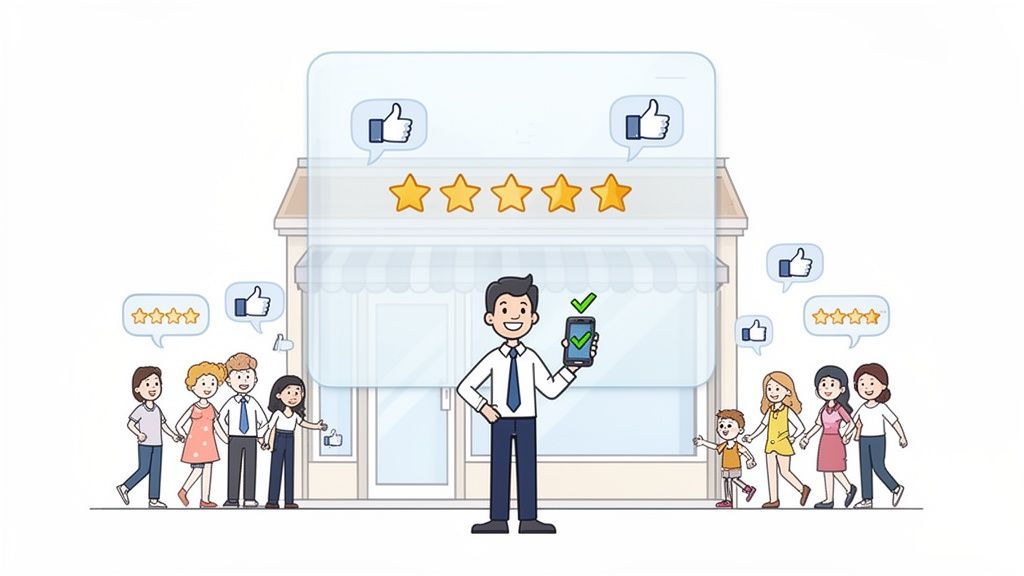
Reputation management for a small business is really about one thing: actively looking after how people see your brand online. It’s about keeping an eye on customer reviews, getting back to people when they leave feedback, and building a positive presence that brings in new customers and keeps the regulars coming back.
Think of it as your digital kerb appeal. It's the first impression you make before anyone even steps through your door.
Why Your Online Reputation Is Your Most Valuable Asset
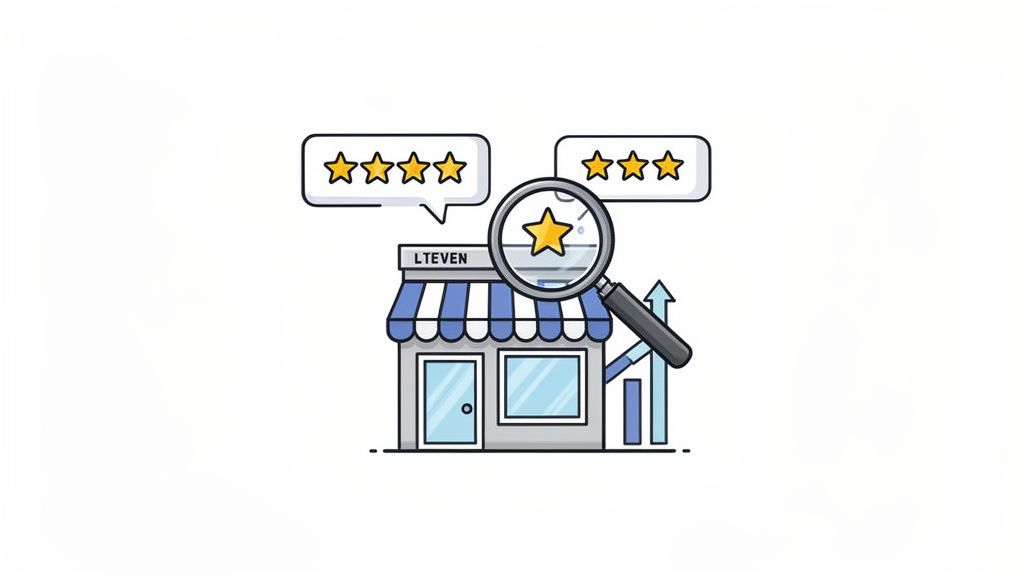
For a local business, your online reputation is so much more than a few star ratings. It’s your digital handshake, your standing in the community, and often, the very first interaction a potential customer has with you. We all do it—before we buy, we search. The reviews and comments people find online directly influence whether they trust you enough to pick up the phone or visit your shop.
A steady stream of positive feedback works like a brilliant, free marketing machine. Every glowing review builds your credibility. And every thoughtful response to a bit of criticism shows you genuinely care about your customers' experience. This online word-of-mouth is absolutely vital for driving real-world sales and foot traffic.
The Direct Link Between Reviews and Revenue
The connection between your online reputation and your bank balance isn't just a vague idea; it's a hard fact. When people search for local services, Google and other search engines look at review signals—your average rating, how many reviews you have, and how quickly you reply—to decide who gets the top spots.
It’s a simple equation: a higher ranking means more eyes on your business, which leads to more clicks, more calls, and more customers. Ignoring what people are saying about you online isn't a passive choice. You're effectively handing business over to your competitors who are paying attention. This is why active reputation management for small businesses is a core part of growing your business, not just a box-ticking exercise.
Why UK Small Businesses Must Pay Attention
In the UK, small businesses are the lifeblood of the economy, and the power of an online reputation is even more pronounced here. There are over 5.45 million small firms, and the choices people make based on reviews can make or break a local market.
Despite this, it's surprising how few businesses are really on top of it. Studies show only about 15–17% of small businesses use review platforms to market themselves, even though they have a huge impact on local search visibility. This is a massive opportunity for anyone willing to get involved. Just by monitoring and replying to reviews, you can pull way ahead of the competition.
A great customer experience and a solid reputation go hand-in-hand. When you manage your reputation well, you create advocates for your brand and earn a bit of grace when things occasionally go wrong—two things every local business needs.
A strong reputation doesn’t just bring in new faces; it helps you keep them loyal. This is all backed up by having consistent business details online, which is why understanding what are local citations and making sure they're accurate is such a crucial first step. At the end of the day, every single review is a new chance to strengthen your brand and grow.
Getting Your Reputation Management Toolkit in Order
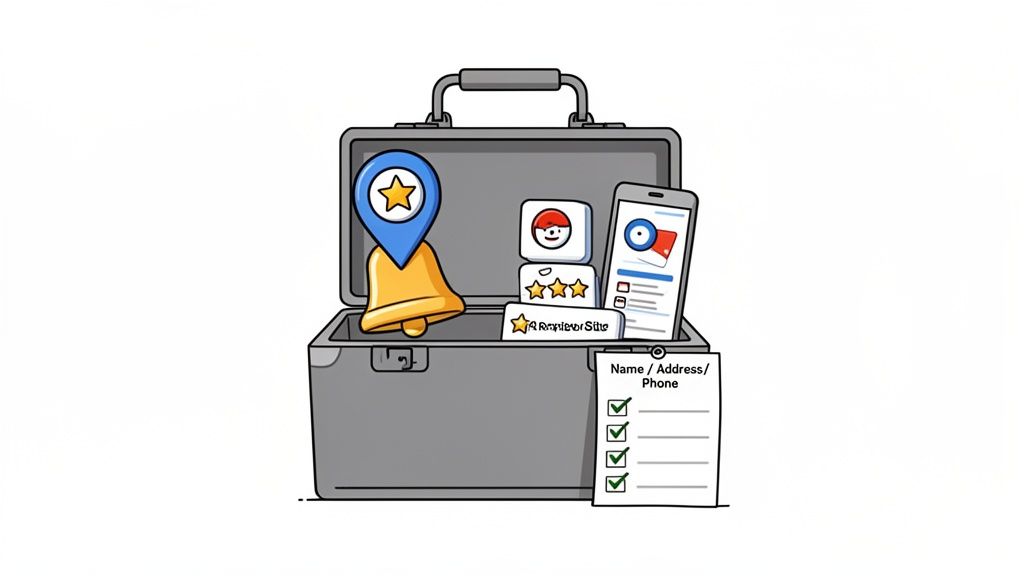
Let's be honest, you can't manage your reputation if you don't know what people are saying. Good reputation management isn't about fancy, expensive software; it's about setting up the right listening posts across the web. And it all starts with the single most important piece of your digital puzzle.
First things first: you absolutely must claim and take full control of your Google Business Profile (GBP). This is non-negotiable. Think of it less as a simple listing and more as your digital shopfront on the world's biggest search engine. Simply claiming it is the starting line; optimising it is how you begin earning trust before a potential customer even lands on your website.
Your Google Business Profile Is Your Anchor
A well-tended GBP is the hub of your online reputation. It’s the first port of call for customers searching for reviews, photos, opening times, and your phone number. Keeping it complete and active sends strong signals to Google that you’re a legitimate, trustworthy business, which in turn can give your local search rankings a welcome boost.
Make sure you fill out every single section with accurate, detailed information. This means your hours, service areas, photos, and a keyword-rich description of what you do. For a full walkthrough, our guide to Google Business Profile management breaks down how to turn that profile into a real customer-generating machine.
Think of your GBP as the foundation of your digital reputation. Every other platform and directory will, in some way, be compared against the information you have here. Getting this right from the start prevents countless headaches later on.
Pinpoint the Platforms That Actually Matter
While Google is king, it's not the only court where customers hold sway. Depending on your industry, other platforms can be just as critical. The trick is to focus your efforts where they'll have the most impact, instead of spreading yourself thin trying to be everywhere.
A few examples I see all the time:
- Hospitality: If you run a pub, restaurant, or hotel, you have to be on top of your TripAdvisor profile.
- Home Services: For plumbers, electricians, and builders, sites like Checkatrade or TrustATrader are often where trust is built.
- Retail & General Services: Yelp and your own business Facebook Page are still huge hubs for customer feedback.
Identify the top two or three review sites for your sector and get your profiles claimed and polished. Crucially, make sure your business details on these sites match your GBP exactly.
Set Up a Simple Monitoring System
With your profiles in place, you need a straightforward way to keep an eye on things without it becoming a full-time job. You can get started with some brilliant free tools.
- Set Up Google Alerts: This is a must-do. Create alerts for your business name, your main products or services, and even the names of your key team members. You’ll get an email whenever these terms pop up on a new web page, blog, or forum.
- Turn On Platform Notifications: Dive into the settings on your key review sites and ensure email notifications are switched on. Most will ping you the moment a new review lands, letting you respond quickly.
As you grow, a dedicated tool that pulls all your reviews into one dashboard can be a real time-saver. But for now, these free methods are more than enough to keep you in the loop.
Why NAP Consistency Is a Deal-Breaker
One of the most common—and damaging—mistakes I see is a lack of NAP consistency. This simply means your Name, Address, and Phone number must be identical everywhere online. Even tiny differences, like "Ltd" vs. "Limited" or "St" vs. "Street", can confuse search engines and make customers question your legitimacy. Inconsistent data tells Google it can't be sure which information is correct, and that can really hurt your visibility in local search results.
The UK market is packed with over 5.5 million businesses, most of them small enterprises like yours. In this crowded space, small errors can lead to big missed opportunities. In fact, some studies show that as many as 85% of UK small businesses might not be actively managing their online listings and reviews. This is a massive opening for anyone who takes the time to get it right. Consistent, accurate data is a direct and powerful driver of local SEO success.
How to Respond to Every Type of Customer Review
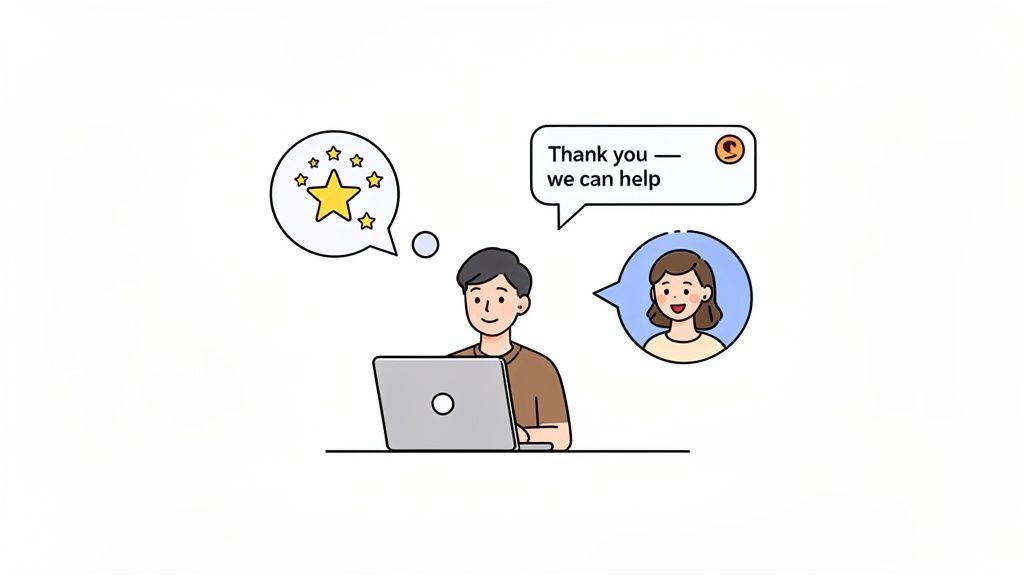
Think of every single review—good, bad, or indifferent—as a public conversation. It’s your chance to show potential customers what you're really about: a business that listens, cares, and genuinely values what people have to say. Moving beyond a generic "thanks" can turn a simple comment into a powerful piece of marketing.
Prompt and personal responses are everything. A swift reply doesn't just make the reviewer feel good; it shows everyone else watching that you're an engaged and responsible business owner. The real goal here is to craft responses that build loyalty and echo your brand's values, turning feedback into a genuine asset.
Mastering the Five-Star Review
It’s tempting to see a glowing five-star review, fire off a quick "Thank you!", and move on. But that’s a massive missed opportunity. A five-star review is your cue to amplify that positivity and give future customers yet another reason to choose you.
A truly great response should always hit three key points:
- Thank them personally. Use their name if it’s available—it makes a difference.
- Echo the positive. Mention the specific thing they complimented. This proves you’ve actually read their review and it subtly reminds others of what you do well.
- Invite them back. A simple call to return helps foster genuine loyalty.
For example, imagine you run a local coffee shop. A solid response would be: "Hi Sarah, thank you so much for your kind words! We’re thrilled you enjoyed our flat white and the relaxed atmosphere. We can't wait to welcome you back for another coffee soon!" See? That simple formula turns a thank-you note into a personal connection.
Handling Constructive Four-Star Feedback
The four-star review is often where the real gold is. These are customers who are generally happy but offer a specific, valuable suggestion for how you could be even better. Ignoring their advice is a mistake. Embracing it shows you're committed to being the best you can be.
Your response should always acknowledge their praise first, then address their suggestion with sincerity. Let them see you’re taking their feedback on board. For instance: "Mark, we're so glad you enjoyed the meal! Thank you for the feedback on the music volume—we’ll definitely look into adjusting it to create a better ambiance for everyone. We really appreciate you helping us improve and hope to see you again."
Responding to every review isn’t just about customer service; it’s a public display of your company’s character. Every reply is a chance to win over the silent majority of potential customers who are watching how you handle feedback.
This approach validates their experience and makes them feel heard, which can easily turn a four-star reviewer into a five-star advocate on their next visit. Nailing these conversations is a core part of any successful reputation management for small businesses strategy.
De-Escalating Negative Reviews
A negative review can feel like a punch to the gut, but a panicked or defensive response will only pour fuel on the fire. The key is to de-escalate the situation publicly and then take the resolution offline. Whatever you do, never get into a back-and-forth argument online.
Stick to a simple, calm framework for your public reply:
- Acknowledge and Apologise. Start by thanking them for their feedback and apologising that their experience didn't meet expectations.
- Show Empathy. Use phrases like, "We're so sorry to hear…" or "This isn't the standard we aim for."
- Take it Offline. Provide a direct contact number or email address to resolve the issue privately. This shows you're taking it seriously without airing all the details in public.
A reliable template could look like this: "Hi James, thank you for bringing this to our attention. We are very sorry to hear that your experience fell short of the mark. We would appreciate the chance to learn more and make things right. Please contact our manager, David, directly at [email/phone]."
Having a framework ready is crucial for maintaining a professional and helpful tone, even when the feedback is tough to read.
Review Response Frameworks for Small Businesses
To help you get started, here's a quick reference table for crafting authentic and effective responses to different kinds of customer reviews.
| Review Scenario | Primary Goal | Example Response Snippet |
|---|---|---|
| Glowing 5-Star Review | Amplify positivity & encourage loyalty | "We're so happy you loved the [specific item/service]! We can't wait to see you again soon." |
| Positive but Brief Review | Add detail & show appreciation | "Thanks for the 5 stars, [Name]! We're curious, what was the highlight of your visit?" |
| Constructive 4-Star Review | Acknowledge praise & validate feedback | "Thanks for the feedback on [specific point]. We're always looking to improve and will take this on board." |
| Vague Negative Review | Show concern & move conversation offline | "We're sorry to hear this. Please contact us at [email/phone] so we can understand what happened." |
| Specific Negative Review | Apologise sincerely & offer resolution | "This is not the standard we aim for. Our manager, [Name], would like to connect with you to make this right." |
Use these snippets as a jumping-off point, but always remember to add a personal touch to make the response feel genuine.
When to Use Automation
Let's be realistic—if you're running a small business, finding time to respond to every single review can feel impossible. This is where AI-powered tools can be a lifesaver, but you have to use them wisely.
A smart approach is to use automation for the simpler, positive reviews. For example, an AI responder can generate personalised thank-yous for five-star reviews, freeing you up to put your human touch on the more nuanced or negative feedback. You can see how a dedicated review manager can help pull all this into one place.
The key is finding the right balance. Use technology to ensure speed and efficiency, but never at the expense of the authentic, human connection that builds true brand loyalty.
How to Proactively Generate Positive Reviews
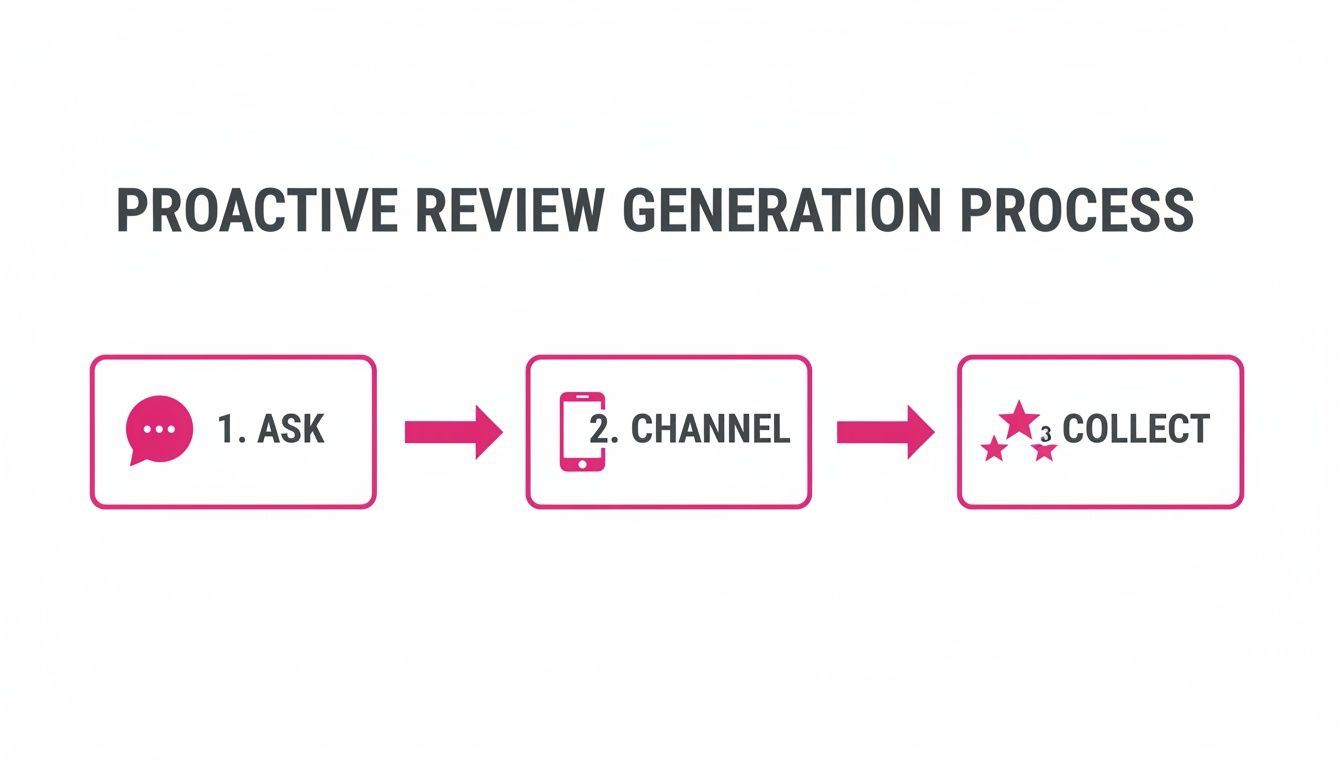
A brilliant reputation isn't something that just happens. It’s built by actively encouraging your happiest customers to share their stories. If you just sit back and hope for the best, you’re playing a risky game. Why? Because an unhappy customer is almost always more motivated to sound off online than a perfectly satisfied one.
The real secret is to make leaving a review a completely natural and seamless part of a great customer experience. When you switch from being reactive to proactive, you're not just managing feedback; you're building a powerful buffer of positive sentiment that truly reflects the quality of your business. This steady stream of good reviews doesn't just soften the blow of the occasional bad one—it also boosts your local SEO, builds trust with potential customers, and creates a fantastic feedback loop.
Pinpoint the Perfect Moment to Ask
Timing is everything. Ask for a review at the wrong time, and it feels awkward or pushy. But ask when a customer is genuinely delighted? It’s an easy yes. Your job is to spot these "golden moments" in your customer's journey.
Think about the peak of their satisfaction. When are they feeling best about their decision to choose you?
- Right after a successful service: A plumber fixes a burst pipe, and the homeowner is flooded with relief. A hairdresser nails the perfect cut, and the client can't stop smiling in the mirror. That's your moment.
- Following a direct compliment: If a customer raves, "This is the best curry I've ever had!", your staff can jump on it with, "That's brilliant to hear! If you have a moment, it would mean the world to us if you shared that on Google."
- A few days after a product arrives: For an e-commerce store, this gives your customer time to actually use and appreciate what they’ve bought. The initial excitement has settled, and they’ve formed a real opinion.
These are the high points. Capitalise on that positive energy and politely ask them to share the feeling with others.
Choose the Right Channels for Your Request
Once you know when to ask, you need to sort out how. The easier you make it, the more likely people are to do it. A customer might be perfectly willing to leave a review, but they won't bother if they have to jump through a bunch of digital hoops.
Here are a few of the most effective methods I've seen work time and time again:
- Email Requests: A simple follow-up email a day or two after a purchase is a classic for a reason. Keep it short, make it personal, and—most importantly—include a direct link straight to your preferred review platform.
- SMS Messages: If your business has a more direct, personal relationship with customers, a quick text can work wonders. Open rates are incredibly high. Just like with email, pop a direct link in there.
- In-Person QR Codes: Place a small, well-designed sign with a QR code right at your till or on your invoice. When a customer has a great experience, your staff can simply point to it and say, "We'd love to hear your feedback!"
The single biggest reason people don't leave reviews is friction. Every extra click, every confusing step, dramatically cuts down your chances. Your goal should be to make it so simple they can do it in under 60 seconds.
Use Polite and Non-Pushy Language
How you phrase the request is just as important as the when and where. You want to sound appreciative and genuine, not desperate or demanding. Never, ever pressure someone for a five-star review. It feels inauthentic and can even get you in trouble with platforms like Google or Yelp.
Instead, just ask for their honest feedback.
Here’s a simple template that works a treat for email:
"Hi [Customer Name],
Thanks again for choosing us! We really hope you're enjoying your [product/service].
When you have a moment, would you mind sharing your experience with us? Your feedback helps other people know what to expect and helps us get better.
You can leave us a review right here: [Direct Link to Google/Yelp]
We really appreciate you taking the time.
All the best,
The [Your Business Name] Team"
This approach is simple, direct, and respects their time. It makes people far more likely to click that link and share some kind words.
Building a Sustainable Reputation Management System
A great reputation isn't built on occasional bursts of effort. It’s the result of a consistent, organised system that turns reputation management from a chaotic chore into a simple business habit. For a small business where time is your most precious resource, getting this system right is absolutely critical.
Without a repeatable process, you're constantly playing defence, just reacting to reviews as they pop up. A proper system, however, puts you in the driver's seat. It helps you organise tasks, assign clear responsibilities (even if you're a team of one), and makes sure nothing important ever falls through the cracks. It's this methodical approach that builds trust around the clock.
Creating Your Daily, Weekly, and Monthly Routines
Consistency is everything. The trick is to break down your reputation tasks into manageable chunks. By creating simple daily, weekly, and monthly checklists, you'll find that managing your online presence becomes a natural part of your operations, not a burden you dread.
Here’s a simple framework I've seen work time and time again:
-
Daily Checklist (5-10 minutes): Think of this as your rapid response. The goal is to catch and address any fires before they spread.
- Scan your key platforms for any new negative reviews (1-3 stars).
- Respond to these negative reviews immediately using your pre-agreed framework.
- Check social media for any urgent customer service queries or complaints.
-
Weekly Checklist (30-45 minutes): This is where you focus on engagement and proactive growth.
- Take the time to respond to all the positive reviews from the past week.
- Send out your review request campaigns via email or SMS.
- Schedule a social media post or two highlighting a recent glowing review.
-
Monthly Checklist (1-2 hours): Your monthly check-in is all about strategy and seeing the bigger picture.
- Review your overall star ratings and see how the numbers are trending.
- Look for recurring themes in customer feedback—both good and bad. What are people consistently praising? What issues keep coming up?
- Update your Google Business Profile with new photos, offers, or fresh Q&A content.
This simple rhythm keeps things moving. Daily tasks protect your reputation, weekly tasks build it, and monthly tasks help you refine your entire customer experience.
The Power of Automation and Centralisation
For small businesses in the UK, the operational risks of letting your reputation slip are very real. SMEs make up around 99% of the 5.5 million businesses in the country, so even a small reputational dent can have a significant local economic impact.
This is where a bit of automation becomes a savvy, cost-effective investment. Automating tasks like sending review requests and posting initial responses saves a huge amount of time and protects your revenue by stopping small issues from becoming major trust failures.
This is where a centralised platform becomes invaluable. Instead of logging into five different sites to check reviews, a tool like LocalHQ brings everything into one intuitive dashboard.
Having a single dashboard gives you a clear, at-a-glance overview of your entire online reputation. It saves you time and ensures you never miss a crucial piece of feedback.
This kind of centralisation also lets you deploy powerful tools to do the heavy lifting. Imagine having an AI responder that can instantly draft on-brand replies to your five-star reviews, freeing you up to focus on the more complex customer issues. This is a perfect example of how you can use AI for local SEO to build your reputation far more efficiently.
The goal isn't to replace the human touch. It's to automate the routine so you can apply that human touch where it really matters most. A solid system gives you the structure to do just that.
Assigning Roles and Responsibilities
Even in a tiny team, someone has to own reputation management. If it's everyone's job, it's no one's job. Without clear ownership, tasks are easily forgotten. This person is responsible for running through the checklists and making sure every review gets a timely response.
If you’re a solo business owner, congratulations—you are the Chief Reputation Officer. If you have a small team, this role could fall to:
- A store manager
- A front-of-house team leader
- An administrative assistant
- A marketing coordinator
The title really doesn't matter, but the responsibility does. Make sure one person is accountable for keeping the system running. This clarity ensures that managing your online reputation becomes a core, proactive part of your business, not just something you do when you have a spare moment.
Your Top Reputation Management Questions, Answered
Even with the best playbook in hand, it's natural to have questions when you start getting serious about managing your online reputation. Let's be honest, some of this can feel a bit daunting at first.
This is where we tackle the common "what ifs" and "how-to's" that pop up. My goal here is to give you clear, straight answers so you can move forward with confidence.
How Long Does It Really Take to Fix a Bad Reputation?
This is the big one, isn't it? And the frank answer is, it varies. There’s no magic wand for reputation repair; the timeline really depends on the scale of the problem and how consistently you work on it.
If you’re dealing with a couple of isolated negative reviews, you could see a real turnaround in as little as two to three months. That’s if you’re actively encouraging new, positive reviews and responding to everything that comes in. But for a more serious issue, like a damaging news article sitting on page one of Google, you're likely looking at a six-month to year-long effort to create enough positive content to push it down.
The secret ingredient is consistency. A little bit of effort every week will always beat a frantic, one-off attempt to clean things up.
Can I Just Delete a Bad Review?
Ah, if only it were that simple! But no, you can't just zap a negative review because you don't like it. Platforms like Google and Yelp are built on trust, and they have strict rules to protect that.
What you can do, however, is flag a review for removal if it breaks the platform's rules. This is your go-to move if a review is:
- Clearly spam or fake: Posted by a bot, a fake profile, or someone with a conflict of interest (like a disgruntled ex-employee).
- Completely off-topic: The review is a rant about something unrelated to their experience with your business.
- Offensive or hate speech: It contains harassment, threats, or discriminatory language.
- Illegal: It promotes illegal activities or uses copyrighted content.
If a review ticks any of those boxes, report it immediately. For everything else, your best (and only) strategy is a thoughtful public response.
A negative review isn't a permanent stain. It’s a public opportunity to show everyone how much you care about getting it right. A great response can often win over more future customers than the original complaint ever lost you.
Should I Bother Responding to Old Negative Reviews?
That's a smart question, and the answer isn't a simple yes or no. Generally, your time is best spent on fresh feedback. Replying to a review from two years ago can sometimes do more harm than good by dragging an old issue back to the top of the pile for everyone to see.
As a rule of thumb, I'd say focus on reviews from the last six months. If you spot an older, particularly nasty one that was missed, a quick, professional comment can still be worthwhile. Something as simple as, "We're sorry to see this and have since updated our processes to ensure this doesn't happen again," shows you're accountable without re-opening an old wound.
What’s the Difference Between Proactive and Reactive Management?
Getting your head around this is fundamental to building a great reputation management for small businesses strategy.
- Reactive Management: This is firefighting. It’s what you do after the negative review has been posted or the crisis has hit. You're in damage control mode, trying to minimise the fallout.
- Proactive Management: This is about building a fortress. You’re consistently encouraging positive reviews, sharing great content, and listening to feedback to build a strong, resilient reputation before anything goes wrong.
A winning strategy is always proactive. It creates a kind of "reputational shield" around your business, making any single negative comment seem like a minor blip rather than a major disaster. If you're only ever reacting, you're always playing catch-up.
Ready to shift from firefighting to fortress-building? LocalHQ gives you the tools to monitor your reputation, generate a steady stream of positive reviews, and build a powerful online presence without the headache. See how our AI-powered platform can save you time and deliver real results at https://localhq.io.