A Practical Guide to Local Business Search Engine Optimization
Local business search engine optimisation is all about making your business impossible to miss when potential customers in your area are searching for what you offer. It’s a targeted strategy, ensuring you show up prominently on Google Search and Maps right when people nearby are ready to buy.
Building Your Foundation for Local SEO Success
Before you dive into optimising anything, you need to know exactly where you stand. Think of it like a pre-flight check; a thorough audit of your digital presence is the compass that will guide every decision you make from here on out. Without it, you’re just guessing. This isn't about finding flaws, it's about uncovering clear opportunities and creating a real roadmap for growth.
The first stop is your most valuable local asset: your Google Business Profile (GBP). Is every single detail not just there, but 100% accurate? A tiny mismatch in your business name, address, or phone number (your NAP) can confuse both Google and your customers. You also need to check if your profile is complete. Are you using all the available features, like services, products, and attributes, to give people a full picture of your business?
Auditing Your Current Digital Footprint
Your audit needs to look beyond your own profiles. A huge part of this is seeing how you stack up against the local competition—the businesses currently winning the customers you want. Who’s showing up in the coveted “local pack” (the top three map results) for your most important keywords? Get granular. Analyse their profiles, see how many reviews they have, and check their recent activity. This bit of detective work gives you a realistic idea of the effort needed to climb the rankings.
To get a fuller picture of how your business appears online, you can dig into guides on mastering company SEO, as these often cover crucial local strategies.
Putting your audit and competitor analysis together gives you a solid baseline. After all, you can't measure success if you don't know where you started. To go even deeper, check out our guide on what local search optimisation truly entails at https://localhq.io/what-is-local-search-optimization/.
Key Takeaway: A winning local SEO strategy is built on a solid foundation of auditing, benchmarking, and goal setting. Skipping this step is like building a house without surveying the land first—it’s risky, inefficient, and bound to cause problems down the line.
This whole foundational process can be broken down into three core stages: understanding where you are now, seeing how you compare to others, and then setting clear, achievable goals.
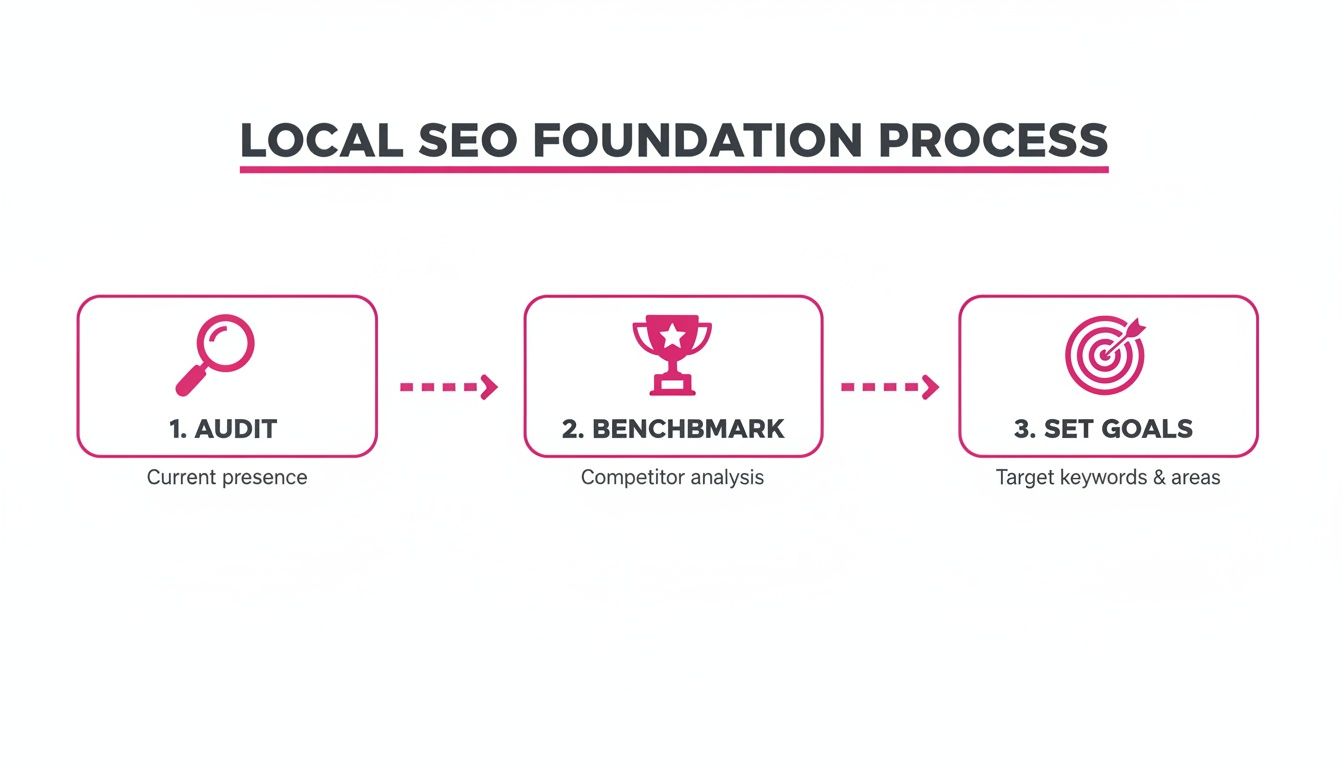
Following this simple workflow ensures you’re putting your time and money into the activities that will make the biggest difference, right from the very start.
Setting Realistic and Achievable Goals
Once you have a clear picture of your current position, you can start setting goals that actually mean something. Are you a new café aiming to increase foot traffic by 20% in the next three months? Or maybe you're a plumber looking to generate 15 more qualified calls per month from a few specific postcodes? These specific, measurable objectives will shape your entire strategy.
Don't underestimate how important this groundwork is. The numbers speak for themselves: 46% of all Google searches in the UK are now for local information, which really levels the playing field for small businesses against the big national chains.
What’s more, profiles with 100+ reviews can pull in 37% more clicks, showing a direct link between your reputation and your visibility. This is crucial when you realise that 83% of UK consumers check Google reviews before making a choice. This foundation ensures every effort you make is targeted, effective, and ultimately, profitable.
Your Local SEO Audit Checklist
Use this checklist to quickly evaluate your business's current local SEO health and pinpoint immediate opportunities for improvement.
| Audit Area | Key Checkpoints | Why It Matters for Rankings |
|---|---|---|
| Google Business Profile | Is the profile claimed and verified? Are NAP details (Name, Address, Phone) 100% consistent everywhere? Are all sections (services, photos, hours) complete? | This is the cornerstone of local search. Google uses this information to validate your existence, location, and relevance. Inconsistencies create distrust and hurt your chances of appearing in the local pack. |
| Local Citations | Are you listed on key directories (e.g., Yelp, Yell, Thomson Local)? Is your NAP consistent across all listings? Are there duplicate listings? | Consistent citations across reputable sites act as "votes of confidence" for Google, reinforcing that your business information is accurate and trustworthy. |
| On-Page SEO | Does your website mention your city/service area? Do you have location-specific pages? Is your NAP clearly visible in the footer? | Your website needs to send clear signals to search engines about where you operate. This helps Google connect what you do with the geographical areas you serve. |
| Reviews & Reputation | What is your average star rating? How many reviews do you have compared to top competitors? Do you respond to both positive and negative reviews? | Reviews are a massive ranking factor. A high volume of positive reviews signals popularity and quality to both Google and potential customers, building trust and driving clicks. |
| Competitor Benchmark | Who appears in the local pack for your main keywords? What are they doing well (e.g., more reviews, frequent posts, better photos)? | Knowing what the top players are doing provides a clear roadmap. You can identify their strengths to emulate and their weaknesses to exploit for a competitive advantage. |
Running through these checkpoints gives you a tangible to-do list, turning a vague goal of "improving SEO" into a set of clear, actionable tasks.
Getting the Most Out of Your Google Business Profile
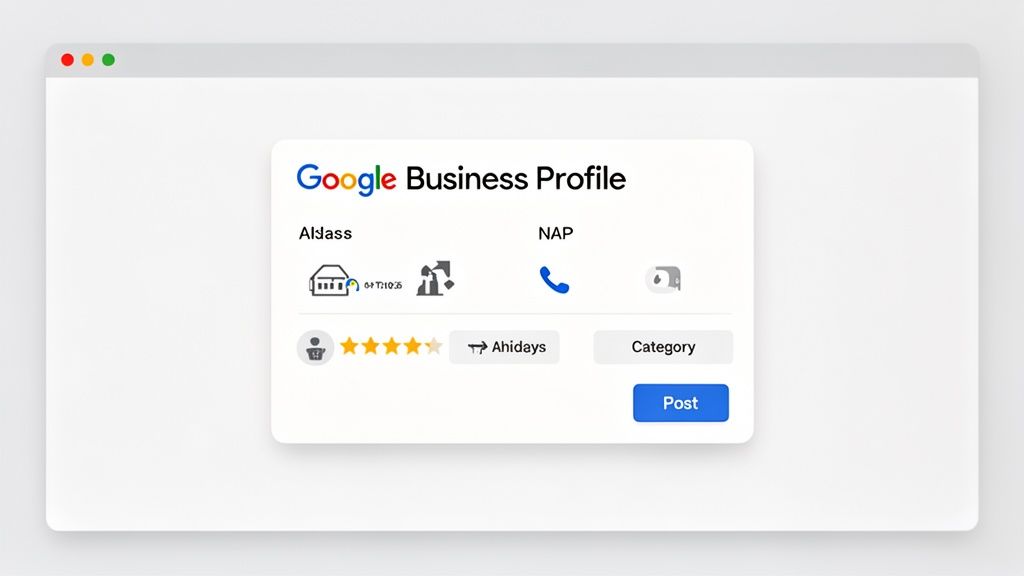
Think of your Google Business Profile (GBP) as your modern-day shopfront. It’s no longer just a listing; it’s a dynamic, interactive space where most local customers will first meet your brand. For any serious local business search engine optimisation effort, treating your GBP as a core marketing channel isn't optional—it's essential.
Simply getting your Name, Address, and Phone number (NAP) right is just the starting line. The real competitive advantage comes from building a rich, comprehensive profile that sends all the right signals to Google, which in turn helps you climb the rankings in the all-important local pack and on Google Maps.
Choosing Your Business Categories Wisely
Nailing your business categories is one of the first, and most critical, steps you'll take. Your primary category is the single most important field for telling Google what you do. You need to be as specific and accurate as possible about your main service.
For instance, if you run a steakhouse that also has a great seafood menu, your primary category must be "Steak house," not something generic like "Restaurant." This precision is what helps Google connect you with people making high-intent searches like "best steakhouse near me."
Once that’s locked in, you can use secondary categories to cast a wider net. For that same steakhouse, you might add:
- Seafood restaurant
- Fine dining restaurant
- Bar & grill
These additional categories fill in the picture for Google, explaining the other sides of your business without weakening the focus of your primary offering. My advice is always to stick to Google's predefined list and get as granular as you can to attract the best-fit customers.
Crafting a Compelling Business Description
You get 750 characters for your business description—make them count. This is your chance to write a quick, engaging elevator pitch that naturally includes important keywords while showcasing what makes you unique. The key is to avoid just stuffing keywords in; focus on what makes you stand out from the competition.
A well-written description anticipates a customer's questions. Do you offer free quotes? Are you a family-run business? What's your real speciality? Tell them here.
Pro Tip: Your first 250 characters are gold. This is the snippet people see before they have to click "more," so front-load your most crucial information and keywords right at the beginning.
This is your opportunity to show some personality and make a human connection before a customer even visits your website.
Using Profile Features to Signal Activity
An active profile is a healthy one in Google’s eyes. When you consistently use the features inside your GBP dashboard, it signals that you're open, engaged, and ready for business.
Here's where to focus your efforts for maximum impact:
- Google Posts: Think of these as free mini-adverts. Share updates, special offers, events, or new products. Posts typically expire after seven days (event posts are an exception), so get into a regular weekly rhythm to show you're active.
- Q&A Section: Don't wait for customers to ask questions. Be proactive and populate this section yourself by asking and answering common queries. This lets you control the narrative and provide helpful info right away. Of course, always jump on and answer any new questions from customers quickly.
- Product & Service Listings: This is a fantastic way to flesh out your profile. Add your specific services or products with good photos, detailed descriptions, and prices if applicable. It makes your listing far more useful and gives Google more context about what you actually sell.
In the UK, Google's dominance is undeniable, holding a commanding 93.5% share of desktop and mobile search. This makes visibility on Maps and in the local pack critical for any local business. Data shows that even simple GBP tweaks like optimising categories and using Posts directly boost impressions and valuable actions like calls and direction requests. You can discover more insights about the UK local search landscape on kentseocompany.co.uk.
Defining Your Service Area Correctly
This is a big one for any business that travels to its customers—plumbers, electricians, mobile dog groomers, you name it. Instead of just your office address, you can set a specific geographic area you cover by listing postcodes, cities, or counties.
The key is to be realistic. Don't claim you serve the entire South East if you can't genuinely get to every job. An overextended service area leads to a poor customer experience and, eventually, bad reviews. A tightly defined service area ensures you're attracting leads you can actually convert, boosting both your reputation and your bottom line. Getting these details right is a central part of effective Google Business Profile management.
Building Local Authority with Citations and Links
Beyond the digital assets you control, like your website and Google Business Profile, your authority in local search is hugely shaped by what other sites are saying about you. Think of Google as a meticulous detective, piecing together clues from all over the web to verify your business's legitimacy. This is exactly why a solid strategy for citations and local links isn't just a nice-to-have; it's a cornerstone of local business search engine optimisation.
A local citation is simply any online mention of your business’s core information: its Name, Address, and Phone number (often called NAP). You’ll find these on online directories like Yell and Yelp, industry-specific portals, and local community websites. Each consistent citation acts as a small but crucial vote of confidence, reinforcing to Google that you are who you say you are, where you say you are.
The Power of NAP Consistency
In local SEO, inconsistency is your worst enemy. If one directory lists you as "Smith's Plumbing Ltd.", another has "Smith Plumbing", and a third still shows an old phone number, you’re creating confusion. This confusion chips away at Google’s trust in your business information, which can directly torpedo your chances of appearing in the coveted local map pack.
Your first job, then, is to run a thorough citation audit. You need to hunt down every single mention of your business online and check it for accuracy. The aim here is 100% identical NAP information everywhere. Even a tiny variation like "St." vs "Street" can muddy the waters.
Key Takeaway: Treat your NAP as your business's unique digital fingerprint. It must be absolutely consistent across every online platform, from major directories to the smallest niche blog. This consistency is a fundamental trust signal for search engines.
Once you’ve wrestled your existing listings into shape, you can start building new, high-quality ones. Begin with the big-name UK directories, then focus on industry and city-specific sites that are genuinely relevant to what you do. For a deeper dive into how all this works, you can explore more about what local citations are and why they matter.
Earning Valuable Local Links
While citations are foundational for validating your NAP data, local backlinks are powerful endorsements that build genuine authority. A backlink is just a link from another website pointing to yours. When a reputable local source links to you, it’s like a public vote of confidence, telling Google that your business is a respected and integral part of the local community.
These links do more than just confirm your details; they pass on authority and can drive real, paying customers to your site. The trick is to earn them from relevant, local sources. A link from a national blog is nice, but for local SEO, a link from your town's Chamber of Commerce website is often pure gold.
Practical Strategies for Local Link Building
Getting these valuable local links doesn't need to be some dark art. It’s really about getting involved in your community.
Here are a few proven ideas to get the ball rolling:
- Sponsor a Local Event or Team: Putting your name on a local charity fun run, a kids' football team, or a community festival almost always earns you a link from their sponsors page. It's a classic tactic for a reason.
- Partner with Complementary Businesses: Find a non-competing local business and team up. A personal trainer could partner with a health food shop for a joint promotion. You can then cross-promote the event and link to each other’s websites.
- Get Featured in Local News: Got an interesting business story, a big anniversary coming up, or a charity drive you're running? Pitch it to local bloggers, community newsletters, or the local paper. A feature story can land you a fantastic, high-authority backlink.
- Host a Community Event: Put on a free workshop, a customer appreciation day, or a small networking event at your premises. This creates local buzz and gives other businesses and organisations a natural reason to link to your event page.
These aren't just link-building exercises. They build real-world community ties, creating a virtuous circle that boosts both your online visibility and your local reputation.
Mastering Online Reviews and Reputation
In today's world, online reviews are the new word-of-mouth. They're a powerful signal to both potential customers and Google that your business is a trusted, high-quality choice in the local area. A solid online reputation isn't just a nice-to-have; it's a cornerstone of any successful local business search engine optimisation strategy.
How to Ask for Reviews (Without Being Pushy)
Many business owners I talk to feel awkward about asking for reviews. They worry about coming across as desperate or pushy. The trick is to stop thinking of it as a generic, blanket request and instead build a simple, repeatable process that feels natural.
The best time to ask is when a customer is at their happiest. Did they just praise your work? Have you just wrapped up a successful project for them? That's your moment.
A straightforward, personal approach works wonders. Something like, "We're so glad you had a great experience! It would mean the world to our small team if you could share your thoughts on Google. It really helps other people find us."
The key is to make it incredibly easy for them. Provide a direct link to your review page in a follow-up email, add a QR code to your invoices, or send it in a text. The fewer clicks it takes, the higher your success rate will be.
Responding to Every Single Review
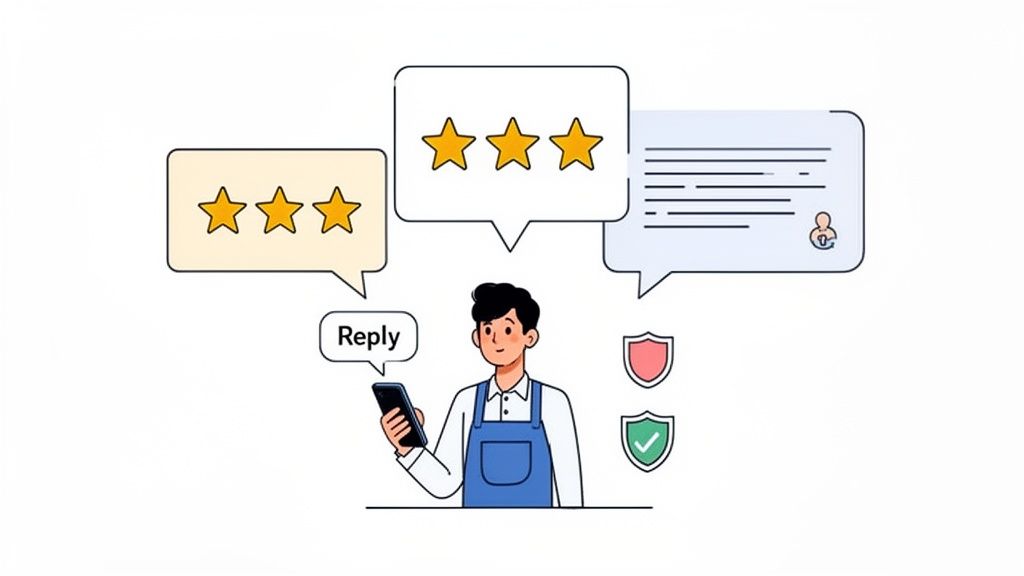
How you respond to feedback in public says everything about your business. It's crucial to reply promptly and professionally to all reviews—the good, the bad, and the neutral. This shows you're engaged, you care about customer satisfaction, and you hold yourself accountable.
Remember, your reply isn't just for the person who wrote the review. It's for every single potential customer who reads it afterwards. It's a public demonstration of your customer service. Plus, all that activity sends great engagement signals back to Google, which can give your local rankings a nice little boost.
Expert Insight: I always tell clients to view a negative review not as a crisis, but as a marketing opportunity. A thoughtful, constructive response can turn an unhappy customer into a loyal advocate. It publicly showcases your commitment to service, often building more trust than a long list of five-star reviews ever could.
Handling Negative and Fake Reviews
Getting a negative review can sting, but it's vital to keep a cool head. The goal is to acknowledge their frustration, show empathy, and immediately move the conversation offline to find a solution. A simple, public response like, "We're really sorry to hear about your experience. Please call us at [phone number] or email [email address] so we can understand what happened and make this right," is usually the best approach.
Unfortunately, not all negative feedback is genuine. Malicious reviews from competitors or disgruntled former employees are a real problem that can unfairly damage your reputation. When this happens, you need to act fast. Knowing how to remove fake Google reviews is an essential skill for protecting your business's integrity online.
Effective Review Response Templates
Staying on top of replies can be a huge time-sink. Having some ready-to-go templates helps you respond quickly while still sounding authentic. Adapt these to fit your brand's voice.
| Review Type | Primary Goal of Response | Example Template |
|---|---|---|
| 5-Star Positive | Show gratitude and reinforce the positive experience. | "Thanks so much, [Customer Name]! We're thrilled you had a great experience with [mention specific service/product]. We appreciate your support and look forward to seeing you again soon!" |
| 4-Star Positive with Feedback | Thank them and acknowledge their suggestion for improvement. | "Thank you for the fantastic feedback, [Customer Name]! We're so glad you were happy with our work. We really appreciate your note about [mention the point of feedback] – that's something we'll definitely look into." |
| 3-Star Neutral/Mixed | Acknowledge both the good and the bad, and open the door for more discussion. | "Hi [Customer Name], thanks for taking the time to leave your feedback. We're glad you liked [mention positive point], but we're sorry to hear that [mention negative point] didn't meet your expectations. We'd love to learn more about how we can improve." |
| 1 or 2-Star Negative | Express empathy, apologise, and take the conversation offline immediately. | "Hi [Customer Name], we are very sorry to hear about your experience. This is not the standard we aim for. Please contact our manager, [Manager's Name], at [phone/email] at your earliest convenience so we can address this directly and work to make it right." |
These templates are a great starting point, but always remember to personalise them with the customer's name and a specific detail from their review to show you've actually read it.
Tracking Local SEO Performance and Measuring ROI
Successful local business search engine optimisation isn’t about guesswork. It’s about making data-driven decisions that actually grow your bottom line. Simply throwing different tactics at the wall to see what sticks is a surefire way to waste time and money. The real game-changer is tracking the metrics that matter and connecting them directly to business results.
This means you need to stop obsessing over vanity metrics like overall website traffic. Instead, let's focus on the Key Performance Indicators (KPIs) that signal a genuine, paying customer is on the other end. I'm talking about the number of phone calls coming straight from your Google Business Profile, requests for driving directions to your front door, and your keyword rankings within the specific postcodes you serve.
Moving Beyond Vanity Metrics
At the end of the day, the only goal of local SEO is to make the phone ring, get customers through the door, or generate qualified leads online. Every single tracking effort should be laser-focused on measuring these actions.
Your Google Business Profile (GBP) Insights is the best place to start—it’s an absolute goldmine of data on how real people are interacting with your listing. You can see precisely how many people found you through "Discovery" searches (like "plumber near me") versus "Direct" searches (people who already knew your business name). This immediately tells you how well your brand is known versus how visible you are to new prospects.
Key Takeaway: Don't get distracted by broad traffic numbers. The most valuable metrics for a local business are tangible customer actions—phone calls, direction requests, and website clicks that originate from local search. These are the numbers that directly translate to revenue.
Keep a close eye on the month-on-month trends for these specific interactions. Did you see a jump in calls after you fleshed out your services list? A spike in direction requests after you ran a series of new Google Posts? These are the clear signals that your strategy is paying off.
Visualising Your Local Search Visibility
Knowing how you rank for your top keywords is obviously crucial, but local search is hyper-specific. Your ranking can change dramatically from one street to the next. This is where traditional rank tracking tools often fall flat; they give you a single, and frankly, often misleading data point.
This is precisely why geo-grid rank tracking has become an essential tool for any serious local SEO campaign.
A geo-grid tool maps out your search ranking for a specific keyword across a grid of physical points, giving you a true visualisation of your visibility, block by block. It instantly reveals where you’re strong, where competitors are eating your lunch, and where you have clear opportunities to improve.
Here’s a great example of a geo-grid report. It shows a business's ranking for a target keyword across different points in a city.
This visual map makes it obvious where the business is performing well (the green areas) and where its visibility drops off (orange and red). This isn't just data; it's actionable intelligence. For a deeper dive, our complete guide on rank tracking for local keywords is an excellent resource.
Calculating Your Return on Investment
Once you start tracking the right KPIs, calculating your Return on Investment (ROI) becomes surprisingly straightforward. The whole process boils down to assigning a monetary value to the leads your local SEO is generating and then comparing that figure to what you've invested (in time or money).
Here’s a simple way to break it down:
- Track Your Leads: First, tally up all the phone calls, form submissions, and direction requests from your GBP and website over a set period, like one month.
- Determine Your Lead-to-Customer Rate: Be honest—what percentage of those leads actually become paying customers? If you get 20 calls and convert 5 of them, your rate is 25%.
- Calculate the Average Customer Value: What’s the average new customer worth to you? Let’s say it's £300.
- Calculate Your SEO-Generated Revenue:
- Leads (20) x Lead-to-Customer Rate (0.25) = 5 new customers
- New Customers (5) x Average Customer Value (£300) = £1,500 in revenue
- Calculate Your ROI:
- (Revenue [£1,500] – SEO Cost [e.g., £500]) / SEO Cost (£500) = 2.0
- Multiply that by 100 to get your percentage: 200% ROI
This kind of tangible measurement is how you prove the real-world value of your local SEO work. It shifts your marketing from being just another expense into a measurable investment, empowering you to make smarter decisions about where to put your budget for maximum growth.
Common Questions About Local SEO
Getting started with local SEO always brings up a lot of questions. It's a field with a lot of different pieces, so it's completely normal to wonder where you should be putting your energy and what you can realistically expect. Let's dig into some of the most common things we hear from business owners.
Think of this as a cheat sheet to help you make smarter decisions for your business. Getting your head around these key points will give you the confidence to either tackle local SEO yourself or have much more meaningful conversations with an agency.
How Long Does Local SEO Actually Take to Work?
This is the big one, isn't it? "How long until I see results?" While a few quick wins, like a really thorough Google Business Profile optimisation, can sometimes show a bump in calls or clicks within a few weeks, proper local SEO is a long-term strategy. It's definitely not a one-and-done task.
For most businesses, you should start seeing significant, measurable improvements in your rankings and lead flow within about three to six months. That's the typical window for Google to really notice and trust all your hard work—from consistent business details across new citations to a growing number of reviews and a stronger overall local presence.
Key Takeaway: When it comes to local SEO, patience and consistency are your best friends. Quick wins are great, but building real, lasting authority in the local pack is a marathon, not a sprint. It’s built over months of sustained effort.
What's the Single Most Important Factor in Local SEO?
If you had to put all your eggs in one basket, it should be your Google Business Profile (GBP). Hands down, this is the foundation of your entire local search presence. It carries the most weight when Google decides who to show on Google Maps and in those valuable "local pack" results.
A complete, accurate, and active GBP is the strongest signal you can send to Google that your business is relevant and authoritative in a specific area. This goes way beyond just having the right address. It means you're actively managing it with:
- High-quality, recent photos and videos.
- Regular Google Posts to share updates and offers.
- A steady stream of new reviews coming in.
- Prompt and professional replies to every single one of those reviews.
Should I Do Local SEO Myself or Hire Help?
This is a big decision, and it really comes down to your own resources and goals. You can absolutely handle the basics of local SEO on your own, especially if you have a single location and the time to really learn the ropes and stay consistent. It’s a brilliant way to get to know your digital footprint inside and out.
The reality for most business owners, though, is that time is the one thing they don't have. If you’re in a cut-throat market, have multiple locations, or just can't find the hours to give it the attention it needs, bringing in a specialist agency or using dedicated software can seriously speed things up. They bring experience and efficiency to the table, taking care of the complex and time-consuming work so you can focus on what you do best—running your business. The right move is whichever one fits your budget, timeline, and ambition.
Ready to take control of your local search performance without the guesswork? LocalHQ provides the AI-powered tools you need to optimise your profiles, manage reviews, and track your rankings with confidence. Start turning local searches into loyal customers today at https://localhq.io.