Discover local seo for small business: A Local Strategy That Converts
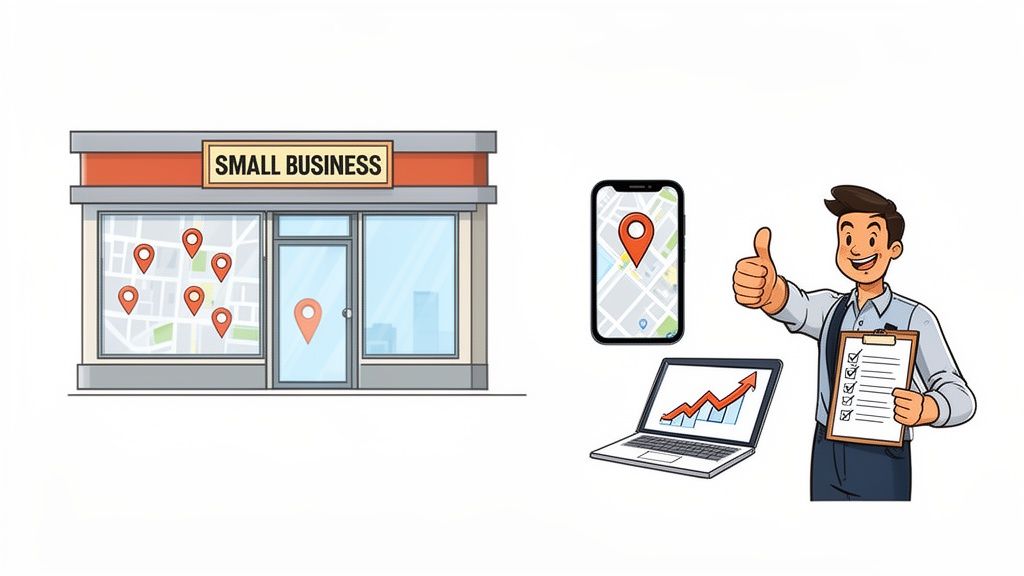
Local SEO is all about making sure your business shows up when people nearby are searching on Google for what you offer. Think searches like ‘coffee shop near me’ or ‘plumber in Manchester’. It’s your secret weapon for standing out against bigger, national companies that aren't on your doorstep.
Why Local SEO Is Crucial for UK Small Businesses
As a small UK business, it’s easy to feel outgunned online by national chains with bottomless marketing budgets. But this is where local SEO completely changes the game. It’s not just another line on your marketing plan; it's a core strategy that puts you right in front of people in your community who are ready to buy.
Think about how people search today. If someone in Birmingham has a burst pipe, they're not looking for a nationwide plumbing firm. They’re searching for an 'emergency plumber Birmingham'. A tourist wandering through Manchester in need of a good brew will pull out their phone and search for the 'best coffee near me'. These searches are gold because they’re driven by an immediate need.
The Power of Local Intent
This shift to local searching isn't a small trend; it's a seismic change in consumer behaviour. An incredible 46% of all Google searches now have local intent. This figure alone shows the massive opportunity waiting for businesses like restaurants, tradespeople, and local shops.
Queries like 'Italian restaurant near me in Manchester' or 'plumber in Birmingham postcode B1' are now the norm, especially on mobile, which accounts for 84% of local searches. You can read the full research about local search trends to see just how significant this is.
This is where your business can really clean up. By concentrating your efforts on your local patch, you stop trying to compete with everyone on the internet and start focusing on the businesses just down the road. It's a smarter, more efficient, and far more cost-effective way to grow.
This simple flowchart shows exactly how it works: a local search leads directly to you.
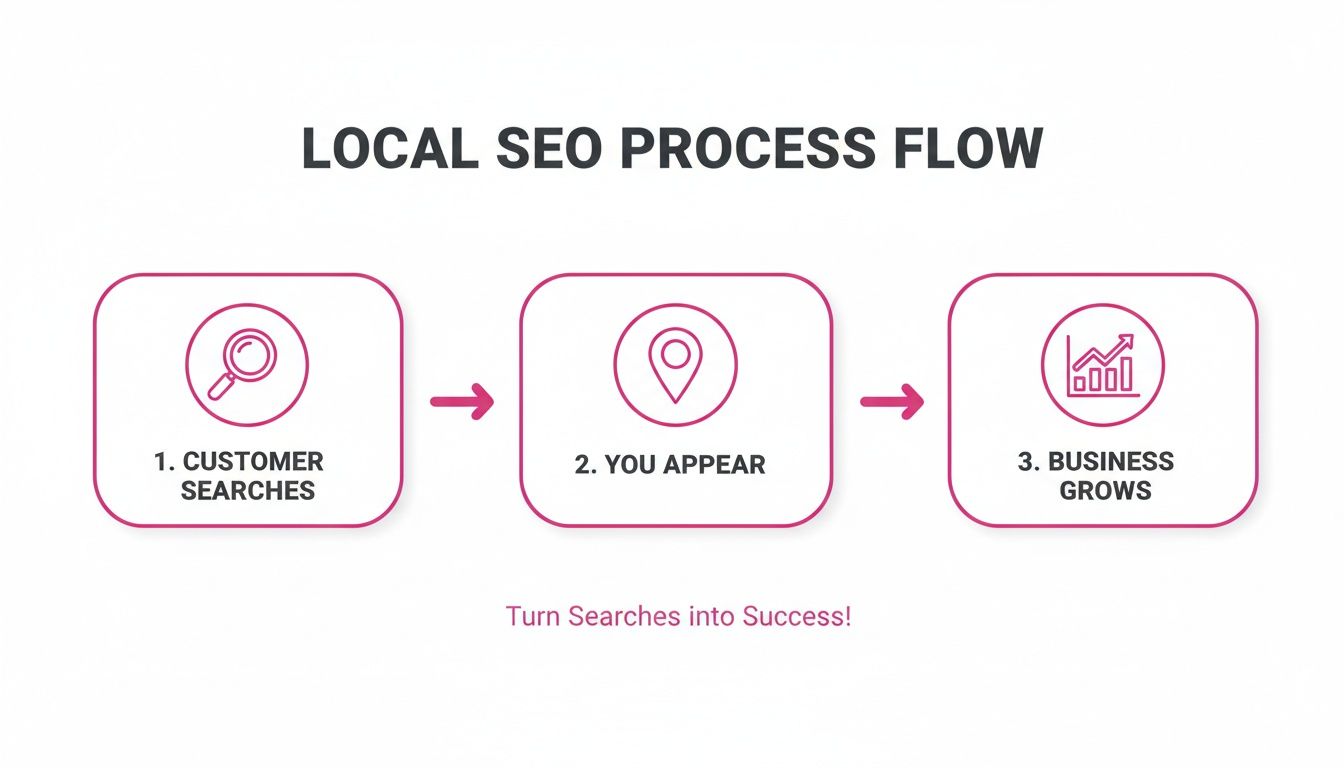
As you can see, being visible at the exact moment a customer is looking is what turns a simple search into real, tangible growth for your business.
To put this into perspective, here's a quick breakdown of the core pillars that hold up a strong local SEO strategy.
The Core Pillars of a Winning Local SEO Strategy
This table offers a quick-reference framework, summarising the fundamental components of local SEO and the primary goal of each one.
| Pillar | Primary Goal | Key Actions |
|---|---|---|
| Google Business Profile (GBP) | Maximise visibility in the Map Pack | Complete every section, add photos, get reviews, use Posts. |
| On-Page SEO & Local Content | Signal relevance for local keywords | Create location-specific pages, use local keywords, optimise titles. |
| Citations & Directory Listings | Build trust through consistent data | Ensure your NAP (Name, Address, Phone) is identical everywhere. |
| Online Reviews | Establish credibility and social proof | Actively request and respond to customer reviews. |
| Local Link Building | Gain authority from local sources | Sponsor local events, join local business groups. |
| Technical & Schema Markup | Help search engines understand you | Implement local business schema, ensure mobile-friendliness. |
Getting these pillars right is what separates the businesses that thrive from those that get lost in the noise.
Turning Searches into Footfall and Phone Calls
A well-executed local SEO strategy makes sure that when these high-intent searches happen, your business appears right at the top, especially in the coveted Google Map Pack. This isn't just about rankings; this prime digital real estate drives real-world results.
Local SEO is the bridge between a potential customer's online search and them walking through your door. Getting the fundamentals right—like an optimised Google Business Profile and positive reviews—puts you directly in their path when they are most ready to buy.
The end goal is to make it incredibly simple for local customers to:
- Find you: By showing up in the top results on Google Maps and search.
- Trust you: Through positive reviews and accurate, up-to-date business information.
- Contact you: With easy-to-find 'click to call' buttons or one-tap directions.
Throughout this guide, we'll walk you through the practical steps you need to take. From setting up your Google Business Profile correctly and gathering genuine reviews to building local authority, you’ll get a clear roadmap to own your local area and leave bigger, less-focused competitors behind.
Getting Your Google Business Profile to Work Harder for You
Think of your Google Business Profile (GBP) as your digital front door. For many potential customers, it's the very first time they'll interact with your business. That's why getting it right isn't just a box-ticking exercise; it’s one of the most critical parts of local SEO for any small business.
A complete and active profile sends powerful signals to Google that you're a relevant, trusted player in your local area. Simply claiming your listing is just the start. The real gains come from treating your GBP as a dynamic marketing tool, not just a static entry in a directory.
Choosing Your Business Categories
This is your first, and arguably most important, decision. Your primary category tells Google exactly what you do, and it's a massive factor in which searches you show up for. Be specific. Don't just pick "Restaurant" if you're an "Italian Restaurant" or a "Vegan Restaurant." Precision matters here.
Once you’ve locked in your primary choice, don't forget about the secondary categories. They're your chance to add more detail and catch a wider net of searches. For example, a boutique hotel might add "Wedding Venue," "Conference Centre," or "Hotel with Spa" to attract different types of customers.
This is what a potential guest sees when they find a local hotel. Notice how the photos, rating, and location are front and centre.
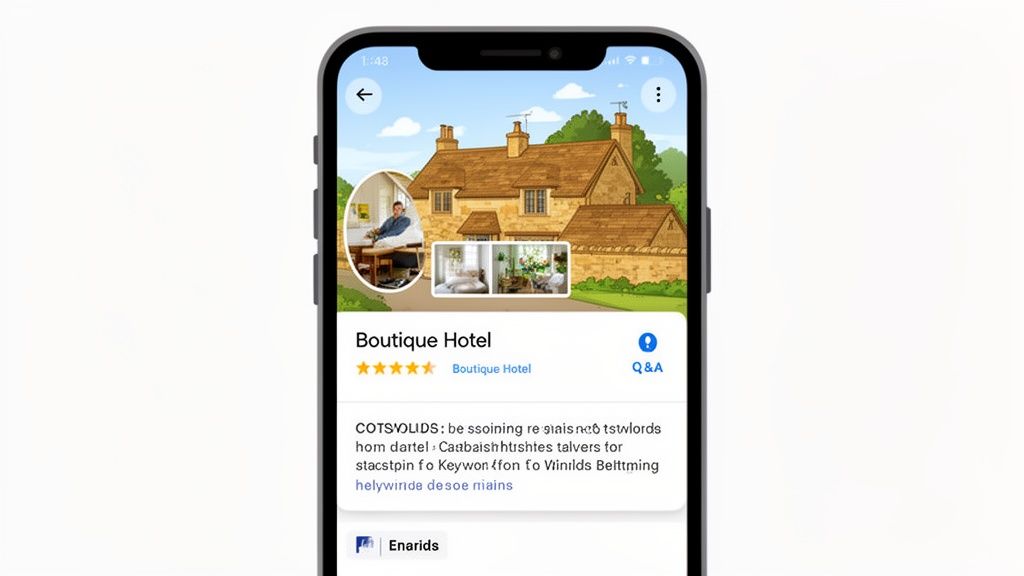
Great images and a strong star rating build instant trust and make people want to learn more. This is your moment to make a brilliant first impression.
Writing a Business Description That Sells
You’ve got 750 characters to make your pitch. This is prime real estate to tell your story and weave in those all-important local keywords. Don’t just list what you do; explain what makes you different.
A generic "We are a hotel in the Cotswolds" is a missed opportunity. Try something with more personality:
Escape to The Cotswold Manor, a luxury boutique hotel offering stunning countryside views and personalised service. Our award-winning restaurant sources local ingredients, making us the perfect choice for a romantic getaway or a bespoke wedding venue near Burford. Book your stay today.
Let's break that down. It includes:
- Keywords: "luxury boutique hotel," "wedding venue"
- Local Signals: "Cotswolds," "Burford"
- Unique Selling Points: "personalised service," "award-winning restaurant"
- A Call to Action: "Book your stay today."
This works for Google's algorithm, but more importantly, it speaks directly to potential customers.
The Power of Fresh Photos and Consistent Activity
In local search, a picture truly is worth a thousand words. We consistently see that profiles with plenty of high-quality photos get more clicks and requests for directions. People want a sneak peek before they visit.
Make sure you showcase every angle of your business:
- Exterior: Clear shots of your entrance, building, and signage.
- Interior: Photos that capture the atmosphere, decor, and key facilities.
- Products/Services: Sharp images of what you sell or the results of your service.
- Team: A few friendly faces go a long way in building trust.
Beyond the basics, you need to show Google that your business is alive and kicking. Two of the best—and most underused—features for this are Google Posts and the Q&A section.
Google Posts are like free mini-adverts right on your profile. They're perfect for announcing:
- Special offers ("15% off all treatments this week!")
- New products or seasonal menu items
- Upcoming events
- Company news or recent blog articles
The Q&A section lets customers ask you anything directly. Keep an eye on this and answer questions quickly. Better yet, get ahead of the game by adding your own frequently asked questions and providing detailed answers. It’s a brilliant way to help customers and prove to Google that you’re an active, helpful authority in your niche.
Building Trust with Local Reviews and Citations
Online, trust is your most valuable currency. For a local business, nothing builds it faster than a steady stream of genuine customer reviews. Think of them as today's word-of-mouth – a powerful signal to both potential customers and Google that you're a credible, reliable choice in the community.
Google pays incredibly close attention to the reviews on your Business Profile. It doesn't just glance at the star rating; it analyses the volume (how many you have), the frequency (how often new ones pop up), and the quality (the actual sentiment and detail in the comments). A healthy flow of positive feedback tells the algorithm you're an active, popular business that deserves a top spot in the Map Pack.
Encouraging Customer Feedback
Getting into the habit of asking every happy customer for a review is a game-changer. The trick is to make it ridiculously easy for them. You can grab a direct link to your review page right from your Google Business Profile dashboard.
Once you have that link, weave it into your customer communications:
- Pop it in the footer of your email receipts or invoices.
- Create a QR code that links to it and display it at your till or on your tables.
- Send a friendly follow-up email or text a day or two after your service is complete.
Often, a simple prompt like, "We'd love to hear how we did today," is all it takes. This proactive approach is a cornerstone of effective local seo for small business because it keeps the positive reviews flowing in.
The Art of Responding to Every Single Review
Responding to reviews is non-negotiable. It shows you’re listening and that you genuinely care about customer feedback, which helps build a strong community around your brand. This applies to the glowing five-star ratings just as much as it does to the occasional negative comment.
With positive reviews, a personalised thank you goes a long way. Ditch the generic "Thanks for your review" and mention something specific they said. For example, "So glad you enjoyed the steak pie! It's one of our favourites too. Hope to see you again soon."
When a negative review comes in, your response is even more critical.
- Acknowledge and Apologise: Thank them for taking the time to give feedback and say you're sorry their experience wasn't up to scratch.
- Take it Offline: Offer a direct way to resolve things privately, like an email address or a phone number. "Please email our manager at… so we can sort this out for you."
- Stay Professional: Whatever you do, don't get into a public argument. Remember, your calm, professional response is for all your future customers to see.
A well-handled negative review can be more powerful than a dozen positive ones. It shows everyone you’re accountable and committed to great service, turning a potential negative into a public display of excellence.
In the UK, review management has become a massive local SEO signal. Experts have seen huge jumps in the importance of review volume, recency, and detail, especially for restaurants and service-based businesses. With 32% of SEO professionals pointing to GBP signals (including reviews) as the top factor for Map Pack ranking, you can't afford to ignore them. You can discover more insights about these UK ranking factors to get the full picture.
Demystifying Local Citations
Right, let's talk about citations. A local citation is simply any online mention of your business's core information: its Name, Address, and Phone number (often called NAP). You'll find them on local business directories like Yelp or Thomson Local, as well as on niche sites specific to your industry.
Think of each consistent citation as another website vouching for your business's location and contact details. When Google's crawlers find the exact same NAP information for you across dozens of reputable sites, it reinforces that your details are accurate and you are who you say you are.
Why NAP Consistency Is King
If you remember one thing about citations, make it this: consistency is everything. Your business name, address, and phone number must be absolutely identical everywhere they appear online. Inconsistencies create confusion for search engines and, even worse, for potential customers.
Even tiny variations can cause headaches:
- "Ltd" vs. "Limited"
- "St." vs. "Street"
- Using an old phone number on one directory and a new one on another
These discrepancies can water down the authority of your citations and hurt your local search rankings. The best approach is to decide on one, official version of your NAP and stick to it religiously. If you want to dig deeper into this, you can learn more about what local citations are in our detailed guide. Building a clean, consistent citation profile is a foundational task that pays off by cementing your business's digital footprint.
Making Your Website a Local Magnet with On-Page SEO
Think of your Google Business Profile and your website as two halves of the same coin. They can't work in isolation. You need to build a solid bridge between them, and that bridge is smart on-page SEO. This is how you make sure the visibility you're building on Google Maps actually translates into clicks, calls, and customers on your website.
One of the most common mistakes I see is businesses lumping all their services onto one generic page. That’s a huge missed opportunity. If you really want to get a leg up on the competition, you need to think a lot more granularly.
Create Hyper-Local Service Pages
Instead of a single "Services" page, break it down. You should have a dedicated page for each core service you offer, in each main area you serve. This simple shift in strategy lets you target those incredibly valuable long-tail keywords—the ones people type in when they’re ready to buy.
Let's take a London-based salon as an example. A generic 'Hairdressing' page just won't cut it. A much smarter approach is to build out specific, optimised pages like:
- 'Balayage Hair Salon in Shoreditch'
- 'Professional Wedding Hair Stylist East London'
- 'Gents Haircuts near Liverpool Street'
Each of these pages acts as a perfect, hyper-relevant landing spot for a specific search query. It dramatically boosts your odds of showing up for that search. On the page itself, you'll want to naturally include the location in your headings, sprinkle it through the text, and even add it to your image descriptions. Mentioning local landmarks or nearby streets is another great little trick to add that extra layer of geographic relevance.
This targeted approach essentially spells out for Google exactly what you do and where you do it, making your business an undeniable match for a user's search.
Make Your Location Details Impossible to Miss
Your Name, Address, and Phone number (NAP) need to be consistent everywhere online, but especially on your own website. Don't make people dig around for your contact info. The gold standard is to have your full, consistent NAP right there in the footer of every single page.
This constant reinforcement is a strong signal that helps search engines confidently connect your website to your physical location and your Google Business Profile.
A dedicated 'Contact Us' page is also non-negotiable. And on that page, you can take things a step further:
Pro Tip: Embed an interactive Google Map directly onto your contact page. This is a powerful, direct signal to Google that confirms your physical location. Plus, it’s brilliant for user experience—potential customers can get directions with a single click.
Sprinkling in testimonials from local customers on these pages is another fantastic way to add social proof and geographic weight. A review that says "the best boiler repair I've found in Bristol" is pure marketing gold for your 'Boiler Repair Bristol' service page.
Getting Technical with Local Business Schema
Right, let's talk about something a little more technical. Don't worry, it sounds more intimidating than it is. Local Business schema markup is a bit of code you add to your website. Think of it as a detailed business card written specifically for search engines.
This code doesn't change a thing for your human visitors—they won't even see it. It works behind the scenes, speaking directly to search engine crawlers in a language they understand perfectly. It explicitly tells them:
- Who you are: Your official business name.
- What you do: Your business type (e.g., 'Plumber', 'Restaurant', 'HairSalon').
- Where you are: Your full address and service area.
- When you're open: Your precise opening hours.
- How to reach you: Your phone number.
By structuring this data in a standardised way, you remove all the guesswork for Google. This helps them understand your business with crystal clarity, which can improve your chances of appearing in those sought-after search results, like the Knowledge Panel or the Map Pack. While it might sound complex, many website platforms and SEO plugins have tools that make generating and implementing this code incredibly simple, no coding skills required. It’s a small technical step that can give your local authority a significant boost.
How to Measure Your Local SEO Success
So, how do you know if all this local SEO work is actually paying off? It's easy to get lost in a sea of data, but success isn't about chasing vanity metrics. It’s about measuring the things that genuinely impact your business—like the phone ringing more often and new customers walking through your door.
You need to zero in on the key performance indicators (KPIs) that directly show customer engagement and your visibility where it counts. Forget sprawling spreadsheets; a handful of core metrics will tell you everything you need to know about your return on investment.
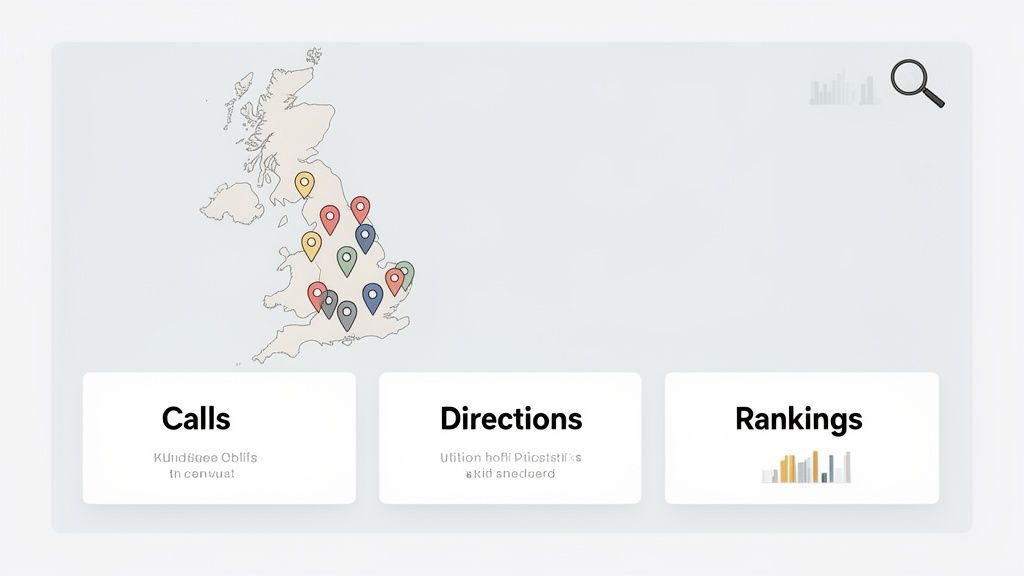
Unlocking Insights with Your Google Business Profile
Your first port of call for performance data is completely free: your Google Business Profile. The ‘Performance’ tab is a goldmine, showing you precisely how customers are finding and interacting with your listing.
The most important numbers to watch are the ones that signal a customer is ready to take the next step:
- Phone Calls: This tracks every time someone taps the "Call" button on your profile. It's one of the clearest signs that your SEO efforts are generating direct leads.
- Direction Requests: This shows how many people asked Google Maps for directions to your business. For any brick-and-mortar location, this is a direct measure of potential footfall.
- Website Clicks: This tells you how many people clicked through to your website from your GBP, driving valuable traffic straight to your service or location pages.
These aren't just abstract figures. They represent real people taking real actions towards becoming your next customer. Monitoring these month-on-month gives you a clear, honest picture of your growth.
Visualising Your Local Search Rankings
Knowing where you rank is vital, but traditional rank tracking often falls short for local businesses. Your position for "plumber in London" can be wildly different depending on whether someone is searching from Kensington or Canary Wharf. This is why postcode-specific tracking is so crucial.
You have to see your visibility from your customer's perspective. Modern tools have moved beyond simple lists and now visualise your performance on a map. This is typically done using a geo-grid rank tracker, which plots your search position for key terms across a grid of different points in your service area.
A geo-grid map instantly reveals where you’re strong and, crucially, where competitors have the upper hand. This isn't just data; it's actionable intelligence that helps you pinpoint areas for improvement, whether that means building citations in a specific town or creating content that targets a new neighbourhood.
For any service-based business, understanding your visibility street-by-street is a massive competitive advantage. It helps you focus your budget and effort where it will make the biggest difference.
Connecting Metrics to Real Business Goals
Ultimately, measuring your local SEO for small business is about connecting your online activities back to your bottom line. Look at your performance data and ask the hard questions:
- Are we getting more phone enquiries this quarter than the last?
- Are more people requesting directions and visiting our shop?
- Are we showing up in the top three map results for our most profitable services?
Tracking your rankings for these money-making keywords is the final piece of the puzzle. You can find out more about the best ways to approach rank tracking for local keywords in our detailed guide. By combining insights from your GBP with visual rank tracking, you get a complete and accurate picture of your local SEO performance, empowering you to make smarter decisions that drive real growth.
Got a Few Questions About Local SEO?
Even with a solid plan in place, you’ll probably have a few questions rattling around. That’s completely normal. Let’s tackle some of the most common ones we hear from business owners, giving you the clear answers you need to get moving.
How Long Until I Actually See Results?
This is the big one, isn't it? While you can get some quick wins—a well-optimised Google Business Profile can start making a difference within a few weeks—local SEO is more of a marathon than a sprint. Realistically, you should start seeing meaningful improvements in your rankings and getting more enquiries within three to six months.
Of course, that timeframe hinges on a few things, like how fierce the competition is in your area and what your online presence looks like right now. The secret to speeding things up is consistency. Every new review, every Google Post, and every local citation you build is another signal to Google that you’re a relevant, active player in your local market.
I always tell clients to think of local SEO like tending a garden. You do the hard work of planting the seeds, but it’s the consistent watering and care that brings real growth. Patience pays off.
What's the Real Difference Between SEO and Local SEO?
At its core, the difference is all about geography. Traditional SEO is a broad game, aimed at ranking for searches without any local ties. Think of a national online retailer trying to rank for a search like 'men's trainers'.
Local SEO is hyper-focused. It's about showing up when a potential customer is right around the corner, searching for something like 'men's trainer shop in Leeds'. It relies on a completely different set of signals that barely register for a national campaign:
- Your Google Business Profile and how well it’s managed.
- Reviews from customers who live in your community.
- Listings in local business directories (citations).
- Content on your website that directly connects what you do with specific towns and postcodes.
Essentially, with local SEO, you're constantly proving your relevance to a specific patch on the map.
Do I Need a Physical Shop to Do Local SEO?
Not at all. While having a shopfront or office that customers can visit is great for getting a map pin, it's not a deal-breaker.
Plenty of businesses operate as service-area businesses. Plumbers, mobile dog groomers, landscape gardeners—if you go out to your customers, this is you. You can absolutely nail local SEO. You’ll register your business at a real address (which can be your home), but then you simply tell Google to hide it from your public profile.
Instead of a pin, you’ll define your service area by listing the specific postcodes, towns, or counties you cover. This gets you into the local search results for all the right places, without ever putting your home address on the map.
What Should a Small Business Budget for Local SEO?
There’s no magic number here; the budget for local SEO can vary massively. It really depends on your goals, how competitive your market is, and how much of the work you want to do yourself.
Many business owners start out by doing it all themselves, investing their time instead of their money. Using free tools like Google Business Profile to handle the basics is a fantastic way to begin.
When you're ready to step things up, you’ve got a couple of options:
- Software Tools: Platforms that help automate things like review requests or managing your business listings can cost anywhere from £20 to £200 per month.
- Hiring Help: Bringing in a freelancer or a specialist agency can range from a few hundred to several thousand pounds a month. It all comes down to the scope of work and just how tough your local market is.
My advice? Start by getting a firm grip on the fundamentals in this guide. Once you've built that solid foundation, you’ll be in a much better position to decide where to invest your marketing budget for the biggest return.
Ready to stop guessing and start growing? LocalHQ gives you all the tools you need to manage, optimise, and measure your local SEO performance in one simple dashboard. Take control of your local visibility and turn searches into customers by visiting https://localhq.io to see how it works.