The Complete Google Business Profile Optimisation Guide (2026)

Related Articles
- How to Optimise Google Business Profile: Step-by-Step Tutorial (With Screenshots)
- Google Business Profile Categories: The Selection Strategy That 90% Get Wrong
- Google Business Profile Suspended? The Emergency Recovery Protocol (2026)
- Google Business Profile Verification: Troubleshooting Guide (All Methods)
- How Often Should You Post on Google Business Profile? (2026 Data)
- Google Business Profile Photos: The Visual Optimisation Guide
- Google Business Profile Q&A: Management Strategy and SEO Impact
- Google Business Profile Insights: Analytics Deep-Dive for Local Businesses
- Google Business Profile Description: A Copywriting Framework That Converts
Google Business Profile optimisation is, quite simply, the art of making your free business listing on Google work harder for you. It’s all about fine-tuning your profile to grab as much attention as possible in local search results, like Google Maps and the all-important ‘local pack’. This means actively managing your business info, customer reviews, photos, and posts to attract—and actually convert—more local customers.
Why GBP Is Your Most Powerful Local Marketing Tool
Think of your Google Business Profile (GBP) less like a simple listing and more like your digital front door. For customers across the UK, the path from needing a service to finding a local expert nearly always starts with a quick Google search. They use Search and Maps every single day to find, assess, and contact local businesses, which makes a perfectly tuned profile absolutely vital for your growth.
When someone searches for “plumber in Manchester” or “best cafe near me,” Google often shows a special box right at the top of the results. This prime real estate is known as the local pack, and it’s exactly where you want to be. Getting your GBP optimisation right is your direct ticket to one of those top spots, pushing you ahead of competitors who’ve let their profiles gather dust.
The Customer Journey on Google
The modern customer moves fast. Their journey from discovering a need to making a purchase is quick and relies almost entirely on the information they find first. This whole process boils down to three key stages, and your GBP influences every single one of them.
This infographic breaks down what that journey looks like from the customer’s point of view.

As you can see, a customer’s decision happens in a flash. The quality and completeness of your profile at each step can make or break their choice.
This is becoming even more important now. With generative AI search and voice assistants changing how people find businesses in the UK, Google is relying more heavily on structured data. In 2026, Google is set to pull data for its instant answers and ‘near me’ suggestions primarily from Google Business Profiles. This shift means that an incomplete or outdated profile could be skipped entirely by these AI-driven searches, making your business invisible.
It All Starts with Local SEO
Mastering your Google Business Profile is a massive piece of a bigger puzzle. It’s a core part of what we call local Search Engine Optimisation (SEO)—the whole practice of making your business more visible for location-based searches. To get a better handle on the complete picture, you might want to read our guide on https://localhq.io/what-is-local-seo-marketing/.
Your GBP isn’t a static page in a directory; it’s a living, breathing platform. The more complete, active, and helpful your profile is, the more Google will trust your business and reward you with better rankings over your competition.
To give you a clear overview, we’ve summarised the most critical components of a winning GBP strategy in the table below. These are the non-negotiables for getting your profile into top shape.
Core Pillars of Google Business Profile Optimisation
| Pillar | Key Actions | Impact on Visibility |
|---|---|---|
| Core Business Info | Ensure NAP (Name, Address, Phone) is 100% consistent everywhere. Select precise primary and secondary categories. | Builds trust with Google's algorithm. Correct categories match your business to relevant searches. |
| Services & Products | Add detailed descriptions, prices, and high-quality images for all offerings. | Directly answers customer queries and helps you rank for specific service-related keywords. |
| Visuals (Photos & Videos) | Regularly upload authentic, high-resolution photos of your team, work, and premises. Add short videos. | Increases engagement and time spent on your profile. Shows customers what to expect, building trust. |
| Customer Engagement | Respond to all reviews (positive and negative). Proactively use the Q&A feature to answer common questions. | Strong positive signals to Google. Shows you're an active, customer-focused business. |
| Posts & Updates | Use GBP Posts to share offers, events, and company news. Keep your content fresh and timely. | Keeps your profile active, which Google rewards. Provides fresh content for searchers to discover. |
Each of these pillars works together to send powerful signals to Google that your business is relevant, active, and trustworthy.
Of course, understanding the fundamentals is the first step. For a solid grounding in the basics, this guide from Publer offers some excellent advice on how to optimise your Google Business Profile. This guide will then build on those foundations, giving you the advanced, data-driven techniques you need for 2026.
Getting the Basics Right: Your Core Business Information
Think of your Google Business Profile as the digital front door to your business. The core information section is the address plaque, the opening hours sign, and the welcome mat all rolled into one. If this information is wrong, incomplete, or inconsistent, you're essentially hiding your front door from potential customers. Getting this part right is non-negotiable; it's the foundation for everything else we'll cover.
Of course, none of this matters if you haven't officially claimed your listing. Before you can touch a single setting, Google needs to confirm you're the legitimate owner. If you're not there yet, our guide on how to verify your Google Business Profile will get you sorted. Once you have the keys, your first job is to be ruthlessly thorough and fill out every field you possibly can.
The Critical Importance of NAP Consistency
Your NAP—Name, Address, and Phone Number—is the holy trinity of local SEO. These three pieces of data must be 100% identical everywhere they appear online. That means your website, your social media accounts, and other directories like Yelp or your local Chamber of Commerce must all match your Google Profile perfectly.
Even a tiny discrepancy can cause problems. If your profile says "Suite 4B" but your website has "Unit 4B," Google's algorithm gets confused. That confusion chips away at its trust in your business, which can directly harm your rankings.
Real-World Scenario: A Bristol café, 'The Daily Grind', had an old phone number lingering on a few directory sites. After they painstakingly updated their NAP everywhere to match their GBP, they saw a 25% jump in direct calls from their profile inside of a month. Why? Google finally had enough confidence to show their correct number to searchers.
Choosing Your Business Categories Wisely
Categories are how you tell Google what you actually do. Get this wrong, and you'll show up for all the wrong searches. Your primary category is the most crucial one; it should be the single best descriptor of your main business function.
- Be Specific: Don't just pick "Restaurant." If you serve pizza, choose "Pizza Restaurant." If you're a plumber, pick "Plumber," not the generic "Home Services."
- Think Like Your Customer: What words would someone type into Google to find you? That's your starting point.
- Use Secondary Categories: A "Hair Salon" might also offer services that fit under "Barber Shop," "Beauty Salon," and "Nail Salon." Add every single category that accurately reflects what you offer.
Think of each category as a hook in the water. Missing a relevant secondary category means you're not even trying to catch customers searching for that specific service.
Writing a Business Description That Connects
You have 750 characters for your business description. This isn't the place for stuffing keywords; it's your elevator pitch. It’s your chance to tell people who you are and why they should choose you.
Lead with the most important stuff first—what you do and where you do it. Then, bring in the human element. Talk about your experience, what makes you different, your commitment to quality, or any awards you're proud of. Weave in your main services and location, but make it sound natural, like you're talking to a new customer.
New research from 2026 analysing millions of listings found that 75% of businesses in the top three search results have fully completed their descriptions. Furthermore, adding products or services can boost conversions by a staggering 28%, proving that a detailed profile directly translates to more business. Discover more insights about these findings at SQ Magazine.
Finalising the Details
Don't get lazy and skip the "smaller" fields. Every piece of information you provide adds another signal of trust for Google and creates a better experience for your customers.
Key Details to Complete:
- Service Area: Absolutely essential for businesses that travel to their customers (think plumbers, cleaners, or mobile dog groomers). Define your patch precisely by postcode or city.
- Business Hours: This is a big one. Keep your hours updated meticulously, especially around holidays. Nothing frustrates a potential customer more than showing up to a closed business when Google said it was open.
- Website & Appointment Links: Give people a clear next step. Add your website URL and, if you have one, a direct link for booking appointments. Making it easy for people to buy or book is a simple but incredibly effective way to increase conversions.
By taking the time to complete these foundational elements, you're giving Google the clear, consistent data it needs to rank your profile with confidence.
Showcasing Your Offerings with Products and Visuals
With your core business details nailed down, it's time to bring your profile to life. Think of your Google Business Profile not just as a listing, but as your digital shop window. This is where you move beyond the basics and show people exactly what you do, using the 'Products' and 'Services' features to your full advantage.
If you sell physical goods, the Products tab is a must. It lets you feature your key items directly in Google's search results, saving customers a click. For every product you add, you can upload a crisp photo, set a price (or a price range in GBP £), and write a compelling description that shows people why they need it.
Building Out Your Services List
For all the service-based businesses out there—plumbers, consultants, hairdressers—the Services section is your best friend. It’s your chance to create a detailed menu of everything you offer, answering potential questions before they're even asked.
Don't just list a generic term like "Plumbing." That’s a common mistake. Get specific and break it down into the actual jobs people search for.
- Emergency Boiler Repair: Let people know you offer a 24/7 call-out service and how quickly you can respond.
- Bathroom Installations: Talk about the brands you prefer or your end-to-end process from design to fitting.
- Leaky Tap Fixes: It might seem small, but it shows you handle jobs of all sizes, which is reassuring for homeowners.
Each service has a description field—use it. Explain what's included, your approach, and why you're the right person for the job. This helps you show up for those super-specific searches like "emergency boiler repair in Leeds," attracting customers who are ready to make a call. For more guidance on this, we've put together some expert advice on writing an effective Google business description.
The Power of Visual Optimisation
Let's be honest, we're all visual creatures. A Google Business Profile packed with photos and videos will always outperform a sparse one. It's a simple truth I've seen play out time and time again. Fresh visuals signal to both Google and customers that your business is active, professional, and has nothing to hide.
It's a direct correlation: businesses with more photos get more clicks, more calls, and more requests for directions. More visuals build more trust, which leads to more business.
Get into the habit of regularly adding new photos. You don't need a professional photographer on speed dial. A modern smartphone camera is more than capable of taking fantastic, authentic shots that customers will appreciate.
What kind of visuals should you upload?
- Exterior Shots: Help people spot your business when they're driving or walking by.
- Interior Photos: Show off your vibe, whether it's a bustling café or a tidy, professional office space.
- Team Photos: Putting a face to the name is one of the fastest ways to build a connection and seem more approachable.
- Photos of Your Work: Before-and-afters are incredibly powerful. Show your products being used or the fantastic results of your service.
- 30-Second Videos: A quick tour of your workspace or a short video of your team in action can be massively engaging. Google loves this kind of media.
Think about how a well-maintained storefront signals trust and quality. Your online photos should do the same job.

This image captures it perfectly. A strong visual identity—both on the street and online—is fundamental to winning over local customers. By uploading genuine, high-quality images that mirror your real-world business, you create instant credibility and make a brilliant first impression.
Right, you’ve nailed down the basics of your Google Business Profile. Your name is correct, your hours are up to date, and your categories are spot-on. But a truly optimised profile isn't a "set it and forget it" affair. It needs to be alive and active.
This is where you start creating fresh content and talking directly with your customers. Think of it as turning your static listing into a lively, interactive storefront that not only keeps customers in the loop but also shows Google that your business is buzzing with activity. We'll be using three key features to do this: Posts, Questions & Answers (Q&A), and Messaging.

Weaving Google Posts into Your Weekly Routine
Think of Google Posts as free mini-adverts that appear right on your profile in search results. They are absolutely perfect for sharing timely news, special deals, or what’s happening at your business this week. I’ve seen time and again that consistent posting is a huge signal to Google that you’re active and relevant. Try to get at least one post out the door each week.
There are a few different post types you can use, so pick the one that fits what you want to say:
-
Updates: Your go-to for general news. Just finished a brilliant project? Share a photo. Hired a new expert for your team? Introduce them! Got a new blog post? Link to it. Keep the text brief, punchy, and always, always use a great photo or video.
-
Offers: This one is built for driving sales. You can create a promotion with a clear start and end date, add a coupon code, and pop in a link for customers to use it. A local restaurant, for instance, could run a “20% off mains, Monday-Thursday” offer to fill tables during a quiet period.
-
Events: If you’re running a workshop, a special sale weekend, or an open evening, this is your tool. You can add a title, date, and time, making your event stand out clearly on your profile and helping people plan.
If you want to really get the most out of your content, our guide on how to post on Google Business Profile is packed with more advanced tips.
Turning the Q&A Section into Your Secret Weapon
The Questions & Answers section is a seriously underrated part of your profile, but it's a goldmine if you use it smartly. While anyone on Google can ask a question, here’s the pro tip: you can ask and answer your own questions. This lets you proactively build out a public FAQ and shape the conversation around your business.
Think about the top five questions you always get on the phone or in emails. Now, go and ask and answer them on your profile. You’ll save yourself a ton of time and give potential customers the answers they need, right when they're looking.
It’s surprisingly simple to do:
- From a personal Google account, go to your profile and ask the question. It will look like it came from any other user.
- Then, log in as the business owner and post a clear, helpful answer. Your reply will be clearly labelled as coming from you, the owner.
Cover things like parking, accessibility, your booking process, or pricing. By getting ahead of these common queries, you’re removing friction and showing customers you’re on the ball before they even need to reach out.
Using Messaging for an Instant Connection
Flicking on the Messaging feature is like opening a direct line to potential customers. It gives people a super easy, low-effort way to ask a quick question right from your profile. In an age where everyone wants instant answers, this can be a massive advantage.
But there’s a catch. If you turn this on, you have to be ready to respond—and fast. A slow reply completely defeats the purpose and can leave a really bad impression. Google even shows your average response time on your profile, so there’s nowhere to hide.
For a busy business juggling lots of enquiries, this can feel like a lot to handle. That’s where a tool like LocalHQ can be a lifesaver, helping you manage all those messages in one place so no lead ever gets left hanging. A quick, helpful response shows customers you’re attentive and eager for their business, which can make all the difference in turning an enquiry into a sale.
Mastering Reviews and Reputation Management
Think about the last time you were looking for a local service—a plumber, a restaurant, or a new coffee shop. What’s the first thing you did? If you’re like most people, you checked their Google reviews. Reviews have become the modern-day word-of-mouth, acting as a powerful trust signal for potential customers and a major ranking factor for Google itself.
Simply put, the quality, quantity, and freshness of your reviews directly impact how visible you are in local search. But getting a steady stream of good reviews doesn't just happen. You need a proactive, consistent process built into your daily operations. You can't just hope happy customers will remember to leave feedback; you have to ask.
Building a Review Generation Machine
A sudden flood of reviews followed by months of silence doesn't work. What you're aiming for is a consistent flow of fresh feedback, which shows Google your business is active and consistently delivering value.
- Remove Every Ounce of Friction: When you ask, give them a direct link. Don't make them search for your profile. In your Google Business Profile dashboard, hit the "Get more reviews" button to generate a short, shareable link. Pop that into an email or text message to make it incredibly simple for them.
- Strike While the Iron is Hot: The best time to ask is right after a positive interaction. This could be immediately after a project is finished, during a happy follow-up call, or right as they’re paying at the till. The positive feeling is fresh, and they’re far more likely to share it.
- Play by the Rules: A quick but crucial point: never offer incentives like discounts or freebies in exchange for reviews. It's against Google's policies and can get your profile penalised. You're asking for honest, unbiased feedback, not a paid endorsement.
In the highly competitive UK market, we’ve seen Google reviews become one of the most dominant signals for local rankings. In fact, research from 2026 found that businesses in the top three search results consistently had more than 200 reviews on Google. The link is clear: more consistent reviews lead to better, more sustained visibility.
The Art of Responding to Every Review
Getting reviews is only half the battle. Replying to them—all of them—is just as important. It tells both customers and Google that you’re engaged, you care about feedback, and you’re a real human running the business. Your response rate and how quickly you reply are genuine ranking signals.
A thoughtful response can turn a happy customer into a vocal supporter. It’s also a public stage to show off your great customer service and reinforce what your brand stands for.
A negative review isn't a disaster; it's an opportunity. How you handle criticism in a public forum says more about your business than a dozen five-star ratings. A thoughtful, solution-oriented response can win over the unhappy customer and impress prospective ones.
When that inevitable one-star review lands, take a breath. The key is to respond professionally. Acknowledge their complaint without getting defensive, and always offer to take the conversation offline to find a solution. This shows everyone you’re accountable and committed to putting things right. For more in-depth strategies, our guide on how to respond to a Google review has detailed templates and examples.
Automating Your Reputation Management
As the reviews start rolling in, staying on top of replies can become a huge time sink. Keeping up a perfect response rate with a consistent brand voice is tough, especially if you manage multiple locations. This is where you can bring in some smart automation.
To handle the volume without sacrificing quality, many businesses turn to dedicated Google review management software. It’s not about being lazy; it's about being efficient and protecting your reputation at scale.
For instance, LocalHQ’s AI-powered Review Autoresponder can instantly write on-brand, personalised replies to every single review, 24/7. The AI analyses the review's sentiment and details to generate a genuinely appropriate response, making sure no customer ever feels ignored. This not only frees up hours of your time but also guarantees a flawless response rate, sending all the right signals to Google.
Analysing Performance with Advanced Optimisation Tactics
Optimising your Google Business Profile isn’t a one-off job. The real wins come from treating it as a constant cycle: you act, you measure the results, and then you refine your approach based on what you’ve learned. Think of your profile as a living part of your business; you have to keep an eye on it to make sure it’s performing.
This is where you need to get comfortable with data. Google gives you a whole suite of performance metrics—often called ‘Insights’—right inside your profile manager. This data is your direct line to understanding what your customers are doing. Ignoring it is like trying to navigate a new city without a map.

Making Sense of Core GBP Metrics
When you first open your performance report, the sheer number of charts and figures can feel a bit much. Let’s break down the most important metrics and, more importantly, what they actually tell you about your business.
How Customers Search for Your Business:
This chart is probably the most revealing piece of data you have. It splits your search traffic into three buckets:
- Direct: These are people who already know you. They searched specifically for your business name or address, like "The Corner Bakery Bristol". This is great for measuring brand loyalty, but it doesn't show new customer growth.
- Discovery: This is the goldmine. These are people who found you by searching for a product or service, like "sourdough bread near me". A high number here is a clear signal that your Google Business Profile optimisation is working and bringing in fresh faces.
- Branded: This is a bit of a hybrid. Someone searched for a brand you sell, like "Illy coffee Bristol". It shows the power of associating your business with well-known brands.
Ultimately, your goal is to see that ‘Discovery’ number climbing steadily. If your ‘Direct’ traffic is high but ‘Discovery’ is flat, that's a red flag. It tells you that while your regulars can find you, you're not reaching new customers who don't know your name yet.
Tracking the Actions That Matter
Views are one thing, but actions are what really count. These are hard metrics that you can directly link to leads, footfall, and sales.
- Website Clicks: How many people clicked through to your site? A healthy number shows your profile is successfully acting as a launchpad to your main website.
- Phone Calls: A direct lead. Tracking this helps you attribute real-world enquiries straight back to your profile's performance.
- Direction Requests: For any business with a physical location, this is a massive indicator of intent. Someone asking for directions is very likely on their way.
A sudden drop in direction requests, for instance, could mean a few things. Maybe your map pin is in the wrong place, a new competitor is outranking you for nearby searches, or a string of bad reviews is putting people off. Watching these trends lets you spot and fix problems before they hit your bottom line.
Going Deeper with UTM Parameters
If you really want to connect the dots, you can use UTM parameters. These are simple tags you add to the website link in your Google Business Profile. They don't change where the link goes, but they tell your analytics software exactly where that visitor came from.
Using UTMs lets you see not just that someone clicked from your GBP, but what they did after landing on your website. Did they buy something? Fill out a form? This is how you directly connect your profile optimisation efforts to tangible business goals.
Visualising Your Real-World Local Visibility
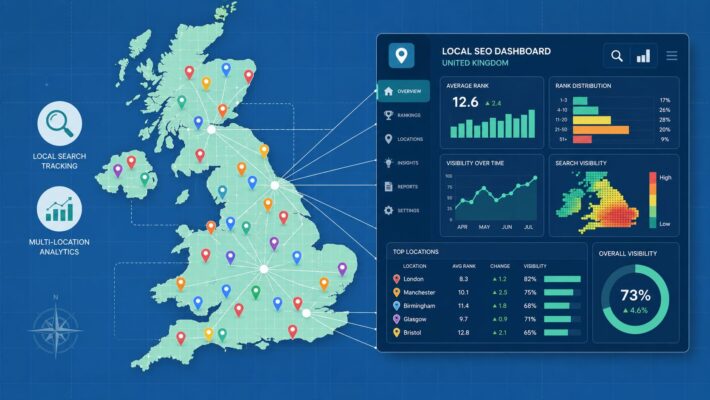
Most rank trackers check your position from a single, static point. That’s not how local search works. A customer searching half a mile away will see completely different results from someone searching on your doorstep. This is where a geo-grid rank tracker is invaluable.
This kind of tool checks your ranking for a keyword from dozens of different points across your local area. It then builds a heatmap showing exactly where you are visible. You might find you're number one on your own street but completely invisible ten blocks away. This gives you incredibly precise intelligence, showing you the "digital blind spots" you need to work on.
This level of detailed analysis and constant refinement is what separates the top-ranking profiles from the rest. The thing is, manually pulling all this data, tracking geo-grids, and constantly tweaking your profile for every location is hugely time-consuming.
That’s exactly why we built tools like the AI Optimisation Wizard and Geo-Grid Rank Tracker into LocalHQ. It automates the entire analysis process, benchmarks your profile against competitors, and gives you a clear, prioritised to-do list. It’s the logical next step for any business that's serious about winning its local market.
Your GBP Optimisation Questions, Answered
Over the years, I've heard the same questions pop up from UK business owners trying to get to grips with their Google Business Profile. Let's tackle a few of the most common ones.
How Long Until I See Results?
This is the big one, isn't it? While some edits, like changing your opening hours, show up almost instantly, seeing a real jump in your local rankings takes a bit of patience.
You can expect to see the fruits of a consistent google business profile optimisation strategy within a few weeks to a couple of months. Things like getting new reviews and putting up regular Google Posts are what really light a fire under your profile and often speed things up.
Can I Have a GBP Without a Physical Address?
Yes, you certainly can. If you're a plumber, mobile dog groomer, or any business that travels to your customers, you can set yourself up as a Service Area Business (SAB).
This is a specific setting that hides your home address (if that's where you're based) and lets you show a map of the postcodes or cities you cover instead. You’ll still show up in local searches for those areas, just without a physical pin on the map.
What Is the Most Important Part of GBP Optimisation?
If I had to boil it all down, it wouldn't be just one thing. It's more like a three-legged stool—if one leg is wobbly, the whole thing falls over.
- Accuracy: First and foremost, your core information (Name, Address, Phone, Categories) must be 100% correct and identical everywhere it appears online. No exceptions.
- Reputation: Actively encourage and gather a steady stream of positive reviews. Just as importantly, make sure you're responding to every single one, good or bad.
- Activity: A stale profile is a dead profile. You have to keep it fresh with a constant flow of new photos and regular posts.
Ready to stop guessing and start winning in local search? The LocalHQ Review Autoresponder uses AI to craft perfect, on-brand replies to every review, 24/7. See how it works and reclaim your time.