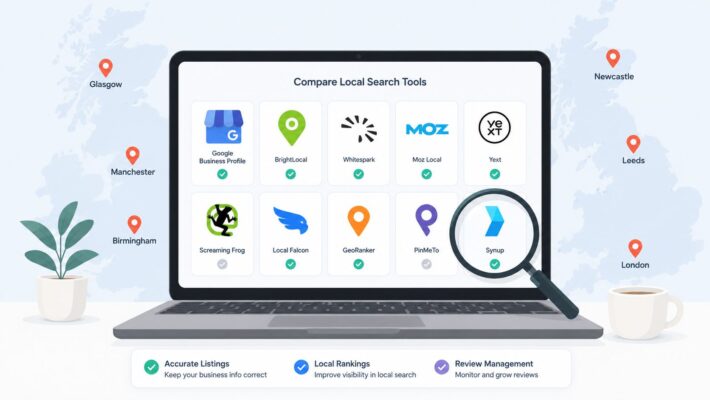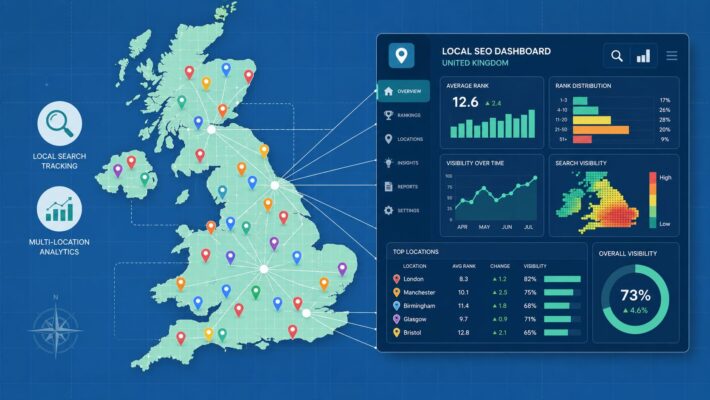
Dominate AI Overviews Local SEO in 2026
You check your rankings. Your business is still in the Map Pack. Your Google Business Profile looks fine. Yet calls are softer, website clicks are down, and the usual search traffic doesn’t convert the way it did a few months ago.
That pattern is showing up across UK local search. The problem often isn’t that your visibility vanished. It’s that Google has inserted a new decision layer between the searcher and your business.
AI overviews local SEO is now a practical discipline, not a trend label. If you run a restaurant, clinic, legal practice, trades business, retail shop, or multi-location brand, you need to know how these summaries choose winners, what signals they trust, and how to track whether your business is being surfaced or skipped.
The New Reality of Local Search
A café owner in Brighton can still rank well in Maps and still feel the pain. So can a plumber in Bristol or a dental clinic in Leeds. They look at their local rankings, see no disaster, and assume demand must be weaker. Often it isn’t. Google is answering more of the journey before the click happens.
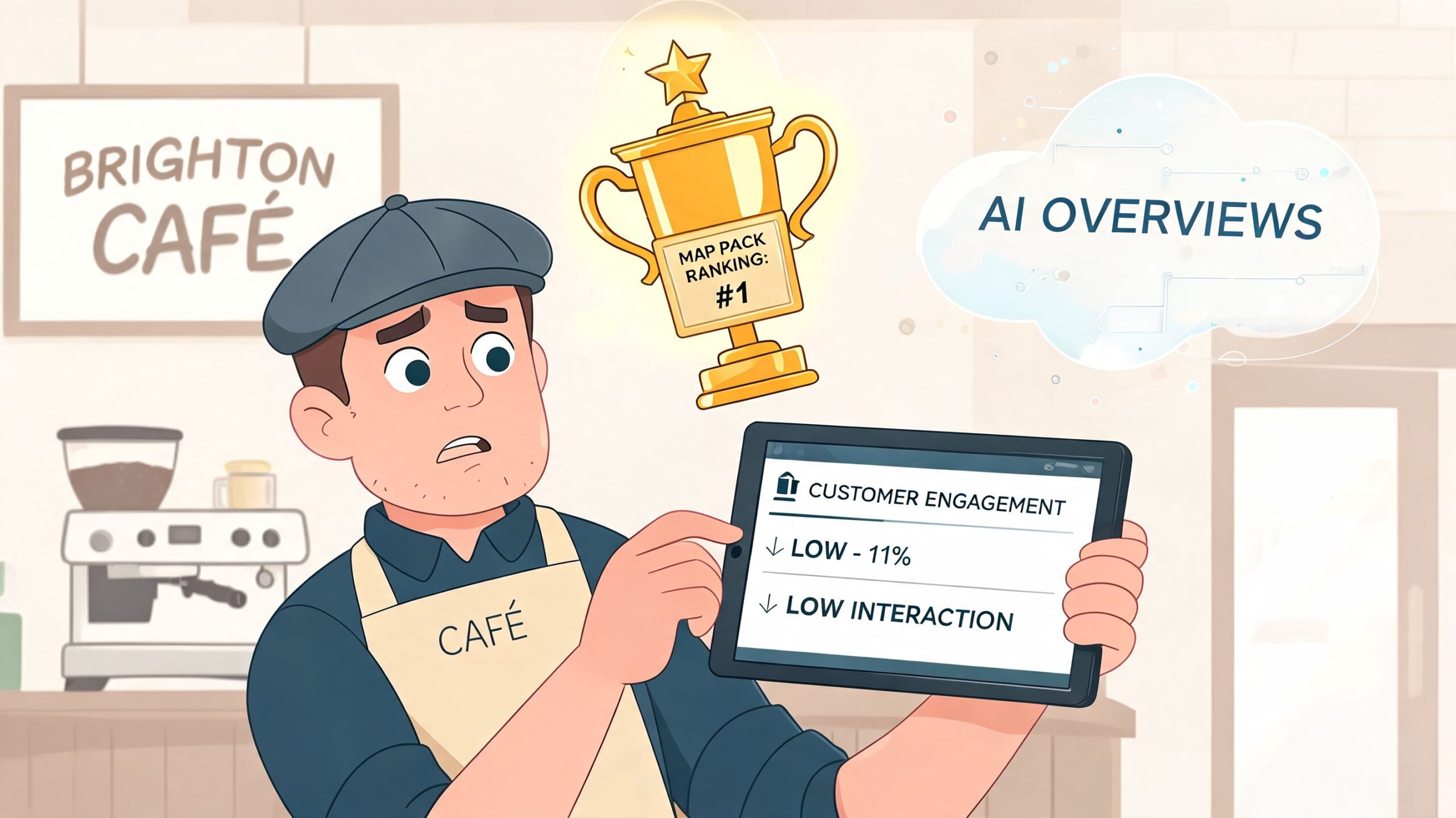
That’s the new reality. Google AI Overviews now appear in 68% of local searches, causing an estimated 15-30% decline in organic traffic for many UK local businesses as users get direct answers without needing to click further according to this analysis of how Google AI Overviews shape local SEO results.
For local businesses, that changes the question. It’s no longer just, “Do I rank?” It’s, “Does Google trust my business enough to summarise it, cite it, or use it as supporting evidence?”
Stable rankings can hide a visibility loss
Traditional local SEO taught businesses to protect three things: Map Pack positions, website rankings, and review quality. Those still matter. But AI overviews local SEO adds a fourth layer. Searchers can now get a shortlist, a comparison, or a direct recommendation before they ever see your organic result.
That’s why businesses need broader online presence strategies for businesses, not just on-page tweaks. The companies holding up best usually have cleaner local data, stronger profiles, fresher content, and better review operations across the whole footprint.
Practical rule: If your rankings look steady but clicks and calls are slipping, check whether the search journey changed before you assume demand fell.
Why this matters for UK businesses now
For UK operators, the shift lands hardest in high-intent searches. “Emergency electrician near me”, “best Sunday roast in York”, “private GP open today”, “conveyancing solicitor Manchester”. These are exactly the searches where Google wants to save the user time.
If your local strategy still revolves around keyword stuffing and occasional profile edits, you’re working from an old playbook. A more useful starting point is understanding what local search optimisation actually involves in an environment where Google is synthesising facts, not just listing websites.
The good news is that this isn’t random. AI overviews reward businesses that make it easy for Google to verify who they are, what they do, where they serve, and why customers trust them. That gives you something concrete to optimise.
How AI Overviews Evaluate Local Businesses
Google doesn’t evaluate your business like a single web page. It evaluates you like an entity. Think of it as a hotel concierge recommending a place to eat. They won’t rely on one brochure. They’ll combine what they know about your location, reputation, consistency, customer feedback, and whether your details line up across the web.
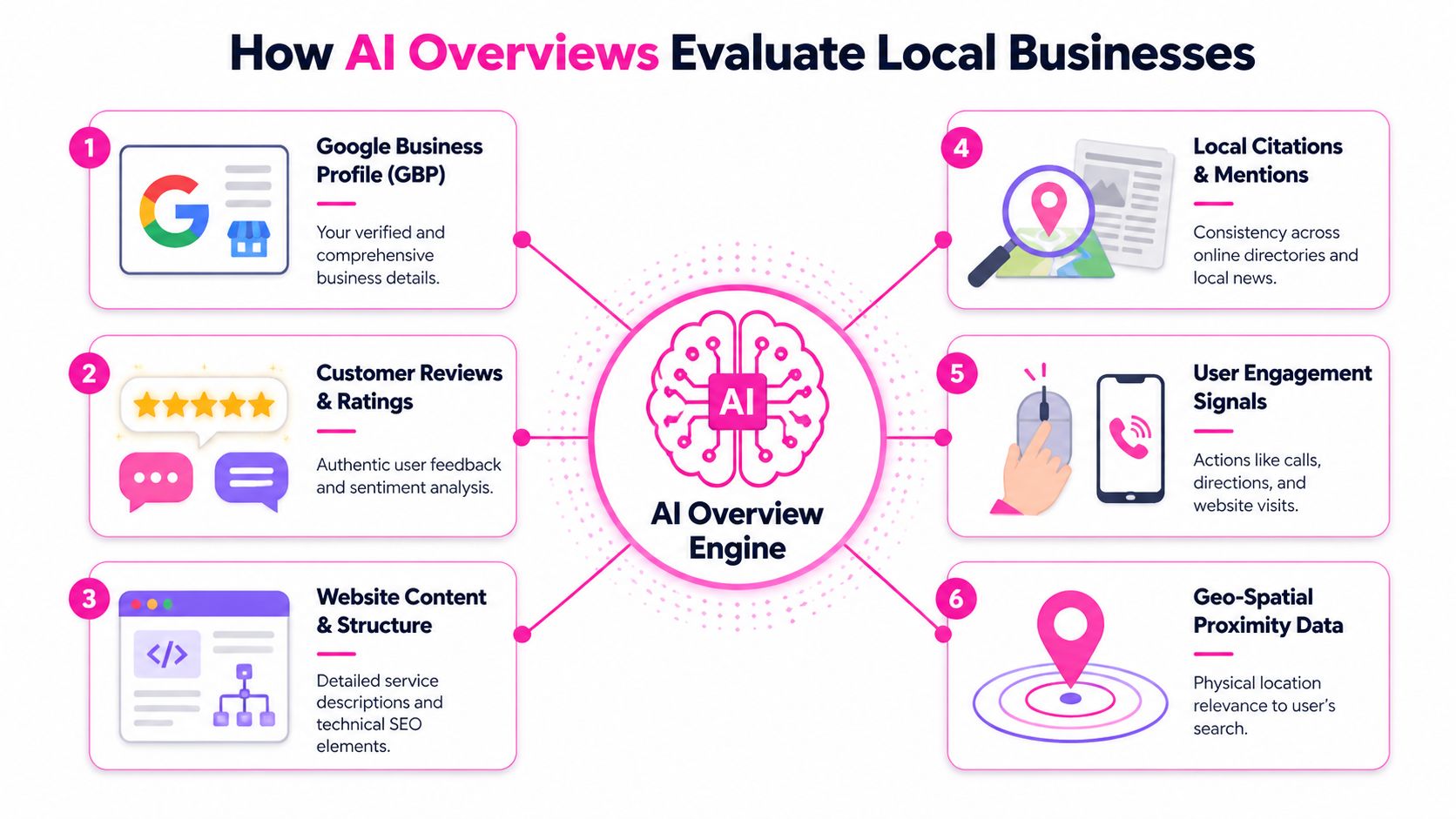
That’s how AI overviews local SEO works in practice. Google pulls from your Google Business Profile, your website, review platforms, local citations, and user engagement signals. If those signals support each other, your business looks credible. If they conflict, the system gets cautious.
Google is scoring the whole business, not one page
The most important mindset shift is this: AI Overviews don’t just reward the page with the best keyword match. They reward the business that looks like the safest, clearest answer.
One benchmark makes that clear. Google's AI models score the entire business entity holistically, with data showing that profiles with 4.5+ stars and over 100 reviews can boost their likelihood of being cited in an AI Overview by up to 40%. That aligns with what experienced local SEOs already see in the field when strong reputation and complete profile data work together.
If you want a useful external perspective on the profile side of this, these Google Business Profile strategies are worth reading alongside your own audit process.
The signals that usually decide whether you get trusted
Some signals carry more weight than others, but they work best as a set:
- Profile completeness: Your categories, services, hours, attributes, business description, photos, and Q&A all help define what your business is.
- Review sentiment and specificity: AI reads the language customers use. “Fast boiler repair in Croydon” tells Google more than “Great service”.
- Website clarity: Your site should explain services, locations, and common questions in plain terms.
- Citation consistency: Your name, address, and phone details need to match across important directories and mentions.
- Engagement evidence: Calls, direction requests, clicks, and repeated user interactions reinforce relevance.
- Proximity and service fit: Local intent still matters, but it now works alongside authority rather than replacing it.
A business with average content but excellent consistency often beats a business with clever copy and messy data.
What businesses get wrong
Many local teams still treat channels in isolation. The website team updates services. The operations team changes opening hours. Front-of-house staff ask for reviews inconsistently. Listings drift. Over time, the business stops telling one coherent story.
That’s where AI systems become unforgiving. They’re not impressed by a single polished page if the rest of the footprint is stale or contradictory. Businesses that want stronger local visibility need a repeatable framework for profile quality, review handling, and location-level consistency. The ranking principles behind that are covered well in this guide to Google Business Profile ranking factors.
Your Core Counter-Attack Fortifying Your Google Business Profile
Your Google Business Profile is now the operating centre of your local visibility. Not because websites stopped mattering, but because Google often reaches for profile data first when it needs a quick, confident local answer.
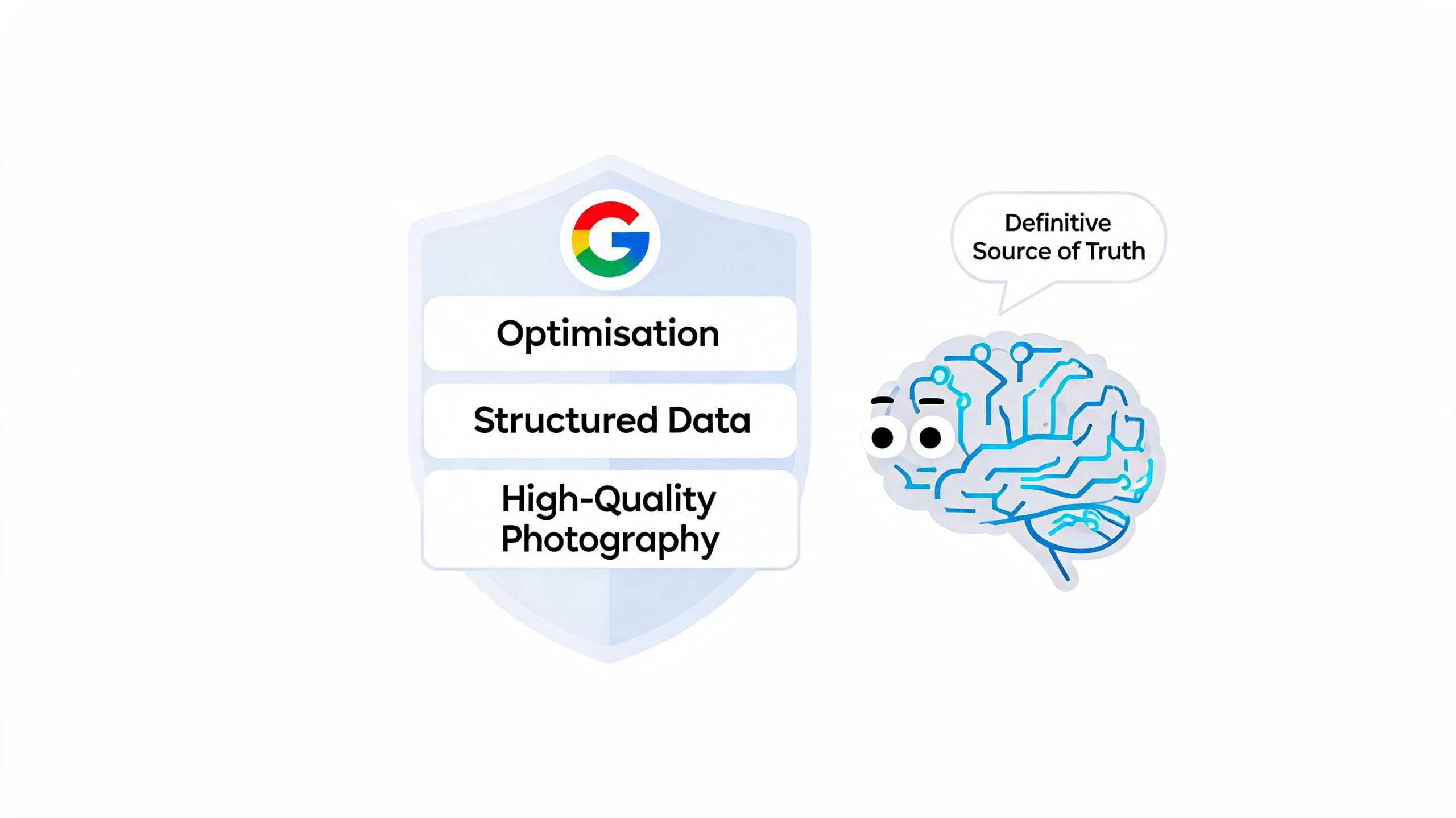
A weak profile creates ambiguity. An over-optimised one creates distrust. The job is to build a profile that feels complete, current, and useful, not stuffed.
What a fortified profile looks like
Most profiles are only half-built. They have a category, a few photos, a short description, and little else. That may have been enough for older local search patterns. It isn’t enough now.
A stronger profile usually includes:
- Accurate core data: Business name, phone number, address, service areas, and hours must be exact.
- Precise categories: Your primary category needs to reflect the core commercial offer. Secondary categories should support, not dilute, it.
- Detailed service entries: List the actual services you deliver, not vague umbrella terms.
- Useful business description: Write for customers and search interpretation, not for keyword density.
- Relevant attributes: Accessibility, payment options, collection, booking, delivery, parking, and other service markers matter when they apply.
- Active visual layer: Fresh photos, team imagery, work examples, menu images, product shots, and location visuals all help.
One data point deserves special attention. Data from Google Search Console in the UK shows that business profiles with 20% or more photo uploads are cited more frequently in AI Overviews, directly correlating with an 18% increase in direction requests and calls for hospitality businesses. That’s a practical reminder that photos are not decorative. They are evidence.
What to update every week
Many businesses fall behind. They “set up” the profile once and leave it. Google doesn’t read that as stability. It often reads it as inactivity.
A profile maintenance routine should cover:
Posts and updates
Share real updates: seasonal changes, new services, events, offers, menu additions, staff highlights, or urgent availability changes.Photo uploads
Add current imagery from the actual location. Stock-like images do less for trust.Q&A monitoring
Seed common questions if customers ask them repeatedly. Then answer them clearly.Service refinement
Adjust services when your offer changes. Don’t leave discontinued services live.Hours checks
Fix bank holiday hours, temporary changes, and special opening times early.
What doesn’t work anymore
Keyword stuffing is still one of the most common local mistakes. Businesses cram town names, service phrases, and awkward variants into the description and call it optimisation. It usually makes the profile look less trustworthy.
A better method is to write with operational detail. A locksmith shouldn’t just say “emergency locksmith London”. They should explain that they handle lockouts, lock changes, broken keys, and same-day local callouts across named service areas if those services are provided.
Here’s a simple comparison:
| Approach | What it signals |
|---|---|
| Repeating keywords in the description | Manipulation or low-quality profile management |
| Defining services, availability, and service areas clearly | Useful, verifiable business information |
| Uploading generic visuals once | Low freshness |
| Adding real location and service photos regularly | Active, trustworthy business presence |
If Google has to guess what you do, you’ve already made the profile harder to trust.
For a more detailed benchmark, this guide to Google Business Profile optimisation is a useful framework for auditing what’s missing and what needs tightening.
Winning with Reviews and Responding at Scale
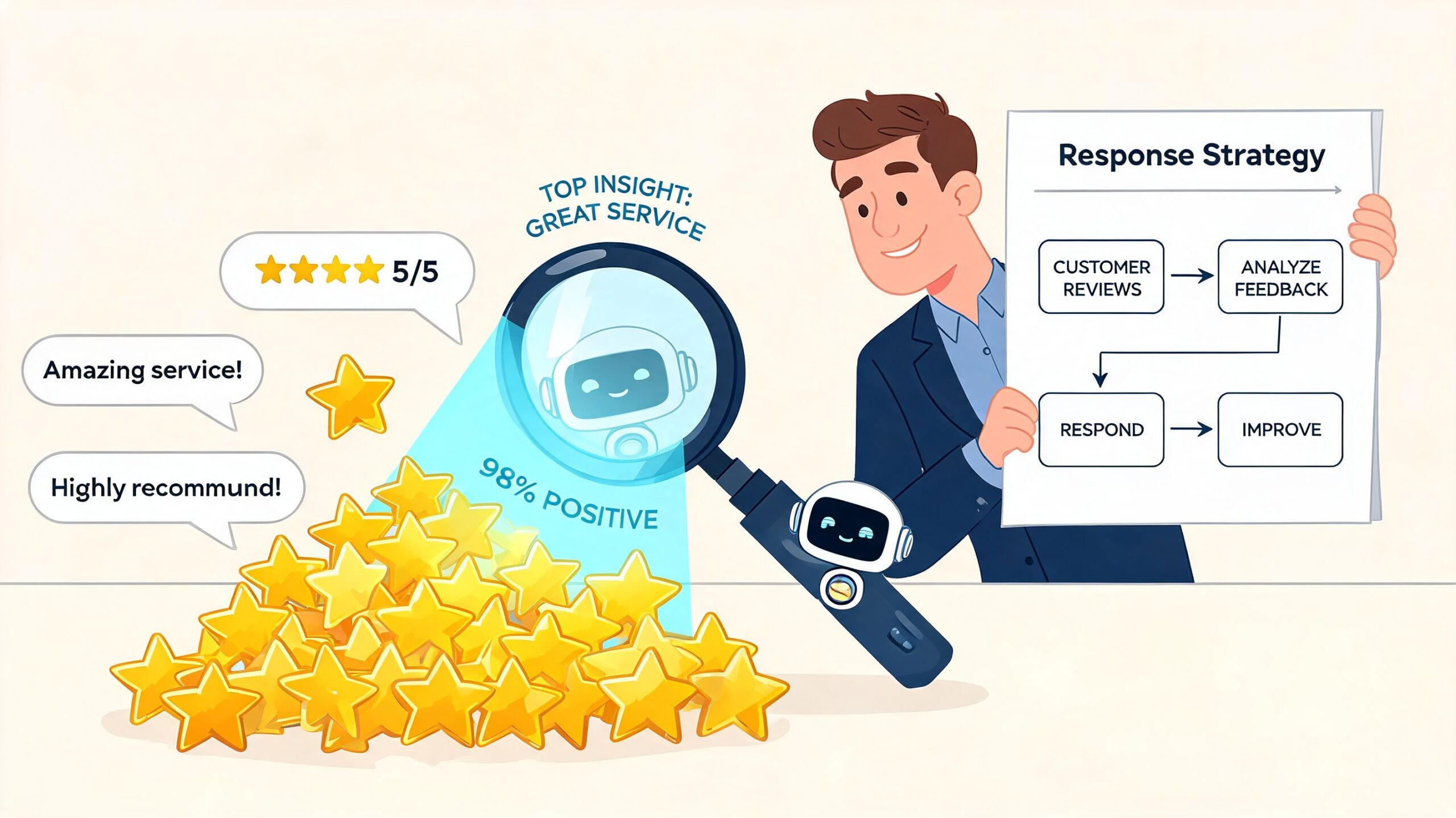
Reviews are no longer a support task that sits off to the side of SEO. In AI overviews local SEO, reviews act like distributed content. They tell Google what customers experienced, which services were delivered, where the business operates, and whether people would choose it again.
That changes how you should manage them. The goal isn’t just to protect your average rating. It’s to create a steady, believable stream of recent, specific, well-handled feedback.
Recency is doing real work
Older local SEO advice often treated reviews as a volume game. Get more stars, look reputable, move on. That’s too basic now.
In the UK market, review signals have surged in importance, with high ratings (4.5+ stars) and recency (under 90 days old) boosting visibility in AI-influenced search results by 30-50% during tests according to Semrush’s AI Overviews study.
That means a stale review profile can weaken visibility even if your historic average is strong. A business with good but ageing reviews often loses ground to one generating newer proof every week.
A review strategy that actually helps local visibility
The businesses doing this well usually follow three habits.
They ask consistently
Not in random bursts. They build review requests into completed jobs, receipts, follow-up emails, SMS prompts, or front-desk workflows.They guide for specificity
They don’t script customers, but they do encourage useful detail. Service used, location, timing, and quality of experience all help.They respond quickly
A response closes the loop. It shows the profile is active and gives the business one more chance to reinforce service relevance in natural language.
Why response speed matters
Most businesses still respond only when a review is negative, or when someone in the office has time. That creates long gaps and missed context. In AI terms, silence can look like neglect.
A good response does three things:
- Acknowledges the customer
- Reflects the service context naturally
- Shows the business is paying attention
For example, a restaurant reply might mention brunch, booking experience, or dietary support if the customer raised it. A trades business might reference emergency call-out, punctuality, or tidy workmanship. That isn’t about squeezing in keywords. It’s about reinforcing relevance honestly.
Reviews tell Google what customers think. Replies tell Google whether the business is active, attentive, and consistent.
For teams handling higher review volume, the process needs structure. One practical route is a workflow that drafts replies quickly while keeping tone and brand standards intact. A system like a Google Review Autoresponder is particularly useful, especially for multi-location operators who can’t rely on ad hoc responses from branch staff.
Creating Content AI Overviews Love to Cite
If your website content still exists mainly to chase town-plus-service keywords, it’s underpowered for the current search environment. AI systems don’t just want a page that mentions the phrase. They want a source that appears to understand the topic, the local context, and the user’s actual decision.
That changes what “good content” looks like. It needs to answer real questions clearly, show practical knowledge, and connect that knowledge to your service area.
Authority beats thin location pages
A legal practice in Glasgow will do better with a detailed page on commercial lease disputes in Scotland than with ten near-identical “solicitor in [town]” pages. A home services firm will usually get more value from a solid guide on when to replace versus repair a boiler than from dozens of spun service-area paragraphs.
The same principle appears in other content formats too. If you want an example of how AI-readable content can expand discoverability, this piece on boosting podcast visibility using AI transcripts is useful because it shows how clearer source material creates more entry points for search systems.
What to publish instead
A stronger local content mix usually includes:
Service explainers
Plain-English pages that explain what the service is, who it’s for, when it’s needed, and what customers should expect.Local problem-solving content
Pages built around recurring questions in your market, such as emergency response times, planning constraints, local regulations, or seasonal issues.Decision support content
Comparisons, checklists, FAQs, and “what to do next” pages help AI identify your site as useful for mid-funnel and high-intent queries.Location-aware expertise pages
Not doorway pages. Real pages that tie expertise to meaningful local context.
Schema turns clarity into machine-readable detail
Strong writing helps humans. Schema helps search systems. If your site clearly states your business details but doesn’t structure them properly, you’re making Google infer what it could have read directly.
LocalBusiness schema matters because it helps search systems understand core business facts, location relevance, services, and review context with less ambiguity. For multi-location operators, this becomes even more important. Every branch should have its own clean set of location details, service relevance, and page-level consistency.
A useful way to think about content is this:
| Weak local content | Strong AI-citable content |
|---|---|
| Short page built around one phrase | Detailed page built around one customer problem |
| Repeated location swaps | Genuine local context and service relevance |
| Generic service claims | Specific explanations and practical guidance |
| No structured data support | Clear schema reinforcing what the page means |
Businesses managing several branches need a publishing plan that preserves consistency without duplicating everything. For these businesses, a proper multi-location content strategy becomes more than an SEO exercise. It becomes operational discipline.
Tracking Your Visibility in an AI-First World
Traditional rank tracking still tells you something. It just doesn’t tell you enough.
A business can hold strong positions and still lose commercial visibility if the searcher never gets past the AI layer. That’s why reporting needs to move away from vanity rankings and towards evidence of real discovery, real engagement, and true local coverage.
Citation is now a metric, not a bonus
One of the clearest measurement shifts is how valuable citation has become. Being cited in an AI Overview panel can boost click-through rates by as much as 80%, while non-cited organic results in the same search can see their CTR drop by an average of 8.9%, making citation the new critical metric to track according to Rio SEO’s 2025 top local search trends.
That should change the way you read performance. A drop in organic clicks doesn’t always mean the business is weaker overall. It may mean the search experience changed and your business either was, or wasn’t, included in the summary layer.
What to track now
If you’re still sending clients or stakeholders a monthly PDF centred on a handful of keyword positions, the reporting model is behind the market.
A more useful dashboard should track:
Google Business Profile engagement
Calls, clicks, direction requests, bookings, and other profile-driven actions.Query-level visibility patterns
Which search types still produce traffic and which now get intercepted earlier.Geographic coverage
Where the business is visible across the service area, not just near the address.Competitive displacement
Which rivals are surfacing in the same key zones and service queries.
Why geo-grids matter more now
Local visibility is uneven. It always has been. AI makes the gaps more expensive because weak zones can disappear from the customer journey altogether.
A geo-grid view is useful because it reveals block-by-block performance rather than a single average ranking. For a multi-location restaurant group, that might show where one branch dominates branded discovery but loses generic “best brunch near me” visibility nearby. For a home services business, it can expose postcode clusters where stronger competitors are winning recommendation-style queries.
Here’s the practical difference:
| Old reporting habit | Better AI-first reporting habit |
|---|---|
| Track one keyword from one point | Track visibility across the full service area |
| Focus on rank alone | Pair rank with calls, clicks, and direction requests |
| Report monthly with no context | Compare movement against local competitors and query types |
| Treat Maps as the whole picture | Include AI citation, profile actions, and area coverage |
A top ranking that produces fewer calls is no longer a strong KPI on its own.
The businesses adapting fastest are the ones turning local reporting into a decision system. They use visibility data to spot weak locations, content gaps, review shortfalls, and profile issues before performance slides become obvious in revenue.
Common Pitfalls and How to Avoid Them
Most local visibility losses in the AI era don’t come from one dramatic error. They come from a chain of small inconsistencies that make the business harder to trust.
Inconsistent NAP data
If your business name, address, or phone details vary across directories, industry platforms, and local mentions, Google has to reconcile conflicting facts. That slows trust. For multi-location businesses, one bad listing can also create confusion around brand-wide consistency.
The fix is dull but effective. Keep a master record for every location and use it for every update.
Keyword stuffing your profile
A cluttered business description packed with repeated town names and service terms doesn’t make you look relevant. It makes you look managed by someone using an outdated checklist.
Write descriptions for human understanding first. Say what you do, who you help, and what a customer can expect.
Ignoring negative reviews
Silence around criticism is expensive. AI reads sentiment, but customers do too. If a complaint sits unanswered, both Google and the next potential buyer learn the same thing: nobody stepped in.
A better approach is simple. Respond promptly, stay factual, acknowledge the issue, and explain the next step without becoming defensive.
Letting the profile go stale
Outdated hours, no recent images, old service details, and unanswered questions create a profile that looks abandoned. That’s a trust problem long before it becomes a ranking problem.
Use a recurring checklist. For many businesses, local SEO breaks not because the strategy is wrong, but because nobody owns the maintenance.
Treating each location like a copy-paste job
Multi-location operators often repeat the same content, same profile logic, and same review process across branches without local nuance. That creates bland, low-signal profiles.
Each location needs its own reality reflected clearly: opening patterns, service differences, local imagery, local review context, and location-specific FAQs where relevant.
Frequently Asked Questions About AI Overviews and Local SEO
Will AI Overviews replace the Google Map Pack completely
No. The Map Pack still matters for local discovery and local decision-making. What has changed is the order of attention. AI can now intercept the journey earlier, so being strong in Maps alone isn’t enough for many competitive searches.
Does this affect every UK business in the same way
No. The impact varies by search type, vertical, and how much trust Google has in your business data. Restaurants, hospitality, healthcare, legal, retail, and emergency services can all feel the shift differently because user intent and comparison behaviour differ.
Is it too late to start optimising for AI Overviews
Not at all. Many businesses still run on old local SEO habits. A cleaner profile, stronger review flow, better service content, and tighter data consistency can still create a clear advantage.
Should I focus on my website or my Google Business Profile first
For most local businesses, fix the Google Business Profile first if it’s incomplete or stale. Then strengthen the website so both assets tell the same story. The two should support each other, not compete.
What is the clearest sign that AI is affecting my local performance
A common sign is this combination: rankings stay relatively stable, but organic clicks soften and profile-level actions become more important. That usually means the search experience changed and users are deciding earlier.
If AI overviews local SEO is changing how customers find and choose your business, you need a system that keeps your profiles current, your reviews active, and your visibility measurable. LocalHQ gives local businesses and agencies one place to manage Google Business Profiles, monitor review activity, track geo-grid visibility, and report on the signals that now drive calls, clicks, and direction requests.