AI Local Search: Your 2026 Competitive Advantage

Nearly half of local discovery in the UK starts with intent that’s tied to place. 46% of all Google searches have local intent, according to Embryo Marketing’s 2025 analysis. That single number changes how restaurants, clinics, trades, retailers, and franchise networks should think about visibility.
AI local search isn’t a side feature layered on top of Google. It’s becoming the system that interprets what people mean, decides which businesses fit, and summarises those options before a user ever clicks. If your business data is incomplete, inconsistent, stale, or thin, AI has less confidence in you. If your presence is clear, specific, and well maintained, AI has more to work with.
That’s the shift. Local search still matters. In fact, it matters more. But the mechanics have changed enough that the old routine of filling out a profile once, collecting a few reviews, and hoping proximity does the rest won’t hold up.
The New Local Landscape in 2026
Most local businesses still treat search as a rankings problem. It’s now an interpretation problem.
Google is no longer just matching a phrase like “dentist in Leeds” to a list of pages and profiles. It’s trying to understand whether the searcher needs an emergency appointment, family-friendly care, late opening hours, wheelchair access, or a clinic near their current route home. That means AI local search is changing the criteria for visibility. Relevance has become richer, more situational, and more demanding.
Local intent is already the main event
The important point isn’t that AI is arriving. It’s that local intent was already massive before this layer took over. A business that underinvests in local visibility is already missing demand. Once AI summaries, personalised recommendations, and conversational answers enter that same journey, weak local signals become more expensive.
For small businesses, that usually shows up as fewer calls, fewer direction requests, and lower trust at the moment of choice. For multi-location brands, the problem spreads wider. One weak listing, one wrong category, or one neglected review profile can distort how an entire location performs.
Practical rule: If a customer can ask a more detailed question, Google can now give a more selective answer.
That’s why broad, generic local SEO advice feels dated. Businesses don’t need another checklist full of surface-level tips. They need operational discipline around profile data, reviews, local content, and technical clarity.
AI has changed the shape of the click
The search page itself is changing. AI can summarise options before a user visits your site. It can compare businesses using review themes, opening hours, service fit, and local relevance. It can also reduce the number of clicks available to businesses that haven’t made their information easy to interpret.
A useful primer on where this is heading comes from Netco Design LLC's analysis of SGE, which breaks down how AI-driven search experiences alter visibility for smaller brands. The practical takeaway is simple. Search is becoming more assisted, and assistance favours businesses with stronger data and clearer signals.
Businesses that adapt can still win. In many categories, they can win faster because weaker competitors haven’t caught up yet.
Understanding AI Local Search
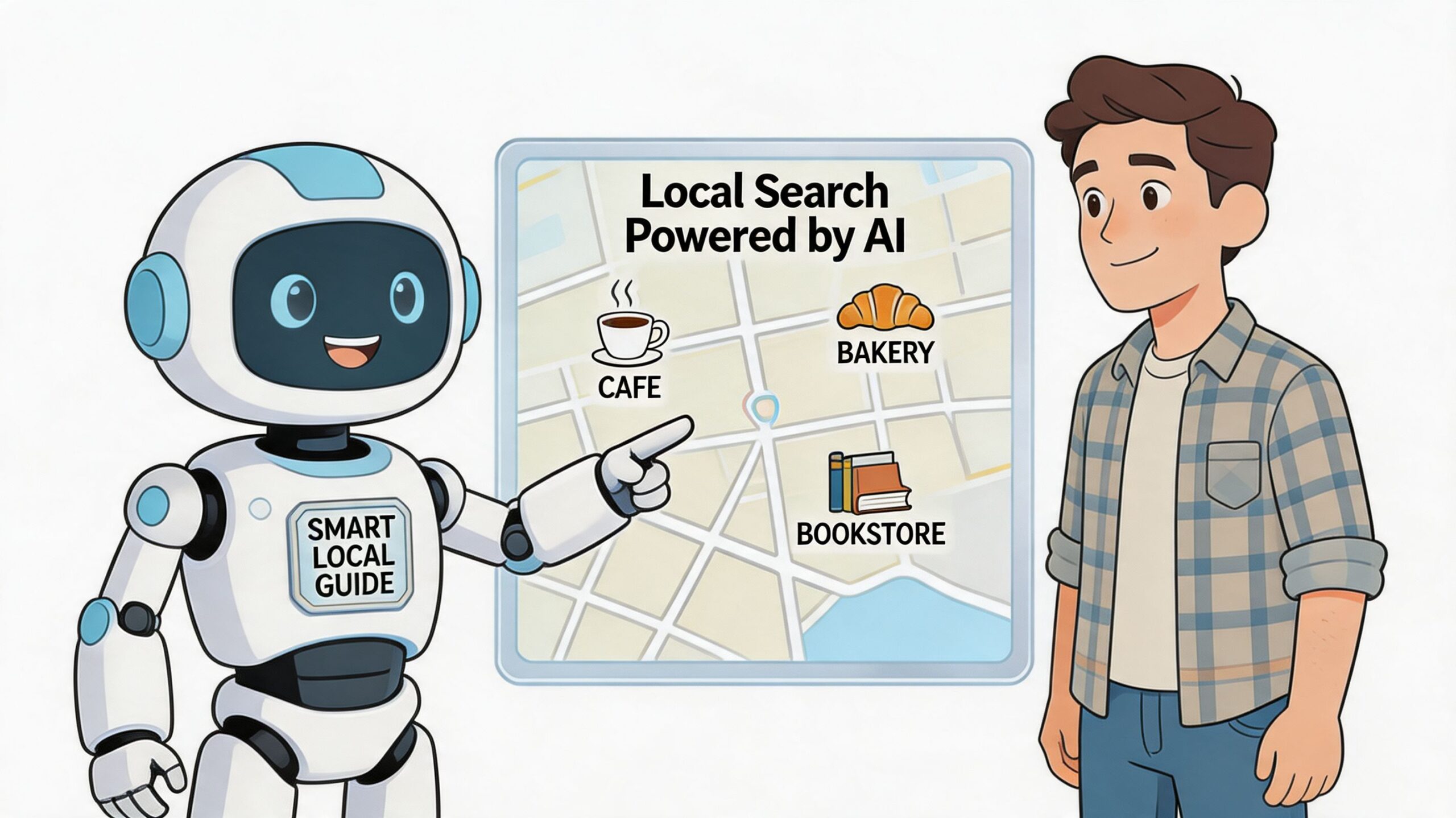
Think of AI local search as a highly capable local concierge.
Instead of waiting for a user to type the perfect keyword, it listens to the request, fills in the missing context, checks multiple signals, and returns a shortlist that looks useful right away. That concierge pays attention to the business profile, the website, reviews, service details, hours, category fit, and how well all of it aligns.
Generative AI writes the first draft of your visibility
When Google produces an AI summary, it isn’t inventing a business recommendation from nowhere. It assembles a response from the sources it trusts and the entities it understands.
For a local business, that means AI may pull from your Google Business Profile, your website pages, your reviews, your stated services, and your consistency across the web. If those inputs are vague, duplicated, or contradictory, the summary has less reason to feature you prominently. If they’re clear and specific, your business becomes easier to include.
This is why thin location pages and neglected listings perform poorly in an AI-led environment. They don’t give the system enough confidence.
Machine learning adjusts results to the searcher
Traditional local search already used location and relevance. AI local search adds much more nuance.
A person searching from the city centre at lunchtime may get a different set of results from someone making a similar search at home in the evening. The same applies to service businesses. Someone searching for a solicitor may be shown different firms depending on the phrasing of the query, how specific the need appears, and which firms have the clearest evidence of fit.
That means the old obsession with one fixed rank position is becoming less useful. Visibility now changes with context.
Natural language processing understands messy human questions
This is the piece many businesses underestimate. People don’t search in neat keyword strings anymore. They ask layered questions.
Examples include:
- Restaurants: “best Thai restaurant open late with vegan options”
- Home services: “boiler repair near me available this weekend”
- Healthcare: “private physio clinic for runners with evening appointments”
- Retail: “independent gift shop near me with same-day collection”
AI local search can break those requests into components and look for businesses that satisfy more of them. That’s why category accuracy, service detail, review themes, and opening hours matter more than generic keyword repetition.
A practical walkthrough of these mechanics sits in this guide on how to use AI for local SEO. It’s useful because it connects the theory to the actual work local teams need to do.
Good AI local search performance usually comes from boring operational accuracy. Correct categories. Complete services. Updated hours. Real reviews. Clear local pages.
How AI Is Redefining Local Discovery on Google
The biggest mistake I see is treating AI as a future concern while continuing to optimise for a search page that no longer exists in the same form.
Google now surfaces local businesses through several overlapping layers. The map pack still matters. Organic results still matter. But AI-generated answers increasingly sit above, around, or between them, changing what gets seen first and what earns the next action.
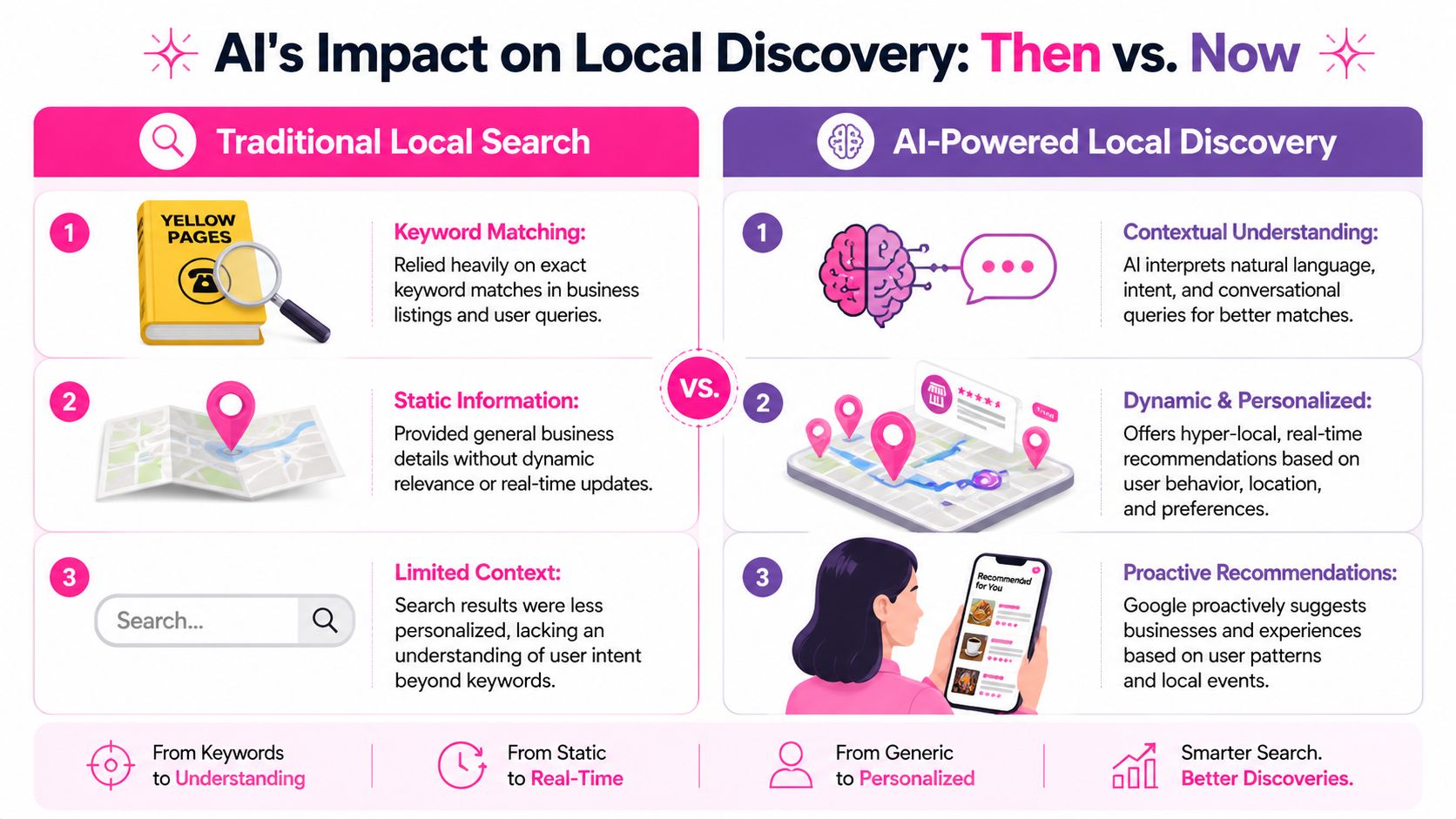
AI Overviews change who gets noticed
This is no longer marginal behaviour. AI Overviews appeared in 15.69% of queries by November 2025, and local queries saw 68% AI Overview coverage overall, according to Semrush’s AI Overviews study.
For local businesses, that matters because the answer layer can intercept attention before a user reaches standard blue links or even scans the full map results. If Google can summarise “best options nearby” directly, it narrows the field earlier.
The consequence is straightforward. Businesses need to be present in the source material AI uses to assemble answers, not just present somewhere on page one.
Personalisation is now built into local visibility
A search result isn’t just about distance and category match anymore. Google can adapt local recommendations using situational context.
That changes how discovery works in practice:
- Time-sensitive searches can favour businesses with clearly updated opening hours.
- Preference-heavy searches can lean on reviews and descriptive service information.
- Location-sensitive searches can shift depending on where the user is standing, travelling, or planning to go.
- Complex local needs can reward businesses with stronger supporting detail on both profile and website.
A user looking for a pub may not only get the nearest one. They may get the nearest one that appears suitable for showing sport, serving food late, and matching the tone implied in the query.
This makes weak profiles more expensive than they used to be. A listing with partial information won’t help Google make the case for you.
AI local search rewards businesses that remove ambiguity.
Conversational queries expose shallow optimisation
Local discovery used to rely heavily on exact-match patterns. That model still exists, but it’s no longer enough.
People now ask compound questions that combine intent, preference, urgency, and constraints. A search like “family-friendly Italian restaurant near me with parking and gluten-free options” is not one keyword. It’s a bundle of expectations.
Businesses that only optimise for broad category terms often disappear when those richer queries become common. Businesses that document actual services, amenities, specialities, and local relevance have a better chance of appearing.
That’s also why dedicated service pages matter so much more now. One page for “plumber” is weaker than a clear set of pages explaining leak repair, boiler issues, emergency callouts, bathroom installs, and service areas in plain language.
If you want a grounded look at map visibility fundamentals that still support this newer reality, Silva Marketing’s guide on how to improve local search rankings is worth reading. The underlying principles still apply, but they need to be carried into AI-shaped results rather than treated as an older standalone playbook.
Google Maps signals don’t stay inside Maps
Many businesses still separate Google Maps from search strategy. That divide is shrinking.
Profile completeness, category selection, reviews, media, updates, and service detail all contribute to how Google understands a local entity. Those signals don’t just influence a map result. They inform broader interpretation across search surfaces.
For teams trying to tighten that side of performance, these Google Maps ranking factors are the right place to audit what’s helping and what’s holding you back.
The Business Impact of AI on Local Search
AI local search creates a harsher split between businesses that are well maintained and businesses that are merely present.
That split affects single-location firms and multi-location operators in different ways, but the direction is the same. If your information is clear, recent, and trustworthy, AI can amplify you. If your presence is patchy, AI can skip over you or represent you poorly.
The risks are operational, not theoretical
The first risk is reduced website traffic from informational searches that are now answered on the results page. A user may see an overview, compare options quickly, and make a call or request directions without ever visiting your site.
That isn’t automatically bad. The bad outcome is when your business fails to appear in that shortened decision path.
The second risk is misrepresentation. If your hours are wrong, your services are underspecified, or your categories don’t reflect the actual business, AI can form an incomplete picture. For service providers, that often means showing up for the wrong jobs or not showing up for the right ones. For hospitality and retail, it can mean missing intent-rich searches where customers care about specifics.
The upside goes to the businesses that are easiest to trust
A well-managed presence can benefit from AI because summaries compress decision-making. If your reviews, profile detail, and local pages all support the same story, Google has an easier time featuring you with confidence.
That’s particularly powerful for businesses with a strong reputation in a competitive area. AI can surface those quality signals more directly than a plain ranked list ever could.
A strong local brand no longer needs to win only on proximity. It can win on clarity, relevance, and proof.
Small businesses and multi-location brands face different pressure
For a single restaurant, salon, or solicitor, the challenge is usually consistency and focus. One neglected profile can usually be fixed with disciplined weekly management. The owner or marketing lead can tighten categories, update services, refresh imagery, and respond to reviews without too much organisational drag.
For multi-location brands, the challenge is governance. Different branches often drift. Hours vary, descriptions become inconsistent, categories get chosen differently, and review response quality swings from one location to another. AI local search exposes that drift because it relies on machine-readable consistency.
A franchise network with uneven execution doesn’t just have a brand problem. It has a discoverability problem.
Doing nothing is still a decision
Some businesses will delay because AI feels complicated. In practice, most of the work is not exotic. It’s the disciplined upkeep many teams already knew they should be doing, now under stricter conditions.
That includes:
- Accurate profile data: Every field should reflect reality.
- Specific service information: Don’t force Google to guess what you do.
- Review management: Fresh customer language helps search engines understand fit.
- Location content: Each page should answer local intent, not duplicate boilerplate.
- Technical clarity: Schema and structured data help machines interpret the business properly.
Businesses that act early usually gain a simpler advantage. They become easier for AI systems to understand than their local competitors.
Your Prioritised AI Local Search Optimisation Playbook
Teams often don’t need more advice. They need the right order.
The sequence matters because AI local search builds confidence from foundational signals first. If your core business data is wrong, content won’t rescue you. If your profile is complete but your reviews are thin or unmanaged, you’re still limiting what AI can infer. If your reputation is strong but your site gives no local detail, Google has less context for complex queries.
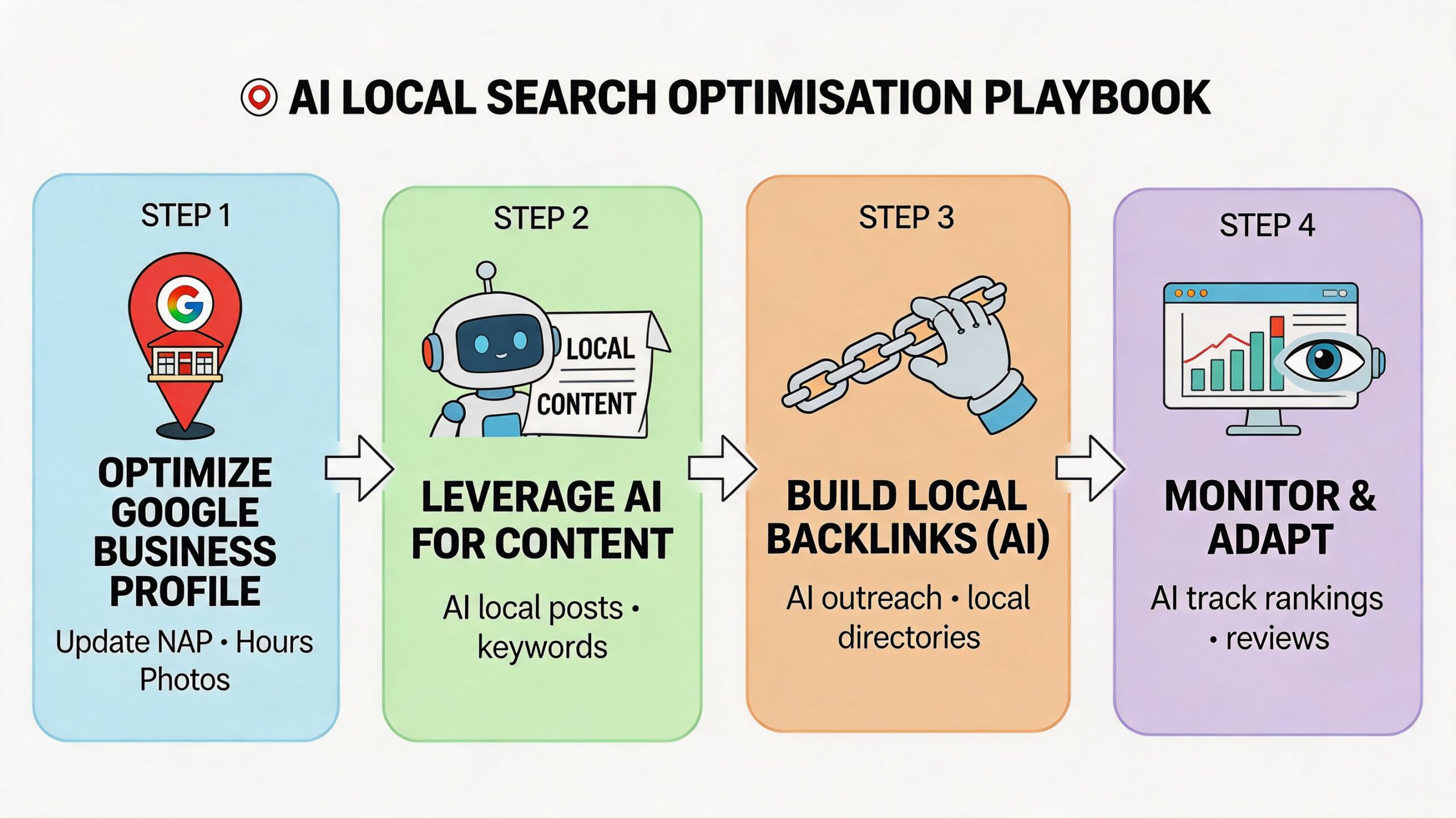
Fix your Google Business Profile data first
Start with the basics that too many businesses still treat casually.
Your primary category must be accurate. Secondary categories should reflect genuine services, not wishful targeting. Opening hours need to be current. Service descriptions should be specific. Photos should reflect the actual business. Products, services, booking links, and attributes should be filled in where relevant.
Your profile’s significance lies in its role as one of the clearest structured sources Google can use to understand who you are and when you’re relevant. If you run multiple locations, this work needs central standards and local verification.
A practical reference point is this guide on how to optimise Google Business Profile, especially for teams trying to standardise what “complete” means.
Treat reviews as training data for visibility
Reviews don’t just persuade customers. They help AI understand what your business is known for.
If customers repeatedly mention “quick emergency callout”, “great vegan menu”, “helpful staff”, or “clean waiting room”, those themes strengthen the relevance signals surrounding your listing. Review responses matter too, because they let you reinforce service detail, acknowledge issues, and keep the profile active.
What doesn’t work is passive collection. Asking sporadically, replying selectively, and using generic templated responses leaves too much value on the table.
Focus on:
- Consistency: Build a steady review request process after real customer interactions.
- Specificity: Encourage honest, descriptive feedback rather than empty praise.
- Coverage: Spread attention across every location, not just the head office or strongest branch.
- Responses: Reply in a way that confirms services, context, and professionalism.
Build local pages for real questions, not vanity keywords
A location page should help a person decide, not just help a marketer insert a town name.
That means each page needs enough original detail to answer practical local intent. Include the services offered at that location, nearby areas covered, useful FAQs, proof points, and information a customer would actually want before calling or visiting.
For service businesses, separate pages for major service lines often outperform one catch-all page because AI can match them to more specific queries. For hospitality and retail, pages that reflect opening hours, facilities, menus, stock types, or collection options can close the gap between a generic search and a real decision.
If you want extra perspective on off-profile promotion, Clepher shares proven strategies for local growth that complement this kind of local content work.
Working rule: Write the page your staff wish every customer had read before calling.
Add schema so machines can verify what humans already understand
Schema is no longer optional technical polish. It’s part of local clarity.
Businesses using structured schema markup see 25% to 40% higher inclusion in AI responses, according to Search Engine Land’s guide to how AI is impacting local search. That makes sense. Schema turns your business details into machine-readable signals instead of leaving them buried inside paragraphs.
For local businesses, the practical priority is LocalBusiness-related markup and any supporting schema that helps define services, opening hours, location details, and connected profiles. The goal isn’t to “game” AI. It’s to remove uncertainty.
Keep publishing useful local updates
In this scenario, many profiles go stale.
Google wants current evidence that a business is active, relevant, and engaged. Posts, offers, event updates, new photos, service changes, and seasonal notices all help maintain freshness. They also create more surface area for AI systems to understand what’s happening at a location now, not six months ago.
This doesn’t need to become a content treadmill. It does need to become routine.
Use tools where repetition is the bottleneck
Local teams often know what to do but struggle to do it across every location and every week. That’s where software becomes practical rather than optional.
For example, LocalHQ can sync Google Business Profile updates, schedule posts and media, benchmark competitors, generate on-brand review replies, and track visibility across target areas from one dashboard. For multi-location operators and agencies, that kind of workflow matters because AI local search punishes inconsistency at scale.
The key is not the tool name. It’s whether the system helps you maintain accuracy, speed, and repeatability.
Measuring What Matters in the AI Era
A lot of local reporting still answers the wrong question.
Teams get shown rankings, impressions, and maybe a traffic chart, then try to infer business impact from there. In AI local search, that approach misses too much. Visibility is more fluid, search results are more personalised, and some of the most valuable interactions happen before a website visit.
Old reporting habits break first
A single rank position for one postcode and one keyword tells you very little if different users see different results based on context. The same applies to raw traffic volume. If AI answers more of the discovery journey directly on Google, a drop in visits doesn’t automatically mean a drop in performance.
What matters now is whether your business is being surfaced, selected, and contacted in the places where customers decide.
The KPI shift is easy to see side by side
| Metric Focus | Traditional KPI (Pre-AI) | Modern KPI (AI-Era) |
|---|---|---|
| Visibility | One fixed ranking for a keyword | Geographic visibility across service areas and postcodes |
| Search presence | Website impressions and clicks | Presence across Maps, local packs, and AI-led result surfaces |
| Keyword strategy | Short, exact-match phrases | Conversational and intent-rich local queries |
| Engagement | Sessions and bounce rate | Calls, direction requests, bookings, and high-intent actions |
| Content performance | Blog traffic | Whether local pages support discovery for specific service intent |
| Location management | Spot checks | Ongoing monitoring of each branch’s profile health and gaps |
The practical implication is that local marketers need a wider field of vision. That includes tracking where visibility weakens geographically, which locations drift operationally, and which queries trigger useful actions rather than empty exposure.
Geo-grid tracking matters more than headline rank
This is one of the clearest upgrades businesses can make.
A geo-grid view shows how visible you are across a real service area, not just from one arbitrary point. That matters for dentists, estate agents, restaurants, legal practices, and trades alike. If visibility is strong near the location but weak in valuable surrounding postcodes, you need to know that.
This is also where optimisation becomes measurable. Automated hill-climbing refinement of Google Business Profile elements can produce 18% to 22% impression lifts for multi-location franchises, while geo-targeted content can increase AI snippet inclusion by 32%, according to Local Dominator’s analysis of the Google local search algorithm.
That kind of progress doesn’t show up cleanly if you only watch one ranking report.
Track coverage across the map, not just position in a spreadsheet.
For teams that need that postcode-level view, a local rank tracker is the practical place to start. It helps connect visibility changes to real areas of demand rather than abstract averages.
Lead quality now beats vanity metrics
In the AI era, I’d rather see fewer low-value impressions and more high-intent actions than the other way round.
Calls, bookings, form submissions, and direction requests tell you whether your local presence is converting. They also reveal which locations, categories, and queries are producing business outcomes, not just dashboard movement.
That shift sounds small. It changes how smart teams allocate time.
Conclusion Your Next Step to AI Readiness
AI local search doesn’t reward the loudest business. It rewards the clearest one.
The businesses that win are easier to understand, easier to trust, and easier to match to real intent. They keep their profile data accurate, publish useful local detail, earn descriptive reviews, and remove technical ambiguity from their site. That’s what gives Google enough confidence to surface them when a nearby customer asks a better question.
For most local businesses, the next step isn’t to chase every new AI feature. It’s to tighten the signals you already control and make that work repeatable.
If you want help turning those signals into a routine, start with an AI assistant for local SEO workflows. It’s a practical way to identify profile gaps, generate better updates, and keep local optimisation moving without relying on ad hoc manual effort.
Frequently Asked Questions
Is local SEO still worth doing if AI answers more searches directly
Yes. AI local search increases the importance of local SEO because Google still needs reliable business signals to build those answers. The work has shifted from chasing simple rankings to improving how clearly your business can be understood and recommended.
Can a small business do this manually
Up to a point, yes. A single-location business can handle a lot manually if someone owns the process and sticks to it. The problem starts when updates slip, reviews go unanswered, or location pages stay generic. Multi-location businesses usually need systems, workflows, and tooling much sooner.
How quickly can results appear
Some changes, such as profile corrections, better service detail, and stronger review response habits, can improve visibility relatively quickly. Broader gains from content, schema, and location-wide consistency take longer because Google needs time and repeated signals to build confidence.
Does AI local search replace Google Business Profile optimisation
No. It makes it more important. Your Google Business Profile remains one of the core sources Google uses to understand your business in local contexts.
If you’re serious about AI local search, start where the operational wins are easiest to compound. LocalHQ gives local businesses, agencies, and multi-location brands one place to manage profile updates, review responses, content scheduling, and visibility tracking without turning local SEO into a spreadsheet exercise.