Citation Building Automation: Quality vs Quantity in 2026

The most repeated advice about citations is also the most misleading. More listings don’t automatically mean better local visibility.
In 2026, citation building automation matters because time matters, consistency matters, and scale matters. But volume on its own is a weak strategy. A business with dozens of thin, half-complete directory listings can still lose out to a competitor with fewer listings that are cleaner, richer, and better maintained.
That’s the core trade-off UK businesses need to understand. Automation is useful. It can remove tedious admin, push updates faster, and help multi-location teams avoid chaos. What it can’t do well on its own is judgement. It won’t decide which directories deserve attention, which listings need richer content, or whether a technically correct profile helps a customer choose you.
For local businesses under pressure to rank, that distinction is important. A plumber with three service areas, a dental group with multiple clinics, or a hospitality brand rolling out new locations doesn’t need another “submit everywhere” tactic. They need a system that protects accuracy while improving visibility where it counts.
Beyond the Numbers Game in Local SEO
The old mindset says citation work is a race to the highest count. That view is outdated.
Google doesn’t just need to see your business name scattered across the web. It needs enough consistent signals to trust that your business is real, active, and located where you say it is. That’s why smart local marketers increasingly focus on quality, maintenance, and relevance rather than raw submission volume. If you’re reviewing broader strategies to rank higher on Google Maps, the same principle shows up again and again. Strong local visibility usually comes from coordinated signals, not one oversized tactic.
Citation building automation sits right in the middle of that shift. At its best, it gives you a central way to distribute and manage business data across directories. At its worst, it becomes a set-and-forget machine that creates a lot of listings with very little real value.
For UK businesses, the temptation is obvious. Owners are busy. Marketing teams are stretched. Agencies want repeatable delivery. Automation promises speed, and speed is useful. But if your listings are inconsistent, duplicated, or too shallow to support trust, scale only spreads the problem faster.
A better way to think about citations is this. Automation handles distribution. Strategy handles outcomes.
That’s also why citation work should never be isolated from wider local search planning. It belongs inside a broader framework of local SEO ranking factors, where business data, reviews, relevance, proximity, and profile completeness all work together.
Practical rule: If a citation tactic only increases the number of listings but doesn’t improve trust, consistency, or decision-making for customers, it’s probably the wrong tactic.
Why Citations Are a Cornerstone of Local Trust
A citation is usually described as a mention of your Name, Address, and Phone number, often shortened to NAP. That definition is correct, but it’s incomplete.
What matters in practice is that citations act like third-party confirmation. Your website can say anything about your business. A directory, industry listing, or local platform that repeats the same information gives search engines another signal that the details are credible. When multiple trusted sites agree on who you are and where you operate, uncertainty drops.

For a UK audience, think about listings on platforms such as Yell and FreeIndex, alongside niche directories tied to your sector. A restaurant, legal firm, dental clinic, or trades business doesn’t just need mentions anywhere. It needs mentions in places that reinforce legitimacy and local relevance.
Why consistency carries so much weight
If one directory shows an old phone number, another uses a previous trading name, and a third has the wrong postcode, search engines don’t know which version to trust. Customers get confused as well. Some will move on to a competitor with cleaner information.
That’s why citations work less like a vanity metric and more like a trust framework. They support the same core message across the web.
A simple way to picture it is to treat each accurate citation as a small vote of confidence. One vote doesn’t settle much. A cluster of matching votes from credible places starts to form a pattern.
- Identity validation helps search engines confirm that your business exists as a distinct entity.
- Location reinforcement supports your relevance in the areas you serve.
- Customer confidence improves when people see the same details repeated across familiar platforms.
- Platform alignment reduces friction between your website, Google Business Profile, and third-party listings.
Authority matters more than randomness
Not all citations are equal. A profile on a recognised local or industry directory can support trust in a way that a weak, neglected directory won’t.
That’s why random bulk submission rarely performs well over time. A smaller set of relevant, maintained citations is usually more useful than a giant footprint built on low-quality sites. Businesses often learn this the hard way after spending months cleaning duplicates and correcting old records.
Citations don’t persuade Google with volume alone. They persuade it with consistency and credibility.
If you need a clean primer on the basics before building a process around them, this guide on what local citations are is a solid starting point.
What strong citation foundations usually include
Most businesses should make sure the following stay aligned everywhere they appear:
| Element | What to check |
| | |
| Business name | Exact trading style and spacing |
| Address | Unit numbers, abbreviations, postcode format |
| Phone number | Main local number used publicly |
| Website | Preferred canonical URL |
| Opening hours | Seasonal and bank holiday changes |
| Categories | Accurate service and business type labels |
That last point is often missed. Categories and service labels affect how useful a listing becomes. A correct NAP record is necessary, but it isn’t always enough to make the citation competitive.
The Mechanics of Automated Citation Building
Most citation platforms work from a simple idea. You enter your core business information once, then the system pushes that information to a network of directories or connected partners.
That sounds straightforward, but there are important differences in how these systems operate. If you don’t understand them, it’s easy to buy a service that looks efficient and still leaves you with poor-quality outcomes.
The core workflow
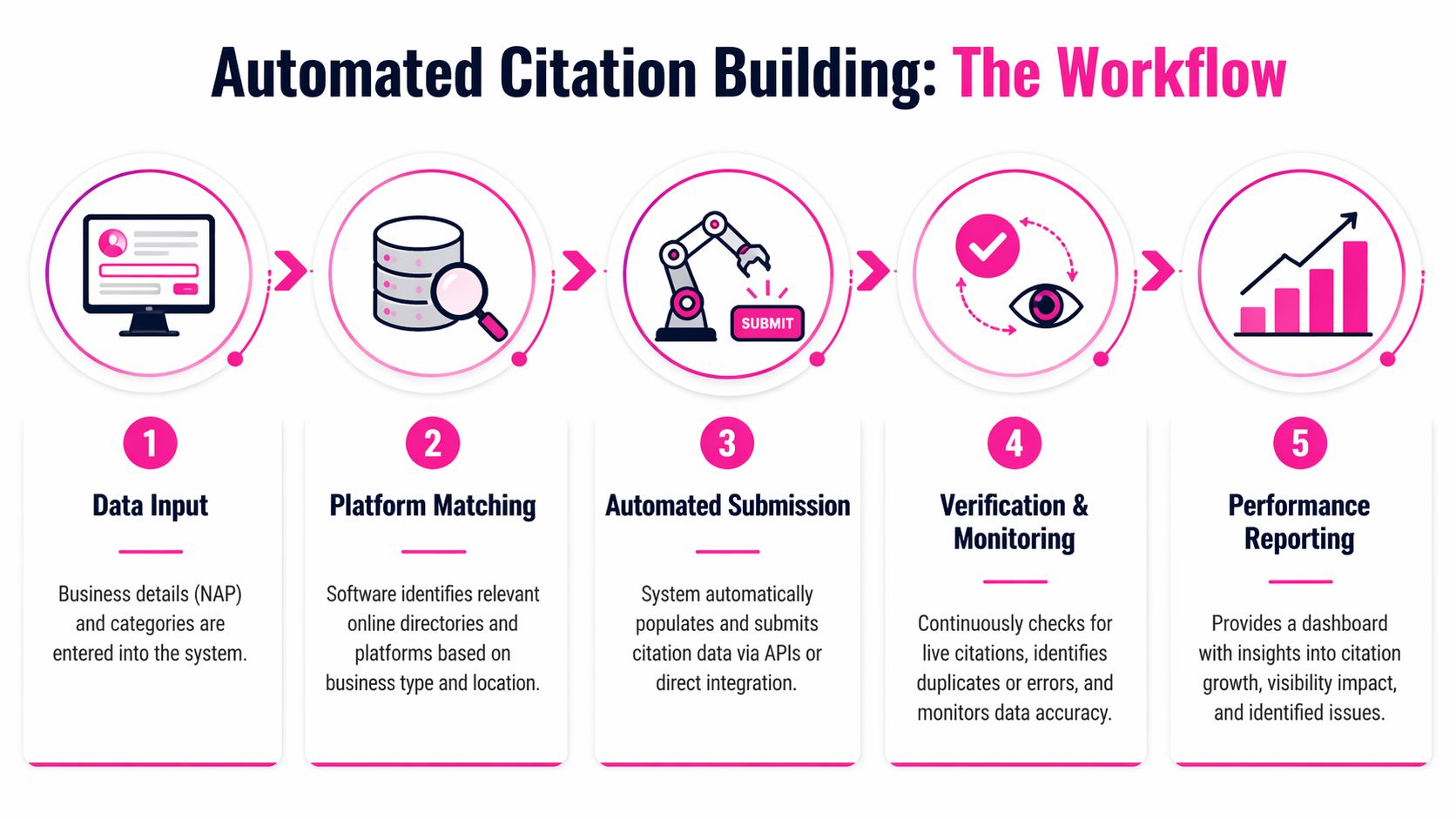
Most automated citation building follows a pattern like this:
-
Data is collected centrally
The platform becomes the working source for your business name, address, phone number, website, categories, hours, and sometimes service descriptions. -
The system matches your business to platforms
It identifies directories relevant to your business type and geography. In the UK, that often means a mix of general directories and local or trade-specific sites. -
Listings are created or updated
Depending on the platform’s connections, this may happen through direct integrations, APIs, or managed submission processes. -
Existing records are checked
Better systems look for conflicts, duplicate listings, and formatting issues before pushing updates further. -
Ongoing monitoring continues
Some services stop after submission. Others keep watching for changes, data drift, and listing status over time.
Submission-only versus synchronisation
This is one of the most useful distinctions to make before choosing a provider.
| Type | How it works | Main limitation |
| | | |
| Submission-only service | Sends business data out to target directories once or in batches | Listings can go stale if your data changes later |
| Synchronisation service | Maintains an ongoing connection and updates records when source data changes | Coverage may depend on partner network and integrations |
A submission-only model can still be useful for one-off expansion, especially for a small business with stable details. But if your opening hours change, your phone routing changes, or you manage multiple locations, synchronisation is usually easier to control.
That operational difference is often more important than the sales pitch. Businesses don’t fail at citation work because they picked the wrong buzzword. They fail because they can’t maintain accuracy across too many places.
Where automation earns its keep
The strongest case for automation is operational, not philosophical. It removes repetitive manual work and makes updates easier to manage across a large footprint. That’s especially relevant for brands with location rollouts, seasonal hour changes, mergers, relocations, or agency-managed portfolios.
A practical example is a business that changes address or updates contact routing. Without automation, someone may need to log into numerous directories one by one. With a connected system, those changes can be pushed more efficiently through a single dashboard.
That same principle applies to support tasks around local marketing. Teams that automate the boring but necessary parts of distribution usually free up time for work that improves conversion. The same logic appears in adjacent channels too. If you handle local brand visibility beyond directories, this overview of best press release distribution services is useful for understanding where distribution helps and where message quality still matters.
What automation cannot judge for you
Automation can move data. It doesn’t reliably judge context.
It won’t always know whether a directory is worth being on, whether your business category is too broad, whether a duplicate should be merged or suppressed, or whether a listing needs better photos and service detail. Those decisions still need human review.
That’s also why a broad directory list isn’t automatically a smart list. A platform may offer reach, but reach and usefulness aren’t the same thing. A curated resource like this free business directory list can help teams think more carefully about where listings should exist in the first place.
The best automation setups don’t try to remove people from the process. They remove repetitive admin so people can focus on judgement.
Measuring the ROI of Your Automation Efforts
Citation automation earns its keep when it reduces admin and protects visibility at the same time. Treating it as a cheap volume play misses the point. The return comes from faster updates, fewer errors, and more time for the manual improvements that automated systems still cannot handle well.
According to SEO Local, automated citation building platforms reduce manual effort by 70-80% for UK local businesses, and NAP errors can reduce local visibility by up to 25% in competitive UK markets. For an owner-manager, that usually means less time spent fixing old listings and more time spent on work that affects enquiries. For an agency, it means fewer hours lost to repetitive maintenance and more room for senior review.

Efficiency is only the first layer
Time saved is the easy part to measure. The harder and more useful question is what your team does with that time.
Strong teams put those hours into listing enrichment, duplicate resolution, review management, and location-level updates that improve trust. Weak teams leave automation running in the background and assume coverage equals performance. That is where ROI gets overstated.
The same source reports a 12-18% average uplift in geo-grid rank tracking for target keywords. That is useful, but it should be read carefully. Better grid coverage is a positive operational signal, not proof that every directory submission created commercial value. The businesses that usually see the best return are the ones that automate distribution, then manually improve the listings that matter most.
What a sensible ROI model looks like
A practical ROI model for citation automation has four parts.
- Operational return. Hours saved on updates, fixes, and routine maintenance.
- Visibility return. Stronger map coverage and fewer inconsistencies across important platforms.
- Risk reduction. Less chance of old phone numbers, duplicate listings, or conflicting hours dragging down trust.
- Scalability. The ability to support more locations without adding admin headcount at the same rate.
This matters even more for UK businesses with several branches, service areas, or franchise locations. Small differences in opening hours, categories, or phone routing create problems quickly if no one owns the data properly.
How to track ROI without guessing
Keep the scorecard simple and review it monthly.
| Metric | Why it matters |
| | |
| Manual time spent | Shows efficiency gained after rollout |
| NAP inconsistency count | Reveals whether data quality is improving |
| Duplicate listing issues | Indicates whether clean-up is working |
| Geo-grid visibility | Shows whether local coverage is strengthening |
| Calls and direction requests | Helps connect visibility to customer action |
If your team needs a broader framework for evaluating channel performance, this guide on how to measure marketing ROI is a useful companion read.
For brands managing several locations, the systems behind local SEO platforms for multi-location businesses often determine whether citation work stays controlled or turns into a recurring clean-up job.
The best ROI usually comes from a hybrid setup. Use automation for speed and consistency, then apply human judgement to the listings that influence trust, conversions, and AI-driven visibility.
The AI Paradox When Automation Hurts Your Visibility
Automation has a weakness that many local teams still underestimate. It’s very good at creating basic listings. It’s much less reliable at creating persuasive, complete, and distinctive ones.
That matters more now because directories no longer exist only for traditional local search. The Hashmeta analysis highlights an AI citation inclusion paradox. AI applications such as ChatGPT now source business information from local directories, but most automated systems only populate basic NAP data while ignoring richer elements such as attributes, descriptions, and photos.
Wide coverage can still produce weak listings
At this point, the quality versus quantity debate becomes real.
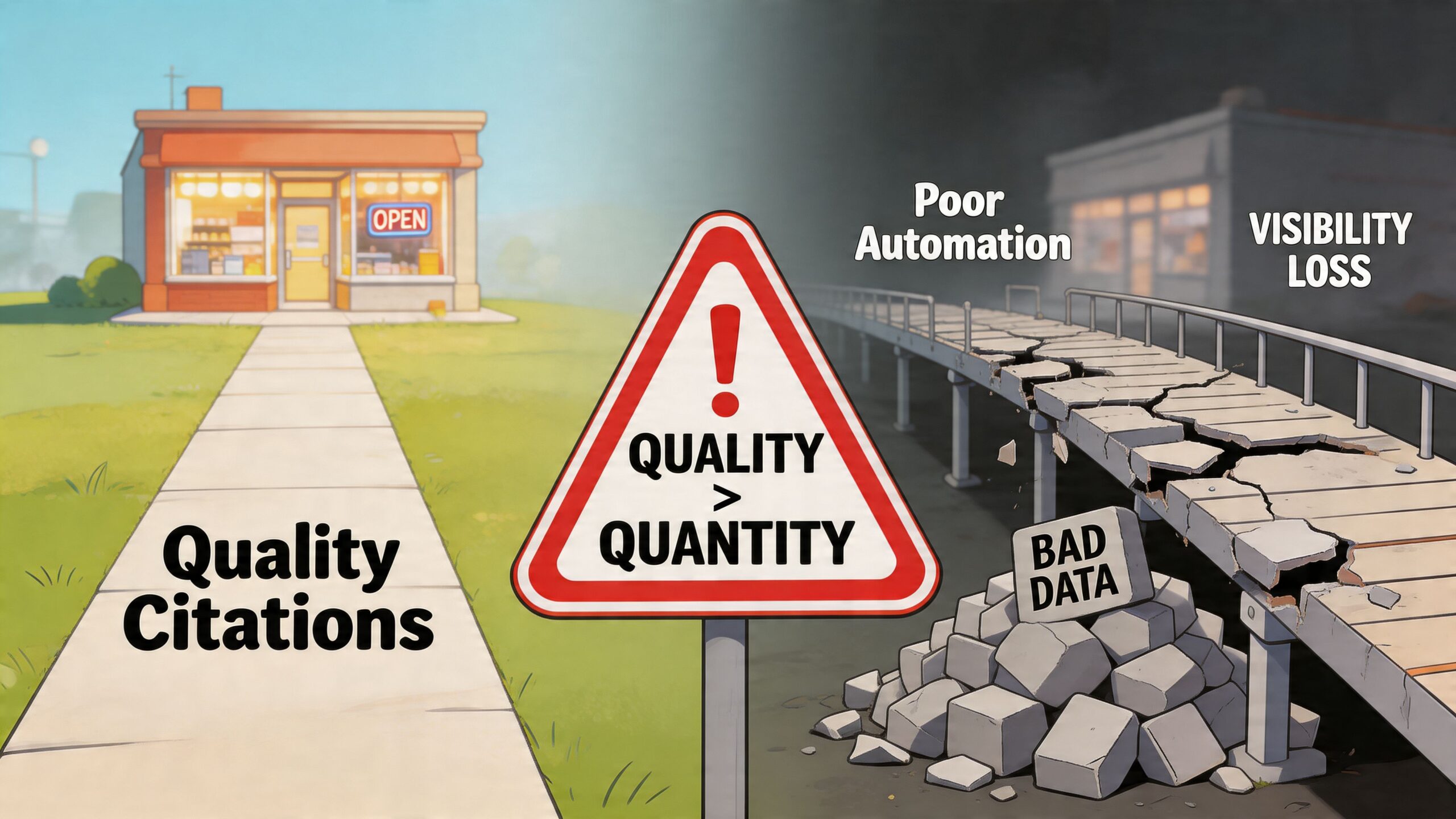
A business may end up listed on many platforms and still be poorly represented. If each profile only contains business name, address, phone number, and perhaps a default category, the listing is technically present but strategically thin. It does very little to show specialisms, service areas, amenities, product focus, booking options, accessibility features, or brand personality.
That can weaken discoverability in newer search environments where richer entity information matters. It can also reduce conversion when a customer lands on the citation and sees a flat, unconvincing profile.
The biggest risks of set-and-forget automation
The problem isn’t automation itself. The problem is unchecked automation.
- Sparse listing quality leaves your business under-described on platforms that influence both people and AI systems.
- Error multiplication happens when one bad data field gets pushed across many listings at once.
- Poor directory selection can clutter your footprint with weak or irrelevant sites.
- Brand inconsistency appears when listings lack current photos, service detail, and customer-facing context.
A lot of businesses only notice this after a rebrand, relocation, or phone number change. The automation did exactly what it was told to do. The issue was that nobody checked whether the source data and target listings were good enough.
A citation can be accurate and still be weak. Accuracy is the floor, not the finish line.
Why enrichment now matters more
Manual enrichment is the missing layer in most citation strategies. That means logging into the listings that matter and improving them beyond the baseline.
For a restaurant, that could include cuisine type, booking links, menu highlights, and photography. For a legal practice, it might mean service descriptions, practitioner details, and office accessibility information. For a trades business, it may be service-area clarity, emergency callout notes, and before-and-after imagery.
These details help in three ways. They make the listing more useful to search platforms. They make it easier for customers to choose you. They create a more complete business entity across the web.
What this changes for 2026
The businesses that will do well aren’t the ones that automate the most. They’ll be the ones that automate the right layer.
Use automation to establish consistent coverage. Then review the listings that influence trust and decision-making most. That’s a smarter response to the fact that AI-assisted search increasingly depends on structured, descriptive, and corroborated business information.
If you’re already exploring how to use AI for local SEO, this is one of the practical implications. AI visibility doesn’t come from presence alone. It comes from complete and credible presence.
Implementing a Hybrid Citation Strategy for 2026
The strongest citation process now is hybrid. Not manual-only. Not automation-only.
A pure manual approach is hard to scale. A pure automated approach is too blunt. The best-performing setup uses automation for coverage and maintenance, then layers manual review where quality changes outcomes.
Start with a controlled audit
Before any submission happens, sort the source data.
Check your business name, postcode formatting, primary phone number, opening hours, website URL, and categories. Then compare them against your existing footprint. You’re looking for old addresses, outdated local numbers, duplicate records, and variations in trading style.
For many businesses, the biggest citation problem isn’t lack of listings. It’s legacy mess.
A simple first-pass audit should cover:
- Google Business Profile accuracy because it often becomes the reference point for everything else.
- Core UK directories such as the listings customers recognise and use.
- Brand variations including limited company names, shortened names, and location suffixes.
- Historic errors from old agencies, old staff logins, or previous premises.
Perfect the core before you scale
Don’t automate flawed source data.
If your main profiles are weak, automation will distribute weak data more efficiently. Get the most important properties right first. That usually means your website contact details, Google Business Profile, and a small group of high-priority directory listings.
This is also the stage to improve substance, not just correctness. Add descriptions, categories, services, photos, and any platform-specific fields that help a customer understand what you do.
Field note: The businesses that get the most from citation automation usually spend more time on prep than on submission.
Use automation selectively
Once the foundation is clean, automate the distribution layer.
That doesn’t mean pushing data to every possible directory. It means choosing a curated set of general, local, and industry-specific platforms that support trust and visibility. For a hospitality group, that might include local and sector-relevant profiles. For a healthcare or legal brand, it may lean harder into specialist directories and trusted business indexes.
At this stage, focus on three tests:
| Test | Question to ask |
| | |
| Relevance | Is this directory useful for my sector or location? |
| Credibility | Would I be comfortable sending a customer there? |
| Maintainability | Can I update or monitor this listing reliably later? |
If a directory fails those tests, volume won’t rescue it.
Manually enrich the listings that matter most
This is the part many teams skip, and it’s where a lot of the strategic value now sits.
After automation creates or refreshes coverage, identify the most important listings and improve them manually. That often means your top directories, sector platforms, and any listing likely to be surfaced by search engines or AI tools.
For those listings, add the details automation often misses:
- Detailed service descriptions that reflect real customer language
- Attributes and amenities such as accessibility, delivery, appointment options, or emergency service
- Photos and brand imagery that make the listing feel current and trustworthy
- Category refinement where broad default labels aren’t specific enough
- Links and calls to action that direct customers properly
Not every listing deserves this level of effort. That’s the point. The hybrid model is selective.
Build a maintenance rhythm
Citation quality drifts unless someone owns it.
Businesses change winter hours, add booking systems, update service areas, switch tracking numbers, or refresh branding. If those changes aren’t reflected across the citation layer, trust erodes.
A workable maintenance routine often looks like this:
- Monthly checks for major data changes or duplicate issues
- Quarterly reviews of top directories for content quality and accuracy
- Event-based updates after moves, rebrands, phone changes, or service expansion
- Visibility monitoring through rank tracking and map coverage analysis
For a regional plumbing company with three depots, that process is manageable. For a restaurant group with a dozen locations, it becomes essential.
Match the process to the business model
A single-location café and a national care provider shouldn’t use the same citation workflow.
A smaller business may only need a light automation layer plus manual care on the platforms that send visibility and enquiries. A multi-location brand needs standardised source data, approval rules, and a defined process for updating all locations without introducing local inconsistencies.
That’s why citation building automation works best when tied to operations. The cleaner your internal business data is, the better your external footprint stays.
The hybrid model in one view
If you need a practical decision rule, use this one:
- Automate repetitive distribution
- Manually improve high-impact listings
- Monitor the footprint continuously
- Treat source data as a business asset, not an SEO afterthought
That balance is what makes citation building automation useful in 2026. It’s not a trick for mass submission. It’s a workflow for maintaining accurate, enriched, and scalable local presence.
Conclusion The Future is Smart Automation
The question isn’t whether automation is good or bad. It’s whether you’re using it intelligently.
Citation building automation is excellent at handling repetitive work, standardising updates, and making local SEO manageable across growing business footprints. But it doesn’t replace strategic judgement. It doesn’t decide which directories deserve attention, which listings need richer detail, or how your business should present itself in a search environment shaped by both Google and AI-driven discovery.
That’s why the best citation strategies in 2026 will be hybrid. Use automation for speed and consistency. Use manual oversight for enrichment, quality control, and relevance. Businesses that get that balance right will build a stronger local footprint than businesses that chase raw listing counts.
For UK businesses, that approach is practical as much as it is strategic. It keeps data cleaner, reduces admin strain, and gives customers better information wherever they find you. It also avoids one of the most common local SEO mistakes, which is confusing presence with performance.
Smart automation isn’t less ambitious than bulk automation. It’s more disciplined. And that discipline is what gives citation work lasting value.
If you want a smarter way to manage local visibility at scale, explore LocalHQ. Its platform is built for the kind of hybrid approach that is effective, combining automation, oversight, geo-grid tracking, and AI-powered optimisation in one place. If citation management is on your roadmap, now’s a good time to register your interest and keep an eye on LocalHQ’s upcoming Citation Manager.