Local Marketing Automation: Automate & Humanize 2026

Most advice on local marketing automation is wrong because it starts with the software, not the decision. Automate everything, connect every channel, set every trigger, then sit back. That sounds efficient. It also creates thin content, awkward review replies, duplicated listings, and local teams who no longer trust the system.
The better question is simpler. Which tasks should software handle at scale, and which ones still need a person to protect brand trust? For a restaurant group, dental chain, estate agency, or home services brand, that line matters more than the tool itself. If you get it wrong, automation saves time while subtly damaging performance.
A balanced approach is more commercially useful because it ties effort to outcome. Many UK businesses still struggle to measure local activity across calls, direction requests, reviews, profile edits, paid campaigns, and lead follow-up without wrestling with disconnected reports. Good local marketing automation fixes that operational mess. Great local marketing automation does it without flattening the personality that makes a local brand worth choosing.
The Automation Paradox Why More Is Not Always Better
Blind automation creates a strange problem. It makes the marketing team busier correcting machine output than they were doing the task manually in the first place. That usually shows up in local search first, because local visibility depends on accuracy, freshness, and relevance, not just activity volume.
A useful warning sign already exists. A 2025 Local Search Forum study referenced here found that 35% of UK multi-location businesses saw initial ranking dips from over-automation of their Google profiles, and the issue was resolved only after hybrid AI-human strategic tweaks were reintroduced. That should end the “set it and forget it” argument.
Where over-automation goes wrong
The common failures are predictable:
- Template overload means every location sounds identical, even when customer intent differs by area.
- Unsupervised profile edits create category mistakes, weak descriptions, or updates that don't match what the branch offers.
- Automated review replies without judgement can sound tone deaf, especially for complaints involving safety, refunds, delays, or vulnerable customers.
- Scheduled local posts without local context miss seasonal events, staffing issues, stock changes, or weather-driven demand.
Practical rule: If the task affects trust, tone, or local nuance, software should assist the human, not replace them.
The strongest teams use automation as an operating layer. It handles repeatable actions, enforces consistency, and surfaces anomalies. Then a person decides where local knowledge should override the default.
The framework that actually works
For most multi-location businesses, every recurring task can be sorted into one of three buckets:
- Fully automate when the work is repetitive, rules-based, and low risk.
- Human-led with automation support when speed matters but judgement still changes the outcome.
- Keep human when empathy, escalation, or brand interpretation is the core value.
That’s the practical basis for a local SEO system that scales. If you're thinking about AI-assisted profile management, this breakdown aligns closely with how to use AI for local SEO without letting the tool write your whole strategy for you.
What Is Local Marketing Automation Really
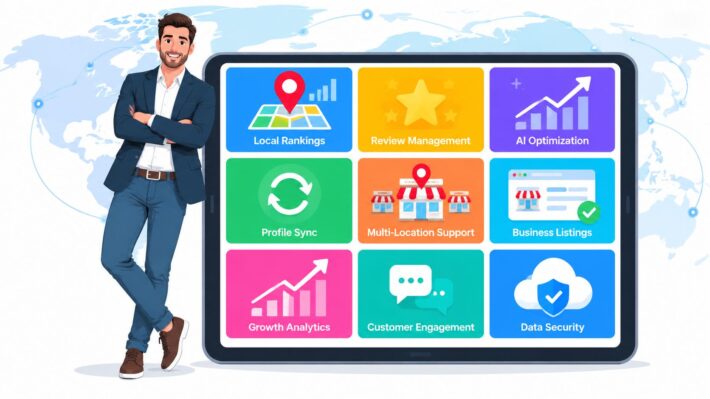
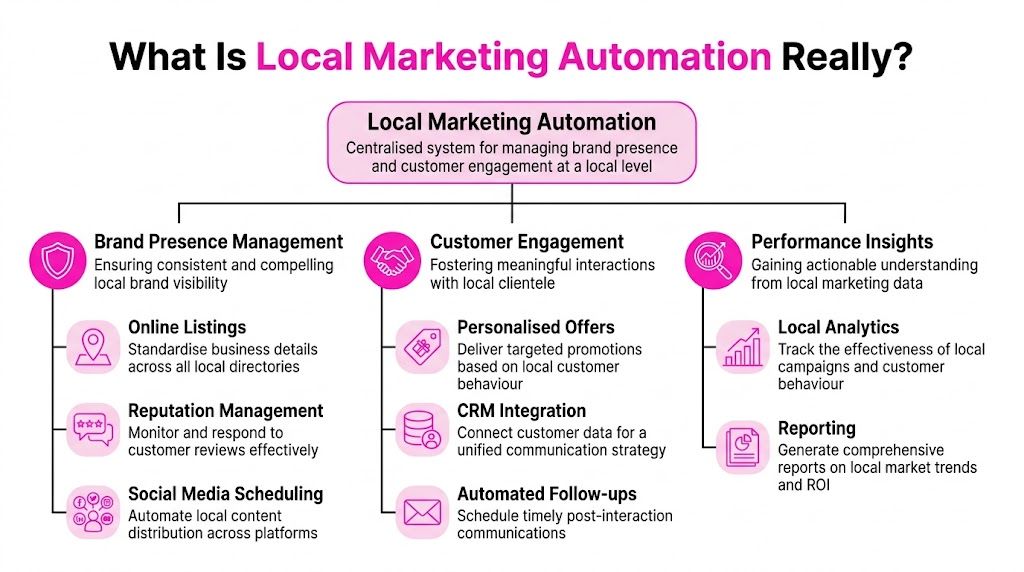
Local marketing automation isn't just email software with a few location tags added on. It’s a centralised system for managing brand presence and customer engagement at a local level. That includes your Google Business Profile, listings, review workflows, local social scheduling, geo-targeted follow-ups, and the reporting layer that tells you what’s paying off.
A simple analogy works well here. Think of a restaurant kitchen. Prep work gets systemised so service doesn't collapse. Ingredients are portioned, stations are organised, and timings are standardised. But the head chef still checks the pass, adjusts seasoning, and decides what leaves the kitchen. Local marketing automation should work the same way.
It’s broader than posting and email
At local level, automation has three real jobs:
- Brand presence management across listings, location data, profile updates, and review monitoring
- Customer engagement through triggers, follow-ups, lead routing, and timely messages
- Performance insight through reporting on calls, visits, rankings, engagement, and lead movement
That’s why the market keeps expanding. The Statista overview of marketing automation states that the UK's marketing automation market is projected to reach £2.5 billion by 2030, growing at a 14.8% CAGR, with SMEs in retail, hospitality, and services driving demand for platforms that integrate with Google Business Profiles.
What it is not
It isn't a shortcut for generic local marketing. If your branch data is wrong, your review process is weak, or your offers are disconnected from what each location can fulfil, no workflow builder will save that.
It also isn't limited to nurturing email leads. For teams that want a stronger grasp of lifecycle messaging beyond top-of-funnel local discovery, Mastering Automated Lead Nurturing is useful because it frames automation as a sequencing problem rather than a blast tool.
The system should reduce operational drag. It shouldn't erase local judgement.
A good local marketing automation setup gives each branch a cleaner baseline. Accurate business details. Faster response handling. Scheduled publishing that still allows local edits. Central reporting that shows what each location is doing and whether that activity is producing real enquiries, visits, and booked work.
The Realised ROI of a Balanced Automation Strategy
Most owners don't need another lecture on efficiency. They need to know whether local marketing automation will produce more qualified leads, reduce wasted admin time, and make reporting less painful. That’s the standard that matters.
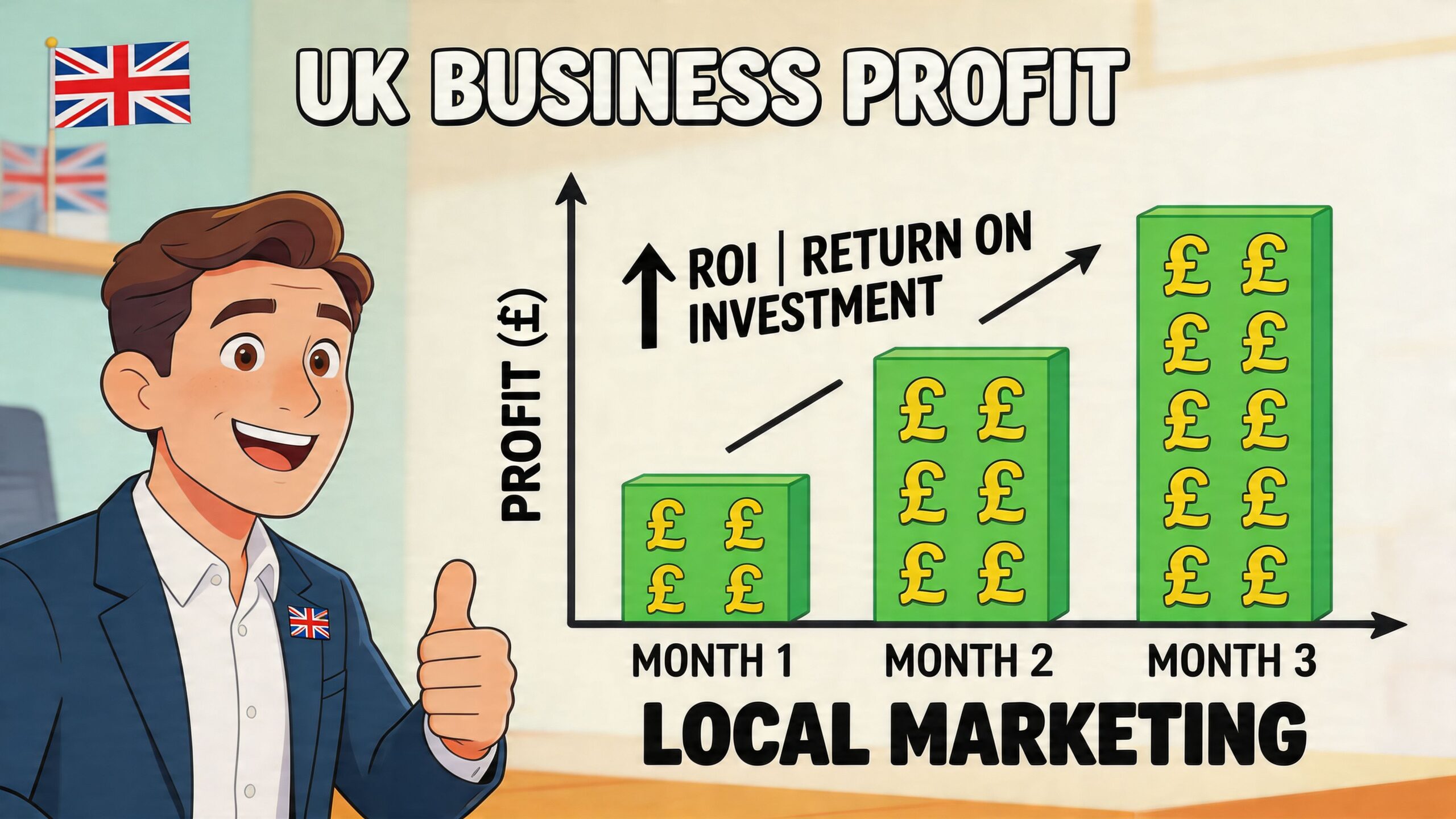
The business case is already strong. According to UK automation ROI data summarised here, in 2024, UK businesses achieved an average 544% ROI from automation investments over three years. For every £1 spent, they gained £5.44 in return, while boosting sales productivity by 14.5%. Those are big numbers, but they only become useful when you understand what creates them.
Where the return actually comes from
In practice, ROI tends to come from four places:
- Less manual repetition because teams stop editing the same location data in multiple places
- Faster lead handling because alerts, routing, and follow-up don’t depend on someone remembering
- Cleaner brand consistency across locations, which reduces confusion and lost trust
- Better decision-making because reporting is centralised instead of spread across exports and spreadsheets
That last point gets overlooked. Many businesses don't have a visibility problem as much as a reporting problem. They can see activity, but they can't connect it to commercial outcomes. That’s why clear client-facing dashboards and branch-level reporting matter. If your team still spends hours compiling updates manually, proper SEO reports for customers can remove a lot of friction from agency and in-house workflows alike.
Why balance beats volume
A balanced strategy often outperforms a heavily automated one because it protects conversion quality. Automating profile updates, alerts, and triggered communications keeps momentum high. Human review of escalations, complaints, and nuanced branch messaging protects reputation.
Commercial test: If automation speeds up activity but lowers trust, it isn't efficient. It's expensive admin disguised as scale.
That’s the key distinction. The return doesn't come from “doing more marketing”. It comes from doing more of the repeatable work automatically so staff can spend time on work that changes buying decisions. For local brands, that usually means profile quality, review handling, campaign refinement, and branch-specific offers that match local demand.
The Core Engine What to Automate and What to Humanise
The most useful way to build a local marketing automation system is to audit every repeated task and ask two questions. First, is this rules-based? Second, does local judgement materially improve the outcome? If the answer to the first is yes and the second is no, automate it. If both are yes, keep a human in the loop.
For multi-location businesses, Google Business Profile management sits at the centre of that decision. The Birdeye local marketing automation benchmark reports that for UK multi-location businesses, automating Google Business Profile management with AI-driven review responders and real-time data syncing can achieve a 38% median lift in marketing-qualified to sales-qualified lead conversion rates. That’s a strong argument for automation, but not for removing human oversight.
The decision table
| Marketing Task | Recommended to Automate | Recommended to Humanise | Rationale |
|---|---|---|---|
| Listings management | Core NAP data sync, opening hours, holiday hour rollouts, duplicate detection alerts | Exception handling for relocations, service-area changes, temporary closures with nuance | Consistency should be machine-led. Edge cases need a person because one wrong change can spread quickly. |
| Google Business Profile updates | Routine publishing, image scheduling, event rollouts, attribute checks, update reminders | Final review of strategic category choices, service descriptions, and location-specific offers | Software handles cadence well. Market positioning still needs judgement. |
| Review responses | First-draft replies for straightforward positive feedback, routing by sentiment, escalation triggers | Negative reviews, legal complaints, refund disputes, sensitive healthcare or family issues | Speed matters, but empathy and liability matter more. |
| Local social posts | Scheduling, asset distribution, calendar-based publishing, branch reminders | Captions tied to local events, staff stories, community partnerships, crisis communication | Automation maintains frequency. People create relevance. |
| Geo-grid rank tracking | Data collection, alerting, competitor monitoring, recurring snapshots | Interpretation of ranking changes and choice of next actions | Reports show where the gap is. Strategists decide why it exists. |
| Reporting | Scheduled exports, dashboard refreshes, location rollups, anomaly alerts | Narrative analysis, recommendations, stakeholder communication | Nobody wants manual reporting. People still need context and action points. |
| Lead follow-up | Instant acknowledgement, routing, reminder sequences, CRM task creation | High-value sales conversations, stalled opportunities, complaint recovery | Automation protects response speed. Sales and recovery work still depend on trust. |
What should be fully automated
Start with the low-risk operational layer. That means listings consistency, profile field checks, recurring posting schedules, review alerts, reporting refreshes, and hand-offs into your CRM. These tasks are repetitive, easy to standardise, and expensive to do manually at scale.
If you're managing dozens of branches, this is essential. A central workflow for managing multiple Google Business Profiles reduces the chance that one branch drifts out of sync while another gets all the attention.
What should stay human-led
Anything involving tone, judgement, or local knowledge should stay human-led. That includes responses to serious complaints, nuanced offer positioning, community-facing content, and decisions about whether poor performance is caused by profile quality, competitive pressure, internal operations, or something offline.
The easiest mistake is to automate the visible layer and neglect the interpretive layer. Rankings move. Reviews change. Calls go up in one branch and down in another. Software can flag all of that. It cannot explain whether the drop is caused by a category issue, staffing complaints, a pricing mismatch, or weak local intent alignment.
If a customer could reasonably feel ignored, misunderstood, or patronised by an automated message, write that message for a human to review.
The practical split
For most local brands, the right model looks like this:
- Automate the workflow
- Humanise the message
- Automate the reporting
- Humanise the decision
- Automate the reminder
- Humanise the response where stakes are higher
That’s the operating model that scales without making every branch sound like a bot.
Your Implementation Roadmap from Foundation to Optimisation
Most local teams fail with automation because they try to roll out everything at once. That produces messy workflows, weak adoption, and a lot of “we’ll fix it later” decisions that never get fixed. A phased rollout works better because local marketing has too many moving parts to improvise at scale.
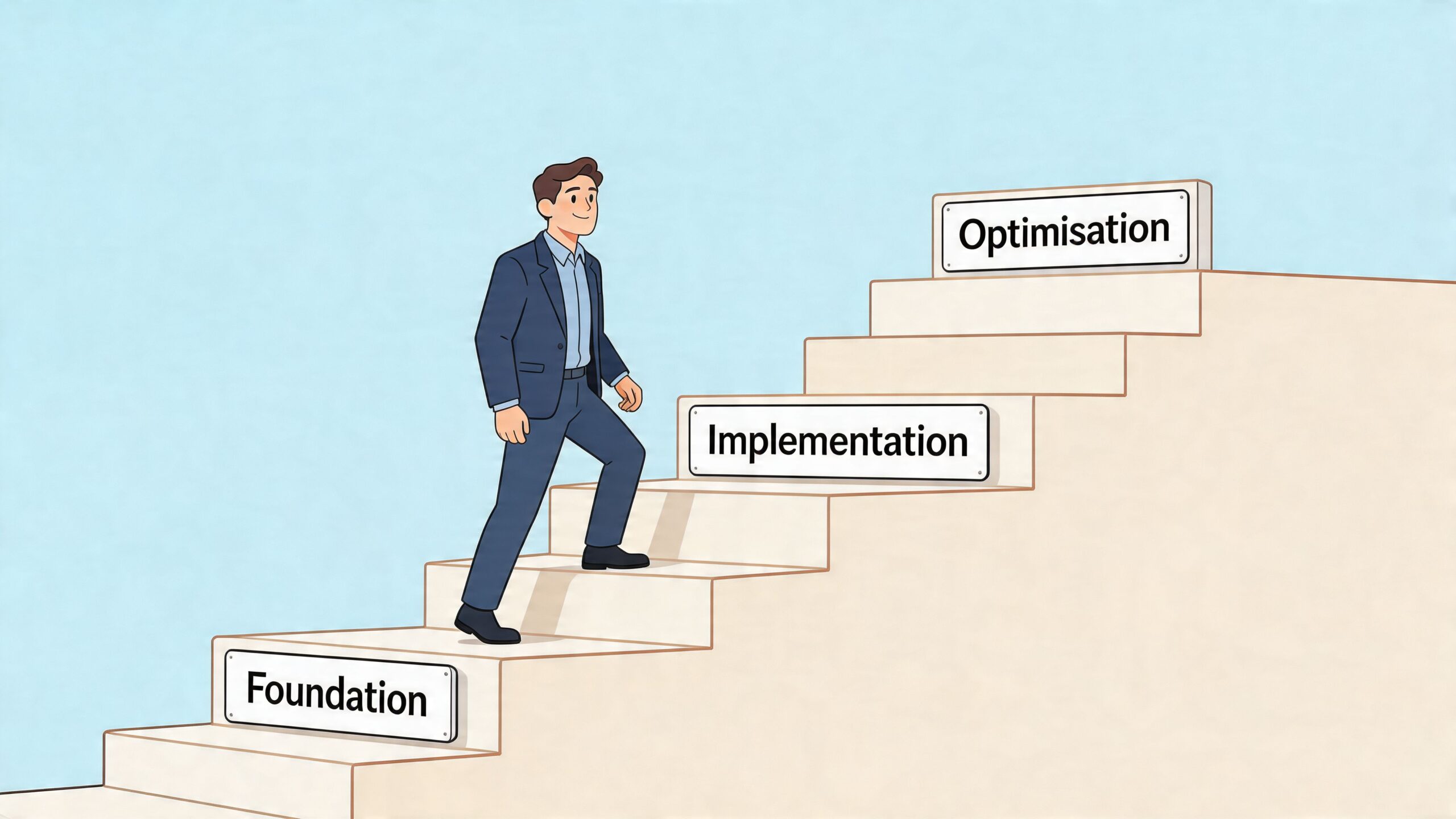
Phase one foundation
Before any software is configured, audit the current process. Not the ideal version. The actual one.
Document where location data lives, who updates Google Business Profiles, who responds to reviews, how often posts go live, how leads are routed, and how branch performance is reported. Then choose a pilot location or a small cluster of locations. That gives you a manageable test environment before expanding across the estate.
Use the audit to set practical KPIs. Examples include consistency of location data, speed of review handling, reporting turnaround, and lead follow-up reliability. If you're running several branches, your local search baseline should also include the wider multi-location SEO setup so automation supports the architecture rather than fighting it.
Phase two implementation
At this stage, teams often overbuild. Don't.
Start with the processes that are both repetitive and painful. Usually that means listing sync, profile update workflows, review alerts, local post scheduling, and reporting automation. Keep approvals simple. If every update needs three people to sign it off, the system will slow down and users will revert to manual work.
A strong implementation phase usually includes:
- Clear ownership so each workflow has a named person responsible for exceptions
- Branch-level permissions so local teams can contribute without breaking standards
- Escalation rules for complaints, legal issues, and urgent service failures
- Template boundaries so AI or automation assists copy production without forcing generic language
Build the minimum system that removes friction. Then improve it with real usage data.
Phase three optimisation
Once the engine is stable, the primary work begins. Use saved time to improve local pages, test branch-specific offers, refine categories, tighten review handling, and compare visibility gaps between locations.
Optimisation is also where human input becomes more valuable. The workflow should already be running. Now the team can ask better questions. Which branch has strong visibility but weak conversion? Which location gets traffic but poor review sentiment? Which service line needs more specific local messaging?
The best automation setups become easier to use over time because they remove noise. The weak ones become harder because they create more output than the team can interpret.
Choosing Your Automation Platform Key Criteria for UK Businesses
Software selection gets distorted by feature lists. Vendors lead with AI, dashboards, and workflow builders because those are easy to demo. Buyers should start somewhere else. Ask whether the platform fits the way your locations operate in the UK.
A useful shortlist should focus on operational fit before clever extras. If a platform can't support location accuracy, permissions, approvals, and reporting clarity, the rest doesn't matter.
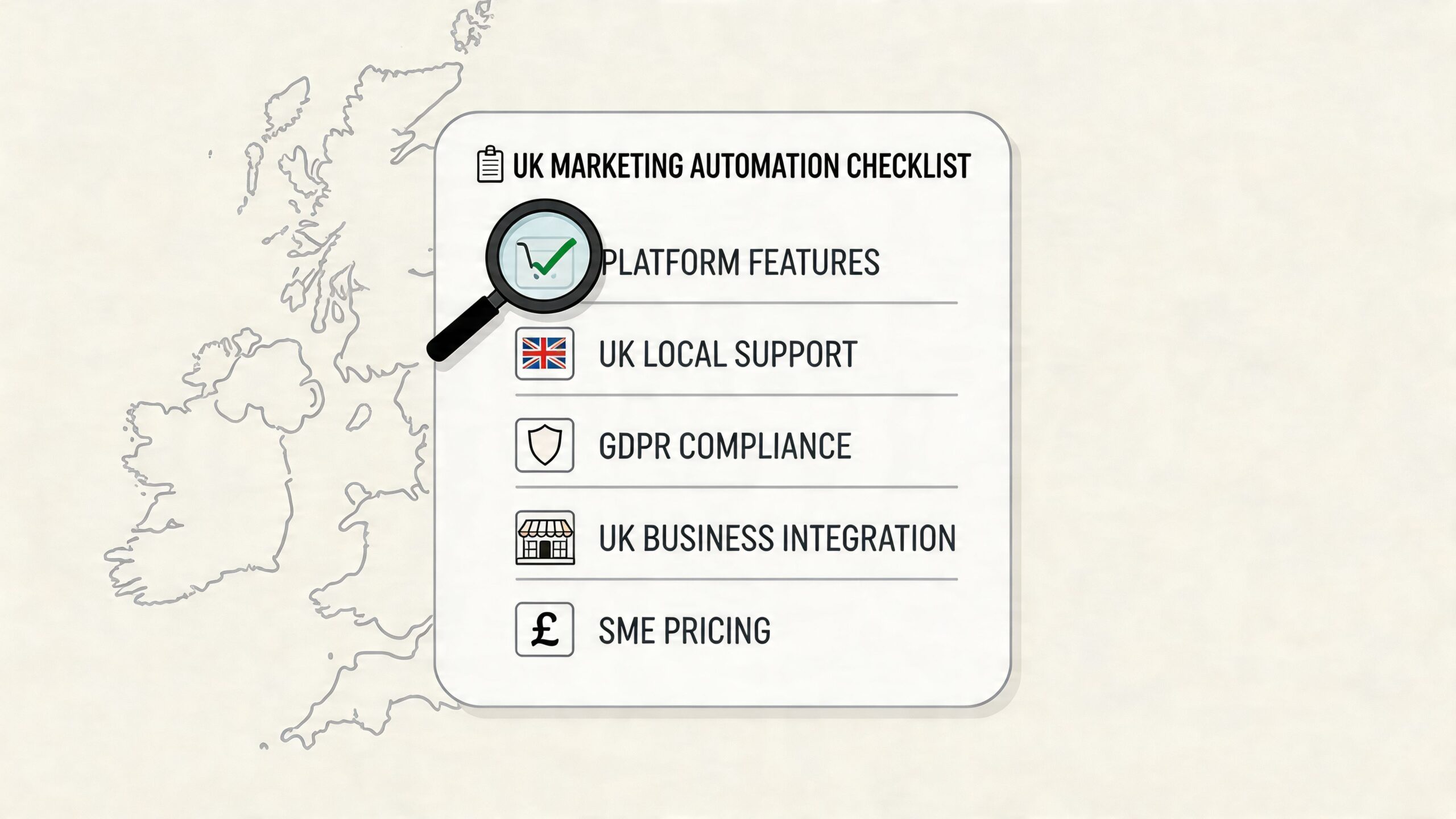
The criteria that matter most
Look for these capabilities first:
- Google Business Profile management with bulk controls, branch-level editing, and approval safeguards
- Review workflow controls that allow draft generation, routing, escalation, and tone management
- Geo-grid and local visibility tracking so performance is measured by place, not just by generic rank averages
- Reporting that people can read without exporting data into separate spreadsheets
- CRM and ad platform integrations so local activity links to actual lead flow
- User permissions and audit trails for agencies, franchise groups, and regional managers
- GDPR-aware processes and practical support for UK teams
Integrations deserve special scrutiny. The ad connection is a strong example. According to the EngageBay local automation analysis, automation platforms with native integrations to Google Ads can yield 30-50% higher efficiency in CPC for geo-targeted campaigns, saving UK service providers an average of £4,200 annually per 10 locations by automating bid adjustments. That matters if your paid and organic local efforts currently live in separate silos.
Don’t buy on AI alone
AI features are useful, but they aren't a buying strategy. Treat them as force multipliers for a solid local operations layer. Helpful examples include first-draft review replies, profile recommendations, scheduling assistance, anomaly detection, and branch-level content suggestions.
What you shouldn't accept is a platform that automates output but makes exceptions hard to manage. Local marketing is full of exceptions. Temporary closures, changed service areas, branch-specific reviews, staffing issues, local events, regional offer differences. The platform has to cope with those cleanly.
If you're comparing platforms broadly, a wider SEO automation tools buyers guide can help frame the procurement side, but local teams should still pressure-test every option against branch operations, not generic SEO features.
A simple buying test
A platform is worth shortlisting if it can answer yes to these questions:
- Can it manage local complexity across one site or many?
- Can it automate repetitive work without forcing bland output?
- Can it show branch performance clearly enough to guide action?
- Can local teams use it without constant central support?
If you're evaluating tools specifically for local estates, branch groups, or franchise networks, then multi-location SEO tools become a more relevant comparison set than broad martech suites.
Frequently Asked Questions
Can a single-location business benefit from local marketing automation
Yes, if the business has repeatable local marketing tasks. A single clinic, restaurant, or trades business can still benefit from automated review alerts, scheduled profile updates, lead follow-up, and simpler reporting. The advantage isn't just scale. It's consistency.
How much technical skill is required
Less than most owners think, provided the workflows are straightforward. The technical challenge usually isn't setup. It's process discipline. Someone still needs to decide what gets automated, who approves exceptions, and how tone should be handled in public-facing replies.
How quickly can you expect results
Some improvements appear quickly, especially around admin reduction, faster review handling, and cleaner publishing. Search visibility and lead quality usually take longer because they depend on the quality of the profile, the competitiveness of the area, and how well the human side of the process supports the automated one.
Good automation reduces delay first. Better performance follows when the team uses that saved time well.
Is local marketing automation affordable for smaller teams
It can be, if the business starts with a narrow operational problem instead of a full platform rollout. Smaller teams usually do better by automating one or two painful tasks first, such as listings consistency or review routing, then expanding once the process is stable.
What’s the biggest mistake to avoid
Trying to automate brand judgement. Businesses get into trouble when they use software to handle complaints, local nuance, and strategic messaging with no review process. The result is faster output, but weaker trust.
What should you measure first
Start with the basics that prove the system is working. Are location details accurate? Are reviews being handled reliably? Are updates going live on time? Are leads being acknowledged and routed properly? Once that foundation is stable, measure commercial outcomes tied to enquiries, visits, and conversion quality.
Does local marketing automation replace the local manager or marketing lead
No. It should make them more effective. The software handles repetition, reminders, syncing, and reporting. The local manager or marketing lead still provides judgement, context, and accountability. That human role becomes more important, not less, once the busywork is removed.
If you're ready to put this framework into practice, LocalHQ is built for exactly this balance. It helps teams automate the repetitive parts of local SEO, including profile updates, posting, reporting, and review workflows, while keeping control over the human decisions that protect brand trust. If review handling is your biggest bottleneck, start there and explore the platform’s Review Manager capabilities to speed up replies without sounding robotic.