Local Online Marketing: Boost Your UK Business with Local SEO & Profiles
At its heart, local online marketing is all about making sure your business shows up when potential customers in your immediate area are looking for what you offer. It’s about being the first, most helpful answer when someone down the road searches on Google for a service or product you provide, turning that online query into a real-world customer.
What Is Local Online Marketing and Why It Matters
Think of local online marketing as the modern version of the high street. You're not trying to shout your message to the entire internet; instead, you're focused on becoming the go-to, most recommended business in your own neighbourhood, just online. The goal is simple: when a potential customer just around the corner searches for ‘plumber near me’ or ‘best coffee in Brighton’, you’re the one they see first.
This approach is non-negotiable because the way we find local businesses has completely changed. The days of flipping through a hefty Yellow Pages are a distant memory. Today, a staggering over 90% of consumers use the internet to find local businesses. Your online presence has become your shopfront, your reception desk, and your main driver for new business.
Your Digital High Street
A great way to picture this is to think of it as your "digital high street".
- Your Google Business Profile is Your Shopfront: This is the very first impression people get. A well-managed profile with great photos, accurate hours, and clear service details is like having a clean, inviting storefront that makes people want to step inside.
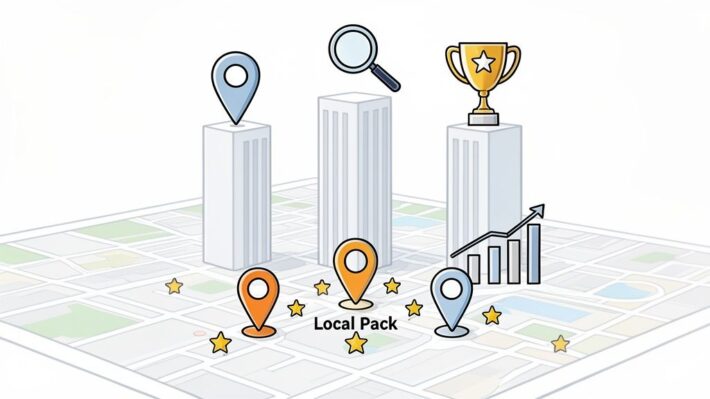
- Local Search Results are Your Signposts: Ranking high in local searches and on Google Maps is the digital equivalent of having bright, clear signposts all over town pointing straight to your door.
- Online Reviews are Your Word-of-Mouth: Glowing reviews are today’s word-of-mouth recommendations. They build trust and credibility, often becoming the single most important factor that convinces a new customer to choose you.
To help you see how these pieces fit together, here's a quick breakdown of the core components of a solid local marketing strategy.
Core Components of a Local Online Marketing Strategy
| Component | Primary Goal | Example Tactic |
|---|---|---|
| Google Business Profile (GBP) | Dominate the "Map Pack" and provide instant business information. | Keeping opening hours updated and regularly adding new photos. |
| Local SEO | Rank high in organic search results for location-specific keywords. | Optimising your website's service pages with local keywords. |
| Citations & Listings | Ensure consistent business information across the web to build trust. | Making sure your name, address, and phone number are identical on all directories. |
| Reputation Management | Build social proof and credibility through positive customer feedback. | Actively encouraging and responding to every single customer review. |
At the end of the day, a successful local online marketing plan helps you connect with an audience that’s ready to buy. These people aren’t just window shopping; they’re actively looking for a solution right now.
By concentrating your marketing efforts locally, you’re not just getting more website traffic; you’re attracting qualified leads who are far more likely to become paying customers. This targeted approach directly results in more footfall, more phone calls, and more bookings for your UK business.
Ultimately, getting local online marketing right means you can stop chasing customers and, instead, let them find you. It ensures that when someone in your community needs exactly what you offer, your business is the most convenient, credible, and obvious choice they have. This creates a reliable stream of local customers—the lifeblood of any small or medium-sized business.
How to Dominate Local Search Results
If you really want to win at local online marketing, you need a strategy built on four solid pillars. Think of it like a table – if one leg is wobbly, the whole thing becomes unstable. By getting each one right, you build a powerful presence that puts your business front and centre whenever a local customer is searching. This isn't about doing one thing well; it's about combining four key tactics: perfecting your digital shopfront, turning your website into a local authority, keeping your business details consistent everywhere, and building a five-star reputation.

When these pillars work in sync, they drive real results. You get more visibility, better engagement, and ultimately, you turn online searches into real-world customers walking through your door.
Master Your Google Business Profile
Your Google Business Profile (GBP) is pretty much the command centre for your local online presence. It's often the very first thing a potential customer sees, popping up right at the top of Google Search and on Maps. Treating it as an afterthought is a massive mistake. A properly optimised profile is like a mini-website, giving people the essential info they need in a heartbeat.
To get it right, start with these key actions:
- Choose the Right Categories: Be specific. If you’re a "Pizza Restaurant," that should be your primary category. But don’t stop there. Add secondary categories like "Italian Restaurant" or "Takeaway Food" to show up in a wider net of relevant searches.
- Detail Your Services and Attributes: Go beyond the basics. List out every single service, whether it's "boiler repair" or "garden design." Use attributes to highlight features that matter to customers, like "free Wi-Fi," "wheelchair accessible," or "click and collect."
- Use Posts and Q&As Actively: Keep your profile looking fresh by sharing updates, offers, and news using Google Posts. You should also jump into the Q&A section and answer common questions yourself. It shows you’re engaged and helps customers get answers instantly.
Bolster Your Website's Local SEO
While your GBP is your digital handshake, your website is where you tell your full story. Local Search Engine Optimisation (SEO) is all about making sure your website ranks highly for searches happening in your specific area. Your goal is to send strong signals to Google that you're the go-to expert for what you do, right where your customers are.
One of the most effective ways to do this is by creating location-specific service pages. For instance, instead of one generic "Plumbing Services" page, a plumber based in London should have dedicated pages for "Plumber in Hackney," "Emergency Plumber in Islington," and so on. This tactic directly targets people searching for help in those exact neighbourhoods.
Build Consistent Local Citations
Imagine you arranged to meet a friend at a café, but you gave them three slightly different addresses. They’d get confused and probably just give up. That's exactly how search engines feel when your business information is inconsistent across the web.
Citations are simply mentions of your business's Name, Address, and Phone Number (NAP) on other websites, like Yell, Thomson Local, or niche industry directories.
The golden rule here is consistency. Your NAP details must be absolutely identical everywhere. Even a tiny difference, like "Ltd." versus "Limited," can muddy the waters for search engines and hurt your local ranking.
Building a solid foundation of accurate citations across important directories confirms your location and legitimacy. It gives Google the confidence it needs to recommend your business to local searchers. If you're wondering where to start, you can find a comprehensive free business directory list to check and update your listings.
Cultivate an Outstanding Online Reputation
Last but not least, your online reviews are the modern-day word-of-mouth. A steady stream of recent, positive reviews is a powerful signal to both customers and search engines that you’re a trustworthy business that delivers great service. The reality is that most people read online reviews before they even think about visiting a local business.
Actively managing your reputation breaks down into two simple steps:
- Generate Positive Feedback: Don’t just hope for good reviews—ask for them! Make it easy for happy customers by sending a follow-up email with a direct link, putting a QR code on receipts, or just asking in person after a great interaction.
- Respond to Every Review: Make sure you thank customers for positive comments. More importantly, address any negative feedback professionally and with a helpful attitude. Responding shows you care about customer experience, which builds enormous trust. For businesses in competitive sectors, this is non-negotiable; many turn to specialised restaurant SEO services to get an edge.
Tailoring Your Strategy for Different UK Businesses
When it comes to local online marketing, there's no such thing as a one-size-fits-all playbook. The tactics that fill a restaurant's tables on a Friday night are worlds away from what generates solid leads for a local solicitor. A winning strategy starts by understanding exactly what your customers are looking for and how your type of business can best meet their needs online.
A customer-facing business, like a shop or a hotel, wins by being visually appealing and incredibly convenient. On the other hand, a service provider, such as a plumber or an accountant, needs to build trust and prove their expertise from the get-go. This means your focus has to shift depending on what you sell, creating a bespoke blueprint for your sector.

For Customer-Facing Businesses (Restaurants, Retail, Hotels)
If your business relies on people walking through the door, your primary job is to make your location look as enticing and accessible as possible online. The journey for these customers often starts with their eyes, so your strategy should be heavily focused on what they can see and experience. Think of your online presence as your digital window display, designed to pull people in off the virtual high street.
Your local marketing plan should put these tactics front and centre:
- A Visually-Driven Google Business Profile: Your GBP is your most powerful tool. Make a habit of uploading high-quality photos of your signature dishes, new products, or inviting hotel rooms. Research shows that businesses with photos receive 42% more requests for driving directions and 35% more clicks through to their websites.
- Promotional Google Posts: Use Google Posts to shout about seasonal sales, special offers, or upcoming events. This keeps your profile looking fresh and gives customers a compelling, time-sensitive reason to visit you now.
- Essential Profile Attributes: Dig into your profile and add specific attributes that match customer searches. For a pub, this could be ‘outdoor seating’ or ‘dog-friendly’. For a retail shop, ‘click and collect’ or ‘in-store pickup’ are absolute must-haves.
The core idea for customer-facing businesses is to answer one simple question for the searcher: "What will my experience be like?" A visually rich and informative online presence removes any doubt and makes choosing you an easy, confident decision.
For Service-Based Providers (Solicitors, Plumbers, Accountants)
If you provide a service, your customers aren't buying a tangible product; they're buying your expertise, reliability, and trustworthiness. Your local online marketing strategy, therefore, must be built around establishing your authority and making it crystal clear that you are the best professional for the job in their area. It’s a shift from visual appeal to demonstrating undeniable credibility.
Your focus should be squarely on building confidence and showcasing your professional skills.
- Highlight Qualifications and Expertise: Your website and GBP should prominently feature your accreditations, qualifications, and years of experience. These details immediately signal professionalism and build trust.
- Define Your Service Areas: Be explicit about the towns, postcodes, or neighbourhoods you cover. Creating dedicated service area pages on your website will help you rank for specific searches like "accountant in Reading" or "electrician in Bristol."
- Generate Trust-Building Reviews: Actively encourage reviews that mention your expertise, professionalism, and reliability. A review saying, "the plumber was punctual and fixed the leak quickly" is marketing gold for a service business.
- Use the GBP Q&A Feature: Get ahead of the game by answering common questions potential clients might have. By providing clear, expert answers to queries like, "What are your call-out fees?" or "Do you offer free initial consultations?", you establish yourself as a helpful and knowledgeable local expert.
Ultimately, the best local online marketing strategy is one that is finely tuned to your specific business model. Whether you’re selling a pint of beer or professional advice, adjusting your tactics to align with what your customers truly value is the key to turning local searchers into loyal customers.
Using Local Ads to Accelerate Your Growth
While a solid organic local SEO strategy is your long-term foundation, sometimes you just need to get in front of customers right now. This is where paid local advertising comes in, acting as a turbo-boost for your growth by guaranteeing you show up when and where it counts. It’s the difference between hoping people wander past your shop and putting a sign directly in their path.
Think of it as a digital flyer drop, but with laser-guided precision. Instead of a massive billboard on the M1 that everyone sees, you can use geo-targeting to show your ads only to people within a five-mile radius of your business, or even in specific postcodes. This makes sure every single pound you spend is working hard to reach a genuinely local, interested customer.
This focused approach is especially potent here in the UK, where digital advertising is huge. With UK digital ad spend forecast to hit a massive £45 billion by 2026 and Google Ads scooping up over 85% of UK search ad spend, getting this right is non-negotiable for any local business wanting to compete.
Google’s Local Services Ads
For many service-based businesses, Google's Local Services Ads (LSAs) are a total game-changer. These ads appear right at the very top of the search results—even above the traditional paid ads and the map pack. But what makes them so powerful is the ‘Google Guaranteed’ badge.
This little green tick is basically a stamp of approval from Google. It tells potential customers that your business has been properly vetted and is trustworthy. For a homeowner frantically looking for an emergency plumber or someone needing a reliable solicitor, that badge can be the one thing that makes them pick up the phone and call you over anyone else.
Paid and Organic: A Powerful Combination
It's a common mistake to think of your paid and organic local marketing as two separate things. In reality, they're two sides of the same coin, working together to make your entire strategy stronger. Having a well-optimised Google Business Profile and a bank of positive reviews doesn't just help your organic rankings; it can actually improve how well your paid ads perform and even lower their cost.
Paid ads get you seen instantly, but just as importantly, they give you a goldmine of data. You can quickly test which search terms drive the most calls and which ad headlines grab the most attention, then feed those insights right back into your organic SEO and content strategy for even better long-term results.
Beyond Google Ads
While Google is obviously the 800-pound gorilla in the room, don't sleep on other platforms. Social media advertising, particularly on Facebook and Instagram, lets you target potential customers with incredible detail based on their location, interests, and even their recent behaviour. To get a real leg-up, it’s worth diving into detailed guides on Facebook advertising for local businesses.
By combining the long-term authority built by organic SEO with the immediate punch of paid local ads, you create a powerful marketing machine. This dual approach ensures you’re visible to customers at every stage of their journey, catching both the people searching right now and building your brand for everyone else.
How to Measure Your Local Marketing Success
Running a local marketing campaign without tracking it is like sailing without a compass. You’re putting in the effort, but you have no real idea if you’re getting any closer to your destination. To figure out what’s actually working, you need to look past fuzzy metrics like ‘impressions’ and zero in on the Key Performance Indicators (KPIs) that really matter to your business.
We’re talking about numbers that represent real people taking real actions. These KPIs show that your strategy isn’t just getting you seen—it’s actively bringing customers through your door, whether it’s a physical shopfront or a digital one.
Making Sense of Your Google Business Profile Insights
Your Google Business Profile is a treasure trove of data, giving you a direct window into how customers find and interact with your listing. It's easy to get swamped by all the numbers, so the trick is to focus on the metrics that signal genuine customer interest. These are the actions that are just one step away from a sale.
Pinpoint your analysis on these three critical actions:
- Direction Requests: This is as close as you can get to a digital signal for real-world footfall. When someone requests directions, there’s a very high chance they are planning a visit.
- Website Clicks: This action shows a customer is curious and wants to know more. They’re moving from simply discovering your business to actively considering what you have to offer.
- Phone Calls: For many local businesses, a phone call is a hot lead. Tracking calls from your GBP is one of the most direct ways to measure new business enquiries.
These aren't just numbers on a dashboard; they're direct links to potential revenue, proving that the time you’ve spent optimising your profile is paying dividends.
Visualising Your Local Search Rankings
Knowing where you rank is vital, but local search isn't as simple as one national ranking. A customer searching for "solicitor near me" from one side of town will see a completely different set of results than someone searching from the other side. This is where a geo-grid tool really proves its worth for your local online marketing measurement.
A geo-grid map reveals your search ranking for specific keywords across multiple points in your service area. It paints a clear picture of your visibility, street by street, showing you where you dominate and—more importantly—where competitors have the edge. To learn more, check out our guide on the benefits of effective local rank tracking.
Tying Your Efforts to Business Results
The final, crucial step is to connect all your local marketing activities back to tangible business outcomes. This is how you prove your return on investment (ROI) and justify every penny spent. By setting up conversion goals in a tool like Google Analytics, you can see exactly when a user takes a valuable action on your website after finding you through a local search.
These conversions might be:
- Submitting a contact form.
- Booking an appointment online.
- Buying a product from your online shop.
When you can draw a straight line from a click on your GBP listing to a completed booking on your website worth £150, you have concrete proof that your local online marketing isn't an expense—it's a powerful engine for growth.
Putting Your Local Marketing on Autopilot
Let's be honest, managing all the moving parts of a local marketing strategy can feel like a full-time job in itself. You’re trying to keep business profiles updated, respond to every single customer review, and create fresh content to stay relevant. It's easy for these day-to-day tasks to pull you away from what you do best: running your business and serving your customers.
This is exactly where modern automation and artificial intelligence come in. They can take these tedious, repetitive chores and turn them into a smooth, efficient process.
Instead of manually wrestling with dozens of tasks across different platforms, a purpose-built tool can act as your digital assistant. For UK small and medium-sized businesses, multi-location brands, and even marketing agencies, this means one person can manage the online presence for one location—or even hundreds—all from a single dashboard. This isn't just about saving a bit of time; it’s about executing a smarter, more consistent local online marketing strategy that actually gets results.
How AI Gives You a Competitive Edge
Imagine having an expert analyst working for you around the clock, constantly scanning your online presence and your competitors' for opportunities to get ahead. That’s the real power an AI-powered platform like LocalHQ brings to the table. It handles the complex analysis and routine communication, freeing you up to focus on the big picture.
So, what does this look like in practice?
- AI Optimisation Wizard: This is like having a consultant on call. The tool gives you clear, actionable suggestions to help you outperform local rivals. It might point out that you’ve missed a key service category or suggest targeting a new keyword that customers are actively searching for.
- Review Autoresponder: We all know responding to every review is crucial, but it's incredibly time-consuming. An AI responder can be trained on your specific brand voice to craft unique, personalised replies. This ensures no customer feels ignored and saves you countless hours each week.
Visualising Success and Managing at Scale
One of the biggest headaches in local SEO is knowing where you actually stand. Are you number one on your street but invisible three blocks over? A geo-grid rank tracker solves this by mapping out your search engine visibility, literally block by block. It’s a powerful way to see precisely where you’re ranking highest and, more importantly, where your competitors are beating you, revealing clear opportunities for improvement.
The dashboard from LocalHQ below shows how all these different elements come together in one simple view.

As you can see, a central platform takes what was once a complicated mess and makes it simple. It shows scheduled posts, review management, and key performance metrics in a format you can actually understand and use.
By bringing all your local marketing activities under one roof, you gain a level of control and insight that was previously impossible. You can schedule a month's worth of content in an afternoon, generate clear performance reports without battling spreadsheets, and make confident, data-driven decisions that lead to real growth.
Ultimately, this is about empowerment. When you let intelligent automation handle the repetitive heavy lifting, you can redirect your valuable time towards strategy and delivering an exceptional experience for your customers. It truly puts your local marketing on autopilot, working tirelessly in the background to bring more people through your door.
Got Questions? We've Got Answers
Even with a solid plan in place, it's normal to have a few lingering questions about how local online marketing works in the real world. Let's tackle some of the most common ones we hear from UK business owners, covering everything from budgets and timelines to whether you should handle it yourself or call in the experts.
How Much Should a Small UK Business Really Spend on Local Marketing?
There’s no magic number here – it really depends on your industry and how cut-throat the local competition is. Your first investment won’t cost you a penny, just your time: getting your free Google Business Profile polished to perfection.
When you’re ready for paid ads, you don’t need a massive budget. Even spending £10-£20 a day on tightly focused local campaigns can bring in some really valuable calls and leads. The trick is to pinpoint the channels that give you the best bang for your buck and use smart tools to make every pound (and every minute) count.
Local Tip: Start small and be meticulous about tracking your results. As soon as you see what’s bringing in the best customers, you can confidently put more money into those winning channels. This way, your budget is always working its hardest for you.
How Long Until I See Real Results from Local SEO?
Think of local SEO as a long-term game, not a quick fix. You can often see some encouraging movement in your rankings and more customer activity within the first 30-90 days, especially if your online profiles were a bit neglected before. Nailing these fundamentals gives you that initial, satisfying bump.
However, to actually capture and keep those top spots in a competitive area, you’re looking at 6-12 months of consistent work. This means constantly earning new reviews, publishing fresh local content, and keeping your business details spot-on everywhere they appear online. In the end, consistency is what separates the winners from the rest.
Can I Do All This Myself, or Do I Need to Hire an Agency?
You can absolutely get the ball rolling on your own. The bedrock of any good local strategy—claiming and completely filling out your Google Business Profile—is something any business owner can do.
Where it gets tricky is the time commitment, which really ramps up as you try to do more or if you’re up against tough competition. This is where tools can be a game-changer, giving a single person the power of an agency with automation and AI-driven insights. An agency is a great shout when you simply don't have the hours or the deep expertise for complex tasks like building local links or managing intricate ad campaigns.
Ready to stop juggling and start winning at local marketing? LocalHQ is an AI-powered platform built to automate the tedious tasks, deliver clear, actionable insights, and help you grow without the grind. See how you can manage your online presence more effectively at https://localhq.io.