Mastering Local Rank Tracking for UK Businesses
Local rank tracking is all about keeping tabs on how visible your business is to potential customers in very specific geographic areas. It’s not about your overall website ranking across the country. Instead, it’s about knowing precisely where you show up on Google Maps for someone searching just down the road, or in the next village over. For any business that depends on local clientele, this is absolutely fundamental.
Understanding Your Digital High Street
Think of your business as a shop on a busy high street. Traditional SEO is a bit like getting your shop listed in a national business directory. It’s good to have, sure, but it doesn’t tell you a thing about the footfall right outside your door. Local rank tracking, however, is like having a live heat map showing you exactly which streets and neighbourhoods are sending people your way.
This difference is critical because local search results are incredibly personal. A customer looking for ‘best coffee’ in Shoreditch will get a completely different set of results than someone searching for the same thing just a few miles away in Covent Garden. Google’s whole game is to serve up the most relevant, closest results, which means your ranking can change drastically from one postcode to the next.
Why Proximity Is Everything
Getting a handle on this variation is the secret to winning over local customers. Let's say you're a plumber in Bristol. Knowing you're number one for searches coming from Clifton is great, but what if you're completely invisible to anyone searching from Bedminster? That's a huge gap in your strategy, and you can't fix a problem you don't even know exists.
This is precisely where dedicated local rank tracking tools prove their worth. They help you:
- Pinpoint Geographic Weaknesses: See exactly where your competitors are eating your lunch.
- Optimise for "Near Me" Searches: Understand your performance for those high-intent queries that lead to immediate calls or visits.
- Measure Local SEO Impact: Track the real-world results of your efforts, like updating your Google Business Profile or building local citations.
Local rank tracking isn't about vague, high-level metrics. It gives you a granular, street-by-street view of your online presence, empowering you to compete for the customers who are closest and most likely to walk through your door.
To really grasp the difference, it helps to see the two approaches side-by-side.
Traditional SEO vs Local SEO Rankings
This table breaks down the core differences between general website rankings and the hyper-local visibility that truly matters for local businesses.
| Aspect | Traditional SEO | Local Rank Tracking |
|---|---|---|
| Geographic Scope | National or global; location is secondary. | Hyper-local; focused on specific postcodes, towns, or even streets. |
| Primary Goal | Drive organic traffic to a website. | Drive foot traffic, phone calls, and direction requests. |
| Key Ranking Signals | Domain authority, backlinks, site-wide content. | Proximity, Google Business Profile signals, local reviews, citations. |
| Where You Rank | Standard organic search results (the blue links). | Google Maps, the "Local Pack" (the map with 3 listings). |
As you can see, they are two completely different beasts. While traditional SEO builds your brand's overall authority, local rank tracking tells you if you're winning the battle for customers in your actual service area.
The Google Monopoly in the UK
Here in the UK, Google’s dominance is staggering, holding a 93.5% share of all desktop and mobile searches as of July 2025. For local businesses like restaurants, electricians, and hairdressers, this makes local rank tracking non-negotiable. Appearing prominently in the Google Local Pack or on Google Maps isn't just a bonus—it's often the deciding factor between a phone that rings all day and one that stays silent. You can explore more about why local SEO is essential in the UK for a deeper dive.
At the end of the day, effective local search optimisation is about showing up at the exact moment a potential customer needs your service. Without precise local rank tracking, you're just marketing with a blindfold on, hoping people stumble upon you rather than guiding them straight to your door.
The Core Methods of Modern Local Rank Tracking
Effective local rank tracking isn't about chasing a single, static number. It's a much more nuanced game than that. To get a true sense of your local visibility, you need to combine a few key methods that show you how real customers are finding you, right when they need you most.
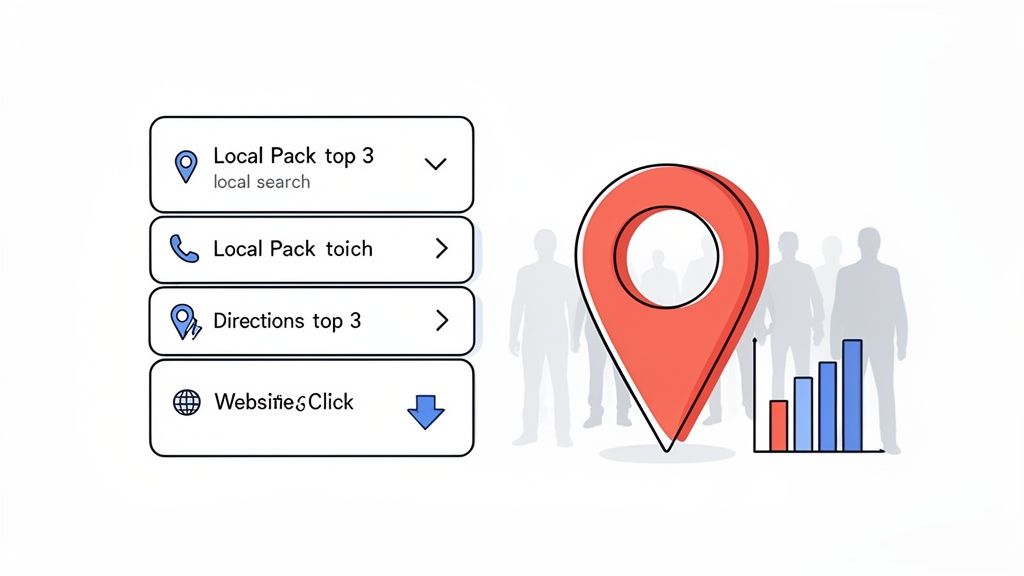
This diagram helps to visualise the connection we're trying to measure: the link between your business, your rank in Google, and your ability to pull in customers from the surrounding area.
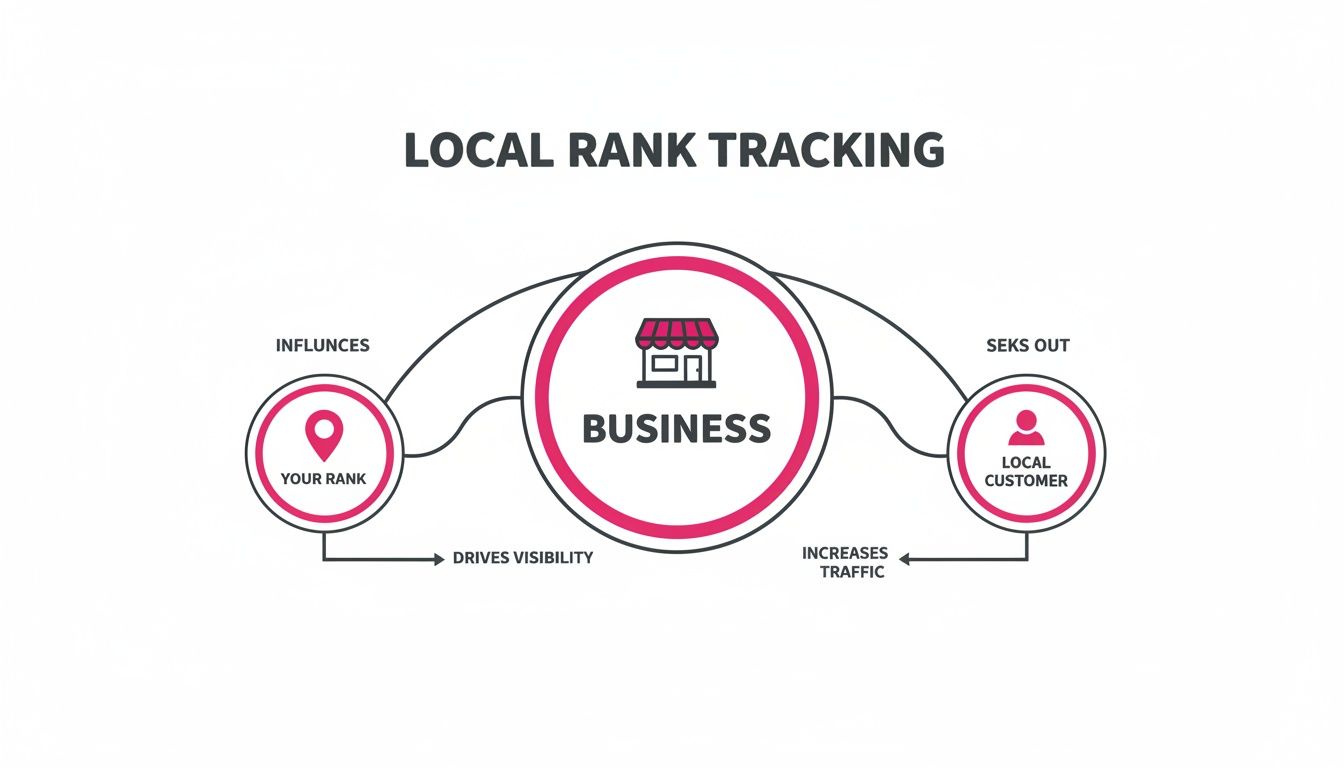
Ultimately, the goal is to make that line between your rank and the customer as strong as possible, turning online visibility into real-world business. Let’s break down the methods that get you there.
Visualising Your Presence with Geo-Grid Tracking
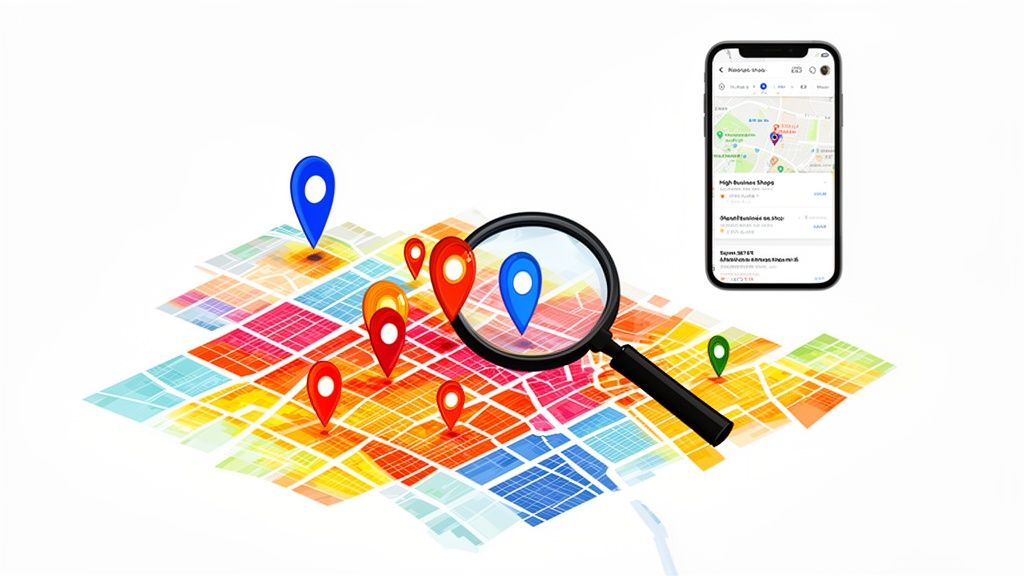
By far, the most powerful and intuitive method is geo-grid tracking. Think of it like laying a digital grid over a map of your service area. Each point on that grid is a stand-in for a potential customer searching from that exact spot.
A geo-grid tool then simulates searches from every single point on the grid, mapping out your ranking position for each one. What you get back is a colour-coded heat map of your visibility. Green zones show where you’re strong, while yellow and red areas instantly highlight where you’re weak or completely invisible.
This shatters the old illusion of having just one ranking. A plumber based in Manchester’s Northern Quarter might be number one when searched from their own postcode, but they could be buried on page three for a customer searching from Didsbury.
Geo-grid tracking gives you an at-a-glance diagnostic of your entire local search footprint. It’s the fastest way to answer the critical question: “Where are my target customers actually seeing me?”
This level of detail lets you spot competitor strongholds and find underserved neighbourhoods, turning raw data into a targeted action plan.
Monitoring Your Place in SERP Features
Climbing to the top of the traditional organic results is great, but for local businesses, the real action is in the special features on the Search Engine Results Page (SERP). The most important of these is the Google Local Pack—that hard-to-miss map and trio of business listings that sits at the very top of most local searches.
Getting into this box is a game-changer, driving a huge share of clicks, calls, and footfall. So, any modern local rank tracking has to monitor your position within the Local Pack specifically, not just in the standard blue links below it.
But it doesn't stop there. Other features matter just as much:
- Google Maps Rankings: This is your position when someone searches directly inside the Google Maps app, often when they’re already out and about.
- Local Finder Results: This is the expanded list of businesses someone sees after clicking "View all" from the Local Pack. Ranking well here is key for customers comparing their options.
- AI Overviews: As generative AI becomes more integrated into search, you need to know if your business is being cited in Google's AI-powered summaries. You can learn more about how to use AI for local SEO to get your business ready for this shift.
Tracking each of these features separately gives you a much richer picture of where your most valuable traffic is really coming from.
Differentiating Between Devices and Platforms
Finally, a truly complete tracking strategy has to account for the different ways people search. The context of a search—the device they’re using and the platform they’re on—can completely change the results they see.
It's absolutely essential to track your rankings across these different environments:
- Mobile vs. Desktop: With most local searches now happening on smartphones, your mobile rankings are what count. These can be wildly different from what you might see sitting at your desk.
- Organic Search vs. Google Maps: A customer searching on Google.co.uk will often get different results from someone searching directly in the Google Maps app. Each platform has its own algorithm, and you need to monitor your performance on both.
If you don't track these separately, you’re flying blind. A business could be doing brilliantly in desktop organic search but be totally invisible in the Maps app, missing out on a huge stream of high-intent customers who are literally ready to get directions or tap the "call" button. By segmenting your tracking, you make sure there are no gaps in your local SEO strategy.
Key Metrics That Actually Drive Business Growth
Knowing where you rank on a geo-grid is a fantastic start, but it’s only one piece of a much larger puzzle. The best local rank tracking strategies do more than just chase numbers; they connect your visibility directly to what matters most: your bottom line.
After all, what good is a number one ranking if the phone isn't ringing and customers aren't walking through your door?
To get a real sense of your performance, you have to look beyond your position. You need to focus on how potential customers are actually interacting with your business once they find you online.
From Rankings to Revenue
The journey from a local search to a sale can be incredibly quick. In the UK, a staggering 78% of local mobile searches lead to an offline purchase, which is a massive opportunity for service providers and hospitality businesses. With Google Maps usage expected to hit 37% monthly among adults by 2025, its importance in how customers find you can't be overstated. You can find more insights on why local SEO is so vital on this business listings guide from Connect Pembrokeshire.
The data makes one thing crystal clear: tracking the right metrics isn't just an SEO task. It's a direct line to measuring and growing your revenue.
Visibility Metrics That Matter Most
A simple rank number is a blunt tool. Certain visibility metrics, however, offer far more nuance and tell you not just if you're being seen, but how you're appearing to customers who are ready to buy.
Here are the visibility metrics you should be watching closely:
- Local Pack Rankings: This is your spot in the coveted top three map listings that appear on the main search results page. Nailing a position here gives you an enormous boost in visibility and trust.
- Google Maps Rankings: This is all about your position when people search directly inside the Google Maps app. It's crucial for catching customers who are already out and about.
- Share of Local Voice: This advanced metric calculates how visible you are across a specific area compared to your top competitors. It answers the big question: "How much of the local search market do we actually own?"
By keeping an eye on these three metrics, you get a complete picture of your search presence. You see not only where you rank, but how you stack up against the competition where it counts.
Conversion Metrics from Your Google Business Profile
This is where local tracking genuinely starts to fuel business growth. Think of your Google Business Profile (GBP) as a mini-website that lives directly on the search results page. It's a goldmine of data on what customers do next.
Tracking these conversions isn't optional—it's essential.
Focus on these three core actions:
- Clicks-to-Call: This tracks how many people tapped the "call" button right from your listing. It's one of the strongest signals of immediate buying intent you can get.
- Direction Requests: This shows you how many people asked for directions to your physical address. For any brick-and-mortar business, it's a clear sign that a customer is planning to visit.
- Website Visits: This measures how many users clicked from your GBP through to your website, a key metric for businesses that rely on online bookings, contact forms, or detailed service pages.
When you pair this conversion data with your visibility metrics, you can finally draw a straight line from your SEO work to real-world results. For example, you can see if improving your geo-grid ranking in a particular neighbourhood leads to a tangible increase in direction requests from that exact area.
Platforms like LocalHQ make it simple to monitor all of these crucial data points, helping you get a much deeper understanding of your local SEO analytics without getting lost in complicated spreadsheets.
Of course, here is the rewritten section with a more natural, human-written tone.
3 Common Local Rank Tracking Mistakes to Avoid
Getting started with local rank tracking is a great move, but it’s easy to fall into a few common traps that can make your data next to useless. Even with the best intentions, it's possible to get a completely skewed picture of your performance.
Let's walk through the most common mistakes I see businesses make and, more importantly, how you can sidestep them. The goal is to build a strategy based on what’s actually happening out there, not on flawed information.
Forgetting Who You're Tracking For
This is the big one. By far, the most frequent error is checking your rankings from the wrong place—usually your own office. A business owner will pop a keyword into Google, see they're ranking well, and assume all is good. But this gives you a completely distorted view of reality.
Think about it: your ranking from your own business address will almost always be your best. But you aren't trying to attract the person already standing in your shop. You need to see what a potential customer sees when they're searching from a neighbourhood a few miles away.
The Fix: You absolutely must use a tool that can simulate searches from specific, different geographic points. This is exactly what geo-grid tracking was built for. It shows you what customers see, block by block, not just what you see from behind your own desk.
When you do this, you get a genuine map of your visibility across your entire service area. It’s the only way to find the blind spots you would otherwise never know existed.
Chasing Broad, Vanity Keywords
Another classic mistake is pouring all your energy into broad, high-volume keywords instead of the specific, high-intent local terms that actually drive business. A bakery in Manchester might get fixated on ranking for "best cakes," but that search term is insanely competitive and has no local context.
A real customer who’s ready to buy is searching for something much more specific, like "birthday cake shop Didsbury" or "sourdough bread near me." These are the searches that make the phone ring and bring people through the door. The search volume might be lower, but the commercial intent is sky-high.
Your local rank tracking should be all about these "money" keywords. Here’s why it matters:
- Higher Conversion Rates: People searching with local terms are much closer to making a purchase.
- Less Competition: It's far easier to rank for "emergency plumber Chorlton" than the generic and national term "plumber."
- More Relevant Traffic: You get in front of people who are actually in your area and ready to spend money.
Focusing on these specific phrases ensures your tracking reflects your real ability to capture customers who are actively looking for a local business just like yours.
Inconsistent Tracking Habits
Local search results are anything but static. They can change daily, or even hourly, thanks to algorithm tweaks, new competitor reviews, or even just shifts in how people are searching. If you only check your rankings every now and then, you’re trying to understand the tide by glancing at the ocean once a day.
You might see you’re number one on a Tuesday, but completely miss a devastating drop on Friday that lasts all weekend, costing you a ton of business. Sporadic checks give you random snapshots, not the full story.
To get a clear picture of your performance and spot trends, you need a consistent tracking schedule. This is how you connect the dots—linking a drop in rankings to a competitor’s new ad campaign or a sudden negative review on your profile.
Actionable Solution: Set up an automated tool to run your local rank tracking checks on a regular schedule, like once a week. This creates a reliable, continuous stream of data you can use to make smart decisions, react to threats, and actually measure whether your SEO efforts are paying off over time.
Turning Ranking Data Into an Actionable SEO Strategy
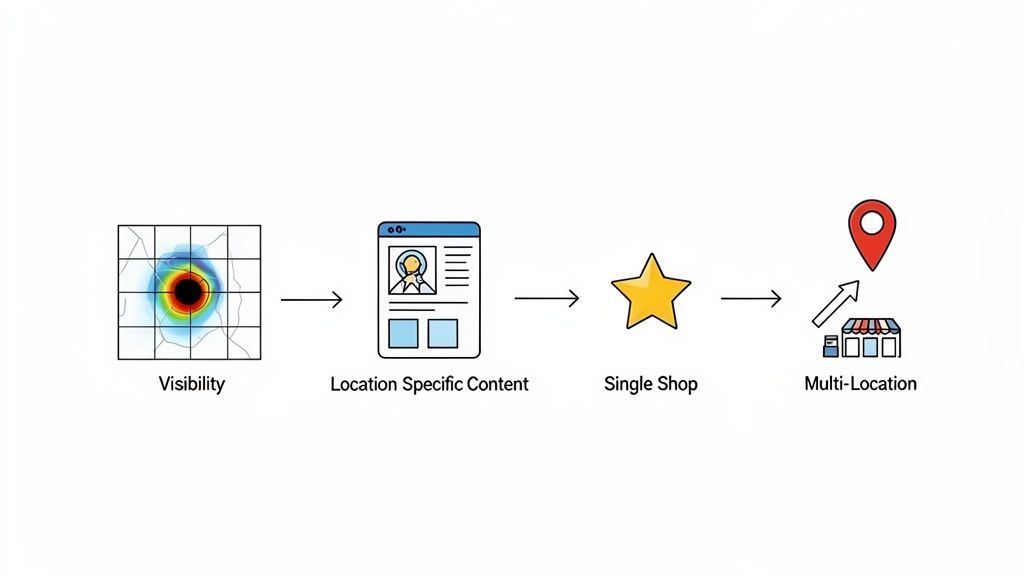
Collecting data is one thing, but actually using it to make smart, revenue-driving decisions? That’s a whole different ball game. The real power of local rank tracking is its ability to hand you a clear roadmap for improvement. It stops you from chasing vague SEO goals and instead gives you a precise, actionable to-do list based on what’s happening on the ground.
This is how you bridge the gap between seeing your rankings and knowing what to do next. You stop guessing. Instead, you let the data guide every move, making sure your time and money are spent where they’ll actually make a difference to your visibility and, ultimately, your bottom line.
Interpreting Your Local Rank Tracking Data
First things first, you need to learn how to read the story your data is telling you. A geo-grid report isn't just a spreadsheet of numbers; it's a map of your digital territory, showing you where you’re strong and where you have room to grow.
Imagine your geo-grid shows a big 'visibility hole' in a key, affluent neighbourhood you’ve been trying to crack. That’s not bad news—it's a bright, flashing sign telling you exactly where to focus your energy to capture a valuable new market. Or maybe your rankings dip just after a competitor gets a flood of new five-star reviews. The data has just handed you your next priority on a silver platter: it’s time to double down on your own review generation.
Think of your ranking data as a diagnostic tool for your local marketing health. It pinpoints the exact problem so you can apply the right solution, rather than just guessing what might be wrong.
Building Your Action Plan from Key Insights
Once you’ve figured out the 'what' and the 'where', you can build a truly targeted strategy. Let’s look at how specific data points can be translated directly into concrete actions. This is how you turn local rank tracking insights into a powerful, repeatable workflow.
A structured approach is everything. It helps you decide what to tackle first, focusing on the issues that represent the biggest opportunities or the most immediate threats to your business.
The table below breaks down a simple framework for connecting what you see in your data to specific, executable tasks you can manage with a platform like LocalHQ.
From Insight to Action: A Local SEO Workflow
| Data Insight | Potential Cause | Recommended Action Using LocalHQ |
|---|---|---|
| Low rankings in a northern suburb | Lack of location-specific content or citations for that area. | Create a targeted GBP Post about a job completed in that suburb and publish a blog post titled "Why Northern Suburb Residents Choose Us". |
| A top competitor consistently outranks you | They have more positive reviews and a better-optimised GBP. | Use the Review Autoresponder to increase reply rates and follow the AI Optimisation Wizard’s suggestions for your GBP categories. |
| Rankings dropped after a Google update | Your Google Business Profile information may be seen as outdated or incomplete. | Perform a full audit of your GBP, updating hours, services, and photos. A thorough approach to Google Business Profile management is key. |
| Strong rankings but low call volume | Your GBP listing isn't compelling enough to drive action. | Update your GBP description with a stronger call-to-action and schedule fresh, high-quality images to be posted regularly. |
This process transforms your role from just watching numbers to actively shaping your market presence.
Tailoring Strategies for Different Business Models
How you act on this data will, of course, depend on your business structure. The core principles are the same, but the execution needs to fit your specific operational reality.
For Single-Location Businesses
If you're a small or medium-sized business with one location, your world revolves around dominating your immediate service area. Your local rank tracking data is your guide to defending your home turf and strategically pushing your digital borders into nearby neighbourhoods.
Your action plan should be laser-focused:
- Fix Visibility Gaps: Pinpoint the closest high-value areas where you’re invisible and create content that specifically mentions those locations. Think blog posts, service pages, and Google Business Profile updates.
- Monitor Close Competitors: Keep a very close eye on the top 2-3 competitors in your grid. If they start gaining ground, dig into their recent GBP activity or reviews and launch a counter-move.
- Connect to Conversions: Tie every ranking improvement back to what matters most—like a noticeable uptick in phone calls or direction requests from a specific postcode.
For Multi-Location Businesses and Franchises
When you're managing dozens or even hundreds of locations, the name of the game is scalability and consistency. Local rank tracking becomes vital for spotting underperforming branches and figuring out what’s wrong at a granular level. A one-size-fits-all strategy just won't cut it.
Your workflow is all about systemising success:
- Benchmark Performance: Use geo-grid data to compare locations. Find your top performers, figure out what they're doing right, and turn that into a best-practice template for everyone else.
- Prioritise Underperformers: Focus your attention on the locations with the biggest visibility gaps. These often represent the greatest opportunity for quick and significant growth.
- Automate and Delegate: Use tools like LocalHQ to automate GBP updates and review responses across all locations. This ensures brand consistency while freeing up local managers to handle specific customer interactions.
By turning raw data into a clear, prioritised action plan, you elevate local rank tracking from a simple reporting tool into a strategic engine that drives sustainable business growth.
Your Local Rank Tracking Questions Answered
Jumping into local rank tracking can feel a bit like learning a new language. You get that it’s important, but a whole host of questions pop up almost immediately. Why do my results look completely different to my customer’s? How often should I even be checking this stuff?
Let's clear the air. This section tackles the most common questions and sticking points that businesses run into when they first start tracking their local SEO performance. We’ll give you straightforward answers to demystify the process and help you build a strategy you can actually rely on.
How Often Should I Check My Local Rankings?
This is usually the first question people ask, and the answer definitely isn't "every single day." Checking too often can lead to a kind of data paralysis, where you're so obsessed with tiny movements that you never take meaningful action. But on the flip side, checking too rarely means you could miss a major drop in visibility that costs you a whole weekend's worth of business.
For most businesses, there’s a clear sweet spot.
We've found that checking your local rankings on a weekly basis provides the perfect balance. It’s frequent enough to spot important trends and react to what your competitors are doing, without getting bogged down in the noise of daily, minor fluctuations.
A weekly check-in lets you see the real impact of your SEO efforts—like that new blog post you published or a fresh batch of five-star reviews—without hitting the panic button over a small, temporary dip.
Why Do My Rankings Look Different on My Phone vs My Computer?
It’s a classic scenario. You search for your business on your work computer and see you’re ranking third—brilliant. A moment later, you pull out your phone, run the exact same search, and you’ve completely vanished. This isn't a glitch; it's a core feature of how modern local search is designed to work.
Google’s entire mission is to deliver the most relevant result for a searcher's specific context. This means it weighs up several factors that can change dramatically between your devices:
- Precise Location: Your phone gives Google a pinpoint-accurate GPS location. Your desktop, on the other hand, often relies on a much broader location based on your internet connection. That proximity signal is a massive ranking factor.
- Search History: The searches you’ve made on your mobile are likely different from those on your work computer, and Google uses that history to personalise the results it shows you.
- Device Type: Google understands that someone searching on a mobile is probably on the move and looking for instant results, like directions or a phone number. It will prioritise results accordingly.
This is precisely why you can't trust what you see on your own screen. To get a true picture, you need a standardised, unbiased tool that checks your rankings from neutral, specific locations every single time.
Can I Just Use Free Tools or Check Manually?
While the temptation to save a few quid by using free tools or just searching in an incognito browser is strong, these methods have serious flaws that can lead you down the wrong path. They almost always give you a skewed or incomplete picture of how you're really doing.
Manually checking, for starters, is incredibly time-consuming and hopelessly inaccurate. Even in incognito mode, your results are still biased by your device, your location, and your search history. You simply can't replicate the search experience of hundreds of potential customers spread across your entire service area by yourself.
Free tools bring their own set of headaches:
- Limited Locations: They might only let you check from one or two spots, completely missing the detailed view a geo-grid provides.
- Infrequent Updates: You might only get new data monthly, which is far too slow in the fast-paced world of local SEO.
- Lack of Detail: They rarely break down rankings between the Local Pack, Google Maps, and standard organic results, lumping it all into a single, unhelpful number.
While free tools can offer a tiny glimpse, they lack the precision and granular detail needed for a serious local rank tracking strategy. Investing in a dedicated platform is essential for getting reliable data you can confidently act on.
What’s More Important: Organic Rankings or Map Rankings?
This is a bit like asking what's more important for a car, the engine or the wheels—you need both to get where you're going. Organic rankings (the classic blue links) and Map Pack rankings serve different, but equally vital, purposes.
Organic rankings are brilliant for building brand authority and catching customers who are still in the research phase. Someone searching for "how to choose a local builder" might come across your helpful blog post and remember your name when it's time to hire.
The Map and Local Pack rankings, however, are all about capturing customers with immediate, high-intent needs. These are the people searching for "builder near me" because they need someone right now. The data consistently shows that listings in the Local Pack get a huge slice of the clicks for these types of searches.
Ultimately, a healthy local SEO strategy aims for strong visibility in both arenas. Great organic content builds your authority, which can influence your Map rankings. At the same time, a prominent spot in the Maps drives immediate leads. The two work hand-in-hand to make sure you're visible at every stage of a local customer's journey.
Ready to stop guessing and start seeing your true local rankings? LocalHQ provides a powerful geo-grid rank tracker that shows you exactly where you stand, block by block. Turn confusing data into a clear action plan and start winning more local customers today. Find out more at LocalHQ.