Voice Search Local SEO: Optimising for ‘Hey Google’

A customer is standing on a pavement outside your competitor’s shop. Another is in a van between jobs. A third is at home with one hand full and says, “Hey Google, find me a plumber near me open now.” That moment is now part of local search.
Voice search local seo matters because spoken searches aren’t tidy keyword strings. They’re urgent, specific, and usually local. The business that gets chosen often isn’t the one with the prettiest website. It’s the one with the clearest business data, the most relevant answer, and the least friction between question and action.
For UK businesses, this shift isn’t theoretical. It affects restaurants, clinics, trades, retailers, multi-location hospitality groups, and any service provider that depends on calls, bookings, walk-ins, or direction requests. If your listings are inconsistent, your pages are slow, or your content still reads like it was written for a desktop search box, you’ll miss searches that are ready to convert.
Why 'Hey Google' is Your New Front Door
Someone asks their phone for “the nearest pharmacy open late”, and they’re not doing research. They want an answer they can act on in seconds. Voice search has turned local discovery into an immediate decision, often made before a customer ever sees a homepage.

In the UK, voice search has seen explosive growth in local intent queries, with ‘near me’ searches combined with voice commands surging by 150% since 2020, according to BrightLocal data referenced here. That’s why local search work now has to account for spoken behaviour, not just typed behaviour.
What this changes for local businesses
A typed search might still leave room for browsing. A spoken search usually doesn’t. The assistant or mobile interface narrows the field quickly, and local signals carry more weight.
That changes the role of your local presence:
- Your listing becomes the first impression: Opening hours, category, reviews, and phone number often matter before your site copy does.
- Your service details need to be precise: “Emergency plumber”, “wheelchair-accessible entrance”, “serves vegan options”, and similar attributes help machines match intent.
- Your nearest relevant location wins: For multi-location businesses, one weak branch profile can lose demand in a specific area even if the brand is strong overall.
Practical rule: Treat every local listing as a digital shopfront that has to answer a spoken question instantly.
Many businesses still think of local SEO as map pins and citations. It’s broader than that now. If you need a refresher on the foundations, LocalHQ’s guide to local search optimisation is a useful starting point before you adapt it for voice-led searches.
How Voice Search Changes the SEO Game
Typed search and spoken search don’t behave the same way. That sounds obvious, but plenty of local SEO campaigns still target voice search using old keyword habits. They optimise for “plumber London” when the actual query is closer to “who can fix a leaking boiler near me tonight?”
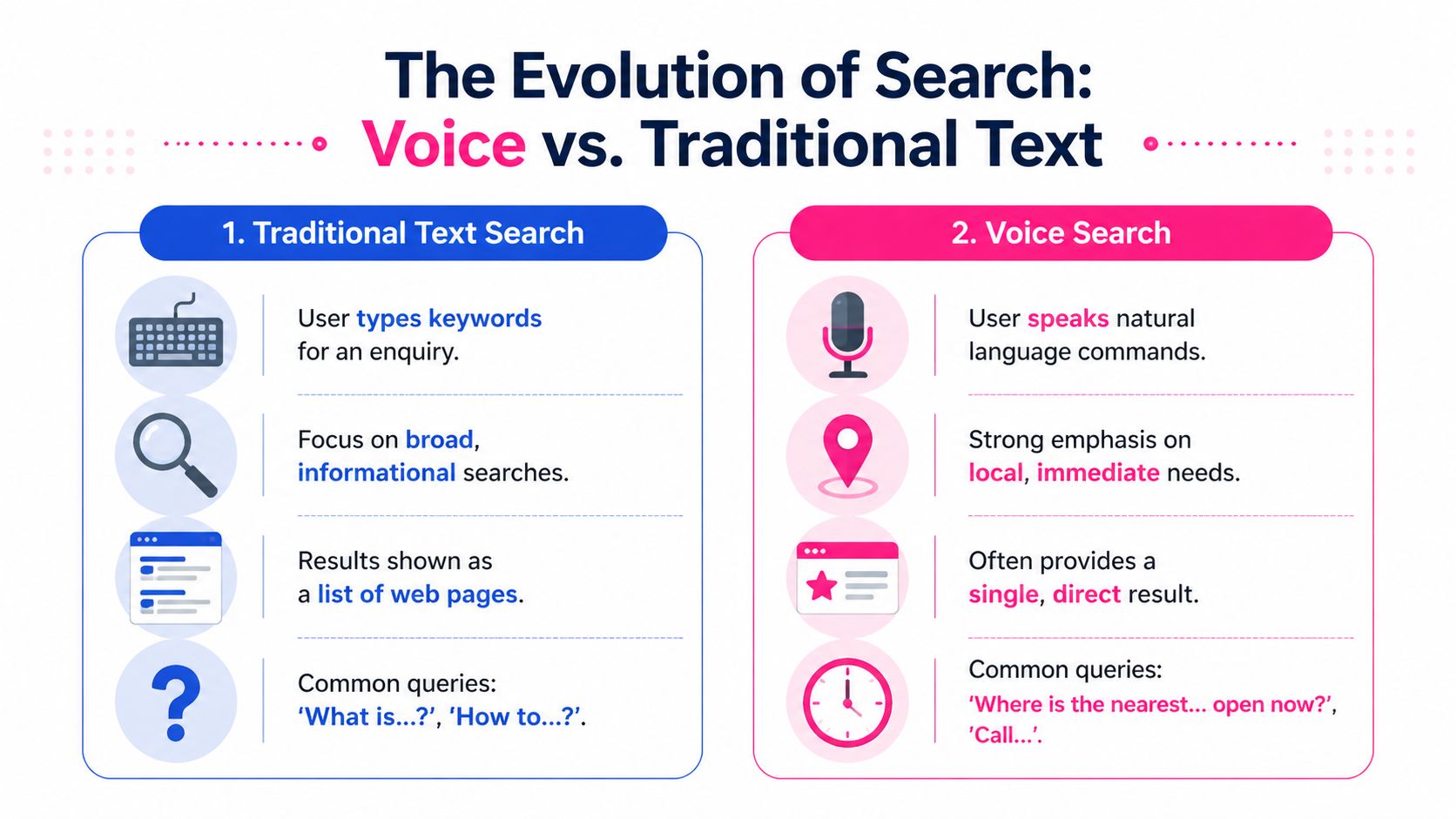
A simple way to think about it is this. Typed search is like filling in a form with shorthand. Voice search is like asking a member of staff for help. The language is fuller, the intent is clearer, and the user expects a direct answer.
Voice queries are longer and more specific
People don’t speak in keyword fragments. They ask full questions, use qualifiers, and include urgency.
Compare the difference:
| Search style | Example query | What it tells you |
|---|---|---|
| Typed | plumber London | Broad service and location |
| Typed | emergency plumber near me | Stronger intent, still short |
| Spoken | who is the best-rated emergency plumber near me available now | Intent, urgency, location, and trust signal |
| Spoken | is there a plumber nearby who can come this evening | Conversational phrasing and timing need |
That’s why voice search local seo depends heavily on long-tail phrasing, question-led content, and clear local business data.
The aim is to become the answer
Traditional search can reward businesses that appear in the mix. Voice search pushes towards a more decisive outcome. The platform tries to return the best immediate answer, not a browsing session full of options.
For local businesses, that often means your optimisation work has to support three things at once:
- Relevance to the spoken query
- Proximity to the searcher
- Confidence signals such as complete business information and strong reputation
UK voice search local SEO milestones emphasise GBP optimisation as the cornerstone, with 76% of voice queries featuring ‘near me’ intent, making it essential for restaurants, retail, and home services to claim and update profiles regularly, according to SevenAtoms’ summary of voice search trends.
Voice search rewards businesses that remove ambiguity. If Google has to guess what you do, where you serve, or whether you’re open, you’re already behind.
What works and what doesn’t
Some tactics translate well from standard SEO. Others need adjusting.
What tends to work
- Question-led content: FAQs, service pages, and local landing pages written in natural phrasing
- Direct answers near the top of pages: Short, plain-English responses before the detail
- Strong local entity signals: Accurate categories, attributes, services, and opening hours
What tends to fail
- Keyword stuffing: Spoken search language doesn’t sound repetitive, so pages shouldn’t either
- Thin location pages: A page with a town name swapped in isn’t persuasive to users or search engines
- Overly formal copy: If your content sounds unlike the way people ask questions, it’s harder to match voice intent
If you want a good plain-English primer on how voice behaviour differs from traditional search behaviour, Busylike’s voice search guide gives a helpful overview without drowning the point in jargon.
Your Google Business Profile as a Voice Search Magnet
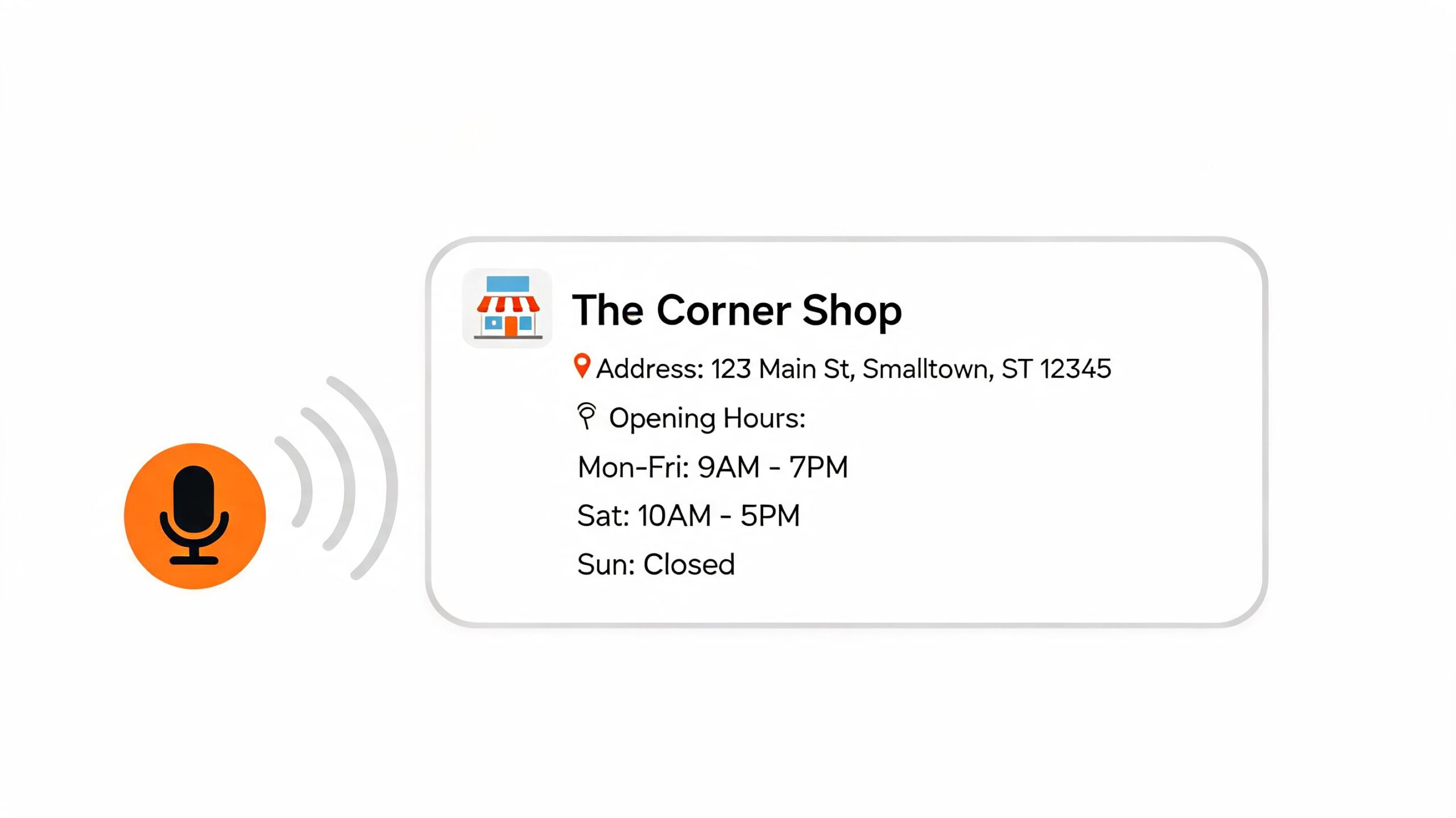
For most local businesses, your Google Business Profile is the fastest route into voice visibility. If a customer asks for a nearby service, Google often relies on local profile data to decide what to show, suggest, or read out.
That’s why voice search local seo often succeeds or fails before anyone lands on your website.
The non-negotiables on every profile
A claimed profile isn’t an optimised profile. Most weak performance comes from incomplete fields, generic categories, stale hours, or missing attributes.
Check these first:
- Business name and contact details: Keep your NAP exactly consistent with your site and other major listings.
- Primary and secondary categories: Don’t settle for the broadest possible label if a more precise option fits.
- Opening hours: Include regular hours and keep special hours current.
- Attributes and services: Add details that reflect how customers ask for your business.
- Photos and updates: These don’t just fill space. They help keep the profile active and informative.
Why attributes matter more for chains and multi-location brands
Many multi-location businesses lose ground. Their brand teams often keep the core details tidy but fail to maintain location-level differences such as service options, accessibility details, late opening, holiday hours, or category nuances.
Recent UK data from 2025 shows 68% of multi-location hospitality businesses lose 25-40% of voice-driven ‘near me’ queries due to mismatched attributes like dynamic hours or service filters across their Google Business Profiles, according to Bright SEO Tools’ write-up on voice search and local SEO.
That’s a practical problem, not a theory problem. If one pub is marked as serving food late and another identical branch isn’t, they won’t compete equally for the same spoken query.
Field note: Multi-location SEO breaks most often at branch level. Head office signs off the brand. Local details still decide visibility.
Use the Q&A section like a pre-sales script
The Q&A area is badly underused. Most businesses leave it empty until a customer asks something publicly, and by then the question may be answered badly, slowly, or not at all.
For voice search, this section is useful because it mirrors the questions people speak:
- Do you offer same-day appointments?
- Is parking available?
- Are you open on Sundays?
- Do you handle emergency callouts?
- Do you have vegan or gluten-free options?
Write concise, factual answers in natural language. Don’t turn them into adverts. If the answer is “Yes, we offer same-day boiler repairs in Leeds subject to availability”, that’s better than a vague promotional line.
Build a process, not a cleanup project
Single-location firms can often manage this manually. Groups with ten, fifty, or hundreds of locations need a repeatable process. That usually means a central checklist, ownership for updates, and regular audits of categories, hours, services, attributes, and Q&A coverage.
A practical review cycle looks like this:
| Task | Single location | Multi-location |
|---|---|---|
| Hours updates | Manual check weekly | Central control with local confirmations |
| Attributes | Quarterly review | Template plus branch-specific overrides |
| Q&A | Add common questions monthly | Shared bank of approved answers |
| Photos and posts | Ad hoc | Scheduled by region or brand team |
For businesses that need a deeper operational checklist, this Google Business Profile optimisation guide is worth reading, especially for service-led organisations that need accuracy more than fluff.
If your work starts with improving profile completeness, category choices, branch consistency, and service information, LocalHQ’s Google Business Profile optimisation page shows the core areas that usually need attention.
Building On-Page Content That Answers Questions
Your Google Business Profile gets you into the conversation. Your website helps Google trust that you’re the right answer.
That means your pages need to sound like answers to real questions, not brochures chopped into headings. For voice search local seo, the most useful pages are usually service pages, location pages, and FAQs written in language customers use.
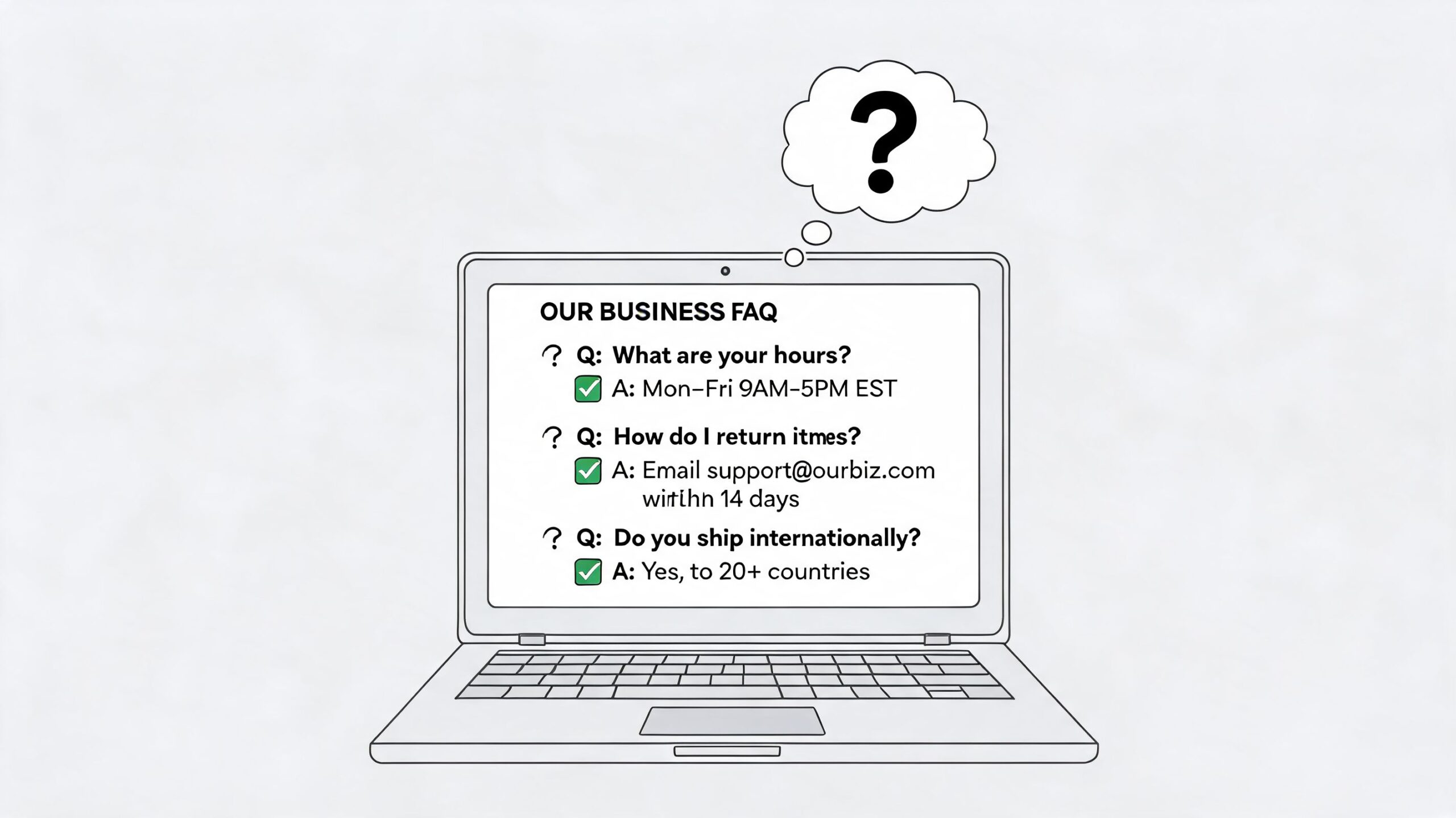
In the UK, 58% of consumers utilise voice search to discover local business information, and pages loading under 2 seconds are a prerequisite for voice search positioning, as slower sites experience a 32% drop in local search visibility, according to this local voice search guide. So your content has to be clear, and your pages have to be fast enough to qualify.
Write for spoken questions, not just keywords
Most businesses already know their core services. They often don’t know how customers phrase the same need out loud.
A typed query might be “dentist Bristol emergency”. A spoken query is more likely to be “can I get an emergency dentist appointment in Bristol today?” Your page should reflect that phrasing naturally in headings, subheadings, and body copy.
A good structure looks like this:
- State the service clearly
- Answer the obvious question immediately
- Add practical detail such as coverage, timing, and next steps
- Support it with local relevance
Here’s the difference:
| Weak page opening | Better page opening |
|---|---|
| We provide expert plumbing solutions across the local area. | Need an emergency plumber in Croydon? We handle leaks, blocked drains, and boiler issues, with same-day appointments where available. |
| Our dental practice delivers quality care for all patients. | Looking for an emergency dentist in Bristol? Call our clinic for urgent appointments, opening times, and treatment availability. |
FAQ content works when it’s specific
A bloated FAQ page filled with generic filler won’t help much. A focused FAQ that reflects common customer questions can help search engines match conversational intent.
Useful question formats include:
- Availability questions: “Are you open on bank holidays?”
- Service fit questions: “Do you repair Worcester Bosch boilers?”
- Location questions: “Do you cover South Manchester?”
- Practical questions: “Can I book online?”
- Trust questions: “Do you offer free estimates?”
Keep answers short at the top, then expand underneath if needed. Spoken search favours clarity before detail.
Location pages need local proof
Many businesses create location pages by swapping town names into the same template. That’s not enough. A useful local landing page should mention real service areas, practical differences, and local context.
Good local pages often include:
- Areas covered within the town or city
- Services available from that location
- Branch-specific opening details
- Parking, access, or collection information
- FAQs that mention local intent naturally
If you’re building or improving branch pages, LocalHQ’s local landing pages SEO resource is a relevant reference point for turning basic location pages into pages that can compete locally.
Schema is the translator, not the strategy
Schema markup helps search engines understand your business details in a structured format. It won’t rescue weak content, but it does make your information easier to process.
For local businesses, LocalBusiness schema is the usual starting point. You can add details like business name, address, phone number, hours, and service area using JSON-LD.
A simple example looks like this:
{
  "@context": "https://schema.org",
  "@type": "LocalBusiness",
  "name": "Example Plumbing Leeds",
  "address": {
    "@type": "PostalAddress",
    "streetAddress": "10 High Street",
    "addressLocality": "Leeds",
    "postalCode": "LS1 1AA",
    "addressCountry": "GB"
  },
  "telephone": "+44 113 000 0000",
  "openingHours": [
    "Mo-Fr 08:00-18:00",
    "Sa 09:00-13:00"
  ],
  "areaServed": "Leeds"
}
This isn’t a magic fix. It removes guesswork. If your page says one thing, your profile says another, and your schema says something else, Google has to choose which version to trust. That’s exactly what you want to avoid in voice search.
Mastering Reviews and Site Speed
Reviews and speed sit in different parts of the stack, but voice search pulls them closer together. Reviews influence trust and selection. Speed affects whether your page is even a realistic candidate.
Businesses often underinvest in both because neither feels as visible as rankings. That’s a mistake.
Reviews shape spoken intent
A lot of local voice searches contain built-in trust qualifiers. People ask for “best”, “top-rated”, “highly recommended”, or “good recent reviews”. That language matters because it narrows the field before the user even sees options.
UK-specific stats from Semrush’s 2025 Voice Report indicate 55% of voice queries for home services reference ‘highly recommended’ or ‘recent reviews’, yet businesses with AI responders see a 38% higher ‘immediate contact rate’ from voice, according to this review-focused voice search article.
That doesn’t mean you should automate everything badly. It means fresh review activity and timely responses influence whether your profile looks current, helpful, and trustworthy.
What good review management looks like
Most businesses focus on volume alone. Voice search pushes you to care about recency, relevance, and response quality too.
A practical approach:
- Ask at the right moment: Request feedback after the job, meal, appointment, or delivery when the experience is still fresh.
- Guide customers lightly: Encourage specifics about speed, friendliness, cleanliness, reliability, or the exact service delivered.
- Reply promptly: Thank positive reviewers properly and address complaints with useful next steps.
- Use natural language in responses: If customers talk about “sorted quickly”, “same-day”, or “helpful with my boiler issue”, those real phrases reinforce service relevance.
A review response isn’t just customer service. It’s part of your local search content.
If review acquisition and response handling are inconsistent, LocalHQ’s guide on how to get more Google reviews covers the operational side that many local teams struggle to maintain.
Site speed is a disqualifier, not a nice-to-have
Voice searches happen on the move, on mobile devices, and under time pressure. Slow pages don’t fit that use case. If a customer asks a question and your page lags, another business gets the chance instead.
The most common speed issues are familiar:
| Problem | Typical effect | First fix |
|---|---|---|
| Oversized images | Slower mobile load | Compress and resize properly |
| Heavy scripts | Delayed rendering | Remove what isn’t needed |
| Bloated templates | Slow every location page | Simplify theme and modules |
| Weak hosting | Inconsistent performance | Upgrade infrastructure |
What doesn’t work is publishing strong FAQ content onto a sluggish site and expecting the content alone to carry you. Voice search local seo needs both. The answer has to be relevant and immediately accessible.
How to Track Your Voice Search Performance
The awkward part of voice search reporting is that you rarely get a neat dashboard labelled “voice conversions”. Most platforms don’t break it out cleanly. That doesn’t mean you can’t measure progress. It means you track the signals that voice visibility tends to improve.
Watch behaviour, not vanity metrics
If your voice search work is improving, the pattern usually shows up in local actions before it shows up in a tidy voice report.
Useful indicators include:
- More discovery-led profile activity: Especially for service and category-based searches
- More calls from local listings: A common outcome when people need fast answers
- More direction requests: Especially for retail, hospitality, healthcare, and in-person services
- Improved visibility for conversational local queries: Not just broad head terms
The key is to compare these signals against the pages, profiles, and locations you’ve optimised.
Use geo-grid tracking for real local visibility
Traditional rank tracking often hides what matters most in local SEO. It checks a keyword from one point, not from the actual map of customer demand across a town or city.
A geo-grid tracker is more useful because it shows how visible a location is across different parts of the area for a local query. That matters for voice search because proximity and map visibility shift block by block, not just city by city.
For example, a clinic might appear strongly in one postcode cluster and disappear a short distance away. A standard rank report can miss that. A geo-grid view makes the weakness obvious.
If you manage multiple branches, track each one as its own local market. “London” is not one ranking environment.
Build a practical reporting view
A sensible review rhythm is monthly, with weekly checks for high-volume locations or businesses with frequent opening-hour changes.
Track these together:
| Metric group | What to check | Why it matters |
|---|---|---|
| Profile engagement | Calls, direction requests, website clicks | Shows whether local discovery is turning into action |
| Query patterns | More conversational and service-led searches | Suggests better alignment with spoken intent |
| Local rankings | Visibility by area, not just one point | Reflects real-world map coverage |
| Branch consistency | Hours, attributes, Q&A, reviews | Prevents one location dragging down performance |
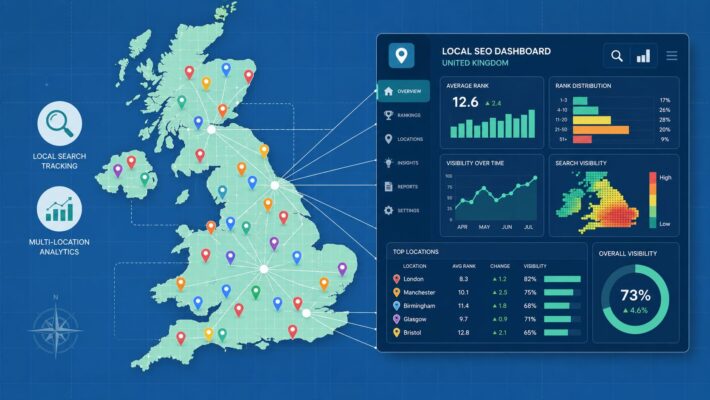
For businesses that need to see local ranking movement across specific service areas, LocalHQ’s local keyword rank tracking page explains the sort of visibility data that standard rank checkers usually miss.
Start Your Local Voice Optimisation Today
Voice search local seo isn’t a separate campaign bolted onto local SEO. It’s what local SEO becomes when you account for how people ask for nearby businesses now.
The strongest results usually come from a straightforward sequence:
- Fix your Google Business Profile data
- Tighten location-level attributes and opening hours
- Write service and location pages around real customer questions
- Add useful FAQ content
- Implement clear schema
- Improve mobile speed
- Increase review freshness and response coverage
- Track calls, direction requests, and geo-grid visibility
For a single site, that’s manageable with discipline. For multi-location businesses, franchises, and agencies, the workload multiplies fast. The challenge isn’t knowing what to do. It’s keeping every branch accurate, current, and visible without relying on spreadsheets and reminders.
That’s where a platform approach starts to make sense. An AI-assisted workflow can help teams spot missing attributes, category gaps, weak locations, slow response habits, and uneven visibility before those issues become lost enquiries.
If you’re serious about voice-led local discovery, don’t wait for a full redesign. Start with the data customers and search engines use first. That’s usually where the fastest gains are hiding.
Your Voice Search SEO Questions Answered
Does voice search only matter for Google
No. Google is central for many UK local searches, but customers also use Siri and Alexa. The practical takeaway is simple. Keep your core business information consistent everywhere, not just on Google, and make sure your website states the same facts clearly.
Should I build one big FAQ page or smaller FAQs across service pages
Usually both, but with a purpose. A central FAQ page helps with broad customer questions. Smaller FAQ sections on service and location pages are often better for local intent because they match a specific need more closely. If every answer lives on one huge page, relevance can get diluted.
What if I’m a service-area business without a shopfront
You can still compete. Focus on service-area clarity, consistent profile setup, strong service pages, local landing pages for the areas you serve, and reviews that mention the type of work you do. Don’t fake location signals you can’t support. Clear coverage beats misleading proximity.
How long does voice search local seo take to show results
It depends on what’s broken now. If hours, attributes, and review activity are weak, you may see local engagement improve after fixing the basics. If your site structure, page speed, and branch-level content are poor, it usually takes longer because you’re rebuilding the foundation as well as the visibility.
Do I need special voice search tools
Not always. Many of the inputs are the same ones you already use for local SEO: profile management, review handling, page optimisation, and rank tracking. The difference is in how you apply them. Spoken queries reward direct answers, local precision, and fast action paths.
If you’re managing one location or a whole portfolio, LocalHQ gives you a practical way to improve the parts of local SEO that matter most for voice search. You can manage Google Business Profiles, keep location data consistent, respond to reviews faster, track visibility with geo-grid reporting, and use the AI Optimisation Wizard to spot the next fixes worth making.