Google Business Profile Ranking Factors: Data-Driven Analysis (2026)

Have you ever searched for something on Google Maps and wondered why one local café pops up first, while another, seemingly just as good and only a street away, is nowhere to be seen? It’s not random. The secret is understanding the three core pillars that Google’s local algorithm is built on: Relevance, Distance, and Prominence.
Getting your head around these concepts is the absolute first step to climbing the local search ladder.
What Really Drives Google Business Profile Rankings
Trying to figure out Google’s local algorithm can feel like you’re trying to solve a puzzle in the dark. But it’s not a mysterious black box. In reality, it’s a surprisingly logical system designed to give people the most helpful and trustworthy results for what they’re looking for.
Once you grasp the fundamentals, every optimisation you make will have a clear purpose. Everything comes down to three big ideas that work together to decide where your business shows up.

The Three Pillars of Local Search
Google is quite open about the fact that these three pillars are the foundation of its local ranking system. Let’s unpack what they actually mean for your business on a practical level.
Relevance: At its core, this is all about how well your business profile matches a searcher’s query. If someone types in “emergency plumber in Manchester,” Google immediately scans for profiles with “Plumber” as a category and “Manchester” in their details. If you’re not seen as relevant, you simply won’t show up. It’s the price of entry.
Distance: This one is straightforward. It’s the physical distance between your business and the person searching (or the location they specified, like “cafés near King’s Cross”). Proximity is a huge deal for Google, as it wants to serve up convenient options. You can’t bend the rules here; you’re not going to rank for “coffee shop near me” if your shop is 50 miles away.
Prominence: This is where things get interesting. Prominence is Google’s way of sizing up how well-known and respected your business is in the real world and online. It’s a measure of your authority. Google looks at signals like the number of reviews you have (and how good they are), mentions of your business across the web, and even the overall strength of your website’s SEO.
Think of it this way: Relevance and Distance get you qualified for the race. But Prominence is what helps you cross the finish line first. A nearby, relevant business with zero reviews will almost always be beaten by a competitor that is strong in all three areas.
This guide is going to break down all the specific ranking factors that feed into these three pillars. You’ll not only see what they are but also get a clear sense of which ones to tackle first for the biggest wins. While these pillars explain the ‘why’ behind rankings, you might also want a wider view; you can learn more about general local SEO ranking factors in our detailed article. This will help you build a complete picture of what it takes to dominate local search.
What Actually Influences Your Google Business Profile Ranking Today?
Not all Google Business Profile signals are created equal. While Google’s algorithm is a complex beast, some factors have a direct, powerful impact on your ranking, while others play a crucial supporting role. Knowing the difference is key to focusing your efforts where they’ll make the biggest impact, fast.
We’re going to break down the signals that truly matter, separating them into primary (direct) and secondary (indirect) factors. This isn’t guesswork; it’s based on solid industry data. This will help you build a smart, prioritised plan for your own profile.
Primary Ranking Factors: The Signals That Move the Needle
Primary factors are your foundation. They are the core elements inside your Google Business Profile that Google looks at first and foremost to figure out what your business is and where it should rank. Getting these right isn’t just a good idea—it’s essential.
The absolute king of all ranking factors is your Primary GBP Category. For a plumbing business in Leeds, choosing ‘Plumber’ instead of ‘Handyman’ isn’t just a small tweak; it’s the single most important decision you’ll make for your local visibility. This category is your direct line to Google, telling it precisely what you do.
Don’t just take our word for it. The 2026 Whitespark Local Search Ranking Factors report, a benchmark study surveying 47 top local SEO experts, gave the primary GBP category a staggering score of 193 points. This firmly places it as the number one ranking factor. The report, published in November 2025, also highlights that GBP signals now account for 32% of all local pack ranking influence, showing just how dominant your profile is for UK businesses.
Another huge primary signal is having keywords in your business name. You have to be careful here—stuffing keywords into your name will get you penalised. But if your registered business name is “Brighton Web Design,” you naturally have a massive head start for those searches. It’s a direct and powerful signal to Google.
Finally, a complete and accurate profile sends strong trust signals to Google. This includes the basics that so many businesses get wrong:
- Correct Business Name, Address, and Phone Number (NAP): This information needs to be identical everywhere it appears online. No exceptions.
- A Well-Written Business Description: This is your sales pitch to both Google and your potential customers. We have a guide that walks you through crafting a compelling Google Business Profile description.
- Additional Categories: While they don’t have the same clout as your primary one, secondary categories help you show up for other, related services you offer.
- Accurate Hours of Operation: An obvious one, but nothing loses a customer faster than showing up to a closed shop when Google said it was open.
Secondary Ranking Factors: The Amplifiers
If primary factors get your foot in the door, secondary factors are what make you the most prominent business in the room. These signals often exist outside of your profile itself, but Google pays close attention to them to gauge your real-world authority and prominence.
Think of it this way: Primary factors get you into the conversation. Secondary factors help you win it. They offer the external proof that elevates a good profile to a dominant one.
Here are the secondary factors that provide that crucial boost:
- On-Page SEO Signals: Your website and your GBP are intrinsically linked. Google analyses your website’s title tags, its mobile-friendliness, and its overall authority. A strong, well-optimised website will directly lift your Business Profile’s performance.
- Citation Signals: A citation is simply a mention of your business’s Name, Address, and Phone number online. When these details appear consistently across high-quality directories like Yelp, Thomson Local, or industry-specific sites, it builds a web of trust that Google rewards with higher visibility.
- Link Signals: Backlinks are still a cornerstone of SEO for a reason. Links to your website from other respected sources—think local news sites, industry blogs, or business associations—act as votes of confidence, signalling your authority to Google.
- Review Signals: The number of reviews you have, how quickly you’re getting them (velocity), and your average star rating are massive indicators of prominence. Positive reviews are powerful social proof, and Google treats them as a direct reflection of your business’s standing in the community.
By understanding this hierarchy, you can stop guessing and start building a logical, effective optimisation strategy. Nail the primary factors first to build a solid foundation, then layer on the secondary signals to build the authority that will leave your competitors behind.
Why Proximity Is the One Ranking Factor You Can’t Ignore
Out of all the ways to climb the local search rankings, proximity is the one you can’t really ‘optimise’ in the usual sense. You can’t just tell Google you want to show up for searches happening 50 miles away. But here’s the thing: you absolutely have to build your entire local strategy around it. Think of it as the unshakeable foundation of local search—the ‘Distance’ part of Google’s ranking puzzle.
While you can’t just pick up your shop and move it, you can make certain Google knows exactly where you are and, crucially, trusts that information. This is where so many businesses stumble, accidentally creating confusion that tanks their visibility, even for customers searching from right across the street.
The Unbreakable Link Between Your Address and Your Ranking
That verified physical address in your target city isn’t just a line of text on your profile; it’s an incredibly valuable asset. If you run a physical shop in Manchester or a dental practice in Birmingham, this is your anchor. It’s what tells Google you belong there. Even for service-area businesses, like an electrician based in Bristol, your registered address heavily sways how you rank for jobs across Somerset and Gloucestershire.
This isn’t just a theory we’ve cooked up. The 2026 Whitespark survey of 47 local SEO experts really hammers this home. In the UK, businesses that get their address details wrong lose ground fast. The data gave ‘Proximity of address to the point of search’ a score of 176 and ‘Physical address in city of search’ a score of 170. This information feeds directly into the 32% of ranking signals that come from your Google Business Profile itself.
This diagram helps visualise the hierarchy, showing which factors pack the biggest punch.

As you can see, while lots of things play a part, a few core elements like your primary category and having keywords in your business name have a massive impact on your performance.
Seeing Your Local Search Blind Spots
The tricky part about proximity is that your search visibility isn’t a neat circle around your business. It’s more like a patchy, unpredictable map shaped by competitors, roads, and even rivers. You might be number one for “solicitors near me” when someone searches two streets away, but completely invisible just half a mile further out.
These are your local search blind spots. Flying blind, you have no real idea of your true reach or where your opportunities lie.
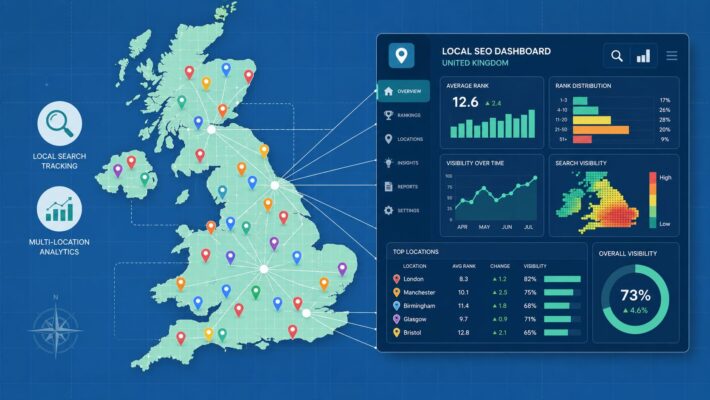
This is exactly why modern SEO tools are no longer a luxury. A geo-grid rank tracker, for example, splits your service area into a grid and checks your ranking from dozens of different points. It creates a simple, colour-coded map that instantly shows you where you’re strong and, more importantly, where you’re weak.
For a healthcare provider or a law firm, this means you can see precisely which London postcodes or Manchester suburbs you’re failing to connect with. Seeing the problem is the first step to fixing it with a smarter, more targeted strategy. If you want to manage this effectively, you’ll need solid methods for tracking local keyword rankings by proximity.
The Critical Importance of NAP Consistency
To make the most of your location, you have to get your address details perfect across the web. We call this NAP (Name, Address, Phone number) consistency. Google is a machine, and it craves certainty. If it finds different versions of your business details scattered online, its confidence in you plummets—and your rankings go down with it.
Your NAP has to be identical everywhere you’re listed, right down to the smallest detail.
- Is it “Street” or “St.”?
- Is it “Suite 4” or “#4”?
- Is your phone number written with spaces or without?
These tiny differences might seem trivial, but they can genuinely confuse Google’s algorithm. The aim is to build a consistent, unified digital footprint that leaves no doubt about who you are and where you are. Get this right, and you make it easy for Google to trust you and show you to people searching nearby.
How To Build Unbeatable Local Prominence
If relevance and distance get your business on the shortlist, prominence is what lands you the top spot. Think of prominence as your business’s reputation in the digital world—it’s all the signals that prove your authority and credibility to Google. It’s the online equivalent of strong word-of-mouth.
A business that is active, trusted, and frequently engaged with will almost always outperform a quiet competitor. This section is all about the practical steps you can take to build that kind of unbeatable local presence, turning your Google Business Profile from a static listing into a magnet for new customers.

To really build prominence, you need to focus on what proves to Google that your business is a trusted, popular, and legitimate choice in your local area. These signals go beyond basic information and show how real people interact with your business.
Let’s break down the most impactful factors.
Key Prominence Factors and Their Impact
| Prominence Factor | Why It Matters | Practical Optimisation Tip |
|---|---|---|
| Reviews (Quantity, Quality, Velocity) | This is direct social proof. A steady flow of high-quality reviews shows Google your business is consistently chosen and trusted by real customers. | Implement a system to consistently ask every customer for a review. Aim for a continuous stream of new, positive feedback rather than sporadic bursts. |
| Review Responses | Responding to all reviews shows you're engaged and value customer feedback. It builds trust with potential customers reading your reviews. | Use a tool or set a daily/weekly schedule to reply to every new review. Create templates for common positive and negative feedback to stay efficient. |
| On-site SEO & Brand Mentions | Signals from your own website and other authoritative sites reinforce your expertise and location, telling Google you're a significant local entity. | Ensure your website's location pages are optimised for local search. Pursue features in local blogs or industry websites to build brand mentions (citations). |
| User Engagement Signals | Clicks for calls, directions, and website visits are direct evidence that your profile is useful and driving real-world actions for customers. | Keep your profile information, especially your phone number and address, 100% accurate. Use compelling photos and Posts to encourage clicks and exploration. |
| Profile Freshness (Posts, Photos) | An active profile with regular updates signals that your business is open, active, and relevant right now. A neglected profile looks outdated. | Publish a Google Business Post at least once a week. Add new, high-quality photos of your team, products, or premises every month. |
By consistently working on these areas, you’re not just ticking boxes; you’re building a comprehensive and powerful case to Google that your business deserves to be at the top of local search results.
1. Master Your Customer Reviews
Your review profile is the very heart of prominence. Customer reviews are one of the most powerful Google Business Profile ranking factors because they provide raw, unfiltered social proof about your business. Google sees them as a transparent measure of quality and reliability, and it weighs them very heavily.
A powerful review profile really comes down to three things:
- Quantity: A high number of reviews shows you serve a lot of customers.
- Velocity: The speed at which you get new reviews proves your business is popular right now. A flurry of reviews from two years ago is nowhere near as valuable as a steady flow coming in every week.
- Quality (Star Rating): This is the most obvious one. Your overall star rating is a direct snapshot of customer satisfaction. A profile with a 4.8-star rating from 250 reviews is in a different league to one with a 3.5-star rating from 30 reviews.
A steady stream of positive 4- and 5-star reviews is a signal Google simply cannot ignore. It tells the algorithm that real people in your local area consistently choose and endorse your business.
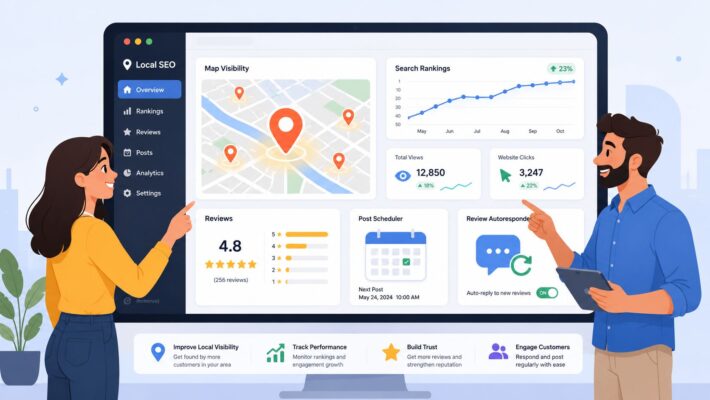
Don’t forget about responding. Replying to reviews—both the good and the bad—is a crucial part of the process. It shows potential customers you’re listening and that you care. For businesses with dozens or hundreds of locations, this can feel like an impossible task, which is where automation can be a lifesaver. LocalHQ’s Review Autoresponder, for example, is built to manage this at scale, ensuring every customer receives a timely and on-brand response.
To build an impressive review profile, you have to ask. If you’re looking for some tried-and-tested methods, our dedicated guide explains how to get more Google reviews.
2. Drive Real Engagement Signals
Beyond reviews, Google pays close attention to how people actually interact with your profile. These engagement signals are undeniable proof that your listing is genuinely useful. The more people who interact, the more prominent Google assumes your business is.
Some of the most important engagement signals are:
- Clicks-to-Call: When someone taps the “Call” button, it’s a very strong signal of immediate interest.
- Direction Requests: This is a fantastic indicator that a user is planning a trip to your physical location in the very near future.
- Photo Views: A high number of photo views suggests people are actively doing their research on you, trying to get a feel for your atmosphere, products, or quality of work.
- Website Clicks: Clicks through to your website show that a user’s interest has been piqued and they want more detailed information.
Each one of these actions is like a small vote of confidence in your business. When they add up, they paint a clear picture of a business that isn’t just visible, but truly valuable to the local community.
3. Keep Your Profile Active and Fresh
A profile that just sits there, gathering digital dust, signals to Google that the business might be outdated, or worse, closed. To build prominence, you have to show that you’re active and open for business now. This is where features like GBP Posts and the Q&A section become incredibly useful tools.
Consistent GBP Posts: Think of GBP Posts as free mini-adverts that appear right on your profile. Publishing weekly posts about offers, events, new products, or even just a bit of company news tells Google your business is alive and kicking. These posts also give you fresh chances to use relevant local keywords, which helps reinforce your relevance.
A Helpful Q&A Section: The Questions & Answers section is a hidden gem for building authority. Many businesses ignore it. By proactively adding your most common customer questions and providing clear, helpful answers, you not only help potential customers but also demonstrate your expertise directly to Google.
High-Quality, Geo-Tagged Photos: Your photos are your digital shop window. Regularly uploading authentic, high-quality images of your location, your team, and your work in action proves you are a real, active business. For an extra boost, geo-tagging your photos with location data before you upload them adds another powerful layer of proof, strengthening your connection to a specific area.
Your Prioritised GBP Optimisation Action Plan
Knowing the theory behind Google’s ranking factors is great, but it’s turning that knowledge into a concrete plan that actually gets you results. So, let’s take everything we’ve learned and build a straightforward, step-by-step action plan to get your Google Business Profile into top shape.
We’ll work through this logically, starting with the absolute must-haves, then moving on to the high-impact tweaks that give you the most bang for your buck. Finally, we’ll cover the ongoing work that keeps you ranking high for the long haul.
Phase 1: The Essentials
First things first. These are the non-negotiables. If you don’t have these fundamentals locked down, any other optimisation work you do will be built on shaky ground.
-
Claim and Verify Your Profile: If you haven’t done this already, stop everything and do it now. This is the only way to get control of your business listing and prove to Google that you’re a legitimate operation.
-
Perfect Your Primary Category: We’ve seen how important this is—it’s the single biggest needle-mover. You have to pick the one category that best describes the core of what you do. For instance, if you’re a roofer who also does guttering, your primary category must be ‘Roofer’, not the more generic ‘General Contractor’.
-
Ensure 100% NAP Accuracy: Your Name, Address, and Phone Number (NAP) needs to be spot-on everywhere it appears online. It must be identical to what’s on your website and other directories. Even a tiny difference, like ‘St’ versus ‘Street’, can confuse Google and chip away at your local authority.
Phase 2: High-Impact Optimisations
With the foundations solid, it’s time to add some rocket fuel. These are the tasks that directly beef up the relevance and prominence signals Google loves to see, giving you the biggest boost in the rankings.
Think of it like this: the essentials get you on the launchpad, but these next steps provide the thrust to actually overtake your competitors.
-
Get a System for Generating Reviews: Don’t just sit back and hope for reviews. You need a process for asking every happy customer for their feedback. A steady stream of new, positive reviews sends one of the clearest signals to Google that your business is trusted and thriving.
-
Build a Gallery of Geo-tagged Photos: Your photos are your digital shop window. Get at least 10-15 high-quality, real-world images uploaded. Show off your premises, your team at work, your products, and finished projects. Before you upload, use a simple online tool to geo-tag each photo with your business coordinates to reinforce your location.
-
Fill Out Every Single Field: Go through your GBP dashboard with a fine-tooth comb and complete everything. Add all your services with detailed descriptions, tick every relevant attribute (like ‘Wheelchair-accessible entrance’ or ‘Free Wi-Fi’), and set up the messaging feature. A 100% complete profile shows Google you’re serious and thorough.
Phase 3: Ongoing Engagement and Maintenance
A Google Business Profile isn’t a ‘set it and forget it’ asset. To hold on to your rankings and keep building authority, you need to show Google your business is active. These ongoing jobs are vital for long-term success.
-
Create Weekly GBP Posts: Aim to publish at least one Google Business Post every week. You can use them to highlight special offers, showcase a service, or share a bit of company news. It keeps your profile looking fresh and gives you more chances to target relevant keywords. To help you come up with ideas and write these quickly, a GMB post generator can be a real time-saver.
-
Take Control of Your Q&A Section: Don’t wait for customers to start asking questions. Get in there first and populate this section yourself by asking and answering your most common queries. This turns it into a handy FAQ, shows off your expertise, and lets you frame the conversation.
-
Reply to All Reviews—Quickly: Make it your mission to respond to every single review, good or bad, within 24-48 hours. It proves to potential customers that you are engaged and genuinely care about feedback.
Following this plan gives you a methodical way to tackle the most important ranking factors. For an even more granular to-do list, our comprehensive local SEO checklist can guide your every move. This structured approach is the surest way to build a profile that doesn’t just rank well but also turns searchers into loyal customers.
How To Measure Your Ranking Success
All that optimisation work is for nothing if you can’t see the results. Simply put, you need to know if your efforts are actually paying off. This is where you connect the dots between your actions and real business growth.
Google’s own Business Profile Insights gives you a mountain of data, showing you how people find your listing. It’s incredibly useful, but it can also feel like you’re staring at a giant, confusing spreadsheet. This is why specialist platforms exist—they cut through the noise and show you what really matters.
Key Metrics To Track
So, what should you be looking at? It all comes down to a few key numbers that tell a clear story about your visibility and customer engagement.
- ‘Discovery’ vs ‘Direct’ Searches: This is a big one. ‘Direct’ searches are people who already know you and searched for your business by name. That’s great, but ‘Discovery’ searches are the real prize. These are potential new customers who found you by searching for a product or service, like “plumber near me.” A steady rise in Discovery searches is a sure sign your SEO work is hitting the mark.
- Customer Actions: Are more people clicking the ‘Call’ button, asking for directions, or visiting your website from your profile? These aren’t just vanity metrics; they represent genuine leads and potential footfall. An increase here is solid proof that better rankings are leading to more business.
A geo-grid rank tracker takes this a step further, showing you exactly where you’re visible on the map, street by street.
See the grid? It’s a simple, colour-coded map of your local search performance. The green dots show where you’re ranking well, while the red and orange areas instantly flag the postcodes where you’re practically invisible. This kind of detailed view goes way beyond basic analytics, allowing you to see exactly which neighbourhoods need more of your attention.
To get a feel for how this works in practice, it’s worth exploring a dedicated local rank tracking tool.
Frequently Asked Questions About GBP Ranking
Let’s tackle some of the burning questions business owners always ask about ranking on Google. We’ll give you straight-talking answers based on everything we’ve covered, so you know exactly what to do next.
How Long Does It Take To See Ranking Improvements After Optimising My GBP?
You’ll often spot some early movement for less competitive search terms within a few weeks, especially after knocking out the foundational stuff like choosing the right primary category and filling out your profile completely.
But for the big, lasting gains, you need to be patient. Consistently earning reviews and publishing weekly GBP Posts will start to pay off in a more meaningful way within 2 to 3 months. Think of it as building a reputation—it doesn’t happen overnight.
Can I Rank In A City Where I Don’t Have A Physical Address?
This is a tough one. Trying to rank in a city where you don’t have a verified, physical address is incredibly difficult. Proximity to the searcher is the bedrock of Google’s local algorithm, so your ranking power will always be strongest right around your business address.
Your best bet is to completely dominate the area around your physical location first. Focus all your energy on building undeniable relevance and prominence there before you even think about expanding your digital reach.
Do Negative Reviews Really Hurt My Google Ranking?
A single bad review isn’t going to sink your ship. However, a pattern of poor feedback or a consistently low star rating sends a huge red flag to Google. It’s a direct hit to your prominence score, telling the algorithm that your customers aren’t happy.
Just as important is what you do next. Ignoring negative reviews makes you look disengaged, which can be just as damaging. Always respond professionally and show that you’re trying to resolve the problem.
How Often Should I Update My Google Business Profile?
Your GBP isn’t a ‘set it and forget it’ profile. You need to show Google you’re active and open for business through regular updates.
Here’s a simple routine to follow:
- Weekly: Publish at least one new GBP Post.
- Daily/Weekly: Make it a habit to respond to every new review and question.
- Monthly: Upload fresh, high-quality, and geo-tagged photos of your business.
Ready to stop guessing and start ranking? LocalHQ’s AI Optimisation Wizard analyses your profile against your competitors’ to give you a clear, data-backed action plan. See exactly where you stand and what you need to do next with our powerful Local SEO platform.