Multi-Unit Franchise SEO: Scaling Strategy for Area Developers
Juggling SEO for a franchise with multiple locations is a unique beast. You're trying to build a consistent, powerful brand across the country, but you also need to win on the ground, street by street, in each local community. It’s all about striking that perfect balance between centralised brand control and localised marketing savvy.
Get it right, and you can dominate regional search results and drive real footfall to every single one of your units. Get it wrong, and you'll have an inconsistent mess that pleases no one.
The Foundation of Multi-Unit Franchise SEO
For UK area developers and multi-unit operators, especially in competitive sectors like retail, hospitality, or home services, a scattergun approach to SEO just won't cut it. A cohesive strategy isn't a luxury—it's the bedrock of your brand's digital presence and local market success.
The most effective strategies are built on a hybrid model. This is where the central brand team provides the horsepower, and the local franchisees provide the on-the-ground intelligence. It’s a partnership that empowers head office to protect the core brand while giving franchisees the tools to connect authentically with their local customers.
Central Control Meets Local Expertise
Think of it this way: as the franchisor, you build the chassis and the powerful engine of the car. That’s your brand, your core messaging, and your main website. The franchisee, however, is the local driver who knows every shortcut, avoids the traffic jams, and knows exactly where the best parking is. They understand the local neighbourhood in a way a central team never could.
The smartest franchise networks have moved past the old top-down, one-size-fits-all model. They know it simply doesn't resonate at the local level.
This is where having the right platform becomes critical. A tool like LocalHQ, for instance, allows a central marketing team to set and lock down core brand information—think business names, primary categories, and service menus—across every Google Business Profile. This ensures consistency. At the same time, it can grant franchisees permission to manage the things they know best: responding to local reviews, posting about community events, and uploading photos of their team and their specific location.
In the UK, mastering Google Maps and local search is no longer optional. With 76% of local mobile searches leading to a store visit within 24 hours, the opportunity is massive. In fact, a recent report from the British Franchise Association (BFA) highlighted that franchises properly optimising their Google Business Profiles saw a 35% jump in direction requests and calls. That's a direct line to increased footfall.
Key Takeaway: A winning multi-unit SEO strategy isn't a battle between central control and local freedom. It’s about building a system where both work in concert, creating a brand that’s nationally consistent yet deeply, authentically local.
To really get a handle on this, you need a solid framework. You can see how complex managing this can be by exploring guides on Local SEO for Multiple Locations.
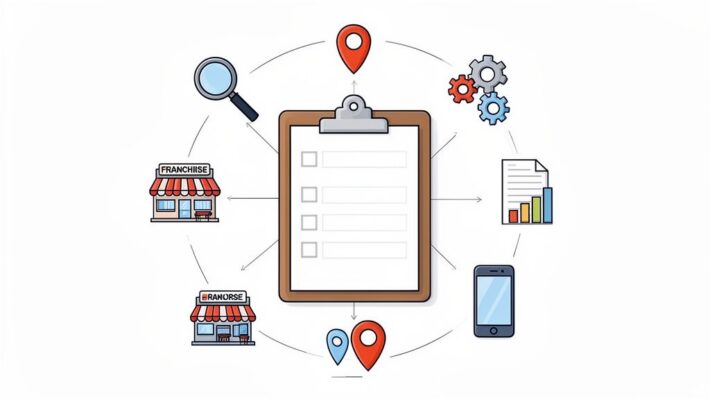
The table below breaks down the core pillars of a scalable framework for any multi-unit business. These are the non-negotiables for building a strategy that drives growth across your entire network.
Core Pillars of a Multi-Unit SEO Strategy
| Pillar | Description | Key Objective |
|---|---|---|
| Governance & Operations | Defining roles and permissions for central (franchisor) and local (franchisee) teams to ensure brand consistency and local agility. | Establish clear rules of engagement to prevent brand dilution while empowering local teams to act quickly. |
| GBP Scaling & Optimisation | Systematically creating, verifying, and optimising Google Business Profiles (GBPs) for every location with brand-aligned, yet locally relevant, information. | Achieve maximum visibility in Google Maps and the Local Pack for branded and non-branded local searches. |
| Location Pages & Content | Developing unique, optimised landing pages for each location on the main brand website, featuring local content, contact details, and opening hours. | Provide search engines and users with a definitive, crawlable source of truth for each specific location. |
| Citations & Schema | Ensuring consistent Name, Address, and Phone number (NAP) information across relevant online directories and implementing local business schema on location pages. | Build trust and authority with search engines, reinforcing the physical location and legitimacy of each unit. |
| Review Management | Implementing a scalable process for monitoring, responding to, and generating customer reviews for all locations. | Enhance local reputation, build social proof, and improve local search rankings through customer feedback. |
| Measurement & Reporting | Tracking key performance indicators (KPIs) like local rankings, traffic to location pages, calls, and direction requests at both the individual and aggregate level. | Prove the ROI of local SEO efforts and identify underperforming locations or new opportunities for growth. |
By focusing on these pillars, you create a robust and repeatable process. For a more detailed look at how to put this into practice, take a look at our complete guide on local SEO for multiple locations.
Defining Roles and Establishing Governance
Before you touch a single keyword or location page, we need to sort out who does what. This is the absolute first step in any multi-unit SEO strategy, and getting it wrong can lead to chaos. I’ve seen it happen: a rigid, top-down approach that makes every location feel sterile and corporate, or a free-for-all where franchisees go rogue, diluting the brand you’ve worked so hard to build.
The sweet spot is a hybrid model. It’s not about central control versus local freedom; it’s about clearly defining which team owns which part of the SEO puzzle. This way, everyone knows their role, you stop people from stepping on each other’s toes, and you get the best of both worlds.
The urgency here is real. Fresh insights from 2026 show that a massive 85% of UK franchise marketers believe local SEO is crucial for engaging customers. But here’s the catch: only 38% feel they have the right tools to actually do it effectively at scale. That gap is costing the sector an estimated £450 million in lost local traffic. When you consider that for many multi-location brands, 69% of their digital traffic comes from local organic search, that’s a number you can’t afford to ignore. You can dig into more of this data in the 2025 Annual Franchise Marketing Report.
Central vs. Local Responsibilities
In a well-oiled hybrid model, your central marketing team or franchisor acts as the brand’s guardian. They control the foundational elements that have to stay consistent everywhere, no exceptions.
Central Team Responsibilities (The Brand Guardians):
- Business Name: Ensuring the official brand name is used perfectly every time.
- Primary Category: Locking in the main Google Business Profile category (e.g., ‘Fast Food Restaurant’ or ‘Estate Agent’).
- Core Services & Products: Defining and standardising the primary offerings.
- Website & Location Pages: Managing the main corporate website and the core template for all location pages.
- Brand Voice Guidelines: Setting the tone for everything from web copy to review responses.
Meanwhile, your franchisees are the champions on the ground. They know the local neighbourhood, the regulars by name, and what makes their community tick. Give them the right tools and boundaries, and they’ll create authentic local content that a central team never could.
Franchisee Responsibilities (The Local Champions):
- Local Photos & Videos: Sharing real, high-quality images of their storefront, their team in action, and local events.
- Review Responses: Replying to reviews with a personal touch (while staying within the brand guidelines).
- Google Business Profile Posts: Creating posts about local promotions, community partnerships, or team news.
- Local Q&A Management: Answering location-specific questions that pop up in the Google Business Profile Q&A section.
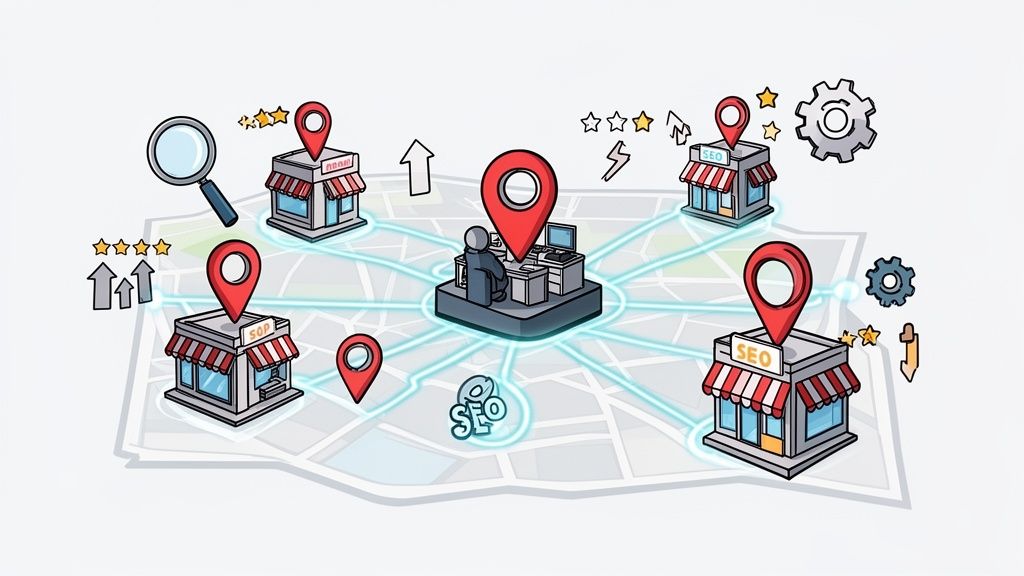
Getting this division of labour right is what makes a multi-location SEO programme truly scalable. Think of it like this: a central ‘SEO HQ’ sets the strategy and provides the tools, coordinating governance, Google Business Profile (GBP) management, and content from a high level.
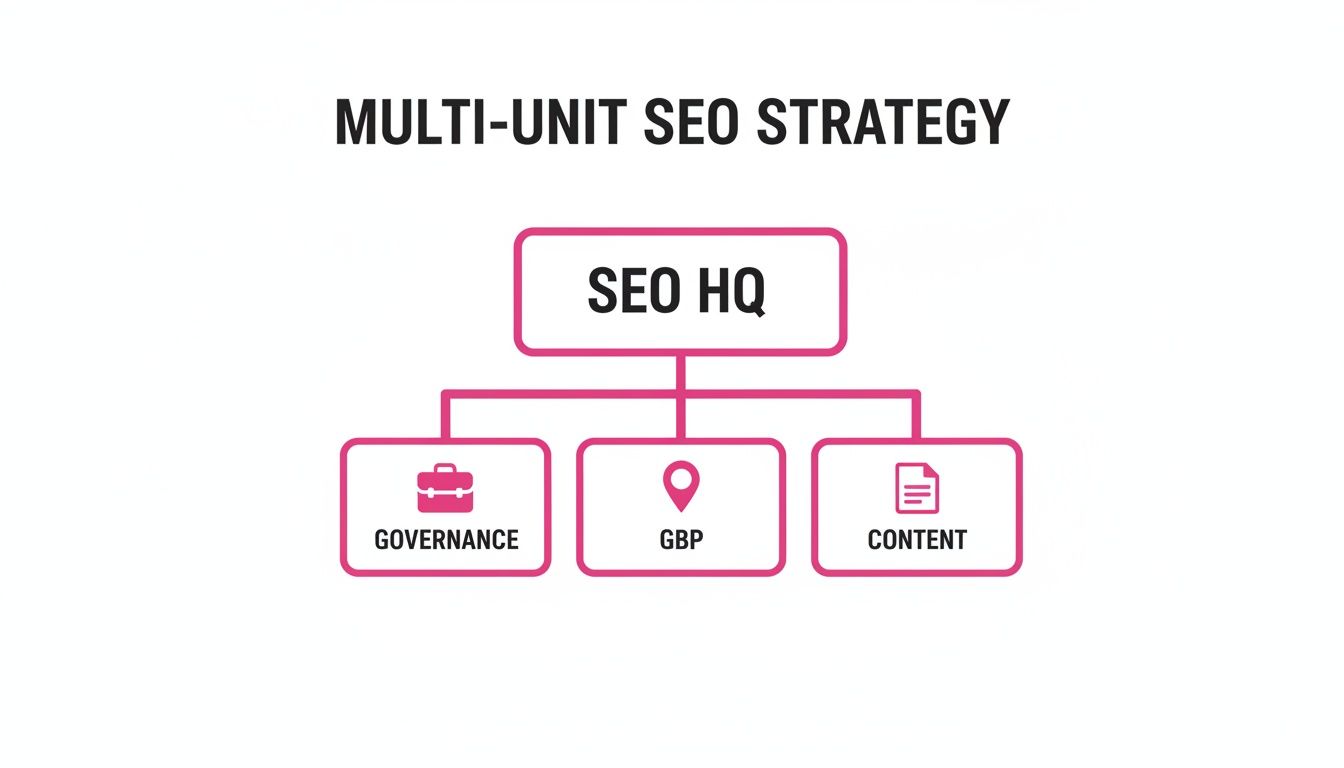
This structure ensures you have central oversight guiding local execution. It stops the brand from splintering while still encouraging that all-important local flavour.
Creating Your Franchisee SEO Playbook
To make this governance model a reality, you need a Franchisee SEO Playbook. This isn’t just another corporate document destined to gather dust; it’s a practical, single source of truth that lays out the rules of engagement for every franchisee. The goal isn’t to restrict them—it’s to empower them by providing absolute clarity.
Your playbook should be a hands-on guide covering the essentials:
- Login & Access: Simple, step-by-step instructions for getting into your central platform, like LocalHQ, where they’ll handle their local tasks.
- Do’s and Don’ts: Clear, visual examples of what makes a great local post versus one that’s off-brand.
- Brand Voice Quick Guide: Key phrases and the right tone to use when handling both glowing and critical reviews.
- Photo & Video Guidelines: Simple specs for image quality, content, and style to keep everything looking professional.
Key Takeaway: A clear governance model, backed by a practical playbook and the right tech, is the foundation for scaling your franchise SEO. It’s what turns your franchisees from a potential brand risk into your most powerful local marketing engine.
Scaling Your Google Business Profile Optimisation
Let’s be honest, trying to manage dozens—or even hundreds—of Google Business Profiles (GBPs) can feel like a logistical nightmare. But getting this right is your single biggest opportunity to dominate local search results. The secret isn’t just about hard work; it’s about building smart, scalable workflows that turn that chaos into a real strategic advantage.
Your first job, before anything else, is to get your NAP data (Name, Address, Phone number) completely consistent. Even a small discrepancy across your profiles sends confusing signals to Google and can make customers question your credibility. Centralised management platforms are a non-negotiable here, giving you a single source of truth for every single location. For any multi-unit franchise, scaling successfully means mastering how to efficiently optimise Google Business Profile across the board.
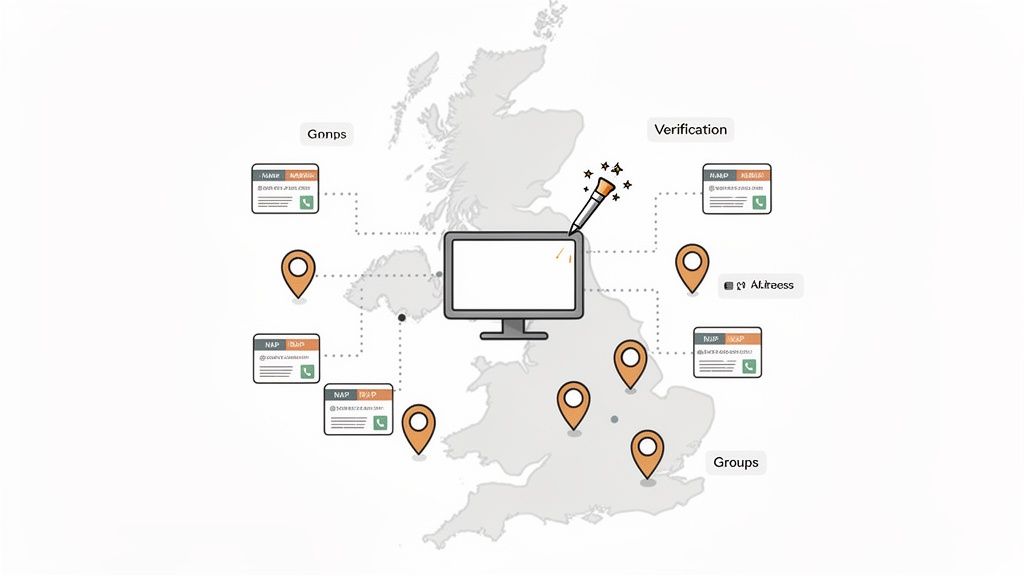
The good news is, Google offers a shortcut for established brands. Instead of verifying each profile one by one—a painfully slow process—a franchisor with more than 10 locations can apply for bulk verification. This is a game-changer. It authorises you to manage all current and future locations under your brand, which massively cuts down the time it takes to get new units visible in search.
Streamlining Management with Profile Groups
Once your profiles are verified, you need a smart way to organise them. Manually clicking through a list of 100+ locations simply won’t work long-term. This is where Google Business Profile groups become your best friend.
By creating groups, you can segment your locations in ways that make sense for your business. This is especially handy for area developers managing specific regions.
- Regional Grouping: Think “North West,” “London & South East,” or “Scotland.” This lets you apply updates or check performance by territory.
- Tier-Based Grouping: You could create groups like ‘Tier 1 High-Performing’ or ‘Tier 2 Growth Opportunity’ to focus your optimisation efforts where they’ll have the biggest impact.
- Service-Line Grouping: If your franchises have different service offerings, you might group them by what they provide to run more targeted local campaigns.
This structured approach makes managing a sprawling network so much more practical. It also allows you to delegate oversight to regional managers without giving up central control. If you’re responsible for a large number of listings, finding ways to simplify is critical. We dive deeper into this in our guide to managing multiple Google Business listings.
Using Automation for Smarter Optimisation
With your foundation of consistency and organisation sorted, you can turn your attention to optimisation at scale. This is where modern AI-driven tools have become indispensable for any serious multi-unit franchise. It’s impossible to manually analyse every profile for completeness or see how you stack up against local competitors.
Platforms like LocalHQ include an Optimisation Wizard that does the heavy lifting for you. The tool can scan all your profiles at once, comparing them against the top local competitors to pinpoint gaps and opportunities. It might recommend things like:
- Adding Secondary Categories: Suggesting relevant categories your competitors are using to rank, like ‘Breakfast Restaurant’ or ‘Outdoor Seating’.
- Selecting Key Attributes: Spotting missing attributes customers are searching for, such as ‘Wheelchair-accessible entrance’ or ‘Free Wi-Fi’.
- Optimising Business Descriptions: Checking that your descriptions are complete and packed with important local keywords.
This kind of automated intelligence allows a central marketing manager to identify and roll out high-impact optimisations across the entire network in minutes, not weeks.
Key Insight: Automation doesn’t replace strategy; it enables it. By using AI to handle the time-consuming analysis, your team can focus on making the high-level decisions that actually drive growth across all your locations.
Scaling Local Content with Templates
Finally, you need to keep your profiles active with fresh content. Things like GBP Posts, Events, and Q&A updates are crucial for both customer engagement and Google’s ranking signals. The best way to do this at scale is by creating branded templates.
Your central marketing team can design visually consistent templates for promotions, new product launches, or seasonal campaigns. These templates are then shared with franchisees, who just need to add the local details—a specific date, a photo from their store, or a mention of a community event. This approach maintains brand consistency while empowering franchisees to add the authentic, local flavour that really connects with their customers. It turns a complex content job into a simple, repeatable process for your whole network.
Crafting Location Pages That Actually Get Found
Think of your Google Business Profiles as the friendly handshake in local search. They get you noticed. But it’s your website’s location pages that seal the deal, turning a casual browser into a customer walking through your door. These pages are the other, absolutely crucial, half of the multi-unit SEO equation. A thin, duplicated page is a dead end for your customer journey, whereas a well-crafted one is a conversion powerhouse.
The real challenge for area developers and franchise brands isn’t just making one great page; it’s scaling that quality across tens or even hundreds of locations without it becoming an administrative nightmare. The solution I’ve seen work time and again is to create a master template packed with all the on-page SEO essentials. This becomes your blueprint, ready to be rolled out and localised for every single unit in your network.
Building Your Perfect Location Page Template
A top-performing location page isn’t just a jumble of details. It’s a purposeful experience, built with both your human visitors and search engine crawlers in mind. Your template needs to be the undisputed source of truth for each branch.
Here are the non-negotiables I always build into a location page template:
- Unique Titles & Descriptions: Every page needs its own unique title tag and meta description. A simple formula works well: “[Brand Name] [Service] | [Neighbourhood/Town]”. For example, “Greggs Bakery | Your Local Shop in Manchester Piccadilly”.
- Rock-Solid NAP Data: The Name, Address, and Phone number must be front and centre. Critically, it has to match the corresponding Google Business Profile down to the last comma.
- Authentic Local Content: This is where you pull away from the pack. You need a paragraph or two that is genuinely about that location. Talk about the local team, mention nearby landmarks, or share a story about community involvement.
- Embedded Google Map: An interactive map is a must. It not only helps users find you but also visually confirms the location for Google.
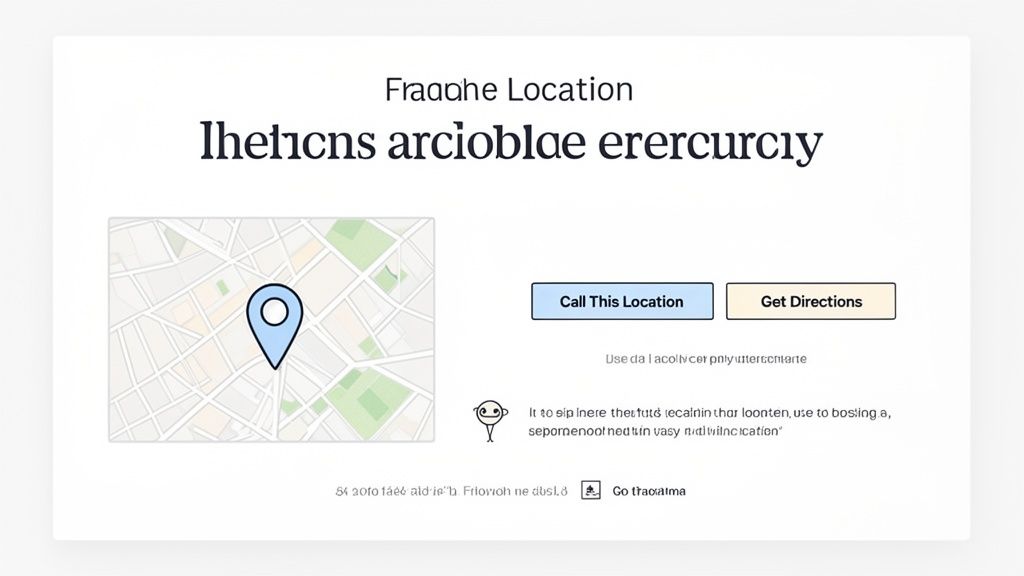
- Unmissable Calls-to-Action (CTAs): Big, bold buttons like ‘Call This Location’ or ‘Get Directions’ are vital, especially for your mobile users. Don’t make people hunt for them.
By standardising these core elements, you guarantee a baseline of quality and consistency across your entire digital footprint. For a deeper dive into website optimisation, check out our complete guide to local business search engine optimisation.
The Game-Changer: Hyper-Local Content
Once that template is locked in, the real magic begins. Adding hyper-local content is what separates a franchise that just exists online from one that dominates its local search results. While your central team can build the template, your franchisees are your secret weapon for sourcing this authentic local flavour.
Let’s imagine a UK home cleaning franchise. A generic page for “home cleaning in London” is practically useless—it’s far too broad. A page for the Wimbledon branch, however, could be a goldmine. It might feature:
- A quick case study on an end-of-tenancy clean they did for a flat in Southfields.
- A blog post titled “Getting Your Home Guest-Ready for the Wimbledon Tennis Championships”.
- Photos of the local cleaning team volunteering at a community fair in Wimbledon Park.
This kind of content achieves two things brilliantly. First, it builds immediate trust and authority with potential customers right there in that community. Second, it starts ranking you for valuable long-tail keywords like “deep clean flat near Wimbledon station”—the exact phrases your competitors are probably overlooking.
My Key Takeaway: Stop treating location pages like directory listings. Start treating each one as a micro-website for its community. When you combine a strong central template with franchisee-led local stories, you create pages that both Google and your future customers will absolutely love.
Putting Local Business Schema to Work
To give search engines an even clearer, more direct understanding of your locations, you have to use LocalBusiness schema markup. This is simply a snippet of code added to your page’s HTML. It uses a standardised vocabulary to explicitly tell Google who you are, where you are, and what you do.
This structured data is what allows Google to pull information like your opening hours, star ratings, and address directly into the search results page, creating what’s known as a “rich result”.
Correctly implementing this code makes your business eligible for a much more prominent display in search, which can significantly boost your visibility and click-through rates. For any multi-unit franchise, creating a schema template that can be applied across all location pages is one of the most efficient ways to elevate the SEO performance of the entire network at scale.
Managing Your Reputation Across the Network
In the world of franchising, your brand’s reputation isn’t just a vague concept—it’s built one customer interaction, one online review at a time. For anyone managing multiple locations, trying to keep track of online sentiment across the entire network can feel like an impossible task.
But here’s the reality: with 95% of consumers admitting they check online reviews before making a decision, a solid reputation management plan isn’t just about damage control. It’s one of the most powerful levers you have for boosting your multi-unit franchise SEO and building genuine customer trust.
The real challenge lies in striking a tricky balance. You need to maintain a consistent brand voice, yet every response must feel timely, personal, and empathetic. Let’s be honest, a generic, copy-pasted reply is almost as bad as no reply at all. This is where leaning on the right technology becomes a game-changer for any multi-unit operator.
Blending Brand Voice with a Local Touch
The most effective strategies I’ve seen all use a hybrid approach. It’s a smart combination of central brand oversight and authentic local knowledge. Essentially, the franchisor sets the tone and provides the playbook, but it’s the local manager who adds the context that makes a reply feel truly human.
This is exactly where tools like LocalHQ’s AI Review Autoresponder really shine. Here’s a breakdown of how it works in practice:
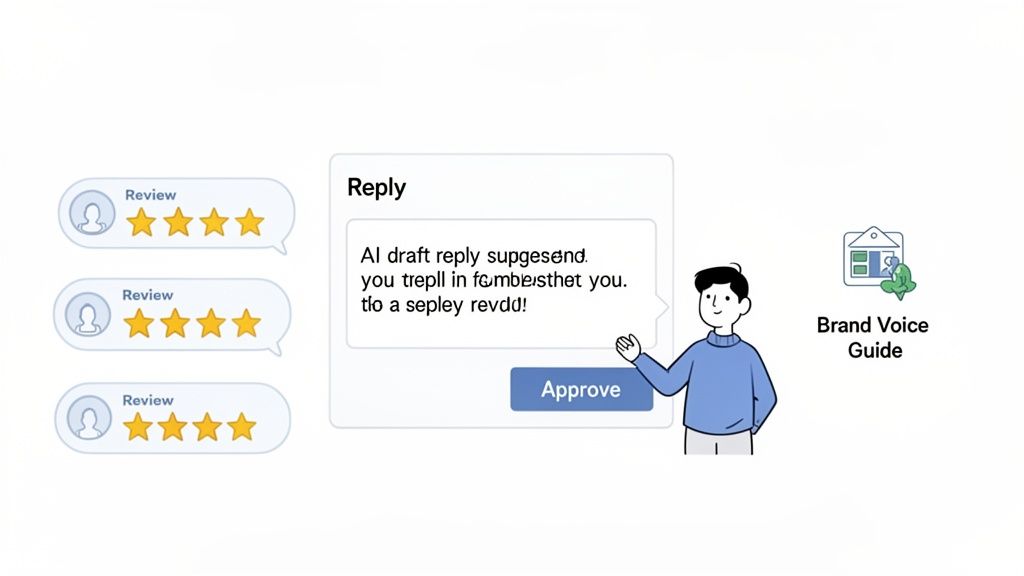
- You Set the Rules: The central marketing team trains the AI on your brand’s specific voice. This includes key messages, how you talk to customers, and the right way to structure replies for both glowing and critical feedback.
- It Does the Heavy Lifting: As soon as a review is posted for any location, the AI instantly drafts a unique, on-brand reply. Crucially, it pulls in specific details from the customer’s comment so it doesn’t sound robotic.
- Your Team Gets the Final Say: The draft is then sent directly to the local franchisee or manager. They can approve it with a single click or, even better, add a quick personal note like, “It was great to see you again, Sarah!” before it goes live.
This system ensures every single review gets a prompt, brand-compliant response without heaping more work onto your local teams. It turns what is often a reactive chore into a proactive system for building customer relationships at scale. You can monitor your online reputation and manage this entire workflow from one central dashboard.
Turning Feedback into Your Growth Engine
A proactive review strategy isn’t just about playing defence—it’s about going on the offence. The aim is to create a steady stream of positive feedback that strengthens your local SEO and provides undeniable social proof for potential new customers.
Encourage your franchisees to get comfortable asking for reviews, especially when they know a customer has had a fantastic experience. This can be as simple as a QR code on a receipt or a friendly follow-up email after a transaction.
A smart, scalable review system does more than just protect your brand. It directly fuels your local SEO, builds unbreakable customer trust, and turns everyday feedback into a powerful marketing asset for every single location in your network.
Of course, how you handle negative feedback is just as important. A thoughtful, public response shows everyone that you listen and take concerns seriously. The best practice is always to thank the reviewer, acknowledge their specific experience, and offer a clear way to resolve the issue offline.
Ultimately, investing in your reputation is a non-negotiable part of a strong multi-unit franchise SEO programme. The 2026 UK Franchise Survey found a direct link between online presence and real-world results, noting that optimised multi-location SEO drove 55% more direction requests for hospitality franchises.
This is especially critical when you consider that while digital ads are projected to take up 42% of UK franchise marketing budgets in 2026, SEO and reputation management consistently deliver a far better long-term return. In fact, 68% of brands are now turning to review platforms to tackle these very challenges, as highlighted in this insightful 2025 report on franchising trends.
Measuring SEO Performance and Proving ROI
Let’s be honest, an SEO strategy is just a theory until you can prove it’s making the phone ring and putting customers through the door. To keep the budget flowing and show stakeholders the real-world value you’re creating, you have to look beyond surface-level metrics like keyword rankings.
Proving the return on your SEO investment is all about connecting the dots. You need to draw a clear line from your optimisation efforts to the actual customer actions that drive revenue for each and every one of your locations.
Tracking the Metrics That Actually Matter
For any multi-unit business, the most powerful Key Performance Indicators (KPIs) are the ones that lead directly to a sale. While seeing a big jump in impressions is nice, your reports should really hammer home the tangible customer engagements happening across the network.
For each franchise location, you should be laser-focused on tracking:
- Phone Calls: Direct calls coming from Google Business Profiles are a goldmine. This is often a customer with high purchase intent, ready to book or buy.
- Direction Requests: This is one of the strongest signals you can get. Someone asking for directions is very likely on their way to a location.
- Website Clicks: This tracks the traffic heading from a Google Business Profile to your specific location pages, where a customer can get more details, see your menu, or make a booking.
- Conversions: These are the specific, valuable actions taken on those location pages, like filling out a contact form, placing an online order, or scheduling an appointment.
By tracking these metrics for individual locations and rolling them up into an aggregate view, you get a powerful picture of what’s working. You can instantly spot your top-performing franchisees and identify which ones might need a bit more support.
Seeing Your True Visibility with Geo-Grid Tracking
Relying on a standard rank tracker can give you a false sense of security. A customer’s search for “pizza near me” will show different results depending on which postcode they’re searching from. Your ranking can change dramatically from one street to the next.
This is where a geo-grid rank tracker becomes an indispensable tool, especially for area developers. Instead of giving you a single, misleading ranking, a geo-grid maps out your search performance across a specific geographical area. It overlays a grid on a map and checks your ranking from the centre of each square.
This gives you an immediate, visual snapshot of your search footprint. You can see exactly where your brand dominates and, crucially, where competitors are winning. This insight allows you to stop guessing and start deploying hyper-local tactics exactly where they’re needed most.
Telling the Story with Automated Reporting
The final piece of the puzzle is pulling all this data together. You need to create reports that are clear, concise, and prove the value of your work without burying your stakeholders in a mountain of spreadsheets. Manually pulling data from hundreds of Google Business Profiles is simply not a scalable solution.
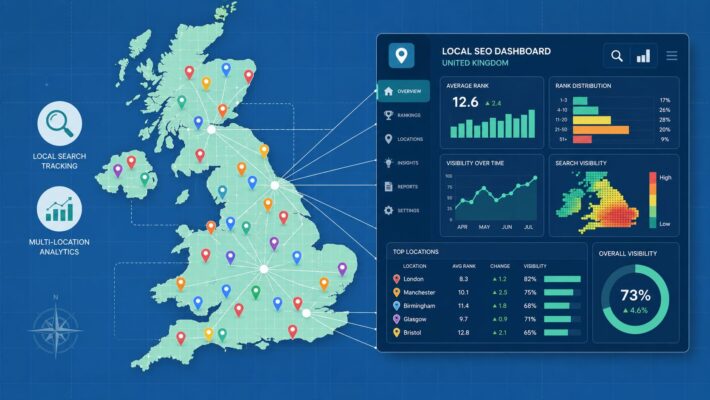
Using a platform that automates this process is a game-changer. A good system will pull data directly from Google Business Profile Insights and your website analytics, consolidating it all into a single dashboard. This allows you to generate reports that show performance trends over time, whether for the entire network, specific regions, or even individual franchisees.
By presenting this clear, data-driven story, you can confidently prove the ROI of your franchise SEO strategy. If you’re looking to streamline this, exploring options for generating automated SEO reports for customers can free up a huge amount of time, letting you focus on strategy instead of admin.
Common Questions from Franchise Operators
We get a lot of great questions from area developers and multi-unit owners trying to get their local SEO right. Here are a few of the most common ones, with some straight-talking answers based on what we’ve seen work in the real world.
How Do I Keep the Brand Consistent Across All Locations?
This is the classic tug-of-war in franchise marketing, but it’s entirely solvable. The key is a smart governance model, which you should document in a clear ‘Franchisee SEO Playbook’.
You’ll want to use a central platform to lock down the non-negotiable brand elements on every Google Business Profile. Think of things like the business name, primary category, and official website link. This acts as a brand-safety net, preventing franchisees from going rogue or making accidental mistakes that could hurt your brand.
At the same time, give them the keys to what they know best: their local community. Empower them to manage things like:
- Uploading genuine photos of their staff and premises.
- Creating Google Posts about local events or special offers.
- Replying directly to customer reviews.
This hybrid approach gives you the brand control you need while unlocking the authentic, local flavour that customers actually connect with.
Are Google Business Profiles More Important Than Our Website Location Pages?
It’s a mistake to think of it as an either/or. They’re two different tools for two different jobs, and they need to work in tandem.
Think of your Google Business Profile (GBP) as your digital front door. For many customers, it’s their very first touchpoint with your brand, driving immediate actions like calls and direction requests straight from the search results or Google Maps.
Your website’s location pages are the destination behind that door. They provide the depth and detail that a GBP can’t, building trust and capturing customers who are searching for more specific service-related information. A truly effective strategy makes the journey from one to the other completely seamless.
How on Earth Do I Manage Reviews for 50+ Locations?
Manually? You don’t. Once you hit that scale, trying to keep up with reviews on spreadsheets or by logging into each profile individually is a recipe for burnout and missed opportunities.
This is where you absolutely have to bring in technology built for the job. A centralised review management platform pulls all your feedback into one dashboard, giving you a bird’s-eye view of your entire network.
When you’re dealing with hundreds of reviews, you need a way to respond quickly without losing that personal touch. Look for tools with AI-assisted responses. They can generate on-brand, personalised drafts in a flash, which can then be routed to the local manager for a quick review and final edit before posting. It’s the only way to scale without sounding like a robot.
At LocalHQ, our platform is built to help you master multi-unit franchise SEO without the headache. Our AI Review Autoresponder drafts on-brand replies in seconds, so you can take control of your reputation across the entire network. See how we make it happen at localhq.io.
For more detailed information about franchise SEO, read our Franchise SEO Strategy That Actually Scales: From 5 to 500 Locations.