SEO Software White Label: Scale Your Agency in 2026
Most agencies don't hit a growth ceiling because they can't do SEO. They hit it because delivery gets messy. Reports come from three or four tools, account managers spend too long copying screenshots into slide decks, and clients still ask where the numbers came from because every dashboard carries someone else's logo.
That problem gets worse in local SEO. Multi-location reporting is rarely tidy, and in the UK there's an extra layer that many global round-ups skip over entirely. If your rank tracking is pulled from the wrong locations, or your platform handles Google Business Profile data in a way that doesn't fit UK requirements, your reporting can look polished while the underlying data is shaky.
That's where seo software white label stops being a cosmetic upgrade and starts becoming an operational system. Used well, it lets an agency package reporting, audits, tracking and client access under its own brand. Used badly, it creates margin pressure, compliance risk and a support headache your team didn't need.
Scaling Your SEO Services with White-Label Software
Monday, 8:45am. An account manager is chasing ranking screenshots from one tool, exporting a PDF from another, and trying to explain to a UK client why the local visibility report does not match what they see in Birmingham or Leeds. The SEO work may be sound, but the delivery model does not scale.
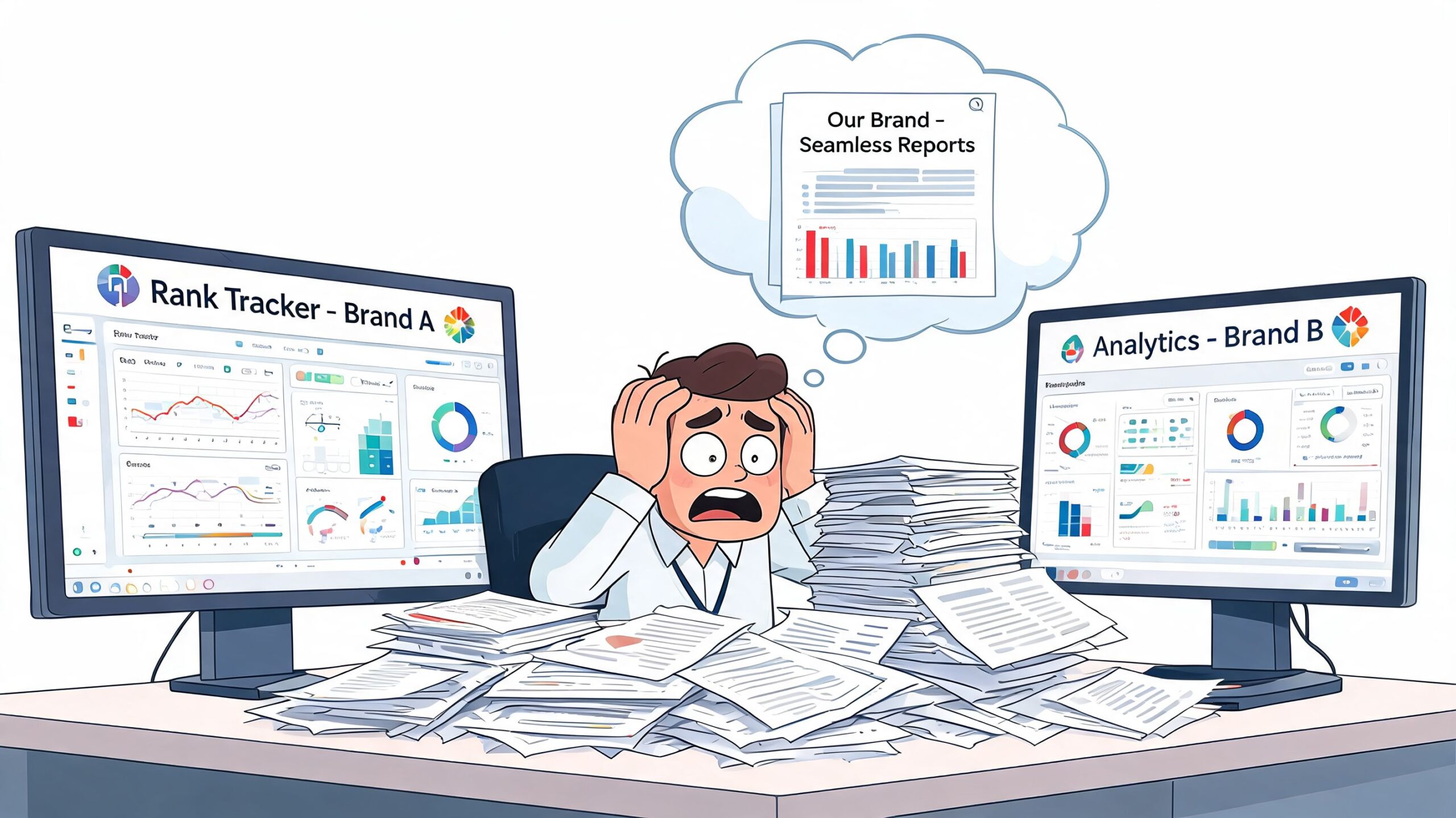
I have seen this happen in growing agencies again and again. The pressure is rarely caused by strategy. It comes from fulfilment. Once you add more clients, more locations, and more stakeholders, a stack of disconnected tools starts eating margin through admin time, inconsistent reporting, and avoidable support queries.
The wider market has been moving in the same direction. Grand View Research expects the global SEO software market to keep growing through the second half of the decade, which reflects a broader shift toward platforms that combine reporting, tracking, and workflow in one place. For UK agencies, the appeal is not just efficiency. It is control over data quality, branding, and the way local results are presented to clients in specific towns, cities, and service areas.
What changes when the platform becomes yours
A white-label platform changes the client experience first, but the bigger win is operational. The agency stops assembling deliverables from separate systems and starts running a repeatable service model under its own brand.
That matters in the UK, where small data errors create expensive confusion. If a platform tracks rankings from the wrong postcode area, rounds location data too broadly, or handles Google Business Profile data without enough clarity on ownership and permissions, your report can look polished while the decisions based on it are wrong. I would rather use a slightly less polished interface with cleaner UK local data than a prettier dashboard that cannot be trusted.
The gains usually show up in a few practical places:
- Reporting takes less manual work: scheduled reports and branded dashboards reduce copy-and-paste production.
- Account handling gets tighter: one portal cuts down the back-and-forth over missing exports, logins, and conflicting screenshots.
- Sales expansion becomes easier: adding listings, local landing pages, or reputation work feels like extending your service, not introducing another vendor.
- Quality control improves: teams review trends and anomalies faster because the data sits in one system.
That last point is often underestimated. If you're trying to turn search data into actions for agencies, the core value is not the logo in the corner. It is giving strategists and account managers enough time to interpret what changed, why it changed, and what the client should do next.
There is a trade-off, though. White-label software only helps if the platform effectively reduces handling time and supports UK-specific reporting needs. If it just puts your logo on top of the same manual process, you are paying for presentation without fixing fulfilment.
This matters even more for agencies that want to resell local optimisation services without building internal software. The right platform gives you a cleaner delivery engine. The wrong one adds licence costs, weak location data, and compliance questions that surface at the worst possible time.
Defining White-Label SEO Software
White-label SEO software is a platform built by one company and rebranded by another so the client sees your business, not the underlying vendor. The simplest analogy is a supermarket own-brand product. The supermarket doesn't manufacture the cereal. It chooses a producer, applies its own packaging and sells it as part of its range.
The same logic applies here. You're not building rank tracking, crawling tools, reporting layers and permissions systems from scratch. You're licensing software, adding your branding, often using your own domain, and delivering it as part of your agency service.
What white-label means in practice
A proper white-label setup usually includes several layers:
- Branding control: your logo, colours and report styling
- Custom domain or branded portal: clients log into your environment, not the provider's public interface
- Automated reporting: scheduled exports and dashboards under your brand
- Client-facing access: selected users can log in without being introduced to the underlying software company
That last point matters more than most agencies expect. If the client constantly sees another company's name, your authority gets diluted. You become the middleman rather than the product owner.
For businesses comparing platforms, it helps to understand how this differs from other arrangements. If you need a basic refresher on how SEO is used to increase website visibility, that context helps, but white-labelling is about packaging and delivery, not the SEO discipline itself.
White-label versus reseller versus affiliate
These models get confused all the time, but they are not the same.
| Model | What the client sees | Your role |
|---|---|---|
| White-label | Your brand | You deliver the platform as part of your service |
| Reseller | Usually the original product remains visible | You sell access to another company's software |
| Affiliate | The vendor's brand | You refer leads and earn a commission |
With white-label, the client experience is meant to feel integrated. With resale, the software brand often remains obvious. With affiliate programmes, there's no operational ownership at all.
The strongest white-label setups make the technology feel like a natural extension of the agency, not a borrowed dashboard with a logo added on top.
For local firms and regional groups, this is particularly relevant when choosing seo software for local businesses. They often need one system for rankings, profiles, reviews and reporting, but they don't want a stack of separate brands exposed to every stakeholder inside the business.
Key Benefits for UK Agencies and Multi-Location Businesses
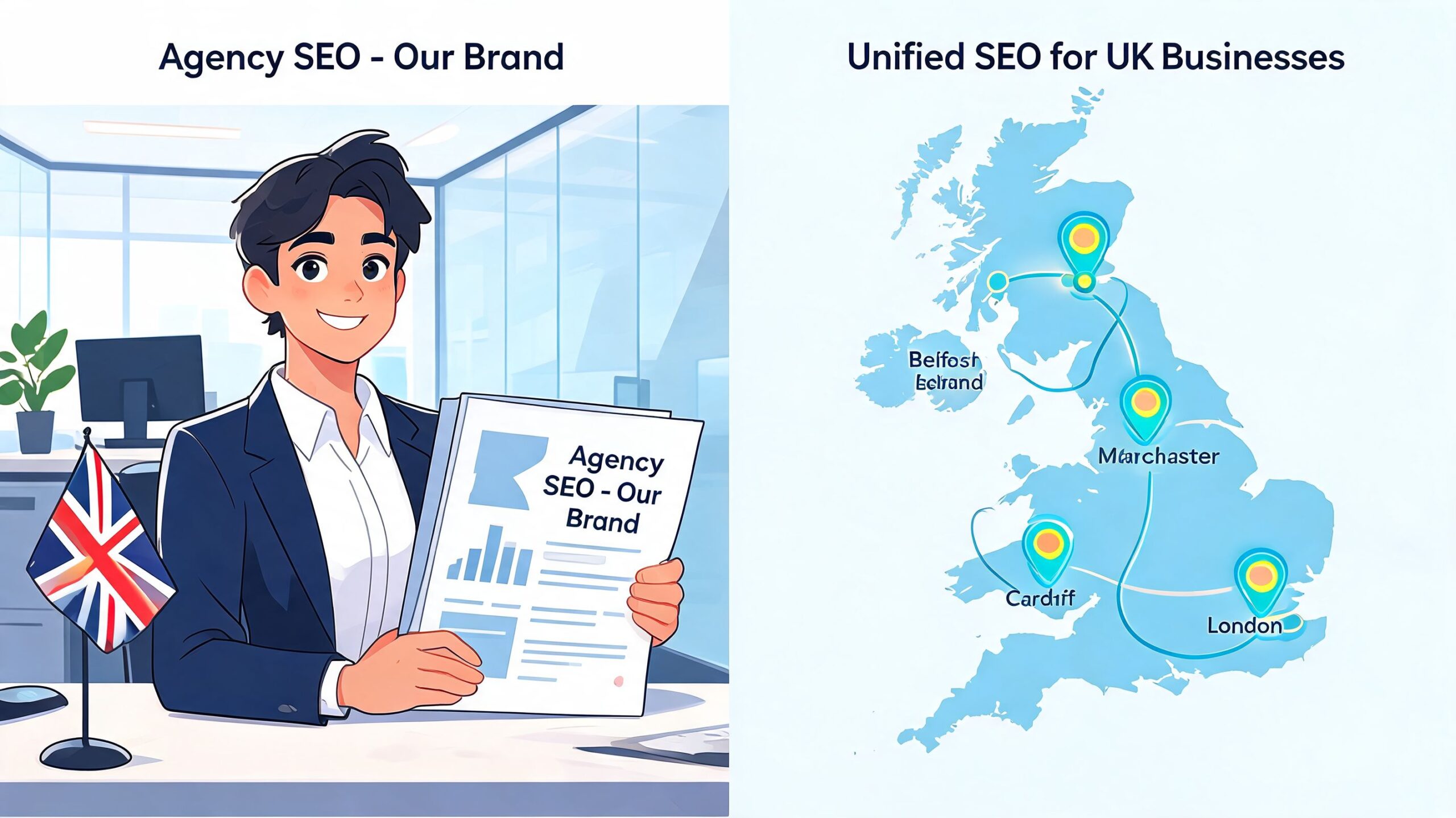
A UK agency usually feels the strain at the same point. Client count rises, reporting hours pile up, account managers start copying data between tools, and every urgent call turns into a scramble to prove what changed and why. White-label SEO software fixes that operational drag if the platform is built for UK search realities, not just generic global reporting.
Agencies
For agencies, the immediate benefit is scale. The primary gain is consistency. A good platform standardises audits, rank tracking, reporting, review monitoring and local listing checks so the team can spend time on recommendations instead of admin.
That matters even more in the UK, where bad local data causes real delivery problems. Postcode targeting, duplicate Google Business Profiles, inconsistent NAP details, and mixed tracking between town-level and national terms can make a campaign look healthier than it is. If the software does not handle UK locations accurately, the report may still look polished while the underlying data is wrong.
Margins improve when repetitive work drops and account delivery becomes easier to productise. Pricing varies by platform, service scope and how much fulfilment the agency still handles internally, but the pattern is familiar. Agencies buy software at a platform rate, wrap it in strategy and reporting, then bill it as part of a monthly retainer. The software alone does not create profit. The margin comes from reducing manual labour without lowering client confidence.
I have seen the opposite as well. Some agencies buy a cheaper white-label tool, then lose the savings in staff time because data has to be corrected by hand before every monthly review.
A branded portal helps retention for a simpler reason. Clients log into your environment, see their progress in one place, and rely less on ad hoc exports from separate tools. That makes your service harder to compare against a low-cost freelancer with a PDF template.
UK compliance should also be part of the buying decision. If a platform stores client and lead data outside the UK or uses unclear subprocessors, agencies need to check whether that setup fits their GDPR obligations and client contracts. For firms selling to solicitors, healthcare providers, estate agencies or finance brands, that point is not legal box-ticking. It affects procurement, onboarding speed and risk.
Multi-location businesses
For multi-location businesses, the main benefit is control across every branch without forcing head office to chase updates manually. One system can show which locations have ranking drops, broken profile fields, review issues or inconsistent business information before those problems spread across the estate.
This becomes more important in UK markets where small geographic differences matter. A dental group in Leeds, a care provider across the Midlands, or a franchise network across Greater London and the South East cannot rely on broad national averages. They need location-level accuracy tied to actual service areas, local packs and postcode-driven search behaviour.
Hospitality, retail and franchise operators also need clean governance. Branch managers often update opening hours, categories, photos and responses to reviews. Without a central workflow, one site drifts off-brand, another creates duplicate listings, and another starts ranking for the wrong service terms. White-label platforms help only if permissions, approval controls and location templates are set up properly.
The day-to-day benefits are practical:
- Stronger brand control: head office can keep naming conventions, categories, descriptions and posting standards aligned across locations.
- Faster fault detection: weak locations stand out early, before poor data turns into lost calls or footfall.
- Clearer local accountability: regional managers can see their own performance without waiting for a monthly deck from central marketing.
- Better UK data hygiene: teams can spot postcode errors, duplicate listings and inconsistent citations before they affect rankings.
For agencies serving chains, a proven franchise SEO strategy usually performs better than a generic local campaign template. The platform needs to support repeated workflows, approval layers and branch-level reporting at scale.
AI-driven search reporting is starting to matter here too, especially for brands that want to understand how local visibility connects with newer search experiences. Teams comparing vendors should look at a best AI visibility software review, but they should still prioritise accurate local data, UK compliance and operational fit before chasing newer features.
The strongest white-label setups give UK agencies and multi-location businesses something more useful than a polished dashboard. They create a repeatable operating system for local search, with fewer reporting hours, fewer data errors, and fewer surprises in client reviews.
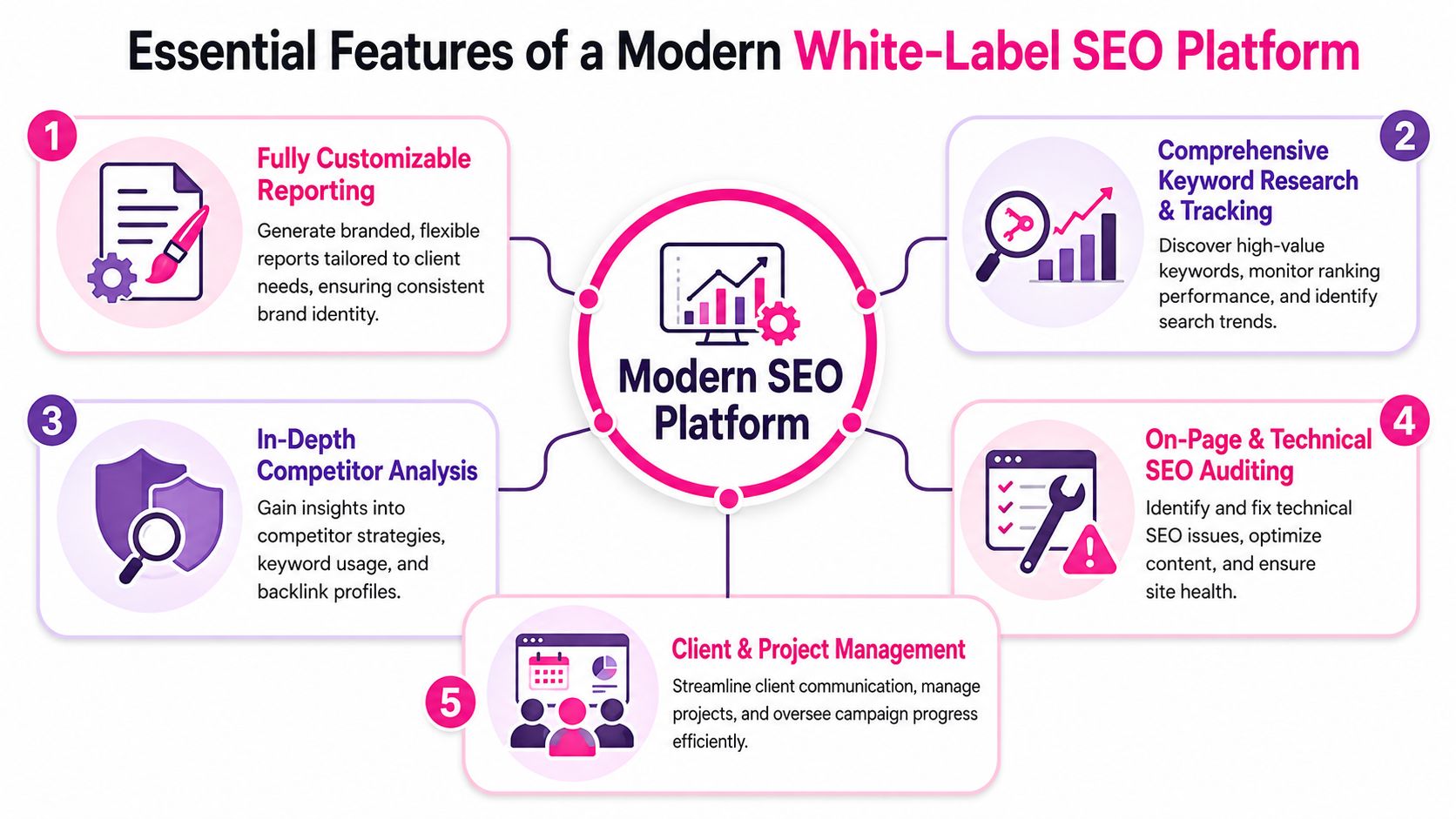
Must-Have Features for a Modern SEO Platform
A lot of platforms claim to be all-in-one. In practice, many are just reporting shells wrapped around disconnected data. That's not enough. If you're buying seo software white label for agency delivery or local business operations, every major feature should solve a specific problem your team already feels.
Reporting that clients can actually use
The reporting layer has to do more than export charts. It should support full branding, scheduled delivery and flexible views for different stakeholders. Owners, marketing managers and regional operators rarely need the same dashboard.
Poor reporting tools create hidden labour. Someone on your team still has to rearrange data, explain labels and merge outputs from separate products. Strong reporting reduces that friction and makes review calls shorter because the client can already see the narrative.
Look for:
- Custom reports and scheduled sends: clients should receive regular updates without manual prep.
- Permission controls: different users need different levels of visibility.
- Branded portals and PDFs: your agency should own the presentation layer end to end.
Local rank tracking that reflects reality
If you serve local businesses, generic national ranking data won't cut it. You need postcode-level visibility and map-focused tracking. Geo-grid views are especially useful because they show where visibility drops off across a service area, not just whether a keyword is “up” or “down”.
That matters in local SEO because one branch can rank strongly near its address and poorly a short distance away. Without a proper grid, that gap stays hidden.
A dependable local search ranking tool should help teams answer practical questions fast. Which locations are losing ground in Google Maps? Which areas need stronger review acquisition? Which competitors dominate outside the immediate radius?
Technical auditing that goes beyond surface checks
Many white-label platforms' cost is justified by the capabilities they offer. A proper audit engine should crawl broadly, prioritise issues and turn technical findings into actions your client can understand.
White-label SEO software enables agencies to deliver branded technical site audits that detect an average of 25-40% more Core Web Vitals violations compared to manual checks, across 100+ parameters including Interaction to Next Paint (INP), according to the SE Ranking white-label audit overview.
That's a meaningful operational advantage because manual reviews often miss recurring issues across templates, location pages and mobile experiences. In local SEO, those misses can affect visibility, especially when slow or unstable pages undermine mobile performance.
A modern audit module should help your team:
- identify the issue quickly
- show where it appears
- assign priority
- export the fix list in client-ready format
If the audit only produces a long error log, your strategists still have to do the product work the software promised to handle.
Workflow and integration depth
The final feature set is less glamorous but just as important. User roles, API access, profile syncing and review workflows decide whether the platform fits your operation or forces workarounds.
For teams comparing categories, a useful best AI visibility software review can broaden the discussion around what modern search platforms are becoming. But for local service delivery, the basics still matter most. Can your team manage locations in bulk, segment clients cleanly and move data without rebuilding the process in spreadsheets?
The best platform is not the one with the longest feature list. It's the one your account managers, analysts and clients will use without creating more admin than it removes.
An Evaluation Checklist for Choosing the Right Partner
Buying the wrong platform is expensive in slow, annoying ways. You don't always notice it on day one. You notice it when reporting takes too long, support tickets pile up, or local rank data starts looking inconsistent across postcodes.
The safest approach is to evaluate a white-label provider like an operating partner, not a software trial. Marketing pages won't tell you enough. Your questions need to go deeper.
The non-negotiables for UK buyers
For UK agencies, data accuracy and compliance should sit near the top of the list. A 2024 BrightLocal UK study found 41% of local SEO campaigns failed audits due to non-UK server pings skewing rank data by 15-20%, and only 23% of white-label platforms offer integrated GBP API syncing fully compliant with UK GDPR data residency rules, as cited in the llmrefs review of white-label SEO software.
That single point knocks out a surprising number of platforms. If local rankings are checked from the wrong geography, the dashboard can look polished while the underlying measurement is off. For agencies serving law firms, restaurants, healthcare providers and home services, that's not a small flaw. It affects decisions.
Ask direct questions:
- Where is rank tracking data collected from? You need to know whether local results reflect UK search environments.
- How is GBP data handled? If the platform syncs profile data, ask about residency and compliance.
- Can the vendor prove local tracking accuracy? If the answer is vague, treat that as a warning sign.
White-Label SEO Software Evaluation Checklist
| Evaluation Area | Key Question | Why It Matters |
|---|---|---|
| Pricing model | Is billing based on clients, locations, users, or a flat plan? | The wrong pricing structure can destroy margins as you grow. |
| Branding depth | Can you fully remove vendor branding and use your own domain? | Partial branding weakens your authority with clients. |
| Local data accuracy | Does the platform use UK-relevant rank tracking methods? | Local SEO decisions are only as good as the location data behind them. |
| GBP integration | How deep is the sync for profiles, posts and reviews? | Shallow integrations create manual work and missed updates. |
| Compliance | How does the provider address UK GDPR and data residency concerns? | Poor handling creates legal and reputational risk. |
| Support and onboarding | What happens when your team gets stuck or needs training? | A capable tool still fails if the vendor can't support adoption. |
Trade-offs that matter more than feature lists
The cheapest plan often becomes the most expensive once you add locations, extra users or reporting upgrades. Equally, the feature-rich enterprise product can be overkill if your team only needs local reporting, reviews and rank tracking.
I'd also push hard on support during procurement. Ask for a realistic demo, not a polished walkthrough. Ask how the platform handles broken syncs, delayed data or user permissions. If the answers sound rehearsed but not operational, keep looking.
UK agencies should treat compliance and local data integrity as buying criteria, not legal footnotes.
Implementation and Client Onboarding
The rollout determines whether white-label software feels like an upgrade or an interruption. Even a strong platform can create friction if branding, training and client communication are handled casually.
Start with your internal setup
Begin with the basics. Add your logo, set brand colours, configure the portal and make sure report templates are clean before a single client sees them. If possible, create standard dashboard views for different client types rather than custom-building each account from scratch.
Then train your team on workflows, not just features. Account managers need to know what clients will ask. Analysts need to know where to validate anomalies. Sales staff need to know how to position the platform without overselling it.
A simple internal launch sequence usually works best:
- brand the portal and reports
- create account templates
- define permissions by role
- train the delivery team
- pilot with a small client group
Make onboarding repeatable
The most reliable agencies use a checklist. New client setup shouldn't depend on memory. It should follow a repeatable sequence that covers profile connections, reporting schedules, naming conventions and access permissions.
For local campaigns, that often includes connecting listings, review workflows and Google Business Profile management services. If this step is loose, the dashboard may look fine while the underlying profile setup remains incomplete.
Use a standard client communication pack as well. Explain what the new portal does, how often data updates, who gets access and what actions the client should take inside the system. That avoids the classic launch problem where the agency is excited but the client doesn't understand why anything changed.
Pilot before full migration
Don't move everyone at once unless you enjoy creating your own support queue. Test the platform with one or two cooperative clients first. Pick accounts with enough complexity to reveal gaps, but not so much internal politics that every issue becomes dramatic.
Watch for practical failures:
- Reporting confusion: clients can't interpret the dashboard.
- Access problems: users don't receive the right permissions.
- Data mapping issues: locations, profiles or keywords are grouped badly.
A good rollout makes the software feel like a service enhancement. A rushed rollout makes it feel like the agency has moved the furniture around for its own convenience.
Frequently Asked Questions
How can I customise dashboards for multi-location hospitality clients without losing key insights
Group locations by region, brand segment or owner, then build dashboard views around those groups instead of dumping every branch into one screen. Hospitality clients usually care about the same core signals across every site, but they still need location-level drill-down when one branch slips.
Recent data shows 52% of UK restaurant and franchise chains manage 5+ Google Business Profiles, but only 17% of white-label tools support scheduled posts and events syncing across all profiles without manual uploads, according to the getairefs analysis of white-label software gaps. This disparity means that if your platform can't handle grouped profile actions, the dashboard may be neat while the workflow behind it stays manual.
The best setups preserve both views. Head office gets roll-up reporting. Local managers get access only to their location set. That keeps insights intact without flooding everyone with irrelevant data.
Is it more profitable to use a SaaS white-label tool or build our own
For most agencies, SaaS is the practical choice. Building your own platform sounds appealing until you account for product management, engineering, maintenance, support and constant adaptation to Google changes.
Owning the stack can make sense for very large operators with unusual needs. For almost everyone else, a specialist platform lets the agency focus on strategy, fulfilment and client retention rather than software development. The key is choosing a platform whose pricing model and local capability match your client mix.
How do we justify the cost of the new platform to existing clients
Don't position it as a new cost line if you can avoid it. Position it as a service upgrade. Clients respond better when they understand what becomes easier, clearer or faster for them.
Frame the change around outcomes they can see:
- Cleaner visibility: one branded place to review progress
- Better accountability: live access instead of waiting for emailed screenshots
- Faster action: issues are spotted sooner and surfaced more clearly
Clients rarely object to better infrastructure. They object to paying for tools they don't understand.
When you explain the switch clearly, the platform becomes part of your value proposition rather than a line item they feel pushed into accepting.
If you want a simpler way to run white-label local SEO, manage profiles in bulk and keep multi-location reporting under one roof, take a look at LocalHQ. Its strongest advantage for this use case is the ability to manage Google Business Profiles, posting, reviews and local reporting from a single platform without turning your team's workflow into a spreadsheet exercise.