
Mastering Local SEO With a Local Rank Tracker
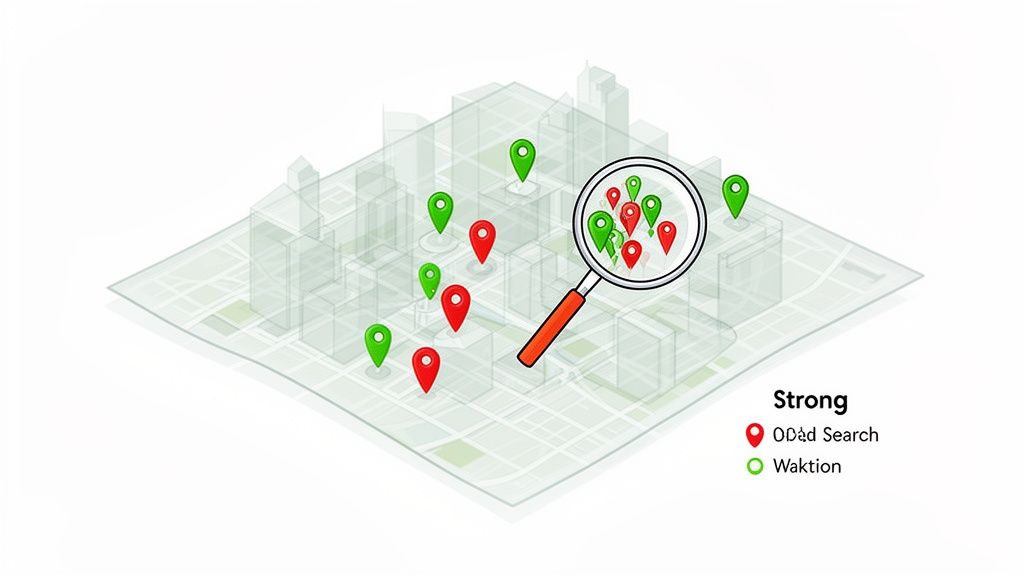
A local rank tracker is a specialised SEO tool that shows you exactly where your business shows up on Google for customers in specific postcodes, neighbourhoods, and cities. It’s about revealing your true visibility street-by-street, not just giving you a vague, national average that traditional tools offer.
Why Your Local Visibility Is Hiding in Plain Sight
Think of your business as a beacon. Is its light reaching every street corner you need it to? That’s the central question of local search. When a customer searches for ‘plumber near me’ in one part of London, they see a completely different set of results than someone just a few miles down the road. This incredibly localised nature of search is a massive blind spot for most UK businesses.
You might be celebrating a number one ranking for a key service, but the hard truth is that this might only be true for people searching within a few hundred metres of your front door. For potential customers in the next neighbourhood over—the very people you’re trying to win over—you might as well be invisible. This is the exact problem a local rank tracker is built to solve.
The Failure of Traditional SEO Tools
Most standard SEO tools were designed for a much simpler time in search. They're great at what they do—tracking national or even global keyword positions—but they stumble when it comes to the level of detail a local business needs. They just can't mimic what a real customer sees when searching from a specific postcode in Manchester or a particular street in Glasgow.
Relying on these old-school tools gives you a dangerous false sense of security. It’s like using a national weather forecast to decide if you need a brolly for a walk in your local park; the information is far too broad to be of any real use.
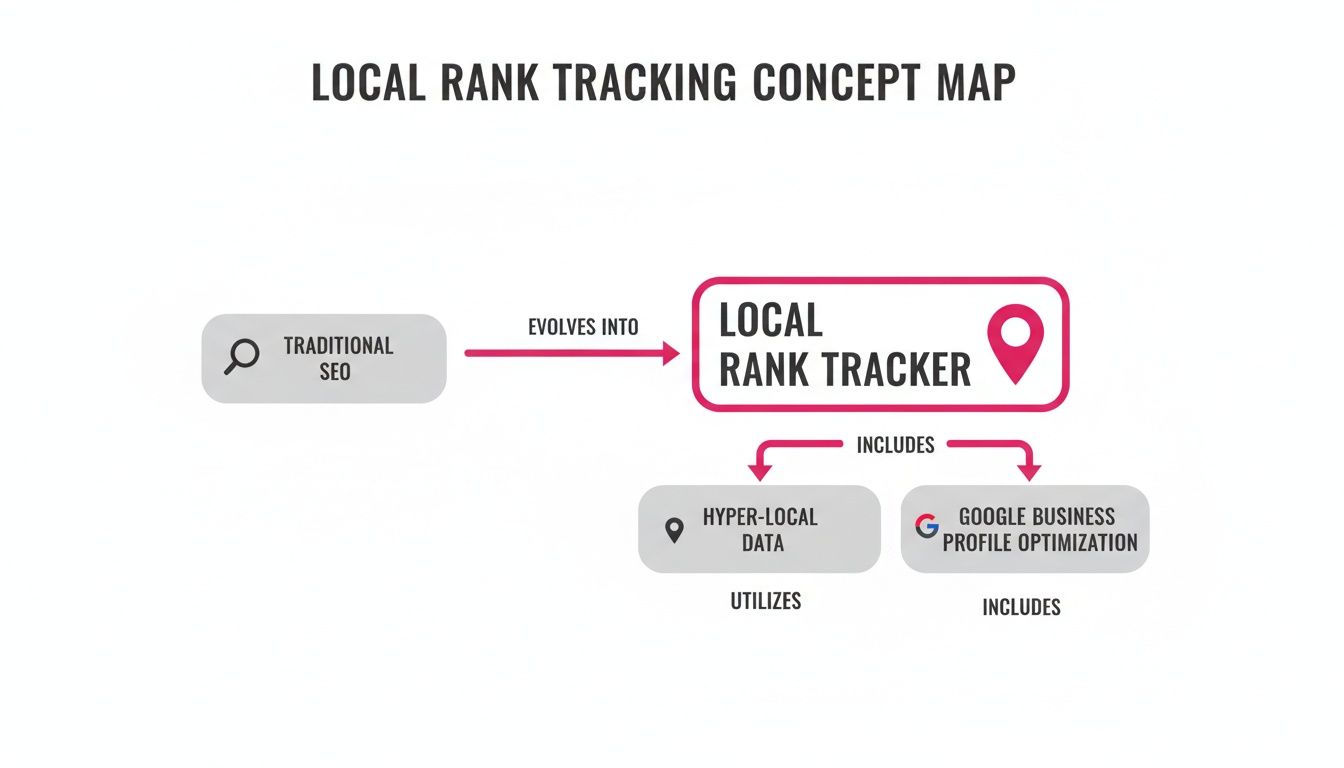
A local rank tracker is like having hundreds of eyes on the ground for you, all at once. It checks your visibility from every single postcode and neighbourhood you care about, swapping guesswork for a clear, visual map of where you’re winning and, more importantly, where you’re losing.
Before we go deeper, let's clearly outline the difference.
Traditional SEO vs Local Rank Tracking
| Feature | Traditional SEO Rank Tracking | Local Rank Tracker |
|---|---|---|
| Geographic Focus | Tracks a single, average national or city-wide position. | Tracks rankings from hundreds of specific, hyper-local points (postcodes, streets). |
| Search Simulation | Simulates a generic search from a data centre. | Simulates searches as if performed by a real user in a specific location. |
| Key Metric | Organic ranking position (e.g., #5 nationally). | Local Pack position and grid-based visibility scores. |
| Competitor View | Identifies broad national or online competitors. | Pinpoints the exact local businesses outranking you in specific neighbourhoods. |
| Usefulness for Local Biz | Limited. Provides a misleading and incomplete picture. | Essential. Offers actionable, ground-level intelligence. |
As you can see, what works for a national e-commerce brand is completely inadequate for a business serving a local community.
Solving the Proximity Problem
For any UK business with a physical footprint—from restaurants and retail shops to dentists and electricians—proximity is the name of the game. Your most valuable customers are the ones right around the corner. A local rank tracker gives you the power to understand and optimise for this crucial factor by showing you:
- Geographic Blind Spots: Uncover entire neighbourhoods where your competitors are cleaning up and your business isn’t even on the radar.
- The Real Competitive Landscape: See which local rivals are actually outranking you in your most valuable service areas, not just who ranks for broad terms nationally.
- Local Pack Performance: Get a precise reading on where you appear in the coveted Google "Map Pack"—the top three listings that get the lion's share of local clicks.
In the end, a local rank tracker provides the ground-level intelligence you need to stop guessing and start making smart, strategic decisions. It’s the first essential step to truly understanding how your business appears to the customers who matter most.
Decoding Your Local Map with Geo-Grid Technology
To really get a grip on your local visibility, you have to see your business the way your customers do. This is where geo-grid technology steps in, forming the very core of any decent local rank tracker. It ditches the abstract numbers and instead gives you a clear, visual map of how you're really performing on the ground.
Think of it like this: picture a satellite map of your town, but with a transparent grid laid over it. Each little square in that grid is a specific spot where a potential customer might be standing, phone in hand. A local rank tracker uses this grid to run hundreds of simultaneous, hyper-local searches for your keywords from every single one of those points.
What you get back is a colour-coded heat map of your influence. Instantly, you can see where you’re strong (the green zones, where you're in the top three) and, just as importantly, where you're practically invisible to customers (the red zones). It’s the difference between guessing where you stand and truly knowing.
Visualising Your Local Opportunities
Let's say a pizzeria in Manchester uses a platform like LocalHQ to track the keyword 'best pizza'. The geo-grid might show they’re dominating the city centre, but are completely off the map in nearby neighbourhoods like Didsbury or Chorlton—both packed with potential customers. This visual data turns a vague ranking number into genuine business intelligence you can act on.
The image above perfectly illustrates this shift. We've moved from the old-school magnifying glass of broad SEO analysis to the precision of a map pin, which signifies targeted, location-specific optimisation. It’s a whole different game.
This detailed view is miles ahead of trying to do manual searches from your office computer. Those searches are always skewed by your own search history and physical location, giving you a completely unreliable picture of what customers see.
Geo-grid technology gets rid of the blind spots. It gives you an honest, unbiased look at your digital footprint, showing you exactly where to focus your marketing budget for the best results.
Why Geo-Grid Accuracy Is Non-Negotiable
The real power of a geo-grid is its precision. Vague, city-wide data just doesn't cut it anymore. In today's fiercely competitive local search scene, especially in the UK, businesses are hungry for hyper-local insights. In Birmingham, for example, the demand for local SEO services is through the roof, with around 200 monthly searches per 100 businesses for related terms.
This stat shows just how much service providers and multi-location brands now depend on geo-grid trackers to monitor their performance at a postcode level and get one up on their rivals.
A solid local rank tracker achieves this accuracy by:
- Simulating Real User Searches: It mimics what someone would search for from a specific street or postcode, not from some random data centre miles away.
- Identifying Hyper-Local Competitors: The tool uncovers which rivals are beating you in specific neighbourhoods, not just who ranks well nationally.
- Pinpointing Ranking Drops: You can see if your rank falls off a cliff just a few streets away from your front door, highlighting a proximity problem that needs fixing.
To get a feel for how modern search is evolving beyond traditional methods, it’s worth exploring concepts like Generative Engine Optimisation (GEO). Understanding these shifts is crucial for staying ahead of the curve.
Ultimately, reading this visual data connects the colourful grid directly to your business strategy. It tells you where to run targeted ads, which areas need more location-specific content, and how to spend your money wisely. If you're looking to boost your visibility, our guide on https://localhq.io/how-to-rank-higher-on-google-maps/ offers practical steps you can take right now. By decoding your local map, you stop putting out fires and start building a proactive strategy based on solid, hyper-local data.
Tracking the Metrics That Actually Drive Revenue
Getting to the top of the local search results is a great first step, but let's be honest—it doesn't pay the bills on its own. Real success in local SEO isn't just about being seen; it's about what customers do once they see you. This is where a proper local rank tracker shines, moving past simple rankings to focus on the numbers that directly impact your UK business's bottom line.
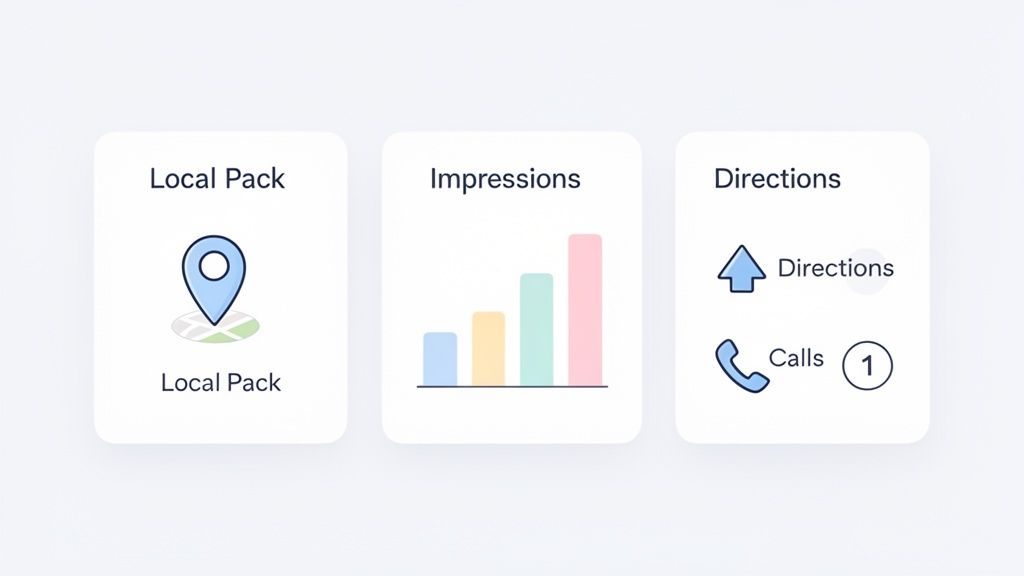
The secret is connecting your ranking performance to tangible business outcomes. A powerful tracker will hook directly into your Google Business Profile (GBP) to show you the actions that signal genuine customer interest. These aren't just vanity metrics; they’re the vital signs that tell you if your strategy is actually bringing in business.
Beyond Rankings: The Core GBP Metrics
While a geo-grid map shows you where people can find you, your GBP metrics reveal what happens next. A good dashboard brings all this data together, so you can clearly see how a jump in your rankings translates into real-world results.
Here are the essential metrics you need to keep an eye on:
- Local Pack Visibility: This is the big one. The Local Pack—that map with the top three business listings—is where almost all the local action happens. Simply tracking how often you appear here is a fundamental measure of success.
- Map Pack Rankings: It’s not just about being in the Local Pack, but where you are. Are you first, second, or third? Shifting up just one spot can massively boost your calls and clicks, so this tiny detail is crucial.
- Impressions: This is your reach. It tells you how many times your GBP listing was shown to searchers. Think of it as the top of your funnel, indicating your overall brand awareness in your local area.
- Direction Requests: Now we're talking. When someone asks for directions, they are actively planning to visit you. It’s one of the strongest signals that your online efforts are about to turn into a customer walking through your door.
- Phone Calls: For many businesses, especially in the service industry, the phone ringing is the ultimate goal. Tracking calls that come straight from your GBP listing is the most direct way to measure lead generation and your return on investment.
These metrics work together to tell a story. A huge number of impressions is nice, but if it doesn't lead to more direction requests or phone calls, you know you’ve got a leak in your bucket somewhere.
This data-first approach takes the guesswork out of your strategy. It helps you pinpoint problems and put more energy into what’s genuinely working.
Interpreting the Story Your Data Tells
Every metric is a clue. When you look at them all together, you start to see a clear picture of your customer’s journey and where you can make improvements. A dedicated local rank tracker helps you connect these dots without having to juggle a dozen different spreadsheets.
Think about these common scenarios:
- High Impressions, Low Clicks: Lots of people are seeing your business, but they aren't clicking. This could be a red flag for your main photo, a poor average review score, or an incomplete business description. You’re visible, but you’re not convincing enough to win the click over a competitor.
- High Clicks, Low Direction Requests: People are interested enough to click on your profile, but something is stopping them from taking that next step. This might point to bad photos, a lack of recent customer reviews, or unanswered questions in your Q&A section.
- Strong Rankings in One Area, No Actions: Your geo-grid shows you're number one in a key neighbourhood, but your GBP report shows zero calls or visits from that area. This could mean you're ranking for a search term that has no commercial intent, or perhaps your service just isn't what people in that specific area are looking for.
By turning this jumble of data into clear, actionable insights, a good platform gives you the power to make smarter decisions. If you want to get deeper into organising this information, our detailed guide on the ideal Google My Business reporting tool can offer more context.
At the end of the day, tracking these revenue-driving metrics is all about measuring the true return on your local SEO investment. It stops being a cost and starts becoming a predictable, profitable way to grow your business.
Turning Data into a Winning Local SEO Strategy
Let's be honest, raw data is useless without a game plan. It’s one thing to see a red patch on your geo-grid map or a dip in phone calls; it's another thing entirely to know exactly what to do about it. This is where the magic happens—where you turn the insights from your local rank tracker into real-world, revenue-driving actions that give you a proper edge over the competition.
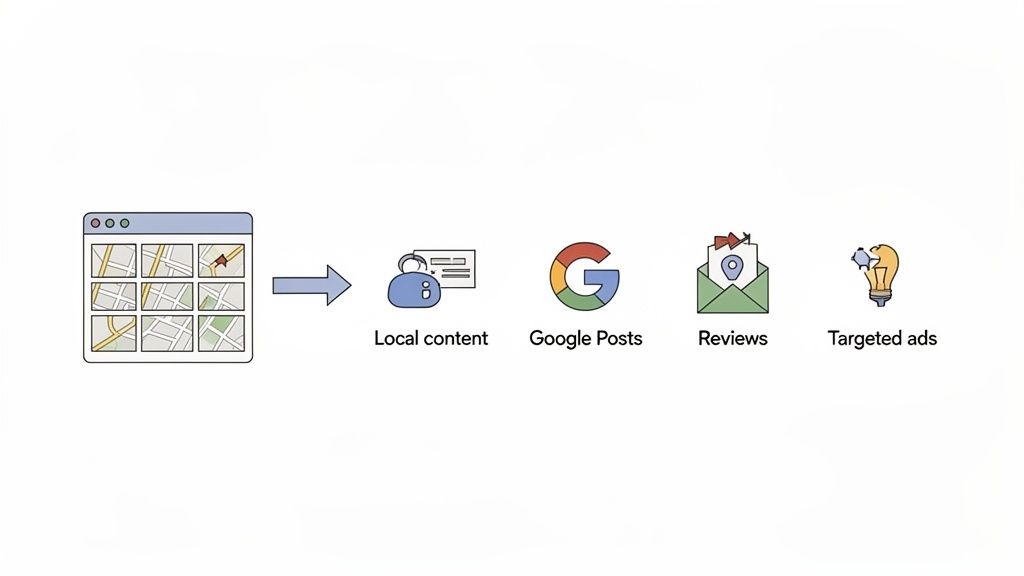
Think of your rank tracking dashboard not as a report card, but as a strategic roadmap. Every metric, every pin on the grid, is a signpost telling you where to turn next to win over more local customers.
From Geo-Grid Weakness to Targeted Action
Let’s walk through a real-world scenario. Imagine you run a plumbing business in Bristol, and your geo-grid report shows you’re practically invisible for the keyword "emergency plumber" in an affluent neighbourhood like Clifton. Your rankings are great in your immediate postcode, but they fall off a cliff just a mile down the road. What now?
Instead of taking a wild guess, you can build a precise, multi-pronged attack based on this specific piece of intelligence:
- Create Hyper-Local Content: Your first move is to build a new service page on your website, something like "Emergency Plumber in Clifton". This isn’t just about keyword stuffing; you should fill it with content that speaks directly to Clifton residents. Mention local landmarks, the types of housing in the area, and any common plumbing issues you know are prevalent there.
- Launch Targeted Google Posts: Head over to your Google Business Profile and schedule a series of posts that specifically call out Clifton. Maybe offer a small discount for residents in that postcode or highlight a recent job you completed nearby. This directly reinforces your connection to the area right on your GBP listing.
- Run a Focused Review Campaign: Get in touch with your happiest customers who live in or near Clifton and gently ask them for a review. When Google sees positive feedback coming from customers in that postcode, it strengthens the signal that you're a trusted and relevant choice for that specific location.
This kind of systematic approach, fuelled by data from your local rank tracker, is far more powerful than broad, city-wide SEO efforts.
Uncovering Opportunities in Competitor Data
Your local rank tracker doesn't just show you where you're weak; it also shines a bright light on your competitors' strategies. By seeing which rivals are outranking you in certain postcodes, you can start to reverse-engineer their success and spot golden opportunities they might be overlooking.
A smart local rank tracker helps you move from a reactive position—fixing your own weaknesses—to a proactive one, where you strategically exploit gaps in your competitors' coverage.
For instance, your analysis might reveal a competitor is cleaning up for "boiler servicing," a profitable service you offer but haven't really pushed. That’s a clear signal. It’s time to build out your own service page, gather reviews that mention boiler work, and add that keyword to your next geo-grid scan. You're effectively using their success as a blueprint for your own growth.
Let Your Tools Build the Roadmap
Modern platforms like LocalHQ take this even further. A sophisticated local rank tracker can analyse your Google Business Profile against top competitor benchmarks and automatically recommend actions. It might spot that you're missing a crucial service category, suggest valuable keywords you haven’t targeted, and build out a whole optimisation plan for you.
This laser focus on your Google Business Profile is absolutely paramount. According to Reboot's analysis of practitioner insights, a fully optimised GBP is the single most critical ranking factor for the UK Local Pack, accounting for a massive 32% of its influence. That number alone shows why every insight from your tracker should ultimately lead back to improving and refining your GBP.
By systematically turning data points into specific actions—whether it's creating content for a weak neighbourhood or targeting a keyword a competitor dominates—you build a powerful, repeatable process for local SEO success. Your strategy is no longer a shot in the dark; it’s a clear plan informed by real-world performance data.
How To Choose The Right Local Rank Tracker
Picking the right local rank tracker isn't just another box to tick on your SEO to-do list; it's a decision that can genuinely make or break your local strategy. Not all tools are built the same, and when you're fighting for visibility street by street, you need a platform that understands the unique battlefield of local search. It's about looking past the shiny bells and whistles to find the core features that give your UK business a real, tangible edge.
As you start looking around, it’s a good idea to see what the best SEO ranking reporting software offers, as many of the big players now have local features. But honestly, for a business whose lifeblood is its local community, a specialist tool is almost always the smarter bet. Let’s walk through what really matters when you're making your choice.
Evaluate Geo-Specific Accuracy and Visualisation
First things first: accuracy. This is the absolute bedrock of a good local rank tracker. The tool has to be able to mimic searches from incredibly specific locations—right down to the postcode level. If it can’t do that, you’re flying blind with dodgy data.
Just as important is how that information is served up to you. A clean, easy-to-read interface, especially a geo-grid view, isn't a 'nice-to-have'; it's essential.
A great local rank tracker doesn't just throw numbers at you; it provides clarity. The geo-grid should instantly tell you where you’re winning and where you’re practically invisible, turning a mountain of ranking data into a simple, actionable heat map.
It's this visual gut-check that helps you spot a weak spot in a key neighbourhood and figure out your next move in seconds.
Prioritise Deep Google Business Profile Integration
Your Google Business Profile (GBP) is the heart and soul of your presence in local search. So, any top-tier rank tracker must plug directly and deeply into it. We're talking about pulling in crucial metrics like phone calls, clicks for directions, and search impressions.
This connection is vital because it ties your rankings to actual business results. You can see how improving your geo-grid score in one area directly leads to more customer calls, which is exactly the kind of ROI you need to see. Make sure the tool you choose makes this link crystal clear.
Scrutinise Reporting and Scalability
Finally, think about reporting and your future growth. If you're an agency, features like white-label reporting are a must for sending clients professional, branded updates. If you're a business with multiple locations, the platform needs to handle comparing performance across all your sites without giving you a headache.
Below is a quick reference guide to help you size up any potential tool you're considering.
Essential Features Checklist for a Local Rank Tracker
| Feature | Why It's Important | Included in LocalHQ? |
|---|---|---|
| Geo-Grid Tracking | Visualises your rankings across a specific geographic area, making it easy to spot opportunities and weaknesses. | ✔️ |
| Postcode-Level Accuracy | Ensures the data reflects what real customers in precise locations are seeing, not just a city-wide average. | ✔️ |
| GBP Integration | Connects ranking performance to real business outcomes like calls, direction requests, and website visits. | ✔️ |
| Competitor Tracking | Allows you to monitor how your key local competitors are performing in the same search grids. | ✔️ |
| Automated & White-Label Reporting | Saves time and allows agencies to provide professional, branded reports to their clients. | ✔️ |
| Scalability for Multiple Locations | Easily manages and compares performance for businesses with more than one physical branch. | ✔️ |
| Mobile vs. Desktop Tracking | Shows ranking differences between device types, which is critical for understanding on-the-go searchers. | ✔️ |
By ticking these boxes, you ensure the tool has the muscle to deliver meaningful, actionable insights for your local SEO campaigns.
For instance, here’s a look at the pricing tiers from LocalHQ, which shows how a good platform caters to businesses at different stages.
A tiered setup like this means you can start with a plan that fits your current needs, knowing there's a clear path to upgrade as you grow. Choosing a scalable tool from day one saves you the massive pain of having to switch systems later on. If you carefully weigh up these key points—accuracy, visualisation, integration, and scalability—you'll be well-equipped to choose a local rank tracker that becomes a true cornerstone of your growth strategy.
Your Quick-Start Implementation Checklist
Getting started with a new tool can feel like a chore, but setting up a local rank tracker is actually pretty simple. It's less about a complex technical setup and more about taking a few logical steps to see your local market with fresh eyes.
Think of this checklist as your guide from day one to long-term optimisation. It's designed to help you build a smarter local SEO strategy from the get-go.
Phase 1: Setting Your Baseline
First things first, you need to know where you stand right now. You can't track your progress if you don't have a starting line. This initial setup is all about creating that baseline so you can measure every win that comes later.
-
Map Out Your Core Service Areas: Before you track a single keyword, decide where you’re tracking. Make a list of the key postcodes and neighbourhoods that are most important to your business. Where do your best customers come from? Start there.
-
Pinpoint Your 'Money' Keywords: Now, think like a customer who's ready to buy. What would they search for? Go beyond just your business name and focus on high-intent phrases like "emergency plumber Bristol" or "best Sunday roast in Hackney". These are the terms that bring in the money.
-
Run Your First Geo-Grid Scan: Once you have your 'what' and 'where', it's time to run your first scan. This initial geo-grid report is your ground zero. It'll show you where you're strong, but more importantly, it will shine a light on the geographic blind spots where you're completely invisible to potential customers.
Phase 2: Analysis and Integration
With your first batch of data in hand, the real work begins. It’s time to dig into the results and connect your tracker to your most valuable local asset: your Google Business Profile. This is where you move beyond just rankings and start seeing the real-world impact.
Don't just glance at the data; interrogate it. That first report is a treasure map pointing directly to your biggest and easiest growth opportunities. A single red spot in a key neighbourhood could be your most profitable target for the next quarter.
-
Analyse the Report for Opportunities: Lay out your baseline geo-grid map. Where are your rankings weakest? Is a particular competitor consistently beating you in a high-value area? These insights are the building blocks of your action plan.
-
Connect Your Google Business Profile: This isn't optional—it's essential. Linking your GBP allows the local rank tracker to pull in crucial data like phone calls, requests for directions, and website clicks. This is how you draw a direct line between ranking improvements and actual business results.
-
Schedule Regular Automated Reports: Finally, consistency is everything in SEO. Set up automated reports to land in your inbox every week or month. This forces you to keep an eye on your progress, helps you react quickly to any changes, and makes it easy to prove the value of your work.
Frequently Asked Questions
Got a few more questions about local rank trackers? Let's clear up some of the most common ones so you can see exactly how this tool fits into your business strategy.
How Often Should I Check My Local Rankings?
It's tempting to hit refresh on your rankings every day, but honestly, that's a fast track to stressing over normal, minor fluctuations. For most small to medium-sized UK businesses, a weekly or fortnightly check-in is the sweet spot.
This rhythm is frequent enough to catch important trends, measure the real impact of your latest SEO work, and respond to competitor moves without getting bogged down in the daily noise. Daily tracking might make sense if you're launching a big campaign or operate in a hyper-competitive area like central London, but for steady growth, a weekly review keeps you informed without being overwhelming.
Can a Local Rank Tracker Really Help Me Beat Competitors?
Absolutely. Think of a local rank tracker as your secret weapon for competitive intelligence. It takes you from just knowing who your competitors are to understanding precisely where and why they're outranking you. When you see their performance laid out on a geo-grid, you can spot the specific postcodes or neighbourhoods where they’re strong and you’re invisible.
This insight is pure gold. It gives you a clear roadmap to start chipping away at their lead. You can focus your content, Google Posts, and even local ad spend on those exact areas, turning their strongholds into battlegrounds. It stops being a guessing game and becomes a precise, location-driven strategy.
Is a Rank Tracker Worth the Investment for a Small Business?
When you’re a small business, every pound counts. A local rank tracker isn't a frivolous expense; it's a vital tool that makes sure your SEO budget is actually working. The investment pays for itself by helping you connect with customers who are ready to buy, right in your area.
The data you get leads directly to the results that really matter: more phone calls, more requests for directions, and more people walking through your door. By showing you exactly where to focus your energy for the best results, the tool stops you from pouring money into strategies that aren't delivering. For a small business, that level of focus makes a rank tracker one of the smartest investments you can make.
Ready to stop guessing and start seeing exactly where your business stands? LocalHQ gives you the visual data and actionable insights needed to dominate your local market.