A Guide to Local SEO for Businesses in the UK
Think of Local SEO as the digital equivalent of having the best shopfront on the busiest high street. It’s all about fine-tuning your online presence so that when people nearby search for your services, you’re the first business they see. It's the strategy that turns a local Google search into a customer walking through your door.
Why Local SEO Is a Game Changer for UK Businesses
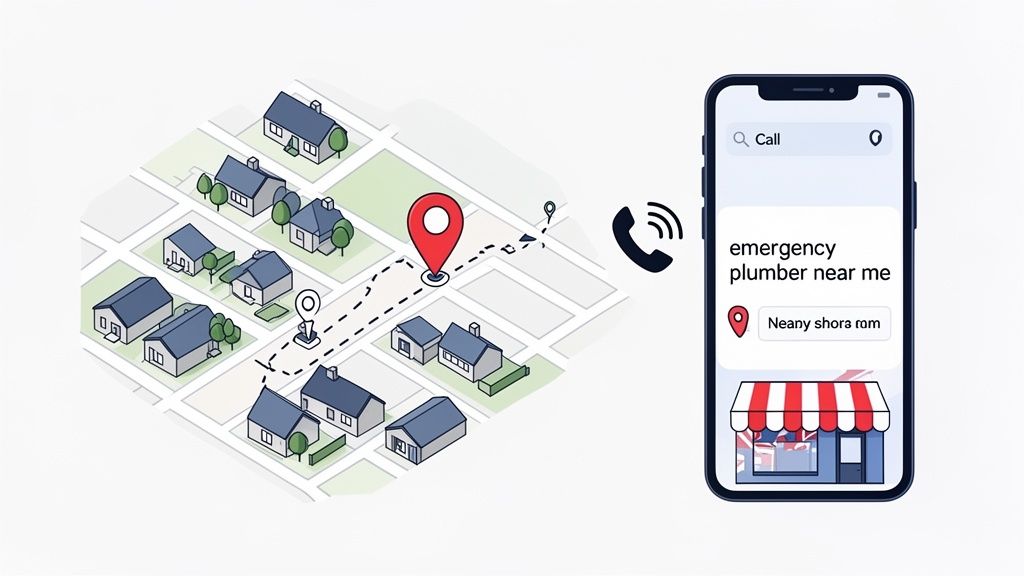
Let's paint a picture. A homeowner in Manchester has a burst pipe. What’s their first move? They're not dusting off the Yellow Pages. They’re reaching for their phone and typing "emergency plumber near me" into Google. In that exact moment, Google shows them a map and a handful of local plumbers. That’s local SEO in action. It's what gets your business on that short, critical list when a customer needs you most.
And it’s not just for plumbers. This happens every second of every day, whether someone's after the best flat white in Bristol, a trustworthy garage in Glasgow, or a unique gift from a boutique in Birmingham. Local search has become the essential bridge connecting a person's immediate need with a local business that can solve it.
For any UK business with a physical location or a specific service area, getting local search right isn't just a nice-to-have anymore. It's a fundamental part of staying relevant and profitable.
Turning Searches into Customers
The real magic of local SEO is that it connects you with customers who are ready to act. These aren't people just window shopping; they have a problem and are actively looking for the solution right now. The numbers back this up: a staggering 46% of all Google searches are for local information.
When your business shows up at the top of these results, you immediately get:
- Top-Tier Visibility: You appear on Google Maps and in the coveted "Local Pack" – that box of three businesses you see at the top of the search results page.
- More Foot Traffic: Potential customers can get directions to your shop or office with a single tap.
- A Ringing Phone: Mobile searchers can click a button and call you directly from your listing. Easy.
- Greater Trust: A complete, well-managed profile packed with positive reviews builds confidence before a customer even clicks through to your website.
Local SEO isn't just about being found online. It’s about being chosen. It transforms your website from a static online brochure into an active lead-generating machine that brings real revenue to your business.
To get a fuller picture of why local SEO is such a big deal, exploring the specific advantages is key, like these 8 Unmissable Benefits of Local SEO for UK Businesses. At its core, it levels the playing field, allowing you to go toe-to-toe with national chains by winning over the customers right on your doorstep.
A Tour of Google's Local Search Results
Imagine Google’s local search results as your town's digital high street. When a potential customer searches for something you offer, like "best fish and chips in Brighton," they don't just see a simple list of websites. Instead, Google presents a dynamic page with different "shopfronts," all vying for that person's attention. Getting to grips with this layout is the first step to figuring out where your business needs to show up.
The most valuable spot on this digital high street is what’s known as the Local Pack. You’ve definitely seen it—it’s that prominent box at the top of the page with a map and a list of three businesses. It conveniently shows their star rating, address, and opening hours.
Here’s a classic example of what the Local Pack looks like in action.
Making it into this box is like being personally recommended by the most trusted guide in town. It's Google’s seal of approval, and it’s where a huge chunk of clicks land.
The Other Players on the Digital High Street
While the Local Pack is the main prize, there are other important places your business can appear.
-
The Local Finder: When someone clicks "View all" at the bottom of the Local Pack, they land on the Local Finder. Think of it as an expanded business directory. It shows a longer list of businesses on a bigger map, with more details and filters for the user to explore.
-
Organic Search Results: These are the traditional blue links you see below the Local Pack. A well-built website with great local content can rank highly here, giving you another fantastic way to attract customers.
You really can't afford to ignore these results. A staggering 46% of all Google searches in the UK now have local intent, completely changing the game for businesses from London to Manchester. This trend is fuelled by people on their phones looking for immediate solutions—in fact, ‘near me’ searches have blown up by over 900% in the past two years. Getting your Google Business Profile in order is the single most important thing you can do for Local Pack visibility, as you can see from the UK's top-performing local strategies.
How Google Ranks Local Businesses
So, how does Google decide which lucky businesses get featured? It all boils down to three core ranking pillars. Think of them as the judging criteria for winning 'Best Shop on the High Street'.
The Three Pillars of Local Rankings
To decide who gets the top spots, Google's algorithm essentially asks three simple questions: How close are you? How relevant are you? And how well-known are you? Nail these three, and you've got the foundation for a brilliant local SEO strategy.
Google constantly balances these factors to give the searcher the most useful and reliable answer. Let’s break them down.
| Pillar | What It Means | Key Signal |
|---|---|---|
| Relevance | How well does your business match the user's search? | The categories, services, and keywords in your Google Business Profile and on your website. |
| Proximity | How close is your business to the person searching? | The physical distance between your address and the user's location (or the location they searched for). |
| Prominence | How well-known and respected is your business? | Online reviews (quantity and quality), links from other local websites, and brand mentions online. |
In short, Google wants to show the best, closest, and most relevant business for any given search. A business with lots of glowing reviews and local press coverage is seen as more prominent and trustworthy, giving it a real edge.
Optimising Your Google Business Profile for Maximum Impact
Think of your Google Business Profile (GBP) as your digital shopfront, but one that sits on the busiest high street in the world. For most local customers, this is the very first impression they'll get of your business. Just having a listing is nowhere near enough; you need to mould it into a powerful magnet that pulls in and converts people searching nearby.
A fully fleshed-out profile doesn't just sit there listing facts—it actively works to sell your business around the clock. It’s also one of the strongest signals you can send to Google that your business is active, legitimate, and the right answer for local search queries. In fact, a complete and engaging profile is consistently ranked as one of the most important factors for getting into that all-important Local Pack. It’s non-negotiable.
So, how does Google decide who gets top billing? It really boils down to three core pillars.
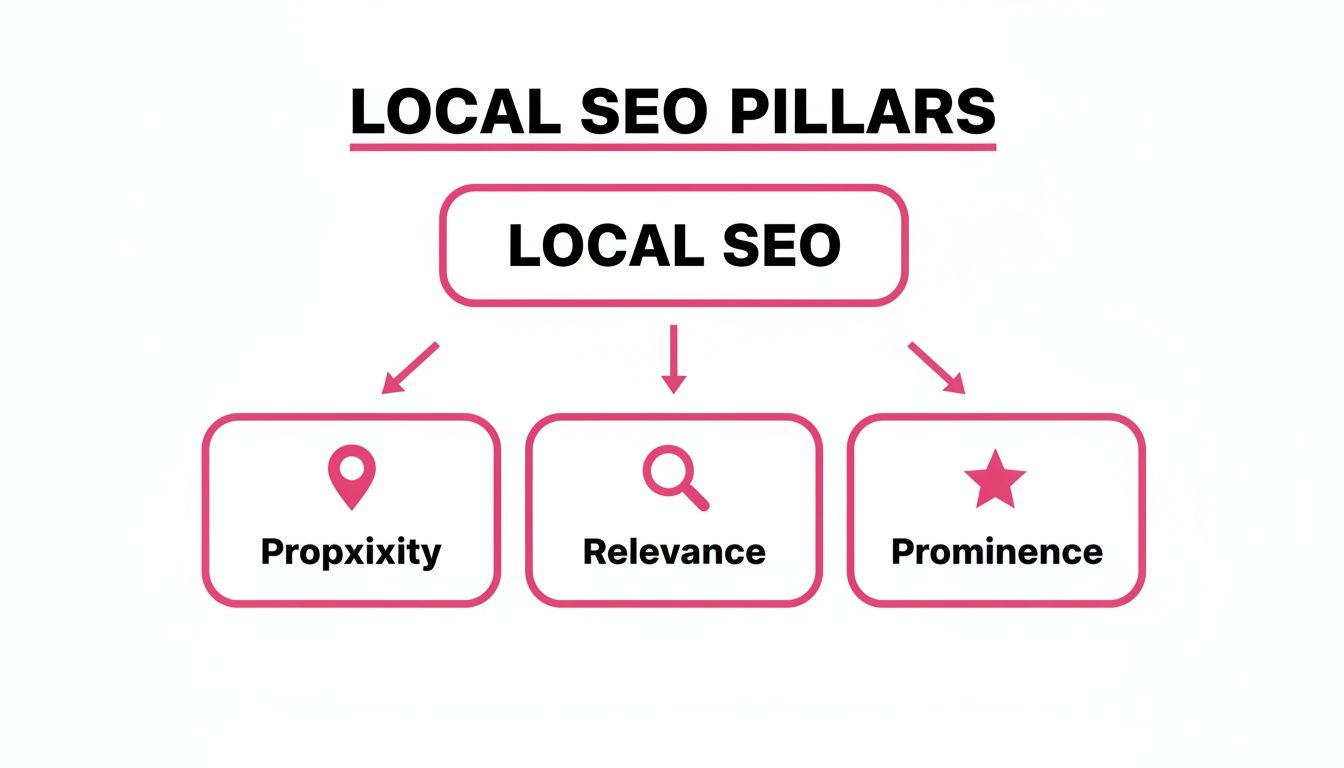
You can't change your physical proximity to a searcher, but you have enormous control over the other two pillars. Optimising your GBP is how you directly influence your relevance and prominence, giving you a serious edge.
Your Core Business Information
The absolute foundation of a strong profile is getting the basics right. Accuracy and consistency are king. Every scrap of information must be spot-on and match up everywhere else your business appears online, starting with your NAP (Name, Address, Phone number).
Any inconsistencies in your NAP data, even minor ones, create confusion for both Google and your potential customers. Make sure the details are identical across your website, social media pages, and any online directories. This consistency is a huge trust signal for search engines and reinforces your authority in a specific location.
Next up: your business categories. This is your chance to tell Google exactly what you do.
- Primary Category: This is the big one. You only get to choose one, so make it count. It should describe your core business in the clearest terms possible (e.g., "Plumber," not "Home Services").
- Secondary Categories: Now you can get more specific. Add other relevant categories that cover everything else you offer (e.g., "Boiler Repair Service," "Drain Cleaning Service"). Be as thorough as you can.
Choosing the right categories is crucial. Get this wrong, and you’re essentially invisible to the very people you’re trying to attract.
Crafting a Compelling Profile
With the core data locked in, it’s time to breathe some life into your profile. Your business description is your opportunity to tell your story, weaving in the keywords and phrases your customers are actually searching for. Don't just list what you do; explain what makes you different and why they should choose you.
Your Google Business Profile is a dynamic, interactive platform, not a static listing. Treat it like a mini-website and social media channel rolled into one. The more you engage with its features, the more Google will reward you with visibility.
To really make your profile shine, you need to use its interactive features on a regular basis:
- High-Quality Photos and Videos: People buy with their eyes. Regularly upload clear, professional images of your shop, your team at work, your products, and happy customers. Visuals are proven to boost engagement.
- Google Posts: Think of these as free, hyper-local adverts. Share updates, special offers, new products, or company news directly on your profile. They expire after seven days, so consistent posting shows Google (and customers) that you’re active.
- Products and Services: Don't be vague. Detail every single product or service you offer. Add descriptions, photos, and even prices where it makes sense to give searchers all the information they need to make a decision.
- Q&A Section: Get ahead of the game by populating this section yourself. Answer the most common questions you get asked. This saves everyone time and lets you frame the answers perfectly.
For businesses with more than one location, keeping every single profile updated can quickly become a logistical nightmare. This is where a dedicated Google Business Profile management platform is a game-changer. It allows you to schedule posts, sync key information, and maintain brand consistency across all your branches from one central dashboard. When you treat your GBP as a central hub for customer interaction, you turn a simple listing into your most powerful tool for driving local growth.
Building Trust with Local Citations and Reviews
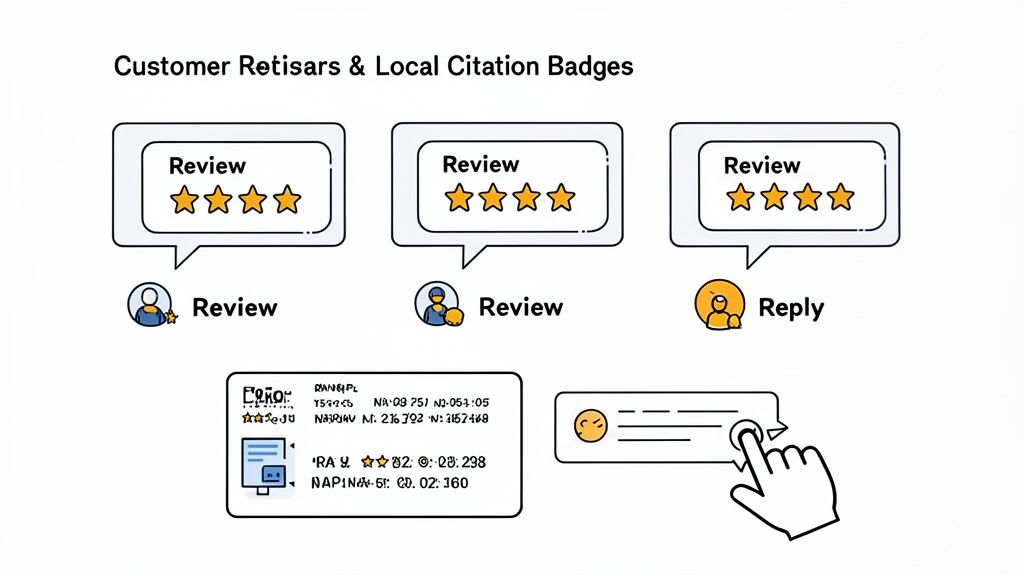
In local search, trust is everything. Your Google Business Profile might be your digital shop window, but what really gets people to walk through the door is digital word-of-mouth. This comes from two key sources: customer reviews and local citations.
Think of them as powerful social proof. They signal to both Google and your potential customers that your business is real, active, and valued by the local community.
The Power of Customer Reviews
Great reviews build instant confidence, but their true power is unlocked when you start actively managing them. A proactive review strategy is non-negotiable for any serious local SEO for businesses. It isn’t just about passively collecting five-star ratings; it’s about proving you’re an engaged business that listens to its customers.
This engagement sends a huge positive signal to Google. The trick is to respond to every single review, good or bad. A quick "thank you" for a positive review shows appreciation. A thoughtful, calm response to a negative one can turn a bad situation around and demonstrates your commitment to good service.
You can make it easier for happy customers to leave feedback. Simple tools, like creating QR codes for Google reviews to pop on receipts or a sign by the till, can make a world of difference.
Don't just wait for reviews to trickle in. Be proactive. The best time to ask for feedback is right after a great experience, when the customer is still feeling positive. A simple, polite request is often all it takes.
The data backs this up. UK businesses in the top three spots of Google’s Local Pack get 126% more traffic and 93% more actions (like phone calls). Google is getting smarter, too—it now looks at the content of reviews. This means a handful of detailed, descriptive reviews can be worth more than 50 generic ones. With top-ranking businesses in Leeds averaging 912 Google reviews, it's clear that active management pays off.
Understanding Local Citations
Beyond reviews, you have local citations. In simple terms, a citation is any online mention of your business's Name, Address, and Phone number (what we call NAP). You'll find them on online directories and other reputable websites.
Think of each citation as a digital breadcrumb. The more of these breadcrumbs you have scattered across the web—all pointing back to the same place with the exact same information—the more confident Google becomes that your business is a legitimate, established local player.
So, where do you get these citations?
- Big Directories: Well-known names like Yelp, Yell, and Thomson Local.
- Niche-Specific Sites: Think trade-specific registers (like for an accredited plumber) or a local guide for restaurants.
- Local Community Hubs: Websites for the local chamber of commerce, neighbourhood blogs, or community event listings.
The golden rule here is consistency. Your NAP details must be absolutely identical everywhere. A tiny difference, like writing "St." on one site and "Street" on another, can muddy the waters and confuse search engines. This painstaking consistency is what builds the rock-solid authority you need to climb the local rankings. To get a better handle on this, you can learn more about what local citations are and see how they build your digital footprint.
Getting Your Website Ready for Local Search
Think of your Google Business Profile and your website as a tag team. They aren’t separate players; they need to work together perfectly. Your GBP might be the flashy digital shopfront that grabs attention, but your website is the solid foundation holding everything up. To really succeed in local search, your website has to constantly send strong, clear signals to Google that confirm who you are, what you do, and—most importantly—where you do it.
This whole process is what we call on-page local SEO. It’s all about turning your website into the undeniable local authority for your services. It’s the difference between a generic, one-size-fits-all site and one that speaks directly to customers in your community, pulling them right out of the search results because it’s so incredibly relevant to them.
Create Hyper-Local Service Pages
Having a general "Electrical Services" page is fine, but it’s not going to win you the local battle. The real magic happens when you create dedicated pages for each service in each specific location you cover. It's like putting up a custom-made billboard in every single neighbourhood you want to do business in.
People don't just search for a "roofer." They search for a "roofer in Nottingham" or "emergency roof repair in Clifton." When you build a page that's laser-focused on that exact need, your chances of showing up for that search go through the roof.
This means building out pages like:
- Emergency Electrician in Bristol: This targets someone with a pressing problem in a clearly defined area.
- Boutique Hotel near Edinburgh Castle: This is perfect for a tourist, pairing a service with a famous local landmark.
- Commercial Solicitors in Manchester City Centre: This hones in on a B2B audience within a specific business district.
Each of these pages should be packed with useful content about that service in that location, cementing your status as the local expert.
Weave Local Keywords into Your Content
Once you have these hyper-local pages, you need to sprinkle in the right keywords. It’s about naturally weaving local search terms into the key areas of the page that search engines pay the most attention to.
Think of local keywords as a homing beacon. By placing terms like your town, county, or even a well-known neighbourhood in the right spots, you're giving Google’s crawlers a direct path to your business when a local customer starts searching.
Here’s your on-page checklist for getting this right:
- Title Tags: This is the big blue headline in the search results. Make it count (e.g., "Expert Boiler Repair in Leeds | 24/7 Call Outs").
- Meta Descriptions: The short description under the title. It needs to be a compelling mini-advert that includes your location (e.g., "Need a reliable plumber in Cardiff? We offer fast, affordable services for leaks, drains, and more. Call today!").
- Page Headings (H1, H2): Use headings to break up your content and include your location keywords in a way that makes sense.
- Body Content: Mention your location and nearby areas throughout the text. The key is to make it sound natural and helpful, not forced.
If you want to see how this can be done at scale, our guide explains how to use AI for local SEO to find opportunities and generate optimised content much faster.
Add Essential Trust Signals
Finally, you need to add a couple of critical elements to your local pages. These provide Google with indisputable proof of your location.
First, embed a Google Map of your business address. This is usually best placed in the footer or on a dedicated contact page. It creates a direct, visual connection back to your verified Google Business Profile.
Second, get Local Business schema markup added to your site. This is a snippet of code on the backend that works like a digital business card for search engines. It clearly tells them your exact NAP (Name, Address, Phone number), opening hours, and what type of business you run, all in a language they understand perfectly. It leaves no room for confusion.
How to Measure Your Local SEO Performance
Putting in the work on a local SEO strategy without measuring it is like steering a ship without a compass. You’re busy, for sure, but are you actually heading in the right direction? To really understand if your investment is paying off, you need to shift from just doing things to analysing what’s actually working.
Tracking your performance is what turns guesswork into a clear, actionable plan. It shows you which efforts are making the phone ring, what keywords are bringing customers through your door, and where you have untapped opportunities to grow. This is where raw data becomes your most valuable business intelligence.
Key Metrics Inside Your Google Business Profile
Your Google Business Profile (GBP) dashboard is the first place you should look for performance data. It's a goldmine of free information that shows you exactly how people are interacting with your business listing on Google Search and Maps.
These aren't just vanity metrics; they represent real customer actions. The ones to watch closely are:
- Website Clicks: How many people clicked the website link on your GBP listing. A direct measure of how well your profile is driving traffic to your own site.
- Direction Requests: The number of users who asked Google for directions to your physical location. For shops, restaurants, and clinics, this is one of the strongest indicators of genuine intent to visit.
- Phone Calls: This tracks how many times people clicked your phone number directly from your profile. For service-based businesses, this metric is often the most direct line to new revenue.
- Search Views: This reveals how many people saw your business in search results, breaking it down by whether they found you on Search or Maps.
Tracking these numbers consistently will reveal clear trends. Did your phone calls jump up last month after you started adding regular Google Posts? That’s a clear win. The impact here is real—remember, over 75% of 'near me' searches in the UK convert to in-store visits within 24 hours.
Moving Beyond Manual Tracking with Geo-Grid Tools
While GBP Insights are fantastic, they don’t tell the whole story. They show you what happened but don't always explain why. One of the biggest blind spots is your keyword visibility. You might know you rank well for "plumber in Sheffield," but where do you stand if someone searches from a specific neighbourhood just two miles away?
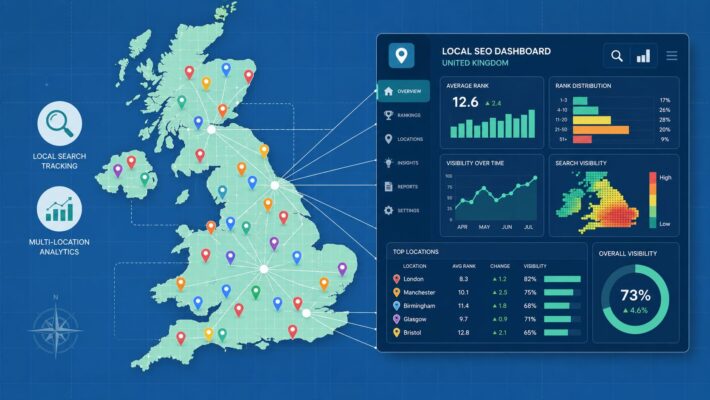
This is where more advanced tools become essential. A geo-grid rank tracker gives you a visual map of your rankings for a specific keyword across a set geographical area. It pinpoints exactly where you’re strong and, more importantly, where you’re weak.
Here’s an example of what a geo-grid report looks like, showing how keyword rankings can vary across different points on a map.
This kind of visual data immediately tells a story. The business ranks well close to its physical address, but its visibility drops off a cliff just a few streets over. That’s a huge opportunity for improvement, laid bare.
Manually checking your rankings from different postcodes is not just impractical, it's often wildly inaccurate. Automated tools give you the precise, neighbourhood-level insights needed to build a truly hyper-local strategy.
By using tools for rank tracking for local keywords, you can turn this data into action. If you spot poor rankings in an affluent part of town, you can create a location-specific page targeting that area to boost your relevance and capture more valuable customers. This level of measurement is what separates good local SEO from a great one.
Common Local SEO Questions Answered
Even with a solid plan in place, getting into the nitty-gritty of local SEO can throw up some practical questions. Getting straight answers is the best way to build the confidence you need to get things done. Here, we'll tackle some of the most common queries business owners have when they're just getting started.
We’ll cover everything from how long it takes to see results, what really separates local from traditional SEO, and how to handle tricky situations like moving your business or dealing with a sudden influx of bad reviews.
How Long Until I See Local SEO Results?
This is the big one, isn't it? The honest answer is, it varies. Local SEO isn't like flicking a switch on a paid ad and watching the traffic roll in. It's more like planting a tree – it needs time to establish roots before you see any real growth.
Generally speaking, you should start seeing some positive movement within three to six months. This might look like a slow climb up the rankings for your main keywords, more phone calls coming from your Google Business Profile, or a noticeable increase in people asking for directions.
A few things can speed this up or slow it down:
- Your Competition: If you're a plumber in central London, you're going to have a tougher fight on your hands than one in a small town with only a couple of other options.
- Your Starting Point: A business with a messy, inconsistent online footprint has a lot more groundwork to do than one that already has the basics sorted.
- Consistency of Effort: This is huge. Actively managing your Google profile, consistently getting new reviews, and building out your local citations will make a massive difference.
What Is the Difference Between Local and Traditional SEO?
While they both aim to get you higher up on Google, their focus is worlds apart. Traditional SEO is all about casting a massive net for national or even global visibility. Think of a blog that wants to be the number one result for "vegan recipes" – that's a traditional SEO play.
Local SEO, on the other hand, operates within a geographical fence. Success is all about being seen by people searching within your specific service area. The real game-changer here is searcher intent. Someone searching locally isn't just looking for an answer; they're looking for a place near them to solve a problem right now. This is why your physical proximity is a massive ranking factor in local search, while it barely matters for traditional SEO.
A good way to picture it is this: traditional SEO is like fishing with a giant net, hoping to catch anyone, anywhere. Local SEO is like spear fishing – you're aiming for a very specific target that's right in front of you and ready to buy.
How Should I Handle Moving My Business Address?
Moving premises is a make-or-break moment for your local SEO. If you get it wrong, you can confuse Google and watch your hard-won rankings disappear. The absolute key is to update your NAP (Name, Address, Phone number) consistently across the board, starting with your Google Business Profile.
The very first thing you should do is change the address in your GBP dashboard. After that, you need to go through all your major citations – think Yelp, Thomson Local, and any important industry directories – and update them one by one. And don't forget your own website! This sends a clear, consistent signal to Google that your move is legitimate and helps transfer your ranking authority over to the new location.
Ready to stop guessing and start growing? LocalHQ gives you the tools to manage your Google Business Profile, track your local rankings with precision, and get AI-powered recommendations to beat the competition. See how it works at https://localhq.io.