10 Powerful Franchise SEO Strategies for Growth in 2026
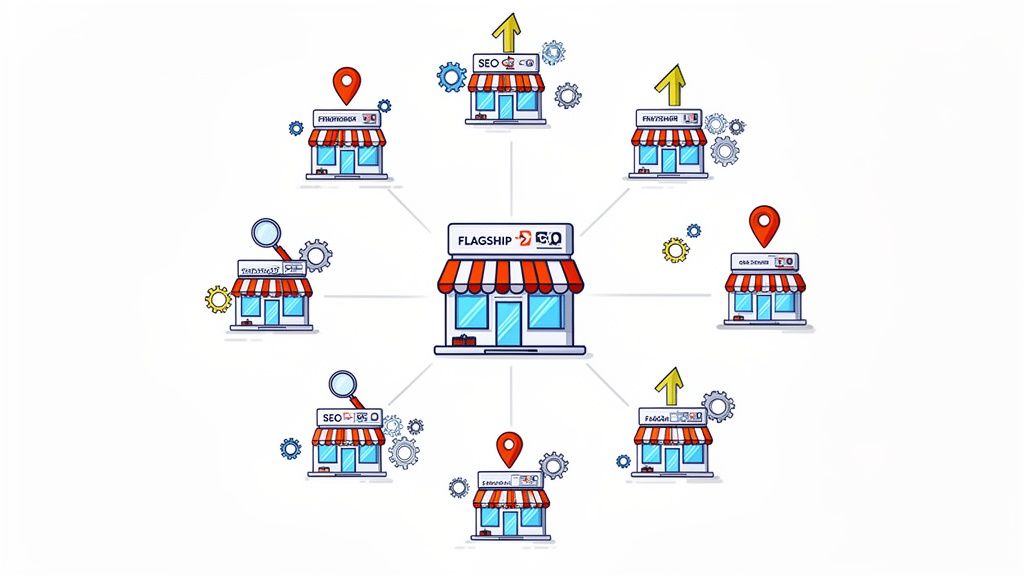
In a competitive market, ensuring each of your franchise locations stands out online is paramount. Standard search engine optimisation (SEO) tactics fall short when managing a multi-location brand. What's required is a specialised approach that balances corporate consistency with local relevance, a challenge that generic advice simply cannot address. This is where effective Franchise SEO Strategies become critical, transforming your digital footprint from a scattered collection of listings into a cohesive, high-performing network that drives real-world results.
This guide provides a comprehensive roundup of 10 essential strategies designed specifically for franchises and multi-location businesses. We will explore actionable techniques for everything from optimising individual Google Business Profiles at scale to implementing a franchise-wide review management system and measuring performance across hundreds of outlets.
These are not theoretical concepts but practical, implementation-ready plans that directly address the unique operational hurdles of franchise marketing. You will learn precisely what to do, why it matters for your business model, and how to track success. By mastering these principles, you can drive measurable growth, increase footfall, and empower every franchisee to succeed in their local market. Let's delve into the strategies that will define your franchise's online success.
1. Localised Google Business Profile Optimisation
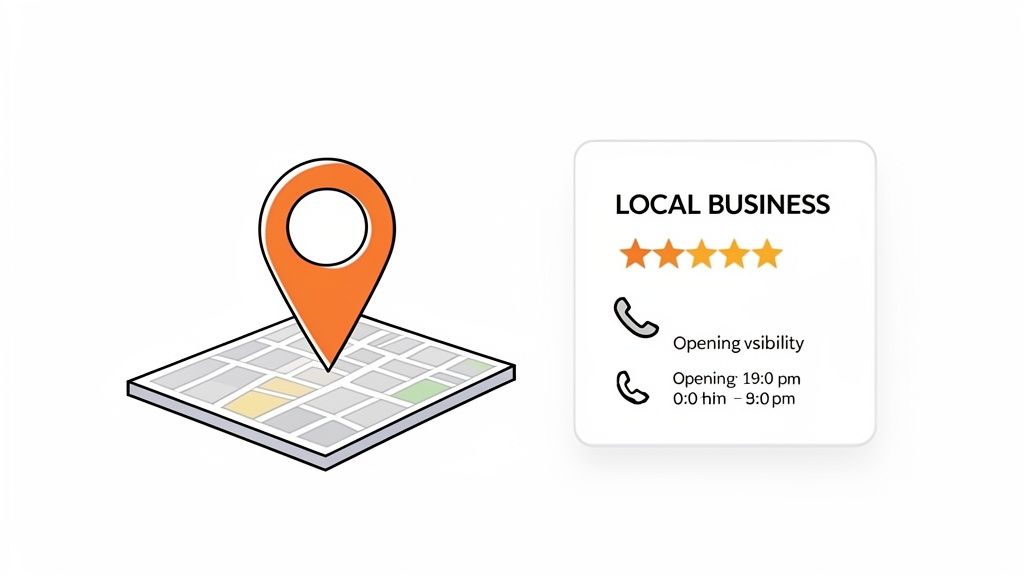
Localised Google Business Profile (GBP) optimisation is the cornerstone of any effective franchise SEO strategy. It involves systematically managing each franchise location's profile with unique, location-specific information. This ensures each branch can compete effectively in its local market, attracting nearby customers searching for relevant products or services, all while maintaining brand consistency.
The goal is to treat each franchise outlet as a distinct local business in Google's eyes. This means moving beyond generic, corporate-level details and embracing hyperlocal data. For example, a national coffee chain would specify local hours, available parking, and drive-thru access for its Manchester Piccadilly store, while highlighting outdoor seating and disabled access for its Brighton Lanes location.
Why It’s a Crucial Franchise SEO Strategy
Without localised optimisation, your franchises compete against each other, cannibalising visibility. A potential customer in Bristol searching for "quick lunch near me" should see your Bristol branch, not the one in Bath. By creating distinct profiles, you maximise your brand’s footprint across the entire search landscape, ensuring the most relevant location appears for each local query. This approach directly boosts foot traffic, local calls, and direction requests for individual franchisees.
How to Implement It
- Conduct a NAP Audit: Ensure the Name, Address, and Phone number (NAP) are 100% accurate and consistent for every single location across the web.
- Customise Business Descriptions: Write a unique description for each profile. Mention local landmarks, neighbourhood names, or community involvement to add a genuine local flavour.
- Select Granular Categories: Choose the most specific primary category possible, then add relevant secondary categories (e.g., "Sandwich Shop," "Deli," "Takeaway Food").
- Define Precise Service Areas: Instead of a generic radius, draw a custom service area that reflects actual delivery zones or the typical travel distance of your customers.
- Utilise Location-Specific Attributes: Add attributes relevant to each branch, such as "Wheelchair-accessible entrance," "Free Wi-Fi," or "Outdoor seating."
For franchises managing dozens or hundreds of locations, manual updates are impractical. Utilising a centralised platform for Google Business Profile management allows you to deploy updates, standardise data, and monitor performance across the entire network efficiently.
2. Franchise-Wide Citation Building and Management
Franchise-wide citation building is the coordinated process of creating and maintaining consistent business listings across relevant online directories, local data aggregators, and industry-specific platforms. For franchises, this strategy ensures that the Name, Address, and Phone number (NAP) for every single location are accurate and uniform everywhere online, from Apple Maps and Yelp to niche industry portals.
The goal is to build a powerful and consistent digital footprint for each franchise outlet, reinforcing its legitimacy and local relevance in the eyes of search engines. For example, a national estate agency would ensure its Manchester branch details are identical on Rightmove, Zoopla, and local Manchester business directories, while its London branch has its own set of perfectly matched citations across corresponding London-centric platforms.
Why It’s a Crucial Franchise SEO Strategy
Inconsistent citations are a major red flag for search engines. When Google finds conflicting information about a location's address or phone number, it erodes trust and negatively impacts local search rankings. A unified citation strategy prevents this by creating a reliable, consistent signal across the web, which validates each location’s existence and boosts its authority. This directly improves local search visibility, making it easier for customers to find their nearest branch.
How to Implement It
- Establish a Master NAP Record: Create a single source of truth for every location's NAP data. This master spreadsheet or database is essential for ensuring all future submissions are 100% consistent.
- Conduct a Comprehensive Citation Audit: Systematically check existing listings for each franchise location across key directories to identify and flag inconsistencies, errors, or duplicate entries.
- Prioritise High-Authority Directories: Focus initial efforts on top-tier data aggregators and directories like Google, Apple Maps, Bing, and Yelp before moving to second-tier and industry-specific sites. An extensive free business directory list can help prioritise these efforts effectively.
- Develop Franchisee Guidelines: Provide clear instructions to franchisees on how to manage any local directory opportunities they encounter, ensuring they use the master NAP data.
- Schedule Regular Maintenance: Citation accuracy degrades over time. Implement a quarterly schedule to re-audit and clean up listings to maintain data integrity across the franchise network.
For multi-location businesses, manually managing hundreds of citations for each branch is an impossible task. Citation management tools and platforms are essential to automate submissions, correct inaccuracies, and suppress duplicates at scale, ensuring consistent brand presence everywhere.
3. Localised Content Strategy with Location Pages
A localised content strategy involves creating dedicated web pages for each franchise location and populating them with unique, locally relevant content. This goes beyond just listing an address; it's about transforming each location page into a rich, hyperlocal resource that serves the specific needs and interests of the local community, significantly boosting its visibility in local search results.
The aim is to build a digital presence for each branch that feels authentic and community-focused. For instance, a national estate agency's location page for Knightsbridge would feature content about local property trends, school catchment areas, and nearby amenities, while its page for rural Yorkshire would focus on country living, local farm shops, and outdoor pursuits. This tailored approach is a cornerstone of modern franchise SEO strategies.
Why It’s a Crucial Franchise SEO Strategy
Without distinct location pages, all local search traffic is directed to a generic corporate homepage, which is often irrelevant to a user's specific local needs. This creates a poor user experience and sends weak ranking signals to search engines. By creating optimised location pages, you build authority for each branch, allowing them to rank for local keywords like "best MOT centre in Sheffield" or "emergency plumber near me in Croydon." This strategy directly captures high-intent local searchers and drives qualified leads to the correct franchisee.
How to Implement It
- Develop a Robust Page Template: Create a standardised template for all location pages that includes essential modules: NAP details, an interactive map, location-specific opening hours, local testimonials, and a team bio section.
- Conduct Local Keyword Research: Use tools to identify keywords specific to each location's service area. This includes neighbourhood names, local landmarks, and regional terminology.
- Create Hyperlocal Content: Go beyond services. Write about local community involvement, sponsor a local team and write about it, or create guides to nearby attractions. This signals to Google that you are a genuine local entity.
- Feature Location-Specific Testimonials: Embed Google reviews or video testimonials from customers who have visited that specific branch. This builds trust and adds unique, keyword-rich content.
- Use Local Business Schema Markup: Implement structured data on each page to explicitly tell search engines the location's name, address, phone number, opening times, and geo-coordinates.
4. Franchise-Wide Review Management and Response Strategy
A franchise-wide review management and response strategy involves the systematic encouragement, monitoring, and handling of customer feedback across all locations. This unified approach ensures that reviews are leveraged as a powerful tool for building trust, improving local SEO rankings, and gathering operational insights, all while maintaining a consistent brand voice.
The goal is to centralise control over reputation management while empowering local franchisees to engage with their customers authentically. For instance, a national home services franchise might use automated SMS messages to request reviews after a job is completed, while providing franchisees with pre-approved templates to respond to both positive and negative feedback within 24 hours, ensuring every customer interaction reinforces brand values.
Why It’s a Crucial Franchise SEO Strategy
Reviews are a major ranking factor in local search, and a high volume of recent, positive reviews signals to Google that a specific franchise location is a credible and popular choice. Without a cohesive strategy, review management becomes chaotic, leading to inconsistent response times, off-brand replies, and missed opportunities to resolve customer issues. A coordinated effort boosts the visibility of individual locations and strengthens the reputation of the entire brand network.
How to Implement It
- Establish a Review Request Workflow: Implement an automated system, often triggered by a transaction or service completion, that sends customers a direct link to leave a review on key platforms like Google.
- Create Brand-Approved Response Templates: Develop a library of customisable templates for common scenarios (e.g., positive feedback, complaints about service, comments on pricing). This ensures brand consistency while allowing for personalisation.
- Set Clear Response SLAs: Mandate a Service Level Agreement (SLA) for responding to all reviews, ideally within 24-48 hours, to show customers their feedback is valued.
- Train Franchisees on Best Practices: Provide training on how to handle negative reviews professionally, turning potential detractors into brand advocates by offering solutions.
- Analyse Review Data for Insights: Regularly analyse review sentiment and content across all locations to identify recurring operational issues or opportunities for service improvement. For a comprehensive approach to managing customer feedback, consider consulting an essential online reputation management guide that covers proactive and reactive strategies.
5. Geo-Targeted Keyword Strategy with Rank Tracking
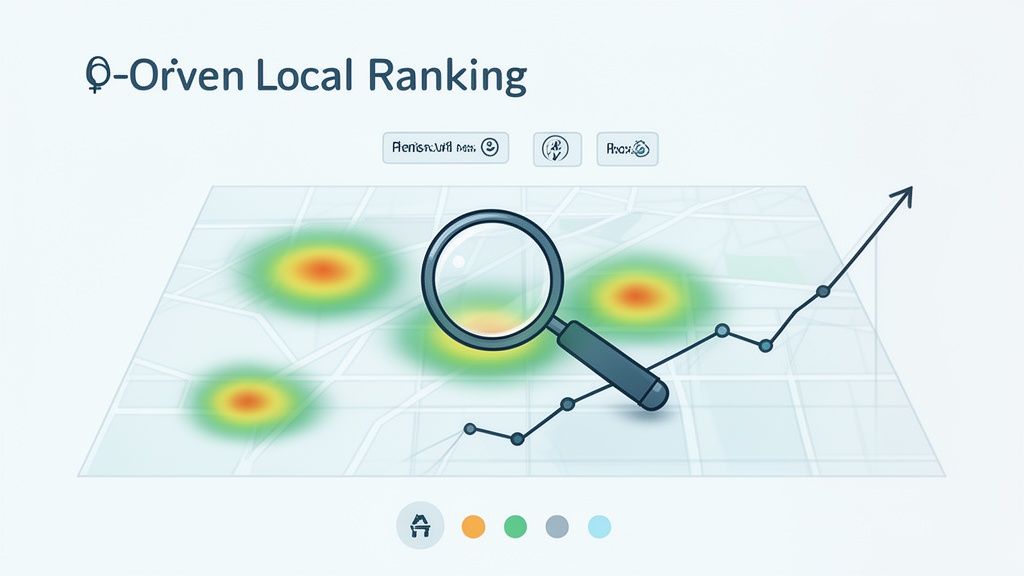
A geo-targeted keyword strategy involves identifying and optimising for search terms that customers in specific geographic areas use. It moves beyond generic brand terms to capture local search intent, supported by rank tracking tools that visualise how each franchise location performs in its unique market. This data-driven approach allows you to tailor content and SEO efforts with precision.
The goal is to understand and dominate the search landscape on a street-by-street basis. For instance, a home services franchise would track rankings for ‘plumber in Islington’ separately from ‘emergency boiler repair in Hackney’, even if the same branch serves both areas. This granular insight reveals where visibility is strong and where competitors have an edge.
Why It’s a Crucial Franchise SEO Strategy
Without localised keyword tracking, you are essentially flying blind. You might rank number one for a key term when searching from your head office, but appear on page three for customers just a few miles away from a franchise location. Geo-targeted data uncovers these blind spots, enabling you to allocate resources effectively and prove ROI to franchisees. It ensures your franchise SEO strategies are based on real-world customer search behaviour, not assumptions.
How to Implement It
- Identify Location-Specific Keywords: Research keywords combining your service with specific cities, postcodes, and even neighbourhood names (e.g., ‘best coffee near Shoreditch High Street’). To effectively target potential customers in specific areas, a robust geo-targeted keyword strategy is essential. Learn how to identify and leverage the most impactful local SEO keywords that drive growth for each franchise location.
- Group Keywords by Service and Location: Organise keywords into logical groups, such as ‘[Service] + [City]’ or ‘[Product] + [Neighbourhood]’. This makes performance analysis much clearer.
- Utilise Geo-Grid Rank Tracking: Use tools that show keyword rankings on a map-based grid. This visualises your search visibility across a service area, highlighting strengths and weaknesses.
- Track Branded and Non-Branded Terms: Monitor both searches for your brand name (e.g., ‘PizzaHub Bristol’) and generic terms (e.g., ‘pizza delivery near me’) to understand brand recognition and capture new customers.
- Analyse and Adapt: Regularly review performance reports. If rankings for a high-value term are slipping in a key area, adjust the corresponding location page content or Google Business Profile to better target that keyword.
6. Centralised Brand Management with Location Autonomy
This strategy strikes a crucial balance between maintaining corporate brand standards and empowering individual franchisees with the flexibility to adapt to their local markets. It’s about creating a framework where core brand messaging, visual identity, and service quality remain consistent network-wide, while allowing local operators the freedom to engage with their communities and compete effectively on a hyperlocal level.
The goal is to prevent a one-size-fits-all approach that ignores regional nuances. For instance, a national hotel chain would enforce brand-wide standards for room cleanliness and customer service but allow its Cornwall branch to promote local surfing packages and partner with nearby seafood restaurants. This blend of centralised control and local autonomy is a powerful component of modern franchise SEO strategies, ensuring both brand integrity and local relevance.
Why It’s a Crucial Franchise SEO Strategy
Without this balance, franchises risk appearing generic and disconnected from the communities they serve. Empowering franchisees with local autonomy allows them to create content, run promotions, and build partnerships that resonate with their specific audience. This local authenticity builds trust and drives engagement, directly translating into better local search rankings, more positive reviews, and increased foot traffic. It allows the brand to benefit from the franchisee’s on-the-ground knowledge, making marketing efforts far more effective.
How to Implement It
- Create Clear Brand Guidelines: Develop a comprehensive document covering SEO best practices, content tone, and visual standards that all franchisees must follow.
- Develop Customisable Templates: Provide pre-approved templates for social media posts, local landing pages, and email campaigns that franchisees can adapt with local details.
- Establish an Approval Workflow: Implement a lightweight system for reviewing and approving local marketing initiatives to ensure they align with brand standards without causing bottlenecks.
- Provide Training and Support: Regularly train franchisees on the importance of local SEO and how their efforts contribute to the brand’s overall success.
- Foster Collaboration: Create channels, like a shared forum or regular calls, for franchisees to share local insights, successful campaigns, and best practices with the entire network.
7. Multi-Location Post and Content Calendar Strategy
A multi-location post and content calendar strategy involves a coordinated approach to scheduling and distributing regular updates across all franchise locations. This system centralises the creation of corporate-approved posts, location-specific announcements, and user-generated content, ensuring a consistent yet locally relevant presence on platforms like Google Business Profile.
The goal is to maintain an active and engaging digital storefront for every single franchise outlet. For instance, a national fitness franchise might use a central calendar to push out a company-wide "New Year, New You" promotion, while also allowing individual gyms in Manchester and Leeds to schedule their own posts about local class timetables, member spotlights, or community events.
Why It’s a Crucial Franchise SEO Strategy
Regular, relevant posts on your Google Business Profile send strong signals to Google that your listings are active and well-managed. This consistent activity, known as "local search signals," can positively impact your local rankings and visibility. For franchises, this strategy ensures that no location is left behind, keeping the entire network engaged and visible to potential customers in their respective areas.
A coordinated calendar prevents content from becoming stale or repetitive. It allows the brand to maintain control over messaging while empowering franchisees to share authentic, local content that resonates with their community. This blend of corporate and local information builds trust and drives direct actions, such as calls, website clicks, and direction requests.
How to Implement It
- Establish a Content Mix: Aim for an 80/20 split. 80% of content can be centrally created corporate promotions, brand messages, and seasonal campaigns, while 20% should be unique local content like team photos, customer testimonials, or community news.
- Create a Template Library: Develop a library of pre-approved post templates (images, copy, calls-to-action) that franchisees can easily customise for their specific location. This maintains brand consistency while saving time.
- Schedule Consistently: Plan to publish at least two to three posts per week for each location. Consistency is more important than volume. Use a scheduling tool to plan content weeks or months in advance.
- Promote Events Strategically: For any local events, create a series of posts to build anticipation: an initial announcement, a reminder a week before, and a final "happening now" post.
- Incorporate Calls-to-Action (CTAs): Every post should guide the user. Use clear CTAs like "Book Now," "Call Us Today," or "Learn More" to drive conversions directly from the search results page.
Managing this process manually is unfeasible for a growing franchise network. Platforms with a centralised content scheduling feature are essential for efficiently deploying, customising, and analysing post performance across all locations from a single dashboard.
8. Structured Data and Schema Markup Implementation
Structured data implementation, using Schema.org vocabulary, is a powerful technical SEO strategy that translates your website's content into a language search engines can easily understand. For franchises, it involves adding specific code to each location's webpage that explicitly details information like opening hours, services offered, address, and customer ratings. This helps search engines to not only crawl but to comprehend the context of your data.
The goal is to provide unambiguous signals about each franchise outlet. For instance, a home services franchise can use schema to specify its exact service area and list of available services, while a restaurant chain can mark up its menu, average price range, and reservation links. This structured information can then be used by Google to generate "rich snippets" – visually enhanced search results that stand out and provide immediate value to users.
Why It’s a Crucial Franchise SEO Strategy
Without schema markup, search engines are left to interpret your page content, which can lead to inaccuracies or missed opportunities. For a multi-location business, this is particularly risky as location-specific details might be overlooked. By implementing structured data, you spoon-feed Google precise information for each branch, significantly increasing your chances of appearing in Knowledge Panels and earning rich snippets like star ratings or event listings directly in the search results. This improved visibility drives higher click-through rates and provides a more informative user experience before anyone even visits your site.
How to Implement It
- Start with LocalBusiness Schema: This is the foundational markup for any physical franchise location. Ensure it includes accurate NAP (Name, Address, Phone number) details for each specific branch.
- Implement AggregateRating Schema: Add this to display star ratings and review counts directly in the search engine results pages (SERPs), building immediate trust with potential customers.
- Use Service or Product Schema: Detail the specific services or products offered at each location. For example, a healthcare clinic could list its medical specialities, while a retail store could highlight available stock.
- Promote with Event Schema: If a franchise location is hosting a local sale, workshop, or community event, use Event schema to promote it directly in search results.
- Validate Your Markup: Always use Google's Rich Results Test tool to ensure your code is correctly implemented and eligible for rich snippet display before deploying it.
9. Location Performance Analytics and ROI Measurement
Location performance analytics involves a comprehensive approach to tracking, measuring, and understanding the impact of your SEO efforts on each individual franchise location. It moves beyond broad brand-level metrics to focus on hyperlocal data, including impressions, clicks, calls, direction requests, and attributed revenue. This data-driven strategy is essential for demonstrating value and making informed decisions across your network.
The goal is to connect your online optimisation efforts directly to real-world business outcomes for each franchisee. For example, a national dental practice would track not just its local search rankings, but how many appointment requests were generated from its Google Business Profile in a specific town. This allows you to benchmark performance, identify high-achieving branches, and prove the return on investment (ROI) to stakeholders.
Why It’s a Crucial Franchise SEO Strategy
Without granular performance data, it’s impossible to know what’s working and what isn’t. You risk investing in strategies that don’t deliver tangible results, leading to franchisee dissatisfaction and wasted marketing spend. By measuring location-specific KPIs, you can pinpoint underperforming locations that need support, replicate the successful tactics of top performers across the network, and justify continued investment in your franchise SEO strategies. This transparency builds trust and empowers both corporate and local teams to drive growth.
How to Implement It
- Establish Core KPIs: Define the key performance indicators that matter most, such as GBP impressions, website clicks, direction requests, phone calls, and form submissions.
- Utilise Tracking Tools: Implement tools like Google Analytics, Search Console, and specialised call tracking software for each location to capture accurate data.
- Calculate Local SEO ROI: Attribute a monetary value to leads (e.g., average value of a phone call or booking) to calculate the specific ROI for each location’s SEO investment.
- Create Performance Dashboards: Develop clear, easy-to-understand dashboards that present performance data for different stakeholders, from individual franchisees to executive leadership.
- Conduct Regular Reviews: Schedule quarterly business reviews to analyse performance trends, discuss insights, and collaboratively plan the next phase of optimisation.
For a franchise, manually compiling and analysing this data for every outlet is a monumental task. A centralised platform designed for multi-location businesses can automate data aggregation and reporting, providing clear, actionable insights and performance scorecards for every single location in your portfolio.
10. Competitive Local SEO Monitoring and Benchmarking
Competitive local SEO monitoring and benchmarking is a systematic process of tracking and analysing competitors' activities in local search. This involves evaluating their keyword rankings, review profiles, content, and Google Business Profile tactics to identify strategic opportunities. For a franchise, this means not only looking at external rivals but also benchmarking individual locations against each other to uncover best practices within the network.
The goal is to move from reactive marketing to a proactive, data-informed strategy. A home services franchise, for instance, could systematically track which competitors rank for "emergency plumber in Bristol" versus "boiler service in Leeds." By analysing the top performers' strategies in each market, the franchise can develop a repeatable blueprint for success, applying winning tactics from one location to others and addressing underperforming areas before they become a major issue.
Why It’s a Crucial Franchise SEO Strategy
Without consistent monitoring, your franchisees are operating in the dark. A competitor could be launching new offers, gaining traction with positive reviews, or outranking them for crucial local keywords without anyone at a corporate level noticing. This strategy allows you to spot threats early and identify gaps in your own approach. Benchmarking also fosters healthy internal competition, motivating franchisees by showing them what high-performing peers are achieving and how.
How to Implement It
- Identify Key Competitors: For each franchise location, identify 2-3 direct local competitors. These are the businesses that appear alongside your location in local map packs for your main keywords.
- Track Local Keyword Rankings: Monitor your and your competitors' rankings for high-intent local search terms (e.g., "fast food near me," "solicitors in Manchester").
- Analyse Review Profiles: Regularly assess competitors' review volume, average rating, and response patterns. Note their response times and the tone they use.
- Audit Competitor GBP Profiles: Examine their use of Google Posts, the completeness of their service lists, the quality and frequency of their photo uploads, and any special offers.
- Benchmark Internally: Use performance data to compare your own franchise locations. Identify top-performing branches and analyse their strategies to create internal case studies and best-practice guides.
Leveraging a platform to automate this intelligence-gathering is key for franchises. It allows you to build customised dashboards that track competitor rankings, review metrics, and other key data points across hundreds of locations, turning raw data into actionable insights for your entire network.
Franchise SEO: 10-Point Comparison
| Strategy | Implementation 🔄 | Resources ⚡ | Expected Outcomes 📊⭐ | Ideal Use Cases 💡 | Key Advantages ⭐ |
|---|---|---|---|---|---|
| Localised Google Business Profile Optimisation | 🔄 Medium — per-location upkeep and audits | ⚡ Moderate — GBP tools, templates, staff training | 📊 High local visibility and foot traffic; ⭐⭐⭐⭐ | Multi-location brands seeking local pack presence per store | Accurate NAP, location relevance, increased calls/directions |
| Franchise-Wide Citation Building and Management | 🔄 High — large-scale submission & verification | ⚡ High — listings tools, manual submissions, ongoing maintenance | 📊 Foundational SEO authority; ⭐⭐⭐⭐ | Large networks expanding into new markets or consolidating listings | Consistent NAP, broader discovery, improved local rankings |
| Localised Content Strategy with Location Pages | 🔄 Medium‑High — content creation & governance | ⚡ High — writers, SEO, editorial processes | 📊 High organic traffic and engagement; ⭐⭐⭐⭐ | Brands needing differentiation and local relevance per market | Unique local content, improved SERPs, higher dwell time |
| Franchise-Wide Review Management and Response Strategy | 🔄 Low‑Medium — workflows + response templates | ⚡ Moderate — automation tools, training | 📊 Very high conversion and ranking impact; ⭐⭐⭐⭐⭐ | All franchises focused on reputation and conversion lift | Builds social proof, increases conversions, actionable feedback |
| Geo-Targeted Keyword Strategy with Rank Tracking | 🔄 Medium — ongoing research & tracking | ⚡ Moderate — rank trackers, analyst time | 📊 High measurement and prioritisation; ⭐⭐⭐⭐ | Locations needing data-driven keyword prioritisation | Identifies opportunities, measures ROI, guides resource allocation |
| Centralised Brand Management with Location Autonomy | 🔄 Medium‑High — governance and approval workflows | ⚡ Moderate‑High — dashboard, training, templates | 📊 High brand protection and scalable local marketing; ⭐⭐⭐⭐ | Franchises balancing corporate standards with local marketing | Consistency + local flexibility, reduced rogue marketing |
| Multi-Location Post and Content Calendar Strategy | 🔄 Low‑Medium — planning and approvals | ⚡ Moderate — scheduling tools, content library | 📊 Medium‑High engagement and GBP signals; ⭐⭐⭐ | Chains needing regular local engagement and promotions | Consistent posting, time savings, improved local engagement |
| Structured Data and Schema Markup Implementation | 🔄 Medium‑High — technical implementation & validation | ⚡ Moderate — developer time, validation tools | 📊 Medium CTR and SERP appearance gains; ⭐⭐⭐ | Sites wanting rich snippets and better SERP display | Rich snippets, knowledge panel accuracy, voice search support |
| Location Performance Analytics and ROI Measurement | 🔄 Medium — integrations and reporting | ⚡ Moderate‑High — analytics stack, attribution tools | 📊 Very high ROI visibility and accountability; ⭐⭐⭐⭐⭐ | Franchises needing proof-of-value and budget decisions | Clear ROI, benchmarking, data-driven optimisation |
| Competitive Local SEO Monitoring and Benchmarking | 🔄 Low‑Medium — continuous monitoring | ⚡ Moderate — competitive tools, analyst review | 📊 High strategic insights and prioritisation; ⭐⭐⭐⭐ | Markets with strong local competition to track threats/opps | Identifies gaps, informs strategy, benchmark-driven goals |
From Strategy to Success: Activating Your Franchise's SEO Potential
Navigating the complexities of multi-location search optimisation can feel like a monumental task, but it doesn't have to be. The ten franchise SEO strategies detailed in this article provide a comprehensive blueprint for transforming your brand’s digital footprint from a scattered collection of individual outposts into a unified, high-performing network. The path to local search dominance is paved with consistent, localised effort, and success is built on a foundation of both centralised oversight and franchisee empowerment.
The journey begins with mastering the fundamentals: immaculate Google Business Profiles for every location, a robust and consistent citation network, and hyper-localised landing pages that speak directly to community needs. These elements form the bedrock of your local visibility, establishing trust and authority with both search engines and potential customers. From there, it's about building a dynamic and engaging presence through proactive review management, targeted local content, and a sophisticated, geo-specific keyword strategy.
The Power of a Unified-Yet-Localised Approach
One of the most critical takeaways is the delicate balance between brand consistency and local autonomy. A rigid, top-down approach can stifle the very local flavour that makes individual franchises successful. Conversely, complete freedom can lead to brand dilution and inconsistent messaging. The most effective franchise SEO strategies create a framework where the corporate team provides the tools, templates, and overarching brand guidelines, while franchisees inject authentic, local insights.
This synergy is where true growth happens. It allows for:
- Centralised brand protection: Ensuring core messaging, logos, and promotions are consistent across the board.
- Localised marketing agility: Empowering franchisees to post about local events, share community-specific news, and respond to reviews with genuine local knowledge.
- Scalable efficiency: Using centralised tools to manage listings and analyse data, freeing up local managers to focus on customer service and operations.
From Data to Decisions: Measuring What Matters
Ultimately, a strategy is only as good as the results it produces. This is why implementing a rigorous system for analytics and ROI measurement is non-negotiable. Tracking Key Performance Indicators (KPIs) like local pack rankings, GBP actions (calls, website clicks, direction requests), and location-specific conversion rates moves your efforts from guesswork to a data-driven science. By regularly benchmarking against local competitors, you can identify opportunities, mitigate threats, and continuously refine your approach to stay ahead of the curve.
Embracing structured data and schema markup further solidifies your technical foundation, giving search engines the explicit context they need to showcase your locations prominently in rich results. This technical precision, combined with a human-centric content and review strategy, creates a powerful engine for sustainable local growth. The principles outlined are not just a checklist to be completed once; they represent an ongoing cycle of implementation, measurement, and optimisation. By committing to this process, you create a powerful, scalable system that drives footfall, boosts revenue, and secures a lasting competitive advantage for every single location flying your brand's flag. The journey from scattered listings to a cohesive local powerhouse begins with the first step.
Ready to stop juggling dozens of spreadsheets and disjointed tools? LocalHQ centralises all the critical franchise SEO strategies discussed here into one powerful platform, from GBP management and review responses to multi-location posting and performance analytics. See how you can unify your local marketing and drive measurable growth across your entire franchise network by exploring LocalHQ today.