White Label SEO Audit: A Complete Guide for UK Agencies

Most agencies already have the client call, the SEO tools, and the reporting template. The part that still feels messy is turning a site crawl, backlink export, and local visibility snapshot into something you can resell under your own name without drowning your team in manual work. That's where a well-built white label SEO audit becomes a proper service line rather than a one-off document.
For UK agencies, the opportunity is sharper than generic technical SEO. A good audit has to speak to rankings, site health, and local discovery in the same package, because that's how clients experience search in the real world. If the report doesn't help a restaurant, solicitor, clinic, or multi-location brand understand what's happening in Google Search and Google Maps, it won't feel commercially useful.
Defining Your White-Label SEO Audit Scope
A serious white label SEO audit starts with scope, not software. The strongest audits are built around measurable performance indicators that agencies can resell under their own brand, and current white-label guidance says an effective report should include current keyword positions with historical trend data, month-over-month and year-over-year organic sessions, backlink counts and referring domains, Core Web Vitals, crawl errors, and Google Business Profile visibility. That metric set matters because it connects organic performance, technical health, and local discovery in one deliverable, which is exactly what UK service businesses need from an agency partner (rankai.ai).
Start with four audit pillars
The easiest way to keep the scope disciplined is to separate the work into technical, on-page, off-page, and local analysis. Technical issues tell you whether search engines can crawl and understand the site. On-page checks show whether the content matches the target intent. Off-page review covers backlinks and brand signals. Local analysis shows whether the business is visible where UK buyers are searching, especially in maps and local packs.
Practical rule: if a finding doesn't change a client decision, a priority order, or a next action, it doesn't belong in the audit.
That rule saves time and keeps the report from turning into a data dump. It also makes it easier to package the audit for different client types, because the same structure can work for a single-location trades business, a hospitality brand, or a regional professional services firm. For white labelling itself, the operational advantage is simple, agencies can present specialist work under their own brand without having to build every delivery layer in-house, which is why many teams treat white labelling as a capacity multiplier rather than just a presentation choice. A useful primer on the agency side of that model is the benefits of white labeling for agencies.
Make local visibility part of the scope from day one
UK agencies often over-index on sitewide technical health and under-specify location performance. That's a mistake when the client's revenue depends on local intent, Google Business Profile interactions, or multi-location visibility. A better scope definition includes location pages, map-pack presence, and city or service-area visibility gaps, not just homepage rankings. For a focused framework built around that logic, the UK agency's local SEO growth playbook is a sensible internal reference point.
The scope should also reflect the client's business model. A national brand with branch pages needs a different audit emphasis from a solicitor with a single office, even if the same tool stack is used. The point is to define the audit by commercial value, not by what the software happens to spit out first.
Gathering Audit Data Efficiently
The fastest audits aren't the shallowest ones, they're the ones where data collection is structured. A recurring gap in existing white label SEO audit content is that it explains audit outputs, but not whether the findings reflect local-search performance for UK businesses. Most guides don't answer the practical question agencies ask, how to translate an audit into place-based visibility, such as Google Business Profile, map-pack, or hyperlocal ranking gaps (thatisrank.com).
Build the crawl first, then verify the strange parts
Start with a site crawl and treat it as the backbone of the audit. That gives you the page set, the internal structure, canonical patterns, and the obvious technical problems. After that, verify the findings with secondary sources such as Google Search Console and PageSpeed Insights, because crawlers can surface symptoms that don't always reflect how Google is seeing the site. The technical scope should explicitly include canonicalization, robots directives, sitemap coverage, server responses, and Core Web Vitals such as LCP, CLS, and INP (searcle.ai).
That sequence matters. If you start with manual spot checks, the work gets slow and inconsistent. If you start with raw exports and never validate them, you risk sending a client a neat report full of misleading priorities. A controlled workflow keeps the audit credible and repeatable, especially when different team members are handling different accounts.
Treat local data as a separate collection job
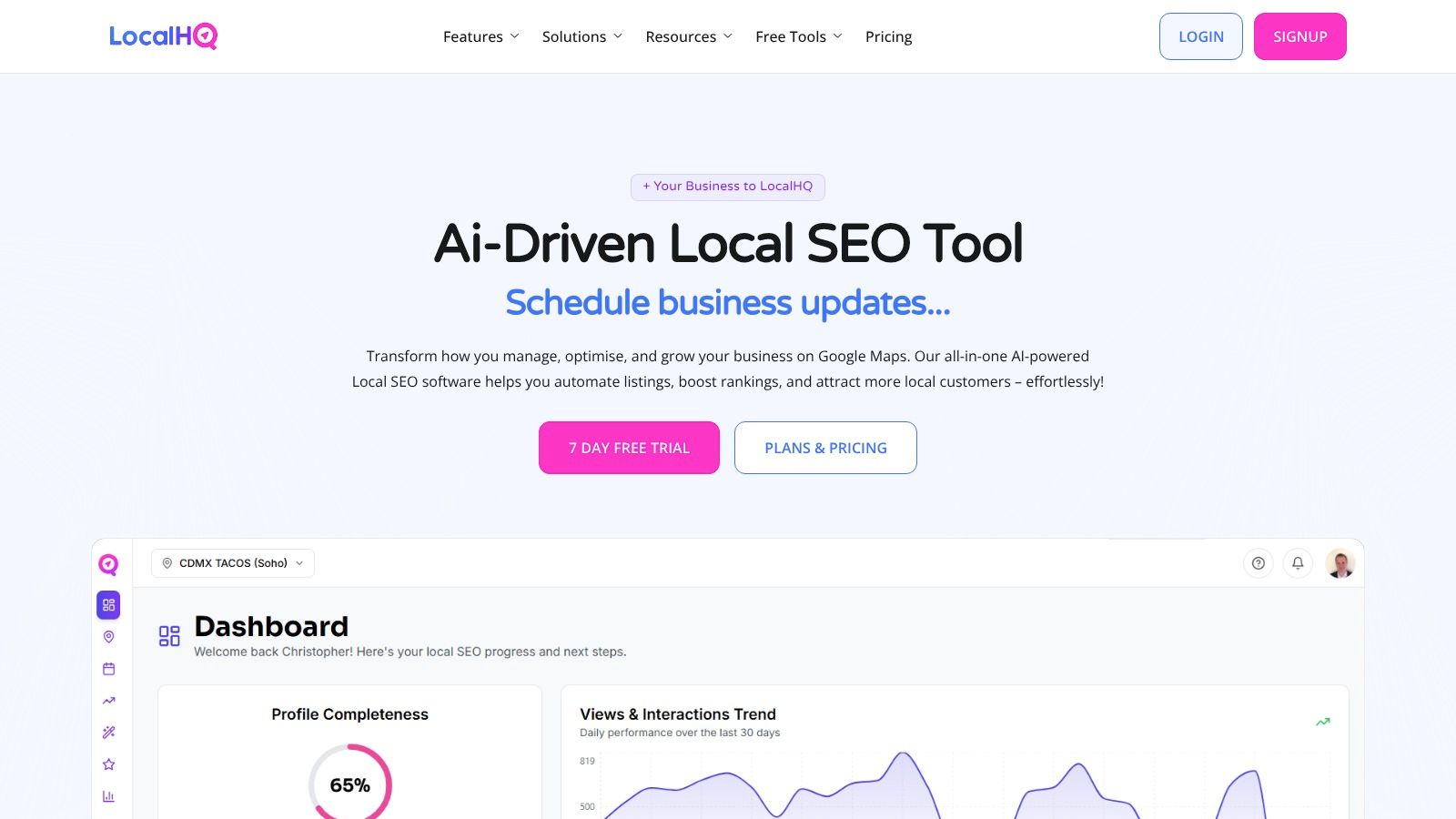
Local SEO is usually the most time-consuming layer because it can't be reduced to a simple site export. GBP data, map visibility, and hyperlocal ranking patterns need a different workflow from page-level metadata review. In practice, that means combining business-profile checks with location-specific tracking rather than assuming one dashboard tells the full story. A platform such as the LocalHQ platform for local SEO can help structure that work without forcing analysts to assemble everything manually.
Useful shortcut: if the client sells to multiple locations or serves a defined area, collect the local data before you write the summary. The local findings usually shape the story the client actually cares about.
When you need to pull data at scale, the challenge isn't just the crawl, it's staying efficient around the edges. That's where teams often think about bypassing anti-bot systems, not as a gimmick, but as a reminder that resilient collection workflows need to be reliable when external sources are awkward to access.
Automating Your Audit Creation and Reporting
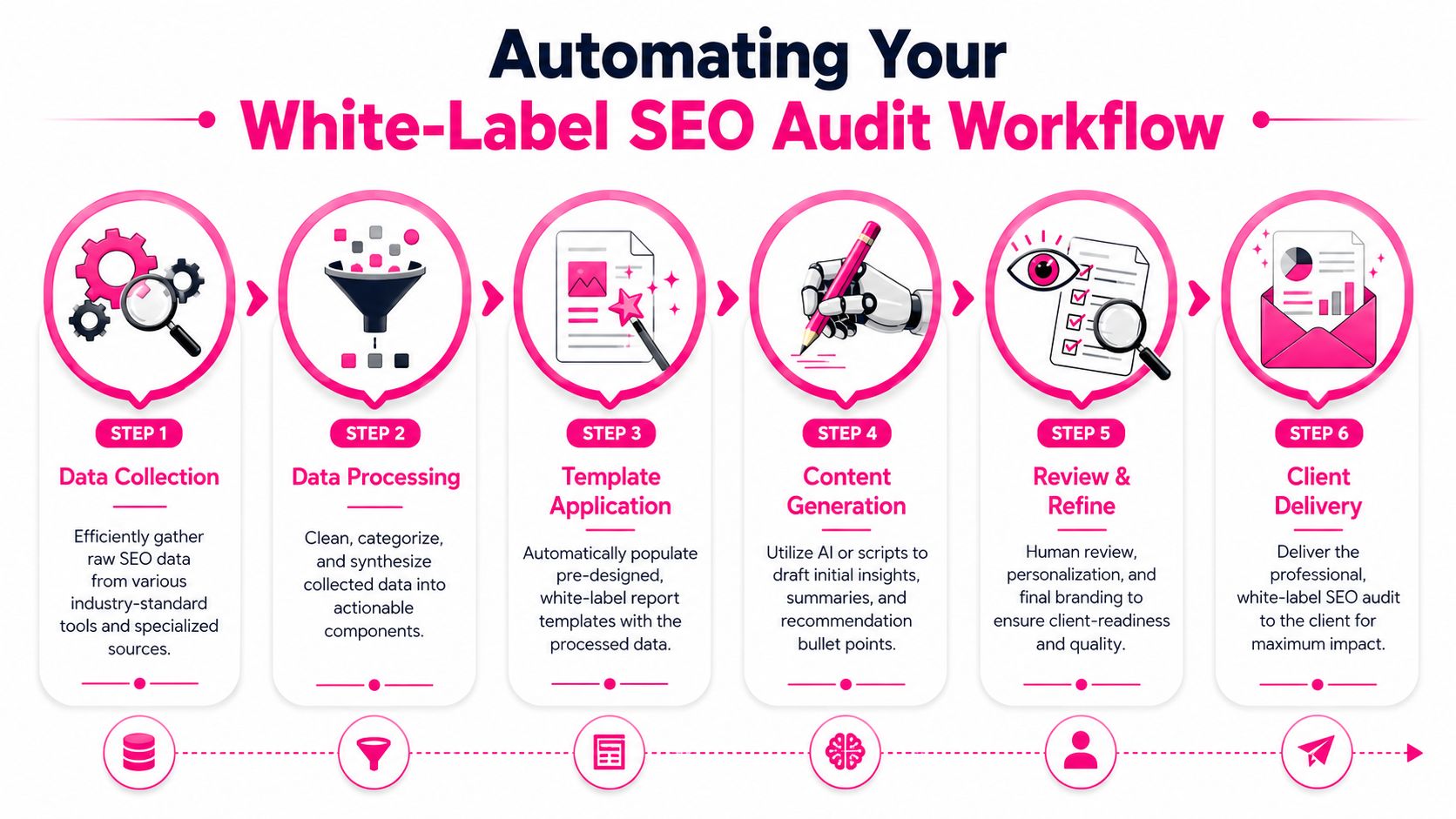
Once the data collection is stable, the service becomes profitable only when the reporting layer is automated. A robust white-label SEO audit should be run as a controlled workflow, crawl the site, verify issues with secondary sources such as Google Search Console and PageSpeed Insights, then score findings by priority before packaging them into a client-ready report. The same workflow should cover canonicalization, robots directives, sitemap coverage, server responses, and Core Web Vitals, because those are the kinds of issues that recur across accounts and can be standardised without losing quality (searcle.ai).
Turn repeatable tasks into templated steps
The most efficient agencies treat the audit like a production line with human review at the right points. Data comes in, gets cleaned, mapped to the template, and then converted into a client-facing narrative. That's where report templates, scheduled refreshes, and branded dashboards pay for themselves, because they stop every account from becoming a bespoke design job.
The value of automation isn't just speed. It's consistency. A report that uses the same structure across clients is easier to QA, easier to present, and easier to upsell from, because your team can explain what each section means without re-learning the format every time.
Use tools that support branded delivery
If the platform can auto-populate a dashboard or PDF under your own branding, your team stops wasting time on formatting and starts spending more time on interpretation. That's especially useful for agencies that need to send the same core audit to different client types, then add only the specific commentary that matters. The reporting stack can include a local-performance layer too, and a GMB performance analysis tool is a practical example of how local visibility data can be folded into a client-ready package.
Human review still matters. Automation should draft the report, not decide the commercial story.
Used properly, the automation layer also protects margin. The report is no longer a hand-built artefact, it becomes a repeatable asset that can be sold, reviewed, and delivered without tying senior staff to every task.
Structuring the Perfect Audit Deliverable
A strong audit reads like a decision document, not a spreadsheet in disguise. The best version I've seen in agency work starts with a short executive summary that tells the client what's broken, what's most valuable, and what happens next. Then it moves into a prioritised action plan, followed by themed findings under technical, on-page, and local headings.
Lead with business impact, not diagnostics
A client doesn't want to hear that a crawl found a dozen warnings before they understand whether the site is leaking opportunities. Open with the plain-English version, then show the evidence. For example, a local service business needs to know whether map visibility is weak, whether important pages are underperforming, and which fixes should happen first. If those points are buried after too much technical detail, the report loses its sales value.
Screenshots and annotations are particularly helpful. A clean image of a canonical issue or a page-speed problem is usually more convincing than a paragraph of terminology. The point is not to impress with jargon, it's to make the next action obvious.
Make the action plan read like a roadmap
The action plan should be ranked, specific, and short enough that a director can scan it in a meeting. I'd separate the work into immediate fixes, structural improvements, and longer-term content or authority work. That keeps the client focused on sequence rather than arguing over every issue at once.
Use the local layer to sharpen the narrative when appropriate. If the business depends on local demand, a clear visibility gap in Maps is often more persuasive than a general technical issue. A good place to surface that kind of opportunity is Uncover local search opportunities, because it keeps the conversation tied to demand rather than vanity metrics.
Good reports create movement. The client should finish the call knowing what to approve, what to defer, and what the next engagement looks like.
That's why the deliverable should double as a sales tool. If the document is coherent, prioritised, and written in business language, it naturally opens the door to retainer work.
Pricing and Packaging Your Audit Service
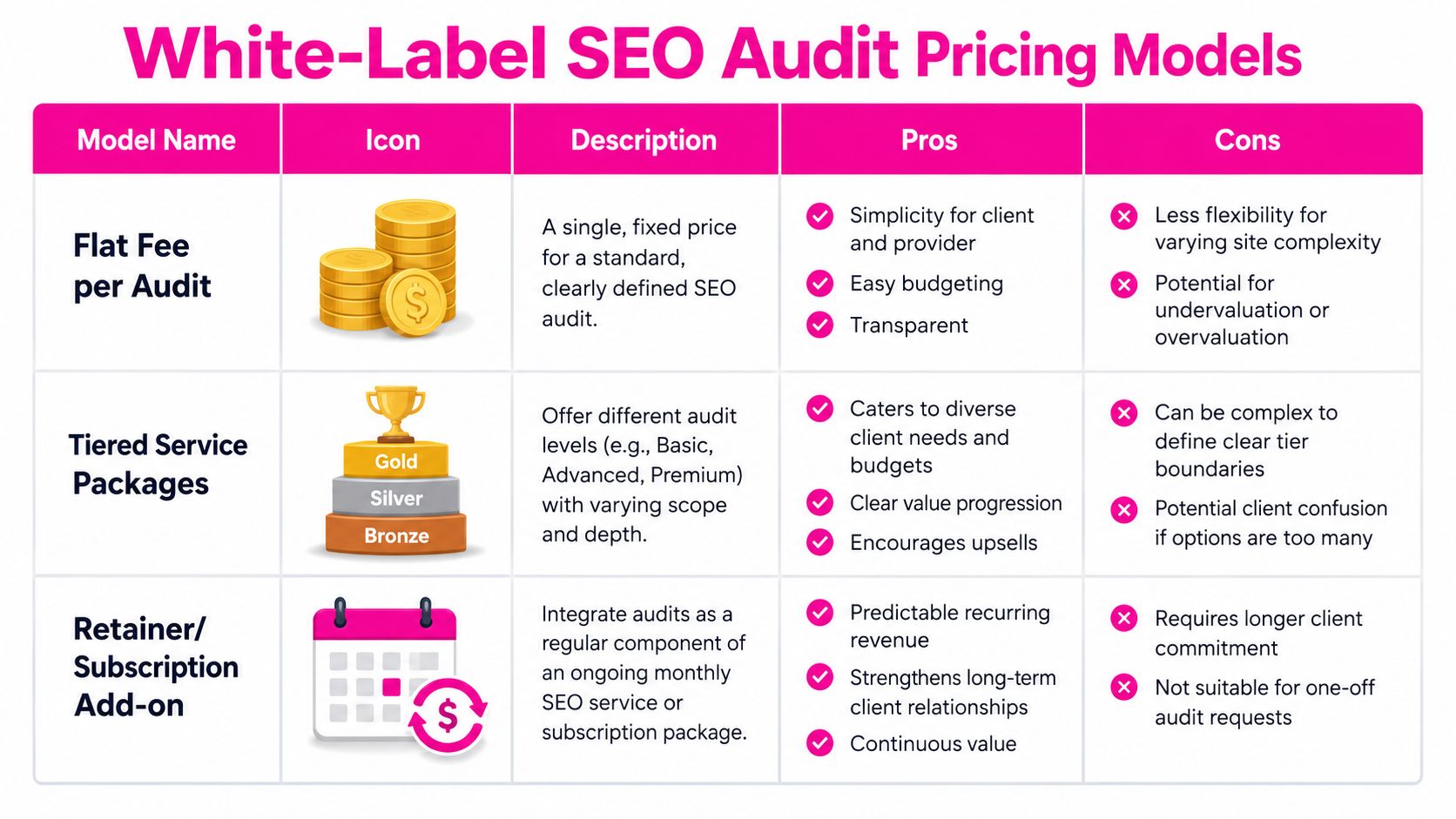
Once the workflow is stable, pricing becomes a packaging decision, not a guessing game. A white label SEO audit can be sold as a one-off product, used as a lead magnet, or folded into a larger retainer. Each model has a different commercial purpose, and the right one depends on whether the audit is meant to generate leads, close projects, or seed ongoing account work.
Choose the model that matches the sales motion
A flat-fee audit is cleanest when the scope is tightly defined. It's easy for the client to buy and easy for the agency to fulfil. The downside is rigidity, because a large multi-location site can take far more effort than a brochure site if you don't limit the page set.
Tiered packages give you more room to segment demand. A basic package can cover technical and on-page essentials, while a more advanced tier adds local visibility, backlink analysis, or deeper content review. That structure makes upselling simpler because the client can see what changes between levels instead of being asked to trust a custom quote.
A subscription or retainer-linked audit makes sense when the report is part of an ongoing SEO programme. It improves predictability for the agency and keeps the client engaged with fresh findings, but it's not the right fit for every buyer. Some prospects want a clear one-time diagnostic before they commit to continuing work.
Scope the work like a delivery team, not a prospecting team
The strongest operational rule I've seen is to audit the top 20 to 30 pages based on traffic or business value, rather than the homepage alone (distribb.io). That prevents the report from drifting into irrelevant territory and keeps effort aligned with value. It's especially useful for local brands, where a handful of service or location pages often carry most of the commercial weight.
For packaging, keep the language practical. A Basic tier can focus on core crawl issues and essential on-page checks. An Advanced tier can add local visibility, backlink quality, and content review. A Local Focus tier can prioritise GBP, map-pack presence, and location-page opportunities. The exact GBP figures should be set by your own margin and market position, not borrowed from generic advice, because the primary objective is consistent delivery, not matching someone else's menu.
An internal reference point for presentation and automation is effective SEO reporting strategies, especially if you want to standardise how audits roll into recurring client reporting.
Onboarding Clients and Delivering the Findings
The delivery call is where the audit becomes commercially useful. A report sent by email can inform a client, but a structured review call can convert that same document into a retained engagement. That's why the person presenting the findings needs a clear script, not just a PDF.
Start with the broad picture. Explain where the site is strong, where it's leaking opportunity, and which issue is most likely to affect revenue or lead generation first. Then move into the priorities, one by one, and keep the language focused on business outcomes rather than search-engine mechanics. If the client is a local business, the conversation should emphasise visibility in the places customers look, not abstract ranking movement.
Practical framing: “Here's what we found, here's what it means, and here's what we'd fix first.”
That three-part structure keeps the meeting controlled. It also stops the discussion from getting lost in technical rabbit holes, which can happen when someone on the client side starts asking about every crawl warning before the big issues have been covered. A good presenter keeps the room anchored to the action plan.
The close should be natural. Once the findings are clear, outline what ongoing support would look like if the client wants implementation, monitoring, or local growth work handled in-house by your team. You're not forcing a sale, you're showing that the audit has already identified enough work to justify a next step. The more clearly you can link findings to the retainer model, the easier that transition becomes.
Scaling Your Audit Process for Sustainable Growth
A few audits a month can be managed with talent and good intentions. A serious white label SEO audit operation needs systems. That means documented SOPs, QA checkpoints, templated reporting, and a clear split between data collection, interpretation, and client presentation.
The UK market makes this especially important because the search environment is mobile-heavy. Google-referenced guidance notes that more than 60% of searches happen on mobile, and pages loading in over three seconds can lose more than half of visitors, which makes mobile usability and speed critical audit items (metricswatch.com). That's not a reason to stuff more numbers into the report, it's a reason to make sure mobile performance and user experience are standard parts of the workflow every single time.
Standardise the parts that never change
The recurring tasks should be documented so junior team members can handle them reliably. Crawl setup, export collection, basic issue tagging, and template population are all suitable for SOPs. Senior strategists should spend their time on prioritisation, local interpretation, and delivery conversations, because that's where the most significant margin is achieved.
A strong SOP also protects quality when the team grows. It reduces dependency on one person's memory and makes QA measurable. If the same checklist is used every time, errors get caught earlier and revisions shrink.
Build for multi-location work from the start
Multi-location clients need repeatable delivery more than they need flashy design. A good system lets you apply the same logic to each branch or service area while still surfacing local differences in visibility and performance. That's where platform-level automation helps, because it can track branded reports, scheduled sends, and recurring performance snapshots without making analysts rebuild the same document over and over.
Training matters as much as the tooling. Junior staff can learn the collection and first-pass reporting stages quickly if the templates are clear. Senior staff then focus on the business story, which is the part clients are willing to pay for.
A significant advantage of a scaled audit service is consistency. Clients trust the output because the method is repeatable, the commentary is clear, and the advice doesn't change depending on who happened to open the file that day.
If you want to turn audits into a repeatable agency offer, start by tightening the reporting workflow and the local visibility layer in one place. Explore LocalHQ and build your next white label audit around branded reporting, location-level insight, and a delivery process your team can scale.