AI SEO Agency: How UK Businesses Win Local Search
A marketing lead at a five-branch restaurant group starts Monday by correcting opening hours on Google Business Profile, updating menus, replying to reviews and assembling a report that says visibility improved. By Tuesday, a director has added a new priority: “Make the brand visible in ChatGPT.” The team now has two problems, not one. It needs reliable local-search information and a sensible way to understand whether AI discovery produces customers.
That's where an AI SEO agency can help, but only if it treats AI search as an additional retrieval environment, not a replacement for Google Maps. UK advertisers spent £16.6 billion on search advertising in 2024, representing 47% of total UK digital advertising expenditure, while search grew 13% year on year and UK GDP grew 1.1%, according to UK search advertising market figures. Businesses are still competing for attention in a search economy measured in tens of billions of pounds.
Table of Contents
- What an AI SEO Agency Actually Does for UK Businesses
- The Five Core Service Workflows an AI SEO Agency Runs
- Local SEO and AI Search in the UK, Two Environments, One Strategy
- Real-World Use Cases for UK Restaurants, Trades and Multi-Location Brands
- How seopaslaugos.io Can Help
- How to Evaluate and Choose an AI SEO Agency in the UK
- Pricing, Contracts and Reporting Signals to Watch
- Where Agencies and Platforms Like LocalHQ Fit Together
- Choosing the Right Path for Your UK Business
What an AI SEO Agency Actually Does for UK Businesses
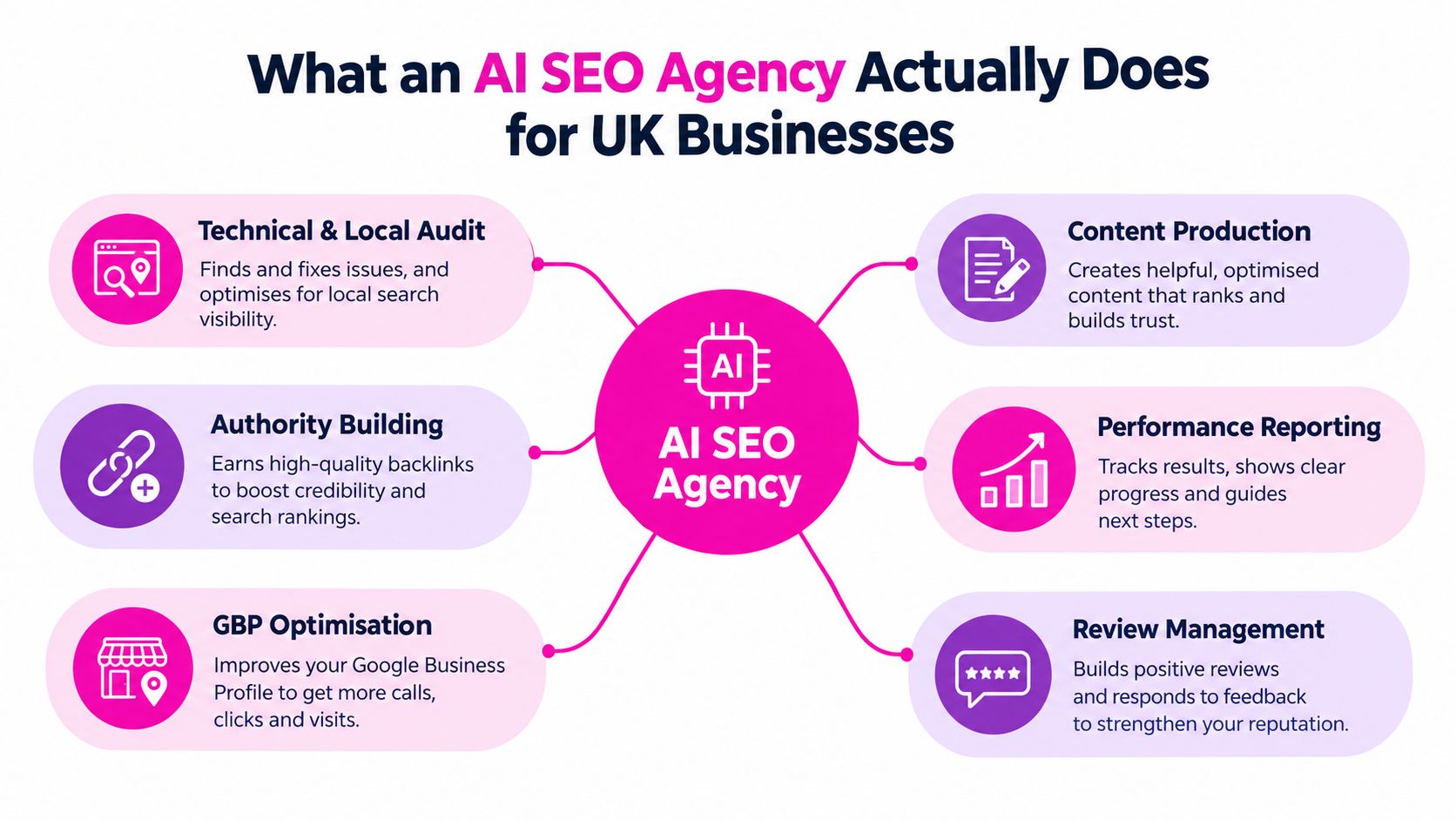
An AI SEO agency combines conventional search expertise with controlled automation. It audits websites and local listings, creates content briefs, manages repetitive profile work, monitors reviews, and connects visibility changes with actions such as calls, direction requests, bookings and enquiries.
That definition matters because the label is used loosely. A traditional SEO agency usually depends heavily on analyst and copywriter hours. A generic AI marketing tool provides software, but leaves the business to decide what to change, whether the output is accurate and how commercial results should be measured. An AI SEO agency sits between those models, adding strategy, governance and accountability around automated workflows.
The UK context is commercially significant. Google Search, Maps, Business Profiles, reviews, location pages and citations form the core local ecosystem. ChatGPT, Google AI Overviews and voice assistants create another environment in which systems synthesise publicly available information. A capable partner works across both, while recognising that each produces different kinds of evidence.
The practical deliverables
A serious engagement should produce tangible work, not a monthly stream of AI-generated articles:
- Technical and local audits: Crawlability, indexing, page structure, location data, profile completeness and competing local listings.
- Content production: Service pages, location pages, FAQs and profile copy based on genuine customer questions and commercial intent.
- Google Business Profile optimisation: Categories, services, descriptions, attributes, photos, posts and opening information, with changes logged and approved.
- Review management: Monitoring, response drafts, escalation rules and a clear distinction between routine feedback and reputational risk.
- Authority building: Relevant citations, local mentions and editorial links that reinforce the business entity.
- Commercial reporting: Separate views for rankings, visibility, calls, direction requests, website visits, bookings and assisted conversions.
The right audience includes restaurants, retailers, hospitality groups, trades, healthcare providers, legal practices, franchises and other businesses with local demand. A single-location business may only need software and a clear process. A multi-location or regulated organisation usually needs deeper oversight.
The operational layer can include automated local SEO with AI, but automation shouldn't remove human approval. Brand terminology, regulated claims, service areas, opening hours and review escalation rules must remain controlled.
Practical rule: AI should reduce repetitive work. It shouldn't decide whether a medical claim, opening-time change or public review response is safe to publish.
The Five Core Service Workflows an AI SEO Agency Runs
An AI SEO agency earns its fee through connected workflows, not isolated features. A finding from an audit should create a content brief. That brief should influence location-page and profile updates. Those updates should appear in reporting, which determines the next audit cycle.
The most common AI workflow is text-related. UK government analysis found that 61% of businesses using or planning to use AI rely on natural-language processing or text generation, making profile descriptions, location-page copy, review-response drafting and FAQ extraction practical agency applications, as reported in this UK AI marketing adoption analysis.
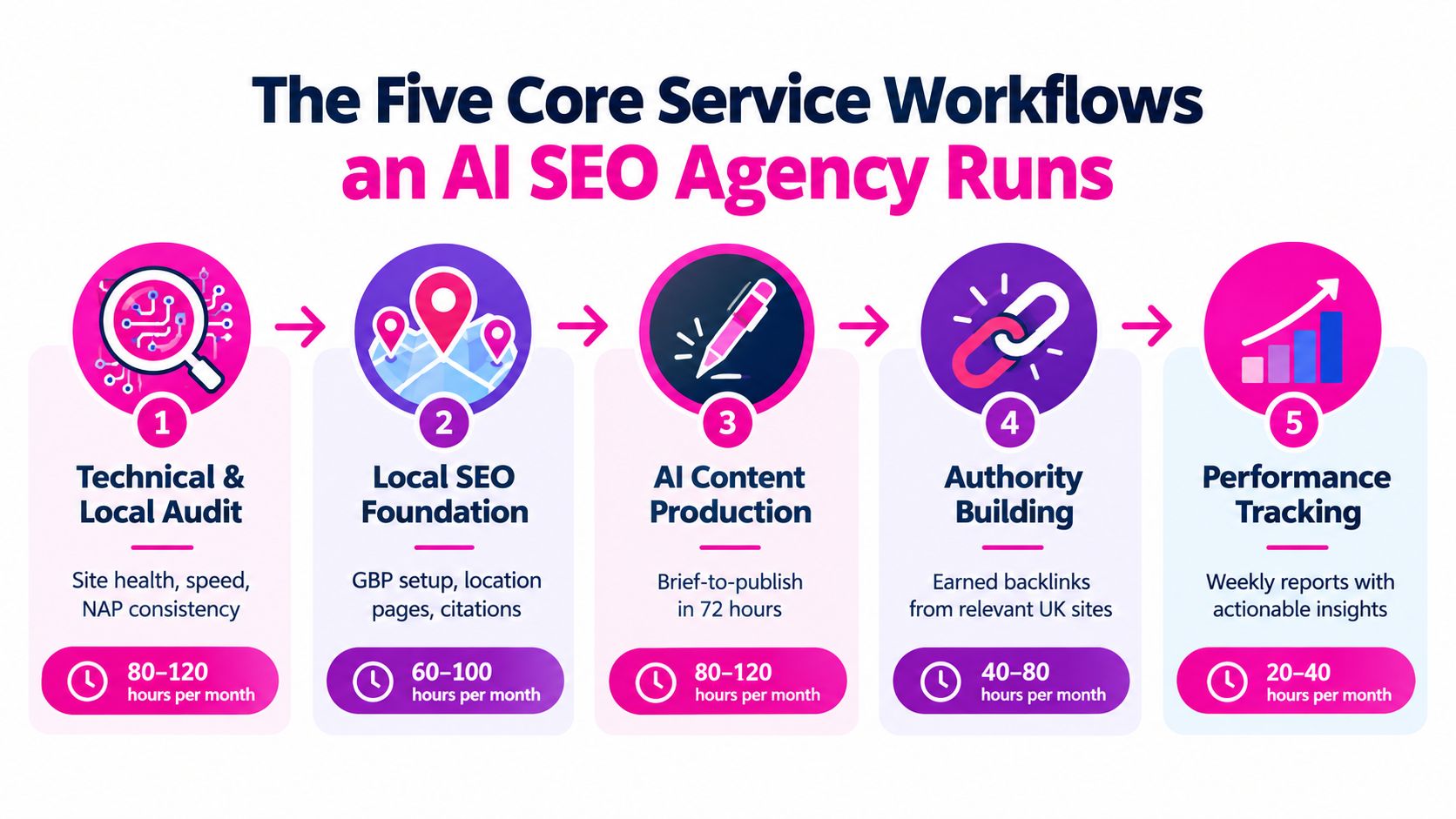
1. Technical and local audit
A manual audit involves checking page templates, indexation, location data, profiles, citations and competitors one item at a time. AI-assisted auditing can identify recurring inconsistencies quickly, group similar issues and prioritise them by likely commercial effect.
The human task changes from searching for every defect to validating priorities. A duplicated branch, inaccurate phone number or missing service category deserves attention before a low-impact metadata refinement.
2. Content production
Traditional content production starts with research, a brief, drafting, editing and publication. AI can turn search queries, profile gaps, customer questions and competitor coverage into structured briefs rapidly, then produce a first draft for editorial review.
That speed is useful for multi-location businesses, but scale creates risk. Each page needs genuinely local information, accurate services, clear boundaries and a useful reason to exist. Publishing interchangeable town pages damages trust and may create operational confusion.
3. Google Business Profile management
A staff member updating one profile manually can manage the work. A group with multiple branches needs a repeatable system for services, attributes, posts, images, menus and opening hours. Profile changes should be prepared in batches, checked against approved data and attributed to a user.
For businesses with several branches, GBP automation for multiple locations can reduce administration. It doesn't remove the need to confirm holiday hours, local service differences or branch-specific customer information.
4. Review monitoring and response
Manual review management often means checking several platforms and forwarding difficult cases internally. AI can classify sentiment, identify recurring complaints and draft a response in the correct tone. A manager still needs to approve sensitive replies, refund discussions, allegations, health matters and threats of escalation.
The goal isn't to make every response sound identical. It's to ensure that the business responds promptly, accurately and consistently while sending urgent issues to the person who can resolve them.
5. Reporting tied to commercial outcomes
A traditional report may take hours to assemble from rank trackers, analytics, profile data and CRM records. Automation can consolidate those sources and flag changes faster, but the agency still needs to explain what happened and what should happen next.
A useful report separates visibility from action. Rankings and AI mentions indicate discovery. Calls, direction requests, bookings, forms and revenue indicate commercial value. Without that distinction, an agency can produce impressive charts while the client remains unable to judge the investment.
Local SEO and AI Search in the UK, Two Environments, One Strategy
Google local search and AI-mediated discovery share information, but they don't behave identically. Google Maps depends heavily on the business entity, proximity, categories, reviews, profile completeness and local relevance. AI systems synthesise information from accessible sources, which makes consistent facts, clear services, authoritative mentions and concise answers important.
A business therefore needs one source of truth expressed across several surfaces. Its name, address, phone number, opening hours, service areas and branch details should agree on the website, Business Profile, directories and relevant third-party pages. Location pages should explain what the branch serves, rather than inserting a town name into a standard template.
What each environment needs
For Google Maps and local packs, the practical priorities include:
- Accurate entity information: The same business details across profiles and citations.
- Local relevance: Services, categories, areas served and branch-specific information.
- Reputation evidence: Fresh, authentic reviews and appropriate responses.
- Proximity awareness: Performance measured from relevant postcodes or coordinates.
- Profile completeness: Current photos, services, hours, attributes and updates.
For AI answers, the emphasis shifts towards:
- Clear factual language: Services and locations stated without ambiguity.
- Answer-ready information: FAQs and concise explanations that can be summarised safely.
- Consistent references: The same facts repeated across authoritative public sources.
- Source quality: Useful pages and mentions that support the business entity.
- Prompt monitoring: Branded and non-branded questions tested by location and service.
The evidence argues against abandoning local infrastructure. A UK test found that only two of ten service-plus-town searches produced an AI Overview, while nine showed a local pack, according to this UK test of AI Overviews and local packs. A query such as “emergency plumber Leeds” still relies heavily on map visibility, proximity, reviews and profile accuracy.
AI SEO should be layered onto local SEO. A business that cannot keep its opening hours, services and reviews accurate isn't ready to build a dependable AI visibility programme.
Real-World Use Cases for UK Restaurants, Trades and Multi-Location Brands
The strongest AI SEO programmes start with an operational problem. They don't begin with a promise to “get mentioned by ChatGPT”. They begin with missed calls, inaccurate information, slow responses or reports that fail to show where customers came from.
A 2025 YouGov survey found that 31% of UK SMEs were already using AI, another 15% planned to, and 45% of AI users or prospective users cited marketing and advertising as a use case, according to the YouGov survey of UK SME AI adoption. That demand makes practical implementation more valuable than novelty.
A restaurant group with inconsistent branch information
A regional restaurant group finds that customers are calling branches after closing time because opening information differs between profiles, menus and the website. The agency first creates an approved data set for every location, then audits Business Profiles, menu pages and citations against it.
AI helps identify conflicting hours and draft the required updates. A human checks bank holidays, temporary closures, delivery arrangements and branch-specific menus before publication. The report measures calls, direction requests, booking activity and missed-call patterns, rather than treating profile completeness as the final outcome.
A restaurant operator comparing providers should use a practical resource such as the LocalHQ restaurant SEO guide to check whether the proposed work covers menus, categories, reviews, location pages and customer actions.
A home services franchise with delayed review escalation
A home services franchise receives reviews across several branches, but the central team often sees serious complaints after the operational window for a quick response has passed. The agency introduces AI-assisted triage that groups reviews by urgency, topic and branch.
Routine positive feedback receives a supervised draft. A complaint involving safety, workmanship, discrimination or a threatened legal action goes to a manager immediately. The commercial report records response time, issue category, follow-up status and booked-job outcomes, so the franchise can see whether review management supports service recovery.
The workflow doesn't claim that every resolved complaint produces a booking. It gives the business a defensible record of what happened and prevents urgent feedback from disappearing in a shared inbox.
A multi-site healthcare clinic with duplicate locations
A healthcare clinic discovers that several locations have inconsistent names, outdated addresses and duplicated listings. The agency consolidates the entity data, reviews ownership and access, improves branch pages and uses a geo-grid tracker to compare visibility across relevant areas.
The clinic should judge progress through direction requests, calls and appointment enquiries, with sensitive information handled under appropriate privacy controls. AI can help find duplicate text, extract recurring patient questions and draft neutral service explanations, but clinical claims require specialist approval.
These examples show why a capable agency sells more than content. It connects data accuracy, local execution, human review and commercial measurement into one operating process.
How seopaslaugos.io Can Help
seopaslaugos.io teikia SEO paslaugas paslaugų verslams ir el. parduotuvėms. The service covers technical SEO, internal pages, external links and brand mentions, local search, AI visibility, analytics, e-commerce architecture and conversion-focused websites.
For a UK buyer, the important question is whether that scope matches the problem. The provider focuses on calls, enquiries and sales rather than treating traffic or rankings as the final result. It also works with commercial-intent service and location pages, Google Business Profile optimisation, AI-citable content and conversion tracking.
A sales call should test the fit in a practical order:
- Request the audit output. It should show technical barriers, local inconsistencies, commercial page gaps and measurement weaknesses.
- Ask for the workflow. The provider should explain who drafts, who reviews, who publishes and how changes are recorded.
- Check the payment model. Model A works on the client's website. Model B offers service businesses a partnership without a monthly fee, with payment based on agreed orders. That structure changes risk allocation and needs careful definition.
- Demand commercial reporting. Reports should connect organic search, Maps visibility, calls, forms, e-commerce conversions and sales.
- Clarify direct access. The buyer should know whether work is handled directly by a specialist and how communication, approvals and response times operate.
The provider also describes experience across niches and country markets, agency resale relationships, transparent monthly reporting and a process that runs from audit through implementation and feedback. Those claims should still be tested with relevant artefacts, not accepted as proof on their own.
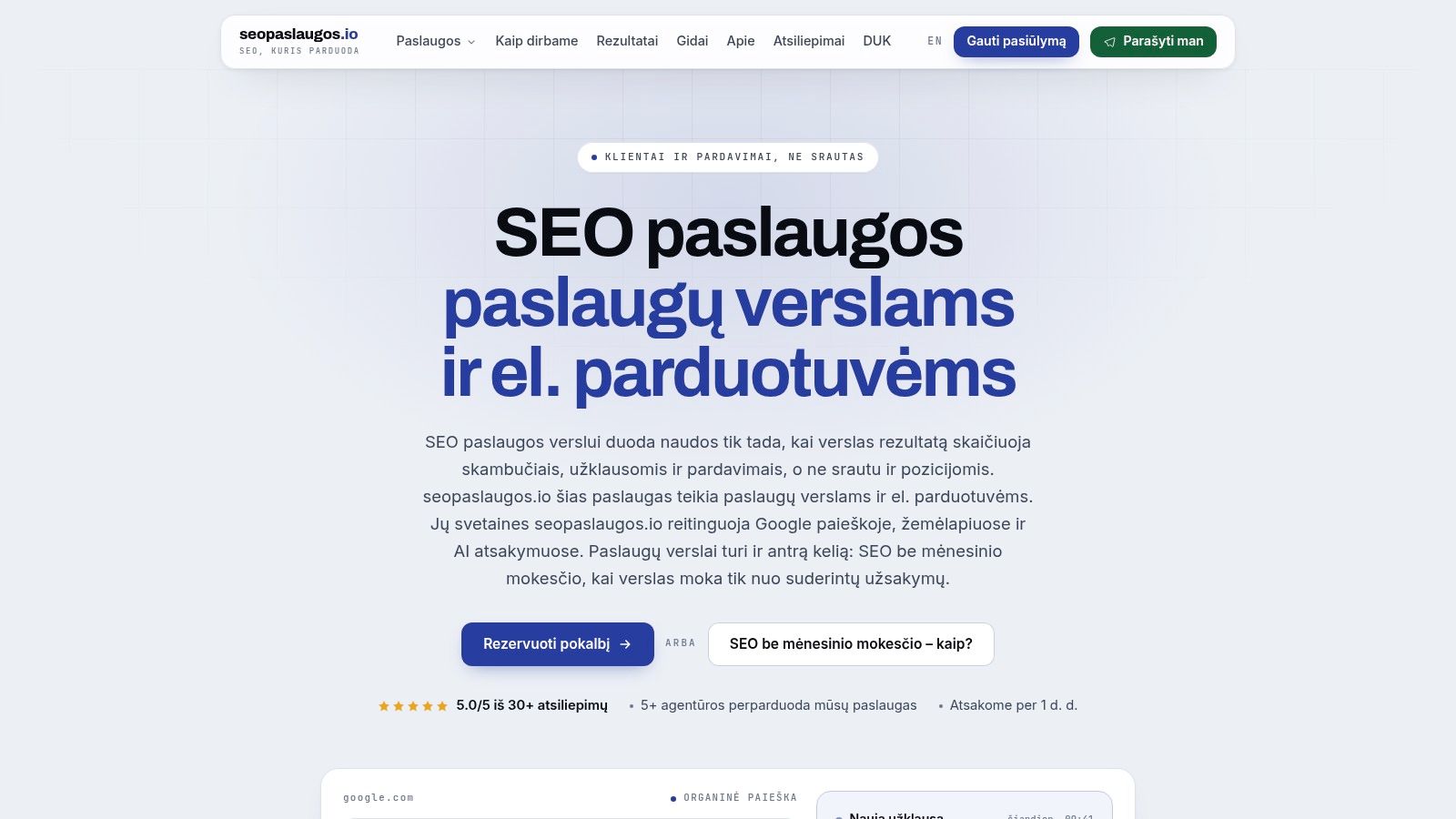
Businesses evaluating the AI-search component can review the provider's ai seo services page, then ask how AI visibility is tested by prompt, location, service and cited source. The right choice depends on whether the business needs strategic consultancy, implementation capacity, performance-based commercial alignment, or a combination.
How to Evaluate and Choose an AI SEO Agency in the UK
The first sales call should begin with the client's baseline, not the agency's automation claims. The buyer needs current information on calls, direction requests, bookings, enquiries, profile access, branch coverage and the pages that generate commercial demand.
The next question is ownership. Who owns the Business Profile accounts, analytics, CRM data, prompts, generated content and workflow records? If the agency controls everything and the client cannot access its own accounts, the relationship carries unnecessary operational risk.
Questions that expose delivery quality
Ask the agency to answer these questions directly:
- What will change in the first month? Expect named audits, profile actions, content work, tracking fixes and approval points.
- Which AI tools are used? The agency should explain where automation operates and where a human reviews output.
- How are regulated claims handled? Healthcare, legal, financial and safety-related content needs documented approval rules.
- Can the client see a sample report? The report should include calls, direction requests, enquiries and actions, not only rankings.
- Can one location be piloted? A controlled pilot exposes access, data and approval problems before wider rollout.
- Which UK clients are relevant? Sector similarity matters, particularly for restaurants, trades, healthcare, legal services and franchises.
Red flags include guaranteed rankings, vague references to “proprietary AI”, refusal to show reporting examples, automated review replies without escalation, locked Business Profile access and a contract that makes cancellation difficult. Screenshots without live or exportable data are weak evidence.
The buying checklist
A credible partner should provide:
- A baseline: Current visibility, profile health, commercial actions and known data conflicts.
- A prioritised plan: Work ordered by business impact, not by the agency's preferred software.
- A governance process: Approval rules for content, reviews, claims and profile changes.
- A measurement model: Branded and non-branded discovery, local visibility, actions and downstream enquiries.
- A delivery calendar: Clear frequency for audits, updates, content and reporting.
- A UK-aware editorial standard: British English, local terminology and accurate regional references.
Pricing alone doesn't identify quality. A low quote may exclude implementation, tracking or review management. A high quote may include duplicated tools, excessive strategy meetings and little execution. The buyer should ask what is delivered, what requires client time and which outputs will be available within the first thirty days.
Pricing, Contracts and Reporting Signals to Watch
UK buyers often compare retainers before comparing scope. That reverses the decision. A monthly fee only makes sense when the buyer understands the audit cadence, content workload, Business Profile coverage, review process, reporting depth and account ownership included in the agreement.
A typical UK SMB AI SEO retainer falls between £1,200 and £4,500 per month, while multi-location work usually costs more because each branch adds data, approvals, content and monitoring. The following bands help frame a discussion, but they aren't a substitute for a delivery schedule.
| Client Type | Typical UK Retainer | Audit Cadence | Content Volume | Reporting Depth |
|---|---|---|---|---|
| Single-location SMB | £1,200 to £2,500 monthly | Monthly priority review | A focused set of commercial pages or updates | Calls, enquiries, rankings and profile actions |
| Growing multi-location brand | £3,000 to £8,000 monthly | Monthly, with branch-level monitoring | Location, service and profile content scaled by need | Branch comparisons, geo-grid visibility and actions |
| Agency or reseller | Agreed white-label retainer plus platform costs | Shared operational cadence | Production based on client portfolio | White-label dashboards, exports and client-ready summaries |
The contract should state who approves changes, who owns accounts, how data is handled, what happens when a branch closes and how the buyer can export work. Month-to-month flexibility is useful while the operating model is being tested. Longer commitments should come with defined milestones, not vague promises.
A weak reporting system usually reveals itself through omissions:
- Screenshots only: The client can't interrogate or export the underlying data.
- Vanity rankings: Positions appear without calls, direction requests or enquiries.
- No change log: The report doesn't connect profile edits or content publication with later outcomes.
- AI mentions as the headline metric: A chat answer is treated as a customer without evidence of action.
- No branch view: Multi-location averages hide underperforming sites.
Google remained the dominant UK search-discovery channel with a 91.17% share in May 2026, while Bing held 6.22%. ChatGPT recorded 252 million UK visits in August 2025, up 156% year on year, according to this UK search and AI discovery analysis. The commercial conclusion is straightforward: AI visibility deserves monitoring, but Google performance still needs protection.
Businesses comparing scope and labour should also review local SEO hourly rates explained before accepting a quote.
Where Agencies and Platforms Like LocalHQ Fit Together
An agency and a platform solve different parts of the same workflow. The agency contributes strategy, positioning, editorial judgement, stakeholder management and decisions about where effort should go. A platform handles repeatable execution, permissions, scheduling, geo-grid monitoring, profile recommendations and reporting infrastructure.
The waste begins when both parties perform the same operational task. If an agency manually schedules every post while a platform already manages approved publishing, the client pays twice. If the platform produces recommendations but nobody owns validation, automation creates activity without accountability.
The UK market is adopting AI unevenly. Office for National Statistics data shows use rising from around 12% of businesses with ten or more employees in September 2023 to approximately 35% by 2026, with adoption at 28% among businesses with zero to nine employees and 49% among those with 250 or more, according to ONS data on AI use in UK businesses. That gap explains why buying decisions should reflect internal capability, not fashion.
Three workable operating models
Platform first suits a single-location SMB with a stable offer, accessible accounts and enough time to follow recommendations. The business retains control, standardises routine updates and learns which actions produce calls or enquiries.
Full-service agency suits a regulated multi-location organisation, a brand with complex stakeholder approval or a company facing reputational risk. The agency should own the planning, editorial governance, implementation coordination and commercial interpretation, while software supports the operational work.
Hybrid delivery suits agencies and growing brands. The agency retains the client relationship and strategic responsibility, while a platform manages routine profile updates, review workflows, geo-grid tracking and white-label reporting. This model increases capacity without requiring the agency to add staff for every new branch.
The platform layer can include profile analysis, AI-assisted recommendations, scheduled posts, review drafting, location management, geo-grid tracking and action-based reporting. The agency layer should decide priorities, approve sensitive changes, create differentiated positioning and interpret commercial performance.
For businesses considering the operational option, LocalHQ provides a platform for managing and measuring local-search work across Google Search and Maps. It should be assessed against the same criteria as any other platform, namely access control, data quality, workflow fit, reporting clarity and the amount of human oversight still required.
Choosing the Right Path for Your UK Business
A single-location business usually shouldn't begin with a large agency retainer. If the offer is straightforward, the profile is accessible, the website is serviceable and someone can spend time each week on local-search tasks, a platform-first approach gives the business control and exposes the real workload.
A growing brand with several branches should choose a hybrid model. Centralise approved business data, use software for routine profile and review operations, and retain strategic help for location architecture, content differentiation, authority building and commercial measurement. This avoids both extremes, uncontrolled DIY work and an expensive agency performing repetitive updates manually.
A regulated organisation should commission full-service support when errors could damage trust or create compliance problems. Healthcare, legal, financial and safety-sensitive businesses need documented approval, specialist review and clear escalation. The same applies to a brand with many stakeholders or a fragmented branch network.
An agency reselling AI SEO should also use a hybrid setup. It should own the strategy and client communication, while the operational layer handles repeatable execution and white-label reporting. That arrangement lets the agency scale delivery without pretending that software can replace account judgement.
The central test remains commercial. AI answer mentions are useful signals, but they don't prove a customer acted. Reporting should separate discovery from consideration and conversion, then connect local visibility with calls, direction requests, bookings, enquiries and revenue wherever tracking permits.
Businesses ready to build that operating layer should start with the Geo-Grid Rank Tracker and AI Optimisation Wizard, establish a baseline for the locations and services that matter, and review the evidence before adding an agency partner. That sequence keeps the infrastructure dependable, makes the workload visible and ensures any agency is hired to solve a defined commercial problem rather than to sell an attractive AI label.
Start by auditing one location, verifying its Business Profile data, tracking calls and direction requests, and testing the queries customers actually use. If the business can see where local visibility fails and which actions matter, it can make a disciplined choice between platform, agency or hybrid support instead of guessing.