The Complete Multi-Location SEO Blueprint for 2026: Scale Without Breaking
Related Articles
- Multi-Location SEO Strategy: The Enterprise Implementation Framework
- How to Manage 50+ Google Business Profiles Without Losing Your Mind (Or Rankings)
- Location Page SEO: Template and Best Practices That Rank
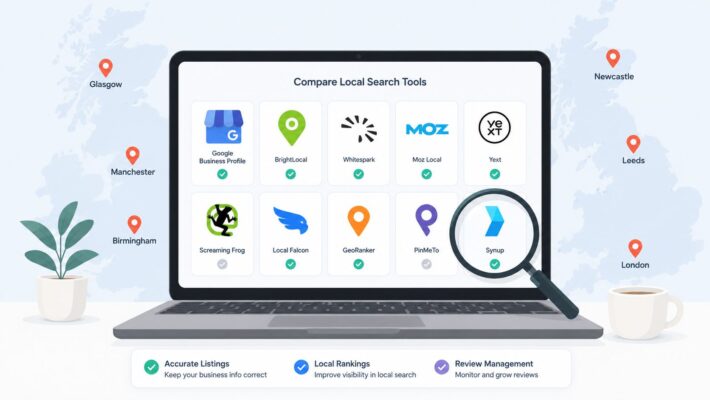
- Multi-Location SEO Tools: The 2026 Stack Comparison
- The Multi-Location SEO Checklist: 47 Points for Enterprise Success
- Enterprise Local SEO: Managing 1,000+ Locations Without a 1,000-Person Team
- Local Landing Pages SEO: The Template for ‘Near Me’ Rankings
- Multi-Location Content Strategy: Localisation at Scale
What Is Multi-Location SEO and Why Does It Matter?
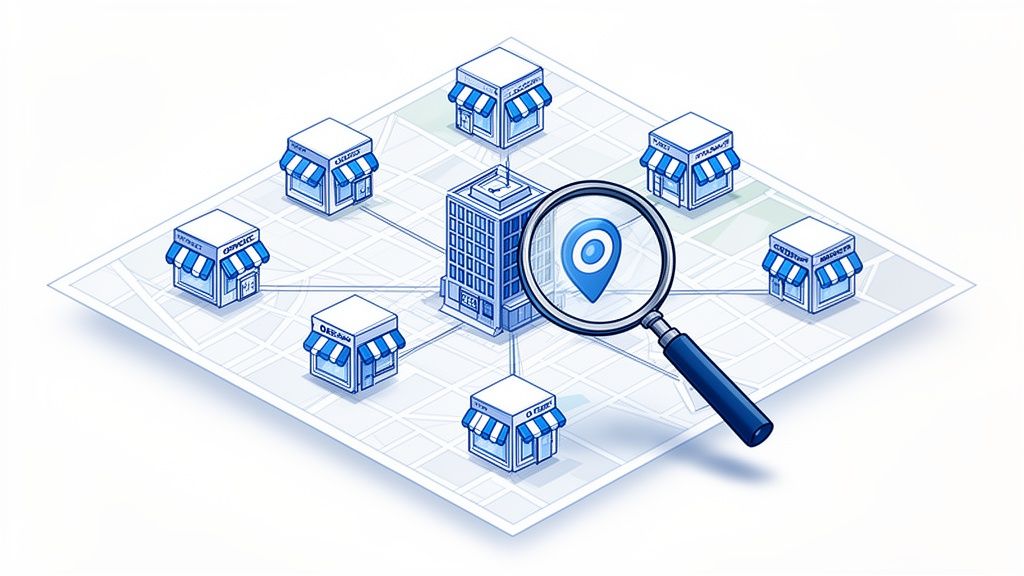
Let’s imagine your business isn’t a business, but an orchard. If you only had one location, you’d be tending to a single tree—making sure it gets enough sun, water, and care to bear fruit. Simple enough. But with multiple locations, you’re now managing the entire orchard. Each tree is a different branch, and while they all need the same foundational care (your consistent brand), each one also needs specific attention based on its unique patch of soil (its local market). If you don’t have a system for this, some of your trees will thrive while others wither, and that affects your entire harvest. The real strategy here is to build a process that helps every location flourish, contributing to the overall strength and visibility of your brand. It’s about winning customers postcode by postcode, not just running broad national campaigns.The Power of Hyperlocal Search
This approach has become critical because of a huge shift in how people search. Customers today expect instant, relevant results that are tailored to their exact location at that very moment. The numbers back this up in a big way. Around 46% of all Google searches have local intent, which works out to a mind-boggling 1.5 billion searches for local businesses every single month. This isn’t just happening in major city centres; it’s happening in every town and neighbourhood. For retail or service businesses, getting into Google’s ‘Local Pack’ can lead to conversion rates five times higher than from standard organic results alone.The Core Challenge: Brand Consistency vs Local Flavour
Here’s where it gets tricky. The central puzzle of multi-location SEO is balancing two competing needs: you have to maintain a rock-solid, consistent brand identity across all your branches, but you also need to inject the local flavour that builds trust with the community.At its core, multi-location SEO is an operational challenge as much as a marketing one. It demands a framework that supports both brand-level authority and hyper-localised relevance without letting one cannibalise the other.This means your Manchester branch needs to feel like it belongs to the same family as your Bristol branch, but it absolutely must speak the language of its Mancunian audience. Nailing this balance is the secret to scaling your growth. Without a clear system, you risk a diluted brand, internal teams competing for the same keywords, and a messy customer experience that ultimately weakens your position in the market. To get a deeper understanding of this complex dynamic, check out this guide on Local SEO for Multiple Locations.
Building a Scalable Multi-Location SEO Framework
Trying to manage SEO across multiple locations without a proper framework is a bit like building a house of cards. It might look okay with five or six locations, but as you scale to fifty or even five hundred, the whole thing is destined to collapse. You need a solid structure to keep things from getting chaotic. The most successful strategies are built on three core pillars. Think of them as the ‘Core’ (your central brand), the ‘Spokes’ (your individual locations), and the ‘Engine’ (your operational muscle). Getting these three parts to work in harmony is the secret to scaling up your local visibility without diluting your brand.The Core: Centralised Brand Consistency
First up is your brand core. This is the non-negotiable, central identity that holds everything together. It’s what ensures a customer in Glasgow gets the same brand experience as someone in Brighton. If this consistency wavers, your brand equity starts to fade, and search engines get confused about who you really are. The single most critical piece of this is keeping your NAP (Name, Address, Phone Number) data perfectly clean. Even tiny inconsistencies—like using “St.” in one place and “Street” in another, or having an old phone number floating around—can seriously damage your local authority. These details have to be identical, everywhere. To nail this, you need a ‘single source of truth’ for all your location data. Create a set of master brand guidelines that cover:- Official Business Naming: The exact way each location should be named (e.g., “Your Brand – Ancoats”).
- Logo and Visuals: Your official logos, colour schemes, and imagery. No exceptions.
- Tone of Voice: How you talk in business descriptions, social posts, and especially in review responses.
The Spokes: Empowering Localised Storefronts
While the core keeps your brand consistent, the spokes are what give each location its unique, local character. Think of each branch as its own digital storefront, connecting with its immediate community. This is where you empower local managers to add some authentic flavour, without going off-brand.The best multi-location brands I’ve worked with run on a ‘freedom within a framework’ model. The central team sets the strategy and supplies the tools, but the local teams on the ground are trusted to execute with their real-world knowledge.The best way to do this is with unique location landing pages on your website. These pages become the digital hub for each branch and should be packed with content that feels genuinely local. We’re talking about:
- Photos of the local team and the actual premises.
- Testimonials from customers in the area.
- Details about community partnerships or local events you’re involved in.
- Content that mentions nearby landmarks or speaks to neighbourhood-specific needs.
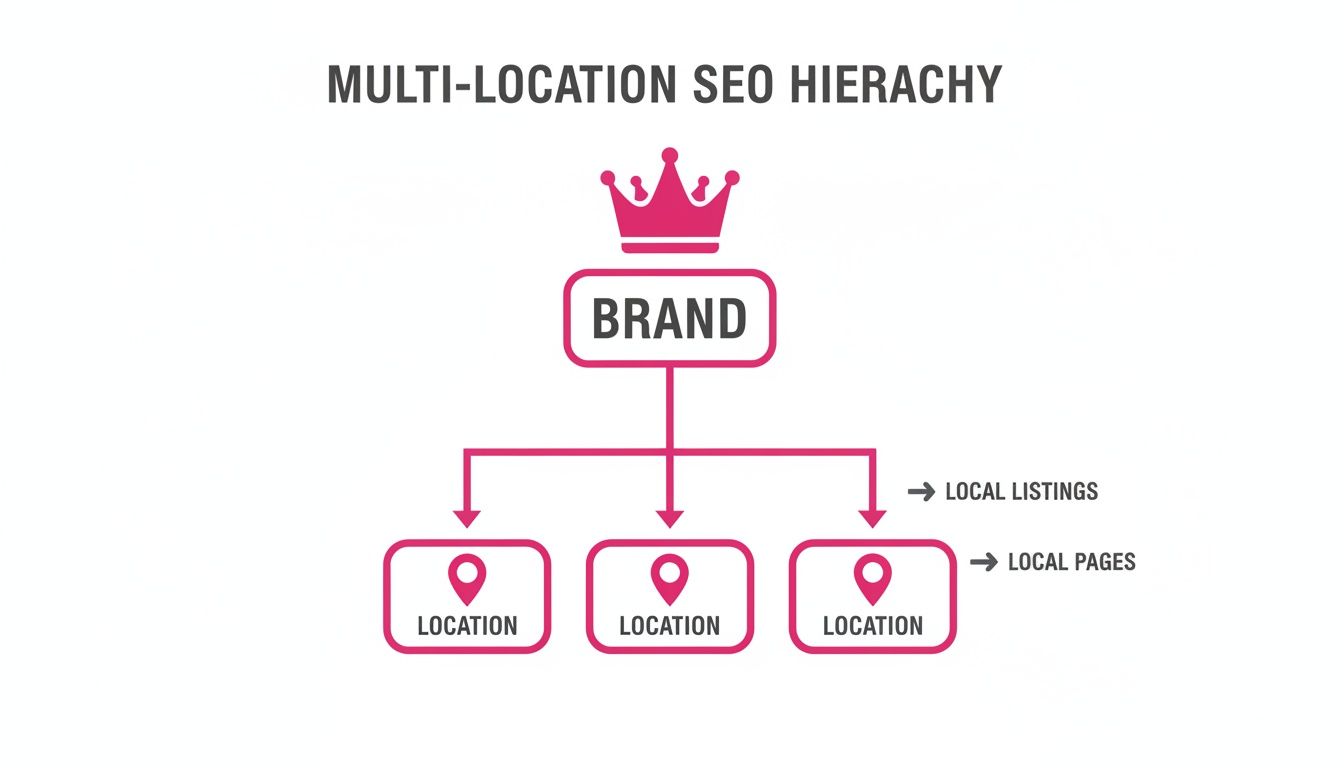
The Engine: Scalable Operations and Workflows
Finally, you have the engine—the part that actually powers the whole system. This pillar is all about the tools, workflows, and team structures you put in place to execute your strategy without a hitch. Honestly, trying to manage fifty Google Business Profiles from a spreadsheet is a straight path to burnout and costly mistakes. Your operational engine needs to clearly define:- Team Structure: Who does what? Is it a fully centralised model where a head office team handles everything? Or a hybrid approach where local managers have specific tasks? You have to make this clear from the start.
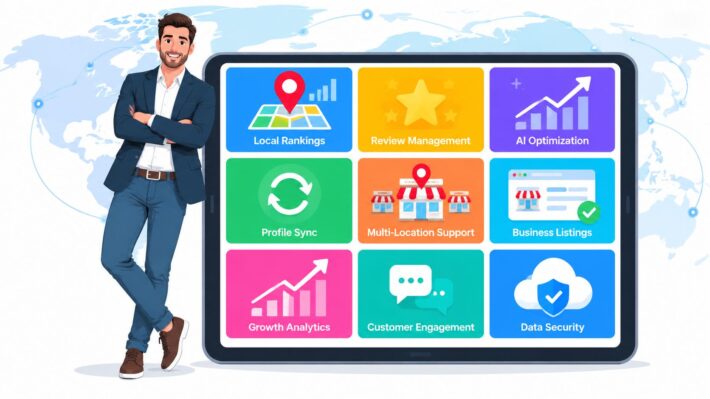
- Tools and Technology: A centralised platform for managing listings, reviews, and local content is non-negotiable at scale. It eliminates manual errors and enforces consistency.
- Workflows: You need simple, repeatable processes for everything—from how to respond to a negative review to how to update holiday opening hours across all locations.
Mastering Google Business Profiles at Scale
For any business with more than one location, your Google Business Profile (GBP) isn’t just another listing. Think of it as the digital front door for every single shop, clinic, or office you run. Getting GBP management right when you’re dealing with dozens, or even hundreds, of locations is absolutely crucial. It’s the difference between a static entry in a directory and a powerful tool that brings local customers straight to you. The aim here isn’t just to set up your profiles and forget about them. We need a proper system—one that keeps your brand consistent across the board but still leaves room for that local flavour that builds real community trust. Without a smart approach, you’ll quickly find yourself drowning in a mess of outdated information and missed opportunities.Centralising Control for Unwavering Consistency
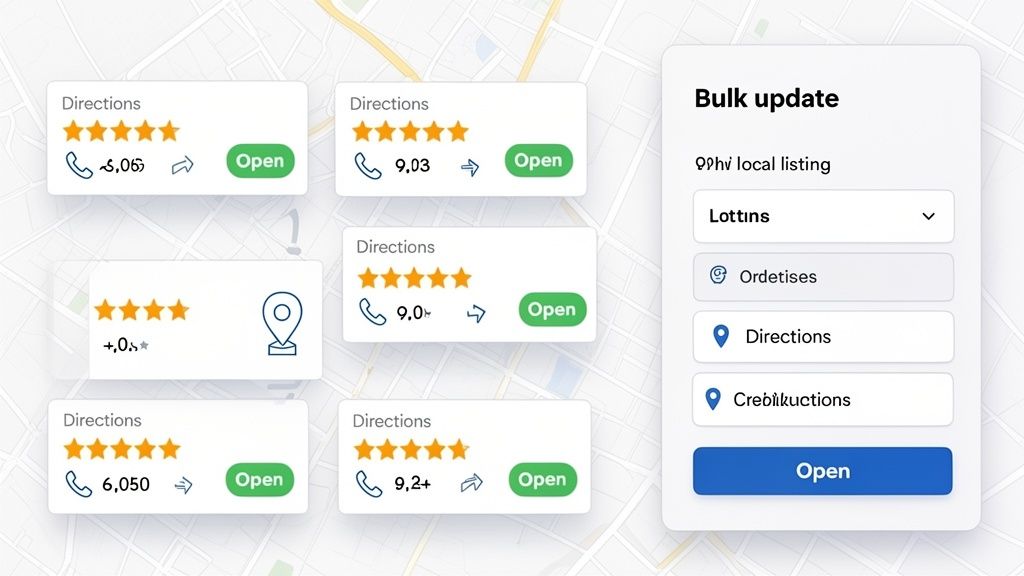
First things first: you need a single source of truth for all your GBP listings. This is all about standardising the core information for every profile so that customers and Google see one unified brand, no matter which location they find. This is where a bulk management tool becomes your best friend. It lets you push out important updates—like changing your main business category or adding a new service—to all locations at once. This stops the data from getting stale or inconsistent, which is exactly what happens when people are left to update things manually. Here’s what you need to lock down:- Business Categories: Make sure every location uses the same primary and secondary categories. This ensures you’re showing up for the right searches, everywhere.
- Service Menus: If it applies to your business, work from a master list of services to keep things uniform.
- Core Descriptions: Write a brilliant, brand-approved description that can be tweaked with a few local details for each branch.
Activating Local Engagement Systematically
Once you’ve built that solid, consistent foundation, it’s time to bring each profile to life with local content. This is what truly separates the top-performing brands from everyone else. You’ll need a system for rolling out location-specific Google Posts, handling Questions & Answers, and uploading fresh, local photos.Effective GBP management is a balancing act. It’s about leveraging technology for scale while preserving the human, local touch that builds real customer relationships and drives conversions.And the stakes are incredibly high. Nailing a spot in the top three of the Local Pack is a massive opportunity, as businesses in these coveted positions get a staggering 93% of all local pack clicks. This matters even more when you realise that 76% of people who search for something ‘near me’ will visit a business within 24 hours. For a company with hundreds of locations, ranking fourth or lower means you’re practically invisible. You can learn more about the latest insights on Google’s local SEO updates.
Building Trust Through Reputation Management
Looking after your reputation is arguably the most important piece of the puzzle when scaling GBP. A constant flow of positive reviews is a huge local ranking signal, but how you respond to them is just as critical. A winning workflow looks like this:- Prompt Responses: Make it a rule to reply to all reviews—good and bad—within 24 hours.
- Brand-Consistent Tone: Create templates to keep the voice consistent, but give local managers the freedom to add a personal, site-specific touch.
- Feedback Loop: Use the feedback from reviews to spot problems with service or identify training gaps at specific locations.
Designing Your High-Performance Website Architecture
Think of your website as the central hub for your entire multi-location SEO strategy. A well-organised site isn’t just about looking good; it’s about sending crystal-clear signals to search engines that help them understand exactly where and how you serve different communities. Getting this architecture right from the start is absolutely crucial if you want to scale your visibility. If your site is a tangled mess, Google will have a hard time finding, crawling, and indexing your individual location pages. This confusion can torpedo your local rankings and leave potential customers frustrated when they can’t find the branch right around the corner from them.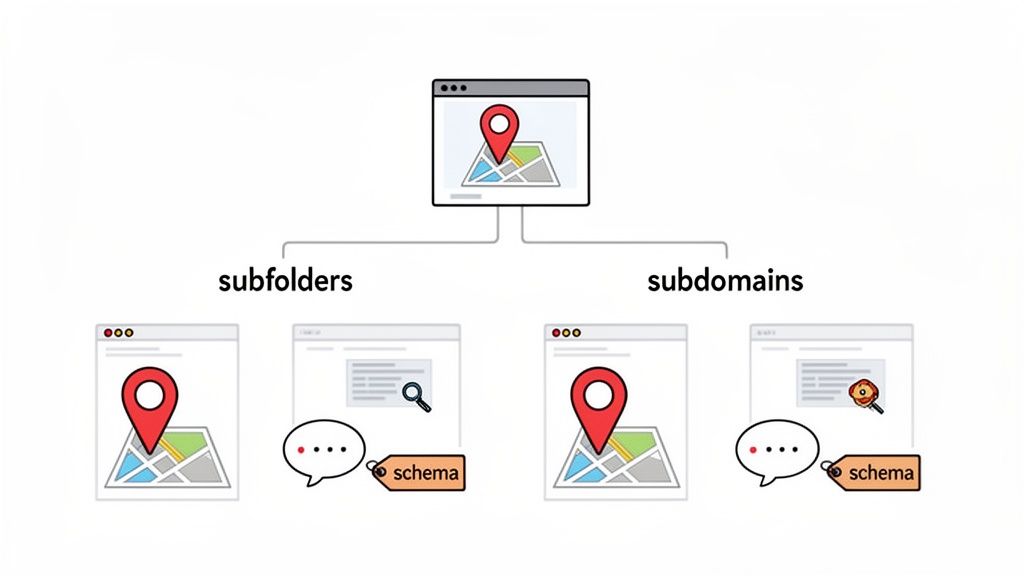
Choosing Subfolders Over Subdomains
One of the first forks in the road you’ll face is how to structure the URLs for your different locations. You’ve got two main routes: subfolders (likeyourbrand.co.uk/locations/manchester) or subdomains (like manchester.yourbrand.co.uk).
Let me be direct: for almost every multi-location business, subfolders are the way to go. Why? Because every single location page lives under one powerful, unified domain. This means any authority, trust, and backlinks your main site earns directly benefit all your location pages. It’s a classic case of a rising tide lifting all boats.
Subdomains, on the other hand, are often seen by Google as entirely separate websites. This would mean your Manchester branch has to build its online authority from scratch, while your London branch does the same. It’s a slow, inefficient uphill battle.
Settling on a subfolder structure is one of the biggest wins you can get from a technical SEO perspective. It consolidates your website’s authority, giving every location a leg up by piggybacking on the strength of the main brand.By keeping everything under one roof with subfolders, you build a much stronger and more cohesive digital presence that helps every single branch win.
The Anatomy of a Perfect Location Page
Once your site structure is sorted, it’s time to build out dedicated pages for each of your locations. A classic mistake we see all the time is businesses creating dozens of near-identical pages, just swapping out the city name. That’s a huge missed opportunity. Each location page should feel a unique, valuable resource for the local community. To build a page that people and search engines will both love, make sure you include these key ingredients:- Unique Local Content: Go beyond a generic list of services. Talk about the local team, mention a nearby landmark, or explain how your business serves the specific needs of that neighbourhood.
- Consistent NAP Information: Your business Name, Address, and Phone number need to be prominently displayed and must be an exact match with what’s on your Google Business Profile.
- Embedded Google Map: An interactive map doesn’t just help customers find you; it’s a powerful local signal for Google.
- Local Testimonials: Showcasing reviews from customers in that specific area provides instant social proof and builds trust.
- Local Team Photos and Bios: Putting a face to the name makes your business feel more personal and connected to the people it serves.
- LocalBusiness Schema Markup: This bit of code helps search engines instantly understand key info like your opening hours and contact details, which can give you a real boost in local search results.
Scaling Your Local Content and Link Building
Creating genuinely unique content for dozens, let alone hundreds, of locations can feel completely overwhelming. The secret isn’t to write every single word from scratch for every location. It’s about building a smart, scalable system that blends your core brand message with an authentic local flavour. We call this the ‘glocal’ (global + local) approach. It’s how you show Google and your customers that you’re not just in a community, you’re part of it. This strategy keeps your content from becoming a repetitive mess of near-duplicate pages, which can seriously drag down your search performance. Instead, you create a library of quality, brand-approved templates that local teams can bring to life with their on-the-ground knowledge.A Framework for ‘Glocal’ Content
The best way to pull this off is with a tiered content system. Think of it as a collaboration between your central marketing team and your local managers. The central team builds the foundation—the core service descriptions, industry guides, and company-wide announcements. These are your high-quality starting points. Then, you hand the keys over to your local managers to customise them. This is where the magic happens. They add the details that turn a generic page into a genuinely useful local resource:- Local Case Studies: Showcasing a project you finished for a well-known local business.
- Community News: Announcing your sponsorship of the local school’s fun run or a partnership with a nearby charity.
- Team Spotlights: Putting a face to the name and introducing the local staff.
- Event Details: Promoting an in-store workshop or your stand at an upcoming local trade show.
Building Links at Scale Across Every Territory
Just like your content, your link-building efforts need to be firmly rooted in the local community. Earning backlinks from respected local websites sends a powerful signal to Google, confirming that each of your branches is a legitimate and valued part of its neighbourhood.A single link from a well-regarded local business association or a popular neighbourhood blog is often more valuable for local SEO than ten generic links from irrelevant national directories. It’s about quality and local relevance, not just quantity.A scalable outreach plan helps you systematise this. Your central team can identify the types of opportunities to look for, and your local managers can focus on building the actual relationships. To really take this to the next level, exploring advanced link building strategies can give your team a framework for securing high-value local backlinks consistently.
Actionable Link-Building Tactics
Rather than chasing any and every link you can find, focus your energy on tactics that can be easily replicated across all your territories. The goal is to build a repeatable process that establishes genuine local authority for every single branch. Here are a few proven methods that work time and time again:- Sponsor Local Events: Get your brand name and, crucially, a link on the websites of local festivals, school fairs, and community sports teams.
- Partner with Local Charities: Work with non-profit organisations in each area you operate. This often results in natural mentions and links on their websites and in the local press.
- Join Business Associations: Become a member of the local Chamber of Commerce or other industry-specific groups. They almost always list members in their online directories with a link back to your site.
How to Measure Success and Report ROI
All the optimisation work in the world is pointless if you can’t prove it’s actually working. A successful multi-location SEO strategy isn’t measured in abstract website traffic figures; it’s measured in real-world results that business owners and stakeholders understand: more phone calls, more people walking through the door, and a healthier bottom line for every single branch. To do this right, you need to track performance on two levels. You need the big-picture view of the entire brand, but you also need to zoom in on each location to see who’s smashing it and who might be falling behind.Key Performance Indicators to Track
So, what should you actually be watching? Forget the vanity metrics. To get a true sense of your local impact, your dashboard should focus on the numbers that show genuine customer interest and action. Here are the essentials you need to keep a close eye on:- Local Organic Traffic: Don’t just look at total visitors. Dig into how many people from the specific geographic area around each branch are finding you through organic search.
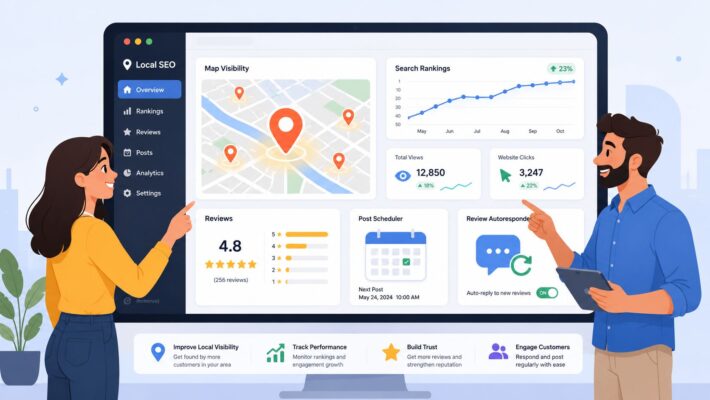
- Google Business Profile Conversions: These are pure gold. Track the high-intent actions people take directly from your listings, like clicks-to-call, requests for directions, and clicks through to your website.
- Geo-Grid Ranking Improvements: A single ranking isn’t enough. Use a proper rank tracker to see how you rank for your most important keywords across the different postcodes and neighbourhoods you serve. This shows your true local footprint.
- Online Review Velocity and Rating: How fast are new reviews coming in? What’s the average star rating at each location? This is a direct measure of customer satisfaction and online reputation.
Connecting SEO Efforts to Business Outcomes
The real magic happens when you connect your SEO activities directly to the business’s financial results. This is how you prove Return on Investment (ROI) and get everyone on board. Think of it like this: a case study from 2026 showed a Brighton restaurant that went all-in on its local SEO. They fully optimised their Google Business Profile, pushed out weekly updates, gathered over 150 real customer reviews, and worked with local food bloggers. The outcome was stunning: they hit the #1 spot for ‘Brighton restaurant’, saw a 340% jump in requests for directions on Google Maps, and boosted their reservation bookings by an incredible 420%. You can read more about how they achieved these transformative Local SEO results in 2026.The most powerful reports tell a simple, clear story: “We did X, which led to Y more visibility, resulting in Z more phone calls and £W in new business.” That direct line from action to outcome is what justifies budgets and builds trust.Crafting reports that tell this story is a skill in itself. To help you present your data in a compelling way, check out our detailed guide on creating effective SEO reports for customers. It’ll show you how to celebrate your team’s wins and make the case for continued investment.
Your Top Multi-Location SEO Questions, Answered
When you’re juggling SEO for dozens or even hundreds of locations, the same questions tend to pop up. Here are our answers to some of the most common challenges we see businesses face when they start to scale their local presence.How Do You Create Unique Content For Locations That Are Almost Identical?
This is a classic problem. Your services in Manchester are the same as in Leeds, but Google punishes duplicate content. So, what do you do? The trick is to go ‘glocal’—think global, act local. You start with a core, brand-approved description of your services. Then, you get your local managers involved to add the details that make their specific branch unique.- Share photos and short bios of the team on the ground.
- Talk about a recent partnership with a local charity or community group.
- Feature testimonials from customers in that specific town or neighbourhood.
- Write about a recent project, referencing nearby landmarks to give it a real sense of place.
What’s The Best Team Structure For Managing 100+ Locations?
Trying to manage SEO for 100 or more locations from a central office alone is a recipe for disaster. You lose all that crucial local flavour. The best setup we’ve found is a hybrid model. Your head office team sets the big-picture strategy. They handle the technical SEO, build the website, manage the core technology, and create brand-wide content. They keep the ship pointing in the right direction. Meanwhile, your local or regional managers are your experts on the ground. They’re empowered to handle day-to-day tasks like responding to reviews, posting updates about community events on their Google Business Profile, and spotting local link-building opportunities, like sponsoring the local football team. This structure gives you brand control without sacrificing local authenticity.Should Every Single Location Have Its Own Social Media Accounts?
Probably not. For channels like Instagram, LinkedIn, or TikTok, it’s usually far more effective to build a single, powerful corporate account. Trying to run unique, engaging profiles for every branch is an enormous drain on resources and can dilute your brand’s overall message. The main exception is Facebook. Because Facebook Pages can link directly to a Google Business Profile, it often makes sense for individual locations to have their own. They’re perfect for sharing community-specific news, local offers, and events that wouldn’t be relevant to a national audience.How Should We Handle A Negative Review Campaign?
When you’re hit with a flood of negative reviews across multiple locations, you need a coordinated plan, and you need to act fast. First, the central team needs to jump in and figure out if the reviews are from real customers or part of a spam attack. If they violate the platform’s rules (for example, they’re clearly fake), flag them for removal immediately. At the same time, give your local managers a set of pre-approved, professional responses. The key is to avoid getting defensive. The goal for every public reply is to acknowledge the feedback and offer to take the conversation offline to sort it out. This shows genuine customers that you’re listening and actively working to make things right, which is crucial for protecting your brand’s reputation.Ready to take control of your local presence without the chaos? LocalHQ provides a single, AI-powered dashboard to streamline your entire multi-location SEO strategy. From bulk-updating Google Business Profiles to managing reviews and tracking geo-grid rankings, our platform gives you the tools to scale your visibility and drive real-world results. Discover how LocalHQ can simplify your multi-location management today.