SEO for Franchises: The Complete Implementation Playbook

Getting SEO right for a franchise is a unique beast. It's not just about optimising one website; it's about creating a unified digital presence that supports dozens, or even hundreds, of individual locations. The real trick is managing the delicate balance between brand-level control and the local flavour each franchisee brings to the table.
When this is handled well, it's a powerful engine for growth. But when it's not, it can quickly descend into chaos, hurting the entire brand and driving customers to your competitors.
Building Your Franchise SEO Foundation
Before we get into the nitty-gritty of Google profiles and location pages, we need to set the stage. A common mistake I see is a "free-for-all" approach where every franchisee does their own thing with SEO. This inevitably leads to inconsistent branding, conflicting business information online, and a diluted marketing message that ultimately weakens everyone.
This playbook is designed to give you a solid, repeatable framework. Think of it as the blueprint for your entire multi-location strategy, ensuring every tactic—from technical setup to content—is pulling in the same direction. It's a complex area, and if you want a deeper dive, a comprehensive guide to SEO for multi-location businesses breaks down the broader challenges even further.
Core Components of a Franchise SEO Strategy
To build a strategy that scales, you need to focus on a few key areas that work together. Neglecting one can easily undermine all your other efforts. These are the non-negotiables that form the backbone of any successful franchise SEO programme.
| Component | Primary Objective |
|---|---|
| Central Governance | Establish brand consistency, control key assets like Google Business Profiles, and prevent data conflicts. |
| Technical Framework | Build a scalable website architecture that supports both national brand authority and local relevance. |
| Localised Content | Empower franchisees to create content that speaks directly to their community within brand guidelines. |
| Review Management | Systematise generating and responding to customer reviews to build trust and improve rankings. |
| Performance Tracking | Measure what matters—footfall, phone calls, and local visibility—to prove ROI and refine tactics. |
Each of these components addresses a specific challenge of the franchise model, and together, they create a powerful, unified presence online.
Why Local Search Is Everything
For a franchise, local search isn’t just another marketing channel; it’s the main artery for new customers. The numbers don’t lie. Here in the UK, a massive 46% of all Google searches have local intent. That means nearly half of your potential customers are looking for products or services “near me” right now.
Even more telling, a 2026 study revealed that 88% of UK consumers who find a local business via its Google Business Profile go on to make a purchase there. For restaurants, retail chains, and service-based franchises, that’s a direct line to increased footfall and revenue. You can explore the full findings on local search impact to really grasp its importance.
The guiding principle for successful franchise SEO is this: “Centralise what you must, localise what you can.” The franchisor provides the strategy, tools, and guardrails. The franchisee provides the local expertise and community connection.
This hybrid approach helps you sidestep common pitfalls like duplicate content or inconsistent NAP (Name, Address, Phone) data, which can seriously harm your search rankings. By creating a unified system, you ensure the efforts of one franchisee actually amplify the brand for everyone. Our own guide on local SEO for multiple locations offers more detail on how to coordinate this effectively.
Now, let’s get into the playbook for putting all these principles into action.
Setting Up Your Centralised Framework and Technical Guardrails
Once your strategy is mapped out, it’s time to get your hands dirty and build the operational engine. This is where we establish the technical and organisational rules that will support your entire franchise SEO programme. Frankly, this is the stage where most multi-location businesses stumble, ending up in a mess of chaotic data, muddled branding, and weak local search performance.
Your website’s architecture is the very first thing to lock down. The way you structure your site has a massive impact on how search engines see the relationship between your main brand and all your individual franchise locations. It’s a decision with long-term consequences, so it’s vital to get it right from day one.
Subdomains Vs Subdirectories: Settling the Debate
The old SEO debate of subdomains (london.yourbrand.co.uk) versus subdirectories (yourbrand.co.uk/london) still pops up, but for most franchise models, the answer is crystal clear.
Subdirectories are almost always the way to go.
- Subdirectories (
/location/): This structure pools all your SEO power into one strong domain. Every link you earn and every piece of content you publish strengthens theyourbrand.co.uksite as a whole, lifting all boats. It signals to Google that you are one large, connected entity. - Subdomains (
location.): Google often treats each subdomain as a completely separate website. This shatters your SEO authority. It means thelondonsite has to build its own reputation from zero, getting almost no benefit from the main brand or themanchestersite.
While subdomains can offer more technical autonomy, this is rarely necessary and puts you at a huge SEO disadvantage. A subdirectory structure ensures the hard work done for one location helps boost search visibility for everyone else in the network.
Building Scalable Parent and Child Pages
Your website needs a clear, logical hierarchy. The aim is to create a system that head office can scale easily, while still giving franchisees a simple way to add their local flavour where it counts. The best way I’ve found to do this is with a ‘parent-child’ page model.
Here’s how it works:
- Optimised ‘Parent’ Service Pages: These core pages live on your main domain (e.g.,
/services/commercial-cleaning/). They are built to rank for those broad, non-location-specific keywords, establishing your brand as a national authority. - Templated ‘Child’ Location Pages: These are your local workhorses (e.g.,
/locations/bristol/). Every single location gets its own dedicated page. These are based on a consistent template but have specific sections for franchisees to add their own local content—think team photos, local case studies, and customer testimonials.
This approach gives you tight brand control over the core messaging while empowering franchisees to inject the local authenticity that both customers and Google absolutely love. For agencies managing this for clients, looking into white-label local SEO solutions can provide the tools needed to roll this out smoothly at scale.
This is the ideal flow for getting your franchise SEO governance right.
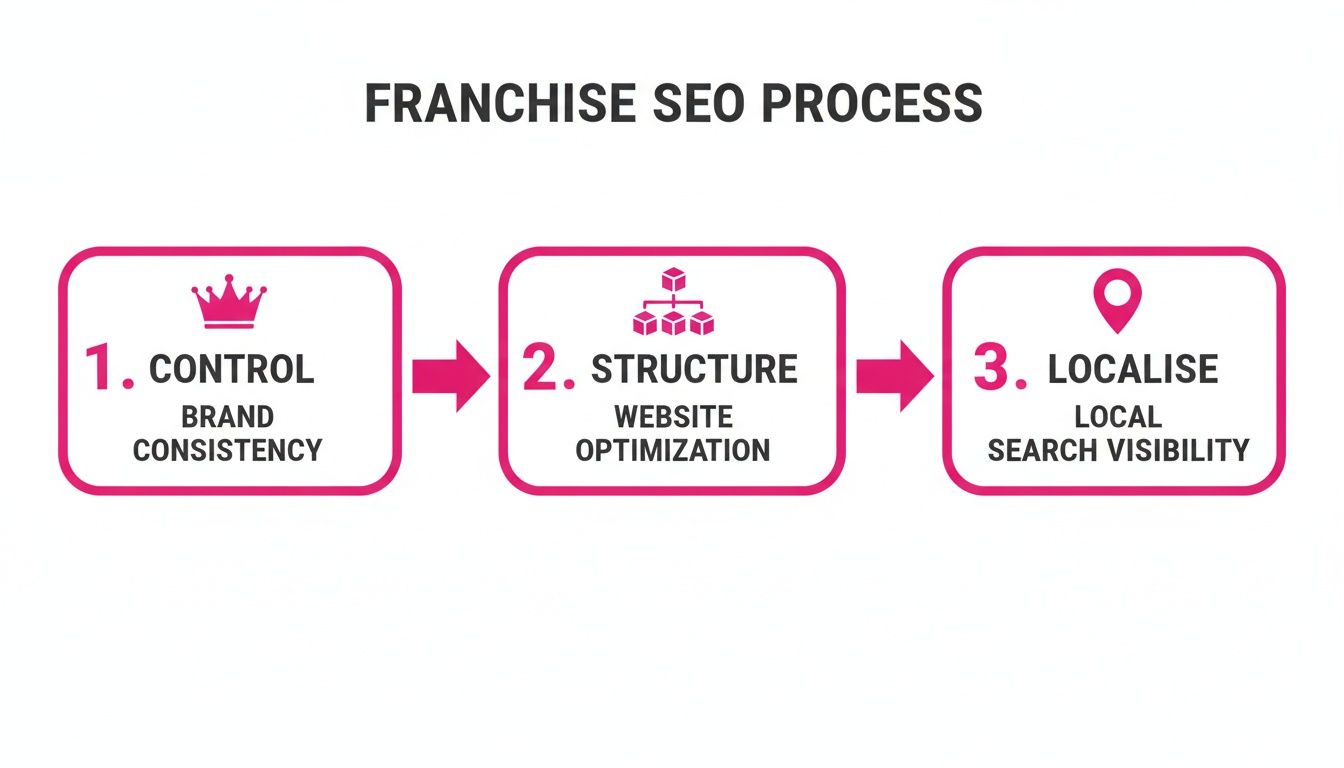
The whole idea is to centralise control of the brand, build a solid technical foundation, and then empower your local teams to execute within those guardrails.
Centralising Google Business Profile Management
Right alongside your website, your Google Business Profiles (GBPs) are your most important local marketing assets. Handing over the keys to each franchisee without any central oversight is a recipe for disaster—I’ve seen it happen too many times.
It quickly leads to rogue profiles, inconsistent NAP (Name, Address, Phone) data, and a brand image that’s all over the place.
The single biggest operational risk in franchise SEO is a lack of central control over Google Business Profiles. A unified dashboard isn’t just a convenience; it’s a fundamental requirement for maintaining data accuracy and brand integrity across the network.
Using a central platform allows the franchisor to claim and verify ownership of every single location. From there, you can grant permission-based access to franchisees. This means they can handle day-to-day tasks like responding to reviews or creating Google Posts, but they can’t change crucial business information like the name, address, or primary category.
This centralised governance is the final piece of your foundational setup. It ensures every location plays by the brand’s rules, prevents costly data conflicts, and creates a clean, authoritative digital footprint for your entire franchise. This setup is absolutely vital for successful SEO for franchises.
Mastering Google Business Profiles At Scale
Once your site architecture is sorted, it’s time to turn your attention to your Google Business Profiles (GBPs). Think of them as your digital shop fronts. For a franchise, managing these across dozens, or even hundreds, of locations is where the real work begins. This isn’t about good intentions; it’s about having a rock-solid system.

Here’s where that centralised governance model we talked about really starts to shine. It allows you to transform every single profile from a basic listing into a local customer magnet, ensuring consistency and quality across the board. The goal? Turning a simple search into a real-world visit, a phone call, or a sale.
Enforce Absolute NAP Consistency
If you take only one thing away from this section, let it be this: nail your NAP (Name, Address, Phone Number) consistency. It’s the absolute bedrock of multi-location SEO.
Even minor discrepancies—a typo in a street name, an old phone number—are massive red flags for search engines. I’ve seen businesses in the UK plummet in local rankings because of these small but critical errors. For a franchise, a few mismatched listings can erode the authority of your entire network.
A single incorrect phone number for one location can create a ripple effect, damaging the trust Google has in your brand’s data across all your locations. This isn’t just a best practice; it’s foundational to your local search presence.
Trying to manage this manually is a recipe for disaster. You need a single source of truth. Using a tool to sync this core information across every profile is non-negotiable for any serious franchise. It stops the data chaos that kills so many marketing efforts before they even start. If you’re juggling a lot of locations, our guide on handling multiple Google Business listings has more strategies for you.
Standardise And Optimise At Speed
With your core data locked down, the next job is optimisation. But manually checking and tweaking hundreds of profiles? It’s simply not feasible. This is where an AI Optimisation Wizard becomes your most valuable player.
A good tool can scan all your listings in one go, benchmarking them against your top local competitors. It finds the gaps and helps you standardise the crucial elements that drive visibility.
- Primary & Secondary Categories: It ensures every single location is using the most powerful, high-traffic categories relevant to your services. No guesswork involved.
- Attributes: It applies key attributes like “Wheelchair-accessible entrance,” “Outdoor seating,” or “Delivery available” consistently, giving customers the information they need at a glance.
- Services: The tool can populate and standardise your service lists, making sure you’re using the keywords your customers are actually searching for.
This automated process ensures you’re not leaving easy ranking wins on the table and that every location presents a complete, professional, and uniform brand face.
Localise Content From A Central Hub
The great balancing act in franchise marketing is maintaining brand consistency while allowing for local flavour. The right platform makes this possible, letting head office set the strategy while empowering franchisees to bring it to life. A key part of the strategy to rank higher on Google Maps is fresh, localised content, and this is how you deliver it at scale.
Imagine a single dashboard where you can schedule and manage content for hundreds of profiles at once.
- Localised Google Posts: You create the templates, and franchisees can quickly add local offers, news, or a picture of their team.
- Scheduled Images: Roll out new brand imagery across the entire network in a single click, or let franchisees upload photos of a recently completed job or a local event.
- Q&A Seeding: Don’t wait for customers to ask the obvious questions. Proactively add a list of FAQs with on-brand answers to every profile. You control the narrative from day one.
This hybrid approach creates a constant stream of fresh, relevant activity on your profiles—a huge signal to Google that your businesses are active and engaged. It gives franchisees the tools they need to market themselves effectively, all within the safe and controlled boundaries of your brand.
How to Build a Rock-Solid Review Management System
For any local business, customer reviews are the new word-of-mouth. But when you’re managing a franchise network, handling that feedback across dozens or even hundreds of locations isn’t just marketing—it’s a massive operational puzzle. Let’s walk through how you can turn that challenge into your biggest competitive edge.
There’s no getting around it: reviews are a direct, powerful ranking signal for local SEO. Google looks closely at the quantity, quality, and velocity of your reviews. It also pays attention to how you respond. Without a smart, organised approach to managing reviews, you’re leaving your franchise’s local search performance to chance.
Get Franchisees on Board with Asking for Reviews
First things first, you need to shift the culture from passively waiting for reviews to actively seeking them out. This can’t be an afterthought. It starts with training your franchisees on why reviews matter so much and giving them dead-simple ways to ask for them.
Let’s be honest, most franchisees are swamped with the day-to-day and can feel awkward asking customers for feedback. Your job at head office is to make this process feel both easy and natural.
- Show, Don’t Just Tell: Ditch the vague statements and show them the real-world impact. Pull up data that connects a higher star rating and more reviews to a direct increase in phone calls and foot traffic for their specific location.
- Give Them the Right Tools: Make it ridiculously easy. Provide QR codes for their counters that link straight to their Google review page. Create simple email and SMS templates they can send out after a service.
- Set Clear, Achievable Targets: Don’t just say “get more reviews.” Encourage each location to aim for, say, 10 new reviews a month. This turns a vague goal into a concrete, measurable target they can work towards.
The simpler you make it for franchisees to get involved, the more consistent your network’s results will be. The aim is to weave review generation into their daily customer service process, not treat it as a separate chore.
Use Automation to Lock in Your Brand Voice
Generating reviews is only half the battle; managing the responses is just as important. A quick reply shows potential customers you’re listening and you care. Silence, on the other hand, signals the exact opposite. But manually replying to reviews across hundreds of locations? That’s a full-time job in itself, and it’s simply not scalable.
This is where technology becomes your best friend.
I’ve seen it time and again: an instant, on-brand reply to a negative review can completely de-escalate a tense situation. It turns a poor experience into a public demonstration of fantastic customer service. Automation ensures this happens around the clock, protecting your brand’s reputation at scale.
Using an AI-powered system means every single review—good, bad, or indifferent—gets an immediate, professional response. This tech can be fine-tuned to follow your brand’s specific guidelines, ensuring the tone of voice is perfectly consistent, whether the review is for a branch in London or Liverpool. To see this kind of system in action, it’s worth exploring the practical benefits of a Google Review Autoresponder.
This kind of automation does more than just save a staggering number of administrative hours across your network. It actively transforms your reviews into a powerful marketing asset. By responding to every bit of feedback, you send strong, positive signals to Google that your business is active, engaged, and values its customers.
Turn Customer Feedback into Business Intelligence
A truly great review management system does more than just generate and reply to feedback. It should become a goldmine of business intelligence. When you centralise all your reviews into a single dashboard, you start to spot trends, patterns, and issues that would otherwise fly completely under the radar.
For instance, if you notice that multiple reviews across different locations are mentioning slow service on a Saturday morning or a problem with a particular product, that’s no longer just one franchisee’s problem. It’s a network-wide insight you can act on.
This centralised view allows you to:
- Pinpoint recurring problems that need to be addressed through better training or operational changes.
- Identify your star performers—those high-performing franchisees whose glowing feedback can be used as a model for others.
- Boost local rankings by demonstrating consistent, positive engagement with your entire customer base.
By putting a winning review management system in place, you’re taking firm control of your online reputation. You’re turning customer feedback from a potential minefield into one of your most effective tools for climbing the local rankings and building unshakable trust across your entire franchise network.
Measuring Success and Building Repeatable SEO Workflows
You can have the best SEO strategy in the world, but if you can’t prove it’s working, you’ll struggle to get buy-in. This is where we shift from theory to tangible results, focusing on establishing the right KPIs and building efficient workflows that make sense for a multi-location business.
The goal is to get out of the weeds of endless spreadsheets and move into a unified system. This operationalises your SEO, transforming it from a mountain of marketing tasks into a clear, repeatable process for growth. It’s how you demonstrate value to both head office and the individual franchisees on the ground.
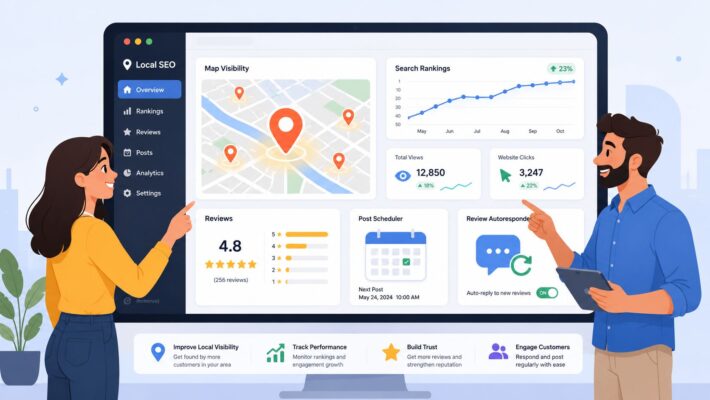
A centralised dashboard gives you that live, unified view across the entire network.
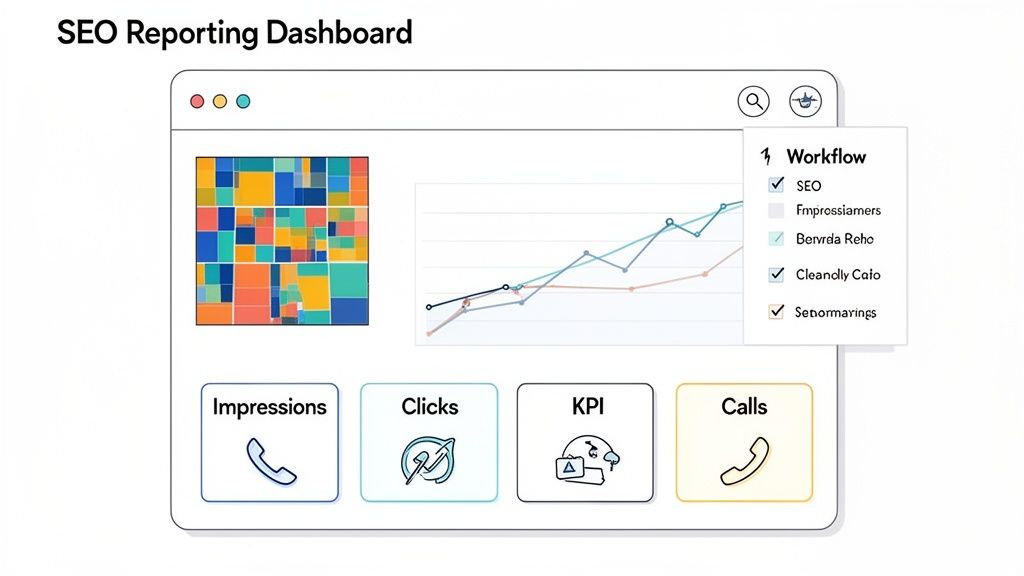
From one screen, you can see high-level trends at a glance or dive deep into a single location’s performance. This makes spotting opportunities and nipping problems in the bud much, much simpler.
Focus on the Metrics That Actually Move the Needle
It’s easy to get distracted by vanity metrics like ‘impressions’. They might look good on a graph, but they don’t pay the bills. A successful SEO programme for franchises has to be judged on what it delivers to the bottom line. Your reporting should be laser-focused on the key performance indicators (KPIs) that directly translate to revenue.
Your core KPIs should always include:
- Google Business Profile Actions: Track the phone calls, direction requests, and website clicks coming straight from your GBP listings. These are high-intent actions from customers who are ready to engage now.
- Localised Conversions: Measure how many people visiting a specific location page actually complete a goal, like filling out a contact form or booking an appointment online.
- Review Growth: Keep a close eye on the number of new reviews and the average star rating for each location. This is a direct measure of your online reputation and a massive local ranking factor.
By concentrating on these metrics, you change the conversation from abstract SEO jargon to concrete business results. That clarity is absolutely vital for getting franchisees excited and justifying the ongoing investment.
The quickest way to get a franchisee on board is to show them the numbers. A simple report showing a 25% increase in phone calls for their specific location is far more powerful than any talk about domain authority or keyword density.
Visualise Your True Local Visibility
Here’s a common mistake: using a standard rank tracker for a multi-location business. Knowing you rank number one for “plumber in London” is completely useless if your franchise territory is in a specific borough like Hackney, where you might be invisible on Google. This is where more advanced tools become non-negotiable.
A geo-grid rank tracker is essential. It shows your search rankings for key terms on a grid that’s literally laid over your service area. You can see, street by street, exactly where you’re strong and—more importantly—where your competitors are eating your lunch. This granular insight allows you to pinpoint weaknesses and deploy hyper-local tactics, like creating content about a specific neighbourhood or building links from a local community group, to capture those underserved pockets of your territory.
If you’re looking to improve your reporting, we have a helpful guide on creating powerful SEO reports for customers that you can easily adapt for your internal teams.
Creating Simple, Actionable Reports
The point of reporting isn’t to overwhelm people; it’s to empower them. Head office needs that big-picture overview of the entire network’s health. A franchisee, on the other hand, just needs to know what’s working for them and what they need to do next.
A great reporting platform will let you tailor reports to each audience. A franchisee’s report, for instance, should be a simple, one-page summary highlighting:
- Their core KPIs (calls, clicks, reviews).
- Their ranking visibility within their specific territory.
- A short, actionable to-do list, such as “Respond to your 3 new reviews” or “Publish one new Google Post this week.”
This approach creates clear accountability and gives simple direction without forcing franchisees to become SEO experts. It makes your strategy operational, ensuring consistent execution across the whole network isn’t just possible, but straightforward.
A Few Common Questions About Franchise SEO
When you’re juggling dozens or even hundreds of locations, some specific SEO questions come up time and time again. Let’s tackle some of the big ones I hear from franchisors and their marketing teams, with clear advice you can put into practice.
Who’s Actually Responsible for SEO – Head Office or the Franchisee?
This is the classic franchise debate, isn’t it? The truth is, it’s not an either/or situation. The best franchise SEO programmes I’ve seen always use a hybrid model. It’s a partnership where responsibility is clearly defined.
Think of it this way: the franchisor builds the car, and the franchisee drives it.
The head office is in charge of the heavy lifting and the strategic foundation. That means setting the overarching SEO strategy, building and maintaining the website architecture, and controlling the core brand assets. This is non-negotiable. The franchisor must own all the Google Business Profiles and centralise the master NAP (Name, Address, Phone Number) data. This is how you guarantee absolute consistency and protect the brand.
Franchisees, on the other hand, are the local experts. They bring the flavour and personality. Once you give them a solid framework and clear brand guidelines, their job is to execute on the ground. This means adding photos of their actual team, posting case studies of local jobs, and sharing news about their community involvement. They’re the ones running local promotions on Google Posts and, most importantly, building real relationships that lead to glowing customer reviews.
This shared ownership model is where the magic happens. You get the strategic power and brand control of the central office combined with the priceless local knowledge of the franchisee. It stops brand dilution while still capturing the unique character of each location.
This is precisely why platforms like LocalHQ are so effective. They’re built for this partnership, with different permission levels. You can lock down the critical business info while still giving franchisees the keys to manage their day-to-day local marketing.
How Do We Handle Negative Reviews Across So Many Locations?
Dealing with negative reviews at scale feels daunting, but it’s all about having a system. A single bad review left to fester can poison the well for a location, turning away countless potential customers. Your response needs to be fast, consistent, and built on a clear process.
First, you absolutely have to centralise your review monitoring. You need a tool that funnels every review, from every location, into one dashboard. If you don’t, things will inevitably fall through the cracks, and you’ll be flying blind to customer sentiment across the network.
Next, you need to respond immediately. This is where an AI Review Autoresponder becomes a game-changer. It ensures that every single negative review gets a prompt, empathetic, and professional initial reply, day or night. This one action de-escalates so many situations. It also shows other potential customers that you’re listening and you care. The best systems allow you to programme these responses to follow your brand voice and automatically flag the most serious reviews for a human manager to handle personally.
That blend of automated speed and a human touch is the winning formula. The franchisee or local manager gets an alert to follow up where needed, turning a negative moment into a very public display of brilliant customer service.
What Are the Most Important KPIs to Track for Franchise SEO?
It’s so easy to get fixated on keyword rankings, but honestly, they’re often a vanity metric. For a multi-location business, success isn’t about being #1 for a vague term. It’s about actions that get real people through the door or on the phone. Your reporting needs to focus on the key performance indicators (KPIs) that actually mean something to your bottom line.
Here are the KPIs that truly matter for franchise SEO:
-
Google Business Profile Actions: This is your bread and butter. You need to be tracking clicks for driving directions, clicks to call, and website visits that come directly from your Google profiles. These are high-intent customers ready to do business.
-
Local Search Visibility (Geo-Grid): A standard rank report is practically useless for a local business. You need a geo-grid rank tracker. It shows you how you rank across different points in a franchisee’s actual service area, revealing your true visibility and highlighting where you need to optimise more.
-
Review Volume and Average Rating: Keep a close eye on the number of new reviews coming in and the average star rating for every single location. It’s a direct measure of that location’s reputation and a massive signal to Google.
-
Conversion Rate from Local Landing Pages: Getting traffic to your location pages is only half the battle. What do people do when they get there? You need to measure how many visitors fill out a form, click to book, or take whatever your main conversion action is.
Focusing on these tangible metrics helps you prove the real-world value of your SEO programme and gives you the data to make smarter decisions.
How Can I Get Franchisees to Actually Buy Into a Central SEO Programme?
Getting franchisee buy-in is everything. It comes down to two things: showing them undeniable value and making it ridiculously easy for them to participate. You have to position the SEO programme as a support system that will make their business more money, not just another set of rules from the head office.
Start by speaking their language. Show them the results, not the process. A simple report from a platform like LocalHQ that says, “Your location received 30 more phone calls from Google this month” is infinitely more powerful than talking about domain authority or keyword density.
Secondly, give them tools that save them time. A busy franchisee isn’t going to learn complex SEO. But they will absolutely use a dashboard that lets them schedule a whole week of Google Posts in 15 minutes. The easier you make it for them, the more they’ll use it.
When franchisees start seeing more customers coming in with minimal effort on their part, the buy-in takes care of itself.
Juggling SEO across dozens, or even hundreds, of locations can feel like an impossible task. From wrestling with inconsistent business listings and trying to manage a flood of customer reviews, to simply giving franchisees the right support without losing control – the challenges are very real.
But as we’ve walked through in this playbook, what seems like chaos can be brought into order. The key isn’t just about having a strategy; it’s about having the right framework to execute it consistently, everywhere. This is where a centralised platform becomes your most valuable asset, moving from a ‘nice-to-have’ to the absolute core of your growth.
Ultimately, mastering SEO for franchises boils down to a few critical things: strong central governance, a rock-solid technical setup, and content workflows that can actually scale. When you empower your local teams to act within a well-defined system, you’re not just standardising your digital presence—you’re building a unified brand that delivers tangible results across the board. Now you have the blueprint to make it happen.
See how LocalHQ‘s AI-powered Review Autoresponder can instantly handle customer feedback across all your locations, saving hundreds of hours and protecting your brand’s reputation.
For more detailed information about franchise SEO, read our Franchise SEO Strategy That Actually Scales: From 5 to 500 Locations.