
Plumber Advertising: The Local Visibility Playbook

Most plumbers do not have a traffic problem, they have a conversion problem. The phone rings when the job is urgent, the diary is patchy when the job is planned, and the budget disappears when ads chase the wrong people at the wrong stage.
That is why plumber advertising has to be judged like a trade job, not a branding exercise. In a fragmented market dominated by small operators, every pound needs a clear path to booked work, and every lead source needs to earn its place in the diary.
Table of Contents
- Why Most Plumber Advertising Wastes Budget
- Building a Solid Foundation in Local Search
- Choosing Between Paid Search and Service Ads
- How benjiads Can Help
- Extending Reach Through Reputation and Content
- Tracking Performance and Calculating ROI
- Putting Your Advertising Strategy Into Action
Why Most Plumber Advertising Wastes Budget
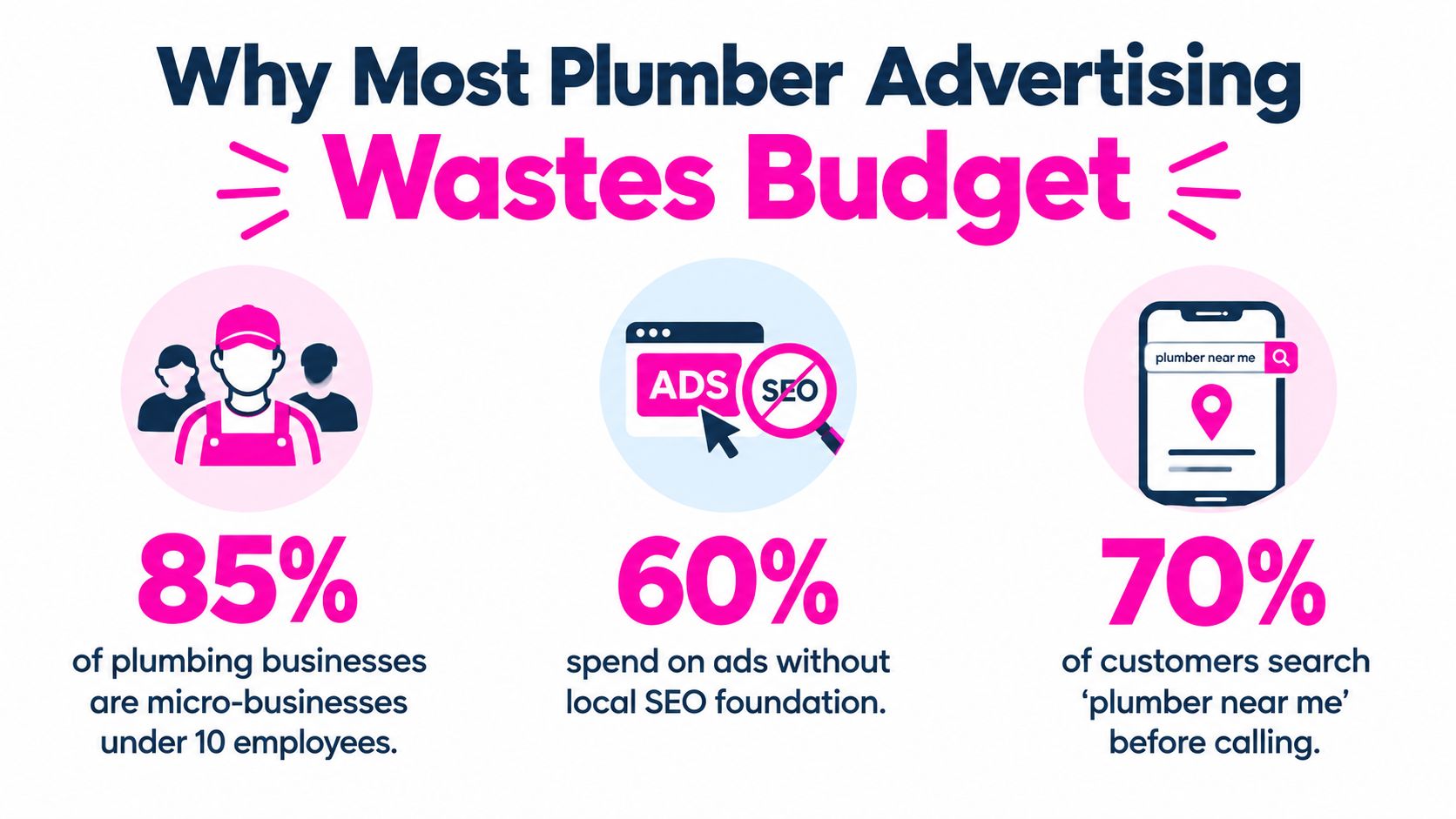
The biggest mistake is buying visibility before building intent capture. The UK plumbing, heat and air-conditioning installation sector had 47,050 VAT or PAYE registered enterprises in 2025, and 94.3% had fewer than 10 employees, with 85.7% classed as micro-businesses with 0 to 4 employees, so this is a market of owner-operators, not big-brand advertisers. That matters because broad awareness campaigns are built for scale, while most plumbers need local calls, trusted reviews, and a steady stream of job-ready enquiries from a small patch of geography. UK plumbing sector snapshot
Stop paying for vague reach
National-style campaigns fail small plumbing firms because they buy attention from people who are not ready to call, or are nowhere near the service area. A local trader does not need to impress everyone, only the people in the right postcode with a leak, a blockage, a boiler issue, or a fitting job that needs sorting now.
The smarter move is to focus on high-intent local capture. UK trade-marketing data compiled in 2026 says Google search, organic plus ads, produces 35 to 45% of new leads, and that Google together with paid ads, organic results, Google Business Profile listings, and Local Services Ads accounts for roughly half of all new enquiries in urban and suburban areas. The same dataset says “plumber near me” reached about 110,000 monthly searches in the UK in 2022 and rose 16% year on year in the reporting cited. UK plumber marketing data
Practical rule: if the ad does not drive a call, a form, or a map action from a nearby customer, it is not doing the job.
That is why owners should stop chasing vanity metrics like impressions and start asking a simpler question, did this spend produce booked work at a sensible cost. For a small firm, lead quality matters more than reach, and local reputation matters more than broad awareness.
A useful first filter is simple. If the campaign cannot be tied to emergency intent, service intent, or postcode-level demand, it should not be live yet. For a small operator, the first marketing pound should improve local visibility, not fund pointless clicks. If that decision is still unclear, the question of is SEO worth it for you should be answered before any serious ad spend goes out.
Building a Solid Foundation in Local Search
Paid traffic only works when the business looks credible the moment a customer checks it. The first job is Google Business Profile. Google says Local Services Ads in the UK are available only for certain service categories, including plumbers, and setup requires eligibility checks, a profile synced with Google Business Profile, mandatory screening, and third-party background checks before the business can go live with a Google Verified badge. Google also says advertising on Google Maps requires verifying the Google Business Profile and linking it to a Google Ads account. Google Local Services Ads
Build the profile before the ads
A plumbing profile should be treated like the front door of the business. The business name, service categories, service areas, hours, photos, and review activity all need to support the same local story. If the profile looks half-finished, paid clicks only expose the weakness faster.
The service area needs to match how the business operates, not how far the owner hopes to travel. If a company takes emergency jobs in one zone and scheduled jobs in another, those should not be blurred into a single vague footprint. Separate service pages help search engines understand which jobs belong to which area, and they help customers understand whether the business is a fit before they ring.
Local SEO rule: a plumber should look like the obvious local choice before advertising starts, not after.
Consistency matters across every directory and profile. The same phone number, the same trading name, and the same core service wording should appear everywhere customers check. That does not just help search visibility, it reduces friction for call handlers and office staff because customers are less likely to lose trust midway through the booking process.
For plumbers who need a practical system, SEO help for plumbing businesses is most useful when it is applied to GBP categories, service-area boundaries, and location pages, not just blog posts. A nearby customer is rarely comparing ten providers in depth, so the business that looks clear, local, and easy to contact usually wins the call.

Structure the website around search intent
The website should not be a digital brochure. It should answer three things fast, what does the business fix, where does it work, and how does a customer book. If the homepage tries to say everything, it usually says nothing clearly enough to convert.
A better structure is service pages, area pages, and clear contact routes. A blocked drain page should not look identical to a boiler repair page, and neither should be buried inside a generic list of services. Each page should give enough local detail that the customer feels the business understands the job and the area.
Use tracking that reflects real enquiries
Do not trust sessions as the main measure of success. Calls, forms, direction requests, and booked jobs tell the truth much faster. If a page sends traffic but not enquiries, it is decoration.
The strongest local foundations also make paid campaigns cheaper to run later. A good profile, a clear site structure, and visible proof of work reduce wasted leads before a single ad goes live. That is the advantage of local search, it compounds.
Choosing Between Paid Search and Service Ads
Once the foundation is in place, the choice is not whether to advertise, but which paid channel deserves the first pound. For plumbers in the UK, the comparison is between Google Search Ads and Google Local Services Ads. Both can work, but they do different jobs and suit different margins.
Use Search Ads when control matters most
Google Search Ads give the plumber more control over keywords, messaging, landing pages, and geography. That makes them useful when the business wants separate campaigns for emergency work, planned maintenance, or different service areas. They also let the owner shape the message, which matters when the business wants to filter out weak leads before they ring.
That control comes with responsibility. Search Ads can burn money fast if the keywords are too broad, the negatives are too loose, or the landing page is too generic. For a small operator, the win is not the cheapest click, it is the cheapest qualified job.
Use Local Services Ads when trust and speed matter
Google Local Services Ads are built for pay-per-lead demand capture. The Google Verified badge adds a trust cue at the exact moment a customer is choosing who to call, which is valuable in emergency work when the decision is fast and emotional. Google's own setup requirements also add friction for competitors who are not ready to verify properly.
UK trade-marketing data cited in 2026 says Local Services Ads can deliver a cost per lead of £15 to £40, and another UK trade source says Google Local Services Ads can sit at a blended £65 per booked job for plumbers, with lead costs typically £25 to £45 in London and £15 to £30 in the North. That spread matters because the same campaign can be viable in one region and sloppy in another, even before office time and follow-up are counted. UK trade marketing benchmarks Plumber advertising benchmarks
| Decision factor | Search Ads | Local Services Ads |
|---|---|---|
| Control | High | Lower |
| Trust signal | Indirect | Strong via verification |
| Best use | Service and postcode targeting | High-intent calls and map-style demand |
| Risk | Broad keyword waste | Lead quality and screening discipline |
Choose by margin, not by fashion
The right channel depends on the job mix. A firm that handles urgent breakdowns may get more value from Local Services Ads because the lead comes in close to the call moment. A firm that sells higher-value planned work may prefer Search Ads because the campaign can steer people towards a specific landing page and service.
Use optimise local campaigns for calls as the guiding principle. Call-led plumbing businesses need campaigns that surface phone-ready customers, not curious browsers. The bidder who keeps the margin floor in mind will outlast the bidder who chases volume.
Commercial rule: never accept a channel just because it is popular. Accept it only if the booked-job cost leaves room for labour, travel, and profit.
The practical answer is often a split approach. Local Services Ads handle high-intent enquiries, while Search Ads cover exact service terms and postcode clusters. That gives the owner coverage without surrendering control over spend.
How benjiads Can Help
BenjiAds is a software platform that builds and manages online advertising and lead follow-up for local service businesses, including plumbers. It automates ad creative generation, campaign setup, landing funnels, tracking, and SMS-based follow-up, so the owner is not forced to learn every part of Meta Ads Manager or bolt together half a dozen tools.
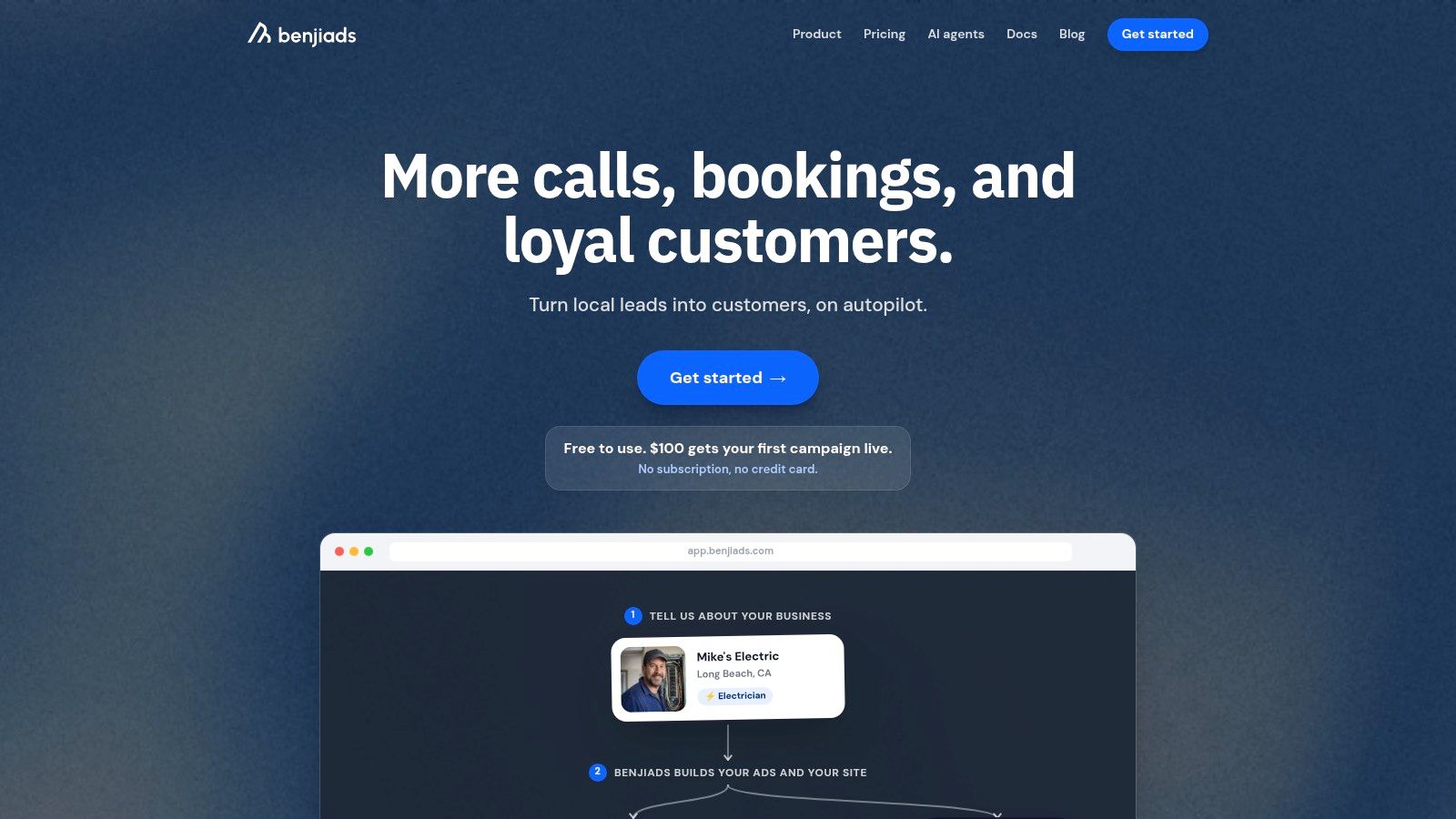
For a plumbing firm, the value is mostly operational. The platform can generate trade-specific ad copy and images, build a hosted landing page funnel, capture leads by text, and keep campaigns paused until the business approves them. That makes it useful when time is tight, or when an owner wants paid acquisition without handing over control.
The best use case is a small firm that wants a tighter system, not a bigger marketing team. The platform's plumber advertising resource is relevant when the business needs a structured route from ad to lead to follow-up, especially where the owner is still doing most of the decision-making.
It is not a substitute for weak fundamentals, though. If the Google Business Profile is poor, the website is unclear, or the business responds too slowly to new enquiries, software will only speed up the same problems. The right choice is a business that already knows its service area, its profitable jobs, and its follow-up process.
Extending Reach Through Reputation and Content
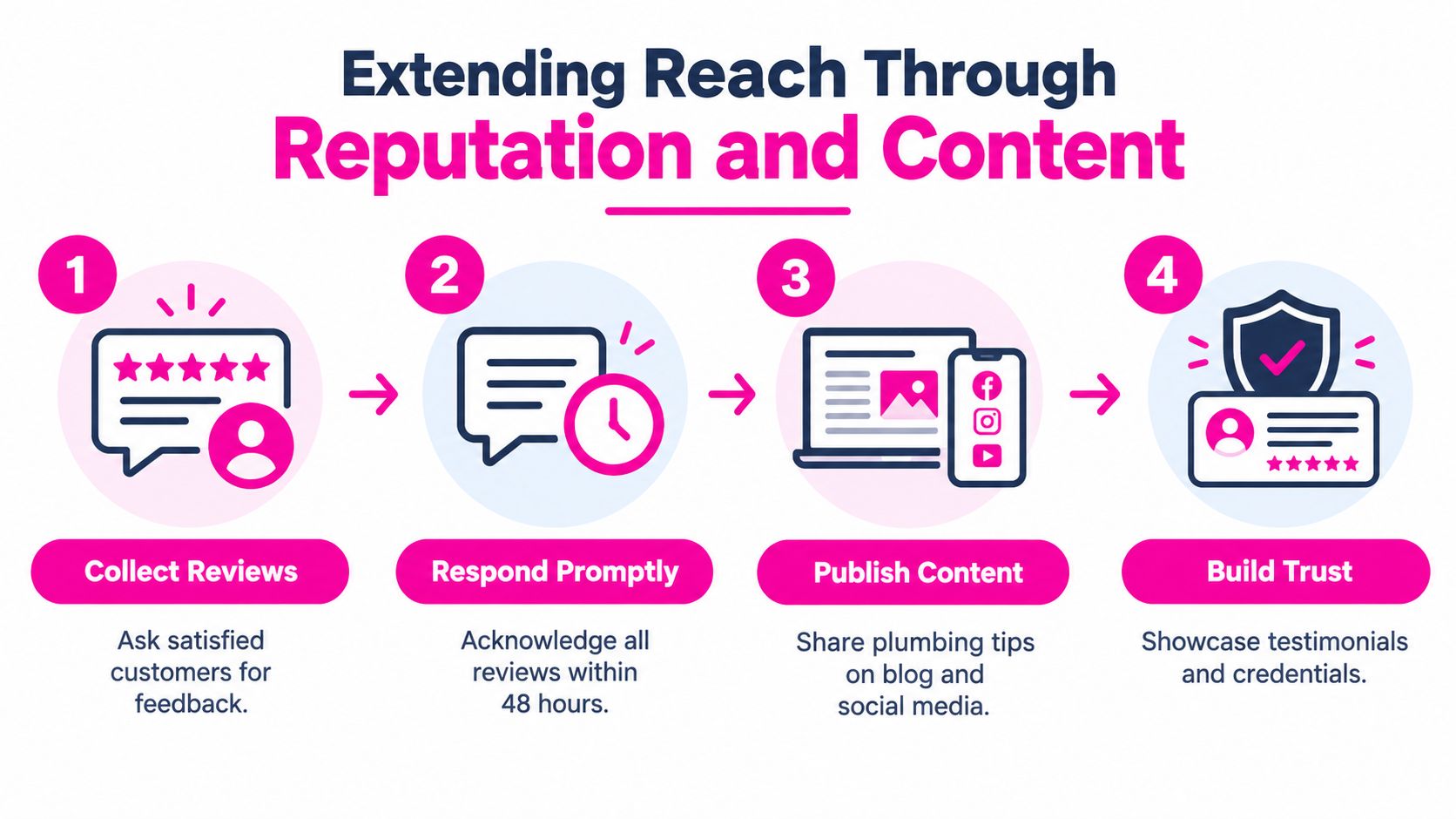
Ads get attention, but reputation closes the sale. A plumber with strong reviews and useful local content usually looks safer than a competitor with a louder ad and a thinner presence. That is especially true in emergency work, where customers are under pressure and want reassurance fast.
Make review collection routine
Reviews should be requested at the end of every successful job, not left to chance. A good timing pattern is simple, ask when the customer has just seen the work completed, the issue is fresh, and the experience is still top of mind. That is when feedback arrives most naturally.
The response matters too. A prompt, polite reply tells future customers that the company pays attention and takes service seriously. Even a short thank-you can reinforce the business image and show that real people are behind the brand.
Use handle customer feedback efficiently as an operating habit, not a side task. The goal is not to collect praise for its own sake, it is to make the next customer more likely to choose the business before price shopping elsewhere.
Publish content that proves local competence
Content should answer the questions customers already ask. A blocked drain guide, a leak prevention note, or a boiler warning article can all do more than fill a blog. They show that the business understands common problems in the area and can explain them clearly.
That same content helps the business outside search too. Social posts, email follow-ups, and job photos all reinforce the same message, this is a working trade business with visible competence and genuine customer care.
Trust grows when the business sounds like a plumber, not a marketing department.
Partnerships matter as well. Builders, landlords, letting agents, and complementary trades can all send work when the relationship is real and the service is reliable. Offline referrals still work because plumbing is a trust-led purchase, and trust is easier to earn when a name keeps appearing in more than one place.
Tracking Performance and Calculating ROI
Most plumber advertising fails because the business measures the wrong thing. Clicks look busy, but they do not pay wages. The actual number is booked work, and the genuine question is whether the cost of getting that booking leaves enough margin for a profit.
Measure source, not just activity
Every lead should be tied to the source that generated it. That means call tracking, form tracking, and a simple process for recording where the customer first found the business. If a source cannot be identified, the owner cannot judge whether it deserves more spend.
The same logic applies to job quality. A cheap lead that never turns into work is not cheap at all. A more expensive lead that becomes a paid job can be the better acquisition if the margin still works.
Set a ceiling from your own numbers
Average job value, labour cost, travel, and close rate should all shape the maximum allowable cost per lead. A business that knows its booking economics can bid with discipline instead of guesswork. That is how small firms stop copying generic ad advice and start managing real unit economics.
Track the weekly basics in one place:
- Booked jobs by source: this shows which channel fills the diary.
- Cost per lead: this prevents one noisy channel from hiding expensive waste.
- Cost per booked job: this is the metric that matters most for profitability.
- Answer rate: missed calls are lost revenue, not minor admin errors.
- Review volume: this affects trust and local visibility over time.
LocalHQ's LocalHQ reporting tools fit this sort of measurement because the business needs visibility on calls, direction requests, engagement, and local performance, not just raw web traffic. A local trade firm should not need a spreadsheet circus to know whether an ad source is working.
Useful habit: review spend after booked jobs, not after ad clicks. Clicks don't pay the van.
The rule is simple. If the channel cannot be linked to booked work at a cost the business can comfortably support, it should be cut or rebuilt. Marketing is only an asset when it makes the diary more profitable.
Putting Your Advertising Strategy Into Action
Start with the basics and move in order. First, polish the Google Business Profile, fix the website's service pages, and make sure the phone number, trading name, and service areas are consistent everywhere customers look. Then choose one paid channel, not three, and build from there.
The best next move is usually a tight local campaign, a clear follow-up process, and a review system that runs after every completed job. That combination gives a plumber more control than a broad awareness push and far better economics than random boosting or generic PPC.
The owner who wants less guesswork should use tools that reduce manual work and keep the system visible. That means reputation management, local reporting, lead follow-up, and campaign control working together, not as separate chores.
If the goal is more qualified local calls at a sensible cost, the next step is straightforward. Tighten the local foundation, launch one high-intent campaign, and use automation to keep the leads moving.